How to Fill Out Rental Application: A Step-by-Step Guide
Learn how to fill out rental application forms accurately, gather the right documents, and avoid the mistakes that get applicants rejected.

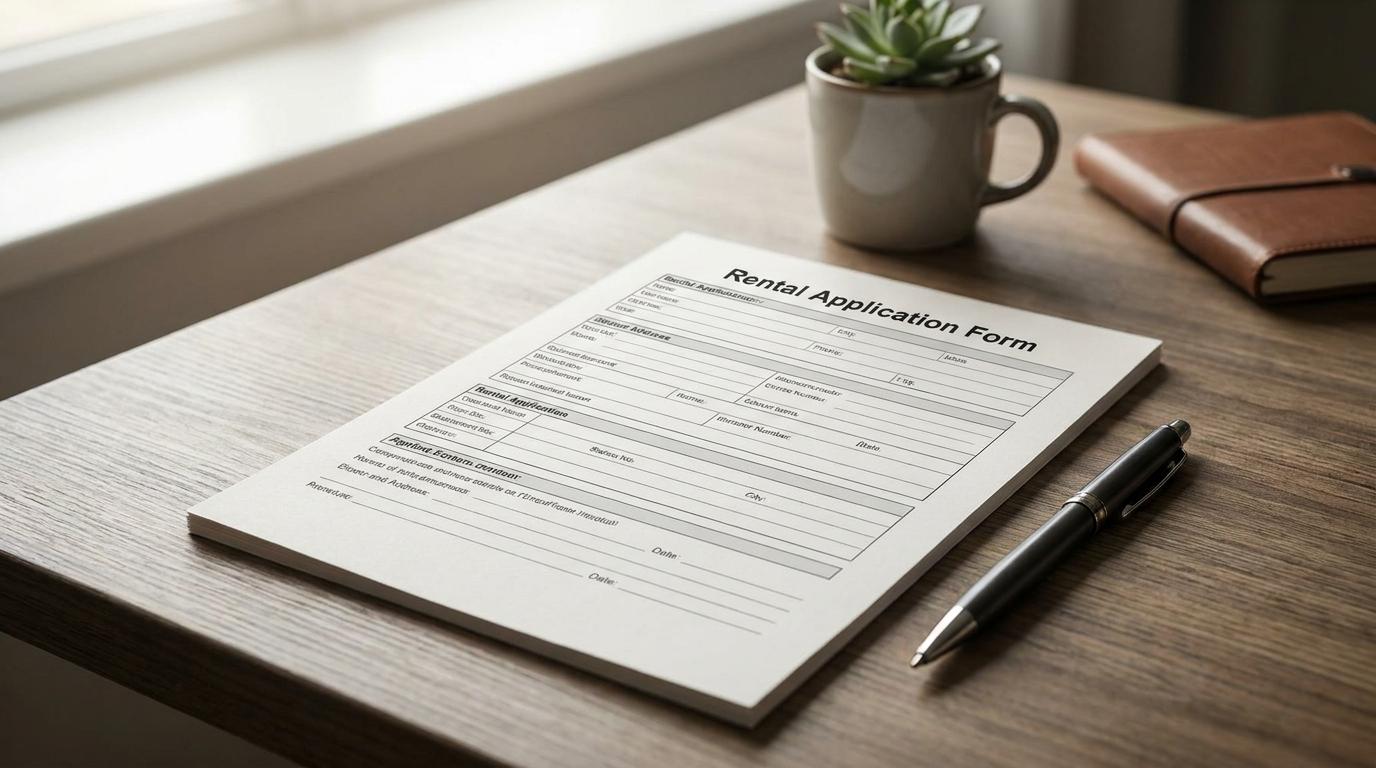
You found the place. The photos match the price, the commute works, and the listing says applications are reviewed in the order received. So you open the form on your lunch break, type fast, guess at a move-in month from three apartments ago, attach the pay stub screenshot that happens to be in your camera roll, and hit submit.
That is usually the moment a good application starts to fail. Not because you don't earn enough, and not because you'd be a bad tenant, but because a property manager comparing six files will pick the one where every number lines up with the paperwork behind it.
What follows is how to fill out a rental application so that yours is that file. Not the polished version, the verifiable one.
Why Accuracy on the Form Decides the Unit
Picture an applicant who clears every hurdle. Steady paycheck, solid references, rent that fits comfortably inside the usual income test. The file still dies, because the address typed into the form differs by one apartment number from the address on the prior lease, or the pay period on the attached stub doesn't match the monthly figure entered two fields above. A landlord with a stack of applications doesn't investigate the discrepancy. They move to the next folder.
Landlords compare four things: that you are who you say you are, that your income covers the rent, that your rental history holds up, and that your references confirm what you wrote. The margin for error shrinks as competition grows. In 2020, the U.S. Census Bureau counted 46.8 million renter-occupied homes and a national rental vacancy rate of 7.4%, down from 9.2% in 2010 (2020 Census housing report). Fewer open units means more files per unit, and consistency is what separates yours.

Three parts follow: the documents to gather, the field-by-field walkthrough, and the mistakes that cause rejection. Then a fee check and a final review before you pay anything. Block off one uninterrupted session, collect the paperwork before you open the form, and save a copy of everything you submit.
Assemble a Verification Packet That Passes Checks
Treat the form as a verification packet, not a questionnaire. Every field you type should trace back to a document you can produce on request, in the same form, with the same spelling.
The CFPB guidance on tenant background checks frames the applicant's job clearly: use the exact legal name and identifying details that appear on your payroll, bank, and prior-lease records, provide current contact information for employers and landlords, upload legible and unaltered income documents, disclose material facts consistently, and keep copies of every submission and authorization. That is the whole method. Everything below serves it.
The documents to gather first
Pull these before you touch the form, because half the errors on rental applications come from filling in the blanks while hunting for paperwork.
| Document | What the landlord checks | Common slip and fix |
|---|---|---|
| Government photo ID | Identity and legal name | Nickname or old surname: use the exact legal name |
| Pay stubs or offer letter, last 2-3 months | Income level and steady work | Cropped or mismatched pay periods: scan complete pages |
| Bank statements, last 2-3 months | Cash flow and savings | Missing pages: scan every page in order, including blank ones |
| Address history with dates | Where and how long you have lived | Gaps or dates that do not match leases: add a dated explanation |
| Prior landlord contacts | Rent payment and lease history | Outdated numbers or wrong property names: call to confirm first |
Two more items go in the packet when the property asks for them. If you're self-employed or paid on 1099s, add tax returns for the last one or two years alongside the statements. If you have a vehicle or a pet, have the plate number, make, model, breed and weight ready, because those fields appear without warning on the last page of many online forms.
Reconcile before you type
Scan every document as a clean, full-page image or an unedited PDF export. A screenshot of a pay stub with the employer name cut off is worse than no stub, because it looks like something was hidden. Submit originals or original exports, never a document you've edited, reformatted, or marked up.
Then reconcile. Enter your monthly gross income from the stub, not from memory. Copy addresses character for character from your ID or lease, including suite and unit designators. Check that the name on your bank statement matches the name on the form, since a maiden name or a hyphenated surname on one document and not another creates the exact mismatch a screening report flags. If a number on the form can't be traced to a page in the packet, change the number or add the page.
Practical rule: if you can't point to the document that proves a field, don't submit that field yet. A five-minute delay beats a request for missing documents two days later.
The operational pitfalls that stall files are consistent across properties: unexplained employment gaps, addresses that don't match, bank statements missing pages, references nobody can reach, and income figures that drift from the supporting documents. Each one is fixable in advance and costly afterward. Requirements differ by property, so the listing's own document list takes priority over this one. What doesn't change is the standard: never submit an altered document, and never pay a fee before confirming the property, the fee policy, and that the application channel is legitimate.
How to Complete Each Section Step by Step
An application can look short on a phone and still require careful checking. In 2025, 77% of recent U.S. renters reported submitting an online rental application, according to Zillow's Consumer Housing Trends Report. Set aside time to complete the full form with your verification packet open, and reconcile each answer against its source before you submit.
The eight steps below cover the fields most likely to delay an application when details are missing or inconsistent.
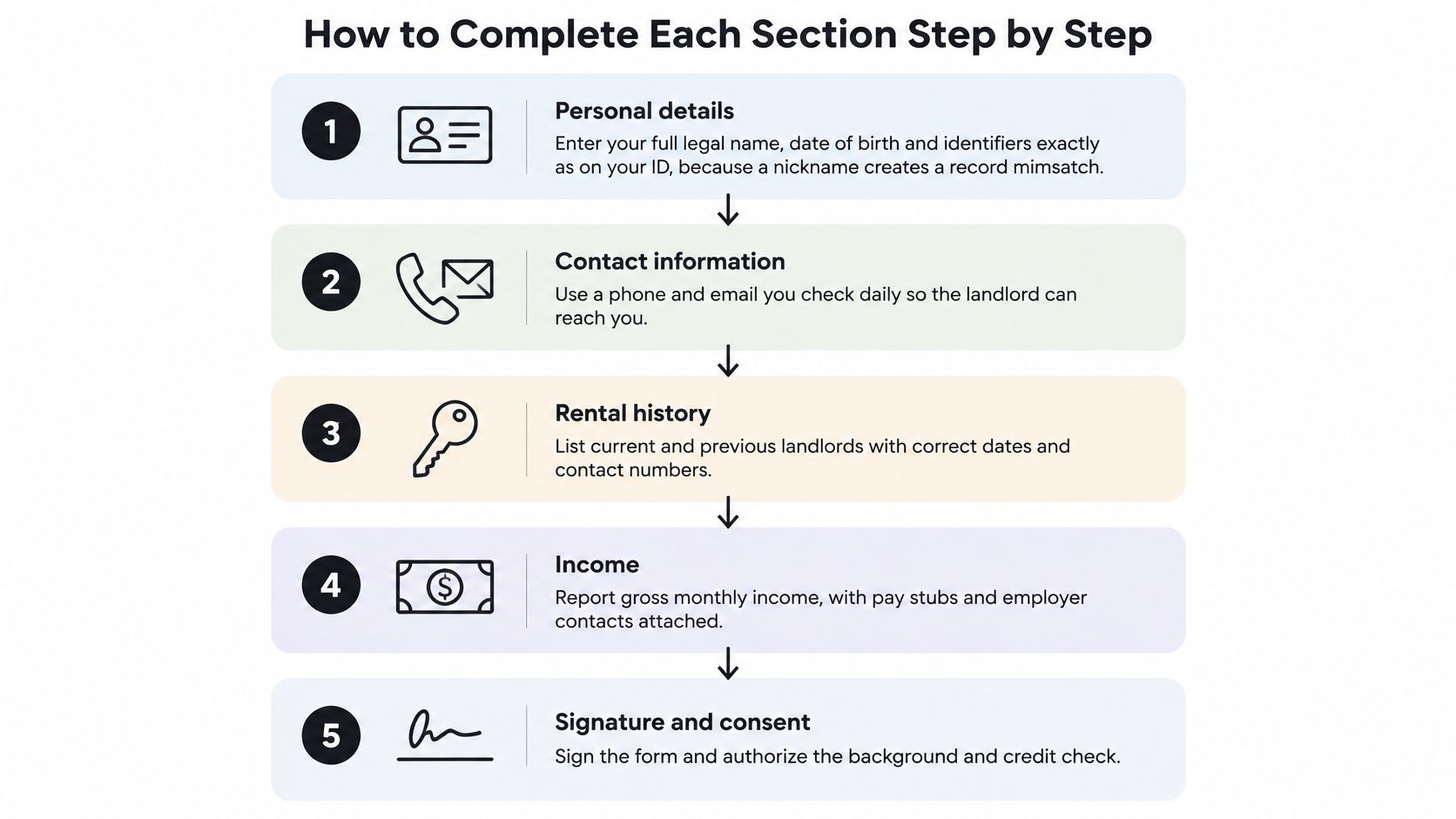
1. Personal details. Enter your full legal name and date of birth as they appear on your ID. Use the same spelling and name format throughout the form so the application matches your supporting documents.
2. Contact information. Provide a phone number and email address you check regularly. Make sure your voicemail can receive messages; a landlord who can't reach you may move on to another applicant.
3. Address history. List every address for the period requested, with accurate move-in and move-out dates. If there's a gap, explain it briefly in the notes field or attach a dated explanation rather than leaving the gap unexplained.
4. Employment. Enter the employer's name, your job title and start date. Provide a manager or HR contact who can verify your employment, and confirm the contact details are current before you submit.
5. Income. Report gross monthly income and use figures that match the documents in your packet. List separate income streams individually instead of combining them into one unexplained total.
6. References. Provide prior landlords' current contact details, then let them know to expect a call. A reference who can't be reached may hold up the application.
7. Occupants, pets and vehicles. List everyone who will live in the unit, including children, along with any pets and vehicles. Check the listing or application instructions for the details requested.
8. Authorization and signature. Read the screening consent before signing, and submit it only through the legitimate application channel. Save the confirmation page and any receipt so you have a record of what you submitted and when.
How to Report Income Without Raising Doubts
Landlords run one arithmetic test before anything else: is this rent sustainable on this income? The common rule is gross monthly income of about three times the monthly rent. It isn't law, and a listing's stated minimum overrides it, but it drives the first pass through the pile.
A woman reviewing her pay stub and rent statement before applying, with the numbers already reconciled against the documents in her packet.

| Monthly rent | Gross monthly income at 3x rent |
|---|---|
| $1,200 | $3,600 |
| $1,500 | $4,500 |
| $1,800 | $5,400 |
| $2,200 | $6,600 |
| $2,600 | $7,800 |
The check exists because housing costs eat a large share of many renters' budgets. The U.S. Census Bureau's 2023 renter cost-burden figures show 42.5 million renter households had calculable housing costs that year, and more than 21 million of them, or 49.7%, spent over 30% of income on housing, the threshold HUD calls cost-burdened. Landlords read the ratio as risk, which is why an accurate, well-documented income figure does more for you than a high one you can't support.
Reporting each income type so it can be checked
- Salaried or hourly: enter gross monthly pay, then attach consecutive stubs covering the last two to three months. If your hours vary, say so and give the average across the period.
- Self-employed or gig: show several months of deposits plus the tax document that matches them. A twelve-month deposit history with a short summary of the average answers the question before it's asked.
- Benefits, support or pension: list each source separately with the award letter or statement. Lumping them into one line makes the total look invented.
- Recent job change: add a one-line dated explanation and attach the offer letter. A start date three weeks ago isn't a problem once the offer letter is in the file.
The mechanics of assembling this evidence, including what counts as acceptable proof for irregular pay, are covered in this guide to providing proof of income for a rental application.
Then distinguish gross from net. Use gross figures for the rent test, and enter net figures only where the form explicitly asks for take-home pay. Say a freelance designer's income swings between lean and strong months. Twelve months of invoices and matching deposits, plus a brief summary of the monthly average, gives a reviewer something to verify. A single best month with no context gives them a reason to ask.
How to Handle Credit and Screening Records
A rental application is a verification packet, and screening records are part of it. Before applying, review your credit report and any tenant-screening report you can access. Check for duplicate accounts, outdated collection items, incomplete files, and records that belong to someone else. A mistaken eviction record can raise questions about your application before you have a chance to explain it.
Rental history reports deserve the same care. They can show periods with no verifiable address and addresses that differ from the ones you listed. Compare each entry with your own address history and gather documents that help clarify any mismatch.
A rental application may involve a screening inquiry rather than a full credit inquiry. For a closer explanation of whether rental applications affect your credit score, check what kind of inquiry the landlord plans to make before you authorize it.
After a denial or a conditional approval
If a consumer report contributed to a denial, a required co-signer, a higher deposit, or higher rent, ask the landlord for the adverse-action notice. It identifies the reporting company and explains your dispute and free-report rights. You can request a free copy of the report from that company within 60 days.
Review the report against your application and supporting documents. If you find an error, dispute the specific entry in writing with the screening company and keep a copy of your dispute and its confirmation. The company has a limited period set by federal law to investigate.
When the record is accurate but misleading: An eviction filing that was later dismissed, a medical debt, or a record connected to domestic violence may need context. Attach a short statement and supporting documents so the landlord can review the circumstances alongside the report.
If a short-term loan appears on your report, focus your explanation on whether the entry is accurate and relevant to the application. A payday loan legality guide for subprime borrowers addresses state rules on payday loans, not how a loan appears on a screening report.
What to Do with Thin Credit or a Guarantor
A short credit file isn't a rejection. It's an incomplete question, and the worst response is leaving the screening section blank, which reads as something to hide. Say plainly that you have limited credit history, then supply the evidence a reviewer can use.
That evidence is payment behavior. Attach a rent-payment record from your current or prior landlord, bank transfers showing regular rent on the same date each month, or a ledger of on-time payments. Fourteen months of consistent transfers tells a landlord more about tenancy risk than a thin credit file does.
Building the guarantor path before you apply
- Read the written criteria for guarantor rules. Confirm the property permits a guarantor at all, and check any income minimum the guarantor must meet.
- Ask whether the guarantor is screened on the same terms as you. Many properties require the guarantor's income to run several times the rent, and some run a full background check.
- Collect the guarantor's paperwork in advance. Photo ID, recent pay stubs, and current contact details, ready to upload before you start the form.
- Ask in writing about alternatives where policy allows. A larger deposit or prepaid rent sometimes replaces a guarantor, and it costs nothing to ask.
- Keep every authorization you sign. A guarantor authorization is a financial commitment, and you want a copy of exactly what was signed and when.
A guarantor application is a second application. If your co-signer's documents are incomplete, your file stalls as surely as if yours were.
Get the guarantor's consent before you name them. A surprised relative who doesn't return a verification call turns a workable application into a dead one, and you won't get a second attempt on a unit that's already been offered to someone else.
Confirm the Fee and Criteria Before You Submit
Pay nothing until you've confirmed four things: the unit is still available, the written criteria are in hand, the fee and refund policy are clear, and the application channel is legitimate. That order matters more than it sounds, because the fee is where applicants lose money without ever getting a decision.
The amounts are not trivial. In 2025, nearly three-quarters of U.S. renters who moved in the previous year paid an application fee, with a median of $75, and Black, Asian, and Hispanic renters reported paying higher total application fees than white renters, according to the 2025 National Renter Survey from the National Low Income Housing Coalition. Paying four or five of those on units you were never eligible for is an avoidable expense.
Local rules change what a landlord may charge. California is the clearest example. Beginning January 1, 2025, landlords there may charge a screening fee only if they provide written screening criteria, evaluate completed applications in the order received, approve the first qualified applicant, and don't charge until the application is considered. California applicants may also submit a reusable tenant-screening report to participating landlords, and a landlord that accepts it can't charge a screening fee or a fee to access the report. If you're applying across state lines, this breakdown of rental application fee laws saves you from assuming your last state's rules apply.
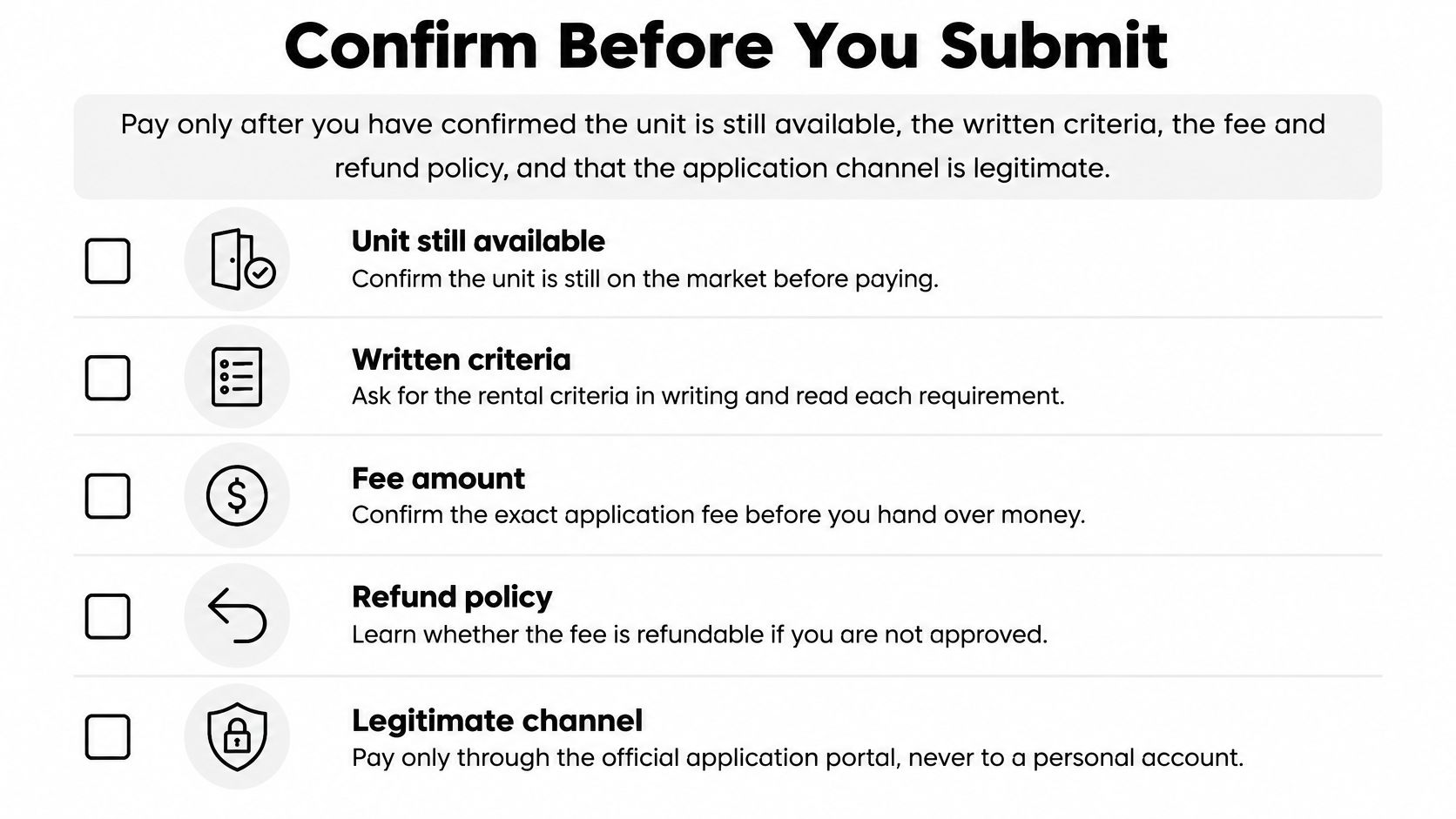
Run this checklist before any payment screen:
- Unit status: confirm the property is still on the market, by phone or in the portal, not from a stale listing.
- Written criteria: request the rental criteria and read each requirement against your file before paying.
- Fee amount and refund policy: know the exact figure and whether any part is refundable if you're not approved.
- Reusable reports: ask whether a reusable screening report is accepted, and whether it waives the fee.
- Legitimate channel: pay only through the official application portal, never to a personal account or a payment link texted to you.
- Receipts: keep every payment confirmation and screenshot the criteria page as it appeared on the day.
It also helps to review your file before it goes out. VerticalRent's free renter tools include Vacancy Search, Roommate Finder, and an AI Application Coach that reviews an application and flags weak spots before submission, so you can catch a mismatched figure while it's still fixable.
VerticalRent gives renters a guided online application with document uploads, a free rental history report you can run on yourself, and an AI Application Coach that reviews your file before a landlord ever sees it. If you're preparing to apply, start with the free tools at VerticalRent and walk into your next showing with a packet that already lines up.
Put this into practice
VerticalRent tools related to this guide
Legal Disclaimer
VerticalRent and its authors are not attorneys, CPAs, or licensed legal or financial advisors, and nothing on this site constitutes legal, tax, or professional advice. The information in this article is provided for general educational purposes only. Landlord-tenant laws, eviction procedures, security deposit rules, and tax regulations vary significantly by state, county, and municipality — and change frequently. Nothing on this site creates an attorney-client relationship. Always consult a licensed attorney or qualified professional in your jurisdiction before taking any action based on information you read here.
Co-founded VerticalRent in 2011, growing it from nothing to 100k landlords and renters. Sold it in 2019, then re-acquired it in 2026 to make it better than ever.


