Are Tenants Responsible for Pest Control? Rules by State
Are tenants responsible for pest control? See who pays by cause, state law and lease clause, plus notice rules and steps to resolve an infestation.


Tenants aren't automatically responsible for pest control. They carry the cost only when documented tenant conduct caused the infestation and local law allows the charge, and until somebody produces that evidence, the bill sits with the building.
Landlords usually arrive at this question already certain of the answer. The lease says pests are the tenant's problem, or pests are always a habitability issue, so the owner pays. Both shortcuts skip the only thing that decides the outcome in a real dispute: what the paper trail shows about where the pest came from and when somebody was told. So are tenants responsible for pest control? Sometimes, and the evidence trail is what separates a defensible charge from a refund plus a code complaint.
That reframe is the entire method. Document the cause, the notice date and the treatment, and the decision makes itself. Skip the records and you're arguing about blame with nothing to point at.
Who Pays for Pest Control in Each Situation
The tenant isn't the default payer, and neither is the landlord. What decides the bill is cause, location and timing, then how the lease and local housing law treat that combination. Sort your case with the table before you touch a deposit ledger or draft a demand letter.
| Situation | Usually Responsible | Why | First Check |
|---|---|---|---|
| Infestation present at move-in | Landlord | The condition existed before the tenancy began | Move-in condition report with dated photos |
| Building-wide or common-area pests | Landlord | The owner controls the shared structure and waste areas | Whether neighboring units are affected |
| Pests entering through a leak or unsealed gap | Landlord | A structural defect is the source | Repair records and inspection notes |
| Infestation caused by tenant waste or hoarding | Tenant may pay | Documented tenant conduct caused the problem | Dated photos, notices and local cost rules |
| Pests migrating from a neighboring unit | Landlord coordinates | Pests move through walls, pipes and corridors | Treatment plan covering adjacent units |
| Bed bugs in California | Landlord arranges treatment; tenant reports and prepares | The statute assumes a cooperation duty | Written notices and treatment findings |
| Lease says all pests are the tenant's job | May be unenforceable | Habitability duties may not be waivable | Local habitability law and court rulings |
Pest calls arrive constantly, which is why the sorting matters. Councils in the United Kingdom made 291,132 home visits for pest infestations in 2024, with rodents accounting for 91% of them, according to research cited by The Pest Guy. Rodents and roaches fill most of the inbox in a small portfolio too, and each one needs the same three answers before anybody gets charged.
Run these three questions over your own case:
- Where did the pest start? Inside one unit, in a common area, behind a wall shared with a neighboring apartment, or before the tenant moved in.
- Who controls that space? The landlord controls structure, shared plumbing, waste areas and seals. The tenant controls housekeeping, food storage and reporting.
- What written evidence exists right now? A date-stamped report, photos, an inspection finding, a vendor invoice. Memory isn't evidence.
Practical rule: If you can't describe the pest's pathway into the unit in one sentence, the cause is unproven, and an unproven cause is a landlord cost.
Why the Cause Decides Who Pays
Think about water coming through a shared roof. Nobody argues about whose bucket it is until they've found where the water gets in. A mouse in a kitchen drawer is a symptom. The coin-sized gap around a radiator pipe is the cause, and the gap belongs to the building.
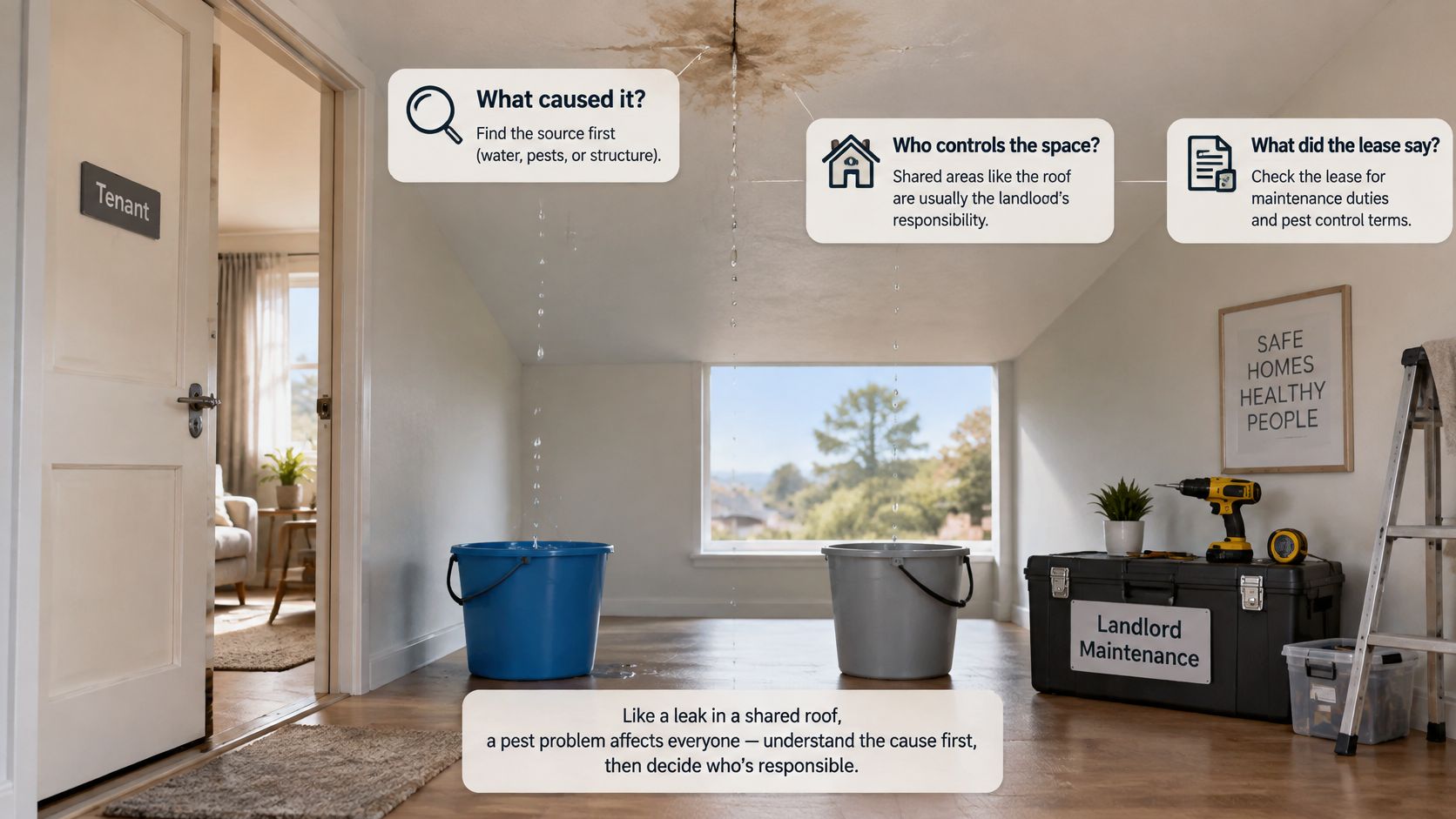
Three questions settle most arguments. What caused it: a structural gap, sanitation habits, a neighboring unit, or unknown. Where it sits: one unit, a common hallway, or the whole building. When it surfaced: at move-in or three months into the tenancy. Write the answers down with dates and you've built the file a dispute turns on.
Washington shows the causation test working in practice. Landlords there must provide a reasonable pest-control program at the start of and during a tenancy in multifamily housing, but the tenant can be charged when the tenant caused the infestation, and tenants must keep sanitary conditions and dispose of waste properly, as Washington LawHelp's guidance on pest infestations explains. Persistent unsanitary waste storage is the kind of documented conduct that shifts cost. A leaky pipe behind the cabinets is not.
Delay matters as much as origin. Pests travel through wall voids, plumbing penetrations and shared corridors, so an untreated unit-level problem becomes a multi-unit problem fast, and that spread weakens any claim that one tenant alone caused it. The working order of operations is unglamorous: arrange treatment first, argue about the invoice second. Reimbursement only holds up when the evidence and local law both support it.
How State Rules Differ Across Jurisdictions
Pest duties come from three places at once: state statute, city ordinance and case law. Start with the state row, then read the local code, because city housing departments often add inspection and disclosure rules the statute never mentions.
| Jurisdiction | Landlord Duty | Tenant Duty | Cost Rule |
|---|---|---|---|
| California | Arrange and coordinate effective treatment; send inspection findings in writing | Report promptly, allow access, prepare the unit | Costs follow cause; a lease can't excuse statutory duties |
| Washington | Provide a reasonable pest-control program in multifamily housing | Keep sanitary conditions; dispose of waste properly | Tenant may be charged when the tenant caused the infestation |
| New York | Arrange treatment through qualified professionals | Permit access and follow preparation instructions | Landlord arranges treatment; cost allocation set by local code |
| Virginia | Maintain habitable premises | Cooperate with treatment and access | Habitability duties generally can't be waived by a lease |
| Other states and cities | Check the state statute and the city housing code | Report promptly and allow access | Set by state statute and city ordinance |
Reading the California row in full
California is the clearest statutory example of shared responsibility. Civil Code section 1954.600, the state's bed-bug provision, states that successful control requires cooperation among landlords, tenants and pest-control operators. It names early detection and prompt reporting as essential prevention, so a renter who suspects an infestation is expected to notify the landlord quickly. It also recognizes that tenants may need to reduce clutter, wash clothing and complete the preparation tasks a treatment plan requires.
The same section cuts the other way. It states plainly that inadequate or untimely landlord response can worsen an infestation, so an owner can't hand the entire problem to residents and walk away. California's framework has applied since the statutory bed-bug chapter took effect in 2017. Lease terms can allocate costs in some circumstances, but they don't erase statutory duties or excuse a delayed response.
The practical distinction is between tenant cooperation and tenant liability. Renters handle reporting, access, sanitation-related preparation and avoiding conduct that causes an infestation. Owners arrange and coordinate effective treatment when the problem involves the property or common areas. Blur those two categories and you end up charging for cooperation failures as if they were damage.
Habitability law sits underneath every row of that table, and the habitability standards guide walks through how it interacts with state statutes. Use the table to find your state, then confirm the city rules before you decide anything.
Lease Clauses That Assign Pest Duties Fairly
"Tenant is solely responsible for all pest control." That sentence looks decisive. It often fails. Habitability duties sit outside the lease, and an owner cannot sign them away. A clause that promises the impossible does not protect the file. It makes the file look unreasonable.
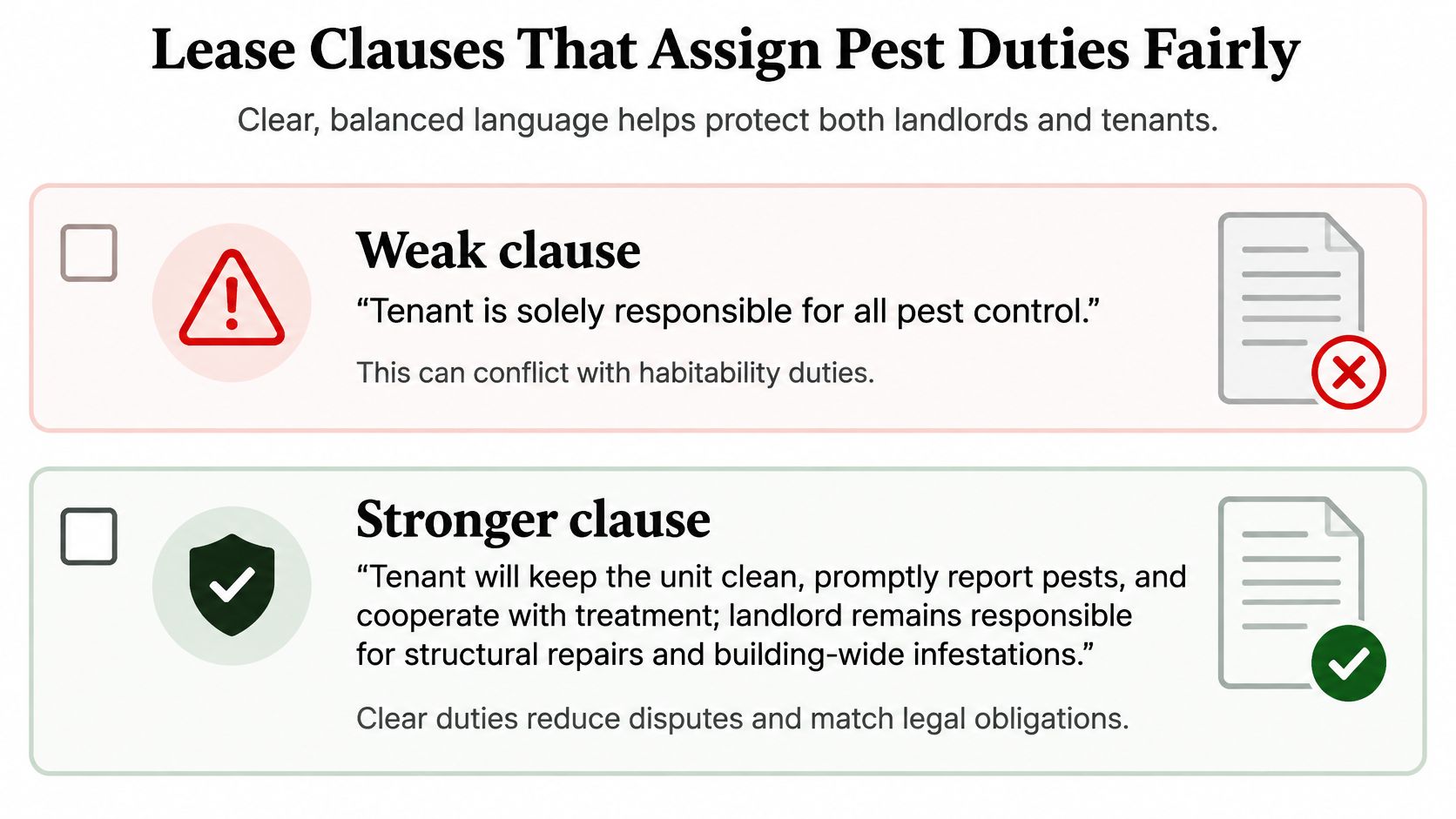
A fair clause splits the work. "Tenant will keep the unit clean, promptly report pests, and cooperate with treatment; landlord remains responsible for structural repairs and building-wide infestations." The first half builds an evidence trail of dates, reports, and cooperation. The second half keeps structural and building-wide problems with the owner.
Neutral legal guidance in the California Department of Real Estate landlord-tenant guidebook treats habitability protections as non-waivable. Virginia reached a similar result on its own law. A Virginia Court of Appeals holding found that a lease assigning broad pest-control obligations to the tenant did not waive the landlord's duties. Test every pest clause against your state's rule before you rely on it.
Five elements turn that split into language you can enforce. Each one records what happened, instead of declaring a winner in advance.
- A written reporting deadline. Twenty-four hours after a sighting, in writing, through a portal or email. The deadline gives you a start date and gives the tenant a clear instruction.
- Access terms with a stated notice period. Twenty-four hours' written notice for inspection and treatment, plus a defined emergency exception when an active infestation is spreading.
- Sanitation duties tied to specific conduct. Waste storage, food handling, and reporting leaks. Skip a vague promise to keep the unit "pest free." No tenant can guarantee that.
- A cost rule that triggers only after documented tenant causation, and only to the extent local law permits the charge. The charge follows the proof, not the first complaint.
- A dispute procedure with a response timeline, so a contested charge is answered in writing within a set number of days instead of appearing for the first time at move-out.
Clauses should describe what each party does and when. The moment a clause assigns a structural defect or a common-area infestation to the tenant, it is writing a check the law may not cash.
Start from a lease agreement template that already separates structural duties from housekeeping duties, then add the reporting, access, and cost rules your jurisdiction will enforce.
Pest Notices and Records You Must Keep
Notice duties decide more disputes than exterminator bills do, because the notice is what proves the landlord acted. California again supplies the model timeline. Civil Code section 1954.605 requires landlords, beginning July 1, 2017, to give prospective tenants written information about bed-bug prevention, the importance of cooperation, and prompt written reporting of suspected infestations. After a pest-control operator inspects a unit, the landlord must send tenants the operator's written findings within two business days of receiving them, and confirmed infestations in common areas must be disclosed to all tenants.
Those deadlines are why a blanket "tenant is responsible for pests" policy is legally risky. Responsibility turns on the pest, the cause, the affected area, the lease and local housing law, in that order.
For a portfolio of one to ten units, the records that matter fit in a single folder per tenancy:
- Move-in condition report with dated photos of every room, including behind appliances and under sinks.
- Tenant reports with the date received, the location described and the method used (portal message, email, phone note).
- Inspection findings from the pest-control operator, including photos and the identified pathway.
- Treatment instructions sent to the tenant and the date they were sent.
- Vendor invoices showing the scope, the units treated and the cost.
- Notices and proof of delivery, plus cooperation records such as missed access appointments.
Every one of those documents answers the origin question: property defect, neighboring unit, common area or tenant conduct. Log each report and each response in a maintenance request log so the sequence survives a change of phone or email. Deducting pest costs from a deposit without this file is how a routine charge turns into a bad-faith claim.
How to Resolve an Infestation Step by Step
Coordinated control beats a single spray, and the professional standard is integrated pest management, which assigns tasks by pest pathway rather than by who pays. The EPA's introduction to integrated pest management describes it as prevention through removal of food, water and shelter; exclusion and physical controls; monitoring; and pesticide use only when action thresholds justify it. Work the eight steps in order.
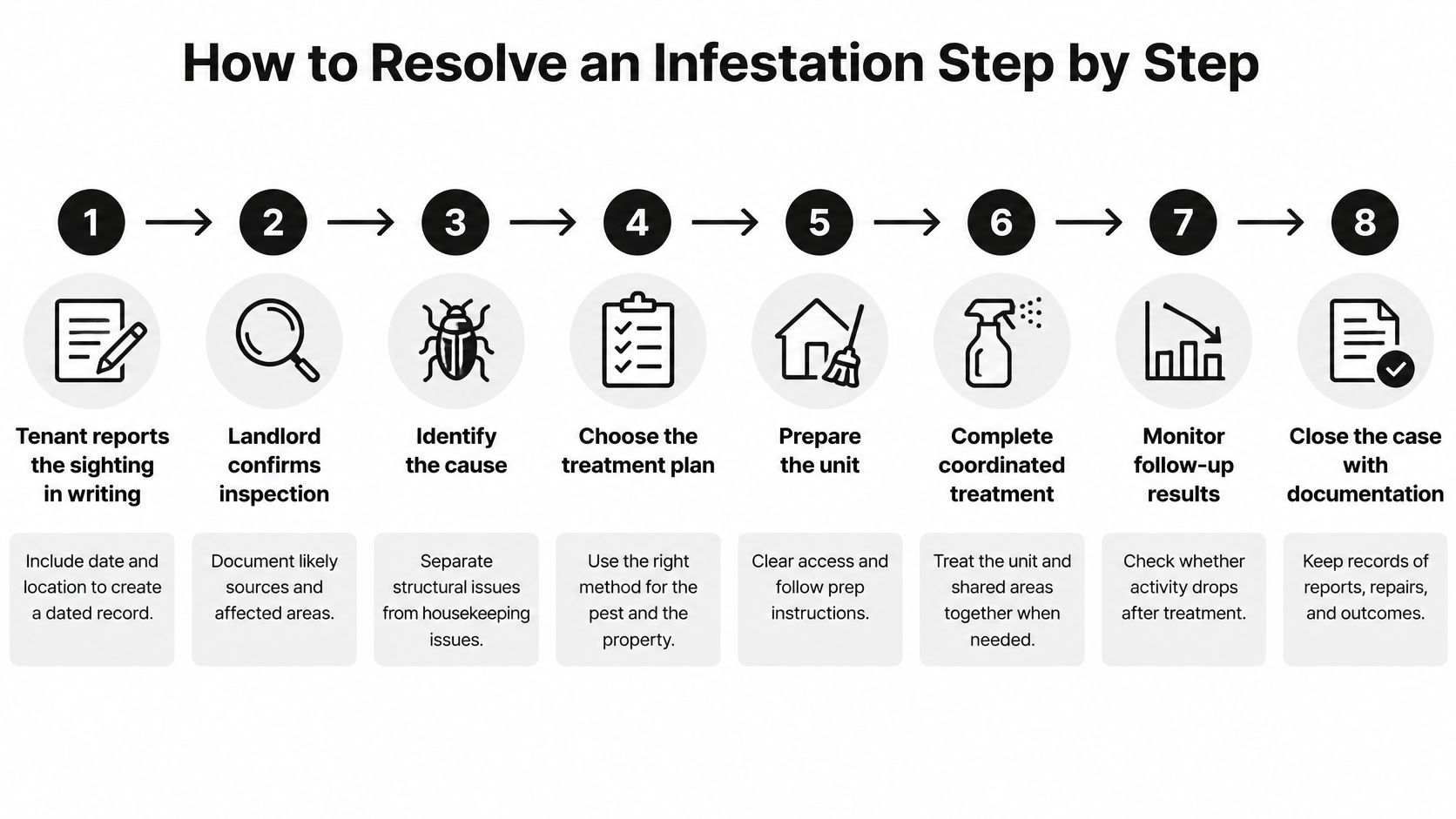
- The tenant reports in writing, with the date and the location of the sighting. A dated record fixes when the clock started.
- You inspect within a set window, without announcing a culprit. Early inspection limits how far the problem travels.
- Identify the likely pathway: food, water, shelter, an entry gap, or a neighboring unit. Treatment follows the pathway, not the complaint.
- Repair the source. Seal cracks and utility penetrations, fix leaks, repair doors and screens, manage common-area waste. Treatment fails when the entry stays open.
- Arrange treatment through a licensed professional with a plan that covers adjacent units when migration is plausible. Treating one apartment alone leaves harborages behind.
- Use physical controls and monitoring. For bed bugs the EPA recommends prompt inspection, evaluation of adjacent units, resident cooperation and careful vacuuming, with a multifaceted professional plan rather than spraying alone.
- Send written findings and preparation instructions to the tenant inside the required window, and keep proof you sent them.
- Decide cost allocation last, only after the cause is documented to a standard you'd be willing to defend.
Keeping the file current while the job runs
The operational order is fixed: tenant report, triage, inspection, vendor diagnosis and treatment, status updates, then the responsibility decision. Software shortens the middle of that chain. Job status updates (Accepted, In Progress, Complete) notify the landlord automatically, and pros mark a job complete, upload photos and send the invoice, which the landlord pays by card through VerticalRent. Photos and invoices land in the same record as the original report, which is exactly what you need months later when the tenant disputes a charge.
One rule holds regardless of who applies the chemical: arranging treatment doesn't authorize an unlicensed person to apply pesticides. New York health guidance notes that pesticide application in an occupied unit may require a certified commercial applicator, so a superintendent with a spray bottle isn't a substitute for a licensed vendor. For a broader walkthrough of preventive habits that keep small problems small, Modern Lyfe's home pest management guide is a useful resource to share with tenants at move-in alongside your written pest notice.
What Tenants Can Do If the Landlord Does Not Act
What if the landlord does nothing after a pest report? The dated report, photos of the pest and the affected area, and any reply already on file work like a chain of custody. Each later step is only as credible as that record.
Send a written follow-up that names the original report date, the pest, the treatment requested, and a response deadline. Keep it factual.
Ask the local housing or code enforcement office to inspect. A licensed inspector's written finding carries weight no tenant photo can match, because it pins the cause to a professional record.
Check whether local law permits repair-and-deduct or rent withholding, then follow its notice steps exactly. Skip a step and a tenant can face an eviction claim even when the pests are real. Where a state protects reporting, such as California's bed-bug chapter at Civil Code section 1954.600, a rent increase or eviction threat that follows a good-faith report can be challenged as retaliation.
Keep paying rent unless local law allows withholding, and keep copies of every notice. Avoid conduct that causes or spreads the problem, because documented tenant causation moves the cost onto the tenant. Before withholding rent or deducting a repair, talk to a local tenant organization or attorney. The sequence matters more than the anger.
Confirm Responsibility Before You Charge a Tenant
Charging a tenant is a documentation exercise. Before a single dollar goes onto a ledger, confirm five things: the cause is documented as tenant-caused, the lease clause matches local law, the tenant received written notice and a real chance to prepare, the treatment findings are on file, and the amount matches the vendor invoice. Check each item against the records folder, not against memory.
Renters get a shorter list with the same logic: report in writing, keep dated photos, allow access, and ask for the treatment findings in writing.
Here's the move to make this week. Write a reporting deadline and a treatment-access clause into the lease, then set up a workflow where every report becomes a tracked job. On VerticalRent you can assign a vendor to a maintenance request or leave it open so service pros can quote, and pros still accept the job from their job board, so the report, the diagnosis and the invoice stay in one thread. Put a review date on the calendar for your next lease renewal so the clause gets checked against any change in local law.
Are tenants responsible for pest control? Only when the evidence says so, and VerticalRent is built to keep that evidence in one place. Tenant reports become tracked maintenance requests with timestamps, AI triage and direct dispatch to verified local vendors, and every job records the photos, findings and invoice you'd need if a charge is ever challenged. Visit VerticalRent to turn pest disputes into documented decisions.
Put this into practice
VerticalRent tools related to this guide
Legal Disclaimer
VerticalRent and its authors are not attorneys, CPAs, or licensed legal or financial advisors, and nothing on this site constitutes legal, tax, or professional advice. The information in this article is provided for general educational purposes only. Landlord-tenant laws, eviction procedures, security deposit rules, and tax regulations vary significantly by state, county, and municipality — and change frequently. Nothing on this site creates an attorney-client relationship. Always consult a licensed attorney or qualified professional in your jurisdiction before taking any action based on information you read here.
Co-founded VerticalRent in 2011, growing it from nothing to 100k landlords and renters. Sold it in 2019, then re-acquired it in 2026 to make it better than ever.


