Rental Application Fee Laws by State in 2026
Rental application fee laws set state caps, refund clocks, and who you may charge. See the 2026 limits and the checks before you collect.


You're about to publish three listings in three different states, and your software is asking for one application fee. You type in the amount you charged last year, copy it across, and hit save. That single setting is where most small landlords get into trouble, because rental application fee laws don't test only the dollar amount. They test jurisdiction, whether a unit is available, what screening method you used, and what happened to the applicant afterward. A fee that looks reasonable in one city can be banned in the next, refundable in another, and unlawful to deposit yet in a fourth. I would stop treating the fee as a price you set once and start treating it as a four-part compliance check you run for every listing.
Rental Application Fee Caps by State
A three-property portfolio can have three different fee rules: a duplex in Maryland, a house in Oregon, and a condo in Vermont. Set the amount by the property's jurisdiction, then check the permitted screening method and any conditions tied to the applicant's outcome. A statewide cap is only one part of the rule.
How to Read the Table Before You Charge
The New Jersey Attorney General's guidance for housing providers on rental application fees describes New Jersey's rules, including a $50 cap effective in 2026. It does not establish limits for other states. The table separates limits and cost tests supported by the information below from rules that require checking the applicable state or local law.
| Jurisdiction | Limit | What the fee may pay for | Extra control |
|---|---|---|---|
| California | $30 maximum | Costs of obtaining applicant information, including references, credit reports, screening services, and reasonable time | Cannot exceed the ceiling and should match actual screening expense |
| New York | $20 | Cost of a credit check, not a general processing charge | No fee when the applicant supplies a qualifying tenant screening report |
| Maryland | $25 | Application screening fee within the cap | Charge no more than the cap for that property |
| Connecticut | $50, subject to inflation adjustment | Tenant screening report fee | Give the report or explain how to obtain it, plus the provider receipt or invoice |
| New Mexico | $50 | Fee within the cap | Charge no more than the cap for that property |
| New Jersey | $50, effective 2026 | Fee within the cap | Apply the 2026 cap to new charges |
| Virginia | $50 base; $32 for public housing or HUD-regulated applicants | Screening, with documented third-party costs allowed above the base | Provide eligibility information upfront so applicants are not charged for homes they cannot qualify for |
| Maine | Actual cost of one screening process | That single screening process only | No flat markup above actual cost |
| Oregon | Average actual screening cost or customary screening company charge | Screening costs only | Apply the cost test before setting a number |
| Vermont | Prohibited | No application fee | Outright ban |
| Massachusetts | Prohibited | No application fee | Outright ban |
| Minnesota | No single statewide dollar cap listed here | Screening tied to an available unit and disclosed criteria | Don't charge if no unit is available or expected soon, and don't deposit until earlier applicants are rejected or decline |
| Hawaii | Unused portion must be returned | Authorized screening purposes only | Return any unused portion within 30 days after submitting the screening request |
| Berkeley, California | City rules layered on the state ceiling | Itemized screening expenses and time | Receipt, report copy, and refund if the applicant isn't selected unless a first-qualified policy applies |
What a Row Is Actually Telling You
Start with the limit. A flat cap sets a ceiling; a cost-based rule makes the screening expense the practical limit. Where fees are prohibited, don't collect one.
Then check the permitted purpose. A fee for a credit check is not a general processing charge. Under actual-cost rules, the report expense cannot justify a larger flat fee.
The extra-control column can change what you do after setting the price. A supplied report may affect whether a fee is allowed; another rule may require a receipt, a report copy, or a refund tied to the selection outcome. Berkeley's row shows why the outcome matters alongside the initial charge.
Practical rule: Before opening the payment field, identify the governing jurisdiction, the permitted screening method, and any conditions on the fee.
A single nationwide setting can exceed a cost-based limit or collect a fee where fees are prohibited. The lawful amount depends on the property and the rule that applies there.
Fees as Reimbursement Not Rent Revenue
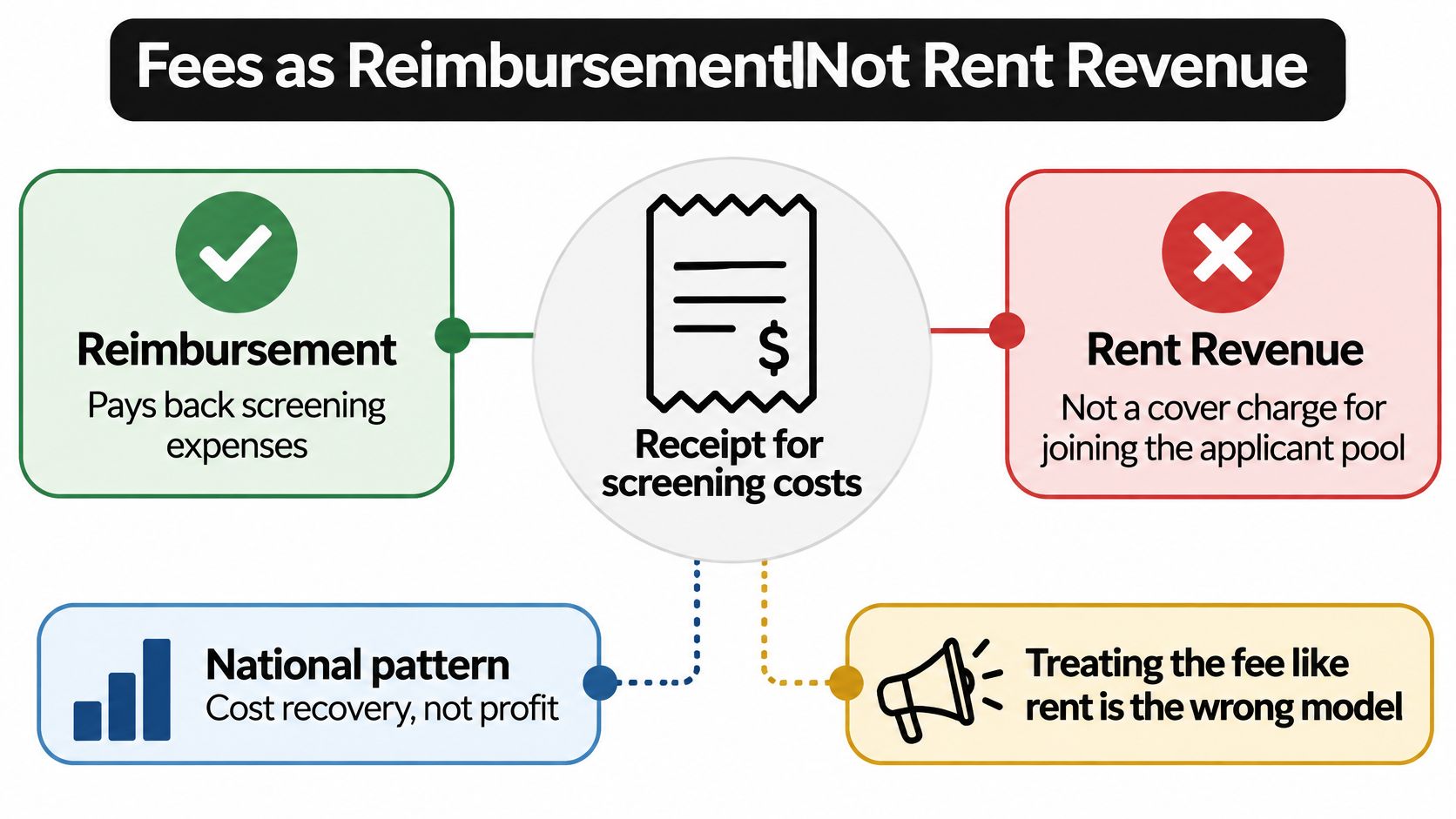
A landlord sets a screening fee at $40, but the screening service costs less. Whether the landlord can keep the difference depends on the jurisdiction and the permitted basis for the charge. Treat the fee as reimbursement for allowable screening costs, not as extra revenue from the application pool.
The diagram below shows the distinction.
The Two Benchmarks Worth Copying
California gives landlords a clear statutory model. California Civil Code §1950.6 permits a landlord or agent to charge for costs associated with obtaining applicant information, including reference checks, credit reports, screening services, and the reasonable value of time spent obtaining that information. The statute caps the fee at $30 per applicant. The cap sets the maximum, while the permitted-purpose rule limits what the charge can cover.
Oregon uses a cost-based test: screening charges are limited to actual screening costs or the customary charge for a comparable service. Before setting the fee, identify the screening service and its cost, then compare the charge with what comparable services typically cost.
The practical rules differ, but both discourage treating an application fee as a profit center:
- California: Stay below the statutory cap and charge only for permitted screening costs and time.
- Oregon: Keep the amount within actual screening costs or the customary charge for comparable service.
- Either model: Set the fee by reference to the applicable rule and the screening service provided.
Where the Profit Center Habit Shows Up
The problem often starts with a fee that no one revisits. A vendor lowers its price, but the published fee stays the same. A landlord copies a round number from another property or adds charges for holding the unit, answering emails, or general office overhead. Calling the total nonrefundable does not change what the law allows it to cover.
If the promised screening never happens, the basis for reimbursement may be missing. If the screening costs less than the fee, the difference is not automatically yours in a cost-based jurisdiction. Keep the vendor invoice and a record of the screening service tied to each charge; a fee you cannot substantiate is harder to defend.
Federal reporting obligations are separate from state fee limits. A lawful fee does not make an improper consumer-report decision lawful, and a proper denial process does not excuse an excessive charge.
If you cannot tie a dollar to a screening cost permitted in that jurisdiction, do not charge it.
Review each property's fee against its governing rule and the screening service purchased. For a cost-based test, compare the fee with documented costs or the customary charge for comparable service. For a statutory cap, check both the ceiling and the permitted purpose before taking payment.
When a Landlord May Take the Fee
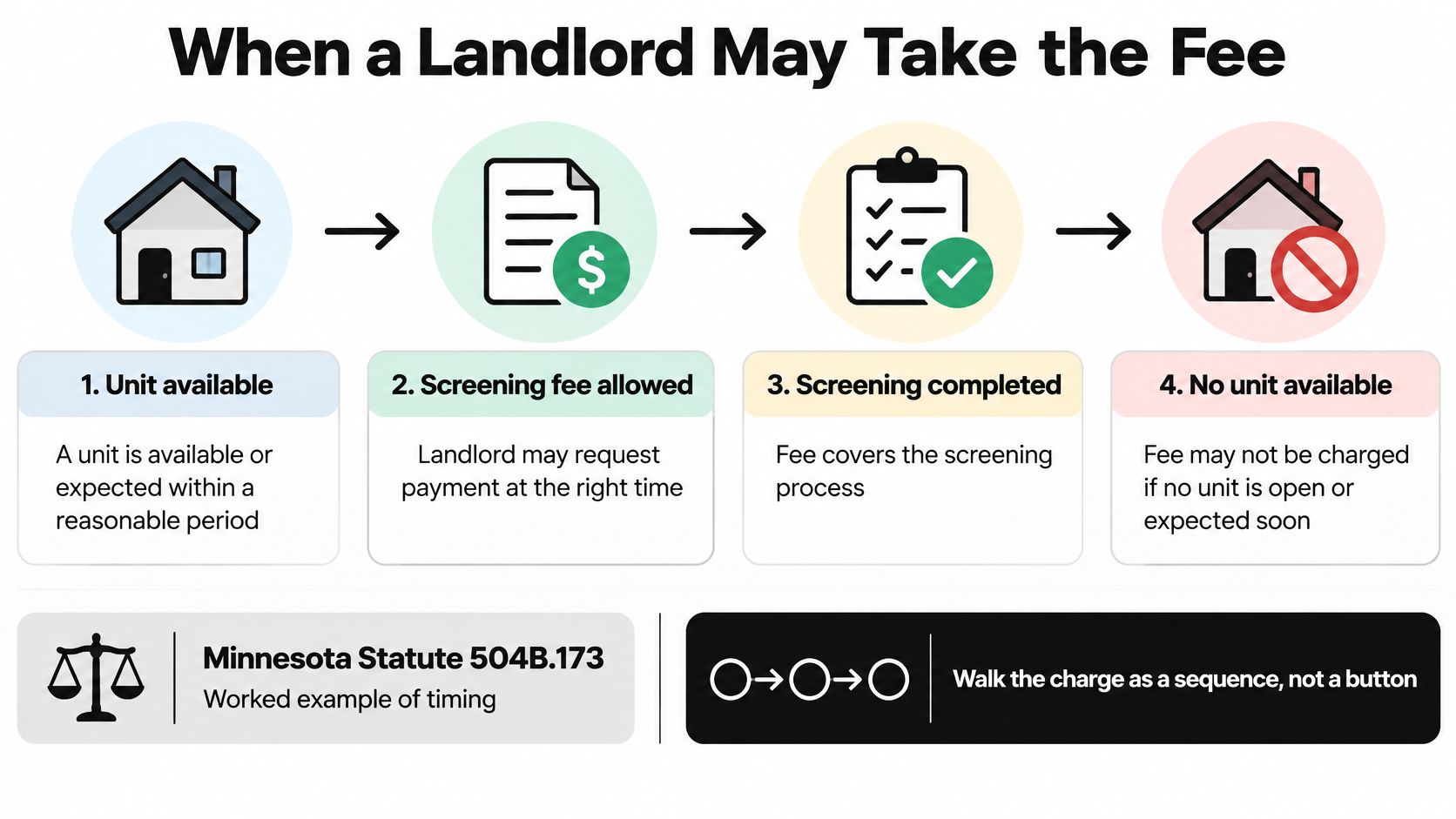
An application fee can fall below the legal cap and still be unlawful if you collect it before a unit is available, take it before the required disclosures, or deposit it before the applicant's turn. Minnesota's screening-fee statute shows how those timing rules work in practice.
The flow below shows why collection should follow a sequence rather than happen automatically when someone clicks Apply.
Minnesota as the Timing Model
Minnesota Statute §504B.173 bars a landlord from charging a screening fee when no unit is available or expected to become available within a reasonable period. Before payment, the landlord must disclose in writing the screening service and rental selection criteria. The statute also limits when the fee may be used, cashed, or deposited: earlier applicants must first be screened and rejected, or decline an offered unit.
That rule matters when several households apply for one opening. Taking payment from five applicants and depositing every fee on day one can put later applicants' money in your account before their screening is reached. Set the application process to hold those funds until the statute allows you to use them.
The disclosed criteria also need to guide the decision. Keep the criteria on file and apply them consistently when reviewing each application.
Connecticut illustrates a separate point: a fee cap does not replace the need to follow the jurisdiction's rules on what may be charged and when. Its tenant-screening report fee is capped at $50, subject to an inflation adjustment.
The short video below shows the application sequence in practice.
A Six Step Sequence You Can Run
Use this operating order for each vacancy, then adjust it to meet any stricter local requirements:
- Confirm a live vacancy: Verify a unit is available or expected within a reasonable period before requesting a fee.
- Disclose before payment: State the screening service and rental selection criteria before the applicant reaches the payment field.
- Check for fee waivers: If the applicant supplies a qualifying report and local law waives the charge, do not collect it.
- Hold while earlier applicants are pending: Where sequencing rules apply, do not deposit the fee while applicants ahead in line are still being considered.
- Use funds only at the permitted point: Deposit or use the fee only after earlier applicants are rejected or decline an offered unit.
- Return unspent amounts: If promised screening is not performed, do not keep the unused balance as income.
A fee collected with no available unit raises a different problem from a fee deposited too soon. Set the vacancy, disclosure, review, and payment steps in your process so staff cannot skip the sequence during a busy application period.
Refunds Receipts and Report Portability
A screening fee can be lawful when collected and still require a refund later. The result depends on four things: local rules, whether a unit was available, what screening was performed, and what happened to the applicant. Keep records that let you answer each question without relying on memory.
Refund Rules Turn on Different Triggers
Hawaii's Act 200 frequently asked questions say landlords or agents must return any part of a screening fee not used for authorized purposes within 30 days after submitting the screening request. Record the submission date, the screening cost incurred, and any amount returned.
Berkeley requires a receipt, an itemized accounting of expenses and time, a copy of the credit report, and a refund of unused amounts. It also bars screening fees when no unit is available. In some circumstances, an applicant who is not selected must receive a refund, unless the landlord uses a first-qualified-applicant policy and does not charge applicants who are not considered. The outcome can matter even when screening took place.
Separate the possible refund triggers in your records:
- Screening not performed: No report was ordered or the vendor could not complete it. Identify any cost incurred.
- Screening partly performed: Record the authorized expense and calculate the unused balance.
- Applicant not selected under a local outcome rule: Check whether the rule requires a refund, even if screening was completed.
- No unit available: The fee should not have been collected.
What to File for Every Payment
Keep a file for each applicant. Separate the vendor invoice from any amount claimed for time so the accounting shows how the fee was used. Include evidence that the unit was available before payment, such as the dated listing and vacancy log, along with the pre-payment disclosure and refund terms.
Save the receipt, any required report handoff record, and the order in which applications arrived. A consistent landlord compliance documentation system helps show what was charged, what screening was purchased, and what was returned.
Consider a vendor that cannot run a report because it cannot verify the applicant's information. If the landlord proceeds with another household, the first applicant's unused balance does not become income merely because the landlord acted in good faith. Keep proof of the cost incurred and return any amount the applicable rule requires.
File test: Could someone reconstruct the charge, screening cost, and refund from the file without calling you? If not, the record is incomplete.
Report Portability
A Harvard Joint Center for Housing Studies review describes portability approaches in Illinois and Colorado, where fees may be limited to actual out-of-pocket screening costs and an applicant may be able to reuse screening across properties. Check the rule that applies before charging again. Depending on the local requirements and screening already completed, the applicant may owe no second fee, may be due a refund, or may have paid for authorized screening costs that can be retained.
Eligibility Screens and Application Order
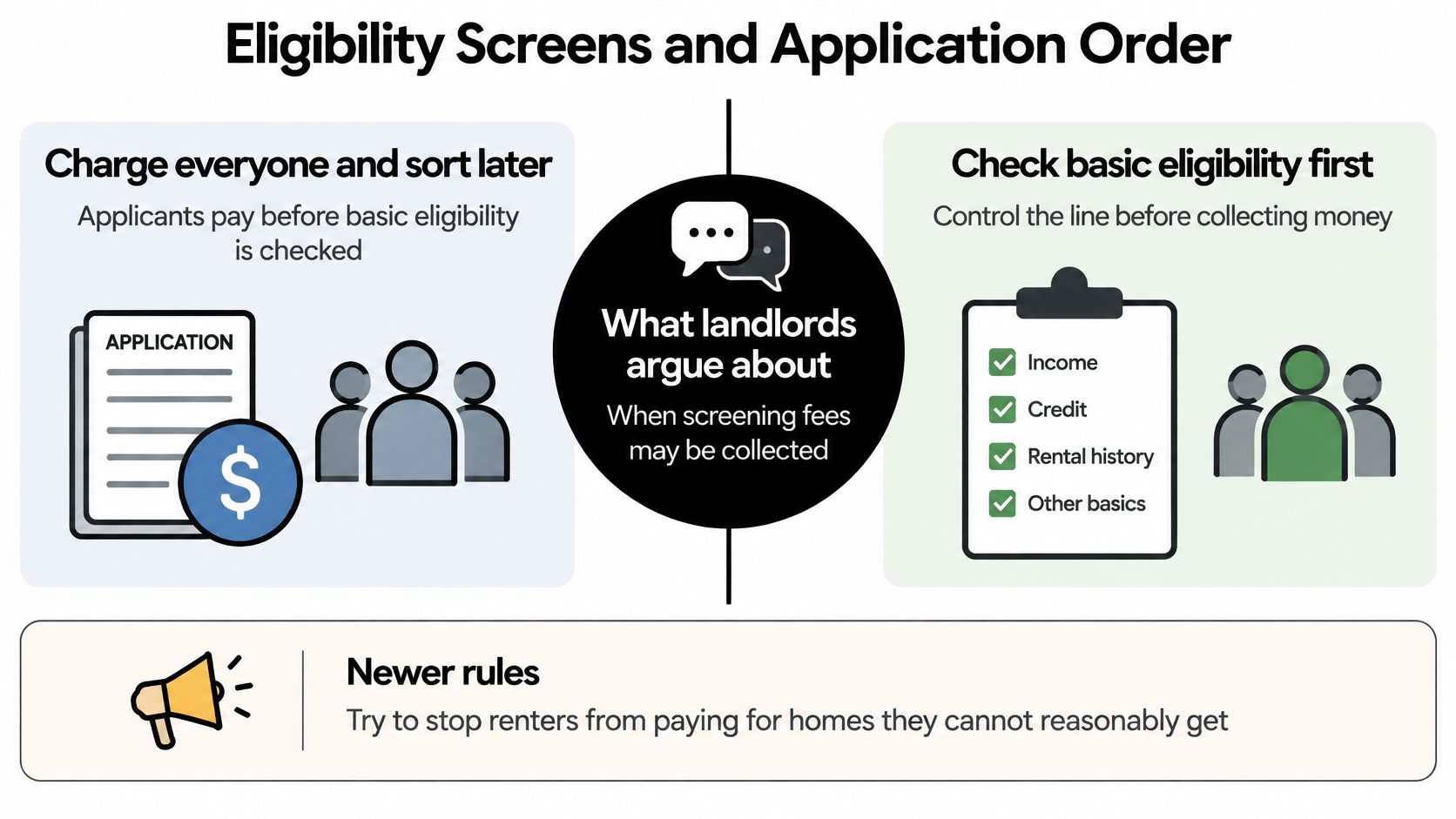
A landlord can lose control of an application fee before screening begins: an applicant pays, but the unit is already effectively promised to someone else. Where local rules govern eligibility checks or application order, the fee's legality turns on more than its amount. Check four points: the jurisdiction, whether the unit is available, what screening the fee will pay for, and what happens to applicants who are not considered.
Three Illustrations of the Same Pressure
Virginia's 2026 housing fee study.pdf) reports that HB 379 requires more upfront eligibility information so applicants do not pay fees for properties they cannot qualify for. The study also describes a $50 base cap, a $32 cap for public housing or HUD-regulated applicants, and a mechanism allowing documented third-party screening costs above the base amount. For an operator, the practical point is to disclose the criteria before collecting payment, so applicants can assess whether to proceed.
Berkeley connects fee collection to disclosure and application order. Landlords charging screening fees must disclose applicants' rights and the maximum permitted fee before collecting payment. They generally must either process the first qualified applicant without charging people who are not considered, or refund applicants who are not selected. Set the process before opening applications, then apply it consistently.
Rules differ by jurisdiction. Some places impose application-order requirements or require refunds when an applicant is not considered or selected. Confirm the local rule before deciding whether to collect from everyone who applies or only from applicants whose screening you will conduct.
Build a Pre Fee Screen That Stays Lawful
A pre-fee screen should be a short check against published, objective criteria, not a second application.
- Publish the criteria on the listing: State income, occupancy, credit, and documentation requirements in plain language.
- Ask only gate facts before payment: Request the limited information needed to identify clear mismatches with those criteria.
- Invite qualified applicants to continue: If they meet the published bar, direct them to the full application and collect a fee only where local law permits it.
The rental application process guide explains how to order these steps without duplicating the full application at the gate. Apply the same questions and criteria to everyone interested in the unit. Selective warnings can create fair-housing concerns and undermine the consistency the published criteria are meant to provide.
For one vacancy, compare two approaches. In the first, every interested household pays before you establish who will be considered. If the unit is effectively decided early, applicants may dispute fees for screening that never happened or for a place in line they never had. In the second, you publish criteria, follow a stated order, and charge only when you will consider the applicant and the law allows the fee. The file can then show why each charge was collected and what screening followed.
A consistent process is easier to explain if an applicant challenges a decision. The fee is not lawful because it falls below a cap: the unit must be available under the applicable rule, the screening must match the stated purpose, and the applicant must receive the treatment local law requires.
Sample Notices and Pre-Invite Checklist
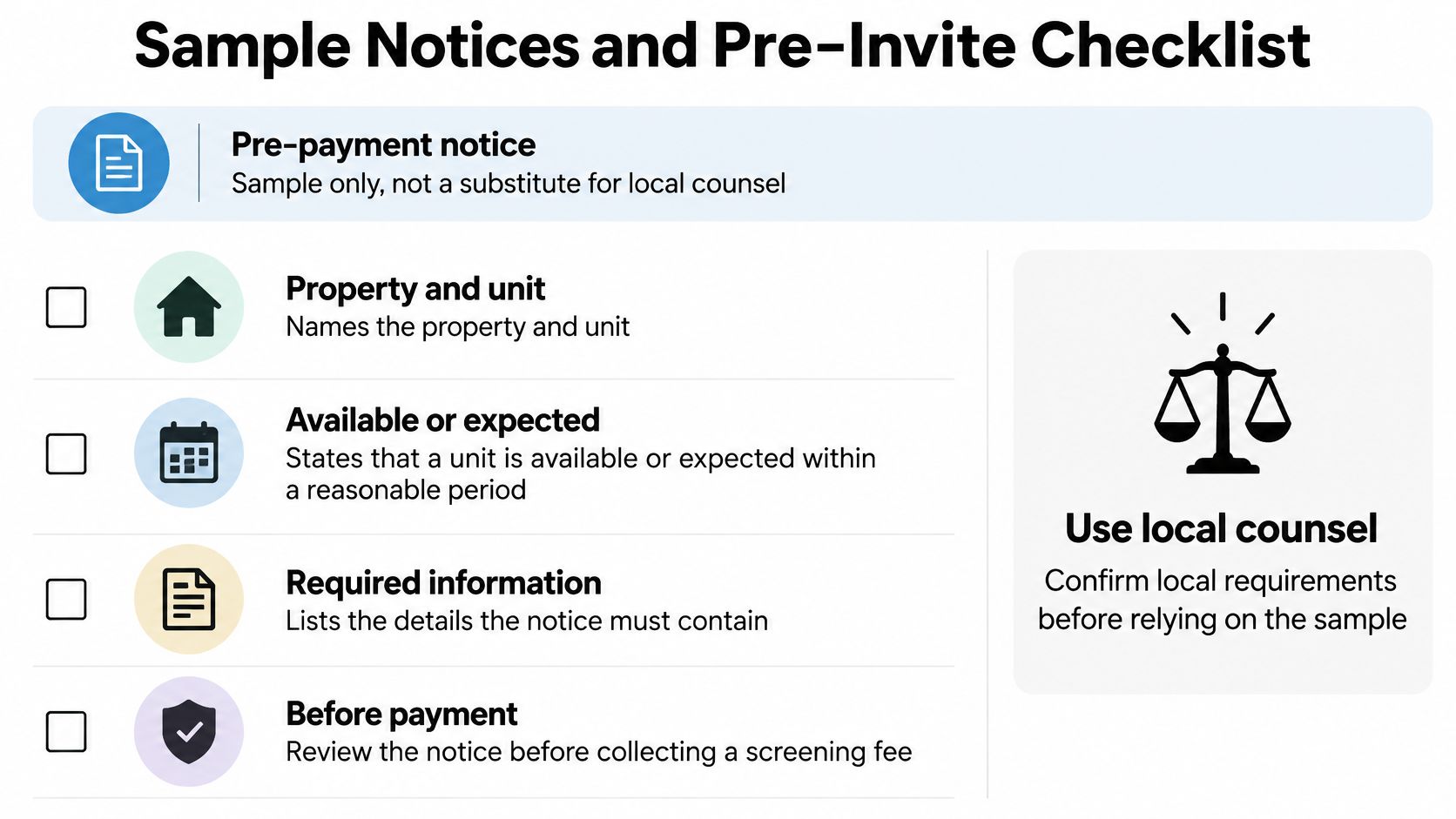
Use the notice below as a sample structure, not as a substitute for local counsel. Your city may require wording, timing, or disclosures this framework doesn't capture. The value is in the order of information. Everything an applicant needs to judge the charge appears before payment, not in a confirmation email afterward.
What the Pre Payment Notice Should Name
Name the property and unit, and state that a unit is available or expected within a reasonable period. List the fee amount and the screening purpose it pays for, and name the screening service that will be used. Paste the objective income, occupancy, credit, and document criteria in full, so the applicant isn't sent hunting through the listing.
Say whether a supplied tenant screening report waives the fee where that applies. State how applications are ordered and when unused funds are refunded. Promise a receipt or invoice, and mean it operationally. Whoever collects payment should know how that receipt gets generated before the first applicant pays.
The post payment receipt is shorter but just as specific. Repeat the amount, date, and item purchased. Split the third party screening charge from any amount you may not keep, so a later partial refund is arithmetic instead of an argument. When you run a report, you must certify that you have the applicant's written authorization, so store that authorization with the receipt rather than in a separate inbox thread.
Payment plumbing deserves one check too. When an applicant clicks Apply, Stripe splits the application payment. We take a platform cut and the landlord's application fee goes directly to the landlord's bank account. Confirm that split matches the amount your notice promised before you invite anyone, because a settings error there becomes an overcharge at scale.
Eleven Checks Before You Send an Invite
- Look up the row: Confirm the state and city rule for this property.
- Turn the fee off on a ban: Don't collect where application fees are prohibited.
- Confirm availability: Verify the unit is available or expected soon.
- Price from the invoice: Where the row is cost based, use the actual third party cost, not a round number from your last property.
- Publish criteria first: Place criteria before the payment field.
- Suppress on a qualifying report: Waive the fee where a supplied report requires it.
- Protect application order: Keep receipt order and don't deposit early where sequencing applies.
- Itemize where required: Record cost and time in the format your city requires.
- Refund on the local clock: Return unused funds by the governing deadline.
- Send adverse action notice: If a consumer report drives a denial, send the required notice. If a landlord denies an application based on eviction history, we generate the FCRA required adverse action notice automatically, including the consumer reporting agency's contact information.
- Store the packet together: File written authorization, receipt, invoice, and refund record with the application.
Two pitfalls undo otherwise good checklists. A nonrefundable label on a cost recovery fee promises you'll keep money the rule may require you to return. Copying a cap from a neighboring state assumes borders don't matter, when the table shows they do. Run the eleven checks per listing, not per portfolio.
Penalties Pitfalls and FAQ
An applicant pays, then the unit is rented to someone else. Whether the fee can be kept depends on the property's rules and what the landlord did with the application. Treat the outcome as part of the compliance test: jurisdiction, unit availability, screening method, and applicant outcome all matter.
Pitfalls That Create Exposure Fast
- Charging when no unit is available: Availability is a precondition, not a detail to settle after collecting payment.
- Taking payment before earlier applicants are resolved: In jurisdictions with application-order rules, collecting or depositing fees out of sequence can create liability.
- Keeping an unused balance: Money collected for screening costs may need to be returned if it was not spent as permitted.
- Calling a cost-recovery fee nonrefundable: A label does not override a local duty to refund unused funds.
FAQ
Can I charge the same fee in every state? No. Apply the state rule for the property, including any city or county rule that also governs it.
Must I refund an applicant I didn't select? It depends on local law, whether the screening was performed, and whether the applicant was considered under the disclosed eligibility policy. Keep the screening invoice and the application outcome together so the records show what happened to the fee.
Can I charge everyone first and decide later? Only if the applicable rules allow it. Some jurisdictions tie collection to eligibility screening or require landlords to process applications in a particular order.
Does a tenant screening report waive the fee? Some jurisdictions recognize a qualifying report as an alternative to paying a fee. New York is the example identified in the table. Check the rule that applies to the property before collecting.
Can an applicant reuse a payment? Portability rules vary. Where a report or fee can be reused, follow the local conditions; otherwise, handle each property's payment and refund obligations separately.
For consumer-report decisions, review this FCRA compliance checklist for landlords. Federal law does not set a general dollar cap on rental application fees, but the Fair Credit Reporting Act governs the use of consumer reports and adverse action notices. A fee that complies with local limits does not make a report-based denial compliant by itself.
If a Hawaii rule is unclear for a particular property, find a Kamuela landlord tenant lawyer for advice tied to that location.
A practical next step is to keep screening and payment records together. VerticalRent offers FCRA-compliant tenant screening, Stripe-split application fee collection that deposits the landlord's share into their bank account, and an income and expense ledger for transaction records.
Put this into practice
VerticalRent tools related to this guide
Legal Disclaimer
VerticalRent and its authors are not attorneys, CPAs, or licensed legal or financial advisors, and nothing on this site constitutes legal, tax, or professional advice. The information in this article is provided for general educational purposes only. Landlord-tenant laws, eviction procedures, security deposit rules, and tax regulations vary significantly by state, county, and municipality — and change frequently. Nothing on this site creates an attorney-client relationship. Always consult a licensed attorney or qualified professional in your jurisdiction before taking any action based on information you read here.
Co-founded VerticalRent in 2011, growing it from nothing to 100k landlords and renters. Sold it in 2019, then re-acquired it in 2026 to make it better than ever.


