How to Provide Proof of Income for Rentals
Learn how to provide proof of income for rentals with accepted documents, formatting tips, secure submission steps, and what to do if you lack pay stubs.


You've found the apartment, your credit is fine, and the landlord sounds ready to say yes. Then comes the email asking for clearer income documents, and another applicant gets the keys while you're still resending files. That's why how to provide proof of income matters as a skill, not an afterthought.
The Apartment You Almost Lost Over a Pay Stub
A renter I screened had solid pay, steady work, and no eviction history. She sent one cropped phone photo of a pay stub, cut off at the employer name, with the pay period missing. I couldn't verify who paid her, how often, or whether the amount was current, so her file sat in pending while she scrambled for a clean copy.
She wasn't unqualified. Her paperwork was. The landlord moved to the next complete application because an incomplete file reads as risk, even when the income behind it is real. That's the part applicants underestimate.
A landlord can't approve income they can't trace to a named source, a date, and a recurring amount.
Proof of income works when three things happen fast. First, the documents match your income type instead of forcing every job into a pay stub mold. Second, a reviewer can find employer name, pay period, gross pay, and year-to-date earnings without zooming, guessing, or emailing you back.
Third, you submit through a channel that protects your data. You'll often see deductions on a stub that confuse first-time renters, so it helps to understand why FIT appears on your earnings before you explain a net deposit that looks smaller than your gross pay.
What a Complete File Signals
A clean package tells me you're organized and that your stated income will survive a second look. A messy one tells me verification will take extra calls, and busy landlords rarely reward extra work. Build the file before you tour, not after someone asks.
Standard Documents Every W-2 Renter Needs
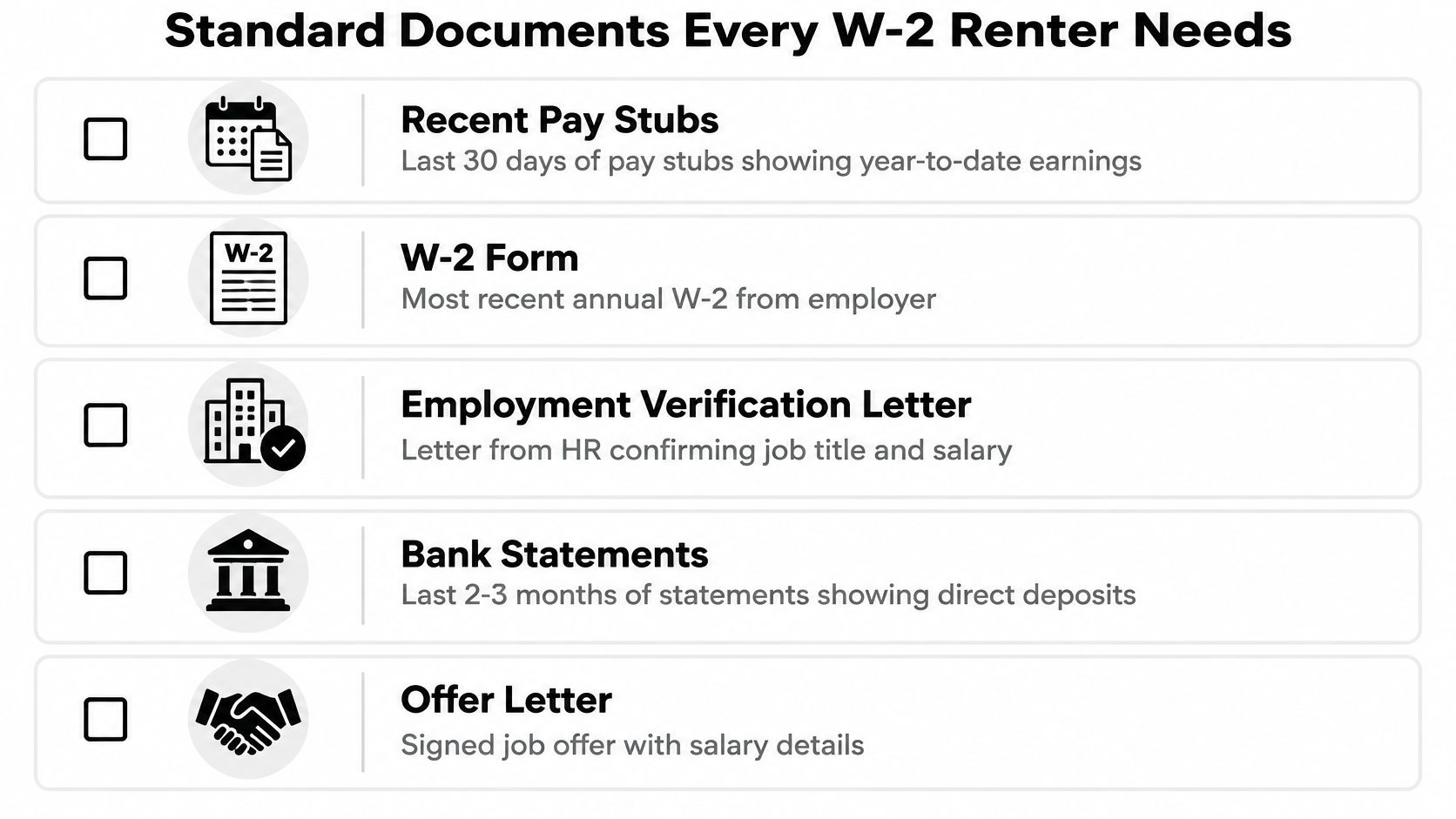
Start with pay stubs that cover a full review window, not a single good payday. HUD guidance on collecting one month of pay stubs at application sets a useful floor. That means one monthly stub, two biweekly or semimonthly stubs, or four weekly stubs, showing hourly wage, overtime, bonuses, hours worked, and year-to-date earnings.
Use official payroll downloads when you can. ADP, Gusto, Workday, and similar portals produce complete PDFs with your name, employer, dates, and deductions intact. Screenshots often crop the exact fields a landlord needs.
The Core Stack to Assemble Tonight
- Recent pay stubs: Include every page, keep dates consecutive, and don't hide year-to-date totals.
- Most recent W-2: Add it when you changed jobs recently, earn variable overtime, or want to show a longer earnings history.
- Employer verification or offer letter: Use this for a new role, and make sure it states title, start date, and pay rate or salary.
- Bank statement pages that match deposits: Include the pages showing your name and the employer's direct deposits, not unrelated spending history.
If you're between payroll systems, ask HR for a signed letter on company letterhead. Don't create your own summary and call it verification. A landlord trusts a third-party document because you didn't produce it yourself.
Don't send your full tax return by default as a W-2 employee. Lead with current payroll evidence, then add the W-2 only when it strengthens the story. More pages don't help if the newest income is buried.
What Landlords Actually Check Inside Each Document
I don't read your pay stub like a novel. I scan for consistency. Your application, pay stub, and bank deposit should tell the same story about employer, frequency, and amount without you having to explain basic math.
Gross income is the number most landlords use because it's comparable across applicants before taxes and deductions. Net pay matters for your budget, but it varies with benefits, garnishments, and withholding choices. If you quote take-home pay on the application, say so plainly instead of letting the reviewer discover the mismatch.
The Fields That Decide Whether I Ask for More
I check that the employer name matches your application, including a parent company or payroll name. I look at pay dates for gaps, compare current period pay with year-to-date totals, and see whether hours and rate produce the gross amount shown. Then I match deposits using the logic behind bank statement verification for rental applications, because a deposit trail can confirm that payroll money landed.
Round, identical deposits with no employer label raise questions. So do stubs where year-to-date earnings don't move sensibly between periods, or where the job title and employer change without an offer letter. None of that proves dishonesty by itself, but it stops a fast approval.
Reviewer habit: If I need a calculator and three guesses to annualize your pay, you've already slowed your own application.
Explain known wrinkles before I find them. Note a recent raise, a shift from contract to staff, unpaid leave in one period, or a bonus that won't recur monthly. One sentence on your cover sheet beats a suspicious silence.
Don't alter a document to make it clearer. Highlighting outside the original PDF in your cover note is fine, editing numbers, names, or dates is not. Once I doubt one field, I doubt the whole file.
Formatting Your Package So It Passes in Two Minutes
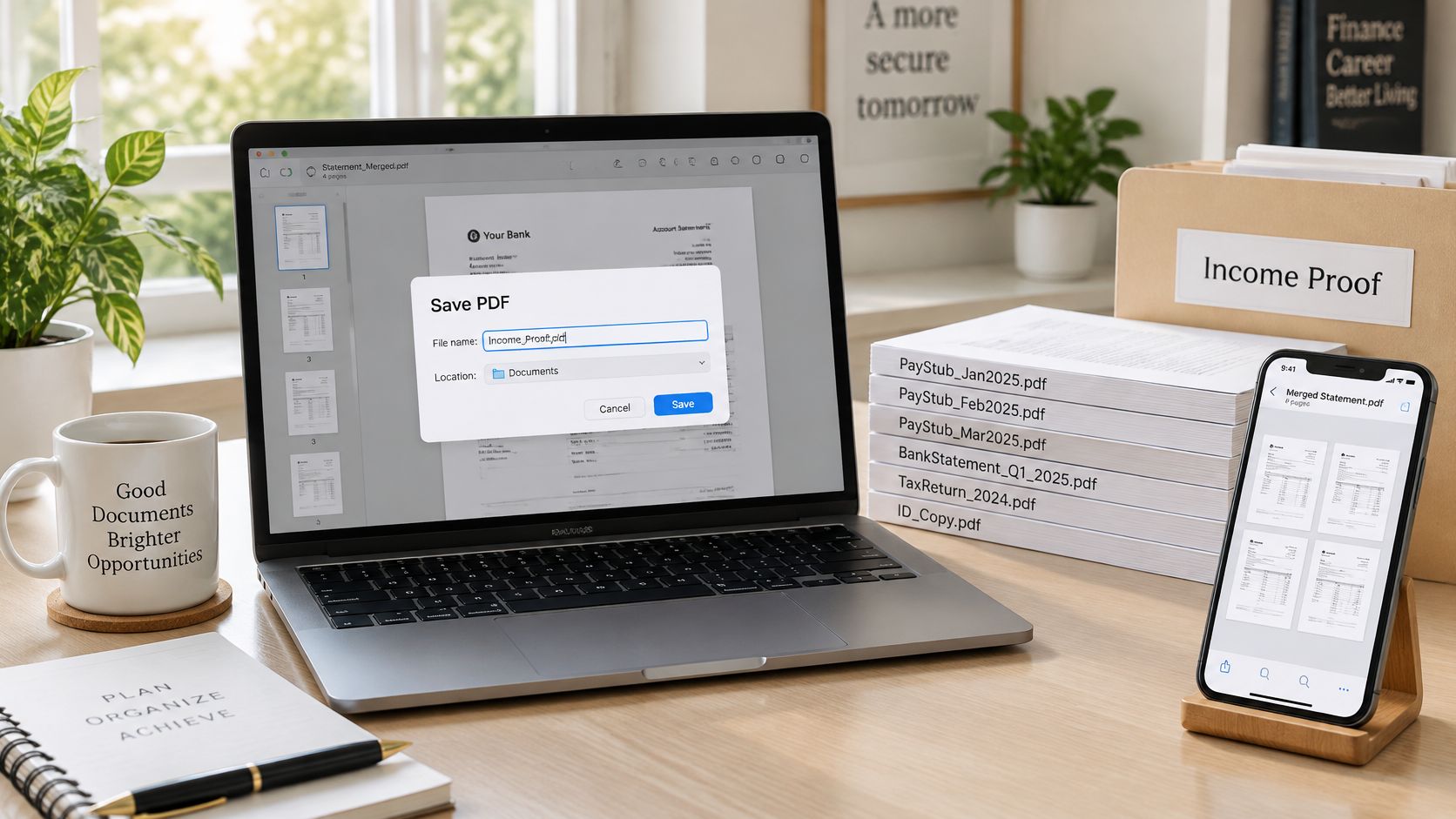
Send PDFs, not loose phone photos. Download statements and stubs from the source portal, keep every page in order, and check that text stays readable when opened on a phone. If you must scan paper, use a scanner app that produces a flat, cropped PDF rather than a shadowed photo.
Name files so I know what I'm opening before I click. Use LastName_PayStubs_30Days.pdf, LastName_W2_MostRecent.pdf, and LastName_BankDeposits.pdf. Generic names like IMG_2041 or Scan3 force me to hunt.
A Simple Packaging Order
- Cover sheet first: List your name, property, income sources, documents enclosed, and any brief explanation.
- Primary proof next: Put pay stubs, benefit letter, or tax return before supporting pages.
- Deposit evidence last: Add only the statement pages needed to corroborate income.
Merge related pages into one file per document type. Don't upload twelve separate images for one bank statement, and don't combine every record into one giant PDF with no labels. I need to forward, save, and recheck individual items quickly.
Before sending, open each file fresh. Confirm no page is sideways, password-locked without a password provided separately, or missing its final page. A two-minute self-check prevents the most common delay I see.
Submitting Securely Without Exposing Your Full Finances
You can be transparent without handing over your entire financial life. An Experian summary reports 93.3% of property managers encountered fraud in the prior year and 84.3% identified falsified pay stubs or employment references as common tactics, according to Experian's summary of the NMHC Pulse Survey on tenant screening fraud. That fraud pressure is why clean, source-downloaded files help honest applicants stand out.
Pick the Channel and Limit the Exposure
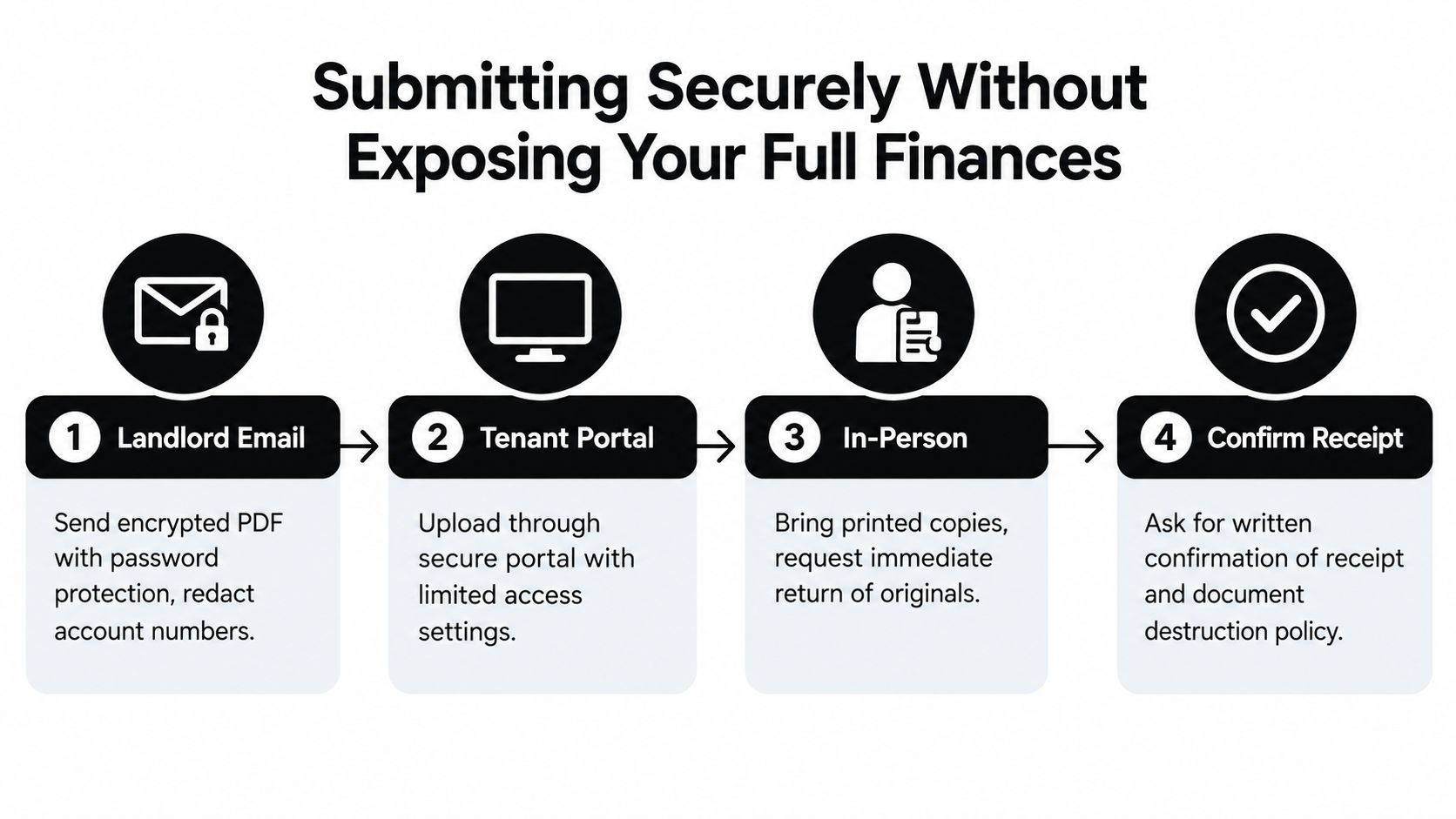
- Tenant portal: Prefer this when available because uploads are tied to your application and easier to trace.
- Email: Send password-protected PDFs and share the password by phone or a separate message, never in the same email.
- In person: Bring copies, keep originals in your hand, and ask what will be retained.
Redact full account numbers, Social Security numbers, and unrelated transactions where the portal allows it. Keep visible your name, institution, statement period, employer deposits, and enough account identifier to show continuity. Don't black out pay dates or year-to-date figures in the name of privacy, because those fields are the verification.
Read any authorization before signing. Consent should let the landlord verify employment and income, not grant open-ended access to every account. The same careful reading habit applies to other housing paperwork, including understanding your mortgage commitment letter if you later move from renting to buying.
Ask for written confirmation of receipt. One polite message is enough. Note what you sent, when, and through which channel, and keep your own copies until the lease decision is final.
If Your Income Does Not Fit the Standard Mold
No pay stub doesn't mean no proof. It means you must prove source and sustainable amount separately. Don't annualize your best month and expect me to treat it as normal.
The Federal Reserve found 16% of U.S. adults performed gig activities in the month before its 2022 household survey, while only 12% of gig workers, equal to 2% of all adults, said gig work supplied more than half their income, per the Federal Reserve report on gig work and household income. That's why one strong deposit proves very little about ongoing rent-paying capacity.
Evidence Matrix by Income Type
| Income Type | Primary Document | Supporting Documents | What to Avoid |
|---|---|---|---|
| Gig or freelance | Platform earnings summary or profit-and-loss statement | 1099s, invoices, contracts, bank statements | Screenshots with no name or period |
| Self-employed | Latest Form 1040 with schedules | Business bank statements, current contracts | Counting gross receipts as net income |
| Benefits or retirement | Benefit award or pension letter | Bank deposits matching the award | Old letters with superseded amounts |
| Rental income | Schedule E or current leases | Rent checks, expense records | Claiming gross rent without expenses |
Reconcile deposits to each source and label transfers between your own accounts. Double-counting the same money as client revenue and again as a personal deposit destroys credibility fast. For rental income, present net income after documented expenses such as taxes, insurance, maintenance, utilities, or mortgage interest.
Add a short cover letter that names each source, states whether it's recurring, and explains seasonality. Then connect the total to affordability using the income-to-rent ratio landlords use to screen applicants, based on documented net or gross income as the landlord specifies. Strong annual income with uneven months can still pass when reserves, recurring contracts, and a clear calculation trail are visible.
Frequently Asked Questions Before You Hit Submit
How current should documents be? Use the latest pay period, benefit letter, and tax return available. Stale evidence invites a follow-up request.
What if the landlord asks for more? Send the specific missing item, not a second unsorted dump. HUD guidance calling for two or more bank statements for self-employed verification shows why extra statements can be a normal request, with a signed statement only when third-party verification can't be obtained and the reason is documented. Review the full rental application process before resubmitting.
Does a bank connection replace documents? Not always. It may miss other accounts or payment channels, so keep a document fallback ready.
Build your income package once, keep it updated, and submit it through a traceable channel that limits unnecessary exposure. Landlords using VerticalRent can screen applicants, manage leases, and collect rent online in one place, while renters benefit from a clearer application path. Visit VerticalRent to see how a cleaner process helps both sides reach a confident yes faster.
Put this into practice
VerticalRent tools related to this guide
Legal Disclaimer
VerticalRent and its authors are not attorneys, CPAs, or licensed legal or financial advisors, and nothing on this site constitutes legal, tax, or professional advice. The information in this article is provided for general educational purposes only. Landlord-tenant laws, eviction procedures, security deposit rules, and tax regulations vary significantly by state, county, and municipality — and change frequently. Nothing on this site creates an attorney-client relationship. Always consult a licensed attorney or qualified professional in your jurisdiction before taking any action based on information you read here.
Co-founded VerticalRent in 2011, growing it from nothing to 100k landlords and renters. Sold it in 2019, then re-acquired it in 2026 to make it better than ever.


