Do Rental Applications Affect Credit Score: The Full Guide
Do rental applications affect credit score? Learn how soft and hard inquiries work, what landlords must disclose, and how to protect your rating.


Usually, rental applications use soft inquiries and don't affect your credit score. If a landlord or screening provider uses a hard inquiry instead, one inquiry typically lowers a FICO Score by fewer than 5 points, while VantageScore models typically decline by about 5 to 10 points temporarily.
Do rental applications affect credit score in the same way a mortgage or credit-card application does? That assumption causes unnecessary anxiety for renters and can also lead landlords to describe screening inaccurately. The application itself isn't the deciding factor. The inquiry type and the information in the screening report are.
A tenant-screening report may include credit history, eviction information, rental-payment history, identity verification, and income or employment data, according to the Consumer Financial Protection Bureau's explanation of consumer reporting companies. A screening provider can review that information without treating the request like an application for new borrowing.
The practical issue is transparency. Renters should know whether the screening will be a soft or hard inquiry before paying an application fee or authorizing access. Landlords should explain the process, obtain the required consent, and understand that a credit-score effect is only one part of the screening decision.
The Short Answer to Credit Impact
A rental application doesn't automatically lower your credit score. Most tenant screenings are structured as soft inquiries, which generally don't affect FICO scores. A landlord or screening company can still request a report as a hard inquiry, particularly when the process is treated like a formal credit application, and that can cause a temporary decrease.
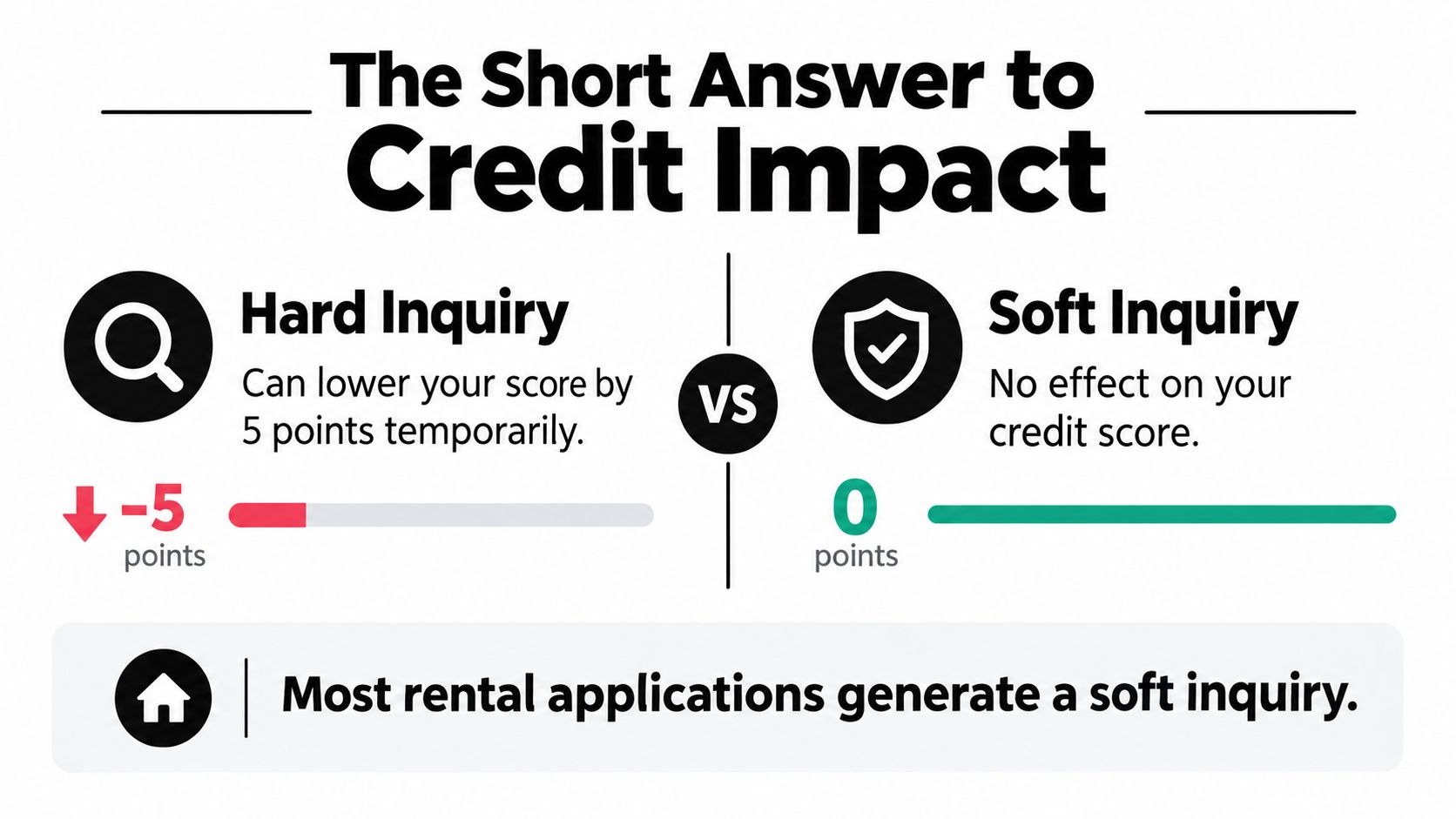
Think of the inquiry as the method used to access your credit information, not as a judgment about your ability to pay rent. A soft inquiry supports screening without being treated as a request to open a new credit account. A hard inquiry is associated with a credit application and may affect scoring.
The CFPB notes that landlords may request a hard inquiry, while tenant-screening companies commonly provide broader reports after an applicant applies or authorizes access. That distinction matters because a screening report can contain far more than a score. It may help a landlord evaluate rental history, identity, income, and eviction information alongside credit history.
What renters should ask before applying
Ask the landlord or screening provider a direct question in writing:
Practical rule: Before you submit personal information, ask whether the screening will be coded as a soft inquiry or a hard inquiry.
Also ask whether every adult applicant will be screened separately, whether the landlord accepts an applicant-authorized report, and whether the authorization language mentions a “hard pull” or “credit application.” A clear answer lets you compare properties without authorizing avoidable hard inquiries.
For landlords, disclosing the inquiry type is more than a courtesy. It prevents applicants from confusing a routine tenant screening with a loan application and supports a process built around documented consent. If the provider requires a hard inquiry, the applicant should learn that before authorizing the check.
The score effect, when a hard pull occurs, is generally limited. The larger practical consequences often come from the screening result itself, such as approval, denial, a larger deposit, or additional rent demanded upfront. Renters should protect their score, but they should also focus on whether the underlying report is accurate.
How Soft and Hard Inquiries Work
The difference between soft and hard inquiries comes down to purpose and authorization. A soft inquiry is a review that doesn't represent a request for new credit. A hard inquiry is connected to a credit application or another decision involving potential borrowing.
For a rental applicant, the same credit information can be accessed through either process. That's why the property name or application form doesn't tell you what will happen to your score. The screening provider's workflow does.
Soft inquiries are usually score-neutral
A soft inquiry can appear when a company reviews information for screening or when a consumer checks their own credit. It may still be visible on a credit report, but it doesn't affect the score. Many rental screenings use this approach because the landlord is evaluating housing risk, not extending a loan.
A hard inquiry is treated differently. Experian reports that one new hard inquiry generally reduces a FICO Score by fewer than 5 points, while the typical VantageScore decline is about 5 to 10 points. These figures come from Experian's explanation of how long hard inquiries remain on a credit report.
The effect is temporary, but the record lasts longer than the scoring impact. A hard inquiry can remain visible for up to 2 years, while FICO scoring generally considers it for 12 months, and the impact often fades after several months. Soft inquiries don't affect scores, even if they appear in the consumer's report.
| Inquiry type | Typical rental use | Credit-score effect |
|---|---|---|
| Soft inquiry | Tenant screening and other non-credit reviews | No scoring impact |
| Hard inquiry | Formal credit application or a provider's required process | Small, temporary decline |
Why repeated applications need attention
One hard inquiry usually isn't a major event. Several separate hard pulls close together can create a larger cumulative effect, although the result depends on the scoring model and the applicant's broader credit profile. Rental applications generally shouldn't be assumed to receive the same treatment as multiple mortgage or auto-loan inquiries.
That's why renters should avoid authorizing repeated full-credit pulls unless a property genuinely requires them. A useful plain-language overview of the distinction appears in Toya AI's credit inquiry guide for borrowers, which can help applicants recognize the terms used in authorization forms.
Landlords can reduce confusion by selecting a screening workflow that uses soft inquiries where appropriate and states the inquiry type before consent. For a practical operational walkthrough, property owners can review how to run a credit check on a tenant, including the steps involved in requesting and handling screening information.
Landlord Obligations Under the FCRA
A landlord's responsibility doesn't end when a screening report arrives. If a property owner uses a consumer report to evaluate an applicant, the process should include a legitimate housing purpose, clear disclosure, documented authorization, secure handling, and a compliant response if the report contributes to an adverse decision.
The Fair Credit Reporting Act, or FCRA, matters because applicants often can't see or correct the information being used until a decision has already been made. A landlord who treats screening as an informal background check can miss important procedural duties.
Build consent into the application
Before requesting a consumer report, provide the required disclosure and obtain the applicant's written authorization. The authorization should make the purpose clear and identify that a consumer report may be used for housing. Keep the consent with the application record so the landlord can show what the applicant authorized and when.
The inquiry type should also be disclosed. A soft pull may protect the applicant's score, but it still involves sensitive consumer information. A hard pull requires even more direct communication because the applicant may experience a temporary score reduction.
Landlords should use a repeatable workflow rather than relying on memory:
- Disclose the screening purpose: Explain that the report supports the rental decision.
- Capture written authorization: Store the applicant's consent with the application.
- Use a consistent screening standard: Apply the same documented criteria to similarly situated applicants.
- Secure the report: Limit access and retain records according to the business's legal and operational requirements.
- Document the decision: Record whether the report affected approval, conditions, or denial.
A detailed overview of the legal framework appears in this guide to FCRA compliance for landlords.
Handle adverse action correctly
If a landlord denies an application, requires a larger deposit, or demands additional rent because of information in a screening report, the applicant may be entitled to an adverse-action notice. The CFPB says that notice must identify the reporting company and explain the applicant's right to obtain a free copy and dispute errors, as described in its consumer reporting companies guidance.
The reporting company generally has 30 days, or sometimes 45 days, to investigate a dispute, according to the same CFPB guidance. Those are not minor administrative details. A landlord who provides a vague rejection may prevent an applicant from identifying a mixed file, outdated record, or incorrect eviction entry.
A compliant screening process protects both sides. It gives the landlord usable information and gives the applicant a fair opportunity to challenge inaccurate information.
Screening Reports vs Credit Applications
A tenant-screening report isn't the same product as a mortgage or credit-card application. A lender decides whether to extend new debt. A landlord evaluates whether an applicant appears likely to meet lease obligations and comply with property requirements.
That difference explains why tenant screening is commonly structured as a soft inquiry. The report may combine several categories of information instead of focusing only on borrowing behavior. The CFPB identifies credit history, eviction information, rental-payment history, identity verification, and income or employment data as information commonly found in tenant-screening reports.
The report is broader than the score
A credit score can be one input, but it doesn't answer every question a landlord needs to answer. A property owner may need to verify that the applicant is correctly identified, assess documented rental history, confirm income or employment information, and review relevant public-record information according to the landlord's policy and applicable law.
Experian states that soft inquiries have no scoring impact, while a single hard inquiry typically lowers a FICO Score by fewer than five points, as explained in its rental credit check guide. The important comparison is therefore not “credit check versus no credit check.” It's soft screening versus hard credit application, followed by a separate question about what information the report contains.
| Housing screening | Traditional credit application |
|---|---|
| Evaluates suitability for a lease | Evaluates eligibility for new borrowing |
| May combine rental, identity, income, eviction, and credit information | Primarily supports a lending decision |
| Commonly uses a soft inquiry | Commonly uses a hard inquiry |
| Can affect housing approval or lease conditions | Can affect access to a credit account |
Why landlords should choose the least intrusive method
A landlord doesn't gain a better housing decision just because an inquiry affects the applicant's score. If a soft-pull report provides the information needed to apply the rental criteria, a hard pull adds potential applicant harm without adding useful screening value.
That doesn't mean a hard inquiry is always improper. Some providers or policies may require it, and a landlord may decide to use that process. The responsible approach is to explain it before authorization, apply it consistently, and avoid presenting a hard pull as an invisible technicality.
Protecting Your Score as a Renter
Renters can reduce surprises by treating the screening process as something to manage, not just a form to complete. Before applying, find out what the landlord will check, how the provider will access the information, and whether the property accepts documentation you already have.

Prepare before paying an application fee
Start with the inquiry question. Ask whether the screening is a soft or hard pull, whether each adult will be screened separately, and whether the property accepts an applicant-authorized credit or screening report. Save the answer, especially if it comes from an online portal or leasing agent.
Then review your own reports. Checking your credit information helps you identify accounts, names, addresses, or payment details that could confuse a screening provider. You can also prepare a concise explanation for legitimate negative information, rather than discovering the issue after a landlord has already made a decision.
A practical renter checklist looks like this:
- Confirm the pull type: Ask in writing before authorizing screening or paying a fee.
- Use consistent identifying information: Provide your full legal name and accurate personal details.
- Offer accepted documentation: Submit a consumer-purchased report or screening result when the landlord permits it.
- Limit repeated hard pulls: Don't authorize full-credit inquiries across multiple properties unless required.
- Keep payment evidence: Preserve rent receipts, bank records, or landlord references that support your rental history.
For help understanding the records used in an application, review this resource on checking a tenant screening report.
A short educational video can also help renters recognize the difference between routine screening and a formal credit application:
If a landlord can use a soft screening process, that option generally avoids score damage. If the provider requires a hard inquiry, compare the property's policy before submitting several applications and ask whether an existing report can satisfy the screening requirement.
When Data Accuracy Matters Most
Could a renter avoid a hard pull and still lose an application because the screening report is wrong? Yes. An inaccurate eviction record, mixed identity file, outdated account, or incomplete rental history can affect a housing decision even when the inquiry itself does not affect the score.
The CFPB identified more than 26,700 tenant-screening-related credit or consumer-reporting complaints from January 2019 through September 2022, and warned that inaccurate or outdated information can affect access to housing in its tenant background-check snapshot. The complaint volume shows why renters and landlords must treat report accuracy as a separate issue from credit-score impact.
A report can miss good rental behavior
Conventional credit reports may omit positive rent-payment history. A renter who pays on time may receive little or no credit benefit from that record in a conventional credit profile, even though the same history could help a landlord assess reliability.
The result is an uneven file. Negative information may appear in a screening report while consistent rental payments remain invisible. Applicants should ask which rental-payment data the provider includes and retain records that verify timely payments. Landlords should understand what the report does and does not measure before treating an incomplete file as evidence of poor payment behavior.
What to do after an adverse decision
If a landlord denies an application or changes its terms because of a screening report, the applicant should request the adverse-action notice and identify the reporting company. The CFPB says the applicant can request a free copy of the report and dispute errors with the reporting company or the relevant furnisher.
Compare the report with your records:
- Identity details: Check for another person's accounts, addresses, or court records.
- Court information: Confirm that eviction data identifies the correct person and outcome.
- Payment history: Compare reported delinquencies with receipts, statements, and payment confirmations.
- Dates and status: Flag information that should have been updated or removed.
Landlords should give applicants a clear way to raise disputes instead of treating a report as conclusive. Accurate matching, documented review, and a pause for credible corrections protect applicants and reduce the risk of basing a housing decision on someone else's record.
Best Practices for Smooth Screenings
Renters and landlords want the same operational result, even though they approach the application from different sides. The renter wants to avoid an unexpected score impact and correct errors. The landlord wants reliable information, documented consent, and a defensible decision.
Renters should confirm the inquiry type before applying, review their reports, keep proof of rental payments, and avoid repeated hard pulls where a soft screening or accepted report will work. Landlords should disclose the process, obtain written authorization, apply consistent criteria, protect consumer data, and send a complete adverse-action notice when a report contributes to a negative decision.
A screening platform can keep the application, consent, and report records together. VerticalRent, for example, provides FCRA-compliant tenant screening with credit, criminal, eviction, and rental history data, while keeping applicant workflows and records connected. Whatever tool a landlord chooses, the process should make the inquiry type and applicant rights clear.
The best screening process isn't the one that gathers the most data. It's the one that gathers appropriate data accurately, uses the least intrusive inquiry that meets the housing purpose, and gives both parties a clear way to resolve mistakes.
If you're a landlord, use VerticalRent to connect rental applications, consent capture, tenant screening, and property-management records in one workflow. Review the screening method before launching your next application process, and give applicants clear information about how their credit data will be accessed.
Put this into practice
VerticalRent tools related to this guide
Legal Disclaimer
VerticalRent and its authors are not attorneys, CPAs, or licensed legal or financial advisors, and nothing on this site constitutes legal, tax, or professional advice. The information in this article is provided for general educational purposes only. Landlord-tenant laws, eviction procedures, security deposit rules, and tax regulations vary significantly by state, county, and municipality — and change frequently. Nothing on this site creates an attorney-client relationship. Always consult a licensed attorney or qualified professional in your jurisdiction before taking any action based on information you read here.
Co-founded VerticalRent in 2011, growing it from nothing to 100k landlords and renters. Sold it in 2019, then re-acquired it in 2026 to make it better than ever.


