8 Responsibilities of a Landlord: Legal and Safety Basics
Learn the key responsibilities of a landlord, from habitability and fair housing to deposits, entry notice, and FCRA screening. Requirements vary by state.

A repair call lands on a Tuesday morning in January. The heat's out, the tenant is calm but cold, and you're forty minutes from the unit with a full workday ahead. Later that spring, the same tenant questions a $180 deposit deduction, and you're digging through texts to prove when the carpet was replaced. Meanwhile, a screening report from an applicant you decided against two months ago is still sitting in your inbox, unread and unresolved.
None of those three moments feels like a legal problem when it happens. Each one is. The responsibilities of a landlord stretch across five areas: legal, safety, maintenance, financial, and communication. The exact rules depend on the state and city where the property sits, and sometimes on the county. A duty that's a two-page form in one state is a criminal penalty in another.
This list covers eight duties, ordered roughly by how often they turn into real trouble for small landlords. Each one is framed around the moment it bites: before move-in, during a repair request, or at move-out. Each ends with a state-variance check, so you know what to confirm locally before you rely on the baseline.
1. Duty to Maintain a Habitable Premises
The obligation to keep a rental fit to live in doesn't come from your lease. It's implied by law in most U.S. states, and it runs the entire tenancy, not just move-in day. In practice, habitability means working plumbing, functioning heat, safe electrical systems, sound structure, weather-tight walls and roof, and no serious pest or health hazards. Javins v. First National Realty Corp., decided by the D.C. Circuit in 1970, is the case that established the implied warranty of habitability for residential leases, and most states followed.
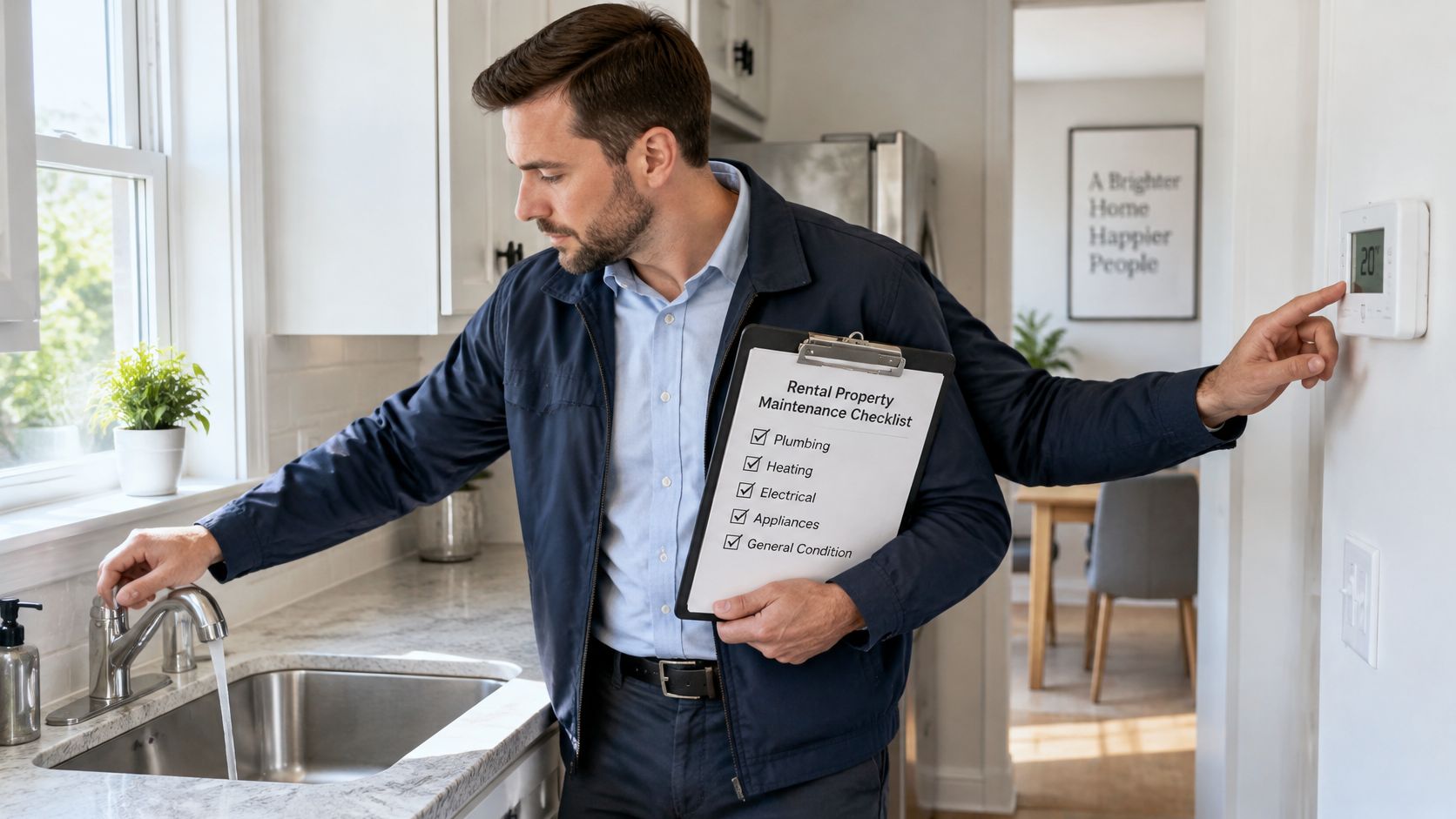
Why it bites during a repair request
This duty is triggered by notice, not by your awareness. The moment a tenant tells you the heat is out in January, the clock starts. Many city housing codes require landlords to restore heat within 24 hours of a complaint during winter months, and code inspectors don't care that your HVAC tech is booked until Thursday.
The consequences are substantial and layered. Tenants in most states can withhold rent, repair the problem and deduct the cost, or sue for damages when repairs are neglected. Some states let them break the lease outright.
The practical rule: treat a heat, water, or electrical failure as an emergency on day one, even if the permanent fix waits. Space heaters, a temporary shutoff, a same-day diagnostic visit. Make the property safe first and repair it properly second.
What works
Log every request with a date, description, and response. A timestamped maintenance request log answers the notice question before it becomes an argument about who knew what and when. Set a preventive schedule for HVAC (twice a year), water heaters (flush annually), and roofs (inspect each spring). Use verified local vendors and keep the invoices, because a paid invoice with a completion date is the single best piece of evidence you own.
For electrical faults specifically, call a licensed electrician rather than a handyman. Sparking outlets and exposed wiring are electrical repair electrician territory, and an unlicensed fix won't hold up if the city inspects.
State variance check
Standards differ substantially. Confirm three things locally: your state's defined repair-and-deduct remedy, the response deadline for heat and hot water, and whether your city requires a rental inspection certificate. Review your local housing code once a year. Codes get amended without much notice, and the amendment usually adds a deadline.
The video below walks through what a defensible maintenance process looks like in practice.
2. Duty to Comply with Fair Housing Laws

The federal Fair Housing Act of 1968, amended in 1988, bars discrimination in renting, advertising, screening, and lease terms. The federal protected classes are race, color, religion, national origin, sex, familial status, and disability. That list is a floor, not a ceiling. Many states and cities add sexual orientation, gender identity, source of income, age, or marital status.
This duty bites hardest in two places small landlords don't expect: the ad copy and the disability request.
The ad copy problem
Phrases like "ideal for single professionals," "quiet building, no children," or "must have excellent credit, no vouchers" read as harmless marketing. Each one signals an excluded class. HUD has entered settlements with landlords who refused to rent to families with children, resulting in monetary penalties and mandatory training, and the ad is usually exhibit one.
Write listings that describe the property, not the person you imagine living in it. "Two-bedroom, first floor, off-street parking" is safe. "Perfect for a young couple" is not.
Reasonable accommodations and modifications
A tenant with a disability can ask you to change a rule (accommodation) or allow a physical change to the unit (modification). A no-pet building still has to allow a documented assistance animal, and courts have held landlords liable for refusing reasonable requests. You can't charge a pet fee for an assistance animal, and you can't demand medical records. What you can ask for is reliable confirmation of the disability-related need from a qualified source.
Apply the same written screening criteria to every applicant, in the same order, and keep the score sheets. Consistency is the defense. Discrimination cases rarely turn on intent, they turn on whether the process was identical for everyone.
What works
Standardize your screening so every applicant gets the same questions and thresholds. Train anyone who shows units, including a friend covering a Saturday open house. Document accommodation requests and your response, even the ones you deny, because a written decision made promptly looks far better than silence.
State variance check
Verify your state and city protected classes before you write another listing. Source of income protection, which covers housing vouchers, has spread quickly and now applies in a large number of jurisdictions. Some cities also restrict how far back you can look at criminal history. Check both levels, because a city ordinance can be stricter than the state statute.
3. Duty to Handle Security Deposits Properly
Deposits are the most common source of small claims filings, and almost always because of a missed deadline rather than bad intent. State law governs the maximum amount, where the money is held, whether it must sit in a separate account, and whether interest is owed to the tenant. Most of that you can set up once.
The deadline is what gets landlords. After move-out, you must return the deposit or send an itemized statement of lawful deductions within a window that ranges from about 14 to 30 days depending on the state. California requires landlords to return deposits or provide itemized deductions within 21 days after move-out. A few states allow longer, but none forgive silence.
The penalty structure
Missing the deadline can cost you the right to withhold anything at all. Some states impose penalties of up to three times the deposit for bad-faith withholding, plus court costs and attorney fees. That's a $1,500 deposit turning into a $4,500 judgment over a $200 carpet charge.
The fix is boring and takes twenty minutes per turnover. Photograph and timestamp the unit at move-in and at move-out, same angles, same lighting, same order. Then calendar your state's return deadline the day the tenant gives notice, not the day they hand back the keys.
What works
Keep receipts for every deduction and send copies with the itemized statement. "Cleaning: $250" with no invoice loses. "Cleaning: $250, invoice attached, photos 12 through 18" wins. Verify account and interest requirements before you accept the first check, because moving deposit money mid-tenancy is itself a violation in some states.
Mail it certified. Send the refund or statement with tracking, even when the tenant says they'll pick it up. The proof of mailing date is what a judge asks for first.
The mechanics of holding, applying, and returning deposits are covered in this guide to rent and security deposit rules, including how the deposit differs from last month's rent.
State variance check
Confirm the cap on deposit amount (some states tie it to one or two months' rent), the return window, whether a separate escrow account is required, and whether interest must be paid. If you own units in two states, keep two separate checklists. The rules rarely match.
4. Duty to Provide Proper Notice Before Entering a Unit
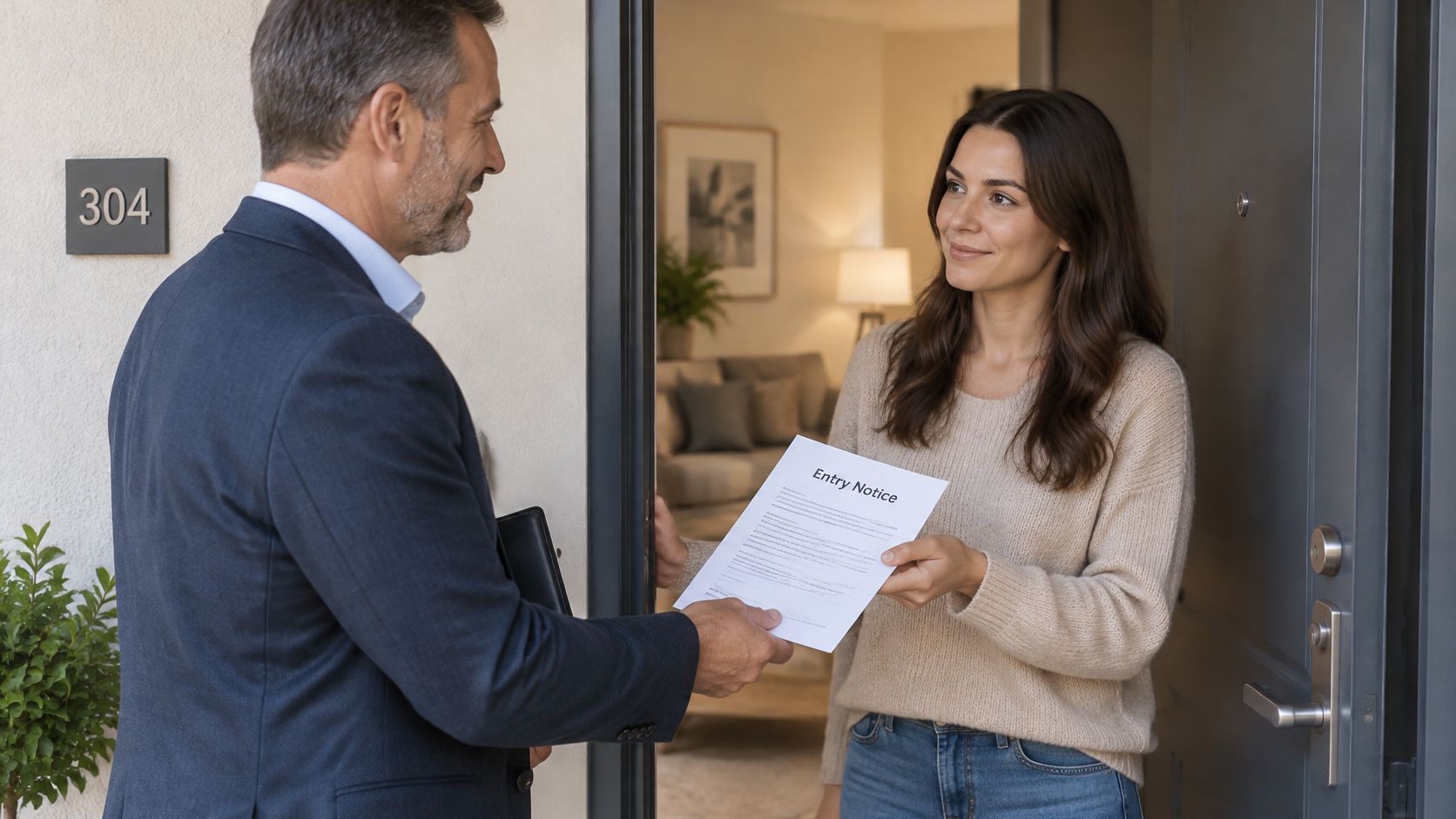
Tenants buy quiet enjoyment along with the square footage. That right means you give advance written notice before entering, except in a genuine emergency. Notice periods commonly run from 24 hours to 2 days, entry must happen at reasonable times, and the purpose must be legitimate: repairs, inspections, showings, or a required safety check.
Landlords damage otherwise good relationships by letting themselves in to "check the place" while the tenant is at work or walking a buyer through without warning, which can be a breach of the lease and, in some states, a trespass.
What counts as an emergency
A gas leak. A burst pipe flooding the unit below. No heat in a January cold snap. Smoke or burning smell. A door that won't lock after a break-in. Those justify same-hour entry. A dripping tap does not, no matter how annoyed the tenant is.
Say so in writing before it happens. Put a short emergency definition and your after-hours number in the move-in packet. A tenant who knows what qualifies won't call you at 11pm about a slow drain, and you won't have to defend an unannounced entry.
What works
Send notices in writing with date, arrival window (two hours, not "Thursday"), and purpose. Use a standard entry notice template attached to your lease so the format is consistent. Keep a log of all entries and the reason for each, which takes thirty seconds and settles arguments months later.
For showings during a tenancy, batch them into one block per week and give notice for the whole block. Tenants tolerate a scheduled window far better than three separate knocks.
Never enter to inspect informally. If you own several units and want to stay ahead of small problems, schedule real inspections with proper notice. The rules on how often a landlord can inspect a property vary by lease and state, and a documented inspection is worth more than ten surprise visits.
State variance check
Some states specify a notice period in statute. Others, like Texas, have no state entry statute at all, which means your lease controls and you should write the clause yourself. Confirm your state's rule, your city's rule if one exists, and what your lease says. If the lease is silent and the state is silent, 24 hours' written notice is the customary standard.
5. Duty to Comply with FCRA When Screening Tenants
Screening is where a routine business decision becomes a federal compliance event. When you use a consumer report (credit, criminal, or eviction history) to evaluate an applicant, the Fair Credit Reporting Act applies to you, a one-unit landlord with no compliance department.
Three obligations follow. You need the applicant's written permission and a clear disclosure before you pull anything. You need to follow the adverse action process if you deny the application or charge different terms because of what the report said. And the notice must do specific work.
What the adverse action notice must contain
The notice has to identify the consumer reporting agency by name, state plainly that the agency didn't make the decision, and tell the applicant they can get a free copy of the report and dispute errors in it. A class action can follow from a missing paragraph. Landlords have faced class-action settlements for failing to provide adverse action notices after denying applicants based on background reports.
The most common failure isn't malice. It's a landlord who decides "not this one," stops replying, and never sends anything.
Put it in writing, every time. Even an informal denial counts. If a report influenced the decision, the applicant is entitled to know why and where the information came from.
Local limits on criminal history
Several cities prohibit landlords from denying applicants based solely on arrest records, and some require an individualized assessment when there's a conviction. Blanket bans on anyone with a record invite complaints. Read your local ordinance before you set a screening policy, not after a rejection letter goes out.
What works
Collect written consent in the application before running any report. Use a screening process that generates the adverse action notice automatically, because a manual step is the step you skip at 9pm. Define written criteria (income ratio, prior eviction lookback, credit threshold) and apply them identically to every applicant, which is also your fair housing defense from the previous item.
For a walkthrough of the consent and disclosure sequence, see how screening meets FCRA requirements from application through adverse action.
State variance check
Confirm your state's lookback limits on eviction and criminal records, whether your city requires individualized assessment, and any local ban-the-box rule for rental housing. These rules have moved fast, and a policy written three years ago may now be noncompliant.
6. Duty to Disclose Lead-Based Paint Hazards
Before leasing a home built before 1978, check whether federal lead disclosure rules apply. The Residential Lead-Based Paint Hazard Reduction Act of 1992, commonly called Title X, generally requires landlords to disclose known lead-based paint and hazards, provide available records and reports, give tenants the EPA/HUD pamphlet Protect Your Family from Lead in Your Home, and include a Lead Warning Statement in or attached to the lease. Tenants must also receive a 10-day window to conduct a lead inspection or risk assessment unless they waive it in writing.
The rules cover most pre-1978 private housing, public housing, federally owned housing, and federally assisted housing. Exceptions include many zero-bedroom units and housing designated for elderly or disabled occupants. Keep the signed disclosure record for three years after the lease begins.
HUD's American Healthy Homes Survey II estimated that 34.6 million U.S. homes, 29.4% of all housing units, contain lead-based paint applied before residential use was banned in 1978.
Why it bites before move-in
Complete the disclosures before the lease is signed or the tenancy starts, whichever comes first. A property can look well maintained and still contain lead-based paint. Federal enforcement actions have resulted in penalties against landlords who failed to provide required disclosures.
What works
Check each property's build date before listing it and record what you find. Add the disclosure and EPA pamphlet to your standard lease packet, then collect the required signatures before the deadline. Retain signed copies for at least three years after the lease begins.
During the tenancy, address peeling or chipping paint promptly. Use certified contractors for work that disturbs painted surfaces. Sanding a pre-1978 windowsill can spread dust through the unit.
State variance check
Federal law sets the baseline, but state rules may add disclosure forms or require notice at renewal. Check whether your state requires an additional lead form or disclosure for units certified lead-free.
7. Duty to Use Lawful Eviction Procedures
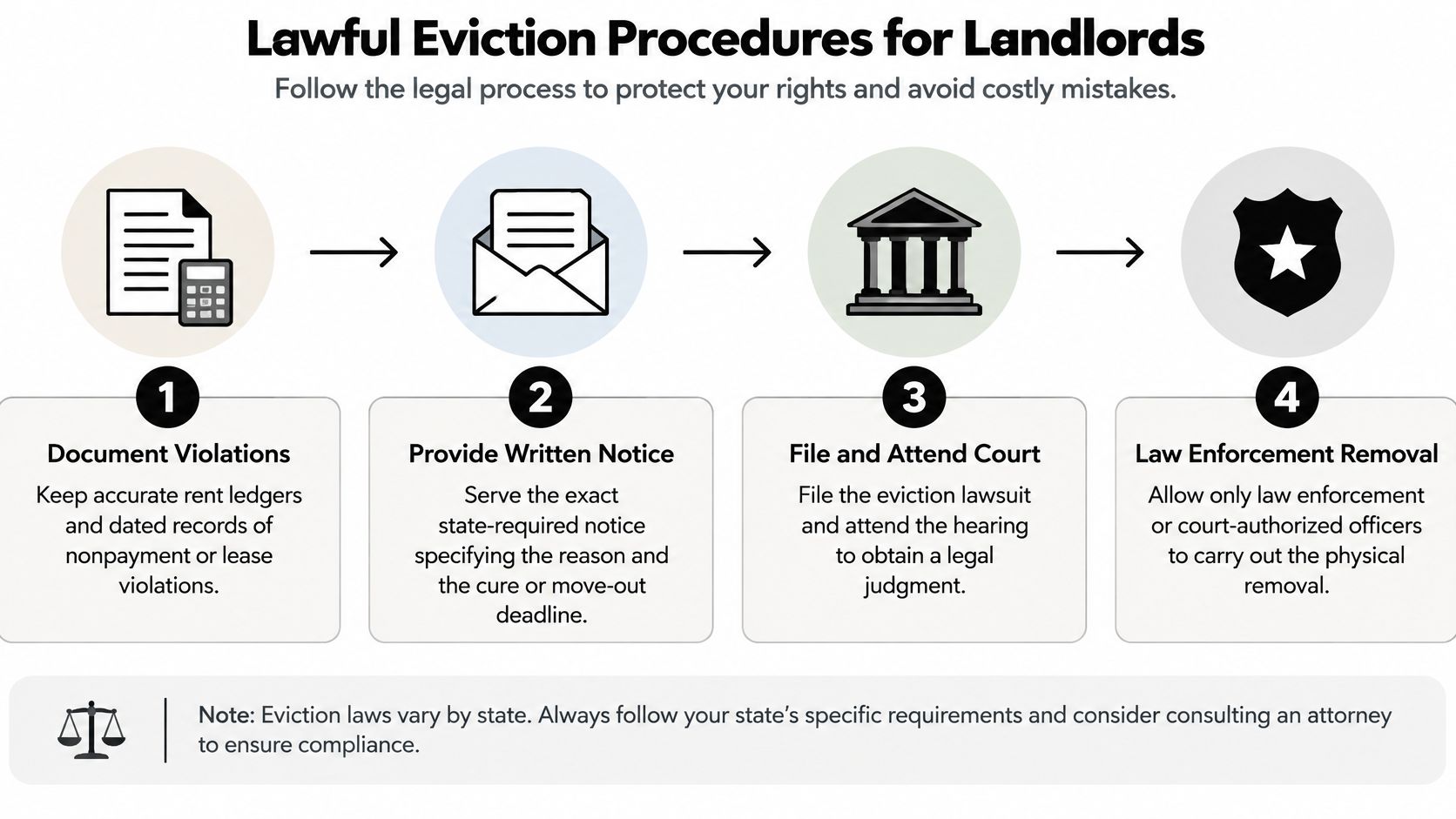
Self-help eviction is the fastest way for a landlord to go from creditor to defendant. Changing the locks, shutting off utilities, removing belongings, or threatening a tenant to force a move-out is illegal in nearly every state. The lawful path runs in one direction: a valid written notice to cure or quit, a court filing, a judgment, and enforcement by law enforcement.
The consequences of skipping steps are severe. Landlords in several states have been ordered to pay tenants damages for changing locks without a court order, and some states add statutory penalties and criminal exposure on top of attorney fees.
The sequence that actually works
A landlord who follows the 14-day notice and court filing process in many jurisdictions typically recovers possession through a judgment and sheriff's enforcement. It's slow. It's also the only version that ends with the tenant out and you not paying damages.
- Document the breach. Rent ledger, dated communications, photos, witness notes.
- Serve the exact notice your state requires. The wrong form, or the wrong number of days, resets the whole process.
- File with the court and attend the hearing. Bring the ledger and the lease.
- Use law enforcement for possession. Not your own set of keys.
What works
Keep an accurate rent ledger from day one, because it's the key evidence in any nonpayment case and it's the document a judge reads first. Use the exact notice form required by your state, downloaded fresh from a current source, not a template from 2018. Talk to a local landlord-tenant attorney before filing, which costs far less than a defective notice and a refiled case.
Partial payments are where cases fall apart. If you accept part of the rent, be clear in writing about what you're accepting and that you reserve your rights, or you may complicate the filing in some jurisdictions.
State variance check
Confirm your state's notice period (3, 5, 7, 14, or 30 days depending on the reason and the state), whether your city has additional tenant protections or a just-cause ordinance, and whether your court requires mediation before a hearing. Some jurisdictions also require rental assistance applications first.
8. Duty to Follow Lawful Rent Collection and Late Fee Rules
A tenant pays a few days late, and you add a fee. Whether that fee is lawful depends on your state and sometimes your city. Many states cap late fees as a percentage of rent or a flat amount, and some require a grace period before a fee applies. Charging more than allowed can require you to refund the fee and may bring additional penalties.
Keep clear payment records. They show what the tenant paid, when you received it, and how you applied it. Landlords must provide written receipts when requested. Accurate records also support tax reporting on IRS Schedule E and help resolve payment disputes.
The partial payment trap
Accepting part of the rent without documenting what remains due can complicate a later eviction filing in some jurisdictions. Record the amount received, how you applied it, and the balance still owed.
Write your payment-application order into the lease, then follow it consistently. For example, state whether payments go toward fees, older rent, or current rent first. A consistent ledger makes the account easier to understand if a dispute arises.
What works
Set the grace period and late fee in the lease, within your state's limits. Send payment reminders before rent is due. Give tenants a written receipt for cash or check payments, and keep a running ledger for each unit that records rent, fees, and deposits.
Reconcile monthly, not annually. A brief check at the start of each month can catch a misapplied payment while the details are still fresh.
State variance check
Check your state's late-fee cap, required grace period, and rules for disclosing fees in the lease. Also confirm whether local rent-control rules affect rent changes or required notices. For current limits, consult your state's official housing agency. If your state requires interest on security deposits, check its rules for calculating and paying that interest.
Eight Landlord Responsibilities at a Glance
| Item | Key Requirement | Typical Notice or Deadline | Main Risk if Missed |
|---|---|---|---|
| Duty to Maintain a Habitable Premises | Keep essential systems and the unit safe and habitable | Repair promptly after tenant notice; timelines vary by local law | Tenant rent withholding, repair-and-deduct claims, or lawsuits |
| Duty to Comply with Fair Housing Laws | Apply consistent standards and avoid discrimination; provide reasonable disability accommodations | No single deadline; comply throughout advertising, screening, and tenancy | Fines, damages, attorney fees, or lawsuits |
| Duty to Handle Security Deposits Properly | Follow rules for deposit limits, holding, deductions, and documentation | Return deposit or itemized deductions, commonly within 14–30 days after move-out | Forfeiture of deductions and statutory penalties |
| Duty to Provide Proper Notice Before Entering a Unit | Give advance notice and enter at reasonable times for legitimate purposes, except emergencies | Commonly 24–48 hours, depending on jurisdiction | Tenant claims for harassment, trespass, or breach of quiet enjoyment |
| Duty to Comply with FCRA When Screening Tenants | Obtain written permission and provide required adverse-action notices when using consumer reports | Get consent before obtaining a report; notify after a report-based adverse decision | FCRA claims, damages, or penalties |
| Duty to Disclose Lead-Based Paint Hazards | For pre-1978 housing, provide required disclosures, warning statement, and EPA pamphlet | Allow a 10-day inspection period unless waived; retain records for at least 3 years | Significant penalties and lead-related liability |
| Duty to Use Lawful Eviction Procedures | Give valid written notice and obtain a court judgment before removal | Notice period varies by state; court process required before removal | Damages, attorney fees, or criminal penalties for self-help eviction |
| Duty to Follow Lawful Rent Collection and Late Fee Rules | Follow lease and local rules for rent, fees, grace periods, and records | Grace periods and rent-increase notice periods vary; increases often require 30–60 days' notice | Disputes, unenforceable fees, or complications in eviction proceedings |
Turning Eight Duties Into a Routine You Can Repeat
Eight duties sound like eight jobs. They're really one job done consistently: knowing what the rules require in your jurisdiction, then leaving a record every time you act. Landlords who get sued rarely lose because they were careless about the property. They lose because they can't prove what they did or when.
Build a state-specific checklist for each duty on this list. One page, one column per duty, with the deadline that applies where the property sits. Then attach the documents to the event: the disclosure packet to move-in, the entry notice to every visit, the timestamped request to every repair, the itemized statement to every move-out, the adverse action notice to every denial.
Documentation does two things at once. It keeps you compliant in the moment, and it becomes your defense months later when memories have blurred and a tenant's account has hardened. A landlord with a consistent record is in a completely different position than one reconstructing events from text threads.
Review local rules at least once a year. Deadlines and caps change, new protected classes get added, and city ordinances move faster than state statutes. Put it on the calendar for January, alongside your insurance renewal, and spend an hour confirming the numbers you rely on. If you own property in more than one jurisdiction, do it once per location because the checklists won't match.
The record-keeping habit is where a platform earns its keep. VerticalRent generates the FCRA adverse action notice automatically when an application is denied based on eviction history, including the consumer reporting agency's contact information, which removes the manual step that's easiest to skip at the end of a long day. It's one less place to fall out of compliance.
Start with the duty that bites soonest. If you have a vacancy, that's the lead disclosure and the screening consent. If you have a tenant in place, it's the maintenance log and the entry notice. Then work down the list.
Most of the eight duties come down to proving what you knew and when you acted, which is where VerticalRent closes the gap for independent landlords: state- and county-specific lease agreements generate in seconds, tenant screening includes full credit, criminal, eviction, and rental history with FCRA-compliant adverse action notices, and every payment logs automatically to an income and expense ledger that outputs IRS Schedule E reports. Maintenance requests arrive with urgency classification and dispatch to verified local vendors, so the repair record builds itself instead of living in your texts. Visit VerticalRent to set up your first door free and put the paperwork on autopilot.
Put this into practice
VerticalRent tools related to this guide
Legal Disclaimer
VerticalRent and its authors are not attorneys, CPAs, or licensed legal or financial advisors, and nothing on this site constitutes legal, tax, or professional advice. The information in this article is provided for general educational purposes only. Landlord-tenant laws, eviction procedures, security deposit rules, and tax regulations vary significantly by state, county, and municipality — and change frequently. Nothing on this site creates an attorney-client relationship. Always consult a licensed attorney or qualified professional in your jurisdiction before taking any action based on information you read here.
Co-founded VerticalRent in 2011, growing it from nothing to 100k landlords and renters. Sold it in 2019, then re-acquired it in 2026 to make it better than ever.


