How Often Can a Landlord Inspect a Property? a 2026 Guide
How often can a landlord inspect a property? Learn the notice rules, entry hours, state differences and a safe inspection schedule for 2026.


Most places set no fixed number of routine inspections, but each visit must meet local rules on purpose, notice and reasonable timing. Twenty-four hours' written notice is a common benchmark, while quarterly inspections are a practical reference point in England, not a national quota.
The familiar advice to inspect as often as possible misses an important risk: entering too frequently can create problems rather than prevent them. A landlord needs more than a recurring calendar reminder. A purpose-and-notice log shows why entry was necessary, how it was arranged and what happened afterward.
The Short Answer Is No Fixed Limit, but Clear Rules Apply
When landlords ask how often can a landlord inspect a property, they're usually looking for a number they can put in the lease. The more useful starting point is whether the law permits that particular visit.
A routine inspection isn't an unrestricted right to enter someone's home. The relevant rules can address the reason for entry, how notice reaches the tenant, permitted hours and whether the overall pattern interferes with the tenancy.
Frequency isn't the whole legal question. Purpose, notice and timing matter for every visit.
Why apparently simple answers conflict
A national overview may describe the general position without accounting for a city ordinance or a particular tenancy. A lease may also promise more notice or a narrower inspection arrangement than the landlord expected.
That's why advice from a landlord in another location can be misleading. Asking for a universal inspection interval is like asking for the speed limit on a road you haven't identified.
Separate these questions before choosing a schedule:
- Legal permission: Does the applicable law allow entry for this purpose?
- Notice requirements: What information and delivery method are required?
- Practical necessity: What condition or obligation makes the visit useful?
- Cumulative disruption: How much access has the tenant already accommodated?
A lease clause doesn't automatically resolve those questions. Don't assume a tenant's signature waives a statutory protection or authorizes unlimited access.
An emergency is also different from ordinary property management. Active flooding may require an urgent response, while a routine check of bathroom sealant should be scheduled through the normal access process.
Identify the property's jurisdiction first. Then establish the applicable notice and entry rules before booking a visit or copying an inspection clause into your lease.
How Often Inspections Are Reasonable for Different Properties
For a standard single-family rental without special maintenance concerns, an annual or six-monthly condition review can be an operational starting point where lawful. That's a planning choice, not a legal entitlement to enter on that schedule.
Choose the baseline according to the building's condition and the work that needs monitoring. A sound property with promptly reported repairs doesn't call for the same oversight as a home with recurring water intrusion.
This visual illustrates how property condition and maintenance history should influence that decision.
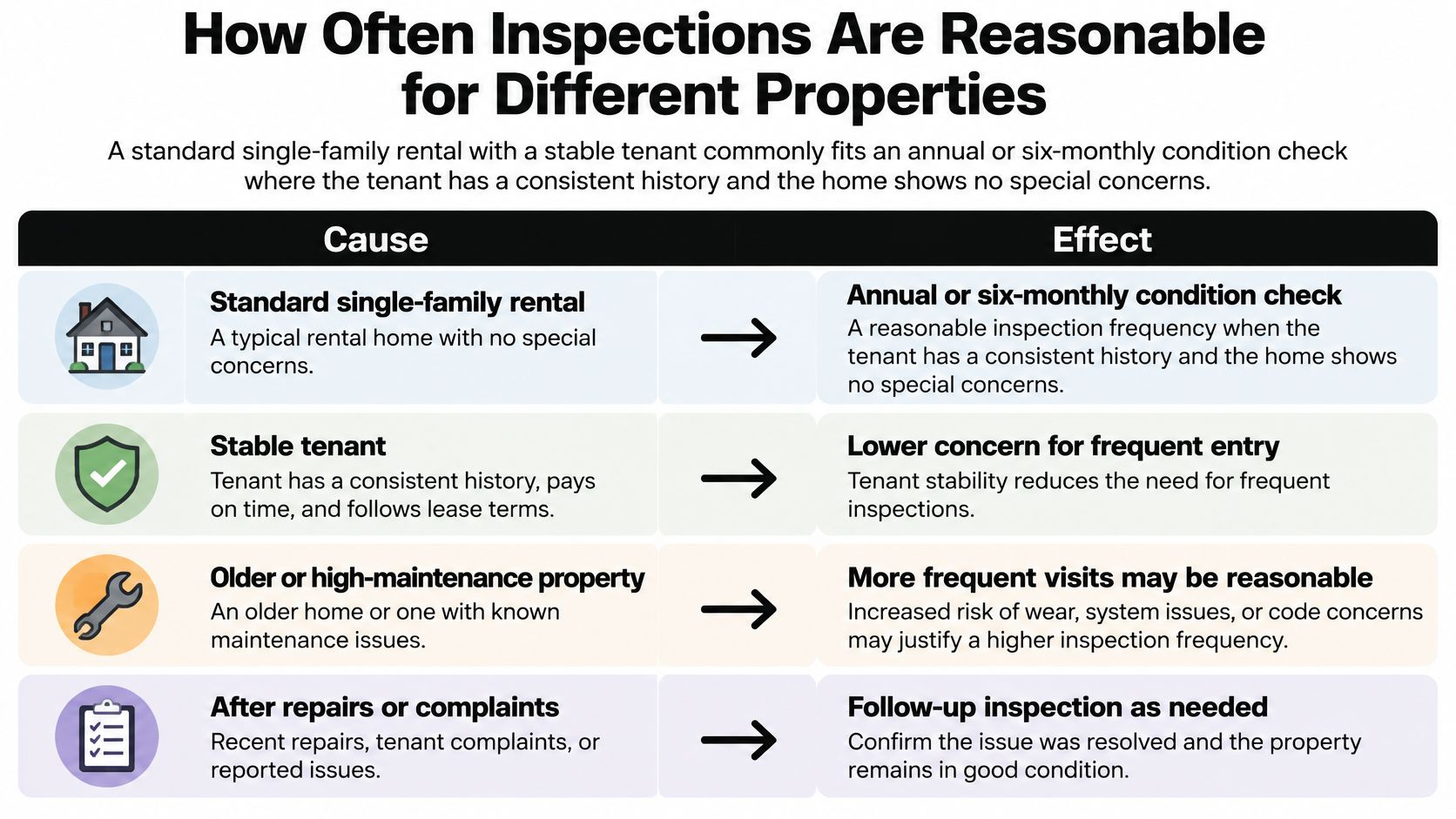
Suggested inspection frequency by property situation
Treat these intervals as planning options subject to local law, rather than automatic permission to enter. The English council recommendations are explained with their legal and safety context below.
| Property situation | Suggested routine interval | Reason and reference |
|---|---|---|
| Standard single-family rental, stable tenant | Annual or six-monthly where permitted | Baseline condition check for the whole tenancy |
| Most US states and cities | No universal quota; establish the applicable local rule | Purpose and notice matter alongside frequency |
| England, benchmark ceiling | Quarterly as a practical reference, not a statutory ceiling | Torbay Council's privacy-focused guidance |
| Family house, England | Regular planned visits using council guidance | Newham Council distinguishes family houses from shared housing |
| House in multiple occupation | More frequent monitoring than a family house where justified and lawful | Unrelated residents share facilities |
| Known leak or unresolved repair | A targeted follow-up after the repair deadline | Document the outstanding condition and give fresh notice |
| Serious or repeated past violations | A shorter monitoring interval while the risk remains open | Focus on the unresolved health or safety issue |
| Emergency such as flooding or gas smell | Immediate emergency response where legally justified | Don't delay urgent protective action for a routine calendar slot |
Let the condition justify the additional visit
Say a tenant reports staining beneath a bathroom. You arrange a plumber, record the repair and schedule a focused check to confirm the area is drying. That follow-up has an identifiable purpose and an endpoint.
Contrast that with adding indefinite inspections because the building is old. Age alone doesn't explain what you need to inspect. Record the vulnerable component, the concern and the condition that will allow you to return to the baseline schedule.
Shared housing can require closer attention to common facilities, but it still calls for a reasoned access policy. Don't use household composition or assumptions about residents as substitutes for evidence about property condition.
Move-out work belongs in a separate workflow. Aquastar Cleaning Services, LLC's rental turnover cleaning checklist can help distinguish cleaning tasks between tenancies from maintenance checks during occupation.
For a visual companion to inspection planning, use this video alongside your local access requirements.
Set a consistent baseline, then add visits only when a documented property issue or separate obligation warrants them. Close the extra monitoring when its purpose has been satisfied.
Notice Rules and Valid Reasons for Each Entry
A landlord emails a tenant at 9 p.m.: "I'll be round at 7 tomorrow morning to check the property." Under the rule below, that visit fails twice before it starts. The warning arrives less than a day ahead, and the appointment falls outside the hours the law allows.
Notice works like a checklist with several boxes, not a single one. The lead time, the form the notice takes, the permitted entry window and the reason for the visit can each be regulated, and each has to be satisfied independently. A compliant gap between notice and arrival doesn't rescue an entry scheduled outside lawful hours.
The Minnesota Attorney General's landlord and tenant handbook sets the pattern clearly: entry requires a reasonable business purpose, at least 24 hours' advance notice, and arrival between 8:00 a.m. and 8:00 p.m. unless the parties agree otherwise. The lease cannot waive the tenant's right to that notice.
For England, Torbay Council's routine inspection guidance explains that Section 11(6) of the Landlord and Tenant Act 1985 permits access to view condition and repair with at least 24 hours' written notice, at a reasonable time of day. The same guidance treats an inspection every three months as acceptable practice rather than a statutory schedule, an important distinction: it describes a workable habit, not a legal ceiling.
Notice and entry rules by jurisdiction
| Jurisdiction | Notice required | Entry timing rule | Notes |
|---|---|---|---|
| England (UK) | At least 24 hours' written notice | Reasonable time of day | Confirm the legal basis for the specific visit; emergencies are distinct |
| Minnesota | At least 24 hours' advance notice | 8:00 a.m. to 8:00 p.m. unless otherwise agreed | Reasonable business purpose required; lease can't waive notice protection |
| Other U.S. states and cities | Check state law, local ordinances and lawful lease terms | Apply the governing local rule | Confirm requirements before the first visit |
The two sourced rows share a 24-hour lead time yet differ on form, permitted hours and the purpose test. One inspection policy can't cover a multi-state portfolio, so confirm the governing rule in the jurisdiction where each property sits.
Public inspections follow a different logic. The Los Angeles County rental-housing habitability inspection guide describes routine agency inspections once every four years on at least 30 days' notice, with more frequent visits where higher risks or compliance concerns justify them. That government cycle doesn't create any private right of entry for the landlord.
State the purpose before sending notice
A notice that reads "inspection" describes nothing. One that reads "check the bathroom ceiling stain reported on 3 May and measure moisture levels" tells the tenant what will happen, who is coming and roughly how long it takes. Specificity is also what lets you show later that each entry had a reason.
Potential access purposes include:
- Condition review: Inspect relevant building surfaces, fixtures and maintenance concerns.
- Repair or contractor attendance: Identify the reported fault and who needs access.
- Showing or valuation: Confirm that local law and the tenancy permit the proposed visit.
- Suspected lease violation: Record the factual concern and verify the lawful access basis.
- Emergency response: Address an immediate threat rather than using urgency as a scheduling convenience.
A pest complaint illustrates why scope matters. Pestless Inc.'s pest guidance for Miami property managers is useful context for planning a pest-related response, but responsibility for treatment and permission to enter remain separate questions.
Write the purpose, notice date, entry window and attendees into the file, then record what the visit found and when the matter closed. A dated log changes the question from "how many times" to "why each time," which is the question that protects you. The explanation of landlord entry rights and tenant notice can help you identify the access questions to resolve before attendance.
Proper notice isn't a warrant to force your way in. If access is disputed and there's no emergency, get local advice on the lawful next step before attending.
Where Routine Inspections Turn Into Harassment
A landlord schedules weekly visits to check on a tenant. Nothing needs repairing, no safety obligation is due and the landlord records no condition requiring follow-up. The notices may look procedurally correct, but the pattern still raises a serious question.
LegalClarity's discussion of apartment inspection frequency explains why repeated entry can become problematic even when individual notices appear compliant: purpose, timing and cumulative interference with the tenant's home all matter.
More inspections aren't automatically better risk management. Unnecessary attendance can create privacy disputes, damage communication and distract from the repairs that need attention.
Warning signs in the visit history
Look beyond whether a notice was sent. Ask what each appointment achieved.
- Repeated checks without findings: The landlord keeps attending but can't identify a maintenance or compliance objective.
- Photography of possessions: Pictures document the tenant's belongings rather than a relevant property defect.
- Complaint-linked escalation: Inspection demands increase after the tenant raises a repair concern, without a separate explanation.
- Unnecessary duplicate attendance: A landlord adds walkthroughs around contractor visits or showings without identifying additional work.
A pre-renewal condition review may be defensible where lawful. So may attendance to inspect a reported defect or confirm that a hazard has been corrected. The distinction is the specific reason and proportionate scope, not the label on the notice.
Practical rule: If you can't explain what the visit will establish, reconsider whether entry is necessary.
Keep a frequency-and-purpose log
Record the category of access, the concern, the notice, who attended, the findings and the next action. Include contractor attendance and other access events so you can see the disruption from the tenant's perspective.
For photographs, record why the image is necessary and focus tightly on the relevant condition. A close-up of a leaking connection is more useful than a room-wide picture full of personal possessions.
The explanation of quiet enjoyment of property helps distinguish legitimate management from interference with the tenant's use of their home.
Before adding another appointment, review the recent visit history. If the log shows repeated attendance but no unresolved condition, improve the management process rather than increasing entry.
What Happens When Entry Breaks the Rules
A tenant who disputes an inspection should start by identifying the specific problem in writing. That might be missing notice, attendance outside the stated window, an unexplained purpose or a repeated pattern of visits.
A useful complaint describes what happened and what the tenant wants changed. Keeping notices, messages and a factual entry history gives both parties something concrete to review.
A practical response to disputed entry
If you're the landlord, don't treat the objection as automatic proof of noncooperation. Separate a scheduling disagreement from a legal challenge to access.
- Pause nonurgent disputed attendance: Don't repeat an unannounced visit while the access question remains unresolved.
- Preserve the record: Keep the original notice, delivery evidence, messages and attendance notes.
- Identify the objection: Record whether the tenant disputes the reason, timing, delivery or frequency.
- Explain the necessary work: Describe the condition that needs attention and propose a compliant arrangement.
- Get local advice: Ask a housing authority or qualified local attorney about the correct process if agreement isn't possible.
A tenant may also contact a local housing office, tenant advice service or other appropriate enforcement body. The right destination depends on whether the concern involves access, harassment, unsafe conditions or another tenancy issue.
Don't assume a universal remedy
Whether unlawful entry supports compensation, an order restricting access or another legal response depends on the governing law and facts. Don't promise a particular outcome or assume a notice mistake has no consequence.
If the dispute follows a repair complaint, preserve the repair timeline as well as the inspection timeline. A documented contractor recommendation explains the need for access more clearly than a vague assertion that the landlord wanted another look.
A defensible file explains both why access was needed and how the landlord responded when the tenant objected.
For example, record the reported leak, the contractor's proposed visit, the tenant's requested alternative and the appointment ultimately agreed. Avoid argumentative notes about the tenant's attitude.
The goal isn't to build a larger pile of notices. It's to show a proportionate effort to maintain the home while respecting the lawful access process.
Mandatory Safety Checks That Run on Their Own Schedule
Safety checks and routine condition inspections are separate tasks. A general walkthrough doesn't replace a required test by an appropriately qualified professional.
For England, Newham Council's guidance on maintaining rented property describes electrical installation checks at least every five years and gas-safety inspections every 12 months where gas appliances are present, alongside a separate recommendation of approximately three routine inspections per year for a family house, with more frequent monitoring for houses in multiple occupation.
Separate the deadlines and evidence
Keep compliance work in its own calendar so you can distinguish a statutory inspection from a discretionary condition review. For each applicable obligation, record the due date, responsible contractor, access arrangements, report and any remedial work.
Common categories to track include:
- Electrical testing: Retain the inspection report and evidence that required remedial work was addressed.
- Gas safety: Identify the relevant appliances and keep the applicable safety record.
- Smoke and carbon monoxide alarms: Establish local installation, testing and replacement duties.
- Follow-up work: Give an unresolved defect its own action record rather than marking the original appointment complete and forgetting it.
DLG Electrical's discussion of landlord duties for electrical compliance provides useful Australian context. Apply it within the relevant Australian jurisdiction, not as a replacement for English or US requirements.
Coordinate access without blurring its purpose
Where lawful and practical, discuss whether the tenant would prefer related work during an already planned appointment. Name each proposed task in the access arrangements rather than expanding the visit unexpectedly.
Alarm duties also need attention outside a general walkthrough. The guide to a carbon monoxide alarm in rented property can help you identify questions about placement, responsibility and maintenance.
A completed appointment isn't necessarily completed compliance. Read the report, assign remedial work and retain the completion evidence.
Build a separate safety calendar and connect every access event to the obligation it serves. That makes the file intelligible without pretending all visits are routine inspections.
Set Your Inspection Schedule and Confirm Local Rules First
A workable inspection policy should let you answer three questions quickly: what needs checking, why access is necessary and how you'll arrange it lawfully. A spreadsheet, calendar and clearly named document folder can support that process.
Begin with the local rule and tenancy terms before deciding how often to attend.
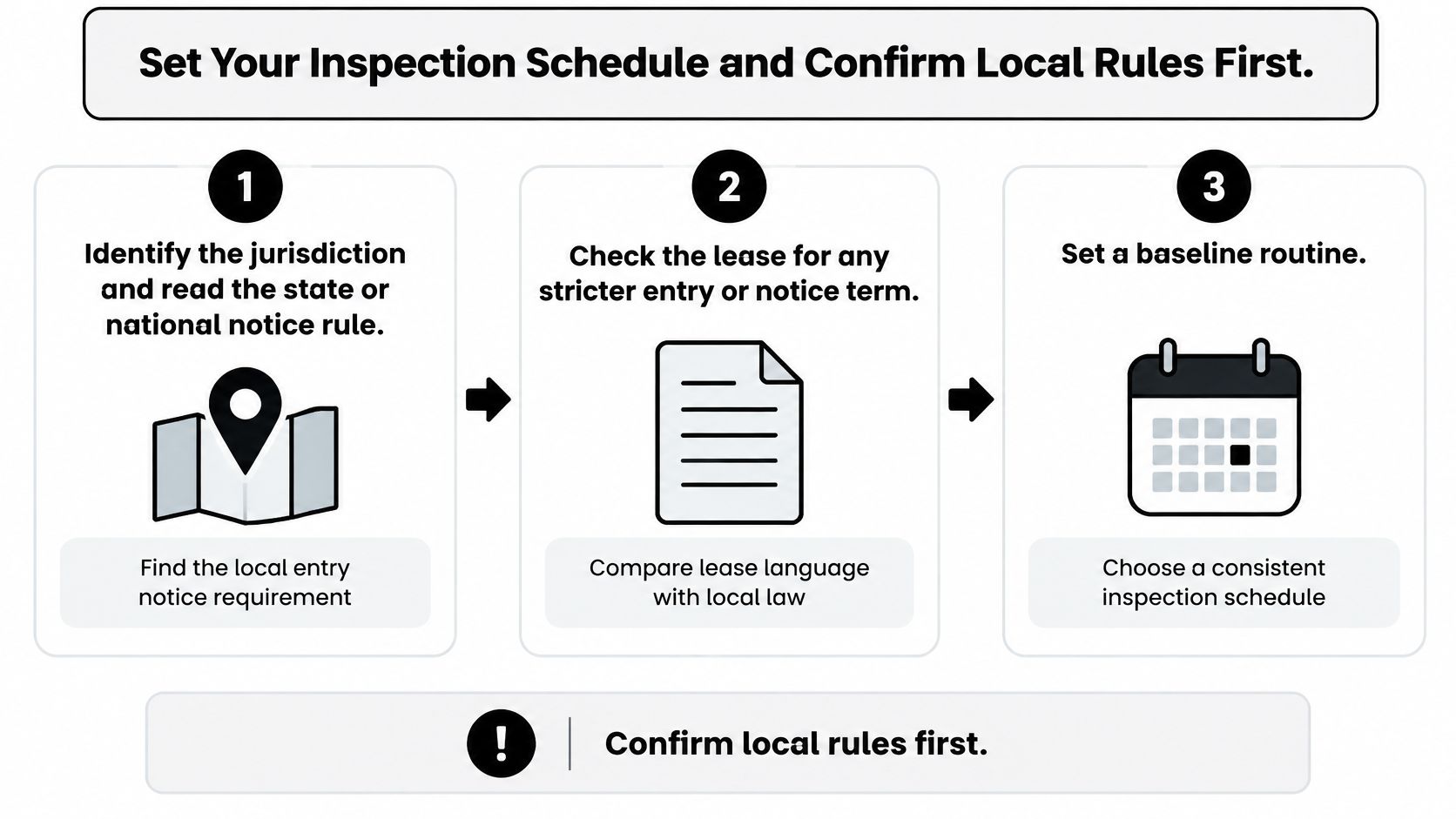
Turn the policy into a working record
Identify the jurisdiction and read the governing access rule. Confirm the permitted purpose, notice method and timing requirements for the property, including any local overlay.
Check the lease for stricter entry or notice terms. Compare the actual wording with the law rather than assuming the lease overrides statutory protections.
Choose a baseline routine. Use the building's condition, maintenance history and lawful access options to select a proportionate schedule, and record why you chose it.
List safety obligations separately. Put each applicable check on its own calendar with the supporting report location, so a general walkthrough isn't mistaken for compliance.
Create an entry record before booking. Write the purpose, proposed window and attendees while the appointment is still being planned.
Send the required notice through the correct channel. State the information local law requires, explain the work clearly and retain evidence of delivery.
Document relevant findings and corrective actions. Use factual notes and focused photographs, then identify who will arrange each repair and the expected completion point.
Close or follow up each open issue. Review contractor evidence before arranging another visit, and use further access only where it's necessary and lawful.
Make the log useful to both parties
Use consistent categories such as condition review, repair, compliance, showing and emergency. Keep an additional field for the specific purpose, because a category alone won't explain why someone needed to enter.
Record tenant-requested changes neutrally. A request to move an appointment isn't the same as refusing necessary access, and clear notes prevent that distinction from disappearing later.
Share a concise findings summary when appropriate, especially where repairs affect the tenant. If nothing requires action, record that outcome and close the visit.
Confirm the local rule and the lease before booking your next inspection. Keep the purpose log with the notice and resulting action record, so the file explains the whole decision rather than merely proving that an appointment appeared on a calendar.
Our rental management tools help independent landlords coordinate maintenance requests and vendor work, with automatic job-status updates as work progresses. Visit VerticalRent to explore tools for managing the repairs and follow-up tasks your inspection process identifies.
Put this into practice
VerticalRent tools related to this guide
Legal Disclaimer
VerticalRent and its authors are not attorneys, CPAs, or licensed legal or financial advisors, and nothing on this site constitutes legal, tax, or professional advice. The information in this article is provided for general educational purposes only. Landlord-tenant laws, eviction procedures, security deposit rules, and tax regulations vary significantly by state, county, and municipality — and change frequently. Nothing on this site creates an attorney-client relationship. Always consult a licensed attorney or qualified professional in your jurisdiction before taking any action based on information you read here.
Co-founded VerticalRent in 2011, growing it from nothing to 100k landlords and renters. Sold it in 2019, then re-acquired it in 2026 to make it better than ever.


