How Tenant Screening Meets FCRA Requirements
Learn how tenant screening meets FCRA requirements for permissible purpose, adverse action, applicant disclosures, accuracy, and recordkeeping.


A tenant report lands in your inbox, and one entry looks serious. You're an independent landlord, the applicant is waiting for an answer, and the screening service has already produced a score. What happens next matters as much as ordering the report. You need to know whether you may access it, whether the information belongs to this applicant, and what to communicate if it changes the terms of the rental decision.
When a process meets FCRA requirements, it isn't just a report that came from a screening provider. It's a documented workflow that connects a valid housing purpose to applicant disclosures, authorization, careful review, decision notices, dispute handling, and retained records. The Fair Credit Reporting Act (FCRA) established a national framework for consumer-reporting agencies and the use of consumer data, and its rules apply when tenant-screening information is used to evaluate a housing applicant. The Federal Reserve's overview of the FCRA
Why FCRA Compliance Extends Beyond Report Ordering
Suppose a landlord receives a report that appears to show an eviction case. The landlord might be tempted to deny the application immediately, especially if a screening platform marks the applicant as high risk. But the report may contain a mismatch, the case may have a different outcome than the summary suggests, or the landlord may not have completed the steps needed to obtain and use the information properly.
Ordering a report is one event in a longer chain. The process starts with a housing-related reason to request the report and applicant-facing disclosures and authorization. It continues with access controls, review of the actual information, a decision based on relevant facts, required notices when the decision is unfavorable, and a record of what happened.
A screening company can provide a report and tools for organizing the process. It doesn't make the landlord's housing decision, explain the decision to the applicant, or automatically prove that the landlord followed the right procedure. Using a vendor doesn't transfer the landlord's responsibilities. A risk score can help draw attention to information, but it can't establish that a record belongs to the applicant or explain why a particular rental outcome is appropriate.
Practical rule: Don't treat a report result as a decision. Treat it as information that you must verify, evaluate, and document before acting on it.
The FCRA's significance reaches beyond credit history. In rental screening, information such as rental history, eviction records, criminal records, and civil judgments can be consumer-report information when used to evaluate an applicant. That makes the landlord's purpose, handling of the report, and response to its contents part of the compliance picture.
Understand the Tenant Screening Compliance Lifecycle
Think of the report as a key that opens a limited door. The applicant's housing transaction is the reason for using that key, and the permission is limited to that purpose. It doesn't authorize you to search for unrelated information, reuse a report for another applicant, or keep unnecessary copies without a clear reason.
The lifecycle has seven linked stages. A weak point can create problems even if the screening service itself works as intended.
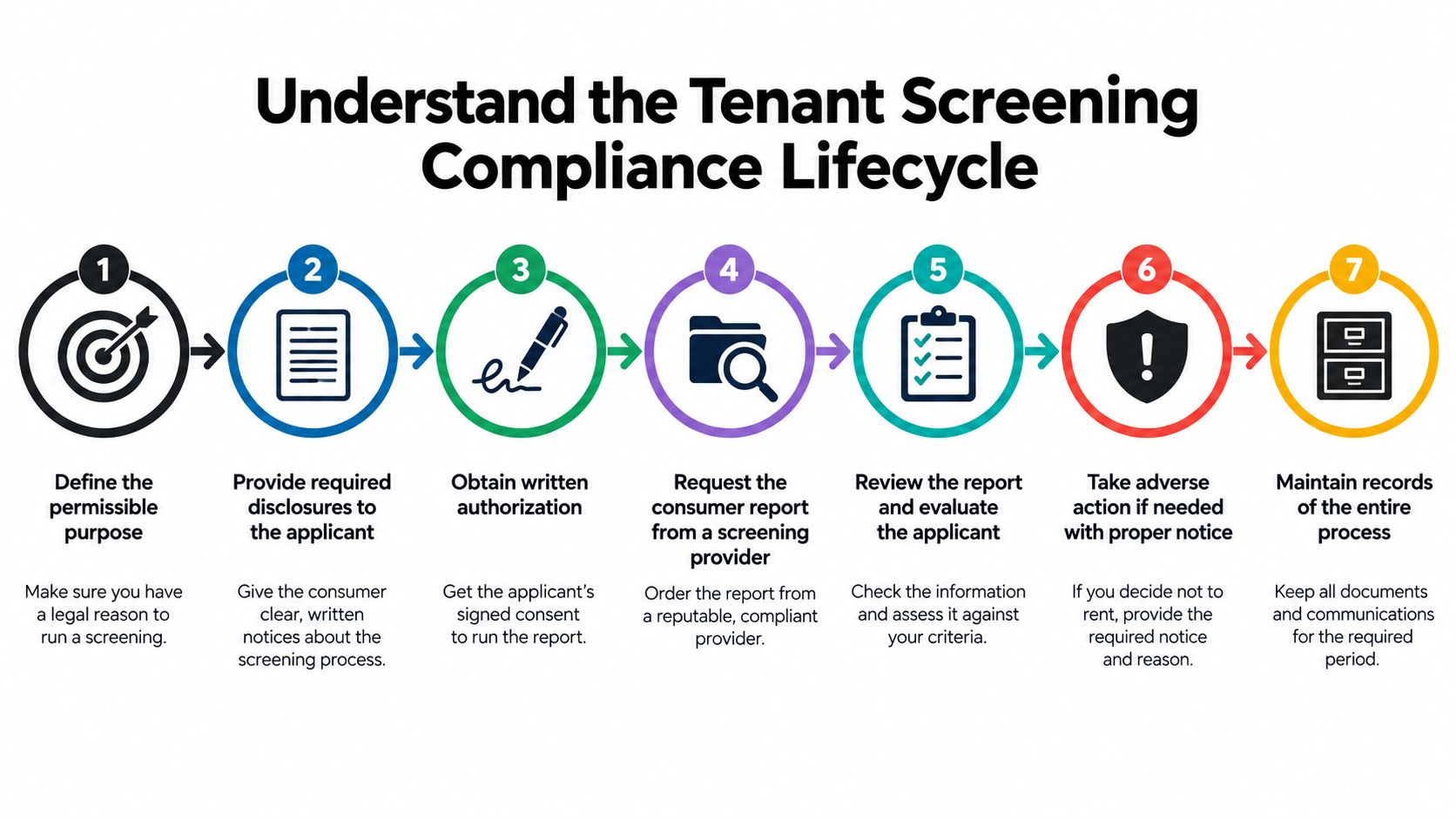
- Define the permissible purpose. Identify the housing application or lease evaluation connected to the request.
- Provide required disclosures. Give the applicant clear information about the screening process and their rights.
- Obtain authorization. Document the applicant's consent before requesting the report.
- Request the report. Use the consumer-reporting agency only for the stated housing purpose.
- Review and evaluate. Check the information, consider its relevance, and make a reasoned housing decision.
- Communicate the decision. If the report contributes to an unfavorable outcome, provide the required notice.
- Retain supporting records. Keep evidence of the purpose, authorization, review, decision, notices, and any dispute.
The reporting agency supplies consumer information. The landlord is responsible for using it only for an authorized housing purpose and for handling the resulting decision appropriately. A valid account with a screening provider isn't the same as a valid reason to access a particular person's report.
Treat each stage as a checkpoint. If you can't show why you requested a report, who authorized it, what you reviewed, or how you reached the outcome, the process may be difficult to explain later.
Establish a Documented Permissible Purpose
A landlord may request a consumer report to evaluate someone applying for housing or to review a tenant for lease renewal. That purpose must relate to the specific housing transaction. A report obtained for one applicant shouldn't be reused to evaluate another, and information collected for housing screening shouldn't be repurposed for something unrelated.
Before requesting a report, create a record that ties the request to the person and property. A practical audit trail should capture:
- The housing transaction: Identify the property and the application or lease review.
- The applicant: Record who is being evaluated and connect the report to that person.
- The requesting user: Note which landlord or authorized user initiated the request.
- The authorization event: Record the application or consent event that supports the request.
- The request timing: Store a timestamp showing when the request was made.
- The permitted-use attestation: Document that the report will be used only for housing purposes.
The landlord must certify to the consumer-reporting agency that the report will be used for a housing purpose. Federal guidance identifies tenant screening as a permissible purpose but also makes clear that reports shouldn't be furnished for unrelated consumers or purposes. The FTC's landlord guidance on consumer reports
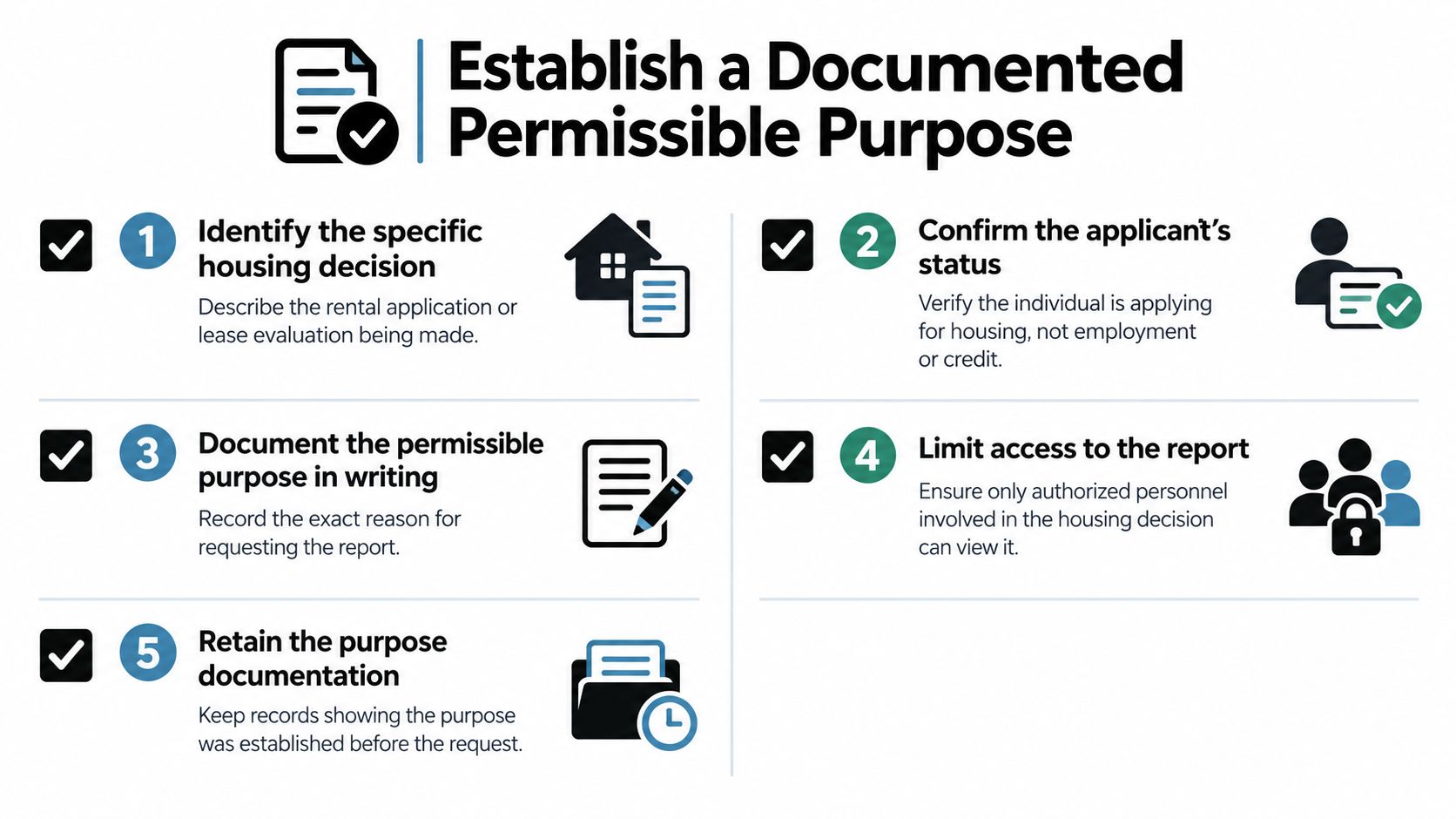
Access should be limited to people involved in the housing decision. A saved report sitting in a shared folder, or a user searching for an applicant without a connection to an active transaction, can undermine the controls you intended to establish.
A common misconception is that an active screening account gives a landlord permission to pull any report. The account gives access to a service, not an unrestricted purpose. Make the property, applicant, transaction, authorization, user, and housing-use certification visible in the same record before the request is submitted.
Provide Disclosures and Preserve Applicant Rights
Applicants should understand that screening is part of the housing process before a report is requested. Tell them that a consumer report may be used to evaluate the application, identify the screening provider where appropriate, and explain how they can ask questions or challenge information they believe is wrong. Keep disclosures understandable. A broad statement that you may run “checks” doesn't necessarily tell an applicant who supplied a report or how to respond to a mistake.
Authorization is a separate operational checkpoint. Provide the required information, obtain the applicant's authorization, and preserve evidence of the completed event. A tenant background check authorization form can help landlords organize the consent step, but the form should fit the actual screening process and applicable law.
A clear notice does more than document a step. It gives the applicant a way to identify the source of information and respond when something appears wrong.
When you're considering an unfavorable decision based on a report, don't wait until a generic rejection email to explain what happened. Federal guidance requires an adverse-action notice when a consumer report contributes to a denial or another unfavorable term. The notice must identify the reporting company and explain the applicant's right to obtain a free copy of the report within 60 days and to dispute inaccurate information. The notice should also make clear that the reporting company didn't make the housing decision.
If your process uses a preliminary communication before a final decision, make sure the applicant can distinguish it from a notice that accompanies an actual adverse action. A vague link, a score with no explanation, or a message naming no reporting company may leave the applicant unsure which report to request or where to raise a dispute.
Keep a copy of what you sent and when you sent it. Clear disclosures, authorization records, and decision-stage notices help the landlord show what the applicant was told and what opportunity they had to exercise their rights.
Evaluate Adverse Action at Each Decision Point
A landlord approves an applicant, but only if they provide a co-signer after a screening report raises concerns. The applicant can still rent the unit, yet the added condition may be adverse action if the report influenced it. Assess each decision point by what changed for the applicant, not just by whether you call the result a denial.
| Decision scenario | What the landlord should examine |
|---|---|
| Approval on the offered terms | Record the approval and the information reviewed when the report did not lead to an unfavorable term. |
| Conditional approval | Check whether a report influenced a higher deposit, co-signer requirement, or other less favorable condition. |
| Denial | If the report contributed to the rejection, provide the required adverse-action notice. |
| Applicant withdrawal | Note whether the applicant left before an unfavorable decision or after receiving a report-based condition. |
| Mixed decision | If the report and independent criteria both influenced the outcome, document each factor. Independent criteria do not necessarily remove notice duties. |
For a notice, identify the consumer-reporting company by name, address, and telephone number. Explain the applicant's right to request a free report within 60 days and to dispute inaccurate information. The notice should also make clear that the reporting company did not make the housing decision. These details help the applicant identify whom to contact and what rights they can exercise.
A conditional approval can look favorable because the applicant still has a path to rent the home. The co-signer requirement may nevertheless make the terms less favorable. If a report influenced that condition, assess whether notice is required rather than relying on the word “approved.”
Keep a decision record that connects the report to the housing outcome: note the report used, relevant information, criterion applied, and final decision. If more than one report influenced the decision, identify each reporting company so the applicant knows where to direct a request or dispute. A practical adverse-action letter guide can help organize the notice, while the actual decision and applicable law determine what the landlord must send. Use the same documented process at each decision point, from a changed rental term to a final rejection, so the record explains how the outcome was reached.
Verify Accuracy and Manage Applicant Disputes
A screening report lists a court case under an applicant's name, but the name alone does not establish that the case belongs to that person. Similar names, outdated addresses, and incomplete case details can lead to a mistaken match. Check identifying information and the underlying record before treating a summary or score as conclusive.
The FCRA requires consumer-reporting companies to use reasonable procedures to assure maximum possible accuracy. A Federal Trade Commission-reviewed study cited by the CFPB found an error on at least one of their three major credit reports for one in five consumers, or 20%. That finding is about credit reports, not every tenant-screening record. It still shows why a database result deserves review rather than automatic acceptance. The CFPB's tenant background-check snapshot
Compare the name, date of birth, address, case date, and disposition with the applicant and the underlying record. If the applicant challenges information that could affect the decision, write down the specific concern and request relevant supporting materials when appropriate. Keep the challenged item from becoming an assumed fact while you assess it.
- Identify the disputed detail. Clarify whether the applicant disputes identity, the case outcome, a date, or another field.
- Preserve the record. Save the report version and the applicant's explanation in the screening file.
- Track the response. Consumer-reporting companies generally have 30 days to investigate a dispute, though some investigations can take up to 45 days. The FTC's credit dispute guidance
- Document the outcome. Note what changed, what remains unresolved, and how you handled the decision.
A landlord does not conduct the reporting company's investigation, but the landlord still needs to assess the housing application carefully. If a material dispute remains unresolved, pause before relying on the challenged item as decisive. Record the steps taken and the basis for the final decision so the file shows how the concern was handled. Applicants can use this guide to check a tenant screening report and identify information they may need to dispute.
Determine Landlord and Platform Responsibilities
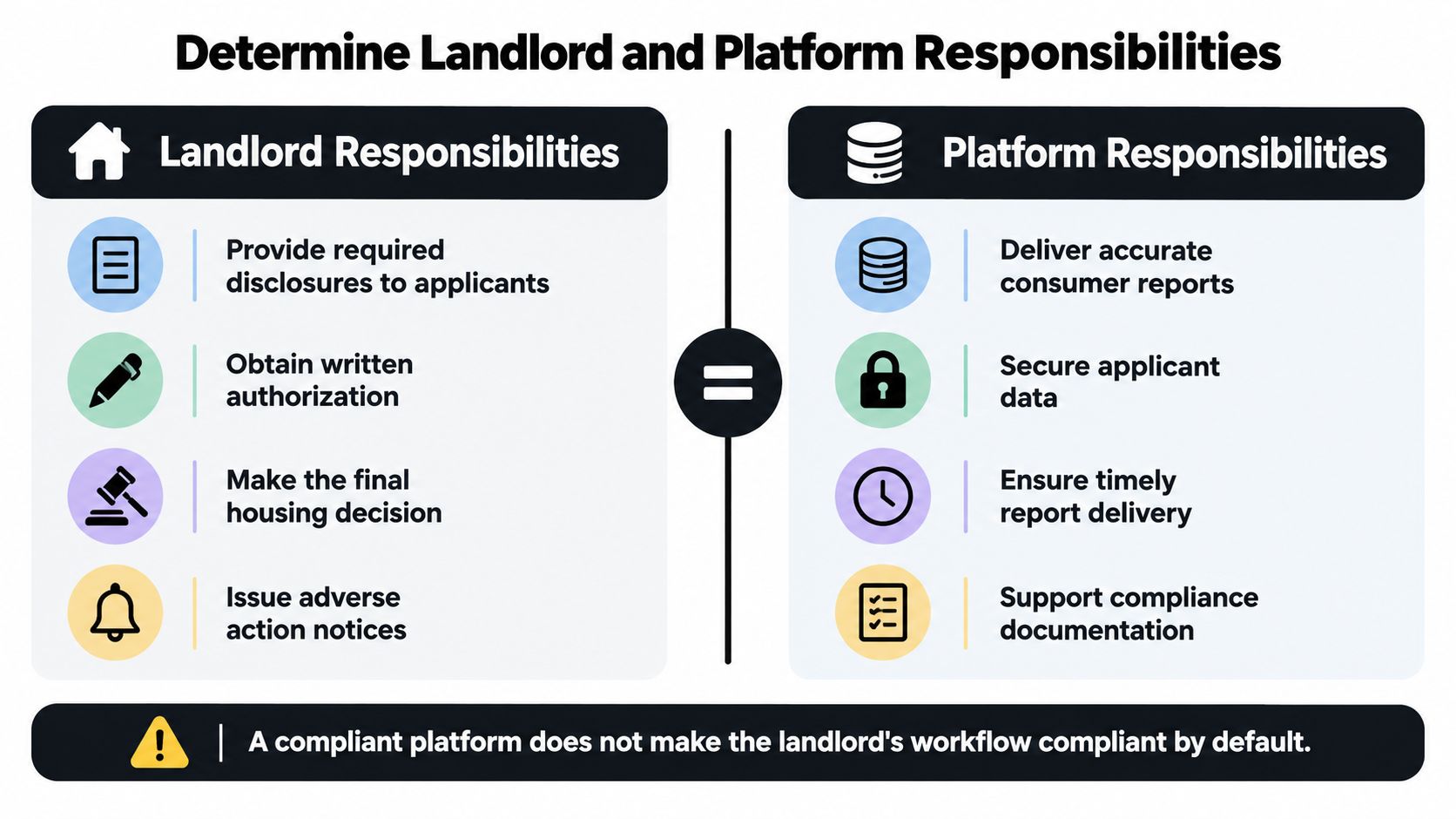
A screening platform can make a process easier to document, but it can't guarantee that every landlord action complies with the law. Separate the tool's role from yours before relying on an automated workflow.
| Platform can support | Landlord remains responsible for |
|---|---|
| Capturing consent and storing a timestamp | Providing and explaining applicant-facing disclosures |
| Delivering reports and organizing records | Reviewing the report and deciding what information matters |
| Supporting notice generation and access controls | Making the housing decision and sending required notices |
| Maintaining activity logs and data safeguards | Responding to applicant concerns and retaining decision evidence |
The same distinction matters with AI risk scores and plain-English summaries. They may help a landlord notice a result that needs review, but an opaque score can conceal which fact affected the assessment, whether it was verified, and how it relates to the rental decision. Use automation to improve traceability, not to bypass judgment.
Criminal-history information deserves particular care. Federal fair-housing guidance cautions against relying on old, incomplete, or irrelevant records and calls for individualized assessment rather than automatic exclusion. Landlords should give applicants an opportunity to correct inaccurate information or explain relevant context. Arrest records and a blanket criminal-history rule shouldn't function as a substitute for evaluating verified, relevant information in the circumstances. HUD's guidance on screening rental applicants
A practical review can ask: Does the record match the applicant? Is the outcome and date verified? Is the information relevant to a stated rental criterion? Has the applicant had a chance to correct or explain it? What specific reason supports the final decision? This keeps the process explainable and consistent without turning a score into an automatic denial.
VerticalRent offers tenant screening with applicant consent capture, stored consent timestamps, adverse-action notice generation, and screening audit logs. Those features can support recordkeeping, but the landlord still needs to review each result, make the housing decision, and ensure the workflow fits applicable law.
The platform also provides an AI risk score and plain-English summary. Treat them as decision aids, not a substitute for checking the report and documenting your own reasoning. The same principle applies to any vendor: tools should make the process easier to trace, not harder to explain.
Build a Final FCRA Compliance Checklist
Use a chronological checklist to test whether your workflow has a record for each important action. A screening account or a completed report isn't enough if the file can't show what happened before and after the request.
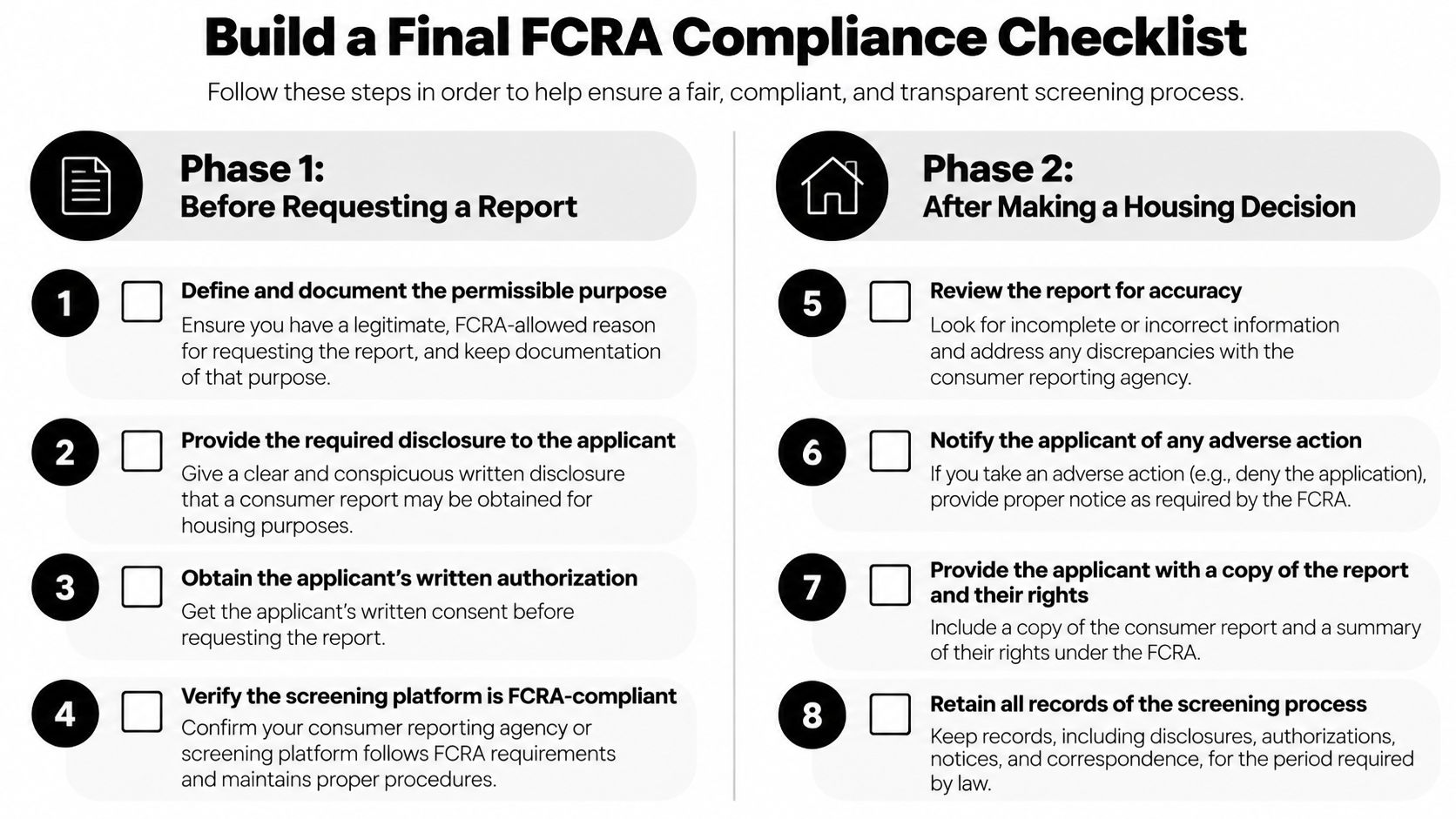
Before requesting a report
- Purpose: Identify and document the specific housing decision.
- Disclosure: Explain the screening process and applicant rights.
- Authorization: Preserve the applicant's authorization before requesting the report.
- Access: Confirm that the request is tied to the right applicant, property, and transaction.
After receiving the report and making a decision
- Accuracy: Check that identifying details and material records match the applicant.
- Evaluation: Record the relevant criteria and why the information affected or didn't affect the outcome.
- Notice: Provide the required adverse-action information when the report contributes to an unfavorable decision or term.
- Records: Retain the report, authorization, decision notes, communications, notices, and dispute outcome.
Federal requirements are only part of the picture. Applicable state and local laws may add obligations, so use this checklist to organize your process, not as legal advice. If you manage a small portfolio, the most useful next step is straightforward: choose one recent screening workflow and audit it from application receipt through final record retention. Mark each step you can prove, then assign an owner and a record location to every gap.
If you want a more organized way to handle applicant consent, screening records, and adverse-action notices, explore VerticalRent. Review how its screening and rental-management tools fit your workflow, then audit your next application from the initial disclosure through the final decision record.
Put this into practice
VerticalRent tools related to this guide
Legal Disclaimer
VerticalRent and its authors are not attorneys, CPAs, or licensed legal or financial advisors, and nothing on this site constitutes legal, tax, or professional advice. The information in this article is provided for general educational purposes only. Landlord-tenant laws, eviction procedures, security deposit rules, and tax regulations vary significantly by state, county, and municipality — and change frequently. Nothing on this site creates an attorney-client relationship. Always consult a licensed attorney or qualified professional in your jurisdiction before taking any action based on information you read here.
Co-founded VerticalRent in 2011, growing it from nothing to 100k landlords and renters. Sold it in 2019, then re-acquired it in 2026 to make it better than ever.


