Fair Housing Regulations: A Landlord's Compliance Guide
Learn fair housing regulations for rentals: the seven protected classes, common violations, FCRA screening steps and a compliance checklist.


You've got a vacant unit, an applicant ready to move, and a screening report that recommends denial. The software looks decisive, but the explanation is vague. Meanwhile, the applicant says an eviction record belongs to someone else and asks whether you'll accept different proof of income.
That's where fair housing regulations become an operating procedure, not just a statement on your listing. You need to know what your criteria allow, what the report establishes, and who reviews the decision before anyone sends a rejection. For a small landlord, a manageable compliance system starts with written standards, traceable records, and a willingness to question automated recommendations.
Seven Federal Protected Classes at a Glance
The federal baseline covers seven protected classes; the original protections and later additions below follow the legislative history described in HUD's fair housing research overview, including the original Fair Housing Act of 1968, the 1974 amendments, and the 1988 Fair Housing Amendments Act.
| Protected class | Added by | Rental example of prohibited conduct |
|---|---|---|
| Race | Original Fair Housing Act, 1968 | Refusing a qualified applicant because of race |
| Color | Original Fair Housing Act, 1968 | Treating applicants differently based on skin color |
| Religion | Original Fair Housing Act, 1968 | Refusing a unit to a family because of its faith or lack of faith |
| National origin | Original Fair Housing Act, 1968 | Setting different rent or deposit terms for applicants from a particular country |
| Sex | 1974 amendments | Denying housing because of sex or subjecting an applicant to sexual harassment |
| Disability | 1988 Fair Housing Amendments Act | Refusing a reasonable accommodation, such as an appropriate assistance animal exception |
| Familial status | 1988 Fair Housing Amendments Act | Stating that families with children aren't welcome or restricting them to certain floors |
What the list means in daily decisions
Race and color are separate protections, even when a landlord assumes they describe the same issue. National origin concerns can arise when staff make assumptions from a surname, accent, or country of birth. Religion includes decisions based on a household's faith, rather than its ability to meet legitimate rental obligations.
Disability requires particular care because a request may concern an exception to a standard rule. An assistance animal request, for example, shouldn't enter the ordinary pet-approval queue. Familial status likewise means you shouldn't substitute your preferences about children for an applicant's choice of home.
The federal framework reaches housing sales, rentals, and financing. For rental operators, the practical reach includes advertising, availability information, access to units, and rental terms, not merely the final acceptance or rejection.
The federal list isn't the complete property checklist
State and local laws can add protections, including source of income or marital status. Build your checklist around the property's location, not just your home address or the location of your management business.
Don't assume a friendly conversation is outside the rules. A suggestion about which building would suit a family can become a restriction if you stop offering other available units. The safer approach is to describe objective features and let applicants express their preferences.
Practical rule: If a protected characteristic could be the reason for your decision, stop and review the decision before acting.
Where Fair Housing Rules Reach Your Rental Business
Say an applicant finds your listing, sends a text, tours the apartment, and applies. Every interaction gives you a chance to provide equal access or introduce an unsupported distinction. A compliant screening decision won't repair discriminatory treatment earlier in that journey.
Start with the listing. Use photos that accurately represent the available unit and describe its features, rent, and terms. Review AI-written advertising before publishing it, especially language that describes the desired resident instead of the property.
At first contact, give applicants the same current availability information and explain the same application process. A saved response helps, but only if you update it when availability changes. Don't tell one caller that a unit is available and another that you're waiting to decide whether to show it because of assumptions about their household.
Follow the applicant through the handoffs
During showings, offer available options based on the applicant's stated needs. If someone asks for a quieter location, explain observable features rather than steering them toward neighbors you think they'll fit with. Record the units offered and any options the applicant declined.
At application, publish the required documentation and explain acceptable alternatives. Different applicants may need different documents to establish the same fact, but staff shouldn't invent extra hurdles for a particular person. A self-employed applicant's income evidence won't necessarily resemble an employee's pay stub.
Lease preparation introduces another handoff. Check that deposits, fees, concessions, and other terms follow the written policy rather than a negotiator's impression of the applicant. During tenancy, use a consistent process for maintenance requests, service access, and communications about rule enforcement.
Keep evidence of the actual process
The National Fair Housing Alliance's 2024 Fair Housing Trends Report reports that private nonprofit fair-housing organizations, HUD, Fair Housing Assistance Program agencies, and the Department of Justice collectively received 34,150 housing-discrimination complaints in 2023, up from 33,007 in 2022. These are reported and processed allegations, not a complete count of discrimination or a finding that every complaint established a violation.
Your records should explain what happened without requiring you to reconstruct conversations from memory:
- Advertising record: Save the published copy, photos, offered terms, and revision dates.
- Contact and showing log: Record availability responses, units offered, and applicant preferences.
- Application standard: Preserve the criteria and document checklist in effect when the person applied.
- Decision record: Identify the factual basis for the outcome and the person who reviewed it.
- Accommodation file: Record requests, follow-up communications, and the response, with appropriate access restrictions.
Keep operational notes factual. Write that income documentation was missing, not that an applicant seemed unreliable. The former identifies something you can verify; the latter leaves an unexplained judgment.
When a Neutral Policy Still Creates Liability
Applying a rule to everyone doesn't automatically make it lawful. A blanket criminal-record exclusion or rigid income requirement may look impartial while disproportionately excluding a protected group without an adequate justification.
Review the policy and its evidence before treating consistency as a complete defense.

Test the rule, not just your intentions
The Congressional Research Service's analysis of disparate impact under the Fair Housing Act explains that Texas Department of Housing and Community Affairs v. Inclusive Communities Project confirmed that disparate-impact claims are available under the Act, while requiring a causal connection to a specific policy rather than statistical disparity alone.
HUD's restored discriminatory-effects framework provides a useful policy-review checklist:
- Identify the challenged practice. Can the claimant establish that a particular rule causes a discriminatory effect? A general difference in outcomes isn't, by itself, the complete analysis.
- State the legitimate interest. Can the housing provider show that the practice is necessary to achieve a substantial, legitimate, nondiscriminatory interest? Identify the actual tenancy concern, such as reliable payment or protection of residents and property.
- Consider a narrower alternative. Could another practice meet that interest with less discriminatory effect? Document the alternatives considered and why you selected the final approach.
Treat that framework as a review discipline, not a substitute for checking current regulations and controlling court decisions with local counsel. Agency policy can change without making a weak screening rule operationally sound.
Replace shortcuts with relevant evidence
Consider a policy excluding every applicant with any criminal record. It treats unrelated offenses, old records, and conduct relevant to tenancy as though they establish the same risk. A narrower assessment considers offense type, severity, age, and relevance rather than treating the existence of a record as the conclusion.
Income screening presents a similar trade-off. A fixed multiple is easy to administer, but it can obscure reliable benefits, assistance, or other verified resources. Define the payment concern first, then evaluate whether a more customized method addresses it.
Use this video as a prompt for a staff discussion about how housing decisions are made.
For a deeper policy review, work through how landlords can avoid disparate-impact claims alongside your actual application form. Don't stop at the published policy; inspect the software settings and staff instructions that implement it.
Write the rationale before reviewing applicants. A business reason developed after a complaint is harder to evaluate than a documented explanation attached to the original rule.
Common Violations and Safer Alternatives
| Violation or compliance risk | Example | Safer practice |
|---|---|---|
| Discriminatory advertising | Describing the preferred resident as young professionals or stating that children aren't welcome | Describe the unit, rent, features, and terms |
| Steering | Showing some applicants only certain buildings based on assumptions about their household | Offer available listings and tours using the same process, guided by applicants' stated preferences |
| Inconsistent screening | Requesting extra documents from one applicant without an objective reason | Use a written checklist with defined documentation alternatives |
| Blanket eviction-filing denial | Rejecting anyone with any eviction filing | Separate filings from judgments and review the disposition and relevance |
| Unequal income counting | Ignoring a housing voucher while counting equivalent resources | Evaluate verified total resources consistently and follow applicable assistance rules |
| Refusing accommodations | Denying an assistance animal request without individual review | Review the request through an accommodation process and document the response |
| Retaliation | Issuing a nonrenewal because a tenant complained to an agency | Avoid adverse action motivated by the complaint and obtain legal review of independently justified action |
| Unreviewed AI scores | Denying on a score with no stated factors | Require intelligible factors, verify the underlying information, and document human review |
These aren't all automatically unlawful in every factual setting. An advertising phrase may raise different issues under local age protections, for example, while an eviction policy requires analysis of its design and effect. The point is to identify practices that need scrutiny before you rely on them.
Informal discretion is difficult to defend
A small portfolio can make informal decisions feel harmless. You know the building, answer your own phone, and think you can recognize a good applicant. But an exception for someone you find relatable can become unequal treatment when another person with equivalent qualifications doesn't receive it.
Written standards reduce that risk, although a written standard must also be defensible. Putting a blanket exclusion into a checklist doesn't establish that it measures a legitimate tenancy concern. Documentation helps explain a sound decision; it doesn't transform an unsound rule into a safe one.
Likewise, a neutral reason in the file doesn't automatically resolve a retaliation concern. Timing, prior communications, and the actual reason for the action matter. Don't create a convenient explanation after the tenant complains.
Build room for structured review
The alternative to unchecked discretion isn't a system that forbids all exceptions. Accommodations and corrections require a defined review path. Specify who may approve a departure, what evidence they must consider, and how the outcome is recorded.
Use distinctions that a reviewer can understand:
- Missing evidence versus adverse evidence: An incomplete file doesn't establish that the applicant failed the underlying criterion.
- A filing versus an outcome: A court record needs its disposition, not just a case label.
- A recommendation versus a reason: A vendor's denial flag doesn't explain which verified fact failed your policy.
- An accommodation versus a favor: An individualized accommodation review isn't the same as overlooking a rule for a preferred applicant.
A strong process lets another person reconstruct the decision without guessing what the landlord meant.
You don't need discriminatory intent to face a disparate-impact claim, and you shouldn't depend on good intentions as your main protection. Staff need usable instructions for difficult cases, not merely a promise to treat everyone fairly.
If you can't explain a decision using the same policy language for every applicant, change the process before the next application arrives.
Screening Steps and Tool Checks That Keep You Compliant
The most useful screening system produces more than a recommendation. It preserves the policy, the relevant evidence, and an explanation a person can check. Automation increases risk when it hides those connections, even if it makes decisions faster.
HUD's discriminatory-effects rule fact sheet describes a framework for evaluating unjustified discriminatory effects, not a declaration that a particular screening activity is automatically unlawful. That distinction matters: the settings, evidence, and implementation need review, not just the name of the tool.
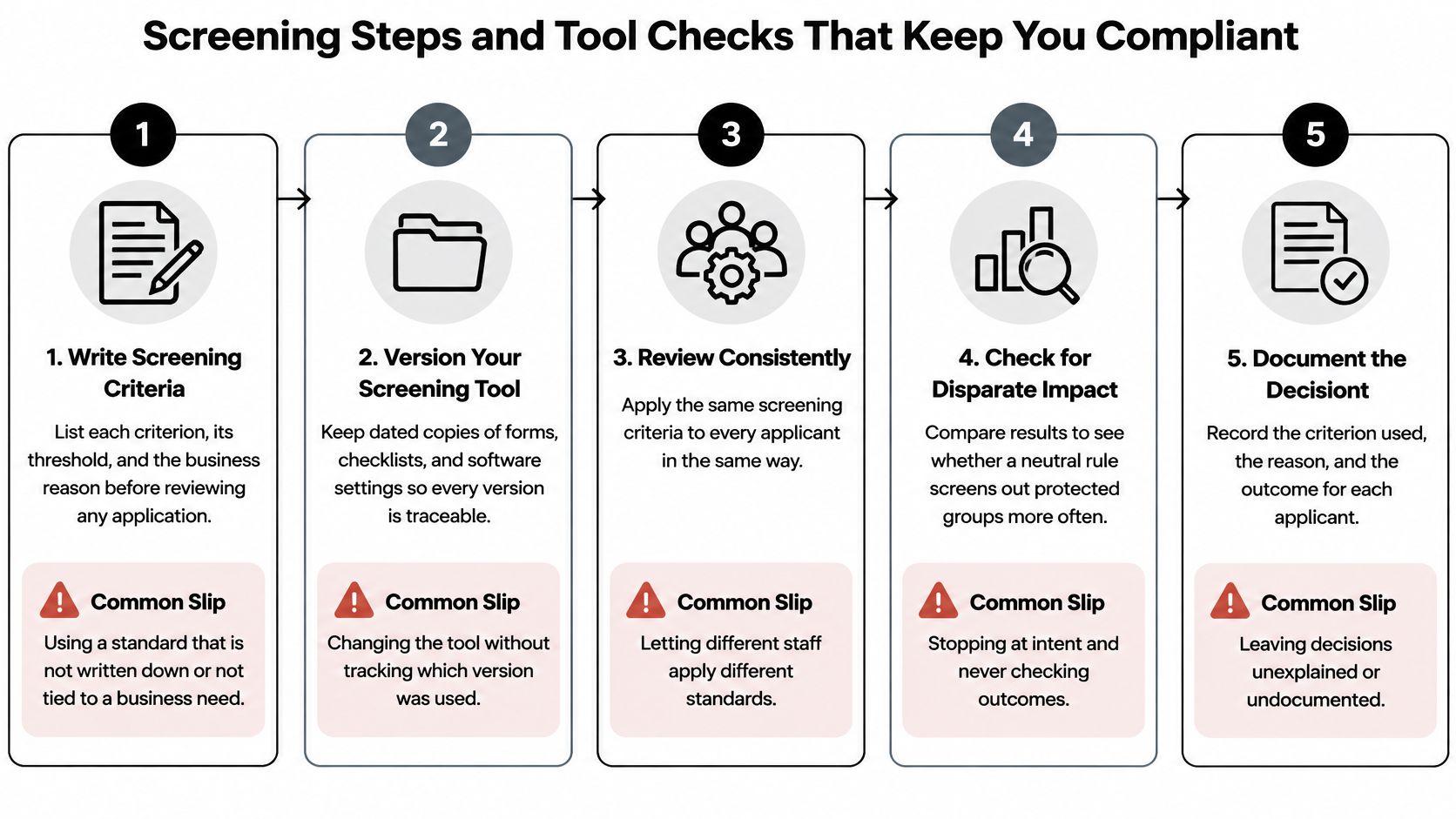
Use this process map to organize the controls around each application.
Run the application through a documented sequence
Write and version the criteria before reviewing applications. For each criterion, record its threshold, acceptable evidence, and housing-related business reason, then save the dated forms and software settings that implement it. Common slip: changing a threshold after seeing an applicant's report without recording the change or reviewing its effect on pending applications.
Obtain written authorization before ordering reports. When running a report, the landlord must certify that the applicant provided written authorization; before an eviction search begins, we collect consent electronically with a timestamped record for the compliance file. Common slip: ordering the search first and trying to obtain or reconstruct consent afterward.
Apply the policy consistently and record factual findings. Keep eligibility variables separate from protected characteristics, use defined documentation alternatives, and route accommodation requests through their designated review process. Common slip: allowing a staff member to waive evidence for a familiar applicant while demanding extra proof from someone else.
Require explainable factors and human review of score-based denials. Match the recommendation to your written criteria, verify the underlying records, and pause when the score alone is the only explanation available. Common slip: recording a vendor's risk category as though it were a factual reason.
Prepare the adverse-action notice and correction route before communicating an eviction-based denial. Our process requires the notice before denial, including the consumer reporting agency's name and contact details, and applicants need a clear way to dispute inaccurate information. Common slip: telling the applicant no before checking that the notice and supporting explanation are complete.
Close the file and inspect outcomes. Keep the criteria version, authorization, report, review notes, decision, and notice together, then investigate patterns that could reflect inaccurate data or unjustified exclusions. Common slip: saving the final score but losing the inputs needed to understand it.
Audit the model as well as the report
HUD's tenant-screening guidance states that the Fair Housing Act applies regardless of whether decisions use machine learning or another technology, and using a third-party screening company doesn't remove the housing provider's responsibility. An automated result therefore needs the same scrutiny as a recommendation from a staff member.
Ask what a score measures. Does an address gap count against the applicant? Does an eviction filing receive the same weight as a judgment? Can someone explain how each factor relates to the applicant's ability to meet tenancy obligations?
A plain-English summary is helpful only if it accurately reflects traceable inputs. A polished explanation generated from an unexplained score isn't meaningful human review. The reviewer needs access to the relevant record and authority to stop or correct the decision.
For criminal-history settings, compare your configuration with this guidance on criminal-history screening and fair housing. Pay attention to whether your tool allows relevance-based review or automatically switches every record into a denial category.
Check notice and record controls
We generate the required eviction-based adverse-action notice automatically, including the consumer reporting agency's contact information, and our system follows state seal laws by excluding sealed records. The landlord still needs to verify that the correct applicant, report, and decision reason appear in the file.
Outcome review should be careful, especially in a small portfolio. A handful of applications doesn't support sweeping conclusions about statistical discrimination. It can still reveal a recurring documentation barrier, an unexplained staff exception, or a data field that triggers rejection without a legitimate reason.
Don't collect protected-class information casually to perform an audit. Obtain legal guidance on permissible methods, including any use of proxies, and restrict access to sensitive information. The objective is to improve the policy, not assign applicants different standards based on group membership.
State and Local Edge Cases Landlords Miss
A voucher applicant can meet your income standard and still fail the file if the worksheet compares personal earnings with the full contract rent. That is the kind of edge case federal summaries miss: source-of-income laws in some states and municipalities protect applicants using housing vouchers or other assistance, and disability-related accommodation duties may require individualized review of screening evidence.
The National Consumer Law Center's tenant-screening policy analysis addresses how credit, criminal, and eviction records can create discriminatory barriers, including barriers connected to race and disability. A rule that ignores the reason for missing documentation can exclude someone without accurately measuring tenancy risk.
Evaluate resources without inventing extra hurdles
For voucher income, identify the applicant's actual payment obligation and evaluate verified resources against the appropriate obligation under local rules. Don't automatically compare personal earnings with the entire contract rent when assistance pays part of it.
For benefits or irregular self-employment earnings, define acceptable verification and a consistent evaluation method. That may involve benefit statements, tax records, business records, or other reliable documentation rather than demanding a conventional pay stub from everyone.
Check the property's jurisdiction against source-of-income discrimination protections, then confirm the applicable rule before adopting a policy. For applicants navigating New York City assistance, RentReboot's guide to find NYC apartments with CityFHEPS provides context for the voucher apartment-search process.
Separate reporting limits from rental decisions
In California, New York, Kansas, Maryland, Massachusetts, Montana, New Hampshire, New Mexico, and Washington, eviction records are subject to a seven-year lookback under those states' rules.
| State | Eviction-record lookback |
|---|---|
| California | 7 years |
| New York | 7 years |
| Kansas | 7 years |
| Maryland | 7 years |
| Massachusetts | 7 years |
| Montana | 7 years |
| New Hampshire | 7 years |
| New Mexico | 7 years |
| Washington | 7 years |
A reporting boundary limits what a report may show. It never supplies the denial reason by itself, and automation makes that distinction easy to lose when a workflow turns any returned record into a fail. Keep the written criterion beside the report, require the reviewer to read the disposition, and document why the information was or was not relevant.
A filing isn't a judgment. Read the outcome and consider whether the information establishes the concern your criterion is intended to measure. Evictions older than the applicable boundary don't appear in some states, and the file should show that the tool, the setting, and the human decision each stayed inside the same rule.
Disability-related financial disruption or difficulty producing standard evidence may also require an accommodation review. Record the request, identify the relevant screening requirement, and consider an effective alternative without demanding unnecessary medical detail.
Before adopting a rule, ask local counsel: Does this criterion, documentation requirement, and reporting practice comply with the laws governing this property, and what individualized review must we provide?
Penalties, Complaints and Where to Report
A fair-housing complaint can reach HUD, a state or local fair-housing agency, a private nonprofit fair-housing organization, or the Department of Justice, depending on the matter. Someone who believes they experienced discrimination can contact HUD or a local fair-housing organization for intake guidance, and court proceedings may also be available.
Agency review can involve an investigation, requests for documents, and efforts to resolve the dispute through conciliation. Some matters proceed to litigation. A complaint is an allegation, not a finding, but it deserves an organized response.
Understand the exposure
Potential consequences can include monetary damages, civil penalties, attorney fees, and orders requiring changes to rental practices. The available remedies depend on the claim and forum; punitive damages aren't available in every proceeding.
Don't rely on a generic penalty chart or filing deadline without checking the applicable process. Different claims and forums can carry different requirements, and delay can affect both the complainant's options and your response obligations.
Respond without altering the evidence
Use this routine as soon as a complaint arrives:
- Preserve the original records. Retain the ad, application, showing log, report, settings, notices, and communications without editing or deleting them.
- Avoid retaliatory action. Don't pressure the complainant to withdraw or restrict services because they complained; have counsel review independently necessary tenancy actions.
- Calendar the response requirements. Record the agency's deadline and identify who will gather the requested materials.
- Contact local counsel before responding. Provide the full file, including facts that don't support your preferred explanation.
Response discipline: Preserve first, investigate carefully, and send a factual response through the appropriate channel.
The common mistake is an immediate informal explanation that contradicts the file. Don't backdate a policy, rewrite a note, or delete an awkward message. Preserve the original and let counsel advise how to explain the facts accurately.
Audit Your Screening Process Before the Next Applicant
Pull your last three screening decisions and review the actual files, not just the outcomes. Choose a mix of approvals and denials if available. You're checking whether another person could follow the path from the application to the final response.
Reconstruct each decision
Start with the criteria version in effect when the applicant applied. Compare it with the report settings and the reason recorded in the file. A mismatch means you need to determine which standard was used before drawing conclusions about the decision.
Then inspect the evidence and communications:
- Authorization: Confirm that the written consent and timestamp are present and precede the eviction search.
- Notice record: Check that any required adverse-action notice identifies the consumer reporting agency and includes its contact information.
- Accommodation review: Confirm that the request received individual consideration and that the response explains the decision.
- Human review: Identify who verified a recommendation and what information they examined.
- Consistency: Compare the decision with your protected-class checklist and look for unsupported exceptions or extra document demands.
Correct inaccurate records through the proper process
A wrong address or a record belonging to someone else shouldn't become an adverse fact just because it appears in a report. Separate the disputed information from independently verified evidence and document the applicant's correction request.
Errors on a rental history report can be disputed through ScreenForge Labs' dispute process. Disputes are investigated under the FCRA, and the report can be corrected when appropriate. Preserve the disputed report and any corrected version so the decision history remains understandable.
Finish this week by creating an application folder template, assigning an owner to unresolved corrections, and testing that the reviewer can retrieve the complete file. If you already use our screening workflow, organize the supporting records alongside it rather than leaving critical explanations scattered across text messages and email.
This guide doesn't replace jurisdiction-specific legal advice. Bring your written criteria, the rules applicable to your property, and the three decision files to a local attorney or fair-housing organization for review.
VerticalRent pairs free core rental-management tools with tenant screening, AI risk summaries, and built-in adverse-action notices to support a documented review process. Visit VerticalRent to organize your next application around written criteria, verified information, and a human-reviewed decision.
Put this into practice
VerticalRent tools related to this guide
Legal Disclaimer
VerticalRent and its authors are not attorneys, CPAs, or licensed legal or financial advisors, and nothing on this site constitutes legal, tax, or professional advice. The information in this article is provided for general educational purposes only. Landlord-tenant laws, eviction procedures, security deposit rules, and tax regulations vary significantly by state, county, and municipality — and change frequently. Nothing on this site creates an attorney-client relationship. Always consult a licensed attorney or qualified professional in your jurisdiction before taking any action based on information you read here.
Co-founded VerticalRent in 2011, growing it from nothing to 100k landlords and renters. Sold it in 2019, then re-acquired it in 2026 to make it better than ever.


