Rent and Security Deposit Rules by State: A Complete Guide
Learn how rent and security deposit rules vary by state, how to collect, hold, and return deposits legally, and how to track them for IRS Schedule E.


A security deposit is a refundable sum held against unpaid rent or damage beyond normal wear and tear. The 2025 median deposit was $795 according to Zillow data.
You're in a new kitchen with a cashier's check, a lease, and a stack of charges that all look like rent. One line is this month's payment for the right to live there. Another is money the owner will hold until you leave. Mix those up and the tenancy gets messy: late notices, surprise deductions, and a refund fight that should have been a bookkeeping task.
Rent and security deposit rules change by state, and sometimes by city. What doesn't change is the need for a clear ledger and records made while the unit still looks the way it does today. Treat the deposit as evidence and accounting, not only as a calendar deadline, and both sides walk out with a number they can defend.
What Rent and Security Deposits Actually Cover
Maya has the keys in one hand and a move-in bill in the other. The bill lists first month's rent, a deposit, and a pet fee. She assumes every dollar is gone for good. Her landlord assumes the deposit is spare cash for a mid-lease paint job. Both are wrong, and that confusion is where most first leases go sideways.
Rent pays for the right to occupy the unit for a stated period. A security deposit is different. It's a refundable sum the owner holds against unpaid rent or damage beyond normal wear and tear. Think of the temporary hold a hotel places on a card at check-in. The hotel isn't charging you for the room a second time. It's setting money aside in case the minibar disappears. When you check out with the room intact, the hold drops. A deposit works the same way, except the "hold" can last a year and the rules for releasing it are written into state law.
Why the amount hits so hard
That hold is large next to a household budget that's already tight. In 2023, 49.7% of the 42.5 million renter households for which rent burden was calculated, more than 21 million households, spent over 30% of income on housing costs, the federal threshold for cost-burdened status, according to the Census Bureau's renter cost-burden release. The Department of Housing and Urban Development uses that same 30% line. Spending over half of income is treated as a severe burden.
A deposit on top of first month's rent can be the charge that empties a checking account before the first night in the unit. Median renter housing costs, which include utilities, have climbed for years. Even a modest extra fee lands on households already near the line.
Practical rule: If the lease doesn't say the charge is refundable and limited to unpaid rent or excess damage, don't assume it is a deposit. Ask before you sign.
Who this walk-through is for
Independent landlords with a few units need a process they can repeat without a legal department. Renters need to know which dollars come back and which records make a deduction fair. By the last page you should be able to separate rent from the deposit, hold the money the way your state requires, build an inspection file, and return the balance with an itemized list.
State Laws That Cap, Hold, and Return Deposits
A lease clause that is lawful in Baltimore can be noncompliant in a New York rent-regulated building. There is no single national deposit statute. Caps, bank-account rules, interest, allowed deductions, and return deadlines all move with the jurisdiction. Copying a form from another state is how owners get penalties and how renters lose money they were owed.
Two markets, two different leases
Maryland's security deposit statute generally limits the deposit to one month's rent, with narrow exceptions that can allow up to two months. The owner must return the deposit plus statutory interest within 45 days after the tenancy ends, minus lawful deductions.
New York rent-regulated rules, described alongside that same comparison of state practice, generally cap the deposit at one month's rent and require the money in an interest-bearing New York bank account. The owner may keep 1% a year for administrative expenses. The rest of the interest is payable or creditable under the applicable rule. Same idea of "one month," completely different handling of the cash and the interest.
| Jurisdiction | Deposit Cap | Return Deadline | Account and Interest Rule |
|---|---|---|---|
| Maryland (general rule) | One month's rent, narrow exceptions up to two months | 45 days after tenancy ends | Return deposit plus statutory interest, less lawful deductions |
| New York rent-regulated units | Generally one month's rent | Follow the rent-regulated return rule for that unit | Interest-bearing New York bank account; owner may retain 1% a year for admin costs |
Run the same $1,800 monthly rent through both columns. In the Maryland pattern, two months would usually be too much unless a listed exception fits. In the New York rent-regulated pattern, even a lawful one-month deposit fails if it sits in an operating account that doesn't pay interest. The lease text can look identical. The compliance result doesn't.
What else changes by place
- Maximum amount: Often one or two months, with exceptions for pets, furnished units, or small landlords. Don't guess the exception.
- Where the money sits: Some states require a separate or trust-style account. Others don't.
- Interest: Some states require it. The rate and who may keep a slice for admin costs are local.
- Deductions: Unpaid rent and damage beyond wear are the usual list. Cleaning, carpet, and repainting turn on condition, not on a nationwide chart.
- Deadline: Counted from move-out, from the end of the lease, or from when you receive a forwarding address. The trigger matters as much as the number of days.
City and county ordinances can go past the state statute. Check the state code, then the local code, before you set the amount in the lease. A nationwide "our company always keeps six weeks" policy isn't a policy. It's a violation waiting for the wrong zip code.
Collecting and Holding Deposits Compliantly
The money is still the tenant's until you make a lawful deduction. Handle it that way from the hour you receive it.
Put the terms in the lease first
Write the deposit amount, the due date, and the permitted uses in the lease before anyone pays. Permitted uses should track your state: typically unpaid rent and damage past normal wear, sometimes specific fees the statute allows. If your state caps the deposit at one month's rent, the lease shouldn't ask for more "just in case."
Give a written receipt the same day. The receipt should name the tenant, the property, the amount, the date, and the word deposit, not rent. Tenants lose refunds because nobody can prove what was paid. Owners lose cases for the same reason.
The sealed envelope
Picture the cash in a sealed envelope with the tenant's name on it. You don't open it to buy paint in March. You don't fold it into the mortgage payment. You open it at the end, list what the law lets you keep, and hand back the rest. That's the mental model even when the money is in a bank, not an envelope.
On the books, record the deposit as a tenant liability, not as rental revenue. It isn't income on the day it arrives if you expect to return it. Keep it segregated from operating cash when your state requires a separate account, and do it even when the statute is silent if you manage more than one unit. Link the entry to the specific lease and property. Reconcile it to the bank statement every month so the liability on the ledger matches the cash in the account.
A simple holding file has five pieces:
- Lease clause: Amount, due date, and permitted uses.
- Receipt: Who paid, how much, and when.
- Bank record: The account where it sits, separate from rent if required.
- Ledger line: A liability tied to that tenant and unit.
- Monthly reconcile: Ledger balance equals the bank balance for deposit funds.
The mistake that creates liability is spending the deposit mid-tenancy. A water heater fails in month four. The owner "borrows" the deposit, fixes the heater, and plans to repay it at move-out. If the tenant leaves the unit clean, the owner may not have the cash on the statutory deadline. Intent to repay doesn't pause the clock. If your state treats the deposit as trust money, spending it early can be more than a cash-flow error. Fund repairs from operating cash. Leave the envelope sealed.
Building a Move-In and Move-Out Evidence Trail
Knowing the repayment deadline doesn't win a dispute about a carpet. The file you build on day one does.
The Federal Trade Commission's review of rental housing fees found that many renters don't know in advance which circumstances can block a full refund or which charges may be deducted. Deposits are also common, not rare: 83% of renters reportedly pay one. When almost everyone pays, and many can't predict the deductions, the argument at move-out is usually about photos, not about the statute's due date.
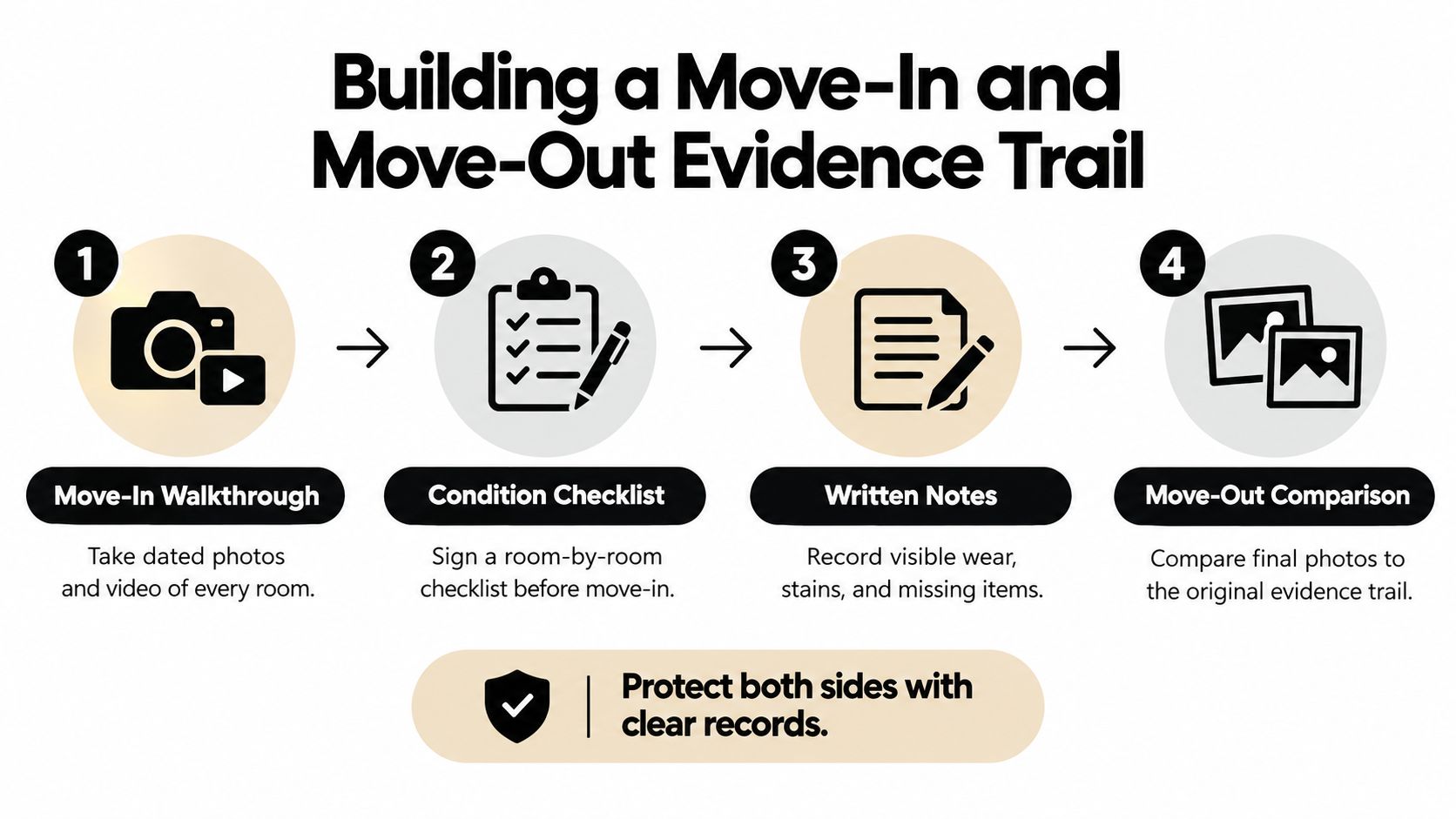
A workflow both sides can audit
Do the move-in walkthrough before furniture covers the floors. Shoot dated photos and video of every room, including inside appliances, under sinks, and along baseboards. Then sign a room-by-room condition checklist the same day. If a wall is already scuffed, write "scuff, north wall, living room" instead of "good." Vague words are what lawyers argue about later.
During the lease, put repair requests in writing and keep the dates. A stain reported in month two is not the same fact as a stain discovered at move-out. Before the last day, confirm the forwarding address in writing so the refund has somewhere to go. Repeat the walkthrough at move-out with the same rooms and, when you can, the same angles.
A guide to documenting property condition before move-in is worth doing before the truck arrives, not after the argument starts.
Wear versus damage in one pair of photos
Move-in photo: a light scuff on the living-room wall, noted on the checklist, timestamped. Move-out photo: that same scuff, plus a hole the size of a doorknob where a bracket was pulled out. The scuff is normal wear from living in the unit. The hole is damage. Repainting an entire room because of the scuff is the deduction that usually fails. Charging to patch the hole is the deduction the photos support.
The same split shows up with carpet life, cleaning standards, and appliances. A ten-year-old carpet that is worn in the traffic lane isn't a tenant bill. A burn mark is. Ordinary cleaning after a careful tenancy isn't damage. A greasy oven left as-is can be, if your photos show the condition at both ends and your lease states the standard. A Clean Space SA move-out cleaning pass, done before the final photos, often removes the cleaning line from the deduction list entirely.
Records hold up when they have timestamps, consistent angles, and a copy given to the tenant at move-in. If only the owner has the photos, the tenant can't check the accounting. Share the file. An auditable trail protects the refund and the deduction at the same time.
Returning Deposits and Handling Deductions Fairly
Plenty of people think the whole job is "send it back before the deadline." The deadline matters. It doesn't decide whether a charge is fair.
What you may keep, and the math
A lawful deduction is unpaid rent or damage beyond normal wear and tear, plus any other item your state statute lists. Faded paint, small nail holes, and carpet wear in a hallway are ordinary use. Broken doors, missing fixtures, and pet urine in the pad are not.
Calculate the refund in one line the tenant can re-add:
Original deposit + required interest − supported deductions = balance returned.
Each deduction needs a date, a short description, and backup: the move-in and move-out photos, an invoice or a written estimate, and the checklist initialed at the start. An itemized statement that says "cleaning, $200" with no photos is an invitation to a dispute. An itemized statement that points to a greasy oven in both the move-out video and the vendor invoice is a record.
Send that statement and the balance by the state deadline, using the forwarding address the tenant gave you. Some jurisdictions add penalties, extra damages, or attorney fees when an owner withholds in bad faith or misses the window. Read your statute before you hold anything back "until they call."
Why a surprise charge hurts
The stakes aren't abstract. Congressional Research Service analysis of renter cost burden reports that in 2021, 20.1 million renter households spent more than 30% of income on gross rent, and 25.4% of renter households were severely cost-burdened, spending more than half of income on housing. For a household already in that group, a withheld deposit can mean the next apartment's move-in cash doesn't exist.
If you can't tie a dollar on the itemized list to a photo, an invoice, or unpaid rent on the ledger, don't deduct it.
How a tenant pushes back
Ask for the itemized list in writing if it didn't arrive. Match each line to your move-in checklist and your own photos. A renter's final walkthrough checklist helps you see the unit the way an owner will score it, before you hand over the keys. If the numbers still don't match the evidence, escalate. Small claims court and local housing agencies are the usual paths, and the right forum depends on your city. Bring the checklist, the photos, the lease, and the forwarding-address email. The strongest case isn't "I know the 30-day rule." It's "here is the wall on day one and here is the wall on the last day."
Deposit Alternatives and Their Hidden Trade-Offs
Alternatives look cheaper on move-in day. Over a full lease they often aren't, because they move the risk instead of deleting it.
The interest in these products is easy to explain. Zillow's 2025 data put the median deposit at $795, a real check to write before the keys change hands. Lawmakers have noticed the cash crunch too. A 2025 New York bill that remains a proposal, not enacted law, would require landlords who collect deposits to offer an installment option or, in some circumstances, accept approved deposit insurance. Nothing in it is binding yet, but it shows where the regulatory conversation sits.
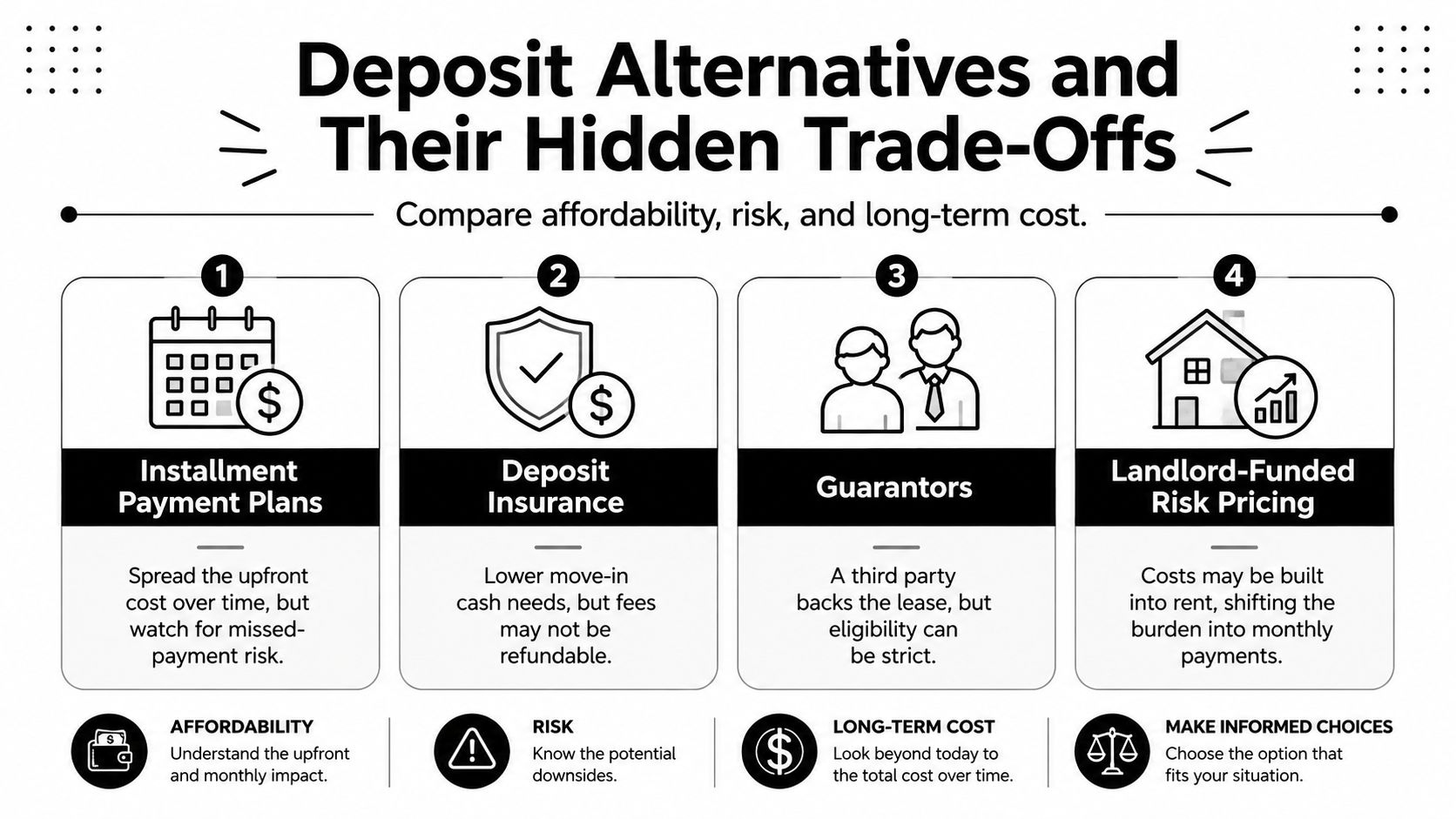
Four options, not one shortcut
Installment plans spread the refundable deposit over several months. You still get the lump sum back if the unit is in order, but a missed installment can breach the lease. Cash is easier in month one and tighter if a paycheck slips.
Deposit insurance or surety-style products cut the upfront check to a fee. The fee is often nonrefundable, and you can still owe the full damage or unpaid-rent claim. You paid for the privilege of not parking cash, and the product doesn't forgive the underlying debt.
Guarantors put a third party on the hook. That can open a unit when income is thin. Eligibility is strict, and a parent who signs carries the same claim exposure you do.
Landlord-funded risk pricing folds the owner's risk into the monthly rent. Nothing sits in escrow under your name, and nothing comes back at move-out, because you never posted a deposit. Compare the higher rent over twelve months with the deposit you would have recovered.
Which one is actually cheaper
Score each option on five points: total lease cost, how a claim is filed, whether you can cancel, whether it touches your credit, and who still owes money at the end.
Use the refundable deposit as the benchmark. Pay it, leave the unit without excess damage, follow the return rules, and your net deposit cost lands near zero, plus whatever interest your state doesn't pass through. A nonrefundable monthly alternative only wins if twelve payments, plus any claim you still have to pay, come in below that result. Run your own fee, not a national average. A product that saves cash on day one and costs more than the deposit by month twelve works like a loan, with the deposit office acting as the lender.
The cheapest option is the one with the lowest cost at move-out for your record, not the smallest check on day one.
Reporting Deposits on Taxes and Schedule E
The tax surprise is simple. A deposit you plan to return isn't rental income when you receive it. It sits on the books as the tenant's money, the liability from the holding section, until something changes.
Three events change the label.
You return it. No income, because you never kept it. The liability goes to zero and the cash leaves the account. Nothing hits Schedule E from that refund.
You keep some or all of it because the tenant broke the lease or damaged the unit. The amount you keep becomes income in the year you keep it, not in the year you first received it. If a tenancy starts in November and you retain $300 for a broken door the following June, that $300 belongs on the later year's return. The repair cost, if you spend it, is a separate expense with its own rules.
You apply the deposit to the last month's rent. That isn't a deposit anymore. It's advance rent, and advance rent is income when you receive it. Labeling last month's rent as a "deposit" in the lease doesn't change the tax result if both sides treat it as rent.
A clean ledger makes this boring, which is what you want. Keep liability entries away from income entries. Date every deduction. Match the bank statements to the ledger so you can see the day a deposit stopped being a liability and became income. A Schedule E rental income guide walks through the form itself. This article isn't tax advice. Confirm the facts of your lease with a tax professional or the current IRS instructions, because a security hold, a nonrefundable fee, and prepaid rent are three different things wearing similar names.
Automating Rent and Deposit Collection Online
Paper receipts and a spreadsheet work for one unit until a deadline, an interest calculation, or a Schedule E export depends on a cell you overwrote. The fix isn't "more software" in the abstract. It's picking a system that keeps rent, deposits, and deductions in different buckets.
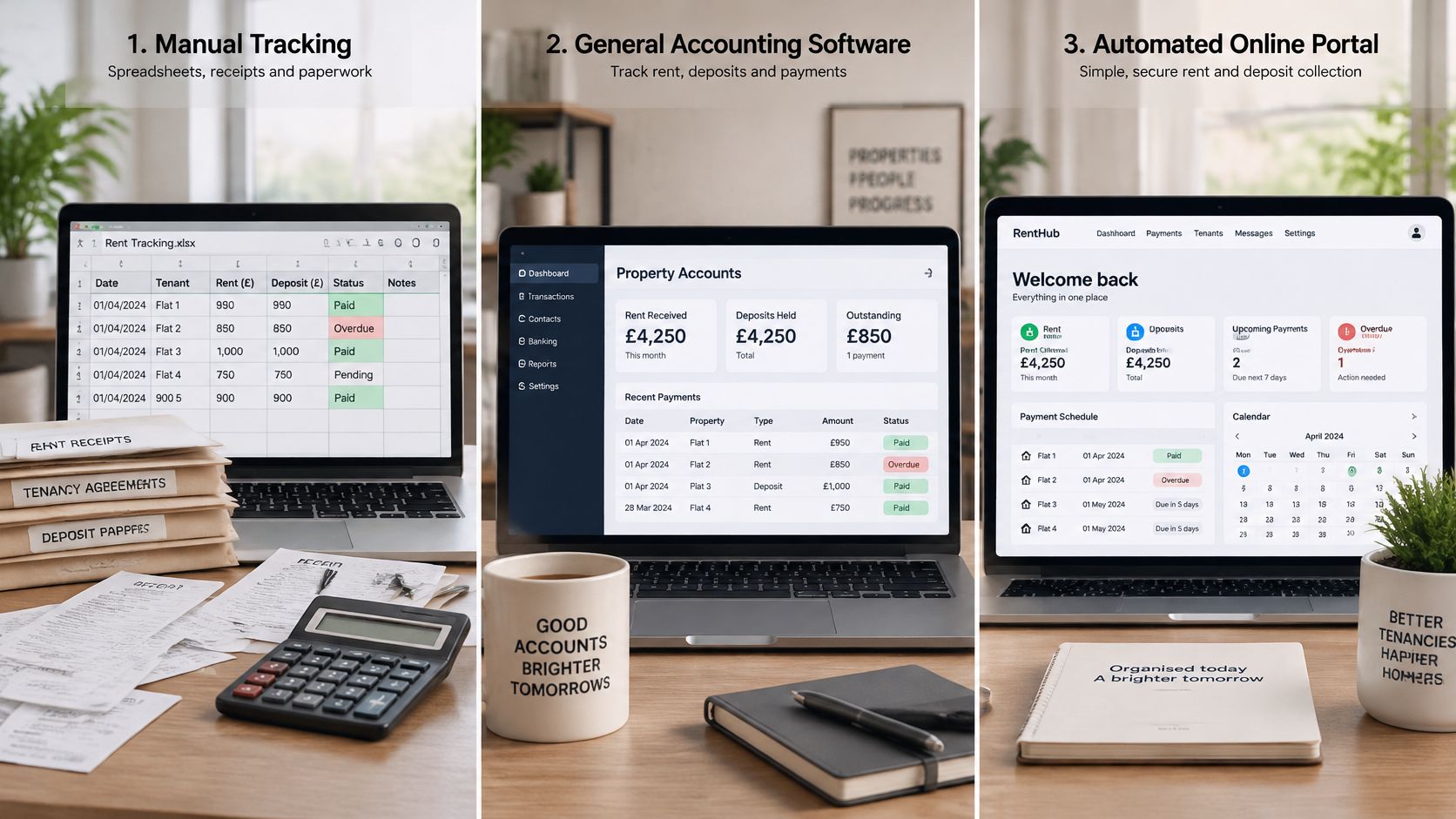
Three ways owners actually run the money
Spreadsheets and paper receipts are free and fragile. You can list a deposit as a liability if you build the sheet that way. You won't get a reminder when a state's return window is about to close, and a city ordinance won't update itself inside the file.
General accounting software reconciles bank accounts well. It usually doesn't know that Maryland's clock and a New York rent-regulated account rule are different problems. You still write the lease, track the inspection photos, and map categories to Schedule E by hand.
Rental-specific platforms start from the lease and the property. The useful test is practical: state-specific lease language, a ledger that separates deposits from rent, reminders for rent and late fees, and an export that resembles what your return needs. Confirm how the product categorizes a deposit before you rely on it. A tool that books every incoming payment as income will create the tax mistake from the previous section at scale.
VerticalRent sits in that third group. It generates state- and county-specific lease agreements, collects rent online by ACH or card with reminders and late fees, and logs transactions into an income and expense ledger that can output IRS Schedule E reports. Stripe can split application fees and deposit the landlord's share within two business days. Check current screens so deposit receipts, deductions, and refunds stay on the liability side until you keep the money. A walk-through of how to collect rent online covers the payment setup without mixing it into the deposit refund.
If you want to see how a renter-side payment flow looks on camera, this short demo is a useful companion to the ledger discussion.
This week, set the lease deposit clause next to your state statute and your city code. Fix the cap, the account, and the return window before the next tenant signs. Then pick one system and post the deposit as a liability the day it arrives, with the inspection file attached to that same tenancy.
VerticalRent helps independent landlords collect rent online, keep a ledger that can separate deposit activity from rent, and generate state-specific leases so the clause matches the property. If you're ready to stop tracking refunds in a spreadsheet, open an account at VerticalRent and set up the next tenancy with the deposit recorded as the tenant's money from day one.
Put this into practice
VerticalRent tools related to this guide
Legal Disclaimer
VerticalRent and its authors are not attorneys, CPAs, or licensed legal or financial advisors, and nothing on this site constitutes legal, tax, or professional advice. The information in this article is provided for general educational purposes only. Landlord-tenant laws, eviction procedures, security deposit rules, and tax regulations vary significantly by state, county, and municipality — and change frequently. Nothing on this site creates an attorney-client relationship. Always consult a licensed attorney or qualified professional in your jurisdiction before taking any action based on information you read here.
Co-founded VerticalRent in 2011, growing it from nothing to 100k landlords and renters. Sold it in 2019, then re-acquired it in 2026 to make it better than ever.


