Roommate Compatibility: What to Check Before You Move In
Roommate compatibility goes beyond shared interests. Learn the six dimensions, conflict data, interview questions and red flags to check before you sign.


Among surveyed university freshmen who considered their roommate a good or close friend, 94.1% reported similar hygiene and cleanliness practices, according to a survey reported by Yale Daily News. That doesn't mean matching cleaning habits creates friendship. It does suggest a better starting point than shared hobbies: what will everyday life together look like?
Choosing a roommate means testing both behavioral fit and financial resilience. You need someone whose routines can coexist with yours, whose housing budget works, and who can negotiate a disagreement without making home uncomfortable. Before anyone signs, turn those expectations into a clear go or no-go decision, not a hopeful guess.
The Seven Dimensions of Roommate Compatibility
Roommate compatibility is how well the daily habits, money, space needs and conflict styles of two or more people fit inside one home. Think of a shared kitchen. Two good cooks can still clash if one prepares an early dinner while the other cooks noisily after their roommate has gone to bed.
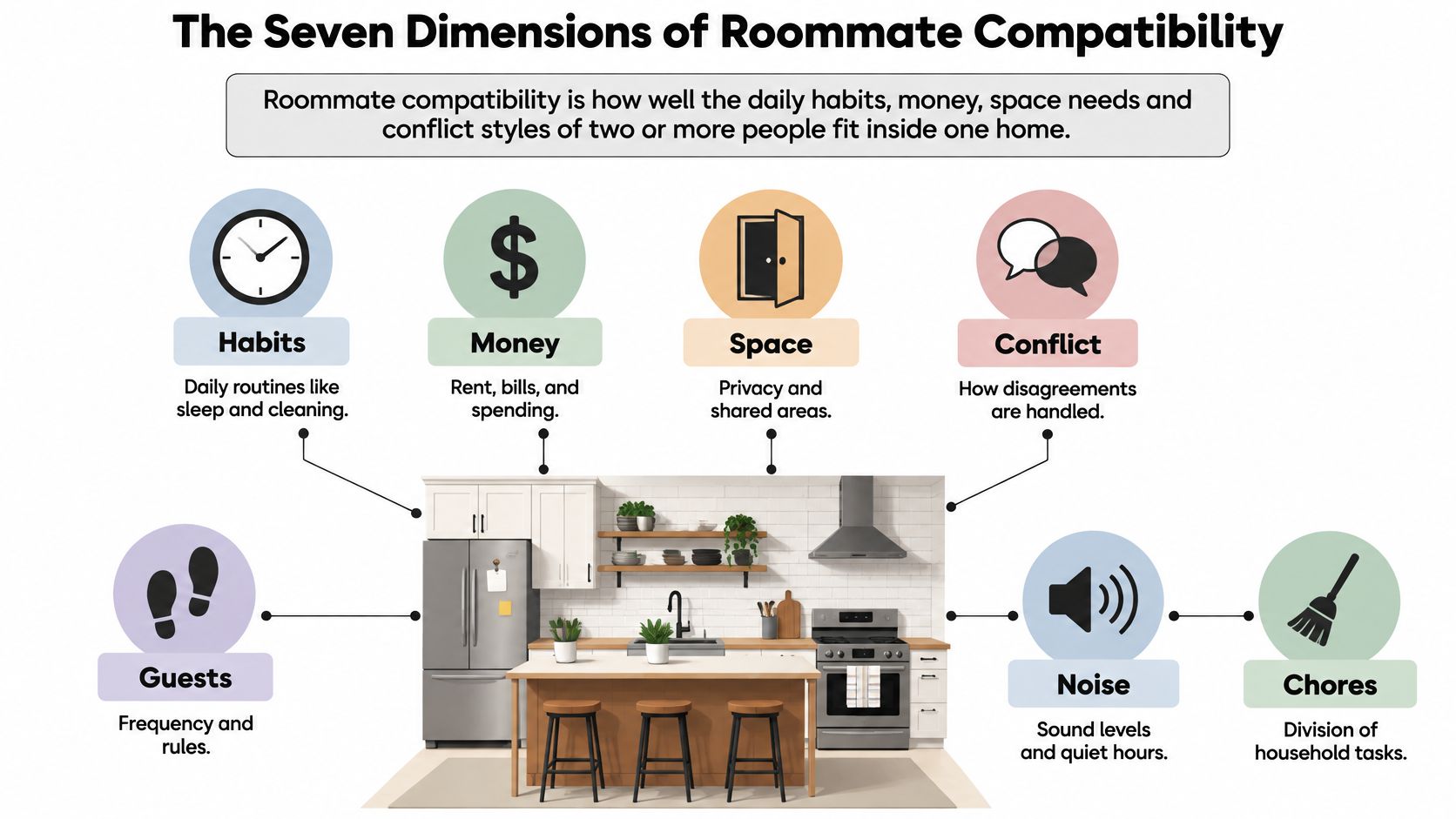
Roommate compatibility dimensions and the mismatches that cause trouble
| Dimension | What to compare | Mismatch that causes trouble |
|---|---|---|
| Sleep and schedule | Bedtime, wake time, work or study hours | One works nights while the other needs evening quiet |
| Cleanliness and shared-space norms | Dishes, bathroom cleaning, clutter, shared supplies | Different standards with no agreed cleaning rota |
| Money and cost sharing | Income, rent share, bills, deposits | Unequal incomes split evenly without discussion |
| Privacy and guests | Overnight guests, room access, locked doors | Guest rules change from week to week |
| Noise and quiet hours | Music, calls, gaming, gym hours | Quiet hours set by one person only |
| Social expectations | Time at home, shared meals, hosting | One wants daily company while the other wants solitude |
| Communication and conflict style | How issues are raised and how quickly | One avoids talking while the other escalates in writing |
Social expectations deserve an explicit conversation. In ApartmentAdvisor's 2024 survey of 1,016 respondents, 64.1% wanted a roommate they could socialize with at home several times per week.
Treat every row as a question to answer, not a requirement to be identical. Prioritize money, privacy, and anything that affects your ability to sleep or use the home comfortably before comparing music or decor.
How Often Roommates Clash and Why
Disagreements don't automatically mean you've chosen the wrong roommate. In a 2024 mixed-method study published by SAGE, 43.9% of participants reported disagreements about once per week, while 39.5% reported none. The evidence comes primarily from university populations, so don't treat these percentages as forecasts for every renter or country.
The practical question isn't whether you'll ever disagree. It's whether you can identify the problem, discuss it, and change the behavior without repeating the same argument.
Identify the underlying problem
The study's conflict categories offer a useful way to distinguish an unfinished task from a broader boundary problem. That distinction matters because each needs a different response.
| Source of friction | What it can look like | What to agree on |
|---|---|---|
| Incomplete household duties | Someone repeatedly leaves the bathroom dirty | Task ownership and a completion deadline |
| Misunderstandings | Each person assumes the other will buy supplies | A shared shopping list and reimbursement rule |
| Rude behavior | Sarcasm or insults during a disagreement | Conduct that remains unacceptable during conflict |
| Privacy invasion | Entering a bedroom without permission | Room-access and borrowing boundaries |
| Feeling excluded | Shared activities create uncertainty about invitations | Whether social plans are household plans or private plans |
A chore rota needs more detail than alternating names. Define what completing the bathroom means, including the toilet, sink, shower, floor, and rubbish. Otherwise, roommates can both believe they've done their share while using different definitions of finished.
Misunderstandings require a different fix. Put requests somewhere both people will see them, and agree whether household messages need acknowledgement.
Practical rule: Name the task or behavior you need changed, rather than assigning a character flaw to the person.
For example, explain that food left on the counter prevents you from preparing breakfast. That's more actionable than calling someone inconsiderate, and it gives them a concrete change to make.
Before moving in, list the sources of friction most likely in your household. Decide who will raise each issue first, how they'll raise it, and what happens if the same problem continues after an agreement.
Why Habits Predict Conflict Better Than Personality
It's tempting to assume that another introvert, fellow creative, or outgoing friend will make an easy roommate. Those descriptions don't tell you whether someone takes calls beside your bedroom or expects visitors to leave before bedtime.
A study testing interpersonal-attraction theories found moderate support for similarity between roommates' self-concepts, little support for matching on generally desirable traits, and strong support for whether each resembled the other's personal ideal. The same study warned that pre-move-in matching has limited predictive power because self-description and another person's perception can differ.

Translate labels into observable behavior
A review of roommate studies describes a study of 84 female roommate pairs that found limited support for personality similarity and no significant relationship between measured personality predictors and conflict frequency. That doesn't make personality irrelevant. It means a personality label isn't enough evidence for a housing decision.
Compare these descriptions:
- Label-based profile: An introvert who likes a relaxed home.
- Behavior-based profile: Someone who wants uninterrupted time after work, welcomes planned weekend guests, and prefers headphones in shared spaces.
The second description gives a potential roommate something to evaluate. Relaxed might mean uncluttered and quiet to one person, but flexible cleaning and frequent visitors to another.
Compare what you do with what you need
Use paired descriptions: write down your own behavior alongside what you need from a roommate. Someone might enjoy hosting but need advance notice when another person hosts. That isn't automatically unreasonable, but both people need to decide whether the arrangement feels reciprocal.
Pay particular attention to sleep, cleanliness, noise, guests, substance use, and responses to disagreement. Ask about the person's current routine rather than the routine they hope to adopt after moving.
Rewrite your own profile before reading listings. Replace easygoing, tidy, and respectful with examples another person could recognize during an ordinary week. You'll give better information and find it easier to spot answers that still need clarification.
Money Is the Compatibility Test Most People Skip
72% of roommates spend more than 30% of their income on rent, and 35.6% spend more than half, according to SpareRoom's U.S. cost-burden analysis. Those figures show why social fit is only part of the decision: a household can get along and still be financially fragile.
Before signing, test two things separately: whether you can share a home comfortably, and whether each person can sustain the costs. A considerate, dependable roommate may still struggle with the proposed rent. Another may be able to pay but unwilling to agree on shared responsibilities. Treat both as go-or-no-go questions, not issues to solve after moving in.
Choose a split deliberately
Equal rent is straightforward, but roommates can also divide it by income, bedroom size, private bathroom access, or a combination everyone accepts. The right formula is the one all parties understand and agree to use.
For a hypothetical proportional split, add the roommates' agreed monthly income figures. Divide each person's income by that combined amount, then apply the resulting share to the rent. This gives each roommate the same rent-to-income proportion, but it does not account for debts, dependents, variable earnings, or other commitments.
Use a spreadsheet or a rent-split calculator to compare options. The calculation can clarify what each person would owe; it cannot replace consent. An equal contribution and an affordable contribution aren't necessarily the same thing.
Discuss income privately and with each person's consent. Agree on what evidence is needed, who may see it, and how it will be stored. Sharing bank statements in a group chat can expose more information than the discussion requires.
Plan for a difficult month
Rent is only one part of the household budget. Set out the other responsibilities before anyone signs:
- Move-in cash: Record each person's deposit contribution, moving expenses, and share of initial supplies.
- Recurring bills: Name the account holder for utilities and internet, set a reimbursement deadline, and decide how statements will be shared.
- Payment backup: Agree whether anyone can temporarily cover a shortfall, what limit applies, and how repayment will work.
- Emergency reserves: Discuss what each person can realistically contribute without assuming access to another person's savings.
- Income interruption: Decide when a roommate must disclose a likely missed payment, and what the household will do if the gap cannot be covered.
A promise to help is not an unlimited guarantee. Before signing, write down the rent split, any backup arrangement, and the process for finding a replacement or choosing another housing option if nobody can cover a payment. If the group cannot agree on those terms, treat that as a no-go rather than relying on goodwill to settle the details later.
Interview Questions and a Scoring Checklist
A useful roommate interview feels like a conversation about a shared home, not a test of whether someone has an appealing personality. Give both people the questions in advance and allow each person to ask follow-ups.
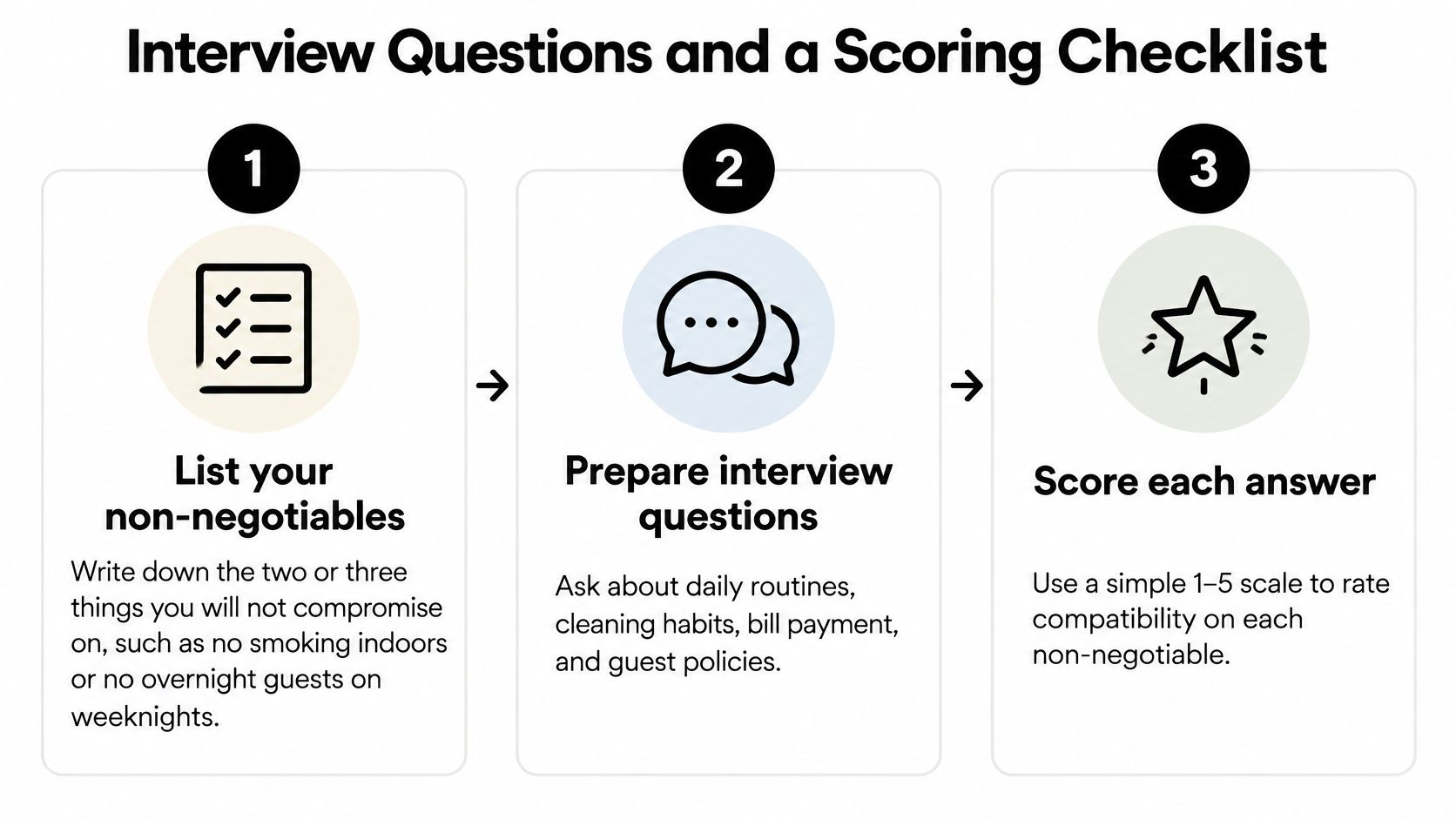
Work through the decision together
Write your requirements privately. Identify the conditions you can't compromise on, such as no indoor smoking or no unannounced overnight guests. Separate requirements from preferences so the other person knows what's negotiable.
Ask about ordinary situations. Use the same core questions for every candidate, then follow the answers rather than rushing through a script.
- Schedule: What time do you usually go to sleep on a work night?
- Cleaning: When dishes sit in the sink until the next day, what do you do?
- Money: How would you tell me that you might miss a payment?
- Guests: How often do you expect overnight guests, and how much notice would you need from me?
- Noise: Which activities at home require quiet, and when?
- Social life: What would a comfortable evening at home together look like?
- Conflict: If we disagree about the thermostat, how would you like to raise it?
- Exit expectations: What would make you want to move out early?
Score the quality of the fit. Use categories such as incompatible, unresolved, workable with conditions, and aligned. These are decision aids, not a scientifically validated prediction of household success. Record the reason for each rating so a pleasant conversation doesn't substitute for an actual answer.
Weight what affects your daily life. Give greater importance to the dimensions that affect your sleep, work, finances, privacy, or ability to use shared spaces. Keep separate notes for schedule, shared-space norms, finances, privacy, and communication rather than hiding a serious mismatch inside an overall average.
Apply the veto. If a core requirement fails, stop. Don't use strong scores elsewhere to cancel out an arrangement you already know you can't accept.
Turn answers into commitments
Before treating an answer as settled, write down the proposed arrangement. Your confirmation checklist should include:
- Sleep window: When each person needs protection from household noise.
- Cleaning rota: Who owns each task and what completion means.
- Bill split: Contributions, account holders, and reimbursement deadlines.
- Guest policy: Notice, overnight stays, and use of common areas.
- Quiet hours: The activities covered and any agreed exceptions.
- Escalation step: What you'll do when a direct conversation doesn't resolve an issue.
General answers need a follow-up before they count. If someone describes themselves as pretty clean, ask how they handled dishes, bathroom cleaning, and rubbish in their previous home. Then offer your own concrete answer so the interview remains reciprocal.
Red Flags and Questions You Cannot Ask
Pay attention when a candidate refuses any reasonable discussion of payment ability, blames every previous roommate, or pressures you to sign before you've settled the terms. Vague guest expectations and an inability to describe a resolved disagreement also deserve follow-up.
A concern isn't proof of wrongdoing. Someone may reasonably refuse to share sensitive documents with a stranger while agreeing to an appropriate, secure verification process.
Assess conduct without demanding sensitive disclosures
Roommate populations include people at many life stages. SpareRoom market figures reported by Yahoo Finance show the share of users aged 45 and older approaching one quarter. Don't assume someone's routines, income source, or social needs from their age.
Keep screening focused on the proposed living arrangement. Questions about religion, sexual orientation, disability, national origin, family status, age, and similar personal characteristics can create discrimination risks; which characteristics and rules apply depends on the location and housing arrangement.
| Avoid using as a shortcut | Ask about the household need instead |
|---|---|
| Age as a proxy for quietness | What noise levels do you prefer during the day and evening? |
| Medical history as a proxy for suitability | Does the layout work for your needs? You don't need to explain why. |
| Relationship identity as a proxy for visitors | What guest arrangements would you want? |
| Nationality as a proxy for communication | How would you prefer us to discuss household problems? |
For landlords, fair housing definitions provide a starting point for understanding the distinction between legitimate screening criteria and discriminatory treatment. Check local guidance before selecting screening questions rather than assuming a shared-home exception applies.
Make power and access explicit
A roommate who controls the lease, deposit, or keys shouldn't get to invent rules after everyone moves in. Agree on bedroom access, emergency entry, spare keys, visitors, and the process for requesting any lock change, subject to the lease and local rules.
Safety boundary: Nobody should have to disclose a diagnosis, identity, or personal history to justify an ordinary request for privacy.
If someone dismisses consent, threatens retaliation, or insists on unrestricted bedroom access, don't treat that as a minor preference mismatch. Pause the arrangement and resolve the concern before proceeding.
Lease Structure and Landlord Matching Practices
Read the lease before deciding who carries the financial risk. A private roommate agreement can organize contributions, but it doesn't automatically change what a landlord can require under the signed lease and applicable law.
Lease structures and who carries the risk
| Lease structure | Who owes the full rent | Replacing a roommate |
|---|---|---|
| Joint and several lease | Each tenant can be held liable for the full rent, subject to applicable law | Usually needs landlord approval and a new signature |
| Individual leases for each room | Each tenant generally owes the rent specified in their own agreement | Landlord manages the vacancy and separate agreements; departure still follows lease terms |
| Lease amended to add a roommate | Liability follows the original lease and amendment, which both tenants sign | Needs landlord approval; unchanged lease terms carry over |
Adding a name isn't enough by itself. Confirm whether the amendment makes the newcomer a tenant with payment obligations or records an authorized occupant.
For an accessible explanation of the document's basic components, the Royal LePage Brookside Realty lease guide is a useful starting point. Apply the requirements of the property's jurisdiction rather than treating a general guide as local legal advice.
Confirm the home can accommodate the arrangement
Local occupancy restrictions can prevent an otherwise workable match. Pew Charitable Trusts' housing analysis notes that some U.S. jurisdictions restrict households to as few as two unrelated occupants.
Check applicable occupancy, zoning, and rental requirements before advertising a room or accepting a deposit. A spare bedroom doesn't establish that another occupant is permitted, and an informal promise from an existing tenant doesn't replace landlord approval where approval is required.
Use a consistent landlord process
Landlords should keep compatibility assessment separate from eligibility screening. Whether applicants like hosting dinner together is different from whether they satisfy lawful, consistently applied rental criteria.
- Set written criteria: Apply the same relevant income, rental-history, and other lawful requirements to each applicant.
- Obtain authorization: When we run a report on an applicant, the landlord must certify that they have the applicant's written authorization. Resolve consent before ordering a report.
- Compare household expectations: Give prospective roommates the same questionnaire and let them review the proposed shared-home arrangements.
- Document the result: Retain the agreed terms and record who accepted them, without collecting unnecessary sensitive information.
The lease should identify tenants and authorized occupants, state permitted occupancy consistently with applicable law, and explain how replacements receive approval. Address deposit accounting, departing tenants, and any release from liability explicitly. A replacement moving in doesn't by itself establish that the departing tenant has been released.
Confirm the Match Before You Move In
A promising conversation isn't the final decision. Use these checks before anyone commits.

Test realistic scenarios. Meet over coffee or walk through the home. Discuss a late night before an exam, an unannounced visitor, and a delayed bill. Notice whether each person listens and negotiates, not just whether they initially agree.
Complete consistent checks. Verify identity and obtain appropriate references through the same lawful process for everyone. Our Roommate Finder uses AI to match renters by budget, location, and lifestyle; identity verification is separate. Matching isn't proof of identity or reliability.
Finish the paperwork. Confirm that the household agreement, financial arrangement, and replacement terms are completed and signed. Use the roommate rental application guide to prepare the application stage without confusing it with a compatibility decision.
Schedule an early review. Put a post-move-in meeting on the calendar to review actual bills, guests, and quiet-hour arrangements before frustrations become established habits.
Go when essential conditions hold, the budget survives a difficult month, checks are satisfactory, and everyone accepts the written terms. No-go when any essential condition fails or a material verification concern remains unresolved.
VerticalRent offers free roommate matching tools to help renters compare potential housemates by budget, location, and lifestyle. Visit VerticalRent to begin your search, then use these behavioral questions and financial checks before committing to a shared lease.
Put this into practice
VerticalRent tools related to this guide
Legal Disclaimer
VerticalRent and its authors are not attorneys, CPAs, or licensed legal or financial advisors, and nothing on this site constitutes legal, tax, or professional advice. The information in this article is provided for general educational purposes only. Landlord-tenant laws, eviction procedures, security deposit rules, and tax regulations vary significantly by state, county, and municipality — and change frequently. Nothing on this site creates an attorney-client relationship. Always consult a licensed attorney or qualified professional in your jurisdiction before taking any action based on information you read here.
Co-founded VerticalRent in 2011, growing it from nothing to 100k landlords and renters. Sold it in 2019, then re-acquired it in 2026 to make it better than ever.


