Roommate Rental Application: A Complete Guide
Learn how a roommate rental application works, what fields it must include, screening best practices, legal rules, and landlord……


Three friends find a two-bedroom rental that fits their budget and apply together. The landlord has three incomes to review, three adults who may need to authorize screening, and one household whose rent obligations will depend on the lease. The roommates, meanwhile, may assume each person is responsible only for their agreed share.
That mismatch is where many roommate rental applications go wrong. A solid process evaluates each adult fairly, records household details separately, and makes the lease's liability structure clear before anyone signs. It also gives the landlord a consistent way to verify identity and income without treating legitimate differences in applicants' circumstances as automatic red flags.
What a Roommate Rental Application Actually Covers
A roommate rental application is not one standard form copied for every person. It combines household-level information, such as the proposed address and number of occupants, with separate screening and consent for each adult applicant. HUD guidance supports that distinction: each proposed adult occupant should be treated as a separate applicant for screening and consent, while the landlord collects household information separately (HUD guidance on rental-housing screening).
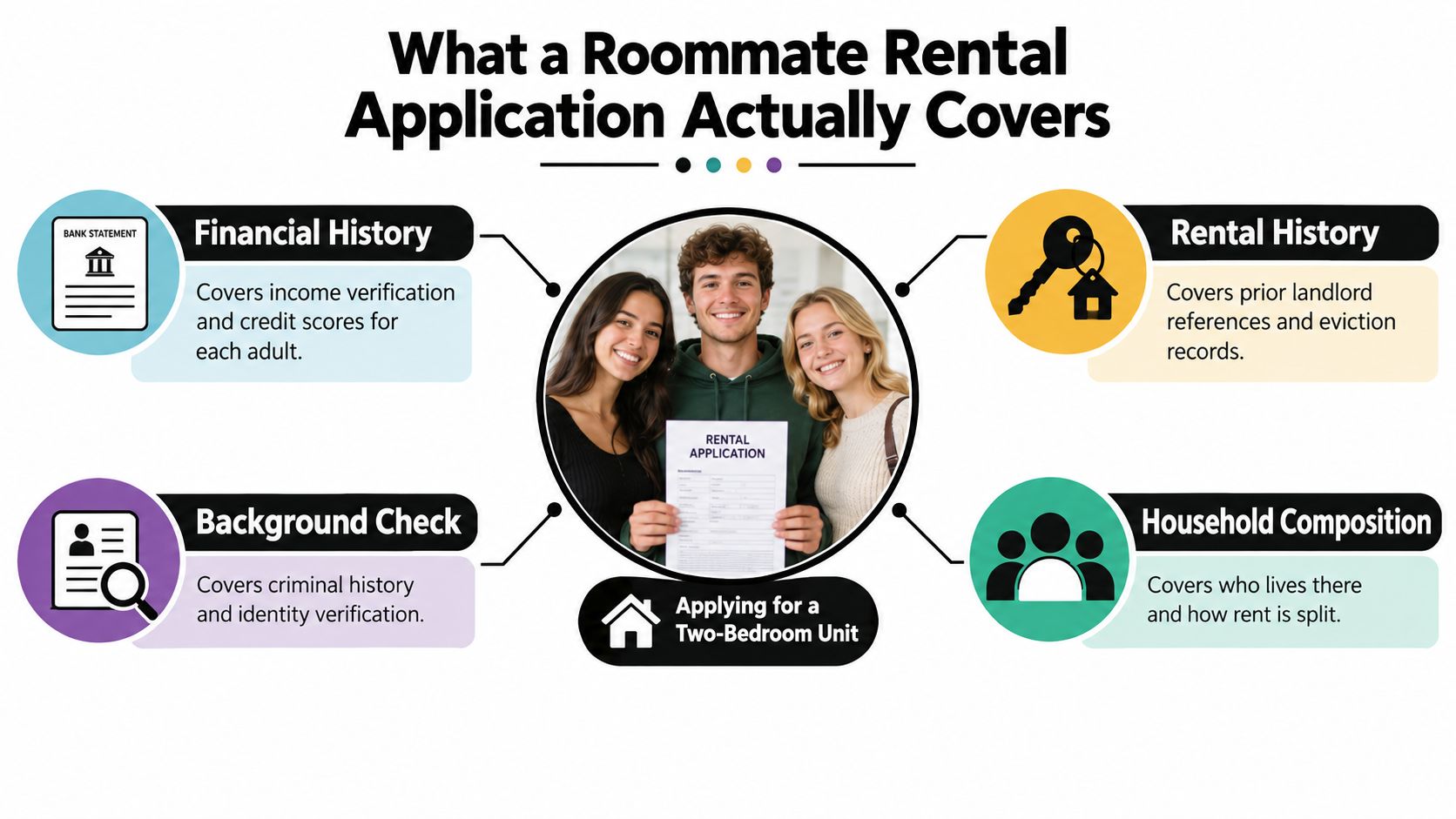
The distinction matters because the landlord is making related but different decisions. They need to assess whether the proposed household meets the rental criteria, and whether each adult who will live there has completed the required application and consented to any consumer-report checks. Combining everything into one household form can obscure whose income, rental history, or report led to a decision.
Lease structure adds another layer. If everyone signs one joint lease, roommates may be responsible for the full rent and other lease obligations, not just their own informal share. If each person signs a separate lease, responsibility may be more individual, but the landlord must manage each agreement accordingly. The application should make clear who is applying, who will sign, and whether anyone is instead an occupant, guarantor, or subtenant.
A well-organized process protects both sides. Landlords can document how they assessed the household and each adult; applicants can see what information is being requested and what obligations they may take on. That clarity is especially useful when a roommate later moves out or a replacement is proposed.
Co-Tenant, Occupant, Guarantor, and Subtenant
The application should identify each person's legal role before screening begins. A name on a form doesn't, by itself, explain who owes rent or who has permission to live in the unit.
- Co-tenant: A person who signs the lease as a tenant. On a joint lease, co-tenants may be responsible for the entire rent and other lease obligations. Three friends signing one lease should confirm whether the landlord can seek the full unpaid amount from any signer.
- Occupant: A person approved to live in the unit but not necessarily a leaseholder. An occupant may have permission to reside there without taking on the same contractual payment obligations as a co-tenant. The lease and local law determine the details.
- Guarantor: Someone who agrees to meet specified financial obligations if the tenant doesn't. For example, a parent might guarantee a student's lease. The guarantor's responsibility comes from the guarantee agreement, not from being listed as an occupant.
- Subtenant: Someone who rents from a tenant rather than directly from the property owner. The original tenant may remain responsible to the landlord for rent and damage, so the arrangement should be disclosed and authorized as required by the lease.
Practical rule: Don't use “roommate” as a substitute for a legal role. Record who will live in the unit, who will sign, and who is financially responsible.
The lease structure must match those roles. A joint lease places multiple tenants under one agreement; separate leases assign obligations individually, often by room. A guarantor supports a tenant's obligations but doesn't automatically become a co-tenant. Spell out the arrangement before approval so a later move-out or payment dispute doesn't leave everyone relying on different assumptions.
Required Fields and Household-Level Information
Use two layers of information: one for the proposed household and one for each adult. This keeps the application organized and makes it easier to spot gaps without confusing one roommate's records with another's.
At the household level, collect the rental address, intended move-in date, proposed number of occupants, pets, vehicles, and any requested parking or unit preferences. If the group expects to split rent or utilities in a particular way, record that as planning information, not as a substitute for the lease's payment terms.
For each adult, collect the legal name, contact details, employment or income information, rental history, references, and any information needed to identify the correct consumer report. A Social Security number may be requested where legally appropriate and handled securely; don't treat a particular identification number or document as universal proof of eligibility. If an applicant has a different documentation situation, give them a clear way to discuss acceptable alternatives.
| Field | Layer | Purpose | Validation Tip |
|---|---|---|---|
| Rental address and move-in date | Household | Identifies the proposed tenancy | Confirm the group is applying for the same unit and terms |
| Occupants, pets, and vehicles | Household | Clarifies who and what will be at the property | Compare with the lease and property rules |
| Legal name and contact details | Per adult | Identifies each applicant | Ask the applicant to check spelling against their documents |
| Income and employment | Per adult | Supports the stated ability to meet tenancy obligations | Offer appropriate options for nontraditional income |
| Rental history and references | Per adult | Provides context on prior tenancies | Confirm references belong to the named applicant |
| Prior addresses | Per adult | Helps reconcile identity and rental records | Ask applicants to explain gaps or name variations |
Don't ask every person to submit the same household information separately. Conversely, don't let one roommate complete screening consent on behalf of the others. Keep private personal data limited to what the process needs, and explain how applicants can provide it securely.
FCRA-Compliant Screening Criteria for Roommate Groups
Write the screening policy before applications arrive. HUD guidance recommends limiting screening to information relevant to whether an applicant is likely to comply with tenancy obligations. For a roommate group, that means applying documented standards to each adult and assessing household-level information separately, rather than relying on a broad or arbitrary sweep of personal data.
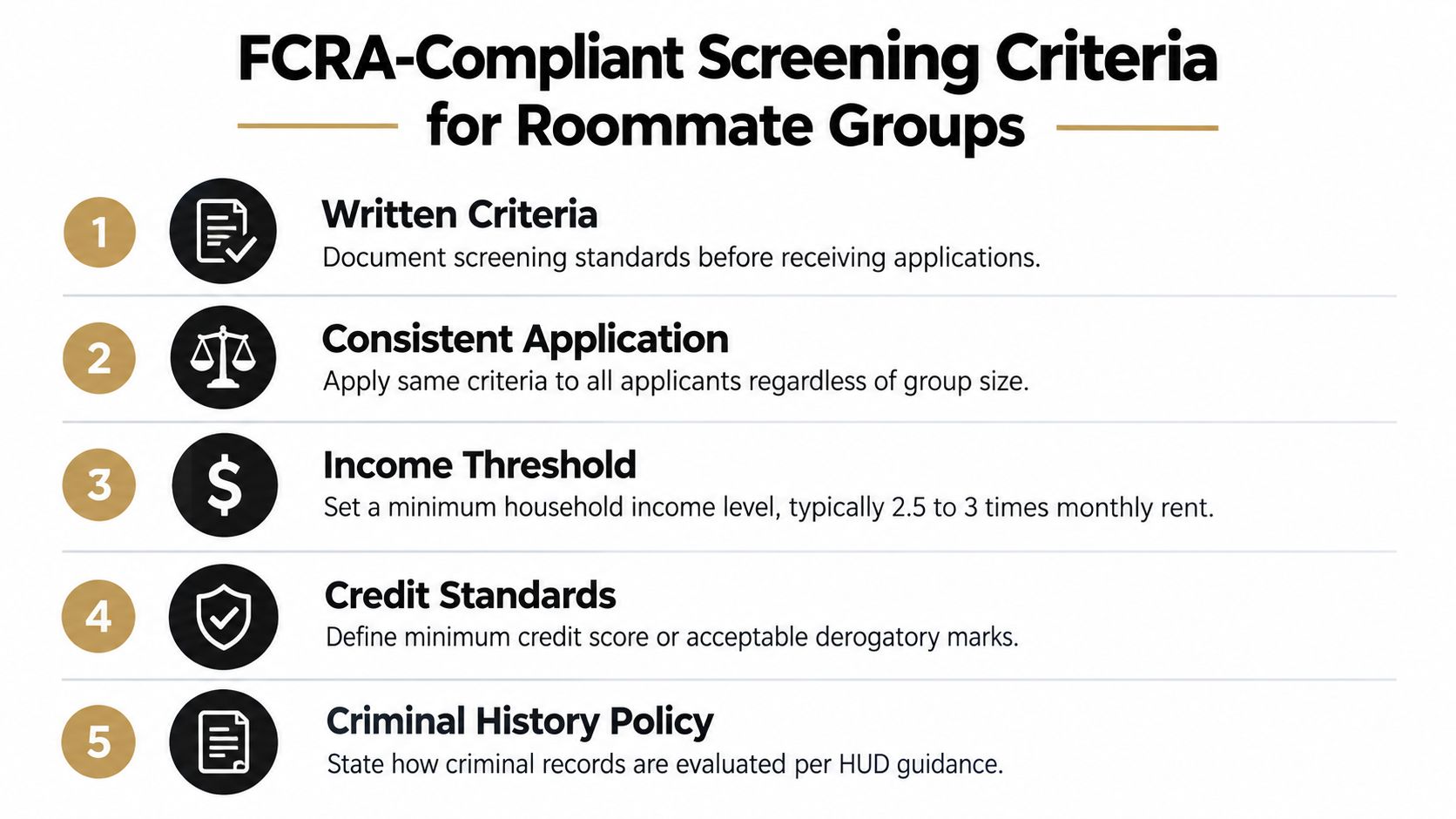
Defensible criteria can include verifiable income, rental payment history, identity consistency, and credit information that can legally be used for the housing decision. The landlord should say how each factor will be assessed and how a concern can be clarified. A policy that says “review income and rental history” is more useful than an unexplained rule that rejects anyone whose circumstances don't resemble those of a typical salaried applicant.
Apply the same criteria to similarly situated applicants. Don't use protected characteristics, or proxies for them, as substitutes for tenancy-related evidence. For example, an applicant's name, national origin, family status, or other protected trait shouldn't change how the landlord interprets an employment gap or a credit file. Criminal-history decisions also require a relevant, legally appropriate policy rather than an automatic, unexplained exclusion.
Screening works best when the landlord can point to a written rule, the specific information reviewed, and the tenancy obligation that rule is meant to assess.
Screening criteria also need to fit the lease structure. A landlord deciding whether a household can meet the full rent may set a household-level standard, but should still evaluate each adult under written, consistently applied rules. For an overview of how rental requirements can vary by property and location, see this practical guide to rental screening requirements in the suburbs. Whatever standards you use, disclose them clearly and don't improvise after seeing who has applied.
Per-Adult Consent and the FCRA Adverse Action Workflow
Before requesting a credit, eviction, criminal, or other consumer report, the landlord needs a permissible housing purpose and clear authorization from the adult being screened. Use a screening provider certified for housing decisions, and don't assume one roommate's consent covers everyone else. The FTC's landlord guidance on consumer reports explains the responsibilities that apply when landlords use these reports.
A workable process is straightforward:
- Collect authorization from each adult. Match each signed consent to the right applicant and requested report.
- Confirm the housing purpose. Record that the report is being obtained for a rental decision and use a provider certified for that purpose.
- Apply the written criteria. Keep the standards used, the report version or retrieval date, and the decision reason for each adult.
- Send a notice when required. If a consumer report contributes partly or entirely to a denial, a co-signer requirement, a rent or deposit increase, or another unfavorable condition, that action is an FCRA adverse action.
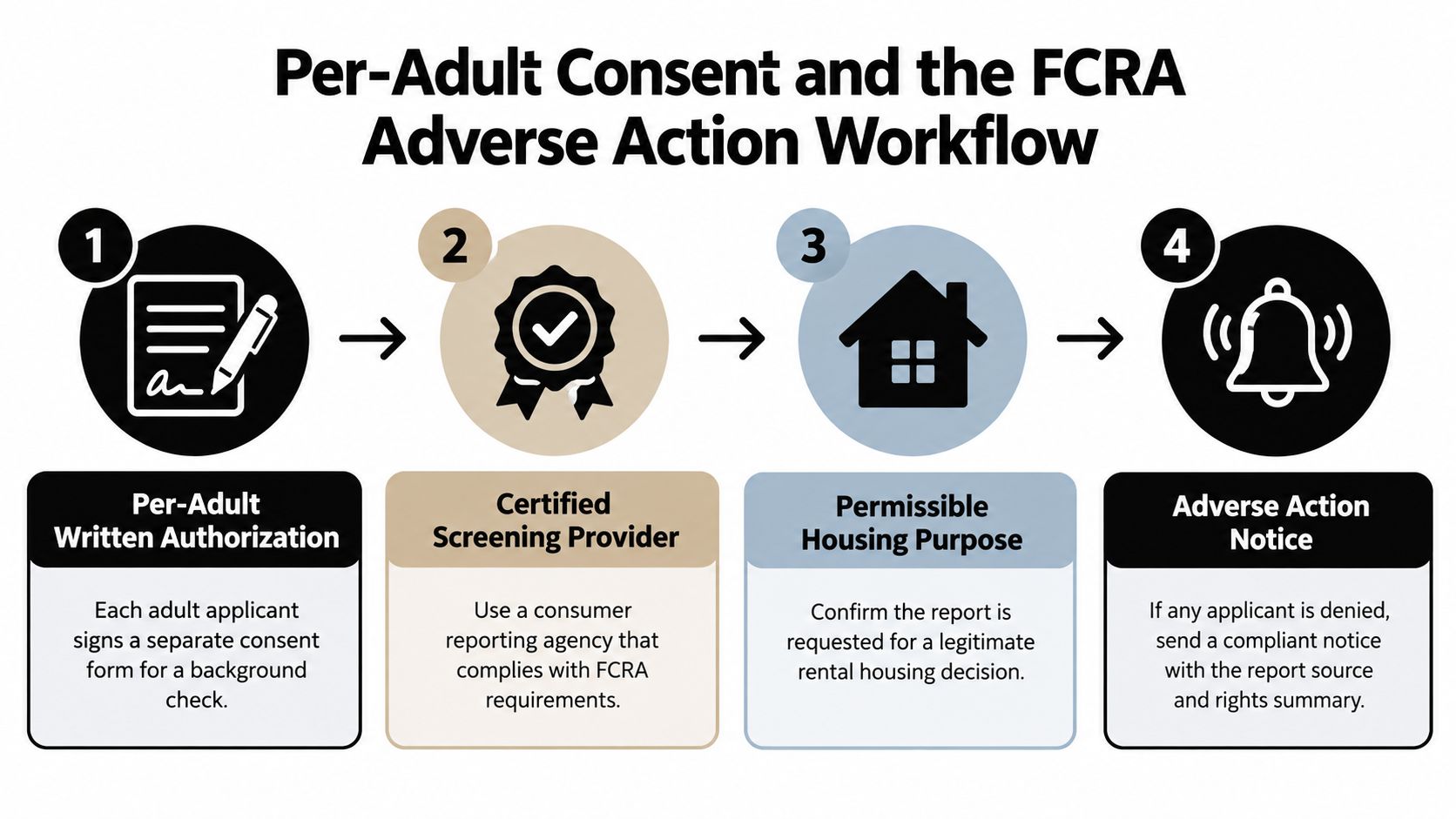
For an adverse-action notice, include the consumer-reporting company's name and contact details, explain that the company didn't make the housing decision, and tell the applicant about their right to dispute inaccurate or incomplete information and obtain a free copy of the report within the applicable period. A durable written or electronic record makes it easier to show what was sent and when. Landlords handling denials can also review this guide to an adverse action letter.
Keep the decision file for each adult, not just a household-level “approved” or “declined” note. Record the criteria, relevant report details, decision rationale, and communications. That way, if one person's report changes the terms for the group, the landlord can explain the decision and provide the correct notice.
Identity and Income Verification Across Roommate Groups
A roommate group can be financially strong overall and still contain conflicting application details. One person may have recently changed jobs, another may be self-employed, and a third may rely on family support. The job isn't to treat every unusual document as fraud. It's to verify each person's information consistently and provide a manual-review path when standard records don't fit.
The fraud concern is real, but it shouldn't become a shortcut for rejecting an entire household. A National Multifamily Housing Council survey found that 70% of housing providers had encountered identity-related fraud, and reporting cited by Business Insider found that nearly 24% of evictions over a three-year period were linked to fraudulent applications and related nonpayment (summary of rental application fraud reporting). Those figures support careful verification, not an assumption that applicants with nontraditional paperwork are dishonest.
Compare information across sources, and ask for clarification when details don't line up:
- Identity: Check whether the name and identifying details are consistent across the application, identification, credit file, and rental history. Give applicants a chance to explain legitimate name or address differences.
- Income: For a salaried applicant, compare employer details and pay records. For self-employment or family support, ask what alternative records are available rather than insisting every applicant produce identical documents. This overview of income verification for tenants beyond the 3x rent rule discusses why one income measure may not fit every applicant.
- Addresses and rental history: Ask about gaps, recent moves, or a prior address that appears differently across records. A discrepancy calls for follow-up, not an automatic household rejection.
A clean-looking document isn't conclusive proof, and a mismatch isn't conclusive proof of fraud. Give applicants specific questions and a fair way to respond. Then record what was checked, what was clarified, and how the result was assessed.
Joint Lease vs Separate Lease vs Guarantor Decision Guide
Choose the lease structure based on how you intend to allocate responsibility, not on which application is easiest to process. A joint lease is straightforward for the landlord, but roommates may wrongly think each owes only their agreed portion. Separate leases can make individual responsibility clearer, although the landlord must manage each agreement and handle shared spaces carefully.
| Structure | Liability | Eviction Mechanics | Screening Approach | Best Fit |
|---|---|---|---|---|
| Joint lease | Signers may be responsible for the full rent and lease obligations | Enforcement may affect the tenancy as a whole, subject to applicable law | Screen each adult; evaluate the household under written criteria | Groups willing to share contractual responsibility |
| Separate leases | Each tenant's obligations are set out individually | Actions generally follow each person's lease and local law | Assess each applicant against the individual lease terms | Room-by-room rentals with clear boundaries |
| Guarantor arrangement | Guarantor's duties depend on the guarantee agreement | The tenant's lease and guaranty govern; don't assume the guarantor is a resident | Screen tenants and assess the guarantor for the promised obligation | A tenant who needs financial backing |
Consider three roommates with unequal incomes. A joint-lease landlord might assess whether the household can meet the rent while also checking each adult under the same tenancy-related criteria. That can work if the group understands that an internal rent split doesn't necessarily limit what the landlord can enforce against a signer. A landlord using separate leases can assess each person's room and lease obligations individually, but must define how shared utilities, common areas, and vacancies will be handled.
A guarantor may help when a tenant can't independently meet a stated financial standard, but the guarantee should spell out its scope. Don't treat the guarantor as a substitute for screening other adult occupants, or as someone who automatically has permission to live in the unit.
Before choosing, ask whether the property will be rented as one household or as separate rooms, who will be named on the contract, and what happens if a roommate leaves. Put the answers in writing and make sure the application reflects the same arrangement.
How Landlords and Applicants Should Evaluate Co-Tenants
Start by testing the household's practical ability to meet the lease, then evaluate each adult under the same written criteria. If the landlord uses combined household income, explain that method before applicants submit documents. If each person must qualify individually, say so just as plainly. Neither method should be invented after the group's circumstances become visible.
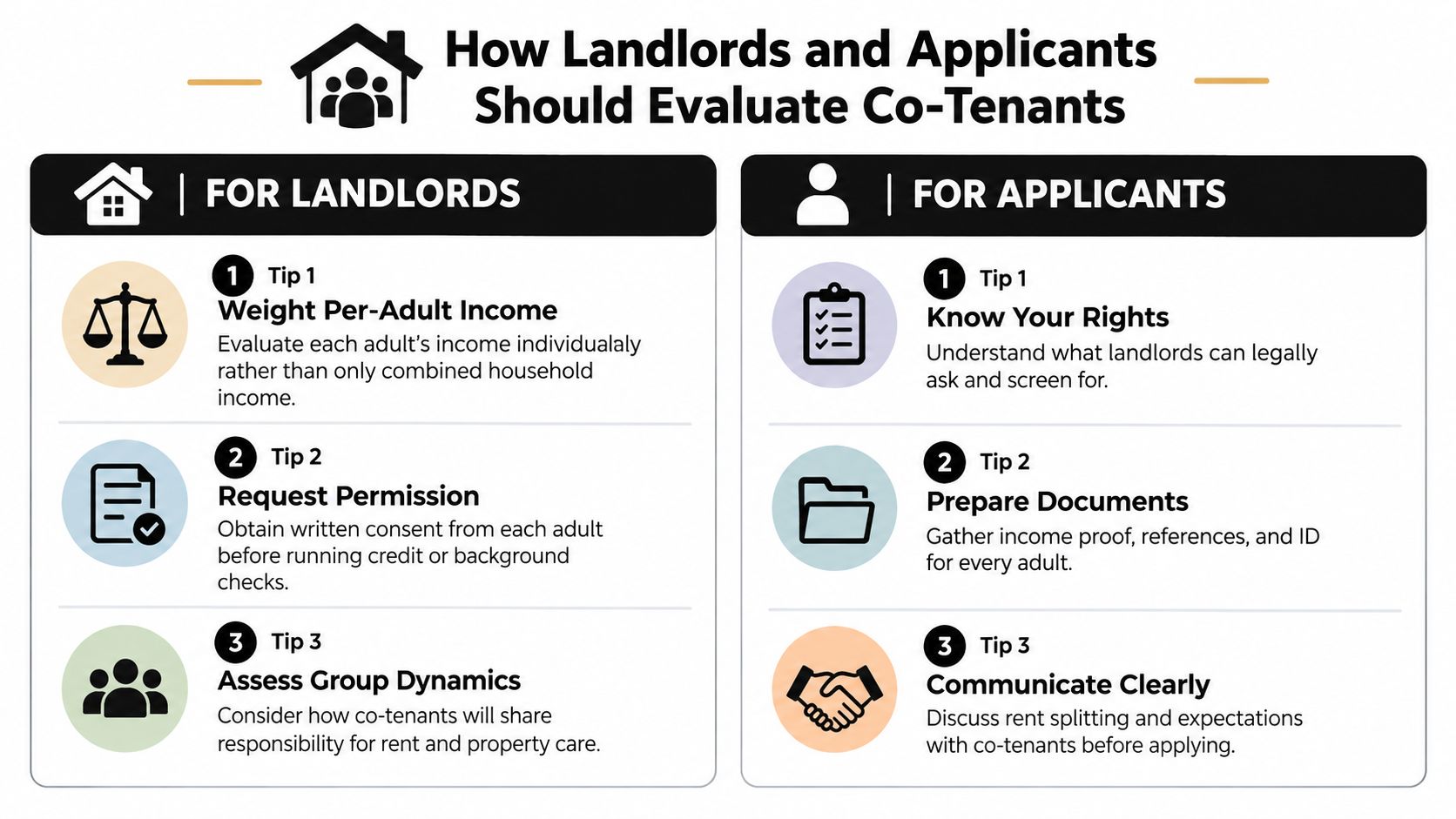
A practical review can include permission to contact each applicant's landlord, with questions focused on tenancy obligations: payment patterns, property care, and whether the applicant followed lease terms. A reference call shouldn't become an informal search for personal information unrelated to the rental decision. Applicants should also talk among themselves about how they'll handle rent, guests, quiet hours, chores, and shared areas before signing.
Roommate replacements require care. Treat a proposed new resident's application as a new applicant's file, not as a reason to automatically re-screen the remaining tenants. Document whether the replacement will be a co-tenant, occupant, guarantor, or subtenant, and clarify how the lease, guaranty, and any deposit arrangements will change. The original agreement may remain in force unless the landlord formally changes it, so don't rely on a private promise between roommates.
Useful context for owners setting expectations around shared housing is available in these renting out a room tips. In practice, warning signs worth clarifying include undisclosed occupants, unexplained identity inconsistencies, and a group that can't agree on who will sign or how the rent will be paid. A concern should lead to a specific question and a documented review, not an automatic conclusion about the whole household.
Fair Housing and Disclosure Rules That Shape Roommate Applications
Apply fair-housing protections to the screening process from the first inquiry through the lease decision. Federal protections include race, color, national origin, religion, sex, familial status, and disability; state and local rules may add protections, including source of income. Requirements can vary by location and housing type, so landlords should check the rules that apply to the property rather than assume one form works everywhere.
Ask questions tied to occupancy and lease administration, not curiosity about an applicant's personal life. You can ask who will live in the unit and whether applicants agree to the disclosed lease terms. Avoid questions that probe protected characteristics or invite different treatment based on an applicant's family situation, identity, or background.
Occupancy standards should be based on the property and applicable law, and applied consistently. A landlord who lives in the property may be subject to different rules or exemptions, but shouldn't assume that owner occupancy removes every fair-housing obligation. Seek local legal advice when an exemption or accommodation question affects a decision.
Keep disclosures neutral and relevant. For example, an application can ask applicants to acknowledge the property's smoking policy or disclose pets or assistance animals through the appropriate process. Criminal-history questions should follow a written, legally appropriate policy, and the landlord should avoid blanket exclusions that don't account for relevance and applicable requirements.
A useful test is whether the same question and decision rule would be used for every similarly situated applicant. If not, pause before collecting the information or acting on it. Remove questions that don't serve a legitimate tenancy purpose, and make the criteria available before applicants pay fees or authorize reports.
Application Fees, Refunds, and Jurisdiction Limits
Application-fee rules vary by jurisdiction, so a roommate form shouldn't impose one fixed charge everywhere. California offers a concrete example: the cited current legislative text permits a screening fee only for specified screening-related costs and sets a statutory maximum of $30 per applicant. Local rules may add requirements, so landlords should verify the law that applies to the property before collecting fees.
For a group application, tell applicants the fee for each person and the household total before payment. Explain what the fee covers, how it will be used, and when a refund may be due. Where charging a fee when no unit is available is prohibited, don't collect it. Keep receipts, itemized costs, refunds, and consent records with the application file.
An application-fee policy should say who pays, when payment is due, which screening costs may be recovered, and how unused amounts are handled. It should also explain whether every adult must submit a separate application and fee, without suggesting that payment guarantees approval.
Applicants can ask what the fee covers, whether it is refundable in their situation, and whether the landlord has an available unit. Landlords comparing processes can also consult this guide to rental application fees. Because local requirements can change, confirm current rules before publishing a form or collecting money.
Roommate Rental Application Quick Reference Checklist
Use this checklist before opening the application, and revisit it when a roommate changes.
- Household: Are the address, occupants, pets, vehicles, and proposed move-in details recorded?
- Roles: Does each person know whether they'll be a co-tenant, occupant, guarantor, or subtenant?
- Criteria: Are written screening standards relevant and consistently applied?
- Consent: Has each adult authorized any consumer report requested about them?
- Decision: Are report details, criteria, reasons, and notices recorded for each applicant?
- Fees: Are charges disclosed, lawful for the location, and documented?
- Changes: Is there a written process for approving a replacement roommate?
- Records: Can the landlord retrieve the application, consent, decision, and communication history?
For a broader landlord workflow, these tenant screening tips for landlords offer useful context. The key is to keep one clear record of the household decision and a separate, traceable record for each adult.
Frequently Asked Questions About Roommate Rental Applications
Does every adult in the household need to apply?
Treat each proposed adult occupant as a separate applicant for screening and consent purposes. Whether each person must sign the lease depends on the lease structure and applicable rules, so clarify their role before screening.
How long can a landlord take to decide?
There isn't one universal decision deadline for every rental. Tell applicants what to expect, process complete applications consistently, and check any state or local requirements that apply.
What if one roommate doesn't pass screening?
Review that applicant's information against the written criteria, and give them a chance to address a possible error. If a consumer report contributes to a denial or another unfavorable condition, send the required adverse-action notice. Decide separately whether the remaining group still meets the disclosed terms.
Can the landlord require one applicant to qualify for the full rent?
A landlord may set a lawful, written standard for how rent capacity is evaluated, but shouldn't apply it selectively. State clearly whether the household is assessed collectively or each adult must meet an individual standard.
VerticalRent offers online rental applications with co-applicant support, document uploads, and application-status tracking, alongside tenant-screening tools for landlords. If you're organizing a roommate application or screening process, visit VerticalRent to see how its rental-management tools handle those tasks.
Put this into practice
VerticalRent tools related to this guide
Legal Disclaimer
VerticalRent and its authors are not attorneys, CPAs, or licensed legal or financial advisors, and nothing on this site constitutes legal, tax, or professional advice. The information in this article is provided for general educational purposes only. Landlord-tenant laws, eviction procedures, security deposit rules, and tax regulations vary significantly by state, county, and municipality — and change frequently. Nothing on this site creates an attorney-client relationship. Always consult a licensed attorney or qualified professional in your jurisdiction before taking any action based on information you read here.
Co-founded VerticalRent in 2011, growing it from nothing to 100k landlords and renters. Sold it in 2019, then re-acquired it in 2026 to make it better than ever.


