Risk Assessment Document: What It Is and What to Include
A risk assessment document records hazards, likelihood, impact, controls and owners. Learn what to include and how to write one that holds up.


You've approved a water heater repair, and the contractor asks why it wasn't treated as urgent. Meanwhile, an applicant wants to know why their screening result led to a rejection. You remember your reasoning, but the maintenance log says only “repair approved,” and the applicant file contains only a score.
A risk assessment document fills that gap. For a small rental portfolio, it doesn't need to be elaborate. It needs to preserve enough evidence that another person can understand your decision without relying on your memory.
What a Risk Assessment Document Records
A site manager can make a reasonable decision and still leave an inadequate record. Suppose you approve a repair because a contractor confirms the equipment can remain safely isolated until replacement. If you save only the approval, a later reviewer won't know about that safeguard.
A risk assessment document is a written record of a risk decision that shows what could go wrong, how likely it is, how serious it would be, what is done about it, who owns the action, and when it is reviewed.
Think of a pre-flight checklist. It doesn't stop turbulence, but a completed checklist and supporting flight record show that the crew considered conditions before proceeding. Your property records should make the same distinction between a decision and the evidence supporting it.
The paperwork can be simple, provided the reasoning remains visible.
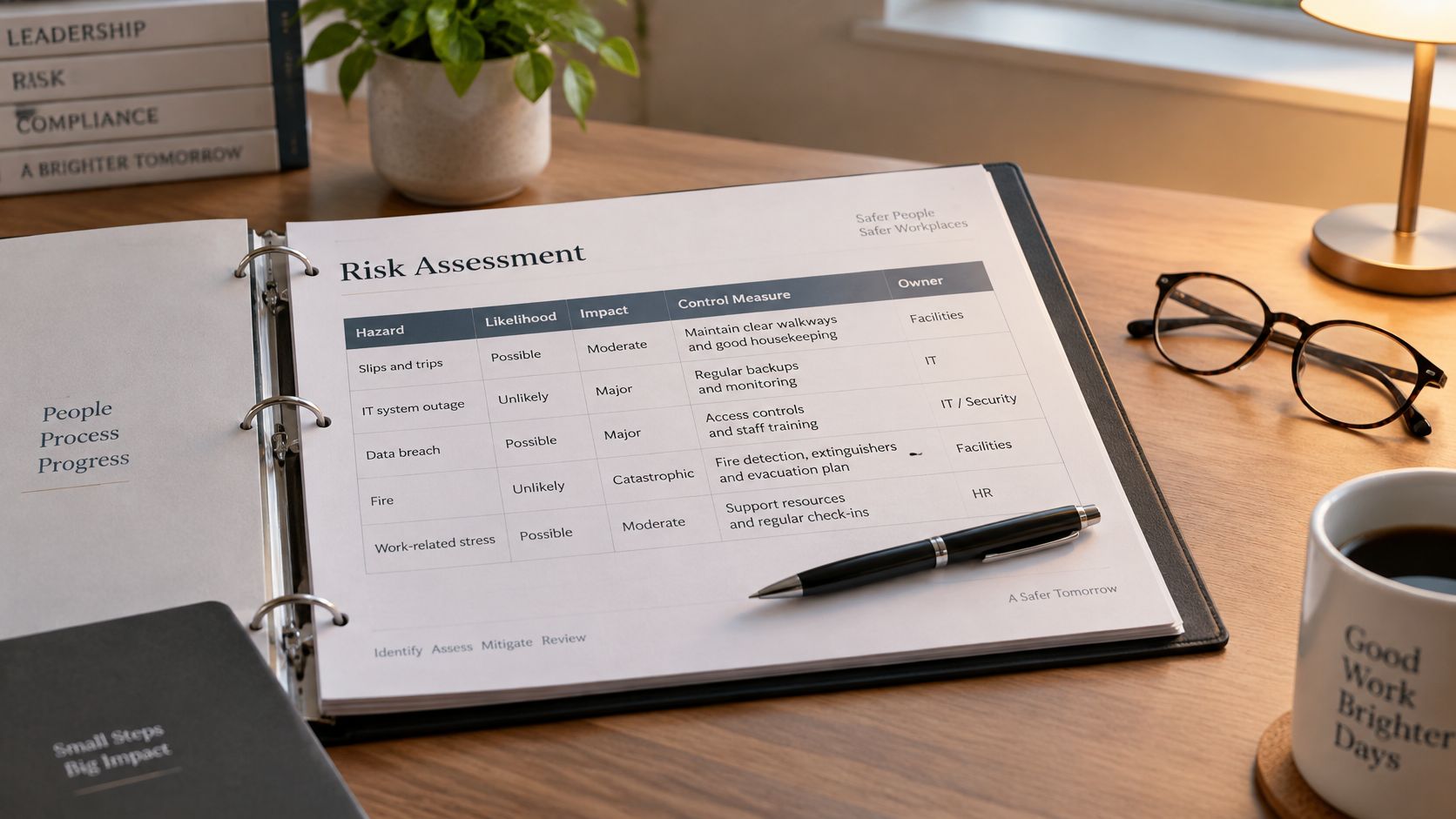
The assessment is the thinking
The assessment is your work of identifying a problem, evaluating consequences, and choosing a response. The document is the record of that work. Labels such as maintenance risk or tenant risk don't explain a failure mechanism, a control, or a decision.
ISO 31000 describes risk management through identification, analysis, evaluation, treatment, monitoring, and communication rather than prescribing a universal scoring formula. That means your document should identify the method you used, including how you defined ratings and decided which actions took priority.
A folder of completed forms isn't automatically useful evidence. Apply this test: Can someone who wasn't in the room see why each decision was made? If not, the missing information belongs in the record.
The Core Sections Every Risk Assessment Document Needs
Use this checklist to examine the contents of your document. The entries below are illustrative working examples, not prescribed inspection intervals or legal deadlines.
Components of a risk assessment document
| Component | What It Records | Sample Entry |
|---|---|---|
| Scope and context | Activity, asset or process covered, date and version | Water heater servicing, assessment date recorded, current version identified |
| Hazards and scenarios | Each cause-based scenario with trigger, exposure and consequence | Water heater valve fails and floods the unit below |
| Likelihood and impact | Rating for each scenario, with the reasoning kept | Medium likelihood, high impact, supported by inspection notes |
| Risk tier | Combined rating taken from the matrix | High |
| Existing controls | Safeguards already in place | Annual inspection log and tenant reporting line |
| Residual risk and actions | Risk left after controls and the planned fix | Flooding exposure remains; install an auto-shutoff valve within a proposed thirty-day action window |
| Owner and deadline | Named accountable person and completion date | Maya Patel, property manager; completion date entered in the action register |
| Review date and history | Next review, changes made and the reason | Proposed six-month review; revised after a tenant complaint |
Read from context to accountability
Scope and context prevent someone from applying an assessment to the wrong building or process. Hazards and scenarios explain the event being assessed, rather than naming a broad category.
Likelihood and impact preserve the supporting judgment. Risk tier records the result of applying the agreed lookup, not a different rating chosen by instinct.
Existing controls distinguish safeguards already operating from improvements you hope to introduce. Residual risk and actions show what remains unresolved. Don't reduce a rating merely because you've ordered a replacement part.
The final components make follow-through possible:
- Owner and deadline: Name a person, not maintenance or management. Without a completion date, an action can remain open indefinitely.
- Review date and history: Preserve what changed and why. Overwriting the previous entry removes the explanation for earlier decisions.
For a practical comparison with site approval paperwork, GM GROUP Services' venue sign-off risk checklist offers a related context for checking responsibilities before approval. Keep the assessment alongside your broader compliance documentation, with supporting files clearly identified.
Give each distinct scenario its own entry. Don't squeeze every hazard into a single building-wide row. Use the table for a short audit of your existing paperwork, marking missing evidence, unassigned actions, and overdue reviews.
Turning Likelihood and Impact Into a Risk Rating
Likelihood asks how plausible the event is within your chosen assessment period. Impact asks how serious the consequence would be if it happened. Define both before assigning ratings.
For a simple working scale, use these definitions:
- Low likelihood: A rare failure with no recent history and no current warning signs.
- Medium likelihood: A failure that has happened occasionally, or that current evidence makes plausible.
- High likelihood: A failure expected during the assessment period because warning signs or repeated failures are present.
- Low impact: A cosmetic repair or minor inconvenience.
- Medium impact: A service interruption, recoverable damage, or substantial repair work.
- High impact: Injury, a legal breach, or loss of a tenancy.
This visual separates the two judgments before combining them.
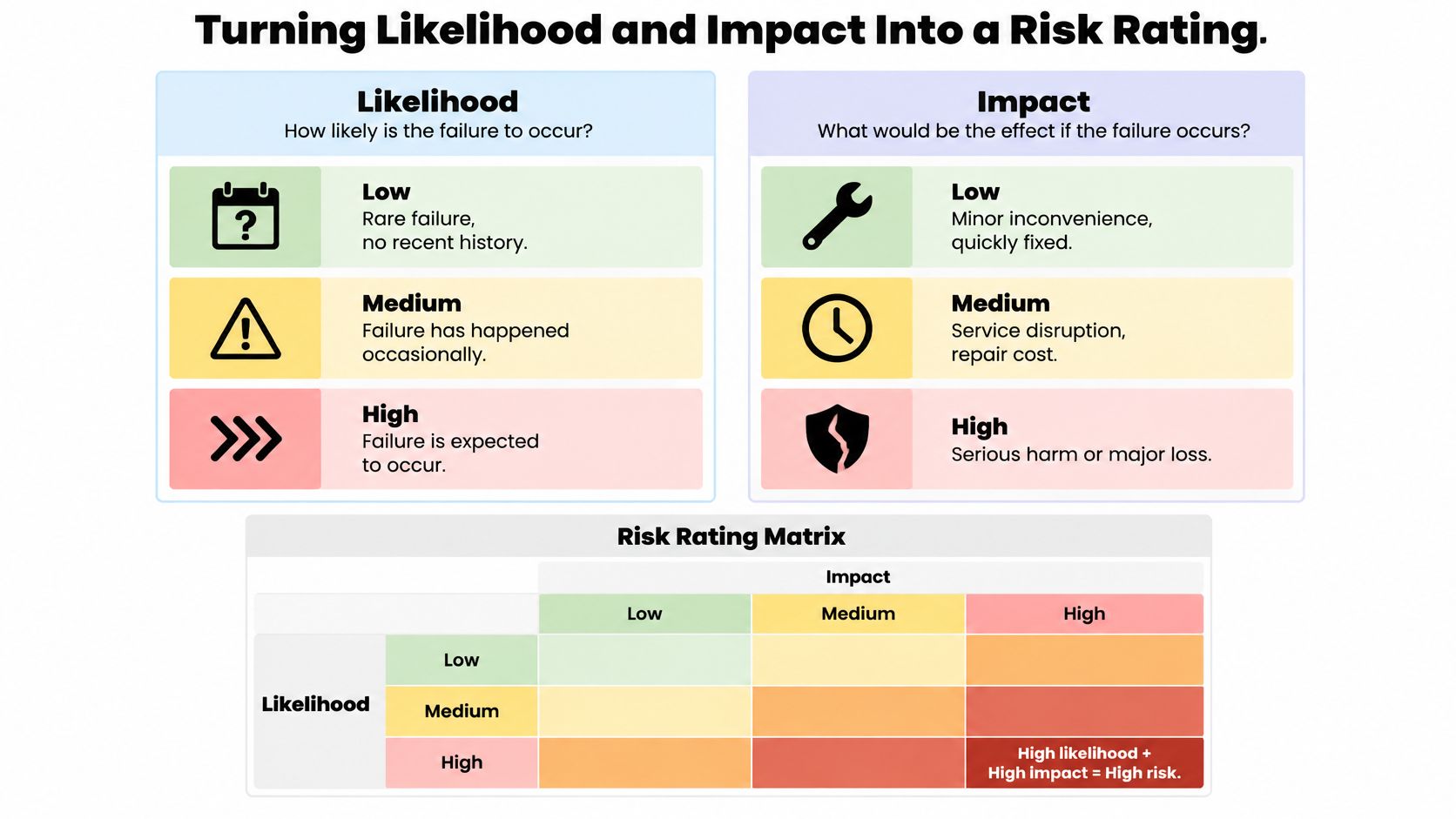
Use a defined lookup
The following is a proposed working matrix, not a universal formula.
Risk tier by likelihood and impact
| Likelihood | Low impact | Medium impact | High impact |
|---|---|---|---|
| Low | Low | Low | Medium |
| Medium | Low | Medium | High |
| High | Medium | High | High |
For this system, low means monitor, medium means schedule a corrective action, and high means act promptly with an interim control. An immediate safety concern still requires an appropriate emergency response, regardless of the table.
Say a water heater has documented deterioration and an uncertain inspection history. You assess likelihood as medium and impact as high because failure could cause flooding or scalding. The lookup produces a high risk tier.
NIST's risk-management methodology calls for documented likelihood and impact discussions, control recommendations, and results documentation. Save the inspection findings and assumptions, not just the final label.
Practical rule: A rating is a conclusion. Keep the evidence that allows someone else to question or reproduce it.
If you adopt a more detailed scale, preserve its definitions and version. A risk score is useful only when reviewers know what it measures and how it informed the decision.
How to Write One Risk Scenario Step by Step
Start with an observable sequence, not a category such as maintenance risk. OSHA's job hazard analysis guidance recommends examining where a hazard occurs, who is exposed, what triggers it, and what consequences and contributing factors follow.
The illustration summarizes the workflow. The routine below separates the details you should retain in the written entry.
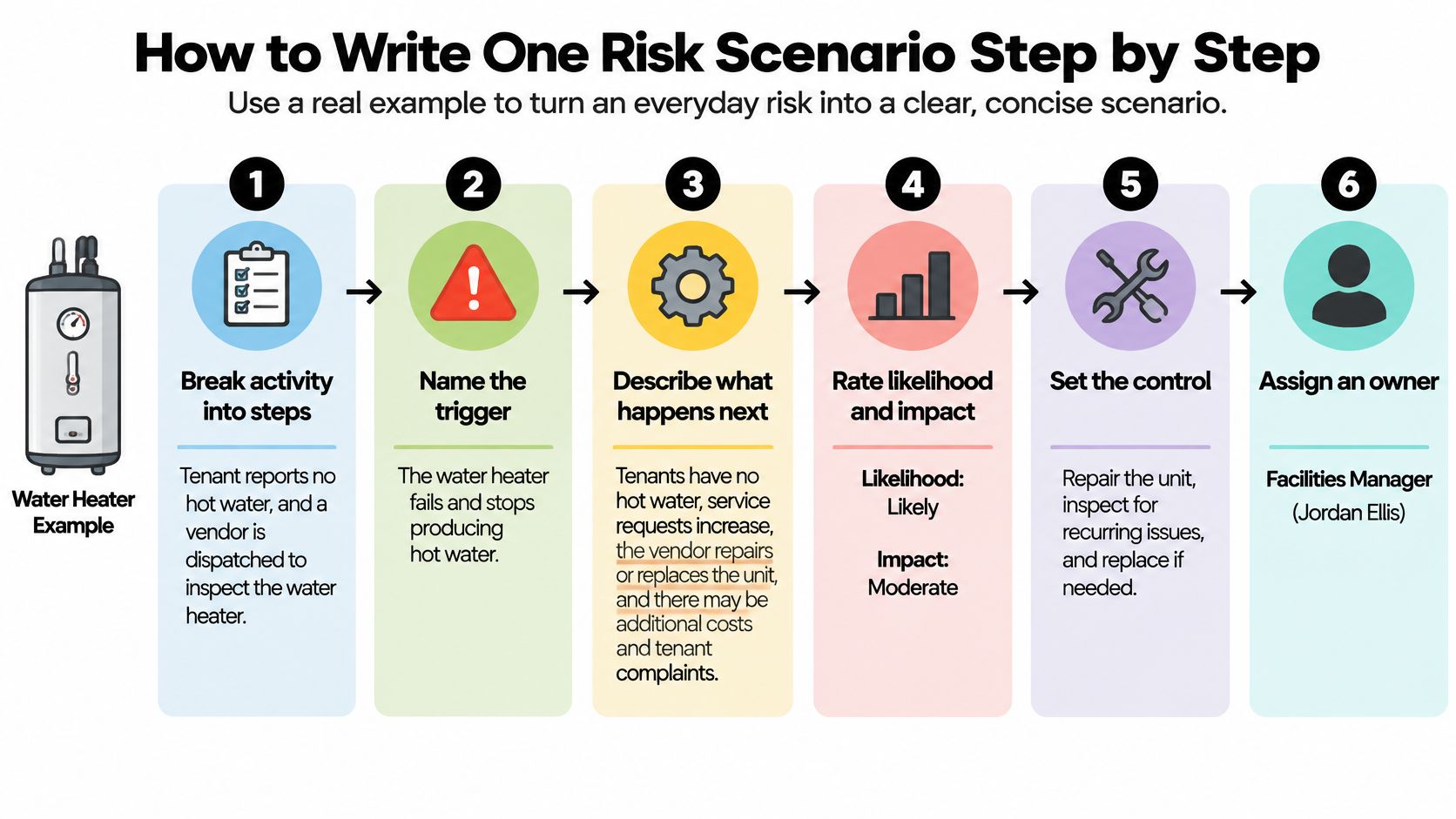
Build the causal chain
Break the activity into observable steps. Record the tenant reporting a hot-water problem, the manager reviewing it, and the vendor being dispatched. This exposes handoffs where information could be missed.
Name the trigger and failure mechanism. In this hypothetical case, corrosion weakens a valve and creates a leak. Mark corrosion as suspected until the contractor confirms it, rather than presenting an assumption as a finding.
Identify who or what is exposed. Include the tenant, children in the home, the attending vendor, and the unit below. The affected property isn't limited to the room containing the heater.
Describe the consequences. Record plausible scalding, flood damage, and interruption of occupancy. Don't treat every imaginable outcome as equally credible.
List current safeguards. Attach the inspection record and identify the tenant reporting channel. Check that those safeguards operate, rather than copying them from a policy.
Assign the initial rating. Use the agreed matrix and state whether the rating includes existing safeguards. For this example, medium likelihood and high impact produce a high tier.
Set an interim control. Arrange safe isolation by a qualified person and give the tenant clear emergency contact instructions. Don't ask a tenant to approach leaking hot equipment or operate an unfamiliar valve.
Define the permanent fix and owner. Name the manager responsible for arranging the contractor's recommended repair or replacement. Require completion evidence and a functional check before closing the action.
Set the review date. Schedule reassessment after repair verification, with earlier review if the leak worsens or isolation fails. Keep the previous entry so the change remains traceable.
Write the completed entry
A corroded water heater valve may fail, exposing occupants and the unit below to hot water and flooding; inspection findings support medium likelihood and high impact, producing a high initial tier. Maya Patel will arrange safe isolation and contractor repair by the recorded deadline, retain completion evidence, and reassess residual risk after the functional check.
That entry gives a reviewer something to examine. Maintenance risk alone doesn't.
Documenting AI Tenant Screening Decisions
An applicant is denied and asks why. The file shows a score, and nothing else. No one can say which record drove the outcome, which policy version applied, or whether a person checked a questionable match. A screening decision is auditable only when the reasoning sits next to the result.
Keep the underlying report and the decision record distinguishable.
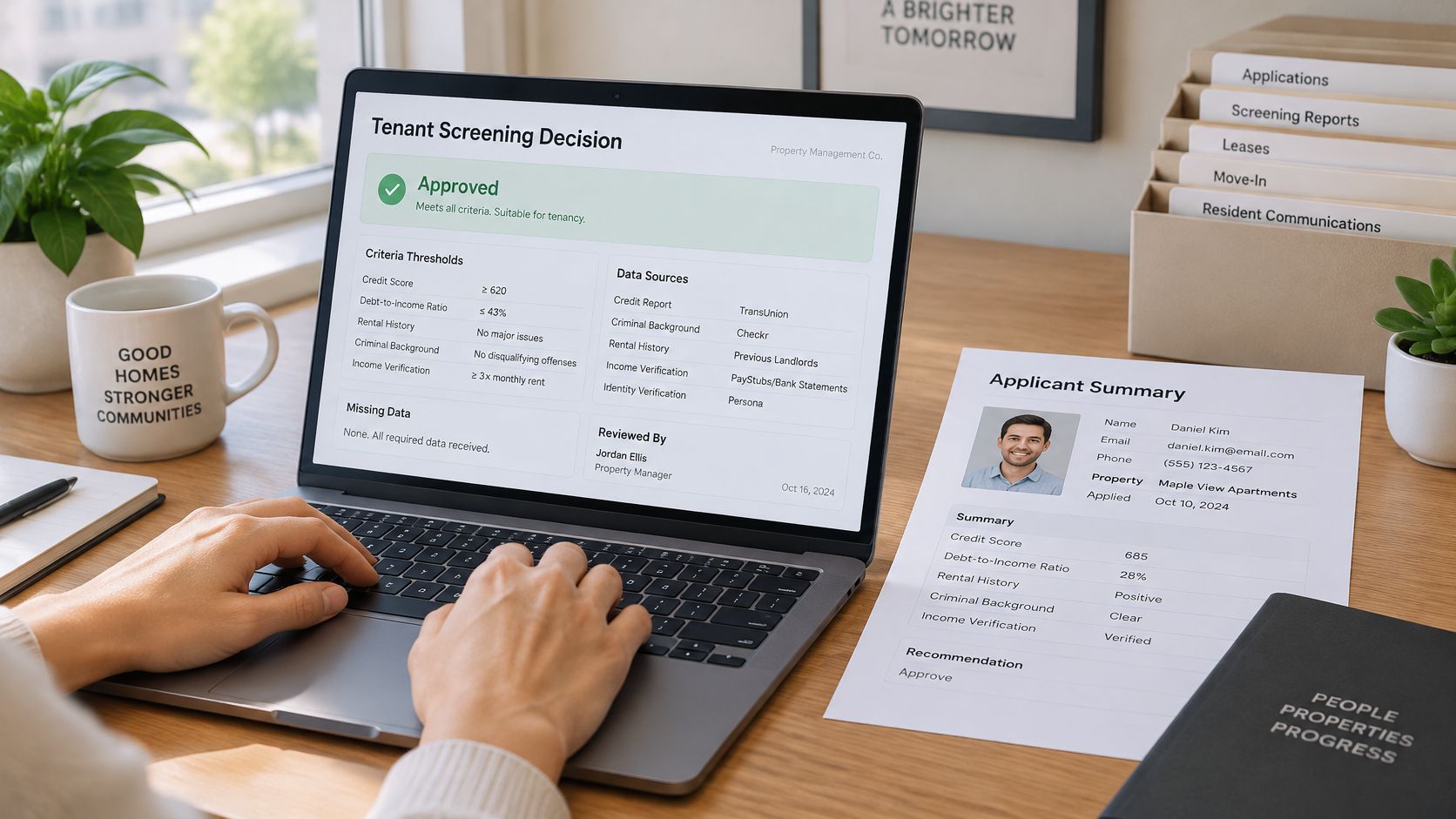
HUD's tenant-screening guidance states that the Fair Housing Act applies to screening decisions involving machine learning or other AI and recommends clear, detailed, publicly available screening policies. The record should connect each decision to those policies, so an automated recommendation never stands as an unexplained exception.
Preserve the decision inputs
For each applicant, retain the information needed to reconstruct the decision:
- Criteria and thresholds: The policy version applied, including how missing information was handled.
- Data and model identification: Report sources, report date, and the model or score version when available.
- Specific adverse information: The actual record relied on, with verified facts separated from predictions or unresolved matches.
- Human review and overrides: Who reviewed the recommendation, what they checked, and why they accepted or changed it.
- Correction route: How the applicant can dispute information and who handles reconsideration.
Consent belongs in this record too. Before an eviction search runs, the applicant provides written authorization, which VerticalRent collects electronically with a timestamped record for the landlord's compliance file, and an audit log tracks every search. Keep that authorization and search history attached to the application so the file shows who searched and when.
When the landlord denies an application based on eviction history, an adverse action notice must go out before the denial, naming the consumer reporting agency and its contact information. VerticalRent generates that notice automatically. Record evidence that it was sent, not merely created, alongside your FCRA compliance record.
The walkthrough below applies this checklist to a screening decision, from consent capture through the notice record.
Check outcomes and access boundaries
Assign responsibility for periodic accuracy and outcome checks across applicant groups. Record complaints, corrections, and reconsideration results, with retention and deletion rules that reflect applicable obligations.
Screening data also has boundaries. An eviction report justifies a housing decision; it does not justify wider circulation. When you set up apartment access control for doors, gates, or common areas, keep those permissions in a separate operational record. A denied applicant's file should never feed a system that manages physical entry, and an approved tenant's entry permissions should never live inside the screening file.
Transparency isn't proof of fairness. A clearly explained policy can still produce discriminatory decisions, so review outcomes and controls, not merely whether applicants were told that automation was used.
Set a Review Schedule and Start Your Document
You don't need to document every possible problem before making this useful. Start with the activities you already manage and the evidence you can retrieve from your maintenance inbox, application files, and payment records.
List your main risk-producing activities. Start with repairs, tenant screening, rent collection, lease signing, and contractor access. Give each activity a clear boundary so you know what the assessment includes.
Write a scenario for each activity. Use the scenario routine to describe an actual failure mechanism. For rent collection, that might be an unauthorized payment instruction change rather than the broad label payment risk.
Rate, assign, and schedule. Apply your lookup, name the action owner, and enter a completion deadline. Keep urgent safeguards separate from the permanent improvement.
Choose a workable review rhythm
As a starting policy, schedule a review every six months, with additional reviews after incidents or complaints and whenever a process, vendor, or applicable law changes. This is a suggested operating rhythm, not a universal legal requirement. More urgent risks need earlier attention.
Stamp each review with a date and version identifier. Record what changed, why it changed, and who approved the revision.
A closed action needs completion evidence. An invoice can show that work was billed, but it doesn't necessarily show that the safeguard works.
Before a review, assemble a compact evidence pack:
- Current assessment and lookup: Preserve the document version and rating definitions used.
- Open scenario register: Include each owner, deadline, interim safeguard, and escalation status.
- Completion evidence: Save contractor findings, photographs where appropriate, and verification results.
- New events: Collect complaints, incidents, near misses, and unresolved corrections.
- Screening decisions: Retain the human review associated with decisions that used automated input.
Keep provider assurances in perspective
We're a consumer reporting agency regulated under the FCRA, and we're SOC 2 compliant. Those credentials don't replace your responsibility to document the criteria you applied and the action you took.
Open a blank document today, add the component headings, and complete your first activity before the end of the week. Choose a live issue with accessible evidence so you finish with an actionable record, not an empty template.
VerticalRent offers tenant screening with consent records and search audit logs to support your decision documentation. Platinum AI Risk Scoring adds a 0–100 score and a plain-English call after screening, which you can retain alongside your own review and reasoning. Visit VerticalRent to explore screening tools for your next application.
Put this into practice
VerticalRent tools related to this guide
Legal Disclaimer
VerticalRent and its authors are not attorneys, CPAs, or licensed legal or financial advisors, and nothing on this site constitutes legal, tax, or professional advice. The information in this article is provided for general educational purposes only. Landlord-tenant laws, eviction procedures, security deposit rules, and tax regulations vary significantly by state, county, and municipality — and change frequently. Nothing on this site creates an attorney-client relationship. Always consult a licensed attorney or qualified professional in your jurisdiction before taking any action based on information you read here.
Co-founded VerticalRent in 2011, growing it from nothing to 100k landlords and renters. Sold it in 2019, then re-acquired it in 2026 to make it better than ever.


