How to Collect Rent Payments Without Chasing Tenants
Learn how to collect rent payments with ACH or card, set up autopay, write lease clauses, handle late payments and keep Schedule E records.


Rent is due, but your records tell different stories. A tenant says they paid, the portal shows pending, and your bank account hasn't received the deposit. Meanwhile, another tenant has sent part of the rent and asked you not to run autopay again.
Learning how to collect rent payments means building a process for all those situations, not just switching on a payment button. You need clear lease terms, traceable payments, reliable bookkeeping, and a fair response when someone can't pay as expected. Automation can handle the routine work. You still own the decisions about fees, hardship arrangements, and legal notices.
Rent Payment Methods Compared Side by Side
| Method | Settlement Speed | Reversibility | Typical Fees | Proof of Payment | Best Fit |
|---|---|---|---|---|---|
| ACH bank transfer | Processor's published bank-settlement schedule | Returns and unauthorized-debit disputes possible | Check transfer, platform, and return charges | Bank transaction, authorization, and ledger entry | Recurring monthly rent |
| Debit card | Confirmation can precede bank payout | Chargeback possible | Processor or convenience fee may apply | Card receipt and processor record | Tenants seeking quick confirmation |
| Credit card | Processor payout schedule applies | Chargeback possible | Processing or convenience fee | Card receipt and processor record | Tenants choosing to pay by credit |
| Personal check | Bank clearing and hold policy applies | Insufficient-funds return or stop-payment possible | Bank and returned-check charges may apply | Check image and deposit record | Tenants without digital access |
| Money order | Cashing or deposit-clearing rules apply | Cancellation or fraud claims can require investigation | Purchase fee | Money order reference and landlord receipt | Documented fallback without a bank account |
| Cash | Received immediately, bank deposit follows | No electronic reversal mechanism | No payment-processing fee | Signed receipt and ledger entry | Controlled fallback where accepted |
Make ACH your default, offer cards as a secondary option, and keep a documented fallback. ACH fits recurring rent because tenants can authorize scheduled bank payments without handing over a new payment instrument each month. Cards offer convenient confirmation, but confirmation isn't the same as money reaching your bank.
The Federal Reserve Bank of Atlanta's consumer-payment survey found that ACH-based transfers represented 42% of payment value in October 2023, while cash, checks, and money orders represented 19% of payments by count. Those are consumer payments generally, not rent-specific results, but they support offering both bank transfers and an accessible alternative.
Compare availability, not just confirmation
Before choosing a processor, read its payout schedule, bank-verification requirements, holds, and returned-payment policy. Don't promise tenants or budget your mortgage payment around an advertised confirmation speed. Ask when funds become available in your connected bank account and what can delay that payout.
Compare total fees, too. An inexpensive bank transfer can still carry a separate platform charge, while a card fee may fall on the tenant, landlord, or both. The practical differences in ACH versus credit card rent payments matter more than which checkout screen looks easiest.
Checks and money orders require physical handling and deposit records. A money order stub establishes purchase, not necessarily delivery to you, so issue your own receipt. Cash needs an immediate signed receipt and secure handling; exclude it only where local rules permit.
Practical rule: Every accepted method must end in the same tenant ledger. Payment choice shouldn't create separate bookkeeping systems.
Lease Clauses That Back Up Every Collection
Your lease should answer the questions tenants ask when something goes wrong: When was payment due? Did submitting it count as paying? Which fee applies? What happens to a partial payment?
Specific language reduces ambiguity, but it doesn't override local law. Don't copy a fee clause from another landlord's lease and assume it's enforceable.
Dates and accepted methods
- Due date and timing. State the due date, relevant time zone, and payment cutoff. Define how initiation, receipt, and settlement affect timeliness, subject to applicable law.
- Accepted channels. Identify the approved portal and offline fallback, including delivery instructions. State whether you accept cash and how tenants obtain proof.
- Payment responsibility. Explain when tenants should initiate payment and how they can confirm its status. Don't turn a processing delay into an undisclosed early-payment requirement.
A cutoff matters because an evening submission can receive a different processing date. The tenant needs to know the rule before making the payment, not after receiving a late charge.
Fees and exception procedures
- Grace period and late fee. Write the permitted grace period, fee amount or calculation, and exact trigger. Check applicable caps and restrictions before enabling automatic charges.
- Returned-payment charges. Identify any lawful charge and the event that triggers it. A processor error shouldn't automatically produce an insufficient-funds fee.
- Partial-payment allocation. State how payments apply to outstanding charges, subject to local restrictions. Don't assume you can allocate money to fees ahead of rent.
- Written arrangements. Explain how a payment plan becomes effective and who can approve it. Keep informal texts from becoming competing versions of the agreement.
- Receipts and reminders. Describe payment confirmations and routine reminders, including failed-payment alerts. Keep courtesy messages distinct from formal legal notices.
The lease agreement laws guide is a starting point for identifying issues to review, not a substitute for advice about your property's jurisdiction.
Have a local attorney or qualified landlord association review fee, allocation, and notice language before using it. Also confirm how to amend an existing lease properly. Updating portal settings doesn't automatically change what the tenant agreed to.
How to Set Up Online Rent Payments Step by Step
Online collection works best when you configure the entire transaction, from authorization through bank reconciliation. The Federal Reserve's payment-system oversight report states that Federal Reserve Banks processed 18.9 billion commercial ACH transactions in 2023. The infrastructure is established; your job is to configure the controls around it.
Use this setup flow to organize the work before inviting tenants.
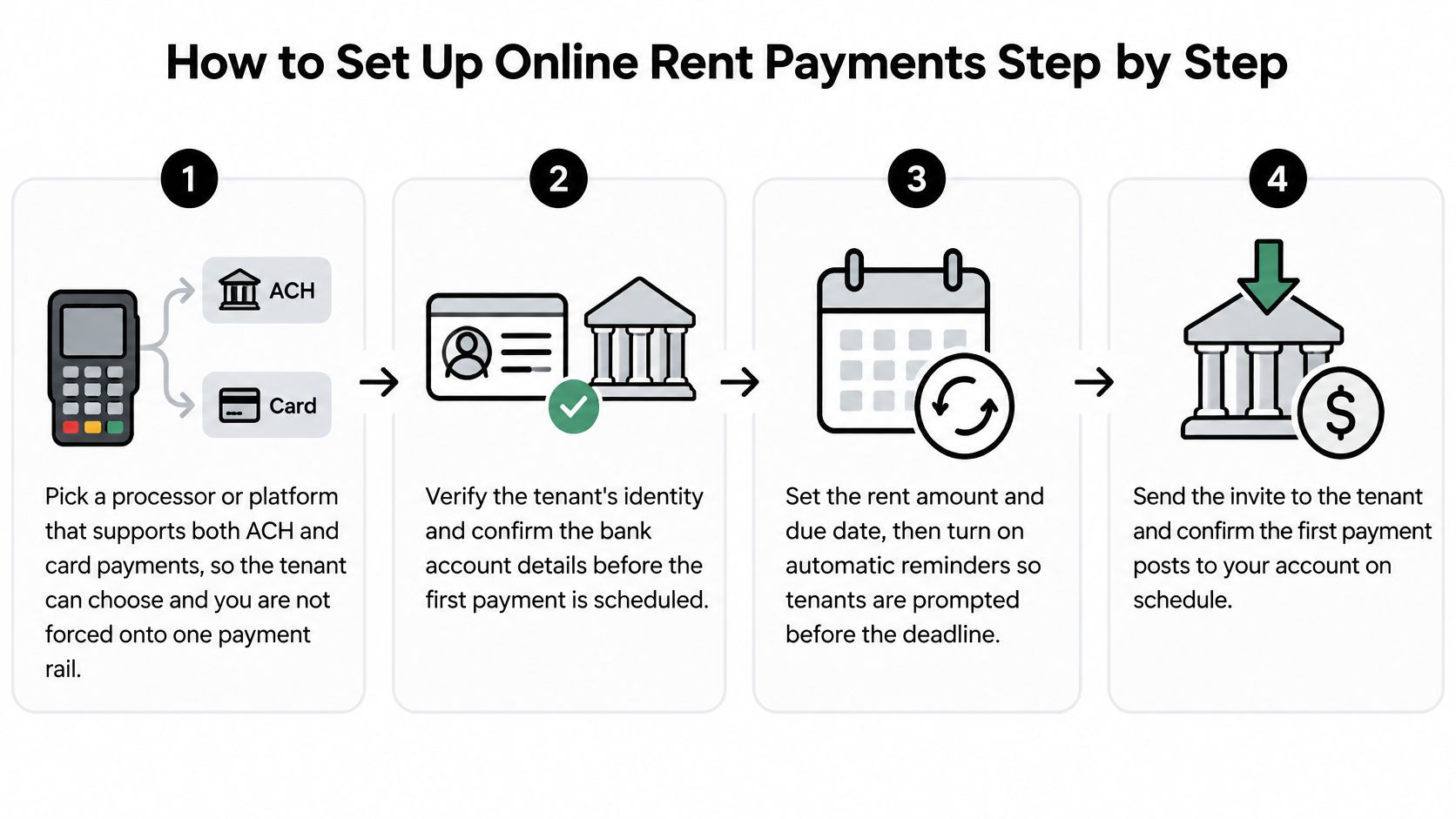
Configure the payment path
Choose a platform with ACH and card support. Compare payout rules, exports, return handling, and the complete fee schedule, not just the payment button. The common slip is choosing on transaction price while overlooking platform costs or inaccessible records.
Verify identity and account details. Use the processor's supported identity and account-ownership checks before scheduling a debit. Don't assume an account belongs to the tenant just because someone entered its routing information.
Keep bank credentials out of your files. Let the processor retain sensitive details and provide a token or masked identifier for your records. Asking tenants to email bank statements or account numbers creates unnecessary exposure.
Capture explicit recurring authorization. Retain the authorized amount or calculation, schedule, consent timestamp, and cancellation instructions. A checked autopay setting without a retrievable authorization record leaves you poorly prepared for a dispute.
Align the calendar. Set the rent amount, due date, first autopay date, and reminders against the signed lease. Watch for a first debit scheduled before the tenancy starts or a recurring instruction that survives a lease change.
Verify the complete posting path. Use the processor's verification process and, where supported and authorized, a test transaction. Confirm the correct tenant, unit, charge allocation, receipt, and eventual bank payout rather than checking only that the account connected.
Publish the instructions tenants will use. Put accepted methods, cash policy, cutoff rules, and permitted tenant-paid fees in the lease and welcome message. Conflicting instructions in the portal and lease create avoidable disputes.
Check the tenant's view
Open the invitation flow as a tenant would. Confirm that the amount due and next scheduled payment are clear, and that tenants can distinguish pending from completed payments. Give them a contact route for mistakes before they submit another transaction.
Use the video alongside your setup checklist, not instead of checking the actual account settings.
Before activating convenience fees, have their legality reviewed for the property's location. Finish setup only when you can follow a transaction from tenant authorization to ledger entry and bank settlement without guessing what happened.
Receipts, Ledger Posting and Schedule E Records
A payment receipt, a ledger entry, and a bank deposit describe different events. Your records need to connect them without pretending they happen simultaneously. A pending payment can deserve an acknowledgment while still carrying a return risk.
HUD's rent-collection guidance for public-housing agencies calls for receipts, same-day recording, and same-business-day deposits. Those requirements aren't automatically rules for independent landlords, but they provide a useful control model; its recommended exception workflow also flags problems within one business day.
Follow this sequence to preserve the connection between payment and accounting.
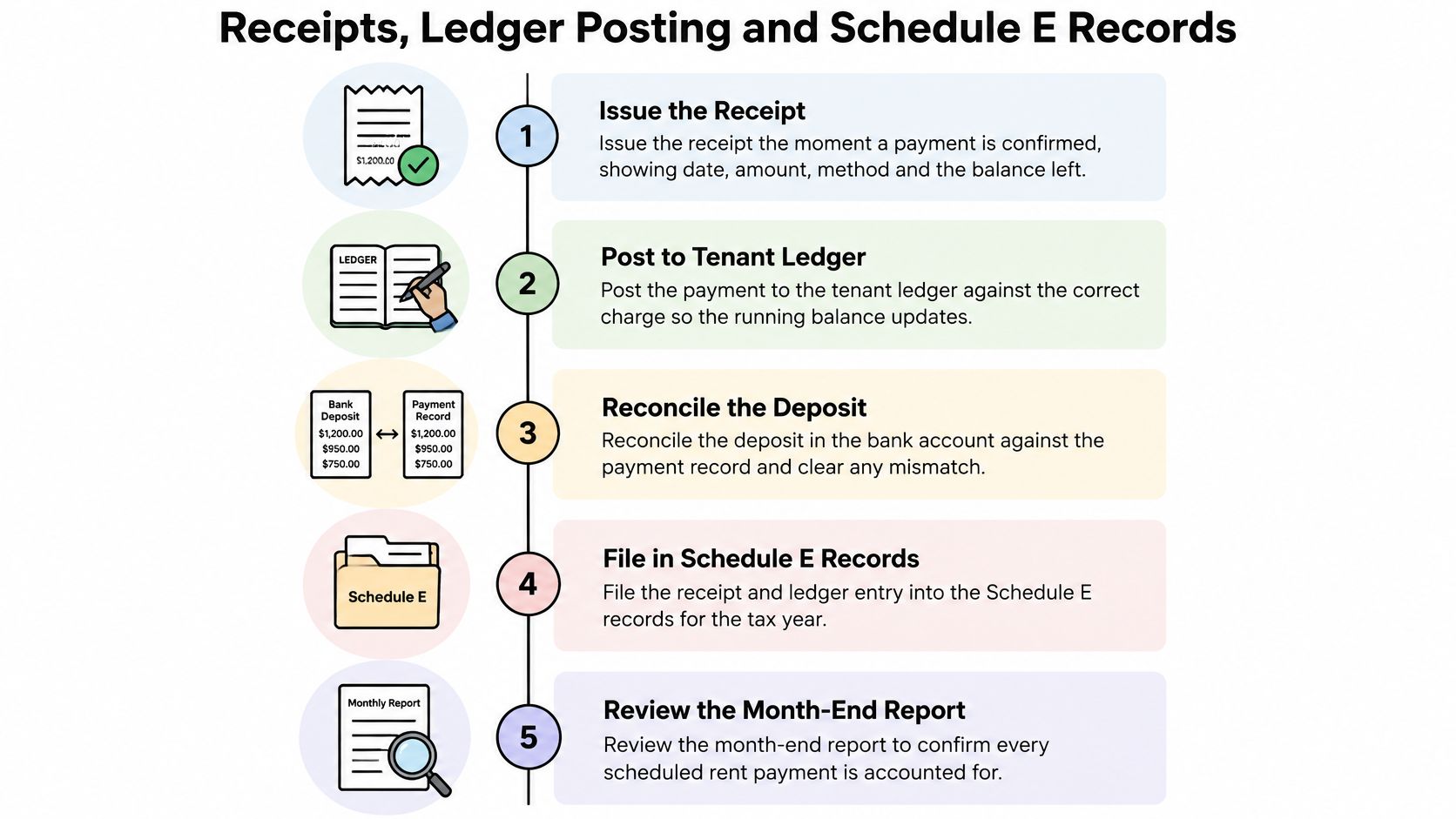
A repeatable posting routine
- Acknowledge the transaction promptly. Show the payment date, amount, method, reference, and remaining balance. Label pending payments accurately rather than implying settlement is final.
- Post against the correct charge. Record the transaction on the tenant's ledger when received or initiated, with its current status. Preserve separate initiation and settlement fields.
- Enter offline payments consistently. Checks, money orders, and cash need the same tenant, property, date, amount, and allocation fields. Don't leave them in a notebook outside the main ledger.
- Reconcile each business day. Match processor batches and bank deposits to ledger transactions, including fees, returns, refunds, and net payouts. A net bank deposit won't necessarily equal the tenant's gross payment.
- Investigate discrepancies promptly. Assign an owner to missing payments, duplicates, partial payments, and unapplied funds. Correct entries with reversals or adjustment notes rather than overwriting history.
A rent ledger example can help you check whether your running balance explains each charge and payment. Store supporting receipts and authorizations under the corresponding transaction reference so they're retrievable together.
Prepare records for tax review
Keep property-level reports of rent received, with fees and other charges separately identified. Maintain distinct categories for refundable security deposits rather than automatically counting every incoming dollar as rent.
For Schedule E preparation, give your tax preparer the rent report, bank reconciliation, expense detail, and any adjustments. Have them confirm the treatment of retained deposits, advance payments, and pass-through charges for your circumstances.
A useful audit test is whether someone unfamiliar with the account can follow a receipt through the ledger to the bank deposit without asking you to reconstruct the story.
Handle Late, Failed and Partial Payments
| Situation | Likely Cause | What to Do |
|---|---|---|
| NSF return on ACH | Insufficient balance on the debit date | Notify the tenant, confirm permitted retry procedures, and charge only a lawful, agreed fee |
| Bank or processor error | Duplicate, reversed, or misapplied transaction | Investigate, correct the affected entry, remove error-related fees, and confirm in writing |
| Partial payment | Temporary shortfall or disputed balance | Check legal implications, apply the permitted allocation, and confirm the remaining balance |
| Payment arrives within the applicable grace period | Timing issue, though hardship is still possible | Record the actual date and don't assess a premature late fee |
| Late beyond the grace period, no contact | Possible nonpayment or disengagement | Verify the account and deliver any required formal notice correctly |
| Repeated shortfalls | Possible ongoing affordability strain | Discuss hardship, assess a written plan, and define the lawful next step if it fails |
Diagnose the problem before adding a fee or retrying a debit. In July 2025, 18.9% of renters surveyed by the Federal Reserve Bank of Philadelphia reported difficulty making a housing payment during the prior three months. A collection process needs a hardship path, not just increasingly urgent reminders.
Separate timing problems from persistent nonpayment
Check the return code, payment timestamp, outstanding amount, and recent payment history. An insufficient-funds return calls for a different response from an incorrect account number or duplicate debit. Don't tell a tenant to pay again while an uncertain transaction may still settle.
A permitted retry should follow the processor's rules and the tenant's authorization. Avoid automatic repeated attempts that create overlapping debits or additional bank charges.
For reminder ownership and performance tracking, Loopfour's guide to collections cadence and KPIs offers a useful operational framework. Adapt the scheduling discipline to residential rent, but don't substitute business receivables practices for housing-law requirements.
Put recovery arrangements in writing
Before accepting a partial payment during a notice or enforcement process, check whether acceptance affects your legal position. Where acceptance is appropriate, record the amount, apply the lawful lease allocation, and confirm what remains outstanding. State whether the original deadline remains or you've agreed to a replacement date.
A payment plan should identify:
- Payment commitments. List the installments, dates, and ongoing rent obligations.
- Fee treatment. Specify any lawful waiver or charge without adding ambiguous penalties.
- Missed-plan response. Explain the next communication or legal step, subject to required notices.
Fair collection: A realistic agreement should help the tenant pay the balance, not merely postpone an unaffordable amount while adding fees.
When shortfalls continue or communication stops, move from courtesy reminders to the appropriate formal process. Verify the required notice format, service method, and cure period locally. Automation shouldn't make that legal decision for you.
Guard Against Unauthorized Debits and Account Changes
Electronic collection isn't automatically safe collection. The Federal Reserve's ACH fraud data estimated debit-transfer fraud at 0.14 basis points by payment value in 2015, compared with 0.05 basis points for credit transfers. Payment direction and authorization matter, even when the overall fraud rate appears small.
The most useful safeguard is a controlled account-change process. Treat an emailed instruction to replace bank details as unverified until you confirm it independently.
Control changes before money moves
- Verify through a trusted channel. Use the processor's authenticated portal or call a previously verified number. Don't use contact details supplied in the suspicious request.
- Review unusual activity. Enable available alerts for new accounts, changed credentials, unexpected amounts, and repeated attempts.
- Prevent duplicate collection. Check the original transaction status before authorizing another debit. Record who approved the action and why.
Preserve authorization versions when account or payment instructions change. Staff or bookkeepers should be able to see which instruction applied to the disputed transaction without accessing full bank credentials.
Read collection metrics together
| Metric | What a Change Signals |
|---|---|
| On-time payment rate | A decline may indicate affordability strain, unclear deadlines, or poorly timed reminders |
| First-attempt success rate | A decline may indicate incorrect bank details or insufficient balances |
| Return rate | An increase calls for review of return reasons and account verification |
| Average days to settlement | An increase may indicate batch delays, holds, or delayed deposits |
| Exception resolution time | An increase suggests unresolved cases or unclear ownership |
| Disputed-payment rate | An increase warrants checking authorizations, receipts, allocations, and lease language |
Review these measures monthly using consistent definitions. Decide whether “on time” means legally timely initiation or another permitted standard, then apply it consistently rather than changing the definition to improve a report.
Don't headline only total dollars collected. A strong total can coexist with delayed payouts, repeated returns, and unresolved disputes. Investigate related changes together before deciding whether the fix belongs in tenant communication, account verification, or your hardship process.
Set Up Automated Collection This Month
Use the coming month as an implementation window, not a deadline to force every tenant onto autopay. Existing lease terms, consent, and accessible alternatives still govern the rollout.
Put the work on your calendar
- Opening week. Audit leases and tenant balances. Resolve conflicting due dates, accepted methods, grace periods, and fee triggers before importing settings.
- Following week. Configure payment methods and send enrollment instructions. Obtain recurring authorization from tenants who choose scheduled debits.
- Next working phase. Activate reminders, verify account connections, and test the posting and reconciliation process. Assign responsibility for failed-payment alerts.
- Month-end review. Examine payment timeliness, returns, disputes, and unresolved exceptions. Change the process where you identify a cause, not because a metric looks disappointing.
Automate the mechanics, retain the decisions
With VerticalRent, tenants set up autopay once for automatic monthly collection, and every rent payment is automatically recorded as rental income in the Schedule E category without manual entry. When a payment bounces, the landlord is notified immediately, the tenant is alerted, and the tenant resubmits payment. Budget for our 3% landlord platform fee on ACH and card rent collections, alongside the applicable plan and tenant card charges.
Compare that cost with the time you spend tracking payments and maintaining records. Also confirm that your accounting categories and exports fit your tax preparer's needs.
You remain responsible for lawful lease wording, notices, and hardship decisions. Start today by opening your current lease and checking whether the due date, accepted payment methods, and late-fee trigger match what you do.
Collect rent through ACH or card, automate payment receipts, and keep transactions connected to your income ledger with VerticalRent. Review the collection options and fees, then configure a workflow that supports both routine monthly payments and documented responses when a tenant falls behind.
Put this into practice
VerticalRent tools related to this guide
Legal Disclaimer
VerticalRent and its authors are not attorneys, CPAs, or licensed legal or financial advisors, and nothing on this site constitutes legal, tax, or professional advice. The information in this article is provided for general educational purposes only. Landlord-tenant laws, eviction procedures, security deposit rules, and tax regulations vary significantly by state, county, and municipality — and change frequently. Nothing on this site creates an attorney-client relationship. Always consult a licensed attorney or qualified professional in your jurisdiction before taking any action based on information you read here.
Co-founded VerticalRent in 2011, growing it from nothing to 100k landlords and renters. Sold it in 2019, then re-acquired it in 2026 to make it better than ever.


