Fair Housing Definitions: Key Terms and Protected Classes
Clear fair housing definitions for landlords and renters: protected classes, disparate impact, reasonable accommodation, and lawful screening rules.


You're looking at an application from a family with a toddler, a credit score just under your cutoff, and a note that they pay rent with a housing voucher. The unit is empty. You want a reliable tenant, and you also don't want a complaint that says you screened someone out for the wrong reason.
Fair housing definitions are the shared vocabulary for that decision. They tell you which traits you can't use, which neutral rules still need a business reason, and which requests you have to answer even when they don't match your usual policy. Landlords and renters often mix up the words. A "protected class" is not the same thing as a screening rule, and a polite refusal can still be unlawful if the reason underneath it is a stereotype.
Core Fair Housing Terms at a Glance
Keep this table next to your screening notes. Each term below is one plain sentence, then the rental moment where people usually get it wrong.
| Term | Plain meaning | Rental example |
|---|---|---|
| Fair housing | Equal access to housing opportunities, not only equal treatment after a lease is signed | Every applicant reviewed against the same written criteria |
| Protected class | A group covered by fair housing law because of a listed characteristic | Families with children, or applicants of a particular religion |
| Disparate treatment | An applicant treated worse because of a protected trait | Quoting a higher deposit to one applicant because of their race |
| Disparate impact | A neutral rule that disproportionately excludes a protected group | A blanket minimum-income rule that excludes most applicants of one national origin without a documented business reason |
| Reasonable accommodation | A change to rules, policies, or services so a person with a disability can use the housing | Waiving a no-pets policy for a documented assistance animal |
| Reasonable modification | A physical change to a unit or common area for a disabled tenant, usually at the tenant's expense | Installing grab bars in a bathroom, with restoration terms agreed in writing |
| Familial status | A household with a child under 18, including pregnant people and adults with legal custody | Refusing a family with a toddler because units are "for adults" |
| Paired testing | Two matched applicants who differ only in the tested trait | A tester who discloses a housing voucher and receives a different response than a matched tester |
| Adverse action | A denial or less favorable term based in whole or part on a consumer report | Denying an applicant because of an eviction record, which triggers a notice requirement |
| Proxy | A facially neutral factor that stands in for a protected trait | "Good schools" wording used to discourage families with children |
The class is the group of people. The characteristic is the trait the law names, such as religion or disability. Saying "I don't rent to that kind of family" is about the class. Asking "do you go to church" is fishing for the characteristic. Both are problems, and they show up in different places in a file.
Fair housing is measured by what comparable people receive, not only by what a landlord meant to say. The United Nations report on housing discrimination describes how HUD used paired testing in nationwide Housing Discrimination Studies in 1977, 1989, 2000, and 2012, sending two otherwise comparable applicants who differed mainly in a trait such as race, disability, family composition, or voucher status. In the mid-1990s, HUD estimated that between 2 million and 10 million incidents of housing discrimination occurred during 1977–1987, and it cautioned that the estimate was not based on recent objective national incidence data.
Practical rule: If you can't explain a term in one sentence to a co-owner, look it up here before you quote a deposit, publish a listing, or hit deny.
A proxy is the term people skip. "No strollers in the hallway" can function as a stand-in for families with children even when nobody says "no kids." Comparable applicants should get comparable information, access, terms, and a real chance at the unit.
The Seven Federal Protected Classes and What Each Covers
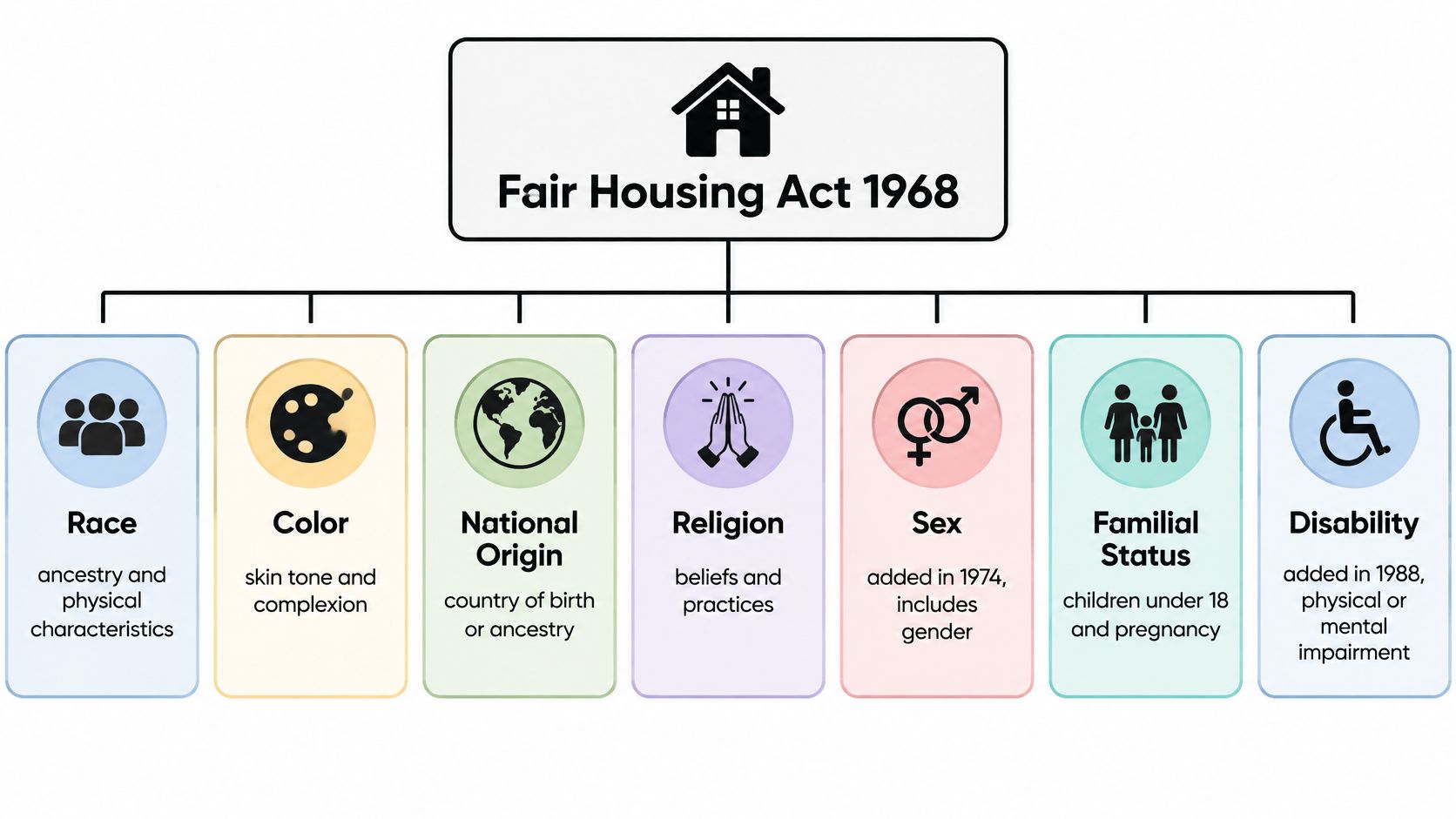
Congress enacted the Fair Housing Act as Title VIII of the Civil Rights Act on April 11, 1968, first covering race, color, national origin, and religion, then adding sex in 1974 and disability and familial status in the 1988 amendments, as the HUD fair housing workbook lays out. Those seven characteristics now run through advertising, showings, rent, terms, financing, and services. Eligibility has to rest on legitimate, consistently applied criteria, not on a protected characteristic or a stereotype about who "fits" the building.
Race, color, national origin, and religion
Race covers steering. Telling one applicant that a building is "more their speed" while walking another applicant through the same vacant unit is unequal access, even if both people eventually get an application. Color is its own class. Charging a higher application fee or a larger deposit based on skin tone is a violation on its own, not a subset of a race claim.
National origin covers place of birth, ancestry, and language. Requiring a larger deposit from applicants with foreign-sounding names, or refusing to explain lease terms to someone who speaks another language at home, treats origin as a risk factor. You can still require that a lease be understood. You can't treat an accent as proof someone won't pay.
Religion covers faith, observance, and religious dress. Refusing a tenant who wears a head covering, or advertising a building as suited to one faith, uses belief as an eligibility screen. A neutral quiet-hours rule can still apply during a holiday if you apply it to every household.
Sex, disability, and familial status
Sex covers sexual harassment by a landlord or manager, including a request for sexual favors as a condition of renewal, a repair, or a smaller late fee. A lease renewal is a housing decision. Conditioning it on personal contact is not a personality conflict.
Disability covers an impairment that substantially limits a major life activity, a record of such an impairment, or being regarded as having one. Refusing an assistance animal without an individualized review treats the animal as an automatic disqualifier. The Law Office of Bryan Fagan explains how these federal classes sit alongside state rules that landlords still have to read for their own market.
Familial status covers households with a child under 18, pregnant people, and adults with legal custody of a child. "Adults only" is not a style preference. The main lawful exception is qualifying senior housing, and it turns on the property meeting the exemption's conditions, not on a landlord's wish for a quieter building.
Protected classes define what cannot be an eligibility factor. Every other criterion needs a consistent, legitimate business reason you could show to the next applicant who asks.
Disparate Treatment Versus Disparate Impact
Disparate treatment asks whether you treated this person worse because of a protected trait. Disparate impact asks whether a rule that looks the same for everyone lands much harder on a protected group. Intent sits at the center of the first theory. It is not required for the second.
The HUD handbook on fair housing frames the federal protected bases as race, color, religion, sex, disability, familial status, and national origin, and it applies them across terms, services, maintenance, renewals, evictions, and access, not only at the application desk. A disparate-impact case generally needs a specific policy, a substantial disproportionate adverse effect, and a causal connection between that policy and the disparity.
| Element | Disparate treatment | Disparate impact |
|---|---|---|
| Core question | Was the applicant treated worse because of a protected trait? | Does a neutral policy fall much harder on a protected group? |
| Intent | Required | Not required |
| Typical evidence | Statements, texts, inconsistent answers, paired tests | Applicant-level outcome data showing a group disparity, plus the written policy |
| Landlord example | Telling one applicant a unit is taken while showing it to others | A fixed credit threshold that excludes many older applicants with no documented need |
| Main defense | A legitimate, consistently applied reason that is not a pretext | A legitimate business need that cannot be met by a less discriminatory alternative |
A neutral formula that still misses
Say your written rule is income equal to three times the rent. An applicant holds a voucher that pays most of the rent, and your spreadsheet counts only the tenant-paid share, or it drops the subsidy because the cell was labeled "wages." The formula is facially neutral. The result can be a denial that tracks voucher use, disability, or national origin if those households rely on that income more often. You didn't write a slur in the file. You still produced a disparity, and the written policy is the thing a tester or an agency will ask to see.
State and local laws may add categories such as source of income, marital status, age, or sexual orientation. A federal-only checklist is not a complete compliance standard for a denial letter.
What a defense actually looks like
On a treatment claim, your defense is a reason you wrote down before you knew who applied, and that you used on the last several files. "I had a bad feeling" is a pretext. A verified skip on the prior lease, documented the same way for every applicant, is a business reason.
On an impact claim, you need the business need and a check for a less discriminatory alternative. If a slightly lower credit threshold, or a larger weight on verified on-time rent, would still protect you from nonpayment, the stricter cutoff is harder to defend.
Ask yourself three questions before you send the decision.
- Did I treat anyone differently? Compare the answers, the tour, and the deposit you quoted.
- Does this rule fall unevenly? Look at who your cutoff removes, not only at whether the sentence is neutral.
- Can I document why the rule is necessary? If the reason lives only in your head, it will not travel well.
How to Handle a Reasonable Accommodation Request
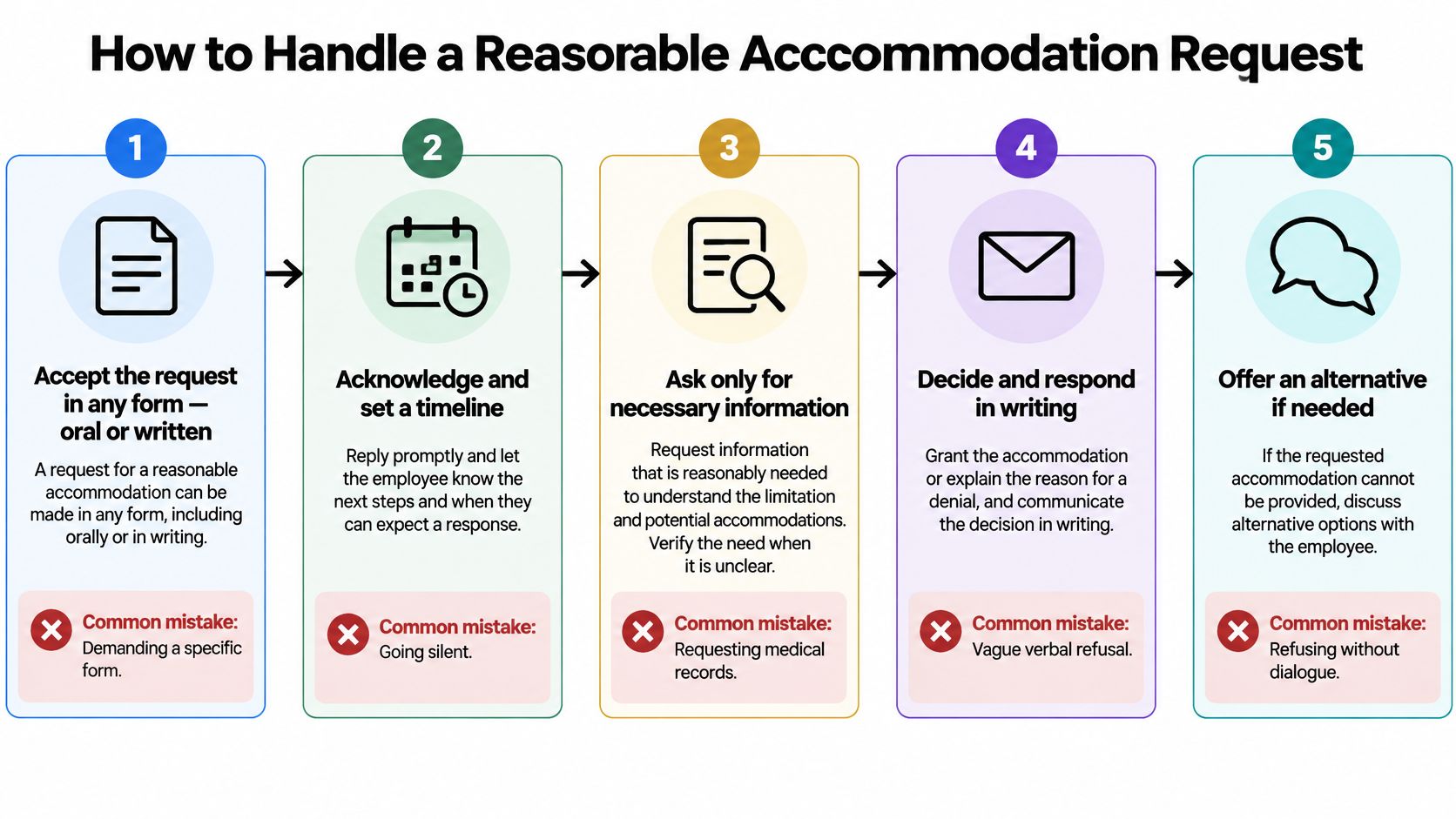
An accommodation changes a rule or a service. A modification changes the building. Assistance animals are generally judged under fair housing standards, not under the rules that apply to service animals in restaurants and stores. Our guide on disability accommodations landlords are required to provide walks through what has to be in the file once you grant or deny a request.
The sequence that keeps the file clean
Accept the request in any form. A tenant can ask orally in the hallway or in a short email. The reason is that the law cares about the need, not your stationery. The common mistake is refusing to start until the tenant uses your form.
Connect the disability to the rule. You are confirming that this request is about using the housing, such as a reserved parking space near the entrance or a waiver of a no-pets clause. The mistake is treating every animal or every parking ask as automatic, with no link to a disability-related need.
Ask only for what you need to evaluate the request. When the disability and the need are obvious, extra paper doesn't help. When they aren't, a letter from a provider who knows the person can confirm the need. Never ask for a diagnosis or a full chart. The mistake is demanding medical records "just to be safe."
Judge whether the request is reasonable. It has to be needed for the person to use and enjoy the housing, and it can't impose an undue financial or administrative burden or change what you offer. The mistake is calling something unreasonable because it is inconvenient or because other tenants might ask next.
Decide in writing, within a reasonable time, and record the reason. Silence reads as a denial and leaves you with no timeline. The mistake is a vague verbal "we'll see" that never becomes a decision.
For a modification, write down who pays and what restoration looks like. Grab bars, a ramp, or a doorway change are usually at the tenant's expense unless a funding rule says otherwise. Spell out restoration when the tenant leaves, before anyone buys hardware. The mistake is arguing about cost after the work is done.
If you deny, offer an alternative that meets the same need. A different unit with a roll-in shower, or a different parking spot, can be a real answer. The mistake is a flat no with no conversation.
The three errors that generate complaints are charging a pet fee or pet deposit for an assistance animal, demanding a diagnosis, and letting a request sit while rent comes due. Put a date on the request the day you hear it, and answer before the next rent cycle if you can.
State and Local Protections Beyond the Federal List
Federal law is a floor. States, counties, and cities can add categories, and a property near a city line can sit under a different set of rules than the building two blocks away. A federal-only ruleset will miss denials that are lawful in one zip code and not in the next.
| Category | Where it commonly appears | What changes for landlords |
|---|---|---|
| Source of income | Many states and cities, including California and New York | Vouchers and other lawful income cannot be rejected on that basis; check each market |
| Criminal history | New York City's Fair Chance Housing Act | Blanket bans may be unlawful; individualized review is often required |
| Marital status | Some state and local statutes | Unmarried couples may need to be treated the same as married couples |
| Age | Some state and local laws | Age-based limits must be checked against the protected status and any lawful exemption |
| Sexual orientation and gender identity | Many states and cities | Applies to applications, roommate matching, and occupancy decisions |
| Military or veteran status | Some states and localities | Application criteria and advertising must follow the local rule |
What actually changes on a Tuesday
Source of income is the addition small landlords feel first. In a protected market you can't reject a voucher, or other lawful income, because of how the rent is paid. You can still verify that the tenant's share plus the subsidy covers the rent. Our rundown of which states have banned source-of-income discrimination is the place to match a property address to a rule before you write "no Section 8" into a listing.
Criminal history is not a federal protected class, and it is still regulated. New York City's Fair Chance Housing Act, as amended, broadly restricts housing decisions based on arrest or conviction records. A printed "no criminal record" rule can be unlawful there even when the same sentence would only be risky somewhere else. Where individualized review is required, look at the nature of the offense, how old it is, and whether it relates to tenancy. Don't treat every record as the same red flag.
Marital status, age, sexual orientation, gender identity, and military or veteran status change everyday calls in less obvious ways. An unmarried couple applying together, a roommate-matching note that sorts people by gender, or an ad that says "young professionals" can collide with a local category even when your federal checklist looks clean. Age limits also have to be read against any senior-housing exemption, not assumed because the building feels quiet.
A yearly verification routine
List the federal, state, county, and city rules that touch that specific property. Check the state civil-rights agency and the local ordinances, not a blog summary from another state. Repeat the check once a year, because cities amend these rules between leasing seasons. If you own units in two neighboring cities, keep two rule sheets. One template for "my portfolio" will apply the stricter city's ban in the wrong place, or miss it entirely.
Advertising Wording That Signals Protected Status
A listing can screen people out before anyone applies. California's civil-rights agency issued 758 compliance notices in 2024, including 374 involving potential fair-housing violations, and it proactively reviewed online advertisements for language that could unlawfully screen people out, according to the California Civil Rights Department.

Run each sentence through one test: does it describe the unit, or does it describe a kind of person? The first is lawful. The second creates the exposure, because a fair-housing tester reads it as a signal about who is welcome. "Quiet neighborhood" sounds like a feature. To a tester it can read as a signal about race or about families with children. The same test applies to application forms and text messages, not only the public ad, so the wording has to survive it everywhere it appears.
| Phrase in a listing | Risk it signals | Safer wording |
|---|---|---|
| "No children" or "adults only" | Familial status | Two-bedroom, 900 square feet; occupancy set by a written people-per-bedroom standard. "Adults only" only where a senior-housing exemption actually applies |
| "Quiet neighborhood" | Race or familial status proxy | Sound-insulated windows and a building with a quiet interior courtyard |
| "Good schools" | Familial status or national origin proxy | Walking distance to the bus line and a neighborhood park |
| "No government assistance" | Source of income in protected jurisdictions | Income requirement of three times monthly rent, counting all lawful income |
| "No criminal record" | Criminal history rules vary and blanket bans can be unlawful | Written screening criteria available to any applicant on request |
| "Ideal for young professionals" | Age, occupation, or national origin proxy | Furnished studio, available June 1 |
| "Christian household preferred" | Religion | Remove the phrase entirely; no safe equivalent exists |
Write from the unit, then have someone else read it
Start from a property-feature template: bedrooms, square footage, rent, available date, parking, laundry, and lease length. If a sentence names a kind of person, delete it. "Christian household preferred" has no factual replacement. Faith is not an amenity.
Have a second person read the draft against your city and state rules before it goes live, because a phrase that passes federally can still trip a local protection like source of income. Our notes on what you cannot say in a rental listing are a useful second pass for phrases that feel harmless and still function as proxies. Use the same sentences in the listing site, the Facebook post, and the text you send when someone asks "is this a good fit for kids?"
New York City's criminal-history rules show why a stock phrase copied from another market is a bad template. If the local ordinance restricts decisions based on arrest or conviction records, "no criminal record" in the ad announces a policy you may not be allowed to apply.
Neutral Screening Criteria and Automated Screening Risks
A neutral criterion is a requirement written down before you open the first application, applied the same way to every file, and tied to a business need you can name out loud. Rent-to-income capacity and verified rental history are the usual examples. A credit threshold can belong on the list if you also write an exceptions process. A criminal-history policy belongs there only if it weighs the nature, age, and relevance of an offense instead of banning every record.
A simple test separates a lawful criterion from a proxy. Ask whether the rule measures the applicant's ability to pay and perform under the lease, or whether it measures something that merely correlates with a protected trait. A criminal-history rule that weighs each offense on its facts can pass that test. A flat "no government assistance" rule cannot, because it screens out a funding source rather than measuring reliability.
Automated tools make that test harder to run. Recent civil-rights filings, described in a California Civil Rights Department comment to HUD, identify automated criminal-history checks that allegedly disadvantaged Black, Latino, and disabled applicants, screening that miscalculated income for Section 8 participants, and a rental chatbot that rejected applicants using government assistance. A landlord often can't see which variables, data gaps, or proxy signals drove the recommendation. Treating the score as an objective fact is how a contestable risk signal becomes a denial.
The legal picture is not settled
Federal enforcement standards for disparate-impact claims have been shifting, so confirm the current HUD rules and your state's position before relying on any cutoff. California and New York authorities continue to defend or codify the doctrine. Whatever the federal position, the underlying work stays the same. You still need to test whether a facially neutral cutoff excludes a protected group, write down the business reason, look for a less discriminatory alternative, and offer a human review.
Leaving questions about race or religion off the application is only the starting point.
Controls you can put in place this week
- Write the criteria before you screen. Income at a stated multiple of rent, two verified rental references, and a credit threshold with a written exception path. If a variable isn't on the page, don't let software use it as the reason you deny.
- Get written authorization first. When you run a report on an applicant, you must certify that you have the applicant's written authorization. Consent collected electronically, with a timestamped record, belongs in your compliance file before any eviction search starts.
- Review outcomes where the law allows it. If one rule removes almost every voucher household or almost every applicant of one national origin, the formula needs a second look, even if nobody typed a protected trait into the tool.
- Send the adverse action notice before the denial is final. When you deny tenancy based on eviction history, the notice must include the consumer reporting agency's name and contact information. A human should be able to explain the reason and hear an appeal, especially when the record might belong to someone else or fall outside the reporting window your state allows (some states bar evictions older than seven years from appearing at all).
A chatbot that auto-rejects "government assistance" is a policy wearing software's clothes. If you can't name the variables, you can't defend them.
Enforcement Terms and Filing Deadlines
These words show up on letters, not in leasing software. Knowing them tells you what to keep and what not to do after someone complains.
Aggrieved person. Anyone harmed by a discriminatory housing practice, including a tester or a neighbor, not only the applicant you formally denied.
Discriminatory housing practice. An act that violates the Fair Housing Act. Refusing to rent, setting unequal terms, steering, and harassment all fit. The label doesn't wait for a lawsuit.
HUD complaint. A complaint filed with HUD, or with a state or local agency that enforces a substantially equivalent law. Filing windows are set by the enforcing agency, and they change in practice when a case is referred. Confirm the current deadline with that agency before you assume a letter arrived too late, and keep the envelope.
Private lawsuit. An aggrieved person may sue in federal or state court on a separate clock from the administrative complaint. Again, confirm the current window rather than relying on a memory of "about two years." Your screening notes and texts are what both paths will ask for.
Conciliation. A negotiated settlement overseen by the agency. It often includes money and a written change to advertising, screening, or accommodation procedures. A settlement is not a finding you can ignore in the next file. If you agree to a new policy, train the person who answers the phone.
Pattern or practice. A matter referred to the Department of Justice when the facts suggest a broader course of conduct, not a single disputed applicant. Repeated use of the same proxy in ads is the sort of fact that travels further than one angry email.
Two operating rules matter more than the vocabulary.
Keep screening criteria, denial reasons, accommodation requests, and the dates you answered them. Those pages become the evidence, whether the outcome is a dismissal or a settlement. Never retaliate against a person who files, tests, or helps someone else file. Retaliation is itself prohibited, and a rent increase or a sudden non-renewal right after a complaint is the fact pattern agencies look for first.
Confirm Your Fair Housing Checklist Before You Rent
Run this against the next listing, the next application, and the next denial. A failed item gets fixed before another applicant is in the queue.
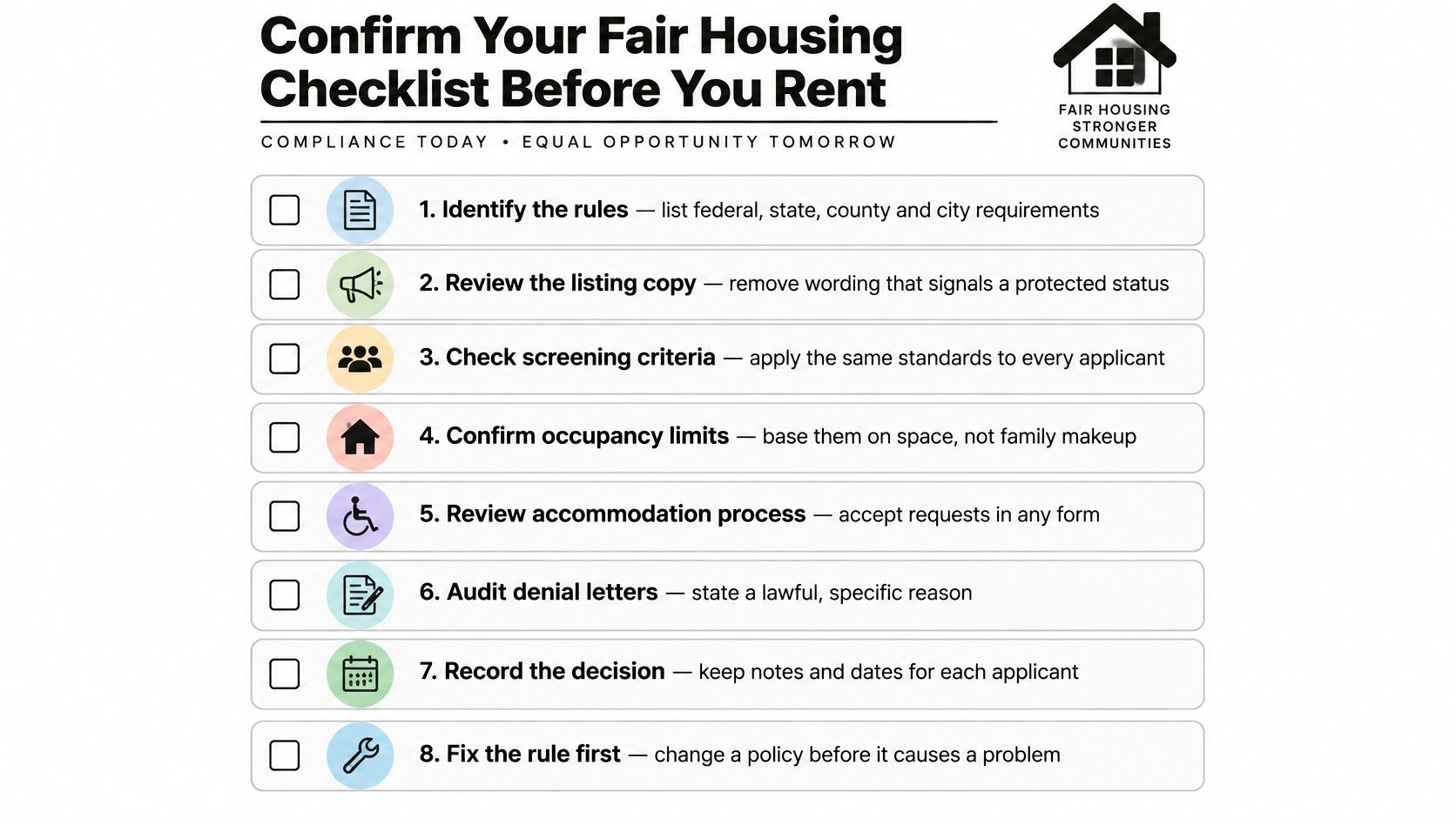
Identify the rules. List the federal, state, county, and city protections for that property, using the added categories that apply in your market. One statewide assumption will miss a city ordinance.
Review the listing copy. Every sentence should describe the unit. If a phrase names children, assistance, religion, age, or a "type" of tenant, rewrite it as bedrooms, dates, and features.
Standardize screening. Keep the criteria in writing, apply them to every applicant, and check each cutoff for proxies. Record the reason for each denial in a sentence someone else could read cold.
Handle requests. Log each accommodation or modification request the day you receive it, set a response date, and keep the written decision with the lease file.
Deliver notices. Send an adverse action notice before you finalize any denial based on a consumer report. If you deny an application based on eviction history, we generate the FCRA-required adverse action notice automatically, including the consumer reporting agency's contact information. FCRA-compliant notices are built in, and AI drafts the notice when you deny after screening.
Review yearly. Revisit the criteria and the jurisdictional rules. Cities amend source-of-income and criminal-history ordinances between your vacancies.
One property, one afternoon
Pick one unit you expect to list or renew this month. Walk it through the six checks in order. Fix the first two items it fails, whether that is a sentence in the ad or a credit cutoff you can't explain, before you take the next application. A checklist that lives in a drawer doesn't change the file an agency will read.
VerticalRent helps independent landlords screen with the applicant's consent, keep a written record of the decision, and produce the adverse action notice a denial based on eviction history requires. That workflow sits next to the fair housing definitions in this guide: same criteria, a human review, and a notice that names the reporting agency. See how it fits a small portfolio at VerticalRent.
Put this into practice
VerticalRent tools related to this guide
Legal Disclaimer
VerticalRent and its authors are not attorneys, CPAs, or licensed legal or financial advisors, and nothing on this site constitutes legal, tax, or professional advice. The information in this article is provided for general educational purposes only. Landlord-tenant laws, eviction procedures, security deposit rules, and tax regulations vary significantly by state, county, and municipality — and change frequently. Nothing on this site creates an attorney-client relationship. Always consult a licensed attorney or qualified professional in your jurisdiction before taking any action based on information you read here.
Co-founded VerticalRent in 2011, growing it from nothing to 100k landlords and renters. Sold it in 2019, then re-acquired it in 2026 to make it better than ever.


