Lease Agreement Template: How to Choose and Customize One
Learn how to choose, customize and use a lease agreement template, with must-have clauses, state rules, sample language and free downloads.

You've approved a tenant, agreed on rent, and set a move in date. Then you open a free lease agreement template and find blanks for a state you don't live in, a deposit rule you've never checked, and nothing about the laundry room two units share. That mismatch is the problem. A useful lease isn't one document you copy. It's a small system matched to your jurisdiction, your property, and the way you'll collect rent and handle repairs.
Choose a Lease Agreement Template That Fits Your Property
Start with three checks before you download anything. Get these wrong and the rest of the form won't save you.
- State and county: Name the governing law first, because deposits, notice periods, and required disclosures change by place.
- Property features: Flag anything that triggers extra rules, such as pre 1978 construction, rent regulation, or subsidized housing.
- Term type: Decide if you're offering a fixed term or a month to month tenancy, and how it renews.
A generic form fails for a structural reason, not a drafting one. The Uniform Residential Landlord and Tenant Act, approved in 1972, recognized an implied warranty of habitability and restricted retaliatory eviction, but as the American Bar Association review of the Uniform Residential Landlord and Tenant Act records, only 21 states enacted the URLTA. The rest wrote their own variations. That's why your template has to identify governing law, habitability and repair duties, rent and default procedures, and required notices for your state, not a national average.
Lease Template Sources Compared
| Template source | Best for | Main risk | Typical cost |
|---|---|---|---|
| Free generic download | Single unit with simple terms | Not tailored to your state, county or property type | Free |
| State-specific form from a housing agency or bar association | Landlords who want a form matching state law | May omit local ordinances and required addenda | Often free or low cost |
| Attorney-drafted lease | Unusual properties, regulated or subsidized housing, high-value units | Slower turnaround and higher upfront fee | Usually a flat fee, quoted per project |
| Lease generator software | Landlords managing 1-10 units who need state-specific leases quickly | Still needs your review of local terms and blanks | Subscription or per-lease credits |
Say you own one duplex in one county, want a twelve month fixed term, and need an addendum for a shared laundry room. A state specific form that accepts addenda fits you. A generic download that buries laundry access in a blank "other rules" line doesn't. Commercial space adds another layer of negotiation entirely, which is why it's worth learning how to navigate office lease negotiations separately rather than adapting a residential form.
Before you open any template, answer one question in writing. Which local rules apply to this unit?
If you can't answer that, you're not choosing a template yet. You're choosing a starting point you'll have to rebuild.
The Must-Have Clauses and What to Fill In
Term comes first because it shapes everything at move in, from when rent starts to when notice is due. Among leases observed from January through June 2022 by the U.S. Bureau of Labor Statistics housing lease spotlight, 59.6% lasted 12 months, 31.8% were month-to-month, and 8.6% used other durations. Your template therefore has to handle both a fixed term and a periodic tenancy cleanly, with precise start dates, end or renewal terms, and notice provisions.
Must-Have Lease Clauses and What to Fill In
| Clause | What to fill in | Common mistake |
|---|---|---|
| Parties and premises | Full legal names of every adult occupant, unit address and unit description | Listing only the primary tenant |
| Term and renewal | Start date, end date or month-to-month start date, renewal method and notice period | Leaving the term open-ended without saying how it renews |
| Rent | Monthly amount, due date, accepted payment methods and proration rule | Rent amount that does not match the listing |
| Grace period and late fee | Grace period in days, late fee amount and the day the fee applies | Fee that exceeds what state law allows or is never stated |
| Security deposit | Amount, where it is held and the return timeline | Deposit above the state cap or no return timeline |
| Utilities | Which utilities the tenant pays and which the landlord pays | Vague wording such as shared utilities |
| Repairs and maintenance | Who handles each repair type and how tenants submit requests | Tenant maintains property with no defined repair duty |
| Entry and notice | Notice method, advance notice period and reasons for entry | No entry clause at all |
| Pets and occupancy | Pet types, pet fee or deposit, occupancy limit | House rules that sit outside the signed lease |
| Default and termination | Breach conditions, cure period and required termination notice | Omitting the notice language required by your state |
| Signatures and addenda | Signatures of all parties, initials on changed clauses and matching copies | Different versions circulating among parties |
Don't treat the rent rows as paperwork. On each lease, you set the due date, grace period, late fee amount, and autopay rules, so what the tenant sees in the payment portal has to match the signed document word for word. If the portal says autopay runs on the first and the lease says rent's due on the fifth, you've built a dispute into the first month.
Repairs need the same specificity. "Tenant keeps unit clean" doesn't assign pest treatment, filter changes, or drain clogs. Landlords in the Midwest, for example, can use guidance on Indiana rental property pest prevention to decide which prevention and treatment duties belong in the lease itself instead of a handshake.
Say a tenant pays on the fourth, certain a grace period exists, but the lease never mentions one. You charge a late fee, the tenant pushes back, and neither of you can point to a sentence that settles it. The fix costs nothing. Write the number of grace period days into the clause.
Before signing, run one verification check. Every rent figure, date, and fee in the lease should match your listing and the approved application exactly. I would not send a lease for signature until those three documents agree.
How to Customize the Template for Your State and County
Customizing a lease isn't editing lines until they sound right. It's building from the jurisdiction down. HUD's model lease guidance shows the modular approach well. Required program terms combine with ordinary industry provisions, and permitted changes go in addenda that can't conflict with governing requirements.
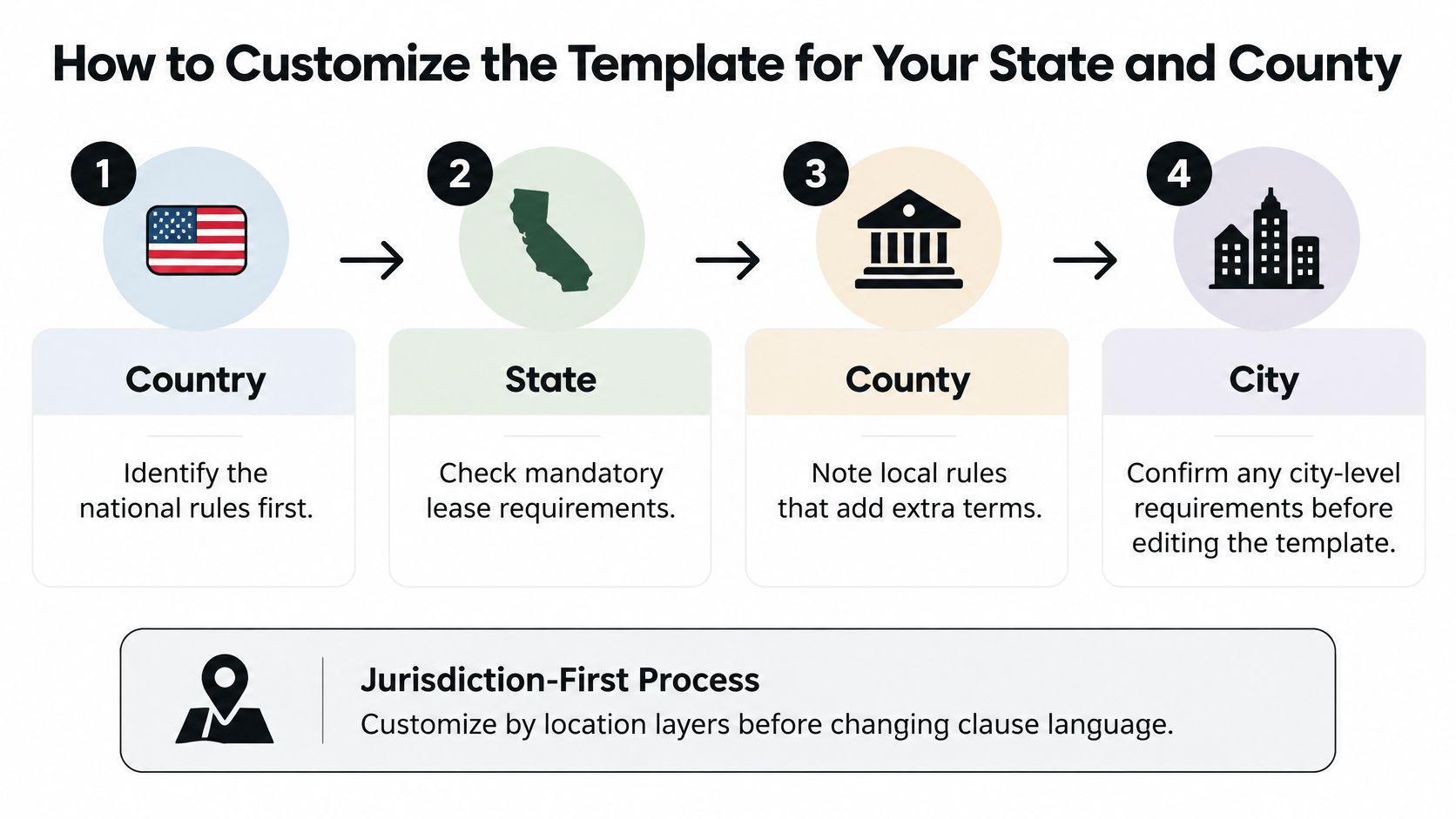
Eight Steps in Order
- List every jurisdiction layer: Write down the country, state, county, and city for the property. This is your control sheet for everything that follows.
- Pull required disclosures for each layer: Collect federal, state, and local disclosures before you touch rent or term. The federal lead based paint disclosure for homes built before 1978 is the classic example landlords forget.
- Check the deposit cap and notice periods: Confirm the maximum you can hold, where it must be kept, and the return deadline. Our guide to rent and security deposit rules walks through how those pieces fit together.
- Check local rules: Look for rental registration, inspection requirements, rent stabilization, and any city notice forms. Local ordinances are where state forms most often fall short.
- Fill in the commercial terms: Only now add parties, premises, rent, utilities, occupants, term, renewal, and maintenance duties. The law layers set the boundaries, your terms operate inside them.
- Use addenda instead of rewriting core clauses: Pets, parking, shared spaces, and program requirements belong in signed addenda. Rewriting core language invites conflicts you won't spot.
- Get attorney review for unusual situations: Subsidized housing, rent regulated units, and properties with mixed residential and commercial use deserve professional eyes. A template doesn't replace legal review there.
- Execute cleanly: Initial every inserted or altered clause, have both parties sign, and confirm every copy matches exactly. Matching signed versions are the benchmark, not a document that merely looks complete.
The failure modes are predictable, which makes them avoidable.
- Copying another state's form: The clauses may read well and still violate your deposit or notice rules.
- Burying material terms in house rules: If it affects money, occupancy, or termination, it belongs in the signed lease or a signed addendum.
- Omitting addenda: An unsigned pet policy attached to nothing is hard to enforce.
- Letting inconsistent versions circulate: Two drafts with different late fees will surface at the worst possible moment.
Aim for 100% completion of your jurisdictional checklist and 100% inclusion of required disclosures before anyone signs. That's the standard that holds up when a tenant, a court, or a housing inspector reads the file.
Sample Language for the Clauses That Cause Disputes
Sample wording works when each sentence answers the question a tenant would otherwise text you at 9 p.m. Keep placeholders, fill every bracket, and check each amount against your state caps before signing.
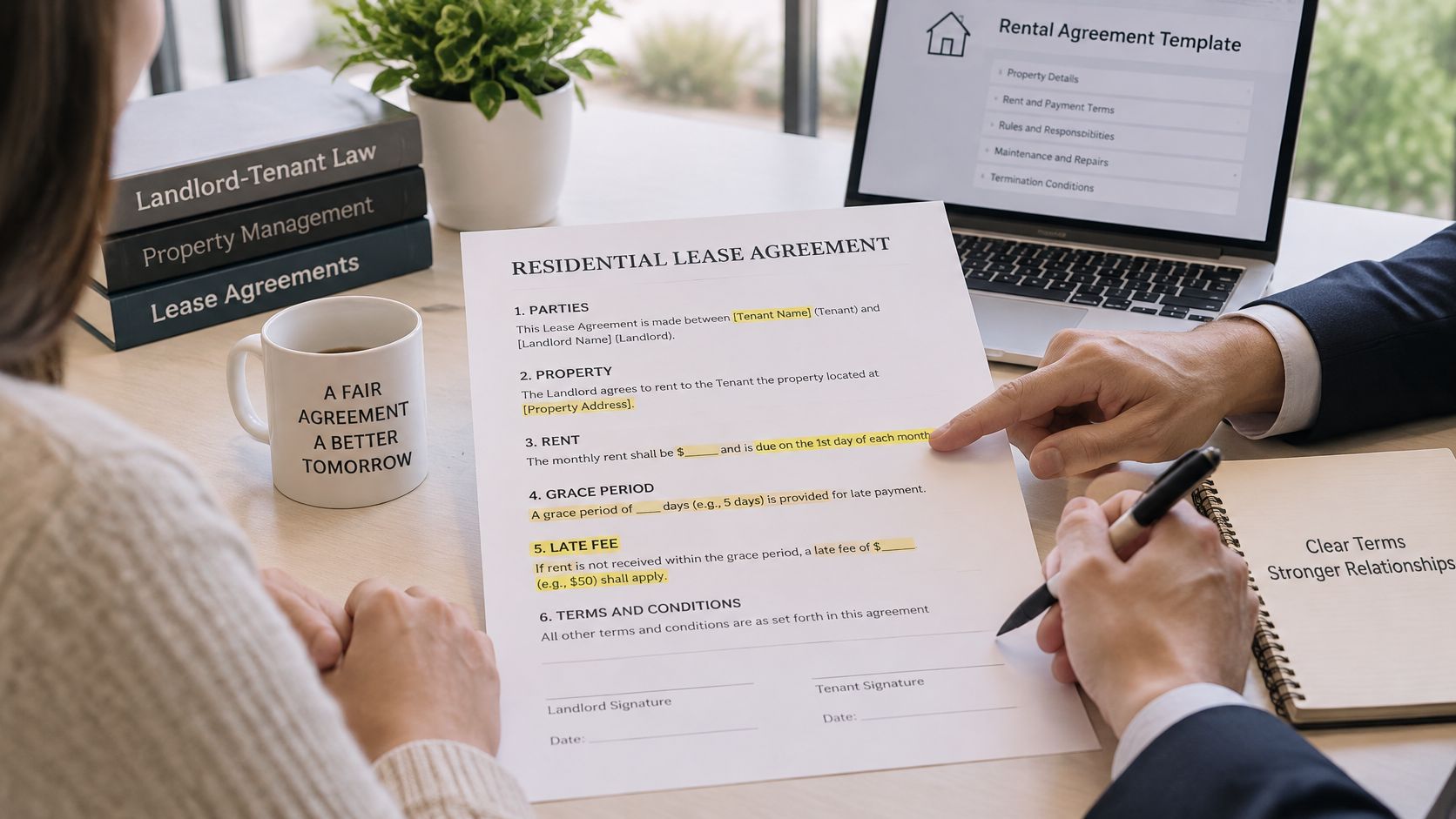
Rent and late fees
Rent of $[amount] is due on the [day] of each month. If rent isn't received within [number] days after the due date, a late fee of $[amount] applies on day [number] and is added to the amount due.
This sentence fixes the due date, the grace period, and the fee trigger in one place. For the policy choices behind it, see our breakdown of the late fee for rent.
Payment methods
Tenant may pay by [ACH, card, check, cash]. A processing fee of $[amount or "none"] applies to [method]. If Tenant can't use the preferred method, Tenant will contact Landlord before the due date to arrange an alternative listed here.
Fee and payment wording now draws regulatory attention, not just tenant complaints. According to the California Apartment Association summary of 2025 rental housing laws, California requires most rental providers, from April 1, 2025, to offer annual reporting of rent payments to credit bureaus, with the offer made when qualifying new leases are signed and annually for existing leases. Separate mandatory costs from optional charges, and make the lease match your listing, application, receipts, and any credit reporting consent.
Entry
Landlord will give at least [number] hours notice by [method] before entering, between [hours], for repairs, inspections, or showings, except in an emergency.
Repairs
Tenant will submit repair requests through [portal, email, or phone]. For emergencies involving water, heat, or security, Tenant will call [number] immediately.
This names the channel, so a request buried in a text thread doesn't become your record of notice.
Pets
Only the following animals are permitted [list]. Tenant pays a pet fee of $[amount] and a pet deposit of $[amount]. These pet rules are part of this lease.
Renewal
At the end of the term, this lease [ends, renews month to month, or renews for a new term] unless either party gives [number] days written notice.
I would read each finished sentence aloud. If you can't tell who pays, when, and what happens next, the clause isn't done.
Keep Your Lease Current as Laws Change
A signed template starts aging the day you save it. Keep yours current with a routine you can run on a small portfolio.
- Record the jurisdiction and last check date: Put both on your template file name or cover sheet, so you always know which version belongs to which property.
- Review every six months and on any announced change: Check state and county updates on a schedule, not when a dispute forces you to.
- Choose addendum or replacement deliberately: Existing tenancies usually call for a signed addendum. New tenancies can start on a replacement lease built on the updated template.
- Don't change core rights unilaterally: Never alter rent, term, deposit, or notice rights in a live lease without written agreement from both parties and legal advice.
Official forms move faster than most landlords expect. In 2025, Maine enacted legislation requiring the Attorney General to create and publish a model residential lease by December 1, 2025, and update it biennially, according to the Maine Attorney General model residential lease page. When your state publishes or revises a model form, treat it as a reference point and compare your template against it clause by clause. Our overview of lease agreement laws helps you track which rules sit at which level.
When a law changes, ask two questions before you edit anything. Which clauses in your current form become unenforceable, and are existing tenancies grandfathered under the old rule or pulled into the new one? The answer decides whether you're drafting an addendum, waiting for renewal, or leaving a signed lease alone.
Practical rule: An existing lease keeps its original terms until both parties agree in writing to change them.
Generate Your State-Specific Lease Today
You have two realistic routes. Draft and maintain the document yourself, or generate it and spend your time reviewing instead of typing. If you manage one to ten units and don't want a drafting fee on every lease, I would generate first and review hard.
This is an example of how the generated output appears in practice.
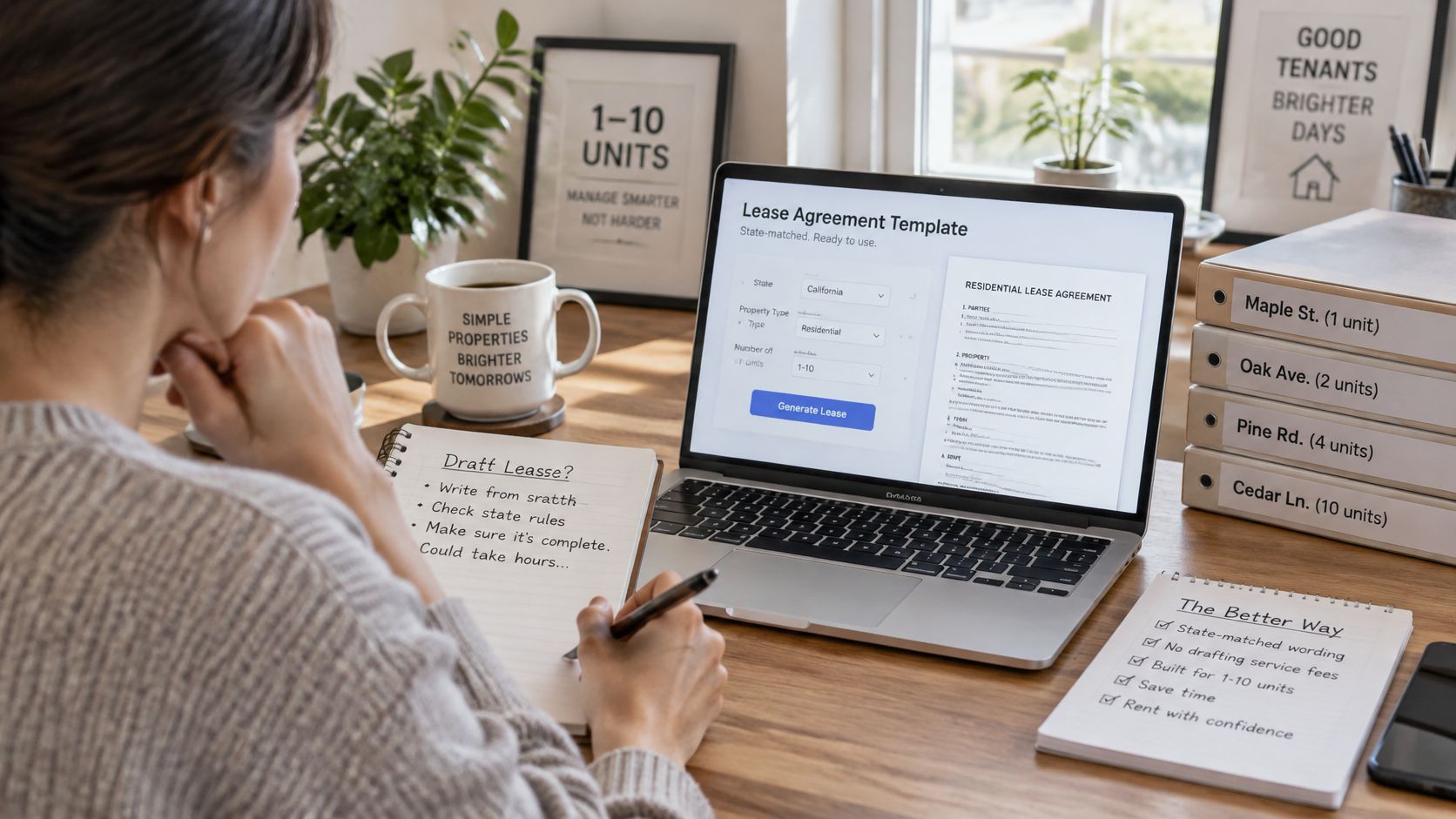
Our lease language is lawyer-reviewed, state by state, generated leases include county-level clauses automatically, and the AI Lease Generator is part of Platinum and creates a state-specific lease in under 30 seconds. You can test the workflow in a free workspace for one door, with no credit card required and setup in about two minutes, before committing to anything.
This short walkthrough shows the generation flow from property details to a signable document.
Before you sign a generated lease, check three things. First, the jurisdiction matches your property's state and county. Second, every addendum triggered by a property feature is attached. Third, every figure passes the verification check against your listing and application. Landlords who also buy, sell, or transfer property can round out their paperwork with forms for property transactions handled by a real estate law office.
A generator cuts drafting errors. It doesn't replace attorney review for subsidized housing or rent regulated units. Finish by running the execution steps for initialing changes, signing, and matching copies, and only then send the lease out.
Generate a state and county specific lease in seconds, set your own due date, grace period, and late fee on each lease, and keep screening, rent collection, and maintenance in one place built for landlords with one to ten units. Start free with your first door and see the finished document before you pay anything at VerticalRent.
Put this into practice
VerticalRent tools related to this guide
Legal Disclaimer
VerticalRent and its authors are not attorneys, CPAs, or licensed legal or financial advisors, and nothing on this site constitutes legal, tax, or professional advice. The information in this article is provided for general educational purposes only. Landlord-tenant laws, eviction procedures, security deposit rules, and tax regulations vary significantly by state, county, and municipality — and change frequently. Nothing on this site creates an attorney-client relationship. Always consult a licensed attorney or qualified professional in your jurisdiction before taking any action based on information you read here.
Co-founded VerticalRent in 2011, growing it from nothing to 100k landlords and renters. Sold it in 2019, then re-acquired it in 2026 to make it better than ever.


