Lease Agreement Laws Every Landlord Should Know
Learn lease agreement laws every landlord should know, from required clauses to state rules, common pitfalls, and compliant drafting tips that protect……


You've found a tenant, signed a lease, and filed the document away. For many independent landlords, that feels like the finish line. It isn't. A lease can look polished and still contain an unenforceable clause, omit a required disclosure, or rely on notice language that no longer matches the law.
That's why lease agreement laws are best understood as a lifecycle problem. Drafting matters, but so do renewals, rent increases, legal reforms, local ordinances, tenant communications, and records. The document you signed yesterday may need an update tomorrow.
When a “Good” Lease Quietly Stops Being Legal
Maya owned a duplex and wanted to avoid the expense of a lawyer. She downloaded a free lease template, filled in the names, rent, deposit, and move-in date, then signed it with her tenant. The agreement looked professional, and nothing seemed unusual during the tenancy.
The problem appeared when Maya filed for eviction after a dispute. The court identified several provisions it couldn't enforce. One clause claimed a security deposit could be deducted without respecting applicable limits. Another attempted to waive the tenant's habitability protections. The notice provision also lacked language required by the governing rules. The filing was dismissed, and Maya had to return part of the deposit before starting the process again.
Maya's mistake wasn't unusual. She treated the lease as a finished form rather than a document operating inside a changing legal system. Landlords can use state-specific landlord law guidance as a starting point, but they still need a process for checking whether their documents remain suitable for the property's location and tenancy type.
Why a signed lease isn't permanently protected
A lease may become defective because of a statute amendment, court interpretation, or city ordinance. Some problems arise immediately because a clause was invalid when the parties signed. Others appear later, when the landlord tries to enforce a term that conflicts with a newly applicable rule.
Independent landlords face particular exposure because they often manage leasing, maintenance, notices, and bookkeeping themselves. A property manager may monitor legal updates as part of a broader compliance system. An owner with a small portfolio may not hear about a change until a tenant challenges a notice or a court rejects a clause.
Practical rule: Treat every lease as a living record. Review it when the tenancy renews, when rent changes, when local rules change, and before serving a formal notice.
The core question isn't only, “Was this lease valid when I signed it?” Ask, “Can I still rely on each important term today?” That shift prevents a clean-looking template from creating a costly legal problem.
The Three Layers Behind Lease Agreement Laws
Lease rules work like a three-layer cake. Contract law forms the base, state landlord-tenant statutes sit in the middle, and local ordinances form the top layer. A lease must survive all three.
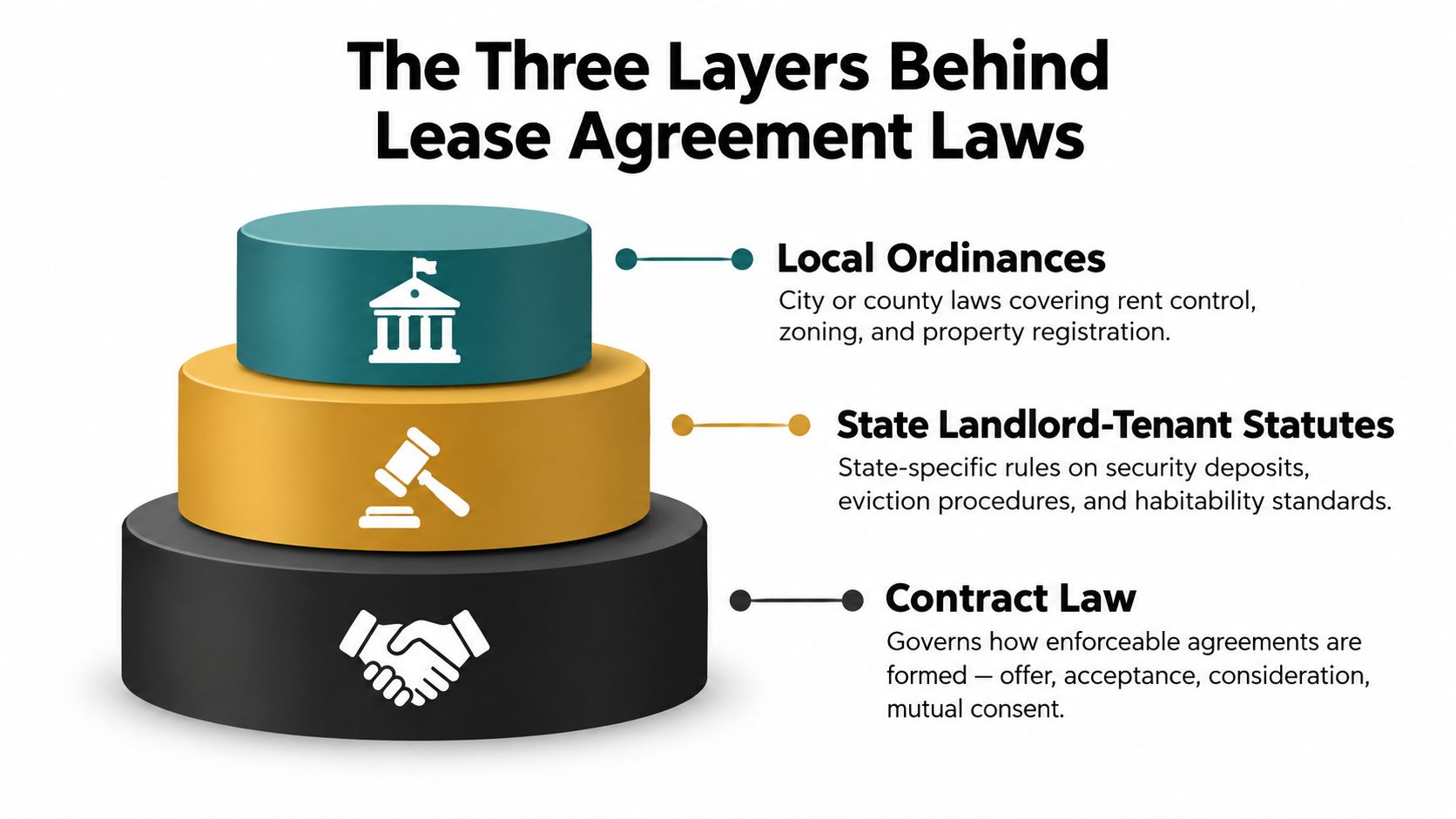
The base layer is contract law
Contract law asks whether the parties formed an agreement. In practical terms, the landlord offers a tenancy, the tenant accepts it, rent provides consideration, and both sides show mutual assent to the terms. If the parties never agreed on a core term, or if consent was obtained improperly, the agreement may be difficult to enforce.
But contract freedom has boundaries. A landlord and tenant can negotiate many terms, yet they can't contract around every legal protection. A lease clause waiving a tenant's right to a jury trial might appear clear and might satisfy ordinary contract principles, but it can still be unenforceable where a jurisdiction prohibits that waiver of statutory remedies.
State statutes add mandatory protections
State law supplies rules on subjects such as security deposits, habitability, retaliation, disclosures, and eviction procedure. These rules often limit what a lease may say, regardless of what the parties prefer.
A lease that says the tenant accepts the property “as is” doesn't automatically eliminate the landlord's legal duty to provide a habitable home. Likewise, a clause requiring a tenant to surrender statutory rights may fail even when the tenant signed it voluntarily.
Local ordinances can override the practical result
Cities and counties may add registration, inspection, rent stabilization, notice, or licensing requirements. A state may permit a rent-escalation clause, while a rent-control city restricts how and when the landlord can use it. The state-level wording isn't enough because the property operates under the local overlay too.
Before drafting, identify the property's jurisdiction, tenancy type, building status, and any special housing program. Then classify each proposed clause against the three layers. This approach helps explain why a lease can be valid as a contract and still lose an enforcement dispute under a statute or ordinance.
Required Clauses, Forbidden Clauses, and the Ones That Actually Matter
Not every lease term has the same legal status. A useful drafting exercise is to place each clause into one of three categories: required, forbidden, or optional. That classification tells you whether the term must appear, must be removed, or can be adapted for practical clarity.
Required language may cover security-deposit handling, landlord identification, the address used for notices, and property disclosures. Lead-based paint disclosures can apply to older properties, while some states require specific habitability acknowledgements or information about rent escrow rights. The exact list depends on the property and jurisdiction, so copying a clause from another state can create a false sense of compliance.
Forbidden terms are more dangerous because their presence can undermine an otherwise usable lease. Common examples include a waiver of the implied warranty of habitability, a blanket attempt to remove a tenant's right to a jury trial, an unrestricted transfer of attorney fees, or language that conflicts with rent-stabilization protections.
Rent increases need more than permission
A clause saying the landlord may raise rent “at the landlord's discretion” is not a complete rent-increase process. A landlord generally can't change a fixed-term lease during its term unless the agreement contains a clear escalation clause or the tenant separately agrees. Even then, required written notice and statutory procedures still matter. Lease enforcement guidance on mid-lease rent increases explains why missing the current rent, new rent, effective date, or legal basis can make a notice ineffective.
| Clause Type | Examples | Legal Treatment | Drafting Risk If Missing |
|---|---|---|---|
| Required | Deposit handling, landlord identity, required disclosures | Must appear when applicable | The landlord may lose an enforcement remedy or face a compliance dispute |
| Forbidden | Habitability waiver, prohibited jury-trial waiver, conflicting rent term | Must be removed or rewritten | A court may strike the clause or reject the related claim |
| Optional | Pet addendum, parking terms, shared-utility rules | Usually negotiable within legal limits | Ambiguity can produce avoidable disagreements |
Optional provisions still deserve attention. A pet addendum can define approval, damage responsibility, and cleanup expectations. A parking addendum can identify the assigned space. Shared-utility terms can explain how bills are allocated. These clauses may not determine whether the lease survives, but they often prevent the everyday disputes that damage a landlord-tenant relationship.
Landlords offering lease-purchase arrangements should also separate ordinary lease compliance from the financial and credit questions involved in a future purchase. Lease purchase mortgage readiness advice can help readers understand that distinction.
For a practical review of mandatory terms, see this guide to required lease clauses. Before signing, label every clause by category. If you can't explain its legal status, don't assume the template has done the work for you.
How Lease Agreement Laws Change After You Sign
A lease can remain physically unchanged while its legal environment changes around it. England's Renters' Rights Act 2025 and Egypt's 2025 rent overhaul demonstrate two different versions of the same lifecycle problem. One reforms how many private tenancies operate going forward. The other phases out older rent arrangements over a transition period.
In England and Wales, rent control and security of tenure began on 23 December 1915 under the Increase of Rent and Mortgage Interest (War Restrictions) Act 1915, and the older system largely ended for most private tenancies under the Housing Act 1988. England's current reform therefore sits within a longer history of legal change, rather than appearing in isolation. The official implementation roadmap for the Renters' Rights Act 2025 states that the Act applies to new and existing tenancies from 1 May 2026.
Two reforms, two landlord workflows
| Lifecycle Stage | England, Renters' Rights Act 2025 | Egypt, 2025 Rent Overhaul |
|---|---|---|
| Existing agreement | Landlords must provide required written information or the government information sheet | Older residential and commercial arrangements enter staged reform |
| Tenancy structure | Many private rentals move from fixed-term assumptions to periodic tenancies | Legacy contracts move toward phase-out or changed rent treatment |
| Possession | Section 21 no-fault evictions are abolished | Landlords and tenants must account for transition and expiry rules |
| Rent administration | Rent clauses and notices must fit the reformed framework | Controlled or legacy rents may change during the transition |
| Records | Written tenancy information becomes a lifecycle obligation | Historical contract dates and occupancy terms become central evidence |
Egypt's reform phases out pre-1996 residential contracts after a seven-year transition and commercial contracts after five years, according to coverage of the 2025 rent overhaul. That framework creates questions that a standard new-lease checklist won't answer, such as how longstanding occupancy interacts with escalation and expiry.
The practical lesson is simple. A clause that worked under one legal framework may become incomplete or misleading after reform. Landlords need a calendar for disclosures, renewal documents, rent reviews, and possession notices, not merely a folder containing the original signed lease.
Rent Increase Notices and Other Mechanics That Decide Enforceability
A rent-increase clause gives a landlord contractual language to work with. It doesn't automatically make the increase enforceable. The landlord still needs the correct notice, timing, delivery method, effective date, and frequency under the governing law.
Notice periods vary by jurisdiction and tenancy type, commonly falling somewhere between 30 and 90 days. In Victoria, Australia, rent increases require at least 90 days' notice from 25 November 2025, as described in this overview of landlord rent-increase notice requirements. Some U.S. jurisdictions commonly use 30 days for month-to-month arrangements, while larger increases may require longer notice.
Match the notice to the tenancy
| Tenancy Type | Typical Minimum Notice | Notes |
|---|---|---|
| Month-to-month tenancy in some U.S. jurisdictions | 30 days | Local law and the size of the increase may require more time |
| Larger rent increase in some U.S. jurisdictions | Longer than 30 days | Check the applicable statute and local ordinance |
| Victoria tenancy | 90 days | Applies to rent increases from 25 November 2025 |
| Fixed-term tenancy | Usually during an allowed review point | A mid-term increase generally needs an existing escalation clause or tenant agreement |
A valid notice should identify the current rent, the new rent, the effective date, and the legal or contractual basis for the change. It should also use the delivery method required by law or the lease. Email may not replace personal service, posting, or another prescribed method in every jurisdiction.
Frequency matters too. A landlord might have a well-written annual review clause, but serving increases too close together can still violate local limits. A local ordinance may also restrict the amount or timing even when state law allows the general concept of an increase.
A missed notice deadline can turn an otherwise permitted increase into a payment dispute. The tenant may remain entitled to pay the prior rent until valid notice is served.
Create a notice checklist for each property. Record the date prepared, date served, method of delivery, effective date, supporting calculation, and proof of service. That file can matter as much as the lease clause when a tenant challenges the new amount.
Why Independent Landlords Are Moving to Automated Lease Generators
A downloaded template is static. The moment a state changes a disclosure requirement or a county adds a local rule, the file remains exactly as it was. That doesn't mean every automated tool is automatically reliable, but it does mean landlords should compare a frozen document with a process designed to account for jurisdictional differences.
An automated lease generator can identify the property's state and county, assemble relevant clauses, and prompt the landlord for missing information. The important benefit isn't speed alone. It's the possibility of creating a repeatable review layer around disclosures, addenda, and local terms.
What automation can and can't solve
A tool may help with:
- Jurisdiction selection: It can tie the draft to the property's location rather than the landlord's home address.
- Required language: It can prompt for disclosures and addenda associated with the selected property.
- Document consistency: It can reduce the chance that a landlord uses one outdated version for every unit.
- Lifecycle review: It can make it easier to regenerate or inspect a lease when rules change.
The tradeoffs are real. Automation can cost money, require setup, and encourage overconfidence if the landlord assumes a generated document needs no review. A tool can't decide whether the facts supplied by the landlord are accurate, and it shouldn't replace legal advice for an unusual property, contested tenancy, or complex local regime.
This buyer's guide to AI lease agreement generators offers a framework for evaluating these tools. VerticalRent is one option that generates state- and county-specific residential lease agreements with related disclosures and addenda, alongside rental-management functions. Treat that capability as a compliance aid, not a substitute for reading the final document and checking current official rules.
The better challenge is to stop asking whether a template is “good.” Ask whether the landlord has a system that flags when the template needs review.
The Compliant Lease Checklist Independent Landlords Actually Use
A practical checklist should cover the period before signing and the months after move-in. Use it as a working document for each property, not as a one-time download.
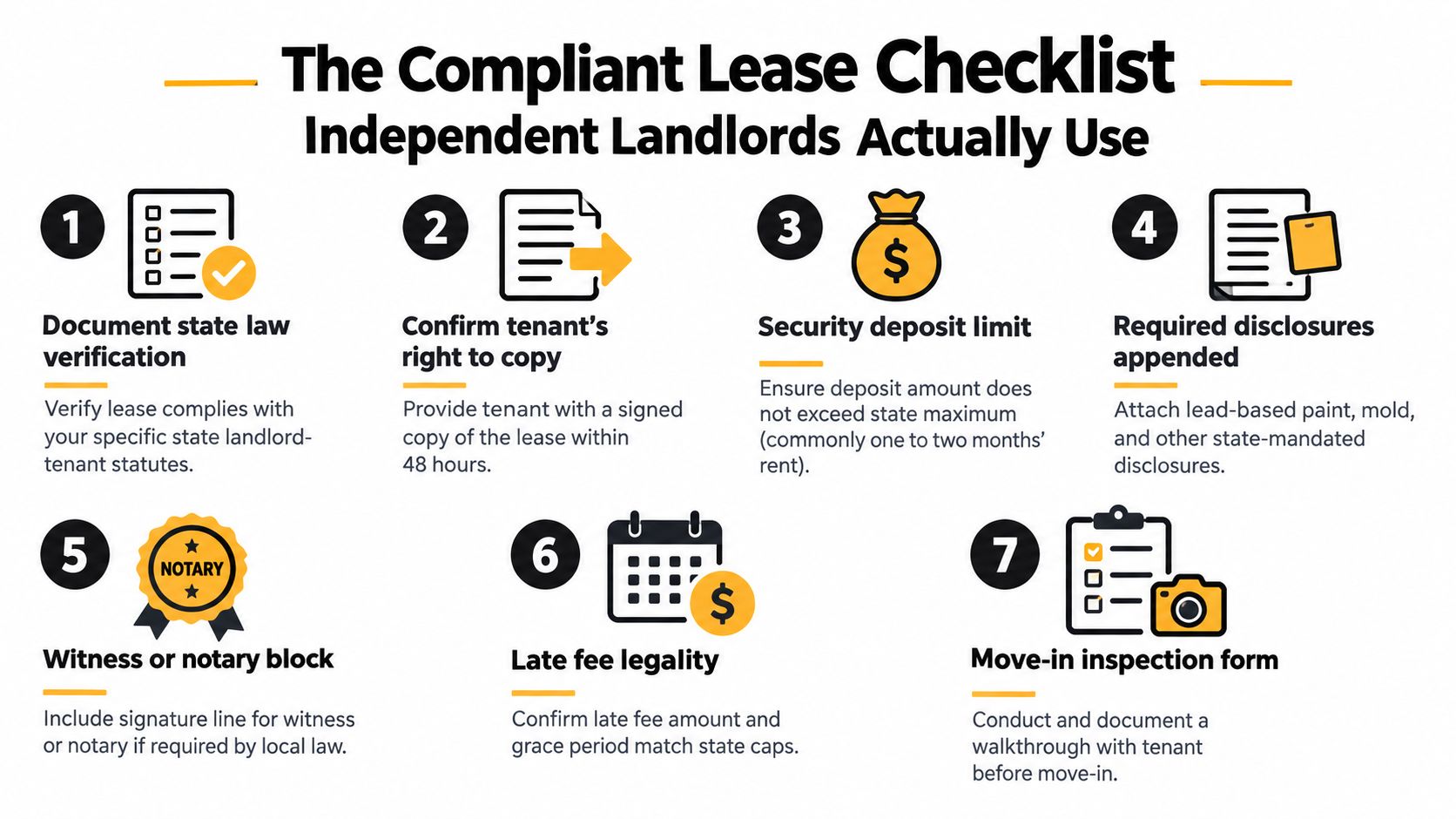
Before the tenant signs
Verify the jurisdiction. Confirm the state, county, and city rules that apply to the property. Check whether rent stabilization, registration, inspection, licensing, or special property classifications affect the lease.
List required disclosures. Add every disclosure required for the property and tenancy. Lead-paint paperwork may apply to older housing, while other jurisdictions may require information about mold, habitability, deposit handling, or rent escrow rights.
Remove prohibited terms. Review the document for habitability waivers, unlawful jury-trial waivers, unrestricted entry rights, blanket fee transfers, and rent language that conflicts with local protections.
Test rent language. Identify the current rent, any permitted review point, the notice method, and the timing requirement. A clause shouldn't promise more than the law allows.
Separate operational addenda. Put pet, parking, storage, utility, smoking, or shared-space terms in clearly labeled attachments. Have the tenant sign each applicable addendum so the responsibilities are easy to locate.
At signing and after move-in
Deliver the completed copy. Give the tenant a fully signed copy and preserve the version signed by both parties. If local law requires a witness, notary, or specific delivery method, complete that step before treating the file as closed.
Document condition. Complete a move-in inspection, record visible conditions, and retain dated photographs with the lease file. This evidence supports both maintenance decisions and later deposit accounting.
Use the following habits to keep the file current:
- Schedule an annual review: Tie the review to the lease anniversary or another reliable date.
- Calendar every notice deadline: Set reminders before a rent, renewal, cure, or possession notice must be served.
- Re-run the checklist after legal changes: Don't assume an existing lease remains operationally complete when a state or county changes its rules.
For visual guidance on lease administration, watch this embedded resource:
A defensible lease is more than a signed PDF. It's a maintained record supported by timely notices, accurate disclosures, inspection evidence, and a repeatable review routine.
VerticalRent helps independent landlords generate state- and county-specific lease agreements, organize disclosures and addenda, and manage related rental records in one platform. Visit VerticalRent to review a lease workflow that supports ongoing compliance instead of treating signing day as the end of the process.
Put this into practice
VerticalRent tools related to this guide
Legal Disclaimer
VerticalRent and its authors are not attorneys, CPAs, or licensed legal or financial advisors, and nothing on this site constitutes legal, tax, or professional advice. The information in this article is provided for general educational purposes only. Landlord-tenant laws, eviction procedures, security deposit rules, and tax regulations vary significantly by state, county, and municipality — and change frequently. Nothing on this site creates an attorney-client relationship. Always consult a licensed attorney or qualified professional in your jurisdiction before taking any action based on information you read here.
Co-founded VerticalRent in 2011, growing it from nothing to 100k landlords and renters. Sold it in 2019, then re-acquired it in 2026 to make it better than ever.


