Rent Collection Software for Landlords: Costs Compared
Compare rent collection software for landlords by ACH and card fees, auto-reminders, late fees, reporting and tax-ready records before you choose.


A low-cost payment method doesn't guarantee low-cost rent collection. VerticalRent charges landlords a 3% platform fee on both ACH and card collections, so a bank transfer still carries a percentage-based platform charge. For a small portfolio, the useful comparison isn't ACH versus cards. It's the total cost of collecting rent, handling exceptions, and turning each payment into an accurate tax record.
What Rent Collection Software Covers and Who Needs It
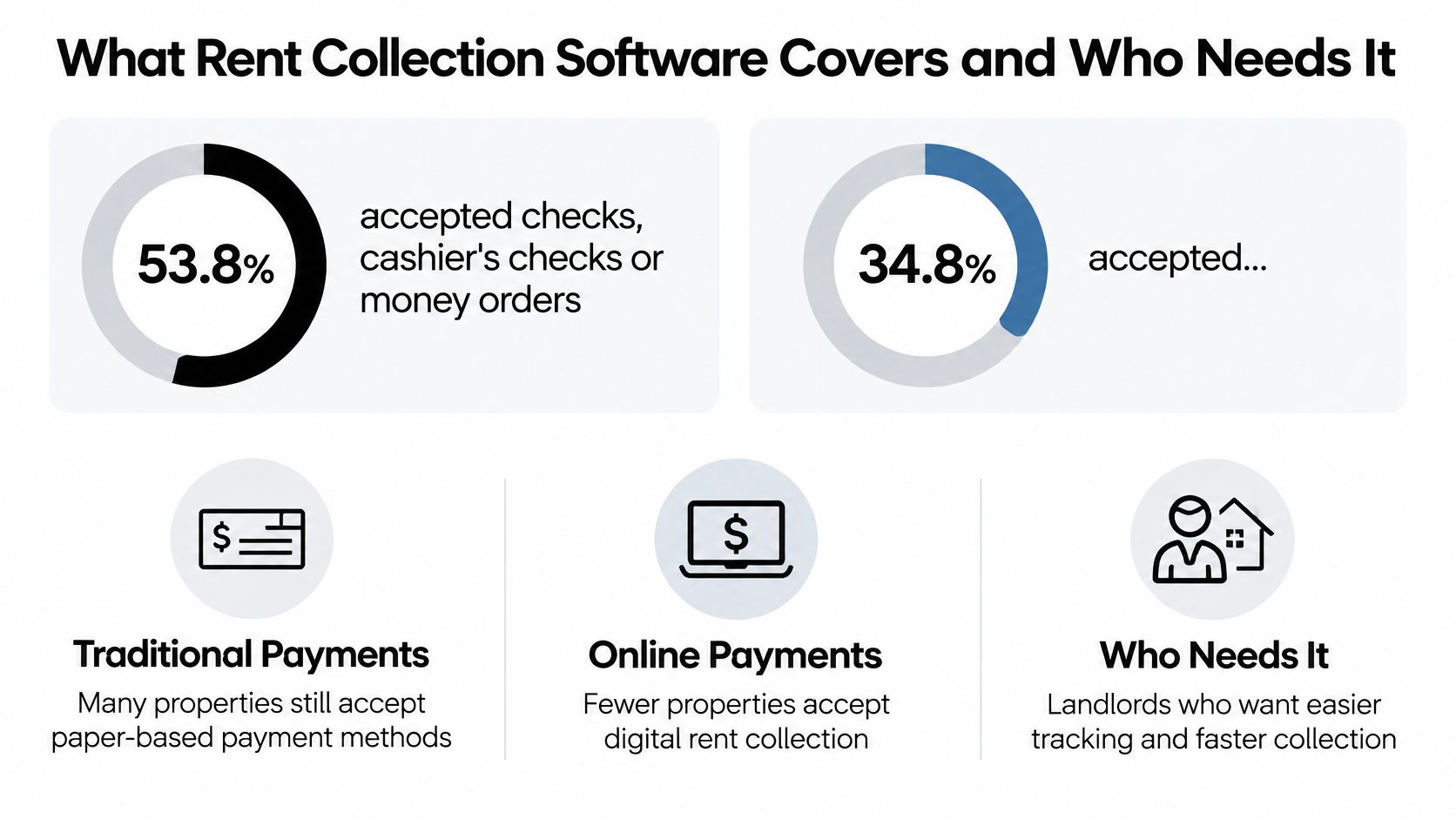
53.8% of rental properties accepted checks, cashier's checks, or money orders, while only 34.8% accepted online payments, according to the U.S. Census Bureau's 2024 Rental Housing Finance Survey, summarized by TenantLedger. Those figures describe payment methods properties accepted, not exclusive usage, because respondents could select multiple methods.
That distinction matters. A landlord might offer online payments while still receiving paper checks, so buying software doesn't automatically eliminate manual collection work. The operational improvement comes when tenants adopt the payment workflow.
Say you collect rent from several households. One tenant mails a check, another transfers money electronically, and another asks whether a partial payment arrived. You're not just collecting money. You're matching payments to leases, maintaining balances, issuing receipts, and deciding whom to contact.
Software should connect payment and bookkeeping
Rent collection software for landlords connects the payment request, tenant payment method, reminders, receipts, and rental ledger. Depending on the product, it can also apply lease-based late fees and generate downloadable financial reports.
That makes it different from just receiving money in a bank account. A deposit tells you funds arrived. A rental ledger should also tell you whose obligation the payment satisfied, which property earned the income, and whether a balance remains.
Our online rent collection went live in 2012, allowing landlords to collect rent without chasing checks. But the reason to switch today should be a specific problem you're trying to solve:
- Repeated follow-up: You spend time checking whether tenants remembered the due date.
- Fragmented records: Payment confirmations, bank deposits, and lease balances live in different places.
- Year-end reconstruction: You rebuild income records from messages and bank statements.
Payment timing deserves separate attention. If tenants need installments rather than a different payment method, Disputely's guide to flexible rent is a useful starting point for evaluating that arrangement. Flexible scheduling and automatic collection solve different problems.
Practical rule: Choose software around the administrative work you need to remove, not the number of payment buttons it offers.
A reliable payer and a clean ledger may need little intervention. Mixed payment habits, partial payments, and inconsistent records create a stronger case for a connected system.
Feature Checklist for Payments, Reminders and Reports
Feature checklist for rent collection software
| Feature | What to verify | Why it matters | Where VerticalRent stands |
|---|---|---|---|
| ACH payments | Recurring bank payments are supported and all transaction charges are disclosed | A flat-fee ACH setup can keep recurring payment costs low | ACH collection requires Verify ($5) or Platinum |
| Card payments | Cards work as a fallback, with fees displayed before submission | Convenience can carry a substantial processing charge | Cards are accepted, and tenants earn rewards for card payments |
| Autopay | Tenant authorizes a recurring schedule and can manage the payment method | Removes the need to initiate each payment manually | Tenants set up autopay once; rent is collected automatically each month |
| Automated reminders | Confirm the available schedule around the due date | Reduces manual reminder messages | Automated rent reminders are included |
| Late fees | Rules match the lease and applicable law | Supports consistent administration | Late fees are applied automatically through rent collection |
| Receipts and ledger | Payments create both a tenant receipt and an identifiable ledger entry | Supports proof of payment and reconciliation | Every payment automatically generates a tenant receipt and is logged to the landlord's income ledger |
| Tax exports | Reports can be downloaded and organized for rental tax reporting | Reduces manual report preparation | Schedule E exports are available on Platinum |
| Credit reporting | Confirm bureau reporting, enrollment, correction procedures, and fees | Payment collection alone doesn't establish bureau reporting | Rent-payment credit bureau reporting is not available |
Use the checklist to test how the software handles ordinary and less routine transactions. Ask the provider to demonstrate a recurring payment, a missed payment, and a corrected ledger entry. A feature label tells you less than seeing the transaction and its record.
Separate collection from optional benefits
Credit reporting illustrates why feature labels need scrutiny. The Urban Institute's analysis of rent reporting, using TransUnion data and Census estimates, found that the share of U.S. renter households with any rent payments reported to a credit bureau rose from about 3% to 13% between 2020 and 2024.
That increase does not mean a particular collection platform reports rent to credit bureaus. Tenant screening credit reports, renter rental-history reports, and rent-payment reporting are separate services. Confirm what a provider offers before presenting collection as a credit-building benefit.
For reminders, inspect the trigger. Does a message follow the contractual due date, an unpaid balance, or a failed transaction? A tenant with a pending payment may need a different message from someone who has not attempted payment.
Late-fee settings also deserve a practical test. Enter the lease terms, applicable grace period, and permitted charge, then check how the system handles partial payments and returned transactions. Automation can apply a configured rule, but the landlord remains responsible for setting terms that comply with the lease and applicable law.
For a small portfolio, prioritize autopay and a clear receipt trail. Autopay reduces the need for tenants to initiate each payment, while receipts and ledger entries make it easier to account for what happened.
What Each Payment Method Costs on Your Rent
Cost of each payment method on a $1,500 rent payment
| Payment method | Typical cost | Cost on $1,500 rent | Who pays |
|---|---|---|---|
| ACH through a flat-fee processor | $0.25 to $2 per transaction | $0.25 to $2 | Landlord, unless passed on where legal |
| Card at typical network rates | 2.5% to 3.5% of rent | $37.50 to $52.50 | Landlord, unless passed on where legal |
| Our platform fee on rent collections | 3% of each collection, ACH or card | $45 | Landlord |
| Card with our tenant convenience fee | Stripe's 2.9% plus $0.30, passed through at cost | $43.80 | Tenant |
| Check or cash | No electronic processing charge in this comparison | $0 electronic processing fees | Landlord contributes handling and reconciliation time; bank charges may apply |
The typical ACH and card ranges, including their costs on the illustrated rent payment, come from the Uinta County Herald's ACH, card, and cash comparison. Its portfolio example puts annual processing at approximately $4,872 for a 2.9% card rate, before fixed transaction charges, versus $180 for $1.50 ACH transactions, for a 10-unit portfolio averaging $1,400 in monthly rent.
The table's platform and tenant convenience charges are our pricing, not alternative estimates of the same fee. On our card collections, the landlord pays the platform charge and the tenant pays the separate card convenience charge.
Compare the complete fee stack
ACH describes the payment method, not the platform's final price. A provider can use bank transfers while charging a percentage of collections. That can erase the cost advantage you'd expect from a flat-fee processor.
Our online payment processing fee guide provides context for separating platform charges from payment-processing charges. When comparing proposals, identify which charges are additive and which are included in a subscription.
Don't treat tenant-paid charges as economically irrelevant. They may not reduce your bank deposit, but they affect whether tenants want to use the method. A card option can be convenient without being the sensible default.
A low subscription price isn't a low total price if the provider also charges against every rent payment.
Use this calculation with your own rent roll:
Annual collection cost = annual rent processed × percentage charges + annual payment count × fixed transaction charges + annual subscription charges.
Then list return fees, dispute fees, and optional services separately where the provider charges them. Use the actual number of transactions, not merely the number of occupied units, if tenants split payments.
Finally, assign each cost to its payer. Confirm applicable law and lease terms before passing fees to tenants, and distinguish a fee the tenant pays directly from a charge you deduct or reimburse. Those arrangements produce different statements and different reconciliation tasks.
Keeping Payment Records Tax-Ready for Schedule E
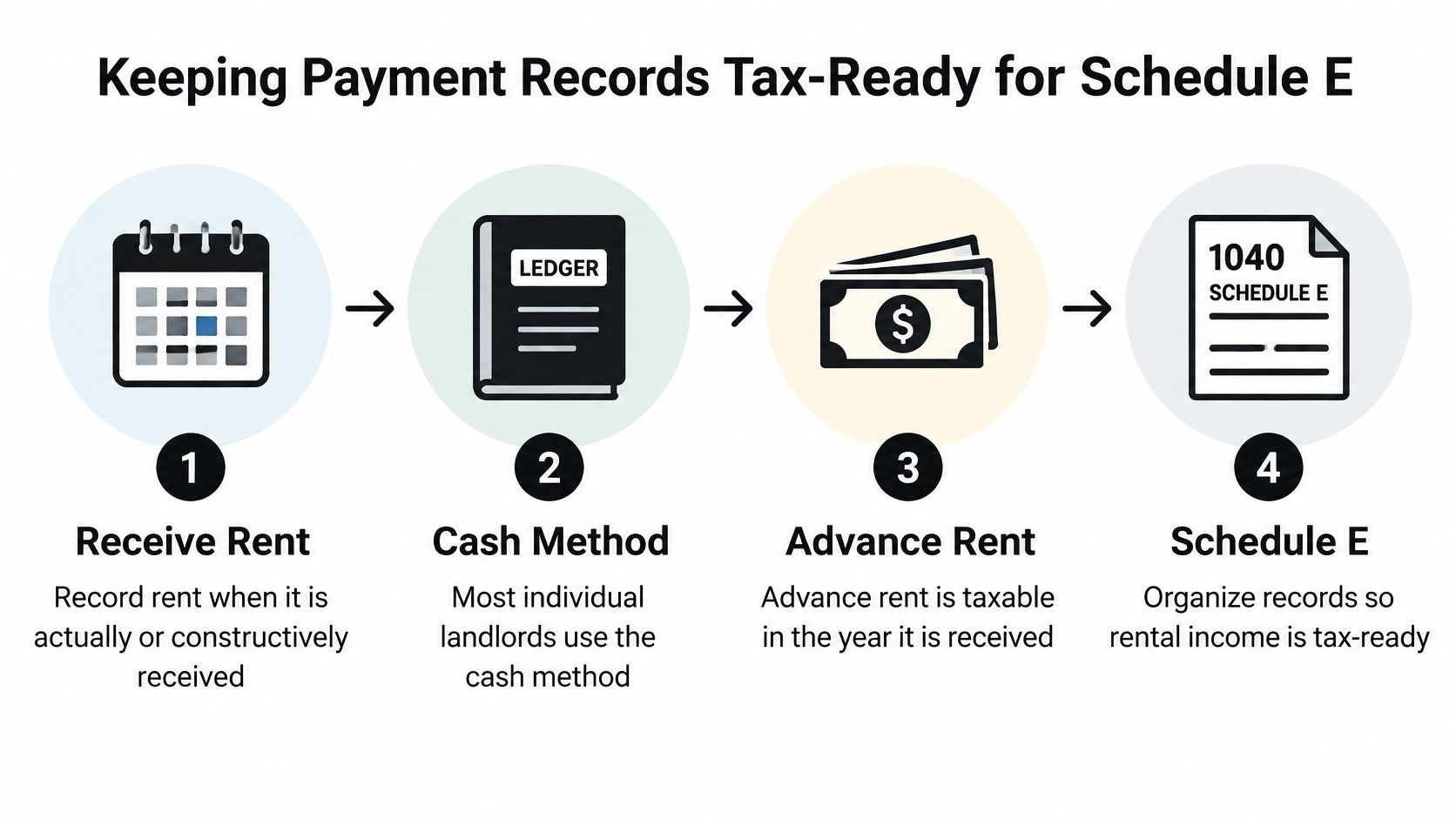
The IRS's Publication 527 explains that most individual landlords use the cash method, generally reporting rental income when received or constructively received; advance rent is taxable in the year received, and rental real estate income is normally reported on Schedule E. That makes payment timing and classification part of software selection, not just bookkeeping cleanup.
Tax-record treatment by payment case
| Case | Record to keep | Schedule E treatment |
|---|---|---|
| December payment that clears in January | Initiation, receipt, availability, and settlement dates | Assign by actual or constructive receipt, not settlement date alone; confirm ambiguous timing with a tax professional |
| Prepaid final-month rent | Receipt date and covered rental period | Taxable in the year received |
| Bounced ACH payment | Return notice, trace number, and linked reversal | Don't leave an unsuccessful collection recorded as received rent |
| Tenant-paid card convenience fee | Separate fee line and processor statement | A fee paid directly to the processor isn't landlord rent; confirm treatment if funds flow through your account |
Preserve the event before assigning the category
For a year-end payment, keep more than the bank posting date. A transaction that settles after year-end may require examining when the money was available to you. Settlement is evidence, not an automatic tax-year rule.
For prepaid final-month rent, separate the period covered from the date received. A tenant's future rental obligation and your current tax reporting aren't necessarily aligned. Also distinguish advance rent from a refundable security deposit rather than classifying both as money held for later.
A returned ACH payment needs a linked reversal. Preserve the attempted payment and return event so the tenant's balance and the income report remain explainable. Deleting the original transaction removes the explanation for the correction.
For tenant-paid card fees, document who received the charge. Don't combine the tenant's entire outlay into your rental income, and don't automatically exclude a fee that passed through your own books without reviewing the corresponding accounting.
Reconcile before exporting
Our payments automatically enter the income ledger, and Platinum adds Schedule E exports. Correct categories still matter: an export can't repair a security deposit entered as rent or an unresolved returned payment.
Use an income and expense ledger to reconcile gross collections, processing charges, refunds, and net bank deposits. Match transactions rather than assuming net deposits equal rental income.
Before filing, resolve uncategorized entries and have a tax professional review uncertain timing or fee treatment. The cheapest payment method can become expensive if you must reconstruct its records by hand.
Handling Failed Payments, Fraud and Disputes
Payment failure modes, evidence and first response
| Method | Failure mode | Evidence to keep | First response |
|---|---|---|---|
| ACH | Returned after appearing successful | Trace number, return reason, verification record | Log the return, contact the tenant, and review any automated late-fee entry |
| Card | Chargeback after payment | Authorization, receipt, lease, ledger entry | Preserve evidence and respond within the processor's stated deadline |
| Check | Lost, delayed, or altered | Check image, deposit record, bank statement | Contact the bank; have the payer arrange a stop payment if appropriate before replacement |
| Instant confirmation | Payment displayed before settlement | Timestamped status history | Keep the collection pending until settlement is confirmed |
| Account takeover | Unauthorized changes to payment or contact details | Login, change, and notification logs | Pause affected automation and verify the tenant through a trusted channel |
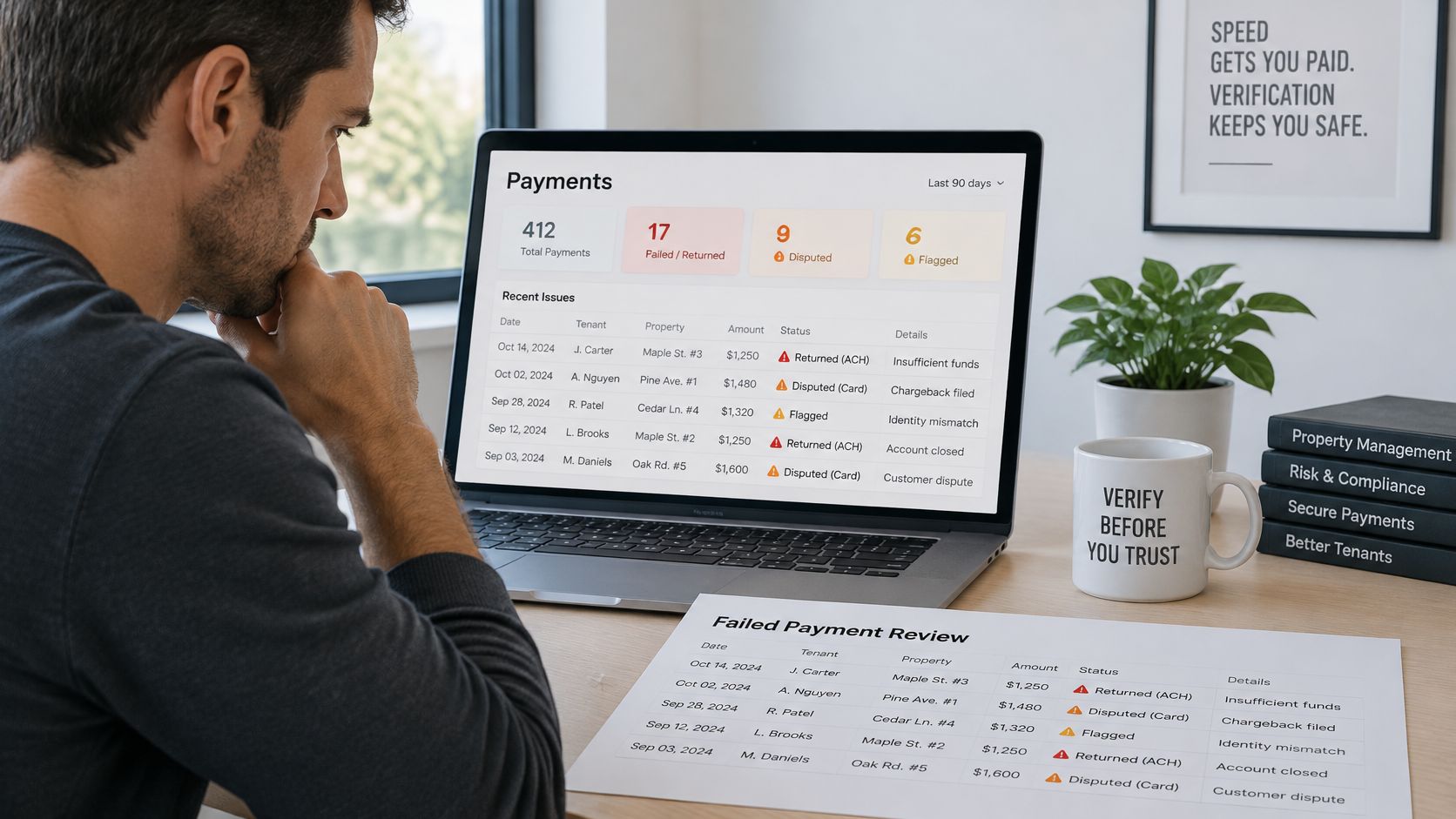
Fast confirmation and verified funds aren't the same thing. A system can acknowledge a payment instruction immediately without establishing that you'll retain the money.
The Federal Trade Commission reported $65 million in reported rental-scam losses from January 2020 through June 2025. That isn't a measure of landlord software chargebacks, but it does demonstrate the financial stakes of verifying rental-payment instructions.
Inspect the exception controls
Ask a prospective vendor to demonstrate what happens when a payment fails, not just when it succeeds. Focus on controls that let you reconstruct the transaction:
- Account verification: How does the system verify the bank account and connect it to the payer?
- Duplicate detection: Can it flag repeated submissions without blocking legitimate split payments?
- Status history: Does it distinguish initiated, authorized, settled, returned, refunded, and disputed?
- Notification records: Can you establish which message went to which address and when?
- Refund permissions: Who can approve a refund or change the destination account?
Operational safeguard: Verify changed payment instructions through an established contact channel, not the new contact information included in the change request.
Automation also needs an exception path. For landlords designing follow-up workflows, property management automation with Truespeak offers a relevant resource for thinking about arrears communications. Keep reminders tied to the verified balance rather than an ambiguous payment notification.
Write down who contacts the tenant, who corrects the ledger, and where supporting records are stored. Preserve the original transaction, link the reversal, and record the resolution. A replacement payment should close the outstanding obligation without erasing the failed attempt.
Matching Software to Your Portfolio Size
Unit count is a useful starting point, but payment habits and record complexity should determine the purchase. A small portfolio with frequent exceptions may need stronger controls than a larger portfolio whose tenants consistently use the same method.
A single-unit owner with a reliable check payer
Don't change a functioning arrangement solely to add software. First identify the inconvenience: mailing delays, trips to deposit checks, missing receipts, or uncertainty about payment arrival.
If the tenant wants electronic collection, start by assessing bank-payment enrollment and recurring authorization. Keep a documented transition date so neither party accidentally submits both a check and an electronic payment.
This month's action: Agree on the future payment method and confirm how the final paper payment will be recorded.
A small portfolio with mixed payment habits
Standardization matters more than a broad feature bundle. Establish consistent tenant instructions, a reminder schedule, and lease-specific fee rules, while retaining any payment alternatives required by applicable law.
Compare tools against the work you perform. CS Outsource's guide can help you find rental software for your portfolio, but evaluate each candidate using your own tenant workflow rather than a general ranking.
This month's action: Create a written collection procedure and test whether each tenant can follow it without individual workarounds.
A growing portfolio with reconciliation problems
When matching deposits consumes more attention than sending requests, prioritize transaction identifiers, property-level allocation, and downloadable reports. A consolidated payout is only useful if you can trace its components.
Our multi-unit management guide provides a broader framework for organizing a growing rent roll. For payment selection, test whether you can reconcile a payout containing rent, a partial payment, and a fee without editing a separate spreadsheet.
This month's action: Reconcile a recent bank statement against the candidate platform's sample export.
An owner offering cards for tenant rewards
Our card payments earn rewards for tenants. Treat that as an optional tenant benefit, not evidence that card collection is the cheapest arrangement.
Present the complete payment charge before enrollment and let tenants evaluate the convenience against the cost. Don't assume rewards offset the fee or that every tenant values them equally.
This month's action: Give tenants a clear comparison of available payment methods before activating recurring card payments.
Avoid buying planning or AI features merely because they're bundled into a higher tier. Pay for them when they address an identifiable task, not when basic collection and reliable records already meet your needs.
Confirm the Fee Math Before You Switch
Choose a workflow before choosing a plan. The strongest setup is the one whose fees you understand, whose tenants can use it, and whose records you can reconcile without guessing.
Build the decision from your rent roll
Inventory actual collections. List occupied units, rent amounts, payment methods, and payment frequency. Include split payments and recurring exceptions. Use your bank statements and ledger rather than assuming every occupied unit produces an identical transaction.
Calculate the complete annual charge. Enter each provider's platform fee, processing fee, subscription, and optional charges in separate spreadsheet columns. Calculate landlord costs and tenant costs separately. A tenant-funded fee doesn't disappear merely because it doesn't reduce your payout.
Assign responsibility before enrollment. Establish who pays each charge and verify that the arrangement complies with applicable law and the lease. Confirm what tenants see before authorizing payment. Don't introduce a new fee through a payment screen without resolving the contractual question.
Rank the functions you will use. Mark essential features separately from conveniences. For some owners, the decisive requirement is recurring authorization; for others, it's an export that preserves gross rent and separate fees. Require evidence for any optional service you'll describe to tenants.
Pilot the complete accounting cycle. Start with willing tenants rather than moving every lease at once. Follow the payment from invitation through authorization, settlement, payout, receipt, and export. Test corrections in a demonstration environment rather than deliberately creating a failed live payment.
Define success before committing
Your pilot should produce an understandable tenant statement and a reconcilable landlord record. Record any manual adjustments you needed, because those are part of the ongoing cost.
Use a short acceptance checklist:
- Tenant clarity: The payer can identify the due amount, payment status, and any charge.
- Landlord visibility: You can distinguish an outstanding balance from a pending collection.
- Accounting continuity: Each payout can be traced to the underlying transactions.
- Exit access: You can download the history you need before discontinuing the service.
Thousands of independent landlords use our platform, but adoption alone doesn't establish suitability for your rent roll. Electronic rent collection requires Verify ($5) or Platinum; select the plan around the functions you need rather than assuming a higher tier delivers better value.
Before switching, complete a fee worksheet and reconcile a sample export. If either task exposes an unanswered question, resolve it before inviting the remaining tenants. The right choice depends on your own collections and records, not a universal best-software label.
VerticalRent offers ACH and card rent collection, recurring autopay, automated reminders, and payment receipts linked to your income ledger. Visit VerticalRent to compare the collection plans against your fee worksheet and decide whether Platinum's Schedule E exports fit your bookkeeping needs.
Put this into practice
VerticalRent tools related to this guide
Legal Disclaimer
VerticalRent and its authors are not attorneys, CPAs, or licensed legal or financial advisors, and nothing on this site constitutes legal, tax, or professional advice. The information in this article is provided for general educational purposes only. Landlord-tenant laws, eviction procedures, security deposit rules, and tax regulations vary significantly by state, county, and municipality — and change frequently. Nothing on this site creates an attorney-client relationship. Always consult a licensed attorney or qualified professional in your jurisdiction before taking any action based on information you read here.
Co-founded VerticalRent in 2011, growing it from nothing to 100k landlords and renters. Sold it in 2019, then re-acquired it in 2026 to make it better than ever.


