Late with Rent in 2026: Fees, Notices, and Plans
Late with rent is not automatic eviction. Compare grace periods and fee caps, then use a message, a short plan, or a notice.


Being late with rent is common enough that a fee, by itself, tells you almost nothing about whether the tenancy will hold. In the Consumer Financial Protection Bureau rental-payment dataset, the share of renters who incurred a late fee during the previous 12 months rose from 15.4% at the end of 2021 to a peak of 23% in early 2023, then fell to approximately 14% by November 2024. The same dataset showed delinquency of any kind climbing from 23% in September 2021 to 30% in January 2023 before dropping to 18% by November 2024.
That swing is the point. A household can miss a draft because payday landed on the wrong side of the first, then clear the balance the next week. I would treat the first miss as a cash-flow timing problem until the ledger shows a balance that keeps growing. A fee can put cash back in the operating account and still make the arrears worse if you stack it on money the tenant doesn't have.
There isn't a national late-fee rule you can copy from a neighboring landlord. Before you post a charge or serve a notice, read the clause in this lease and the statute that governs this unit.
Grace Periods and Late Fee Caps That Actually Apply
The morning rent is short, the lawful fee is a state rule plus a lease sentence, not a flat dollar amount you saw online. Texas Property Code § 92.019 shows the pattern: Texas requires the late-fee provision in the written lease, requires rent to remain unpaid for two full days, and can expose an improper fee to statutory damages and attorney fees. Colorado prohibits a late fee until rent is at least seven calendar days late and caps it at the greater of $50 or 5% of past-due rent. Tennessee provides a five-day grace period and caps late charges at 10% of past-due rent, with special treatment when the deadline falls on a Sunday or legal holiday. Among renters who struggled to pay, 54.8% reported being unable to pay on time, being charged a late fee, or both, and one in ten said the difficulty led to some form of eviction.
| State | Earliest fee | Fee cap | Condition that changes the charge |
|---|---|---|---|
| Texas | After two full days unpaid | Reasonable fee under the statute's conditions | Clause must be in the written lease; a violation can mean statutory damages and attorney fees |
| Colorado | After seven calendar days | Greater of $50 or 5% of past-due rent | No fee at all before day seven |
| Tennessee | After five days | 10% of past-due rent | Deadline moves if it falls on a Sunday or legal holiday |
Three mornings, three different charges
Say rent is $1,200 and nothing has posted. In Texas you don't add a fee on day one. You wait until rent has stayed unpaid for two full days, and only if the written lease authorizes the charge. A "reasonable" fee that isn't in the lease isn't a shortcut. It's a damages problem.
In Colorado the same $1,200 sits fee-free through day six. On day seven the ceiling is the greater of $50 or 5% of the past-due rent, so 5% of $1,200 is $60 and that $60 is the cap. Posting $75 because a friend in another city does it is already over the line.
In Tennessee you count five days, then stop at 10% of what is past due. If the fifth day is a Sunday or a legal holiday, the deadline moves. Don't charge the fee on the holiday and "fix the ledger later."
The fee clock is not the eviction clock
A contractual late fee doesn't start an eviction, and skipping an illegal fee doesn't waive the rent. You can be fully paid on the fee and still need a separate nonpayment notice later. You can also refuse the fee and still be owed every dollar of rent.
Practical rule: Read the clause, count only the full days the statute requires, stay inside the cap, and don't add a fee to a partial payment unless both the lease and the state allow it.
City ordinances and rent-controlled units can tighten a state cap or ban a fee the state would allow. Re-read the local code before you copy a neighbor's flat $75. If you want the arithmetic checked before it hits the ledger, run the past-due balance through a late fee calculator and post only the smaller of the lease amount and the statutory cap.
Why One Late Month Is Not an Eviction Forecast
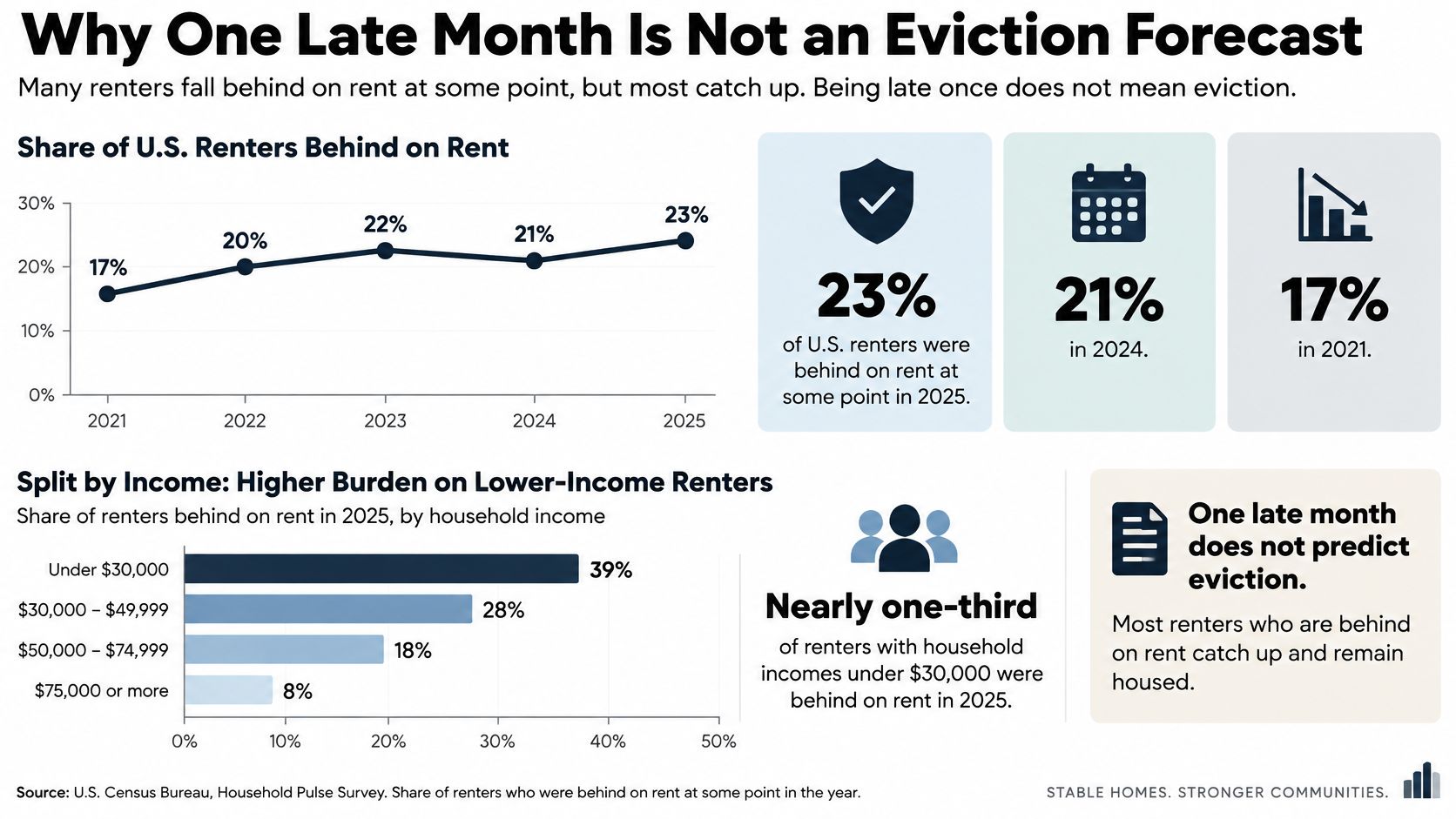
The Federal Reserve's report on the economic well-being of U.S. households in 2025 found that 23% of U.S. renters were behind on rent at some point in 2025, up from 21% in 2024 and 17% in 2021. Nearly one-third of renters earning under $50,000 fell behind, compared with only 5% of renters earning at least $100,000, and 20% of working-age renters either paid late or didn't pay the full amount during 2025, the highest level in that series and up from 16.5% in 2024.
Lateness isn't only a low-income signal. Households that looked fine at screening are missing drafts because hours dropped, a bonus moved, or two pay cycles didn't line up with the first of the month. A single late month is a timing miss until the ledger says otherwise. A late fee is a speed bump. A balance that is still open after the next paycheck is a stalled engine.
Three questions before you label the tenant risky
- Was this paycheck timing? Ask for the date the money arrives, not a vague "soon." A named Friday is a timing problem. "I don't know when" is a different problem.
- Is a partial payment hiding a growing balance? Apply the dollars you received and write the remainder in the same line. A $900 credit on a $1,500 month is not a paid month.
- Is there a credible cure date and amount? If the tenant can say both, keep the file in the timing lane. If they can't name either, stop assuming the next month will look like last year.
Blanket rescreening or a punitive "one strike" policy misclassifies viable tenants, including people well above the lowest income band who still had a disrupted month. Ignoring a rising balance does the opposite harm. It hides the files that stop being timing problems. I would not predict default from one late payment, and I wouldn't wait for a third silent month before I asked the three questions.
What to Do from the Due Date to a Cure Date
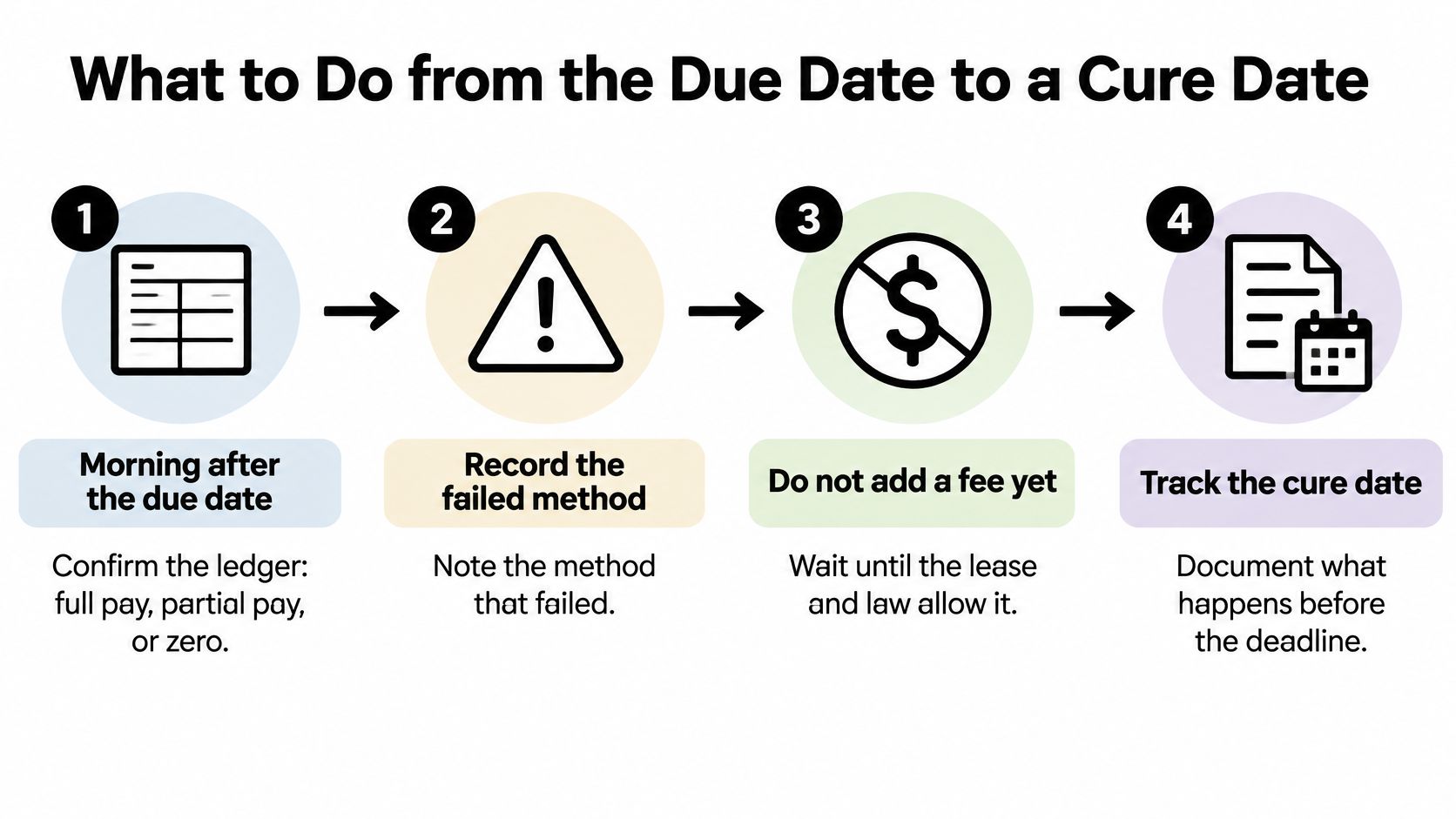
Run the same sequence every time rent doesn't clear. The window is front-loaded. Two quiet weeks turn a paycheck delay into the multi-month balance that is much harder to cure.
- Confirm the ledger the morning after the due date. Mark full pay, partial pay, or zero, and note the method that failed. That line is what you will quote later, so a portal glitch doesn't get treated as a skip.
- Don't add a fee during a statutory or lease grace period. Calendar the first lawful fee day from the state rule that applies. A fee posted early is money you may have to unwind, and it muddies the rent balance.
- Contact the tenant the same day in one written channel. State the exact shortage and ask whether this is a date mismatch or a longer shortfall. One channel keeps the file readable. Five texts don't.
- If a partial payment arrived, apply it the way the lease requires. Show the remaining balance in the same note. Don't let the partial amount look like a paid month, because a later notice that says "unpaid" will look inconsistent if your ledger says "current."
- Set a written cure date. For a timing problem, put it inside the current month, and say which amount must clear, including any fee that is already lawful. A date without a dollar figure isn't a cure.
- Log the outreach, the reply, and any promise. Use the same steps for every tenant so fair-housing treatment stays consistent. The log is the proof that you didn't invent a harsher path for one household.
- If the cure date passes with no payment and no agreed plan, stop informal extensions. Move to the notice rules that govern the unit. Another "just checking in" text after a missed cure date trains the tenant to ignore the date you set.
When the payment bounces
A reversal is its own branch. Alert the tenant the same day, ask for a resubmit, and don't treat the reversed amount as paid rent. The ledger stays open until a new payment clears.
If the tenant says the gap is a few days until wages hit, they may look at a short-term cash advance on their own. You don't require that product, you don't collect it, and you don't pause the cure date while they shop for one. Your job is the written shortage and the date the balance must hit zero.
A cure date works only if both of you could point to the same dollar amount on the same calendar day.
Late Rent Messages You Can Send Today
Send these in order. Each good note stays short, names the property, and includes one line you can't drop. Paste the sent text and the timestamp into the tenant file so a later notice isn't the first written record.
Before any fee
Use this on the due date or inside the grace period. The line you can't omit is the date the grace period ends.
Rent of $[amount] for [property address] was due on [due date]. No late fee is being added in this note. The grace period ends on [grace end date]. Please reply with the date you will pay the full $[amount].
After grace, if a fee is already lawful
Use this only once the statutory wait is over and the fee is inside the cap. The line you can't omit is the fee dollar amount next to the unpaid rent, not a blended "balance due."
As of [today's date], rent of $[unpaid rent] for [property address] is still unpaid. A late fee of $[fee], which is within the [cap, for example 5% or $50], is now due. The new total is $[rent plus fee]. Pay that total by [cure date] using [one payment method].
A short plan, and the note that makes it worse
Use the plan note when the tenant has named a paycheck date and can pay something now. The line you can't omit is that a missed installment ends the plan and that the lease stays in force.
We can split the missed $[arrears] for [property address] into [two or three] installments of $[amount] due on [date], [date], and [date], on top of the regular rent due on its normal date. Accepting this plan doesn't erase the lease. If an installment is missed, the plan ends and the remaining balance is due at once.
The bad version of that third note sounds friendly and creates a mess. "Pay when you can" has no date and no amount. A threat of an immediate lockout isn't a rent-collection tool. A fee quoted before the grace period ends isn't collectible just because you typed it.
Partial payment
Thank them for the dollars that arrived, then state what is left. Don't write "you are current."
We received $[amount received] on [date] for [property address]. The remaining balance is $[remainder], due by [cure date]. This month isn't marked paid in full until that remainder clears.
When a Short Payment Plan Is the Better Move
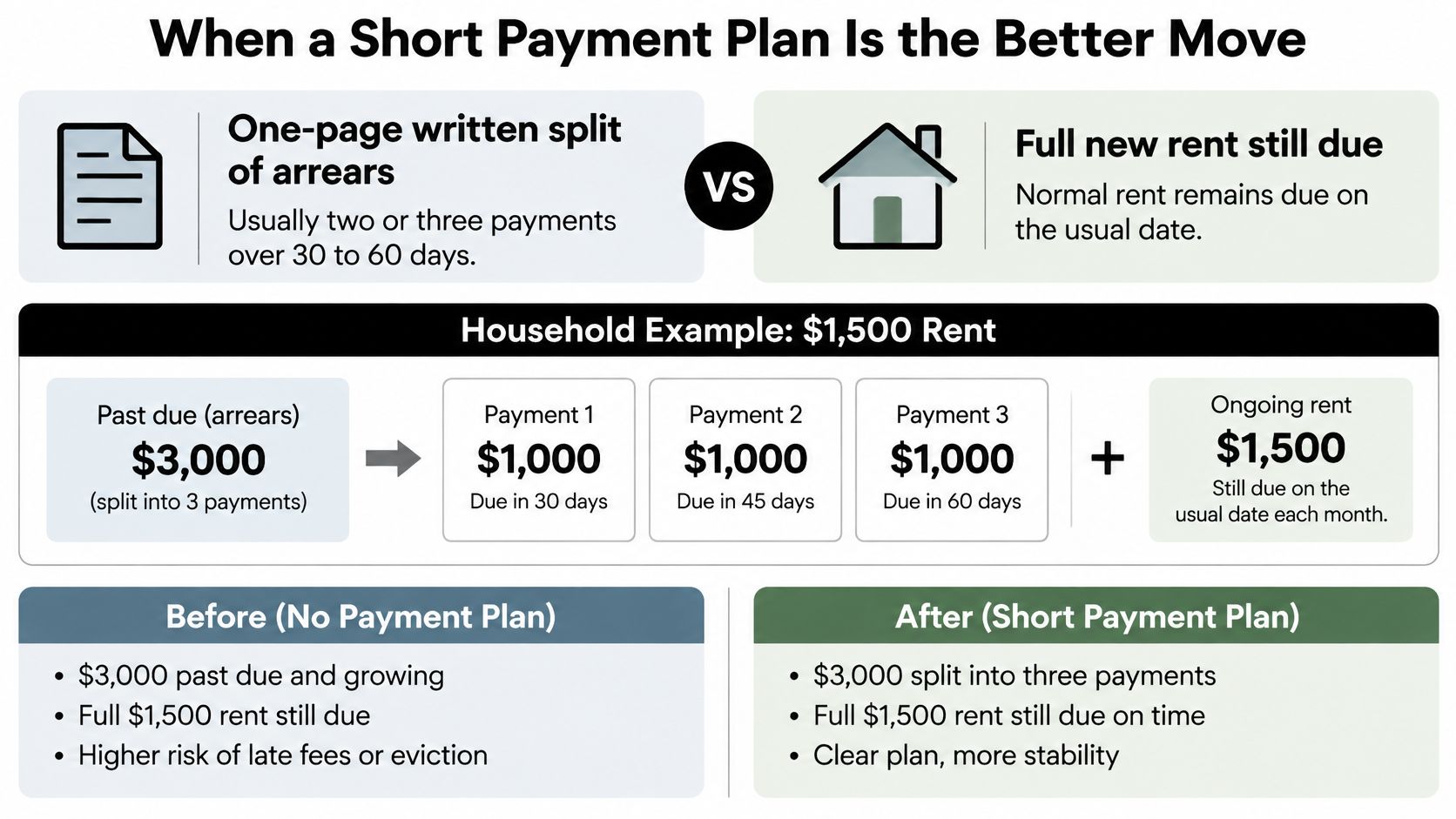
A useful plan is a one-page written split of the arrears, usually two or three payments over 30 to 60 days, with full new rent still due on the normal date. It isn't a text thread and it isn't a rent reduction.
| Pattern | What it usually means | Next move | Do not do |
|---|---|---|---|
| First late month, tenant names a paycheck date | Timing, not a proven default | One written cure date or a two-payment plan | Treat it as grounds to file immediately |
| Partial payment posted | A balance can hide inside a "paid" month | Apply the dollars, show the remainder, set a cure date | Mark the month current |
| Late more than once in the year but catching up | A pattern worth tighter terms | Shorter plan and on-time rent required alongside arrears | Add a new fee on every installment by default |
| Two or three months unpaid, no credible amount | Persistent inability to pay | Stop extensions and follow the notice rules | Keep trading texts with no written balance |
Offer it, or don't
Offer the plan when the tenant names a date tied to a paycheck, has been current for most of the prior year, and can pay something now. Decline a long informal plan when two or three months are already unpaid or the tenant can't name any cure amount. That second pattern is the one that turns into filings, and stretching it across more texts doesn't shrink the balance.
Say the rent is $1,500 and $900 has posted. The arrears are $600, plus a late fee only if that fee is already lawful. A clean cure is $300 with each of the next two rent payments, so the tenant sends $1,800 on each of those due dates and the old shortage is gone in two cycles. Write it as "$1,500 current rent plus $300 arrears," not as a new rent of $1,800. If you change the rent number, you will argue about it at renewal.
Document every partial payment so it can't be mistaken for a waiver. Put the date, the amount, the remaining balance, and one sentence that you reserve lease remedies if an installment is missed. A sample structure for that page is in this payment plan contract guide. Stacking a fresh late fee on every installment can wipe out the point of the plan and deepen the arrears. I would charge the original lawful fee once, then stop, unless a later full month is late on its own.
Local emergency rental aid is something the tenant can pursue in parallel. Don't pause the written dates while an application is only "in process." If aid arrives, apply it to the written balance and send a revised remainder the same day.
Notice Timelines After the Grace Period Ends
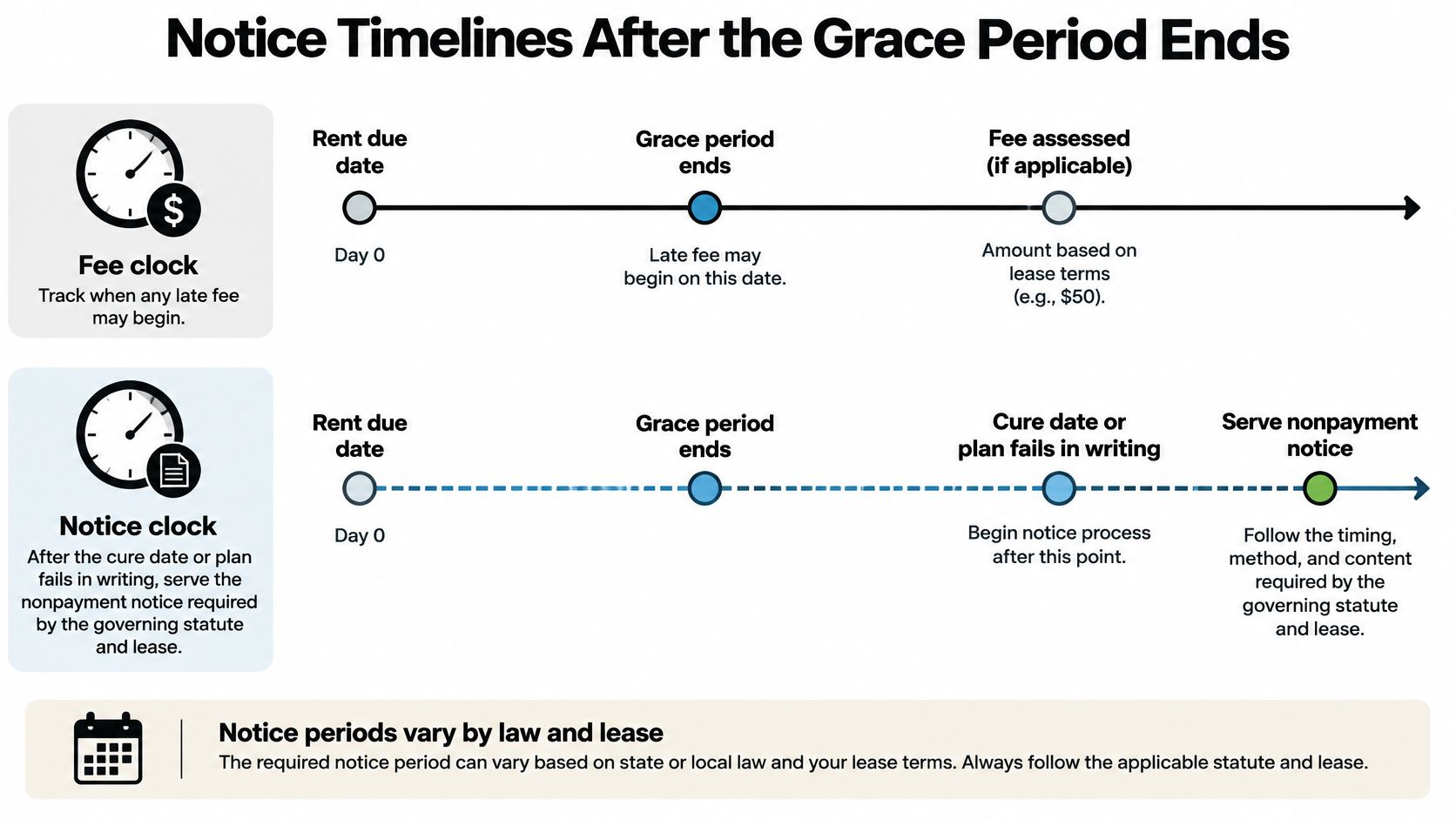
The fee date and the notice date are different clocks. A fee may already be on the ledger while you are still inside a cure date. A notice starts only after that cure date, or the written plan, has failed. There is no single national day count. Notice type, length, and how you count weekends all come from the statute and the lease for that unit. Copy them into your file before anyone drafts a demand.
| State | Notice type | Notice period | Day-count rule |
|---|---|---|---|
| Texas | The written nonpayment demand the current Texas statute requires before a possession filing | The day count printed in that statute for this unit type | Count only the days that statute includes |
| Colorado | The written nonpayment demand the current Colorado statute requires before a possession filing | The day count printed in that statute for this unit type | Count days the way that statute counts them |
| Tennessee | The written nonpayment demand the current Tennessee statute requires before a possession filing | The day count printed in that statute for this unit type | Count days the way that statute counts them |
What the filing pattern actually looks like
Research summarized by the Chicago Booth Review, using detailed ledgers for approximately 6,000 tenants and discussed in this housing-payment stress brief, found that about half missed at least one month's rent, while roughly one in four faced an eviction filing. Landlords commonly waited until tenants had missed two or three months before filing, and 80–90% of eviction cases involved tenants who had become persistently unable to pay rather than isolated late incidents.
A notice after a single missed week is often premature. Silence until arrears pass two or three months is how a late payment becomes a filing. The middle path is a served notice once the written cure has failed, not a court case on day two and not a month of unread texts.
- Confirm in writing that the cure date or plan has failed. If you can't point to the missed date, you aren't ready to serve.
- Copy the notice period from the statute that governs the unit and count days the way that statute counts them. A pay or quit notice built on another state's form is a restart, not a shortcut.
- Include only rent and lawful fees inside the cap. Drop undocumented "admin" add-ons.
- Serve by a method the law allows and keep proof of service. The copy in your sent folder isn't proof if the statute required posting or certified mail.
Assemble the file before anyone discusses court: the lease, the ledger, the fee calculation, copies of messages, any signed plan, and proof of service. Apply the same notice timing to every tenant with the same arrears pattern. A court filing follows its own local forms and waiting periods, and a self-help lockout isn't a substitute for a lawful notice.
Set the Next Due Date Before Rent Is Late Again
Lock four fields on the lease before the next due date so a partial month can't be renegotiated by text. On each lease, set the due date, a grace period at least as long as state law requires, a late fee inside the state cap, and whether autopay is required or only offered. Tenants who set up autopay once get rent collected automatically every month, which removes the "I forgot" miss. It doesn't fix a short paycheck.
- If the struggle was timing rather than income, ask the tenant to turn autopay on once. A standing draft on the morning after payday beats a manual transfer they have to remember.
- When a payment bounces, move the same day. You get notified immediately, the tenant is alerted, and the tenant resubmits. Keep the ledger showing the month as unpaid until the new payment clears. Tenants who want to prevent overdrafts with better bill scheduling can line the draft up with the paycheck instead of the calendar first.
- Issue a receipt for every cleared payment and post a matching ledger line. That pair is what a later notice relies on.
- Open the current lease this week and compare its fee clause with the state cap. Amend it at renewal if it is over the cap or silent. Leave it alone if it is already lawful.
If the tenant has a dated cure and is keeping it, stay on the plan. If the written cure date has passed and the balance is still open, prepare the state notice instead of sending another reminder.
VerticalRent lets independent landlords set a grace period and late fee on each lease, send rent reminders, and log every payment so a shortage is visible the morning it happens. If you're sorting a tenant who is late with rent, put the ledger, the cure date, and the state cap in one place instead of a spreadsheet and a text thread. Start with the tools at VerticalRent.
Put this into practice
VerticalRent tools related to this guide
Legal Disclaimer
VerticalRent and its authors are not attorneys, CPAs, or licensed legal or financial advisors, and nothing on this site constitutes legal, tax, or professional advice. The information in this article is provided for general educational purposes only. Landlord-tenant laws, eviction procedures, security deposit rules, and tax regulations vary significantly by state, county, and municipality — and change frequently. Nothing on this site creates an attorney-client relationship. Always consult a licensed attorney or qualified professional in your jurisdiction before taking any action based on information you read here.
Co-founded VerticalRent in 2011, growing it from nothing to 100k landlords and renters. Sold it in 2019, then re-acquired it in 2026 to make it better than ever.


