Landlord vs Property Manager: Duties, Costs, and Fit
Compare landlord vs property manager roles, costs, and responsibilities to decide which approach fits your rental property and goals.


It's 9:40 on a Tuesday night. A tenant texts about a leaking water heater, rent from the other unit is three days late, and you're pricing a turnover clean while your day job waits until morning. That's when the landlord vs property manager question stops being abstract and becomes a question about your time, your cash flow, and your tolerance for interruptions.
The Decision Most Small Landlords Eventually Face
I have self-managed small buildings and I have paid other people to manage them. Neither choice made me a serious investor by itself. What mattered was whether the work I kept, or paid to remove, made sense per unit.
That's the frame you need. Don't ask whether DIY landlords are tougher or whether professional managers are more experienced. Ask what one occupied unit costs you each month in money, hours, vacancy risk, and mistakes, then ask whether a manager improves that result enough to justify the fee.
A Duplex Makes the Trade-Off Obvious
Take an owner with a duplex twenty minutes from home. She knows a plumber, can show a vacant unit on Saturday, and likes choosing tenants. Handing over the whole operation because one toilet ran on a holiday weekend would be an expensive reaction to a solvable coverage problem.
Now change two facts. She moves across the country, works irregular hours, and has no reliable local help. The same duplex now carries travel time, delayed repairs, and compliance risk she can't easily monitor. Paying for management stops looking lazy and starts looking rational.
Don't buy management to escape one annoying task. Buy it only when the full operating burden, priced honestly, exceeds the full fee.
Most owners land between those extremes. You may want control over screening and pricing but hate emergency calls. You may enjoy tenant relationships but lose track of receipts. That's why the useful answer isn't always full-service or full DIY. Sometimes it's a hybrid model, where you keep judgment calls and automate or outsource the repetitive work.
Your decision should turn on four things, portfolio size, distance, the cost of your time, and how much legal and operational risk you're equipped to carry. If you can't yet put a rough dollar value on your hours, start there. A manager who saves you trivial effort on a stable nearby rental is a luxury. A manager who prevents a long vacancy, handles a problem tenancy correctly, and keeps repairs moving while you're unavailable can pay for the service.
My recommendation is blunt. Default to self-management when your units are nearby, stable, and systematized. Hire help when distance, volume, or compliance complexity makes your personal involvement the bottleneck. Don't decide from frustration after one bad week, and don't keep every task out of pride while service slips.
How U.S. Landlords Actually Manage Their Properties
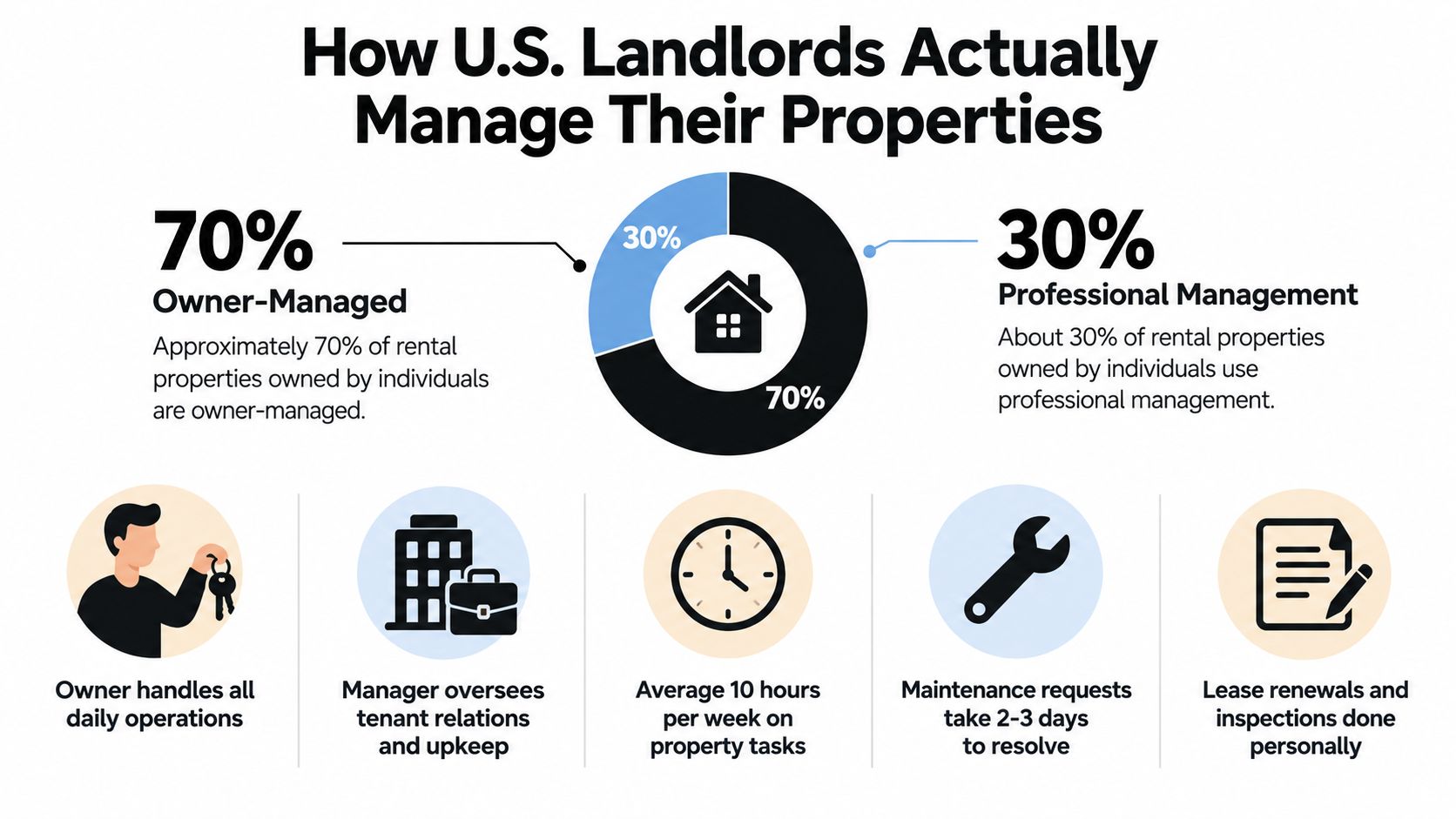
Self-management isn't the unusual path. It's the baseline. A national estimate reports that 80.0% of rental properties owned by individuals are owner-managed, while 16.9% use a hired property manager or management company, according to national landlord statistics on owner management.
The same baseline helps explain why so many owners resist a percentage fee. For many small portfolios, management is a part-time set of tasks layered onto ownership, not a separate full-time job. When a property is occupied by a reliable tenant and nothing breaks, the monthly work can feel light enough that outsourcing looks unnecessary.
Industry Size Isn't the Same as Outsourcing
Professional management is still a real occupation at meaningful scale. The Bureau of Labor Statistics recorded 253,210 property, real estate, and community association managers in 2025 in its Bureau of Labor Statistics industry profile for real estate.
Don't confuse that headcount with the share of landlords who hire help. BLS notes that a substantial proportion of property management is self-performed by lessors, so plenty of management work never appears as a job at a management company. An owner answering maintenance texts, renewing a lease, and scheduling a vendor to protect tenants from pests is doing management work, even though no outside firm sends an invoice.
That distinction matters because the market is built around small holdings and direct oversight. Owners often keep control because they know the building, distrust handoffs, or don't want to surrender margin on a property that mostly runs itself. Managers win business when owners value delegation, live far away, need compliance support, or have enough doors that personal coordination breaks down.
There's also a middle arrangement people overlook. Some owners employ help directly, others hire a company, and others keep the owner role while using software and local vendors for defined pieces. Treat those as different operating models, not as one category called outsourcing.
If you're weighing landlord vs property manager for one to ten units, start from the correct premise. You're not deciding whether to join the normal model. You already sit in it if you self-manage. You're deciding whether adding a paid layer produces enough operational improvement to beat the default.
Duties Compared Side by Side
A property manager doesn't eliminate duties. The work moves, and a coordination layer gets added. You still own the asset, fund major repairs, set risk tolerance, and answer for outcomes. The table below shows who normally performs each task day to day.
| Duty | Self-Managing Landlord | Property Manager |
|---|---|---|
| Marketing and showings | Prices the unit, writes listings, schedules tours | Markets the vacancy and conducts showings |
| Screening and leasing | Reviews applications and signs the lease | Screens applicants and prepares lease paperwork |
| Rent collection | Collects rent, sends reminders, pursues late payment | Collects rent and reports delinquency to owner |
| Maintenance intake | Receives requests and dispatches vendors | Triages requests and coordinates vendors |
| Inspections and renewals | Schedules inspections and negotiates renewal | Handles inspections and renewal process |
| Evictions and compliance | Works with counsel and tracks local rules | Coordinates process and compliance steps |
| Records and taxes | Keeps ledger, receipts, and year-end reports | Provides owner statements and transaction records |
Where Your Time Actually Goes
Leasing is episodic but intense. Pricing, inquiries, showings, screening, and move-in documentation bunch together, and a slow response can cost you a good applicant. A manager with a real leasing system can help here, but only if you verify who answers inquiries, how quickly tours happen, and what screening criteria are applied.
Rent collection looks simple until it isn't. Routine payments are easy to automate, while delinquency requires prompt, documented, legally careful follow-up. Don't pay a full management fee just to receive on-time rent. Pay attention to how each model handles the first missed payment, partial payment, and repeated excuse.
Maintenance is where owners most often overestimate a manager's magic. Managers don't usually fix things themselves. They receive the request, decide urgency, call a vendor, approve work within a limit, and document the result. You can replicate that chain if you have vendors, spending authority rules, and a reliable intake system. If you don't, the manager's network may be genuinely valuable.
Practical rule: Outsource the duty you repeatedly perform late or badly, not the duty that merely sounds professional to delegate.
Compliance and recordkeeping carry quieter risk. Lease terms, deposits, notices, fair housing, habitability, and tax records don't create daily drama, but errors can become expensive. A competent manager brings process. A sloppy one creates distance between you and paperwork you still need to understand.
Inspections, renewals, and turnovers sit in between. They're scheduled work, so a nearby owner can often handle them well with a calendar and checklist. They become outsourcing candidates when travel makes site visits costly or when several units turn at once.
My view is simple. Keep owner judgment where it protects the asset, especially pricing, applicant standards, major repairs, and capital spending. Delegate execution where speed, coverage, or documentation beats your current performance. Never sign a management agreement until every row in the table has a named owner, a response standard, and a fee attached or explicitly included.
The Real Cost of Hiring a Property Manager
Stop comparing a manager's fee with zero. Compare it with the cost of your hours, your vacancy, your repair mistakes, and the vendors or tools you'd otherwise pay for. That's the only math that tells you whether landlord vs property manager favors delegation for a specific unit.
Full-service management commonly runs 8% to 12% of collected rent, and leasing, renewals, and maintenance services often raise the effective all-in cost to roughly 15% to 22% of collected revenue, according to multifamily operating expense benchmarks on management costs. The same source gives the clean example you should copy. At a 10% base fee, a unit renting for $2,000 per month costs $2,400 per year before ancillary charges.
Read the Fee Schedule Line by Line
The headline percentage is rarely the whole bill. Before you sign, price each possible charge against collected rent, not scheduled rent, and use a detailed breakdown like this guide to property management fees and common add-ons to test what the quote leaves out.
- Leasing charges: Ask what's due for a new placement and whether marketing or photography costs extra.
- Renewal charges: Confirm whether keeping a good tenant triggers another fee.
- Maintenance charges: Identify markups, dispatch fees, after-hours charges, and approval limits.
- Inspection and turnover charges: Price routine inspections, move-out coordination, and make-ready oversight separately.
- Eviction coordination: Separate manager time from attorney and court costs so you know who gets paid for what.
A lower base percentage can lose to a higher one if the cheaper firm charges aggressively for every event. It can also lose through slow leasing or reactive repairs. Conversely, a higher fee may be fair if it includes work you'd otherwise buy piecemeal and the firm documents faster turns and cleaner collections.
Now divide the all-in annual cost by the hours the manager removes. If the fee buys back only occasional rent posting and a few vendor calls, you're paying an extraordinary hourly rate. If it removes leasing, emergency coverage, inspections, delinquency follow-up, vendor supervision, and compliance administration, the calculation changes.
Then adjust for outcomes. Track days vacant, delinquency, renewal results, repair cost per work order, and owner hours per unit. A manager deserves credit only for improvement you can see, not for the comforting feeling that someone else is in charge.
Don't forget the costs that remain yours either way. Insurance claims after water damage, major systems, capital projects, and legal advice still land with the owner. For a covered loss, a step-by-step landlord claim guide can help you document the event properly, but no manager's percentage fee absorbs the underlying property risk.
My recommendation is to negotiate from a per-unit budget, not from a brochure. Write the expected annual all-in cost beside your own expected hours and likely leakage. Hire the manager only when the avoided labor and loss clearly exceed that cost. If the numbers are close, keep control and improve your systems first.
What Service Quality Actually Looks Like
Hiring a manager doesn't automatically upgrade the tenant experience. I've seen professional firms add handoffs, slow approvals, and vague repair invoices while calling the result full service. A capable owner with a portal, clear response rules, and dependable vendors can outperform that arrangement.
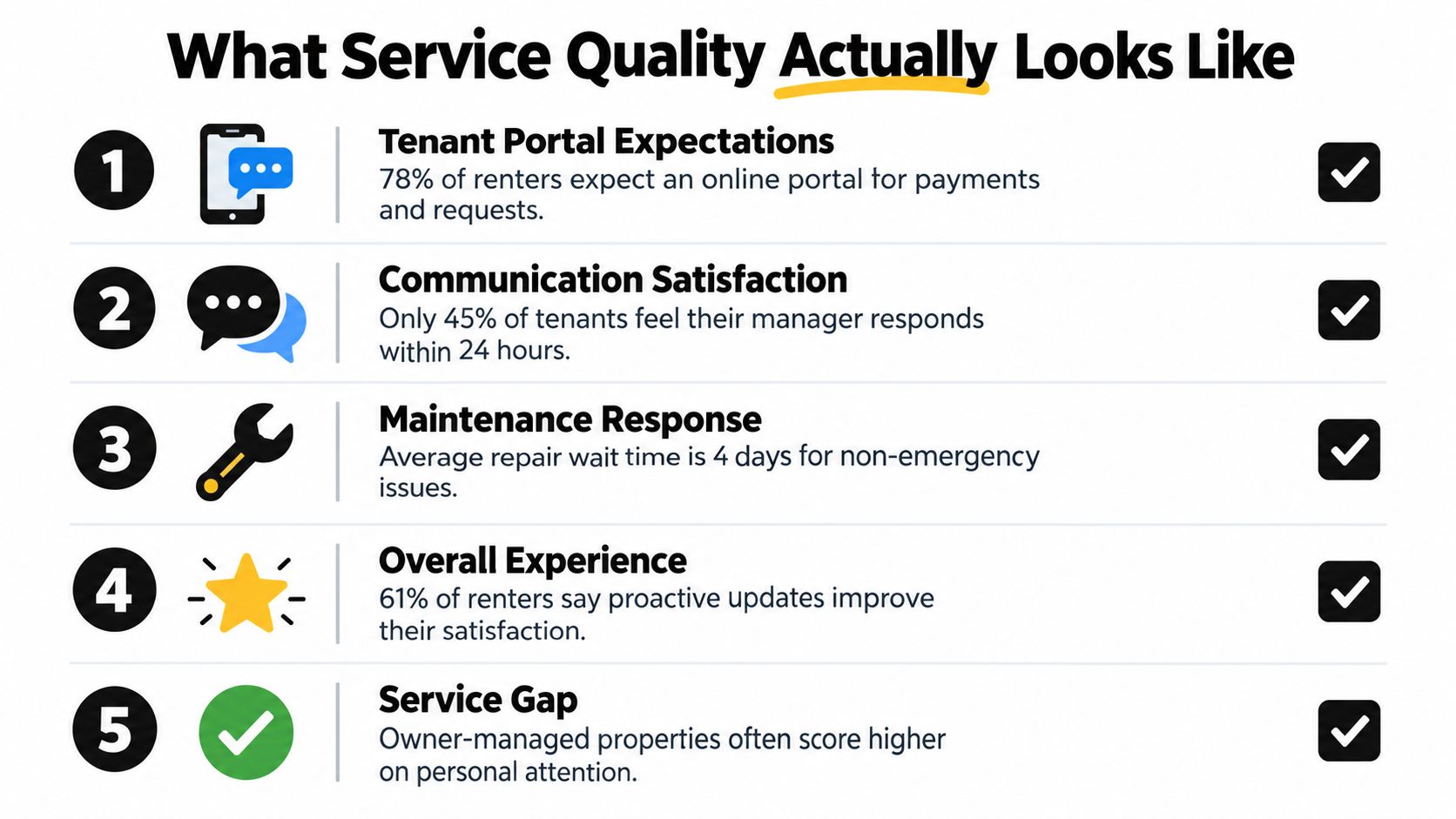
Renter expectations make the point concrete. In a 2025 landlord-tenant survey, only 41% of tenants said maintenance issues were addressed within 48 hours, while separate research found 66% of renters considered an online portal for rent, maintenance, and communication important, as reported in the 2025 landlord and property manager survey results.
Judge Commitments Not Labels
Ask any manager for service standards in writing. If the answers stay general, expect the service to stay general too.
- Response targets: How fast will staff acknowledge routine requests and emergencies?
- Emergency procedure: Who answers after hours, and who can authorize immediate work?
- Repair authority: At what dollar limit must the manager get your approval first?
- Vendor control: Are vendors licensed and insured where required, and can you see invoices?
- Documentation: Will photos, tenant messages, inspections, and completed work sit in one record?
- Escalation: Who handles a complaint when the assigned contact doesn't solve it?
Then apply the same standard to yourself. If tenants text a personal phone, repairs live in your memory, and invoices sit across email threads, you don't have a service system yet. Structured intake through maintenance request software for documented tenant repairs can close much of that gap without surrendering the relationship.
There's also a relationship trade-off you shouldn't romanticize. Some tenants value reaching the owner directly and getting a straight answer. Others prefer a professional buffer, especially around late rent or lease enforcement. Some owners want that buffer too because personal familiarity makes hard conversations harder.
Professional distance helps when it produces consistent enforcement. It hurts when the tenant becomes a ticket number and the owner hears about a small leak only after it damages flooring. The best model is the one that creates accountability you can audit.
A manager earns the fee with documented speed and follow-through. A logo, an office, and a monthly statement don't prove either one.
Don't ask whether managers provide better service in theory. Ask which option, yours or theirs, will acknowledge the request, dispatch the right person, communicate the timing, verify completion, and preserve the record. Choose the operator who can demonstrate that chain before a tenant tests it.
How to Decide Between DIY, Hybrid, and Full-Service Management
Use your actual operating conditions, not your identity as a hands-on or hands-off investor. Four signals usually settle the landlord vs property manager decision for a small portfolio. Score each unit separately if your properties differ by location or tenant stability.
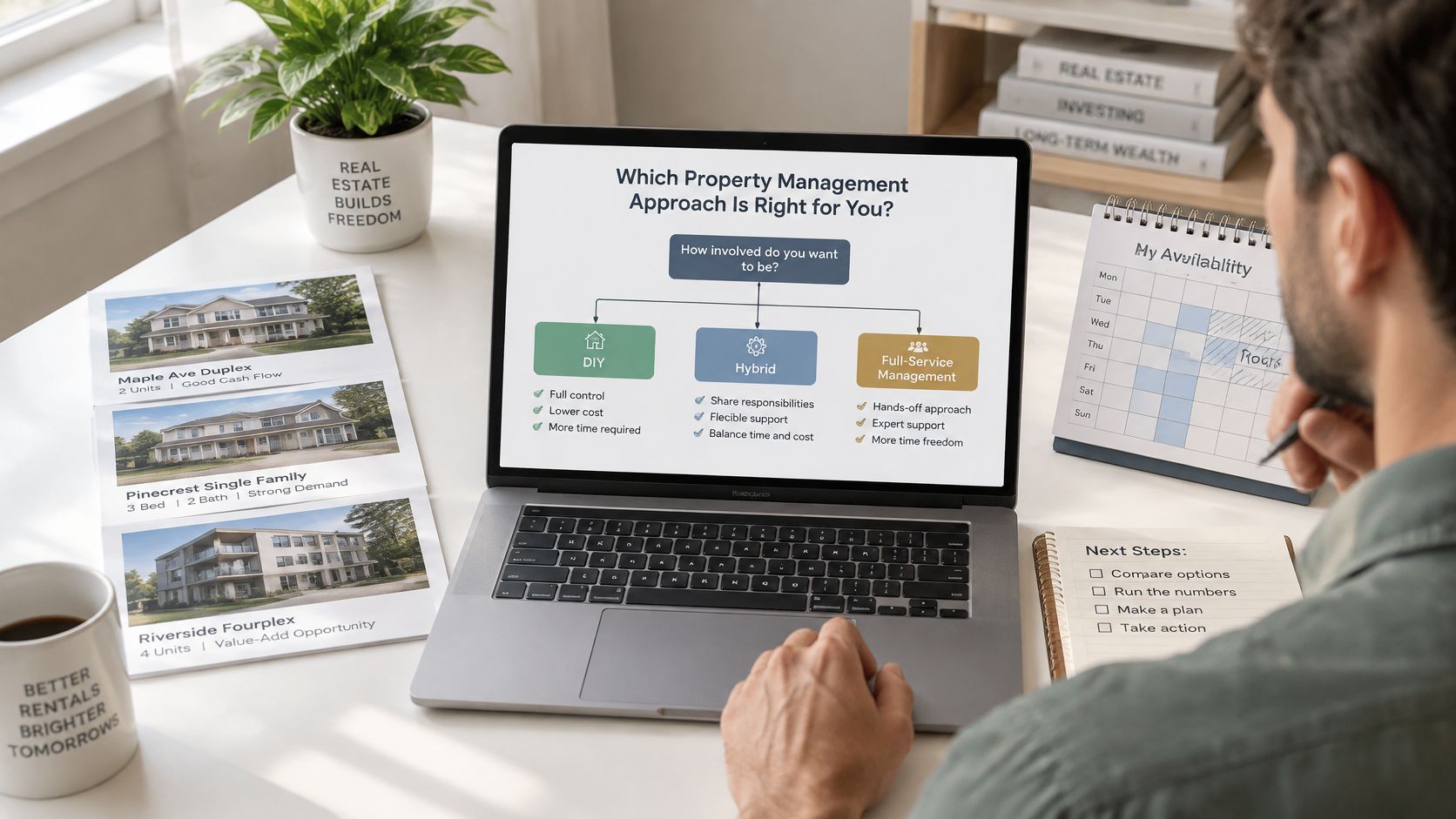
The decision visual below is a useful prompt for mapping those signals before you talk to vendors.
Four Signals That Point to a Model
Distance comes first. If you can reach the property easily and know local vendors, self-management or hybrid usually wins. If every inspection requires a trip and you have nobody local you trust, full-service becomes much easier to justify.
Time cost comes second. Be honest about availability, not just hourly value. A high-income owner who can batch tasks on weekends may still run a stable single-family rental well. An owner who travels, works nights, or can't respond to emergencies needs coverage regardless of how capable they are at a desk.
Portfolio friction comes third. One quiet unit differs from several units with staggered leases, shared systems, and frequent turns. Count interruptions, vendor coordination, renewals, and recordkeeping together. When small tasks start colliding, process matters more than effort.
Compliance complexity comes fourth. Local notice rules, deposit handling, inspections, licensing, and eviction procedure can punish informal habits. If you won't learn the rules or hire qualified advice when needed, don't self-manage out of stubbornness. Records matter at tax time too, and Texas owners organizing deductions and Schedule E reporting may find a guide for Texas landlords on tax software useful when comparing recordkeeping options.
The hybrid route deserves more respect than it usually gets. Keep pricing, screening, lease decisions, and tenant communication. Pay specialists for turnovers, inspections, emergency coverage, or maintenance dispatch. That structure preserves owner judgment while removing the tasks most likely to fail when you're busy.
The short video below reinforces the same practical test from an operator's perspective, which is useful before you turn the checklist into a contract.
Choose full DIY when the property is nearby, your systems are documented, and your response times are reliable. Choose hybrid when you want control but need local hands or specialized help. Choose full-service when distance, scale, or legal complexity means your involvement creates delay and risk.
Don't sign a long management term to solve a temporary workload spike. Test hybrid support first. If the problems persist after you've systematized the basics, then interview managers with your cost ceiling and service standards already written down.
Where a Self-Service Platform Fits In
A self-service platform changes the comparison because much of a manager's fee pays for routine administration. Applications arrive, screening reports get ordered, leases get signed, reminders go out, payments post, invoices get filed, and maintenance requests get routed. Those are workflows. They don't all require handing your tenant relationship to a third party.
That's where VerticalRent fits as one option for independent owners. It supports FCRA-compliant tenant screening with credit, criminal, eviction, and rental history data, state-specific lease generation, online rent collection by ACH or card with automated reminders and late fees, and a transaction ledger that outputs Schedule E reporting. For a broader feature checklist, compare those capabilities against this overview of property management software features for independent landlords.

Automate Administration Keep Judgment
Use the duties table as your buying guide. Automate listing distribution, application intake, screening workflow, payment reminders, ledgers, and maintenance documentation first. Keep final applicant decisions, rent pricing, major repair approvals, and capital planning with you. That division is the economic center of the hybrid model.
Maintenance shows the limit clearly. Software can collect photos, triage urgency, and dispatch a verified local vendor, but it can't climb into an attic or judge whether a repair should become a replacement. Pair the platform with local trades and clear approval limits. Now you've bought process without paying a percentage of rent for every routine month.
Screening and leasing work the same way. Structured reports and state-specific documents reduce improvisation, but you still set lawful criteria, verify inconsistencies, and decide whether the tenancy fits your risk tolerance. Automation makes your decision faster and better documented. It doesn't make the decision for you.
This option isn't right for every owner. If you won't log in, won't maintain vendor relationships, and won't respond when a workflow escalates, software will only organize your neglect. Hire a manager in that case. But if your real problem is scattered texts, manual reminders, loose receipts, and repeated paperwork, fix the system before outsourcing the asset.
In the landlord vs property manager choice, a platform is neither a trophy for DIY owners nor a cheaper imitation of a manager. It's operating infrastructure. Use it to remove repetitive work, preserve records, and expose which remaining tasks require a human specialist.
Common Questions Independent Landlords Ask
When is a manager worth it for a small portfolio? When distance, availability, or compliance risk costs you more in vacancy, delay, and mistakes than the all-in fee.
Can I switch models mid-lease? Usually yes, if your management agreement and lease obligations allow it. Transfer records, deposits, keys, vendor history, and tenant notices carefully.
How do I judge an existing manager? Review vacancy time, delinquency, renewals, work-order closure, invoice transparency, and inspection documentation. Don't judge by friendliness alone.
What records should I keep either way? Keep leases, screening documentation, payment history, notices, inspection reports, invoices, and maintenance communication in one retrievable file.
If your properties are suitable for self-management but your paperwork, screening, rent collection, and maintenance tracking are scattered, VerticalRent gives you a structured way to run those tasks without paying a full-service fee. Visit the platform, compare its workflows with your current per-unit workload, and keep only the outside help your numbers justify.
Put this into practice
VerticalRent tools related to this guide
Legal Disclaimer
VerticalRent and its authors are not attorneys, CPAs, or licensed legal or financial advisors, and nothing on this site constitutes legal, tax, or professional advice. The information in this article is provided for general educational purposes only. Landlord-tenant laws, eviction procedures, security deposit rules, and tax regulations vary significantly by state, county, and municipality — and change frequently. Nothing on this site creates an attorney-client relationship. Always consult a licensed attorney or qualified professional in your jurisdiction before taking any action based on information you read here.
Co-founded VerticalRent in 2011, growing it from nothing to 100k landlords and renters. Sold it in 2019, then re-acquired it in 2026 to make it better than ever.


