Maintenance Request Software: What It Is and How It Helps
Learn what maintenance request software does for landlords. Covers AI triage, vendor dispatch, tracking, and a feature checklist for choosing the right tool.

A HUD-sponsored analysis found that 35.8% of occupied U.S. housing units needed some form of repair, with total repair needs estimated at $126.9 billion, so maintenance request software must do more than collect complaints. It gives tenants a digital place to report problems, tracks each issue through completion, and uses tools such as AI triage and vendor dispatch to speed response while preserving an audit trail.
At 9 p.m., a tenant sends you a photo of water spreading across a ceiling. You forward the message to a handyman, assume someone will call the tenant, and move on to the next problem. Two days later, the tenant texts again. The handyman never confirmed the appointment, the leak worsened, and nobody can say whether the original repair was completed.
That pattern is familiar to independent landlords. Texts, emails, phone calls, and hallway conversations create fragments of information, but not a dependable process. Maintenance request software replaces those fragments with a shared record that tells you what happened, who owns the next action, what the tenant has been told, and whether the repair was verified.
Why Maintenance Chaos Costs Landlords More Than Just Time
The first cost of informal maintenance is obvious: you spend time searching through conversations. The less visible cost comes later, when an incomplete repair produces another call-out, a damaged unit, or a tenant who no longer trusts your promises.
A leaking supply line illustrates the problem. The tenant reports it by text, you forward the photo to a contractor, and the contractor says they'll “take a look.” If nobody records the appointment, access instructions, parts used, or completion evidence, the message thread becomes the entire maintenance file. When the tenant follows up, you're reconstructing events from memory.
The repair itself may also involve more than the visible symptom. A useful guide to what drives restoration pricing can help landlords understand why water-related work varies according to factors such as the affected materials, extent of damage, and required restoration steps. The operational lesson is simple: a leak should trigger documentation and follow-up, not just a contractor referral.
Practical rule: A request isn't resolved when someone says they visited. It's resolved when the owner has evidence of the work, the tenant knows the outcome, and the record explains what happens next.
The financial exposure can be substantial across a portfolio. HUD's analysis of the 2017 American Housing Survey estimated a median repair cost of $1,449 per unit, while structural repairs represented more than half of national repair costs despite leaks being the most common repair problem. HUD's housing repair analysis shows why a landlord needs to separate routine issues from defects that may involve safety, structure, or escalating damage.
Software doesn't eliminate repairs. It prevents the same request from being forgotten, duplicated, or closed without proof.
What Maintenance Request Software Actually Does
Maintenance request software is a centralized system for reporting, organizing, assigning, and closing property repairs. A tenant submits a problem through a portal or app, attaches photos, and identifies the unit or location. The system turns that report into a structured work order rather than leaving it buried in a personal inbox.
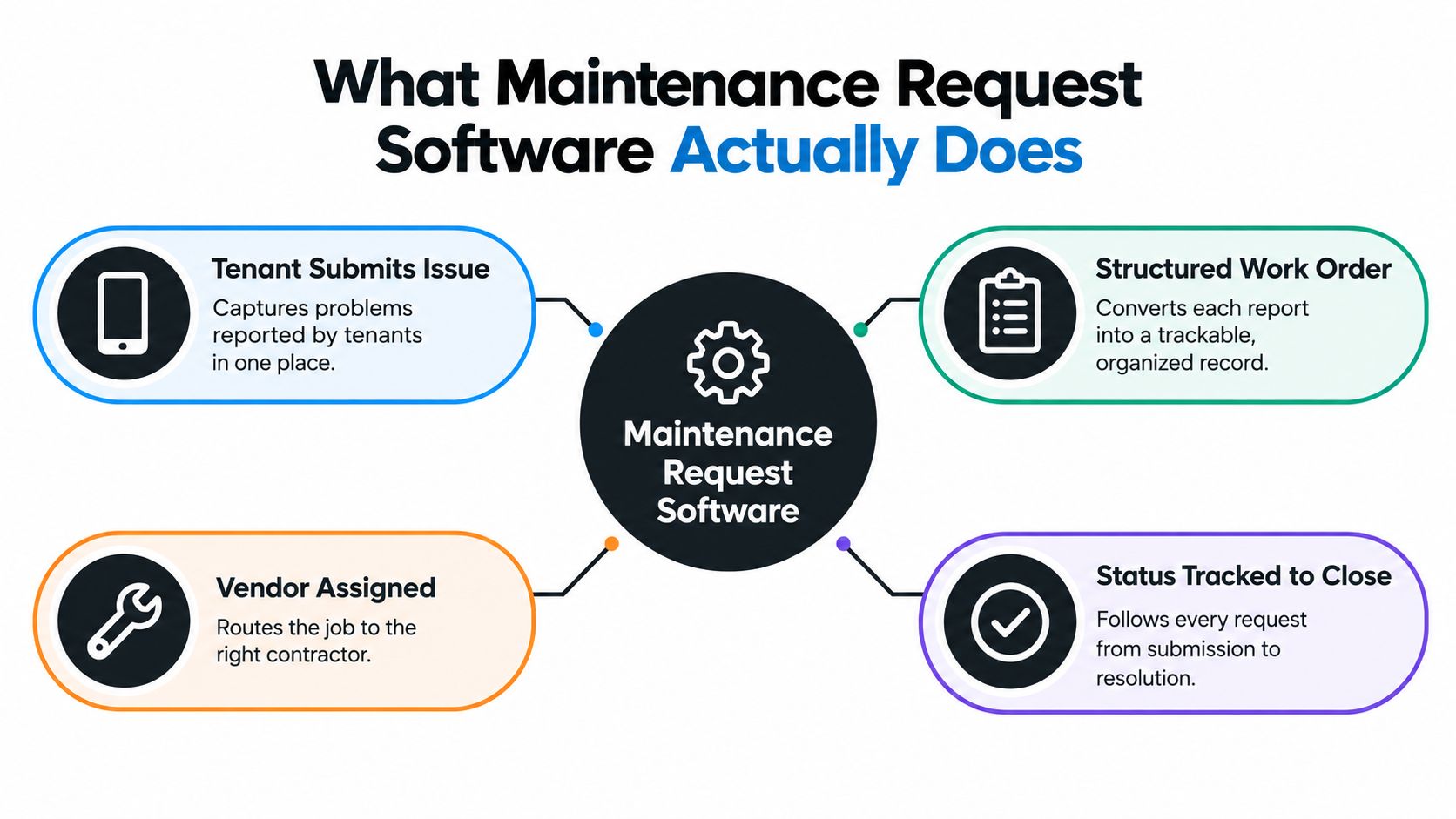
The distinction matters. A tenant's message might say, “The bathroom is leaking.” A work order can preserve the original description, identify the unit, attach an image, assign a trade, record the contractor's appointment, and show whether the tenant confirmed access.
A practical workflow looks like this:
- The tenant submits the issue. The platform captures the location, description, photos, and contact details.
- The landlord reviews the request. The issue receives an urgency classification and any necessary follow-up questions.
- The system creates a work order. The record gains an owner, vendor, due date, and communication history.
- The vendor updates the job. The contractor records arrival, work performed, materials, and supporting images.
- The landlord verifies completion. The tenant receives an update, and unresolved work remains visible.
This is why a maintenance work order system should be treated as an operating layer between tenants, owners, and service professionals. Email can transmit a request, but it won't reliably manage state, accountability, escalation, and evidence.
The strongest platforms also connect maintenance to the property, unit, and asset. Over time, that history helps you recognize repeated appliance failures, recurring plumbing issues, and units that need more than another isolated repair.
Core Features That Turn Requests Into Resolved Work Orders
A basic form records a complaint. Useful maintenance request software manages the work that follows. The difference appears in the fields, status rules, and evidence collected after submission.
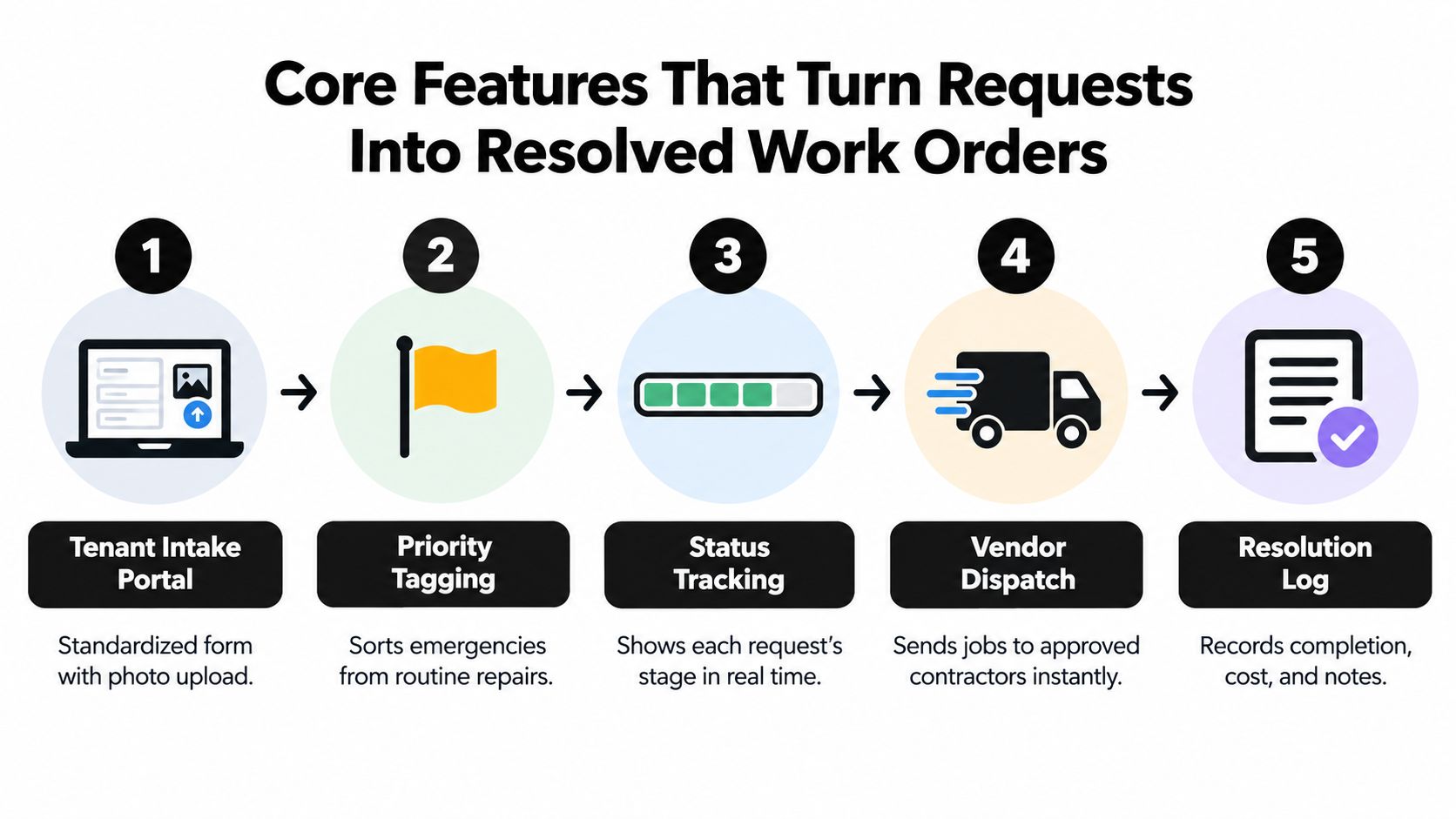
HUD's residential-care management worksheet treats receiving, assigning, completing, and billing work orders as core maintenance controls. HUD's maintenance-control worksheet also supports tracking work priorities and response times. For a small landlord, those controls can be implemented through a straightforward status sequence:
Submitted → Triaged → Assigned → Scheduled → In progress → Completed → Verified
Each transition should carry a timestamp. That allows you to measure first response, vendor assignment, time to completion, overdue backlog, repeat incidents, and emergency volume without manually reconstructing events.
A strong request record should include:
- Tenant intake: A simple portal where the tenant describes the problem and uploads photos.
- Priority classification: A distinction between safety, habitability, water, heating, electrical, and routine issues.
- Assignment details: The responsible vendor, appointment information, access notes, and approval status.
- Communication history: A record of acknowledgments, promised timelines, delays, and tenant updates.
- Completion evidence: Contractor notes, invoices, before-and-after photos, and tenant or owner verification.
Consider a broken water heater. The tenant reports no hot water and uploads a photo of the unit. You acknowledge the request, classify it as urgent, assign a verified plumber, and record the appointment. The plumber adds the diagnosis and invoice, while the system keeps the request open until the tenant confirms that hot water has returned or you verify the repair another way.
The record should also distinguish a completed job from a partially completed visit. “Part ordered” and “repair finished” aren't the same state, and software that treats them as identical creates false confidence.
The Hidden Problem Is Communication, Not Just Tickets
A ticket can exist and still leave the tenant feeling ignored. The difficult question isn't only whether the request entered the system. It's whether someone acknowledged it, set a credible expectation, updated the tenant when plans changed, and documented the result.
A 2025 survey of 378 landlords and 357 tenants found that only 41% of tenants said their landlord addressed maintenance issues within 48 hours, while 75% said issues were addressed within a week. The survey also identified faster responses and clearer communication as major improvement areas. The landlord and tenant survey supports a point many software demos miss: closing a ticket doesn't prove that the process felt reliable.
Build communication rules into the workflow:
- Acknowledge receipt: Send an automatic confirmation that includes the request summary and next step.
- Set an expectation: Tell the tenant when they should expect an appointment or another update.
- Document delays: If a part is unavailable or access fails, record the reason and revised timeline.
- Escalate exceptions: Require owner review when an urgent request remains unassigned or overdue.
- Close visibly: Send the resolution details and retain completion evidence in the tenant and property record.
A tenant can tolerate a repair that needs coordination more easily than unexplained silence.
Speed still matters, but automation can create a new failure if it sends a fast, incorrect response. A leak misclassified as cosmetic, a heating outage treated as routine, or an accessibility issue routed without review can expose the landlord to greater risk. The record must show the tenant's original words and images, not only the system's later category.
Government tenant research has also found that satisfaction with completed repairs can be weaker than satisfaction with the broader property-management relationship. That gap means landlords should measure resolution quality and communication, not merely the number of tickets marked closed.
How AI Triage and Vendor Dispatch Should Work in Practice
A tenant sends a late-night message about water spreading across the kitchen floor, while another leaves a vague note about a loose outlet cover. Software should sort both requests quickly, but it should not treat them the same. Triage has to preserve judgment, because the wrong routing decision can turn a manageable repair into a safety problem.
The best workflow starts with the tenant's original words and photos. AI can flag terms like “smoke,” “sparking,” “no heat,” “flooding,” or “mold,” then ask a few standard follow-up questions to fill in the missing details. It can suggest an electrician, plumber, HVAC technician, or general handyman, while keeping the raw report visible for review.
Human approval belongs in requests involving:
- Life safety or habitability
- Water intrusion or possible structural damage
- Heating, electrical, smoke, or fire concerns
- Mold, accessibility, or health-related reports
- A repeated failure that may require replacement
- Sensitive tenant information or unusual access circumstances
Vendor dispatch should follow the same discipline. The system needs to route only to contractors whose trade, service area, verification status, and availability match your rules. A vendor can be free today and still be the wrong choice if the job needs a different license, a faster response, or a stricter access window.
For a practical look at AI maintenance triage in rental operations, the key issue is handoff. The software should explain why it assigned urgency, let you override that call, and keep both decisions in the audit trail. That record matters when a tenant asks why one request was handled first and another was queued.

The same logic should also support planned maintenance and recurring work. IFMA's maintenance benchmark shows why landlords need a system that connects requests, vendor activity, and asset history instead of treating each ticket as an isolated event. When dispatch data, repair notes, and repeat failures live in one record, it becomes easier to spot patterns and assign the right work before the next tenant complaint arrives.
Preventive Maintenance and Cost Tracking That Reduce Expenses
A broken water heater is expensive. So is the second visit, the missed invoice, and the tenant who has already spent a night waiting for a fix. Preventive maintenance software earns its place when it connects planned service to the same property, unit, and asset history you use for reactive work.
IFMA high-performance-building guidance points to benchmark differences between reactive, preventive, and predictive work. The exact numbers are a benchmark comparison, not a promise for every portfolio, but the direction is clear. Repeated failures cost more than scheduled care because they usually arrive with extra labor, faster dispatch pressure, and more tenant disruption.
A landlord can use that idea without building a separate maintenance department:
- Tie each repair to a unit, asset, warranty, and vendor.
- Set calendar tasks for HVAC servicing, safety checks, filter changes, and inspections.
- Log labor, materials, invoices, and approval limits against the asset.
- Review repeat failures each month and look for patterns by unit or equipment type.
- Create a replacement or inspection task when the same asset keeps generating requests.
That record also helps with planning. If cooling calls keep coming from the same property, the system should point you toward a deeper inspection instead of another short-term fix. Practical guidance on AC maintenance in Mesa shows the kind of recurring service context landlords often need to track, even though the schedule still depends on the property and equipment.
The test is whether the software turns history into action. If it only stores old tickets, it stays reactive. If it creates reminders, tracks costs, and flags repeat failures, it helps you decide when maintenance, repair, or replacement makes more sense. For a closer look at how preventive maintenance scheduling software fits that workflow, review how it handles recurring tasks before you commit.
Feature Checklist for Evaluating Maintenance Request Software
Choose software by testing the complete path from tenant report to verified completion. A polished dashboard won't compensate for missing communication records or weak vendor controls.
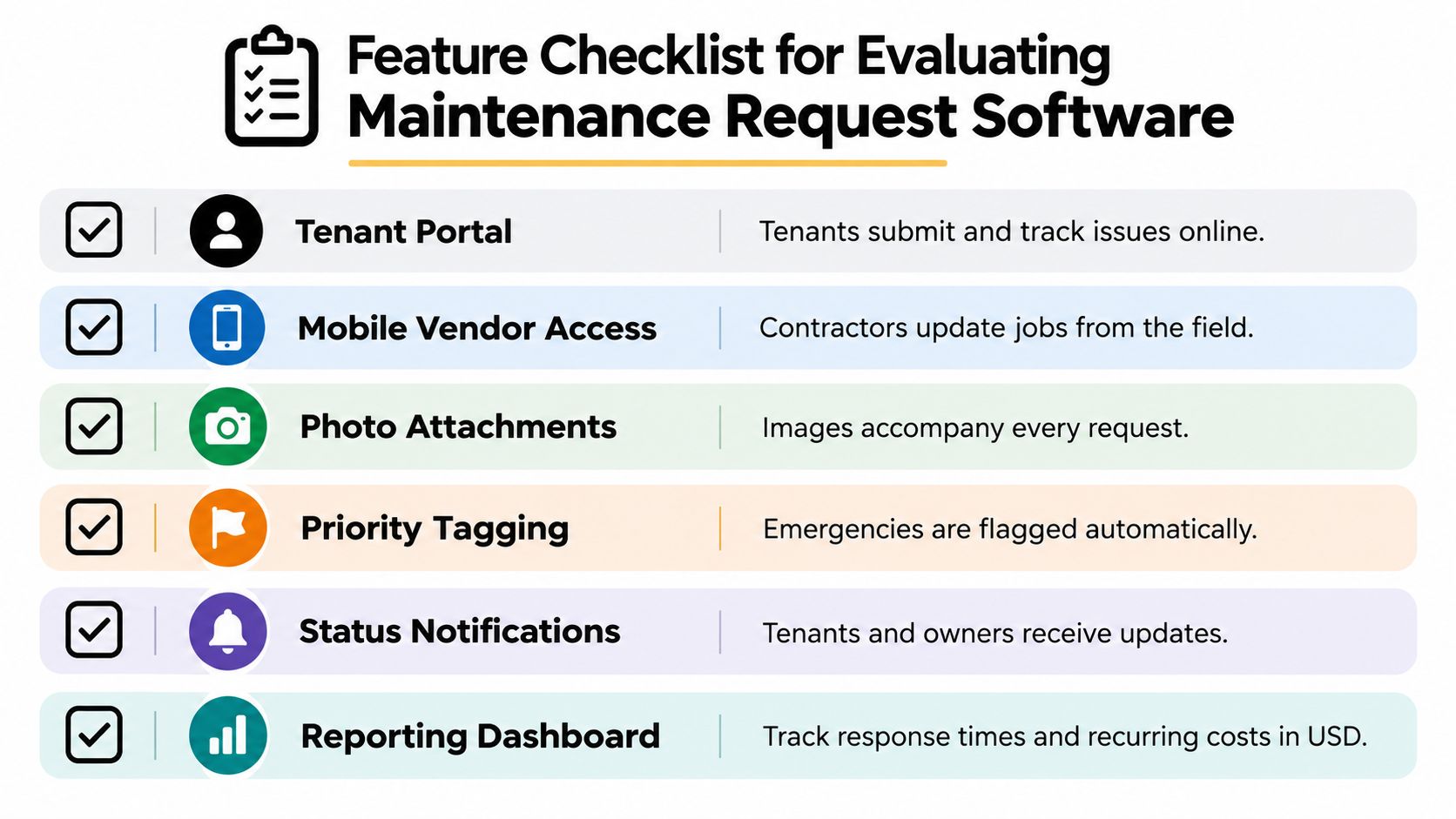
Look for these capabilities:
- Tenant portal: Tenants can submit and track requests without relying on personal texts.
- Mobile vendor access: Contractors can update jobs, upload images, and add notes from the field.
- Photo documentation: The request, work performed, and final condition remain connected.
- Priority rules: Safety and habitability signals receive appropriate review and escalation.
- Status notifications: Tenants receive acknowledgments, appointment updates, delay notices, and closure messages.
- Reporting dashboard: Owners can review response time, backlog, repeat issues, vendor costs, and completion history.
Then test the uncomfortable scenarios. Ask what happens when a vendor doesn't accept a job, a tenant doesn't provide access, a repair needs a part, or an automated priority appears wrong. If the answer requires a separate spreadsheet, phone log, or email chain, the platform hasn't replaced the underlying chaos.
Avoid tools with vague update templates, no vendor verification process, or an audit trail that records only the final status. Basic ticketing can be adequate for very small portfolios, but full workflow management becomes more valuable as you add vendors, properties, or recurring maintenance.
Integration, Compliance, and Vendor Verification Before You Commit
Maintenance software shouldn't become another isolated system. Before adopting it, check whether it connects cleanly with your property records, rent collection, accounting, lease management, and tenant communication processes. At minimum, the maintenance record should identify the correct owner, property, unit, tenant, vendor, cost, and payment status.
Compliance requires equal care. Automation should apply consistent triage rules rather than changing treatment based on a tenant's protected characteristics or personal circumstances. Limit access to sensitive information, define how long records and images are retained, and preserve the original request when an employee or automated tool edits its classification.
Vendor verification is part of risk management, not an optional convenience. Confirm the contractor's identity, trade capability, service area, insurance or licensing requirements where applicable, and access permissions before sending them into an occupied rental. The platform should also show who accepted the job, when they arrived, what they did, and which images or invoices support completion.
A reliable system should answer five questions at any time:
- What did the tenant report?
- How urgent was it, and who reviewed that decision?
- Who owns the next action?
- What has the tenant been told?
- What evidence proves the work is complete?
That is the dividing line between a logging tool and an operating system for a small rental business. The right platform doesn't promise that repairs will never be inconvenient. It makes responsibility visible, keeps safety concerns from disappearing, and gives you a defensible record when the work becomes complicated.
VerticalRent gives independent landlords a centralized way to collect tenant maintenance requests, store descriptions and photos, use AI-assisted triage, and dispatch verified local vendors while keeping job updates in one record. Visit VerticalRent to see how its maintenance workflow can replace scattered text messages with accountable repair tracking.
Put this into practice
VerticalRent tools related to this guide
Legal Disclaimer
VerticalRent and its authors are not attorneys, CPAs, or licensed legal or financial advisors, and nothing on this site constitutes legal, tax, or professional advice. The information in this article is provided for general educational purposes only. Landlord-tenant laws, eviction procedures, security deposit rules, and tax regulations vary significantly by state, county, and municipality — and change frequently. Nothing on this site creates an attorney-client relationship. Always consult a licensed attorney or qualified professional in your jurisdiction before taking any action based on information you read here.
Co-founded VerticalRent in 2011, growing it from nothing to 100k landlords and renters. Sold it in 2019, then re-acquired it in 2026 to make it better than ever.


