Oregon Lease Agreements: A Complete Landlord Reference
Oregon lease agreements explained for independent landlords.


You're preparing a rental for move-in, the applicant is ready to sign, and you've got a generic lease open beside a spreadsheet. The form looks complete until you reach the renewal clause, the deposit language, and the requirement to pay through a portal. The practical question isn't whether the document looks official. It's whether you can administer its terms lawfully and prove what happened if someone challenges them.
What an Oregon Lease Agreement Actually Does
An Oregon lease is both an occupancy agreement and a compliance record. It should establish the bargain while preserving the information you'll need to administer rent, repairs, amendments, and the end of the tenancy.
Oregon recognizes written and oral rental agreements, including valid rules and regulations governing occupancy. A landlord must retain the agreement at the resident manager's office or the address provided to the tenant, allow inspection within a reasonable time, and limit requested-copy charges to the lesser of 25 cents per page or actual copying cost, under Oregon's residential landlord-tenant statutes.

What writing changes
A written agreement gives both parties a stable reference for the unit, payment obligations, duration, and agreed policies. An oral agreement may establish a tenancy, but reconstructing the parties' understanding from conversations is an avoidable administrative problem.
The document doesn't replace Oregon's landlord-tenant laws. Treat a broad waiver, an aggressive fee provision, or a convenient notice shortcut as something requiring legal review, not something made safe by a signature.
Practical rule: Draft only terms you can explain, administer, and document.
A workable lease file should contain more than the signed form:
- The operative agreement: Preserve the version the parties signed.
- The incorporated documents: Keep the rules and addenda attached to that version.
- The change record: Retain amendments and evidence that the tenant received them.
- The administration record: Connect notices, receipts, repair communications, and accounting to the correct tenancy.
A polished template without these records leaves you answering factual questions from memory. A less elaborate agreement supported by an orderly file is a better starting point for resolving a disagreement.
The Three Tenancy Structures and Why They Matter
Choosing the tenancy structure is a business decision with legal consequences. The categories recognized in Oregon's statutory framework are week-to-week, month-to-month, and fixed-term. Don't let a payment schedule substitute for a clear statement of which structure you intend.
A fixed term suits a landlord and tenant who want a defined occupancy period. A periodic arrangement suits an ongoing rental without a negotiated expiration date. Neither choice eliminates the need to check the applicable termination and rent-change rules before acting.
Choose deliberately
| Structure | Practical fit | Drafting issue to resolve |
|---|---|---|
| Week-to-week | An arrangement genuinely organized around weekly occupancy | Make the structure explicit and verify its distinct notice rules |
| Month-to-month | Continuing occupancy without a fixed expiration | Separate the rent due date from termination procedures |
| Fixed-term | Occupancy for an agreed beginning and ending period | Record exact dates and distinguish expiration from lawful termination |
Under ORS 90.220's rental-agreement provisions, an agreement creating neither a fixed-term nor a week-to-week tenancy defaults to month-to-month. The same statute prevents unilateral changes to a fixed-term tenancy's terms, including rent, and requires tenants to receive the written agreement and its amendments or additions.
That makes ambiguous drafting expensive to administer. A form that says “annual lease” in its heading but describes an indefinite term elsewhere invites disagreement about what the parties agreed.
Choose by occupancy arrangement, not building style. A detached house doesn't require a fixed term, and an apartment doesn't require month-to-month occupancy. Consider the intended duration, the tenant's need for stability, and your ability to manage the applicable procedures.
Avoid language suggesting that a periodic tenancy gives unrestricted termination rights. Likewise, don't assume a fixed expiration automatically authorizes recovery of possession. Before sending a notice, identify the tenancy structure, the factual reason for the action, and the law governing that action.
Core Clauses Every Oregon Lease Must Define
A useful lease answers operational questions without pretending to reproduce the entire statute book. The lawful-term and amendment rules discussed above provide the boundary: negotiate the bargain clearly, but don't assume you can rewrite statutory protections.
Define the bargain
Start with parties and premises. Identify the landlord, tenants, rental address, unit designation, and included areas. Parking, storage, and shared amenities deserve express treatment rather than assumptions based on a showing.
Then establish term and possession. Distinguish the agreement's execution date, the intended possession date, and any fixed expiration. If possession depends on unfinished work, address that issue before collecting signatures instead of relying on an informal promise.
For rent and payments, state the amount, due date, accepted methods, and where payments go. Keep payment-processing language separate from late-fee and returned-payment provisions so a tenant can identify each charge and its trigger.
A drafting example, not a complete legal clause:
Payment clarity: Rent is payable using the methods identified in the payment addendum. That addendum identifies payment locations, processing procedures, and any applicable disclosed charges.
Define responsibilities without overreaching
- Deposits and fees: Separate refundable security from charges. Review each proposed fee for legal authorization rather than labeling everything an administrative expense.
- Maintenance: Explain how tenants report problems, who receives requests, and how access is coordinated. Don't use a tenant-cleanliness clause to suggest the landlord has transferred habitability responsibility.
- Entry and occupancy: Describe the workflow for access and the agreed use of the premises. Leave statutory notice requirements to current legal review rather than copying an oversimplified rule.
- Default and remedies: Identify obligations clearly without promising automatic eviction, automatic forfeiture, or unrestricted collection rights.
Policies concerning utilities, smoking, pets, guests, and common areas should be concrete enough to administer consistently. “Tenant pays utilities” is incomplete if the landlord allocates a shared bill.
The trade-off is specificity versus maintenance. Detailed clauses can reduce misunderstandings, but copying statutory procedures into the lease creates another document you must update. Use plain operational language, then have legally sensitive provisions reviewed against current law.
Rent Increase Rules and the Annual Cap
A rent increase requires a calculation and a notice workflow, not just permission in the lease. Oregon's statewide framework limits most covered increases during a 12-month period to the lesser of 10% or 7% plus the Consumer Price Index, as explained in the Oregon Legislative Policy and Research Office's landlord-tenant reference.
The distinction matters: the upper percentage isn't automatically the permitted increase. When the alternative formula is lower, use the lower result.
Build a calculation record
Keep these fields together rather than scattered between your lease, email, and bookkeeping system:
- Current rent and history: Record the amount being charged and previous effective dates.
- Coverage review: Document why the cap applies or which exemption you believe applies.
- Applicable limit: Store the relevant annual calculation and its supporting authority.
- Notice record: Preserve the notice, delivery evidence, proposed amount, and effective date.
- Fixed-term restriction: Check the existing agreement before treating a statutory ceiling as permission to change rent.
For most residential tenancies, the operational safeguards include no increase during the first year, increases generally no more than once in a 12-month period, and at least 90 days' written notice stating the increase and new rent. Noncompliant increases can expose landlords to three months' rent plus actual damages, according to the state guidance linked in the deposit discussion below.
Test the result before issuing notice
Use your actual rent as the calculation base. Compare the proposed amount against the applicable ceiling, then separately test timing, notice, and the agreement's existing restrictions.
Don't use statewide median gross rent as a substitute for your property's contractual rent. Gross-rent measures and a particular tenant's rent obligation aren't interchangeable operational fields.
The costly mistake is treating these checks as alternatives. A percentage below the cap doesn't cure defective notice, and timely notice doesn't authorize a unilateral fixed-term amendment.
Security Deposits and Move-Out Accounting
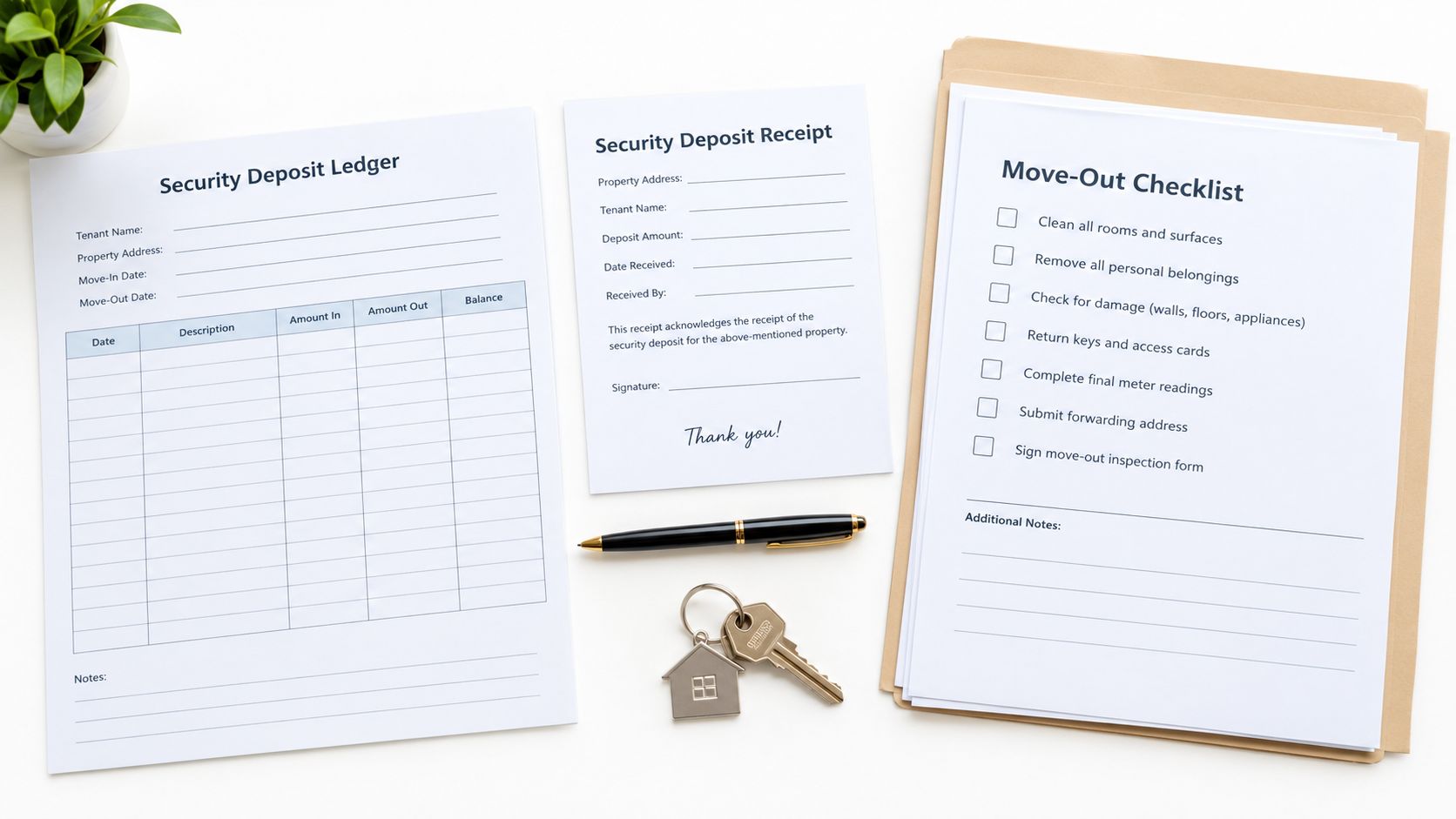
Security deposits need a continuous record from receipt through disposition. Oregon requires the written agreement to identify every security deposit required or paid and requires a receipt. At termination, landlords generally have 31 days to return the deposit and prepaid rent owed or provide a written accounting, as summarized in the state's landlord-tenant rights guidance, which also explains the rent-increase safeguards noted earlier.
Keep the ledger defensible
| Ledger field | Supporting record |
|---|---|
| Deposit category and amount | Signed agreement |
| Payment received | Receipt and transaction record |
| Starting condition | Dated inspection notes and photographs |
| Proposed deduction | Description, evidence, and cost support |
| Refund or balance | Accounting and delivery record |
Permissible deductions can include unpaid rent or tenant-caused damage, subject to the governing rules. Don't convert a routine turnover expense into a deduction merely because you've incurred it. Match each proposed charge to its legal basis and the documented condition.
Your accounting framework should identify the tenancy, deposits held, each deduction, the reason for it, and the resulting refund or balance. Keep cost records attached to the internal file even when the communication itself is concise.
Separate cleaning guidance from legal entitlement
Give tenants clear move-out expectations before they start packing. Canes Cleaners' deposit-saving cleaning guide for Miami renters can help tenants organize cleaning tasks, but it isn't an Oregon deduction standard or legal authority.
Use a security deposit return workflow to organize the administrative steps. The strongest accounting isn't the longest letter. It's the one that lets a tenant connect each deduction to an obligation, condition record, and supported cost without guessing.
Required Disclosures and Common Addenda
Don't build a disclosure packet by copying another landlord's attachments. Two nearby properties can require different review because their construction history, utility arrangements, management structure, or local jurisdiction differs.
Keep three categories separate: federal disclosure review, Oregon-required documentation, and city or county requirements. A policy you choose to attach isn't automatically a mandatory disclosure, and a mandatory disclosure doesn't become optional because your template omitted it.
Build a property-specific review sheet
- Identity and contact information: Identify the landlord or management contact and the address used for tenancy administration. Check that notices and repair requests won't disappear into an unattended inbox.
- Building-related disclosures: Review whether the property's history triggers lead-related paperwork or other condition-specific requirements.
- Utilities and services: Explain who pays each bill and how shared charges are allocated.
- Property policies: Attach clear smoking, pet, parking, storage, and common-area rules where relevant.
- Local overlays: Verify current city and county requirements before approving the packet.
Treat mold or bed-bug forms as items requiring a local applicability check, not universal Oregon requirements. Similarly, don't confuse a property-registration obligation with an addendum every tenant must sign.
Make the packet traceable
Maintain an addendum register showing each document's title, purpose, applicability decision, version, and delivery status. If you conclude a disclosure doesn't apply, preserve the reason internally rather than removing it.
Use separate documents when that makes a subject easier to update or understand. But excessive attachments create their own risk: inconsistent definitions, conflicting payment instructions, and missing incorporated pages.
The practical goal is a complete, coherent packet. Have a qualified reviewer confirm the governing statute or ordinance for each mandatory item and the agency responsible for enforcement. A generic disclosure checklist is useful for issue-spotting, but it shouldn't be your final applicability determination.
The 2026 Tenant Portal and Payment Clause
A portal can simplify administration, but mandatory digital participation is a drafting risk. Oregon's 2026 legislative update on tenant portals and payments describes portals broadly as apps, websites, or digital platforms used during the rental process.
The update requires a non-portal alternative when an applicant or tenant requests one in writing, prohibits electronic-only payments, and requires alternative common-area access. It permits processing fees for credit-card or portal payments and excludes email and text messaging from the portal definition.
Draft around actual alternatives
An illustrative clause framework should establish that the portal is available, identify a non-electronic payment method, and explain where a written request for non-portal service goes. Complete those details with methods you support before using the clause.
- Payment instructions: Name the alternative method, recipient, and delivery location.
- Request handling: Log the written request, acknowledge it, and record the arrangement provided.
- Access continuity: Document how the tenant enters common areas without the platform.
- Fee disclosure: Identify permitted processing charges before the tenant selects the relevant method.
Don't offer an offline alternative that your staff can't process. A lease naming mailed payments is incomplete operationally if nobody checks the designated address.
Convenience for the landlord shouldn't become a barrier the tenant must overcome to pay rent or access the property.
Evaluate any online tenant portal against the entire tenancy workflow, not just its payment screen. Application submission, document access, maintenance reporting, and common-area entry each deserve an alternative-process review.
When Statutory Protections Override Your Clause
A signed fee clause isn't the end of the enforceability analysis. Later events can change what the landlord may retain or collect, even when the agreement describes the charge clearly.
Portland's landlord-tenant policy changes effective January 1, 2026 explain that a security deposit must be returned when habitability defects under ORS 90.320 prevent a tenant from taking necessary steps to enter a rental agreement. The same guidance explains that, following a qualifying landlord action under ORS 90.427, typically involving a 90-day no-cause termination, a tenant's 30-day notice prevents collection of a termination fee or rent after the tenant's termination date.
Review events before charging
For a failed move-in, identify why possession or agreement formation didn't proceed. Distinguish a tenant's change of plans from a habitability problem, and preserve communications about the condition.
For landlord-initiated termination, review the landlord's action and the tenant's response together. Don't process the tenant's departure as an ordinary voluntary lease break without checking that sequence.
- Deposit dispute: Review the condition evidence and the reason the tenancy failed or ended.
- Termination charge: Confirm the triggering events permit collection before posting the fee.
- Rent balance: Check the legally operative termination date before continuing accrual.
Use conditional language carefully
A fee provision should be subject to applicable law, but that qualification doesn't rescue an otherwise unlawful clause. Likewise, a side letter can record facts or clarify an arrangement; it shouldn't attempt to contract around a protection that applies.
Keep an Oregon landlord-law reference available for issue-spotting. When habitability and termination overlap, pause automated collection and obtain property-specific legal review before sending a demand.
Build an Oregon Lease Workflow That Stays Current
The lease workflow should connect the property file, document versions, and deadline calendar. A spreadsheet can do this for a small portfolio, provided someone owns the review process and keeps it current.
Start with property facts: address, tenancy structure, rent, deposits, utility arrangements, applicable disclosure decisions, and payment alternatives. Generate the agreement from those facts, then check the completed packet rather than assuming correctly entered fields guarantee lawful language.
Separate generation from approval
Use a status sequence such as draft, reviewed, issued, signed, and superseded. Preserve issued versions instead of editing them in place, and identify which version governs each tenant.
Before approving a renewal, verify which statutory process applies to the property and tenancy. Where ORS 90.545 governs, the proposed agreement must be provided at least 60 days before expiration, with a written summary of changes, and the tenant generally must accept or reject at least 30 days before expiration; failure to provide the proposal can lead to month-to-month continuation under Oregon's fixed-term renewal provisions.
Don't apply that process indiscriminately to every residential lease. Record the applicable legal pathway before placing deadlines on the calendar.
Assign ownership to each task
- Document owner: Reviews clauses and addenda when law or property facts change.
- Notice owner: Calculates deadlines and preserves delivery evidence.
- Accounting owner: Reconciles rent, receipts, deposits, and move-out balances.
- Maintenance owner: Connects reported defects with responses, access arrangements, and completion records.
For a DIY setup, a spreadsheet, shared calendar, and restricted document folder can work. A rental-management platform can consolidate those functions, but someone still needs to confirm the legal settings and review exceptions.
A useful final check is whether another person could take over the file without interviewing you. They should be able to identify the operative agreement, current obligations, unresolved repairs, upcoming decisions, and supporting records directly from the system.
Quick Reference for Oregon Lease Agreements
Use this reference to identify the next check, not to select a notice period without reviewing the underlying facts. The applicable rule depends on the tenancy and action, and the detailed discussions above supply the timing and calculation guidance.
Oregon Lease Quick Reference
| Topic | Rule or Deadline | Lease Field to Track |
|---|---|---|
| Tenancy structure | Identify fixed-term or periodic status | Type, commencement, expiration |
| Rent increase | Check cap, timing, notice, and contractual restrictions | Rent history, coverage, notice delivery |
| Deposits | Identify and receipt deposits; calendar accounting | Categories, receipts, termination date |
| Disclosures | Verify federal, state, and local applicability | Review decision, version, delivery |
| Portal and payments | Maintain workable alternatives | Methods, written requests, access procedure |
| Renewal | Determine the governing renewal process | Legal pathway, proposal and response dates |
| Habitability | Review defects before assessing charges | Reports, response, completion evidence |
Copyable file checklist
Copy this checklist into your spreadsheet or document manager and save a property-specific version:
- Agreement packet: Signed lease, incorporated rules, and addenda.
- Version history: Amendments, superseded documents, and delivery records.
- Money records: Rent ledger, deposit receipts, and charge support.
- Condition records: Inspections, photographs, repair requests, and follow-up.
- Deadline calendar: Notice, renewal, and accounting tasks with assigned owners.
- Exception log: Offline requests, disputed charges, and legal-review decisions.
Questions that recur
Can a tenant's signature make a questionable clause enforceable?
Don't rely on the signature alone. Review the clause and the events triggering it against applicable protections.
Does sending a notice prove valid delivery?
No. Preserve evidence of the delivery method and verify that it satisfies the requirements for that particular notice.
Should you replace the lease whenever a rule changes?
Not automatically. Review the affected clause, the existing tenancy, and the lawful amendment process before changing documents.
VerticalRent offers state- and county-specific lease generation alongside rental-management tools for independent landlords. Visit VerticalRent to explore those tools, then use this checklist to review your property details, payment alternatives, and document workflow before issuing your next Oregon lease.
Put this into practice
VerticalRent tools related to this guide
Legal Disclaimer
VerticalRent and its authors are not attorneys, CPAs, or licensed legal or financial advisors, and nothing on this site constitutes legal, tax, or professional advice. The information in this article is provided for general educational purposes only. Landlord-tenant laws, eviction procedures, security deposit rules, and tax regulations vary significantly by state, county, and municipality — and change frequently. Nothing on this site creates an attorney-client relationship. Always consult a licensed attorney or qualified professional in your jurisdiction before taking any action based on information you read here.
Co-founded VerticalRent in 2011, growing it from nothing to 100k landlords and renters. Sold it in 2019, then re-acquired it in 2026 to make it better than ever.


