Property Management Fees: A Practical Guide for Landlords
Understand property management fees, from percentage vs flat models to leasing and maintenance markups. Learn benchmarks, costs, and how to choose wisely.


A property manager charging 8.49% of collected rent sounds straightforward, but that headline rate can hide what really matters for the decision. On $2,000 in monthly rent, the recurring charge would be about $169.80, before leasing, renewal, inspection, maintenance coordination, setup, or eviction costs, based on the survey of property-management pricing. For a landlord with one to ten units, the useful question isn't “Is 8% or 10% cheaper?” It's what will this property cost me to manage over a full year, per unit, under realistic vacancy and turnover conditions?
What Property Management Fees Cover
8.49% of collected monthly rent is the average recurring management fee reported in a survey of 722 property-management branches across 80 U.S. metropolitan areas. The observed range was roughly 3.75% to 14%, and 75.3% of companies used a percentage-of-rent model, according to the survey published by iPropertyManagement.
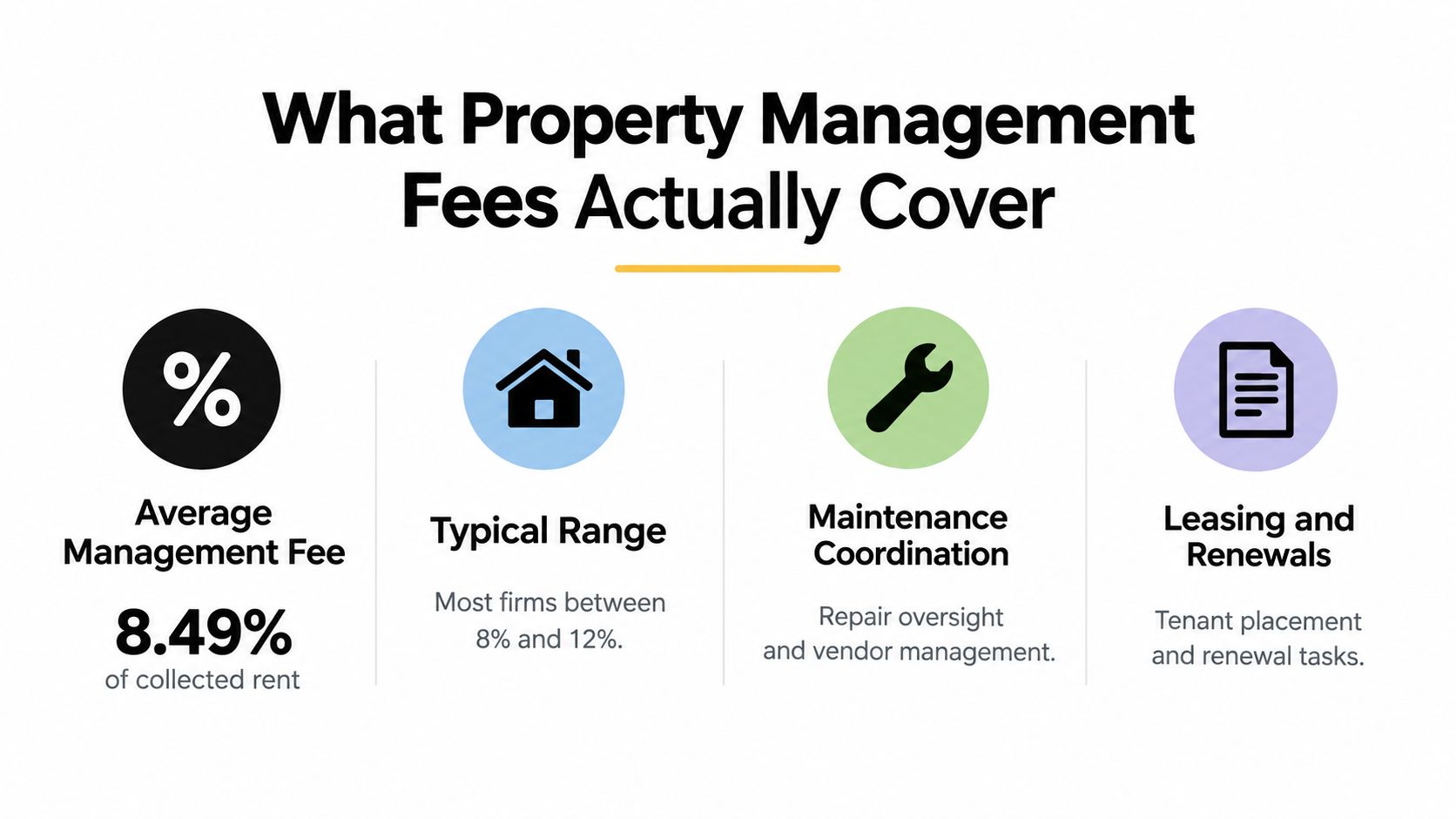
For a home collecting $2,000 per month, that recurring charge would be approximately $169.80 per month, or $2,037.60 across twelve months. The figure is a useful benchmark, not the annual cost you should put in your budget.
The base fee covers the operating layer
A standard management fee often includes rent collection, tenant communication, lease enforcement, financial reporting, and coordination of routine property issues. The agreement controls the details. One company may include inspections and maintenance coordination, while another bills for each service separately.
The fee base also changes the result. If the manager charges only when rent is collected, vacancy, late payment, or failed collection can reduce the monthly fee. A contract based on scheduled rent produces a different annual cost even when the advertised percentage is identical.
Read the service schedule line by line. A lower percentage can exclude inspections, maintenance oversight, tenant placement, or other work that another proposal includes. Review Pinnacle Property Media's clearly stated fees for an example of a provider presenting its charges plainly.
Practical rule: Put the recurring percentage in one budget row. Do not treat it as the full price of management.
Event-based charges often determine the true difference between proposals. A new tenant can trigger a placement fee, while an existing tenant can generate a renewal charge. Repairs may include coordination fees or vendor markups. Inspections, evictions, insurance claims, and renovation projects may sit outside the base scope.
Calculate effective annual cost per unit before choosing full-service management. Add the recurring fee to every charge your property could reasonably incur during the year, then compare that total with self-management plus software. The percentage is only the starting input.
Percentage of Rent vs Flat Fee Structures
The pricing model changes who carries the risk of vacancy and collection problems. A percentage-of-rent arrangement rises and falls with the amount collected. A flat monthly fee stays predictable, but the landlord may continue paying during periods when the property produces little or no rent.
| Dimension | Percentage of Rent | Flat Monthly Fee |
|---|---|---|
| Payment basis | Usually tied to rent collected, subject to contract terms | Fixed amount stated in the agreement |
| Vacancy impact | May fall when no rent is collected | Often remains payable unless waived |
| Budgeting | Variable from month to month | Easier to forecast |
| Incentive | Manager's compensation can track realized collections | Manager's fee is less sensitive to collection changes |
| Portfolio growth | Can rise as rents and units increase | May remain stable or change by unit |
| Main risk | Higher cost as collected rent grows | Paying the same amount during weak revenue periods |
Consider a stable property with a long-term tenant who pays consistently. A percentage model can work well because the fee scales with actual revenue and remains easy to reconcile. If the manager handles collection, communication, and enforcement effectively, the arrangement links compensation to the property's income.
Now consider a seasonal turnover pattern or a unit with frequent payment interruptions. A percentage fee based on collections may reduce the manager's compensation when realized income falls. That alignment can encourage attention to delinquency and vacancy, although the contract still determines how quickly the manager must act and which services cost extra.
A flat fee creates the opposite trade-off. The landlord knows the recurring charge in advance, which helps when managing several units with different rent levels. But the owner may pay the same management amount during a vacancy unless the agreement says otherwise. A low-rent property can also suffer when the flat charge consumes a large share of monthly income.
Hybrid structures can fit uneven workloads
Some owners negotiate a flat base fee plus a performance component tied to collections above an agreed threshold. Others keep rent collection in-house while outsourcing leasing, inspections, or maintenance coordination. These arrangements can work when the landlord wants predictable administration but still wants compensation to reflect actual collections.
Don't compare a flat fee and a percentage by looking only at the monthly invoice. Normalize both against the same assumptions for occupancy, collections, tenant turnover, and included services. For a small portfolio, a higher-looking flat charge may be economically sensible if it includes work that a percentage manager bills separately.
The contract should also state whether the fee applies to base rent, late fees, utility reimbursements, deposits, or other tenant-paid amounts. The revenue base can change the effective price more than the advertised rate suggests.
Leasing Renewal and One-Time Charges
The recurring percentage is often the easiest line item to understand because it appears every month. Event-based charges are where proposals become difficult to compare. They appear only when a tenant moves in, renews, requires a special inspection, or creates a situation outside routine administration.
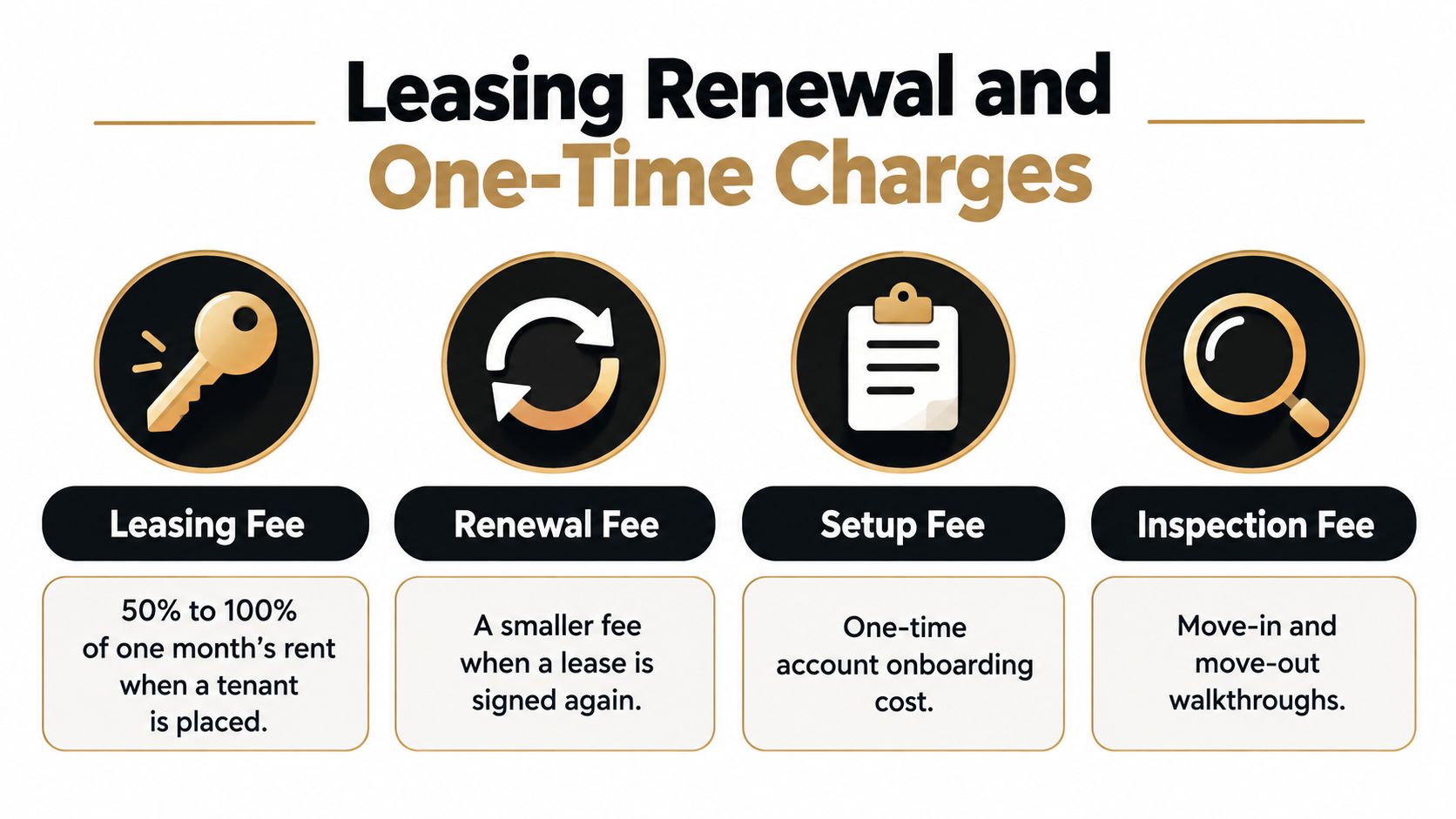
A tenant-placement fee commonly ranges from 50% to 100% of one month's rent, according to RentBumper's overview of property management charges. That fee may cover marketing, showings, application processing, screening coordination, lease execution, and move-in documentation, but the agreement should identify each included task.
Model the events, not just the monthly charge
Suppose a unit rents for $2,000 and changes tenants during the year. A placement charge equal to half a month's rent adds $1,000. A full-month placement charge adds $2,000. Those amounts sit on top of the recurring management fees already paid while the prior tenant occupied the unit.
Renewal charges deserve equal scrutiny. A manager may bill for preparing a renewal, negotiating terms, updating the lease, or completing a new signature process. The fee can appear even when the tenant stays and the workload is modest. Ask whether renewals are included, charged per event, or waived when the landlord handles the paperwork.
Setup fees generally cover onboarding the property, entering records, collecting documents, and configuring the account. Inspection charges may apply to move-in, move-out, or periodic visits. Some managers include selected inspections in the base fee, while others charge for each one. Eviction work, court appearances, insurance coordination, and renovation oversight can also sit outside ordinary management.
Use a fee schedule with separate rows for:
- Tenant placement: State the exact amount and whether marketing, showings, screening, and move-in records are included.
- Renewal processing: Confirm whether the charge applies to every extension, even without a new tenant.
- Setup and transfer: Ask whether onboarding is charged once per property or once per unit.
- Inspections: Identify which inspections are included and what documentation you'll receive.
- Evictions and special projects: Require written rates for work outside routine administration.
Negotiate the items that are predictable. You may be able to request a renewal waiver, a cap on inspection charges, or a reduced placement fee for an owner-supplied tenant. More important than winning one line-item concession is getting a complete schedule that prevents surprises.
Collected Rent vs Scheduled Rent Fee Bases
A fee based on collected rent applies to money the manager receives. A fee based on scheduled rent applies to the amount the tenant owes under the lease, whether payment arrives or not. That distinction affects both your cash flow and the manager's financial incentive.
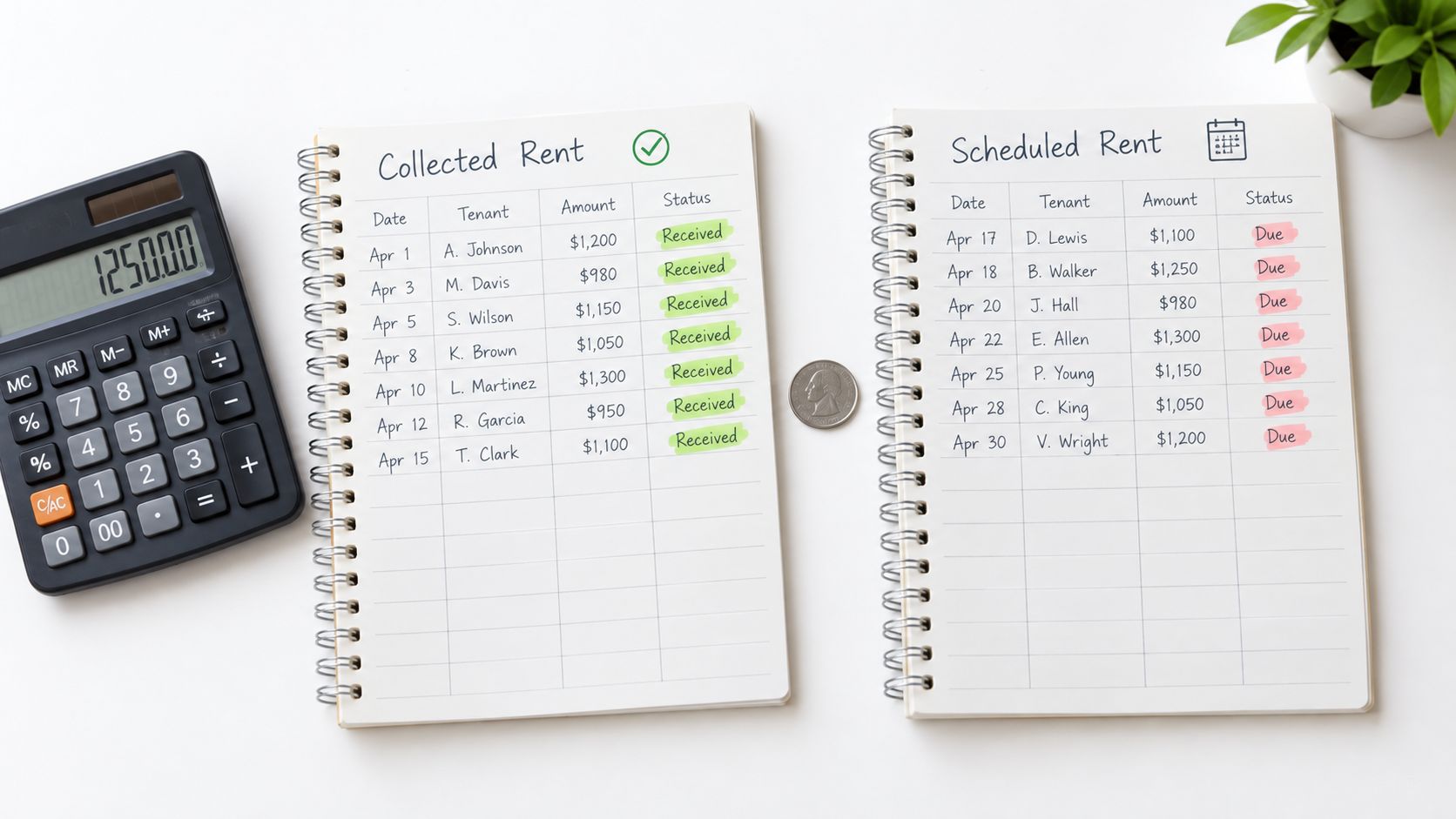
At the benchmark rate, 8.49% of $2,400 in monthly collected rent equals approximately $203.76 per month, or $2,445.12 annually, before leasing, renewal, inspection, maintenance-coordination, or eviction charges, as shown in Steadily's explanation of management costs.
Why the contract wording matters
Assume the tenant pays late for two months. Under a collected-rent model, the manager's percentage charge can fall during those months because the realized revenue falls. Under a scheduled-rent model, the fee may remain calculated on the contractual rent due. The landlord bears the collection shortfall in either case, but the manager's compensation changes.
That difference can create useful alignment. A manager paid on collections has a direct financial reason to monitor delinquencies, communicate promptly, and pursue the remedies allowed by the lease and local law. A scheduled-rent arrangement provides more predictable manager revenue, but it doesn't reduce the owner's need to scrutinize collection performance.
Watch for definitions that expand the fee base. The agreement should say whether the percentage applies to base rent only or also to late fees, utility reimbursements, deposits, parking charges, and other payments. It should also explain what happens when a tenant pays only part of the amount due.
Use this clause as your minimum checklist:
- Define the base: Is the fee calculated on collected rent or scheduled rent?
- Define the revenue: Which tenant payments count?
- Define timing: When does the manager earn the fee?
- Define nonpayment: What happens during partial payment, delinquency, vacancy, or eviction?
- Define reporting: Where can you verify the calculation in the monthly statement?
The percentage is incomplete until those definitions are clear.
Building an All-In Cost Model for Small Portfolios
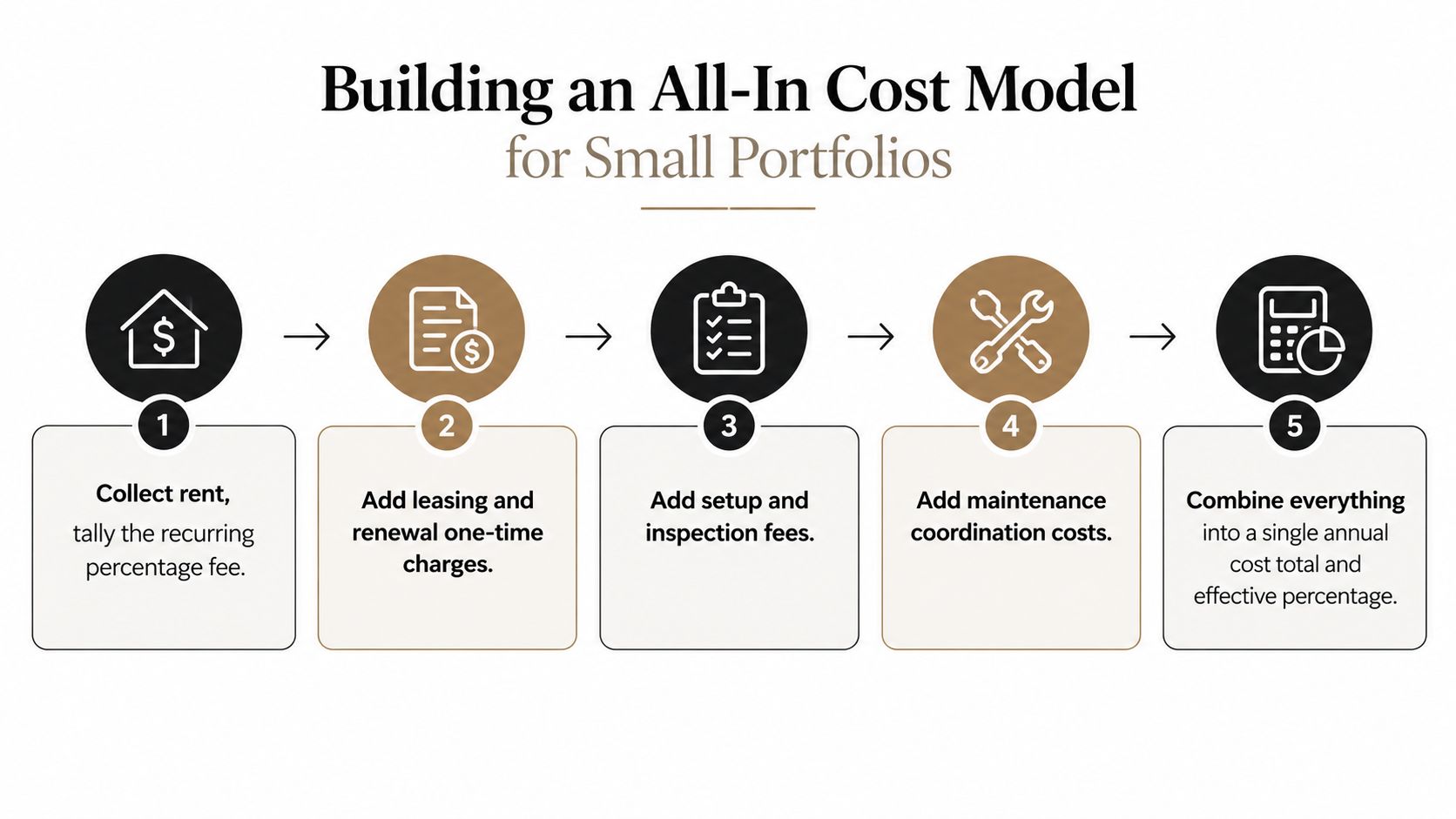
An all-in model turns a confusing proposal into one comparable number: annual management cost per unit. It should capture recurring fees, leasing, renewals, setup, inspections, maintenance coordination, and any other charge the manager can reasonably bill.
Use the same assumptions for every option
Create a worksheet with one column for full-service management and another for self-management plus software. Use your own rent, expected collections, tenant stability, and likely turnover. Don't make the full-service option carry every possible expense while giving self-management a zero-cost assumption. Your time, leasing work, bookkeeping, screening, inspection travel, and emergency coordination all have an economic cost.
For full-service management, calculate:
- Recurring management: Apply the contract rate to the stated fee base and expected collected rent.
- Leasing: Add the placement fee for each expected tenant change.
- Renewals: Add the renewal charge for each renewal event.
- Setup and inspections: Include one-time onboarding and expected inspection costs.
- Maintenance coordination: Add markups, work-order charges, or other repair administration fees.
- Special events: Include a reasonable allowance for eviction, insurance, project, or after-hours work if the agreement permits them.
For self-management, include software, payment processing, screening, lease preparation, bookkeeping, listing promotion, contractor coordination, and your own time. A platform such as VerticalRent can combine screening, lease generation, online rent collection, ledgers, maintenance requests, and listing workflows, but you still need to verify the current plan and transaction pricing before relying on it in a forecast.
Convert the result into an effective percentage
Divide annual management cost by annual collected rent. This gives you an effective rate that includes charges the headline percentage omits. Then divide the same annual total by the number of units to see how the burden changes across a one-unit, five-unit, or ten-unit portfolio.
Keep a second version of the worksheet for a difficult year. Add a vacancy, a placement event, a major repair, or an eviction-related charge. The point isn't to predict the future precisely. It's to see which proposal remains acceptable when normal ownership becomes less tidy.
For bookkeeping and tax-record questions related to management expenses, landlords can review VerticalRent's guide to property management fee deductibility. Confirm tax treatment with a qualified professional, especially when costs are capitalized or shared across properties.
Maintenance Markups and Vendor Incentives Explained
Maintenance charges deserve separate scrutiny because the manager may earn revenue from the repair. A contract can add a markup to the vendor invoice, apply a flat coordination fee, or disclose a referral payment from the contractor. Each arrangement changes your effective annual cost per unit and may influence which vendor receives the work.
The percentage is only one part of the comparison. Ask the manager to state the markup percentage and any work-order charge in writing before you sign. Confirm whether the agreement also includes after-hours rates, diagnostic visits, emergency dispatch fees, or minimum charges.
Consider a $500 repair. A 10% markup raises the bill to $550, while a 20% markup raises it to $600. The arithmetic is straightforward, but repeated repairs can materially increase the annual cost per unit. Your proposal should explain whether you can see the original invoice, compare vendors, and approve work above a stated threshold.
Ask who benefits from the repair decision
Request clear answers to these questions before signing:
- Invoice access: Will you receive the vendor's original invoice and a description of the completed work?
- Related parties: Does the manager own, control, or have a financial relationship with any recommended vendor?
- Referral payments: Does a contractor pay the manager a commission, rebate, or other incentive?
- Vendor choice: Can you use your own licensed and insured provider?
- Approval limits: What work can the manager authorize without your approval?
- Emergency pricing: Are after-hours calls, diagnostic visits, or emergency dispatches billed separately?
A manager can provide useful coordination, especially when an owner lives far from the property. The trade-off is cost and control. Compare the manager's projected maintenance charges with self-management plus software, contractor coordination, and your own time. A lower headline management percentage may still produce a higher annual cost per unit if repair markups and work-order fees are frequent.
Managers who follow documented contractor-selection and oversight practices can make those costs easier to review. See VerticalRent's vendor management best practices. Whether you use a platform or a manager, keep the work order, invoice, approval, and completion record together. That file gives you a practical basis for checking service quality, disputed charges, and future vendor decisions.
Choosing the Right Fee Structure for 1 to 10 Units
For one to four units, self-management with software often deserves the first comparison. The owner can retain control of tenant communication, approvals, and vendor selection while using tools for screening, leases, rent collection, reminders, and recordkeeping. Full-service management can still make sense, but only when the time savings or geographic convenience outweighs the recurring and event-based charges.
A portfolio of five to ten units may justify a hybrid arrangement. You might retain rent collection and routine communication while outsourcing leasing, inspections, or maintenance coordination. Another landlord may do the opposite, handling stable tenants personally but delegating new placements and emergency calls.
Use this decision path:
- You live near the property and have stable tenants: Compare self-management plus software first.
- You work long hours but remain nearby: Consider a hybrid provider for leasing and urgent maintenance.
- You live far away: Full-service management may justify its cost if local access and response are difficult.
- You dislike tenant communication or late-night calls: Price the delegation realistically instead of assuming your time is free.
- You have frequent turnover: Focus on leasing speed, placement charges, and vacancy handling rather than the recurring percentage alone.
Your portfolio size matters, but it isn't decisive. A single distant property can require more delegation than several nearby units with reliable tenants. For a broader decision framework, review VerticalRent's guide to hiring a property manager.
Questions to Ask Before Signing a Management Agreement
Bring the proposal and ask:
- What exactly is the fee base? A vague answer about “rent” needs clarification.
- Is the percentage based on collected or scheduled rent? This changes nonpayment economics.
- What does the recurring fee include? Ask for exclusions, not just included services.
- What are the leasing and renewal charges? Confirm whether tenant placement and extensions are billed separately.
- Are setup, inspections, evictions, and after-hours calls extra? Request the rate for each event.
- Are maintenance markups or vendor commissions disclosed? Ask for invoices and related-party disclosures.
- What happens during vacancy? Confirm whether a minimum or flat fee continues.
- Can I terminate without a long lock-in period? Review notice periods and auto-renewal language.
- How will I verify every charge? Require itemized monthly statements and supporting records.
A proposal becomes comparable only after the manager answers these questions in writing. Calculate the annual total per unit, test it against a turnover scenario, and compare that result with the cost of handling the work yourself using software, contractors, and your own time.
If you want to reduce the administrative workload without treating every management task as a full-service expense, visit VerticalRent to review tools for tenant screening, leases, online rent collection, maintenance coordination, and rental bookkeeping. Build your own all-in comparison using the platform's current pricing, then decide which responsibilities you want to keep and which are worth delegating.
Put this into practice
VerticalRent tools related to this guide
Legal Disclaimer
VerticalRent and its authors are not attorneys, CPAs, or licensed legal or financial advisors, and nothing on this site constitutes legal, tax, or professional advice. The information in this article is provided for general educational purposes only. Landlord-tenant laws, eviction procedures, security deposit rules, and tax regulations vary significantly by state, county, and municipality — and change frequently. Nothing on this site creates an attorney-client relationship. Always consult a licensed attorney or qualified professional in your jurisdiction before taking any action based on information you read here.
Co-founded VerticalRent in 2011, growing it from nothing to 100k landlords and renters. Sold it in 2019, then re-acquired it in 2026 to make it better than ever.


