How to Calculate Rental Property Depreciation Step by Step
Learn how to calculate rental property depreciation: find your basis, apply the 27.5-year recovery period, and use the mid-month convention correctly.


You're staring at a closing statement, a county tax card, and a tax form asking for depreciation. You've heard you divide by 27.5, but divide what, exactly? The purchase price includes land, the keys changed hands in March, and the first tenant didn't move in until May. If you guess here, you'll repeat that guess on your return for decades.
That's why learning how to calculate rental property depreciation starts with getting three inputs right, not with punching numbers into a calculator.
The Depreciation Formula and Recovery Periods
For most residential landlords, the working formula is simple.
Annual depreciation = depreciable basis divided by the recovery period, prorated for the months in service in year one.
For a residential rental building, that recovery period is 27.5 years. So a $275,000 depreciable building basis produces $10,000 a year before first and final year adjustments: $275,000 ÷ 27.5 = $10,000. Clean math, once the $275,000 is correct.
The complication is that a rental property is a bundle of assets with different clocks. The building runs on one clock, the refrigerator on another, the driveway on a third, and the land on none at all.
Recovery Periods by Asset Type
| Asset | Recovery period | Method | Depreciable |
|---|---|---|---|
| Residential rental building | 27.5 years | Straight-line, mid-month convention | Yes |
| Furniture and appliances | 5 years | MACRS declining balance, half-year convention | Yes |
| Land improvements (fences, driveways, parking pads) | 15 years | MACRS declining balance, half-year convention | Yes |
| Land | None | Not applicable | No |
The building moves slowly and evenly. Appliances and carpet wear out faster on paper, so the rules let you recover them faster. Land has no recovery period because the calculation assumes it does not wear out.
Two consequences follow from that table, and both catch people off guard.
First, lumping every component into the building line stretches deductions you were entitled to take sooner across 27.5 years. A five-year appliance folded into the building basis still gets recovered, just far more slowly than its actual schedule allows.
Second, every dollar of depreciation lowers your adjusted basis, whether you claim it or not. Skipping a yearly deduction does not preserve basis for the sale. It gives up the annual benefit and still leaves the lower basis behind.
That sale-side effect is why depreciation belongs in long-term planning, not only in this year's return. Owners who track rentals beside retirement savings often keep one eye on benchmarks that compare retirement wealth by age while the property's basis changes year by year.
Before any division, name the three inputs the formula needs.
- Depreciable basis: what part of the cost is building, separated from land and personal property
- In-service date: the month the unit was ready and available for rent
- Recovery period: which clock applies to each component
With those three settled, the arithmetic is the easy part.
Establish Basis and Separate Components Before Any Math
Basis is where most errors begin, and they begin before depreciation even starts. IRS Publication 527 on residential rental property sets the sequence: allocate total cost between land and improvements because land is not depreciable, add eligible capitalized acquisition costs to the building portion, and exclude loan principal, mortgage payments, and other financing repayments.
Work through it in order.
Build the Number in Four Steps
- Start with total cost. Take the purchase price and add eligible acquisition costs such as legal fees, title insurance, recording fees, and survey charges.
- Split land from building. Use the county assessor ratio or an appraisal. Say you paid $400,000 and the assessor puts land at 25 percent. That's $100,000 to land and $300,000 to building basis.
- Add capitalized improvements to the building side. Work that adds a new asset or extends life belongs here, not on the land line.
- Keep financing out. Your loan balance and monthly mortgage payments don't create basis. You're depreciating cost, not debt.
The assessor point confuses people. You use the assessor's ratio, not the assessor's dollar values, and you apply that ratio to your actual cost. If the card shows land and improvements in a 25 to 75 proportion, you keep that proportion even though the assessed dollars are lower than what you paid.
Don't depreciate the full purchase price because it's the only number on your closing statement. That single shortcut overstates every year's deduction.
Timing is the other common slip. Depreciation starts when the property is ready and available for rent, not at closing and not necessarily when the first tenant moves in. If you closed in June, spent July renovating, and listed the unit in August, August controls.
Repairs don't belong in basis either. Patching a leak to keep the property working is a repair you expense in the year paid. If you're unsure where a job falls, work through the distinction between repairs and capital improvements for rentals before you add it to a 27.5 year schedule. Owners who also work from the property sometimes need the same discipline on the personal side, and a clear guide to allowable home office expenses can help you keep rental basis and home office deductions from bleeding into each other.
Separate Components Into Their Own Records
One property record isn't enough. IRS Publication 946 on how to depreciate property identifies basis, recovery period, and depreciation method as the three governing inputs, and it supports a component level asset register where you separate the building from personal property and improvements and document invoices, dates placed in service, business-use percentages, and disposition dates.
In practice, that means separate lines like these.
- Building structure: 27.5 years, straight-line, mid-month convention
- Appliances and carpet: 5 years, on their own schedule
- Fences, driveways, and parking pads: 15 years, as land improvements
- Land: recorded for basis, never depreciated
Mixed use adds one more allocation. Say you own a duplex that's rented 60 percent and owner occupied 40 percent. You depreciate only the 60 percent rental share, and you pick one reasonable method for shared costs such as the roof or hallway and apply it consistently every year. Don't switch methods because one gives a bigger deduction this year.
Later projects get their own lines too. Replacing a roof, furnace, or windows is a capital improvement with its own placed in service date, generally recovered over 27.5 years. It doesn't disappear into the original building basis, and its clock starts when that improvement is placed in service, not when you bought the house.
Keep original basis, accumulated depreciation, and adjusted basis reconciled for every asset. Depreciation that's claimed, or even just allowable, can affect gain when you sell even if you failed to claim it. Form 4562 may be required to calculate and report depreciation, with the rental activity generally flowing to Schedule E.
Write this one line down for each property before you move on: total cost, minus land share, plus eligible acquisition costs, equals final building basis.
How to Calculate First-Year and Annual Depreciation
Once basis is settled, turning it into a dollar deduction is a short routine. The part most calculator style guides skip is step two.
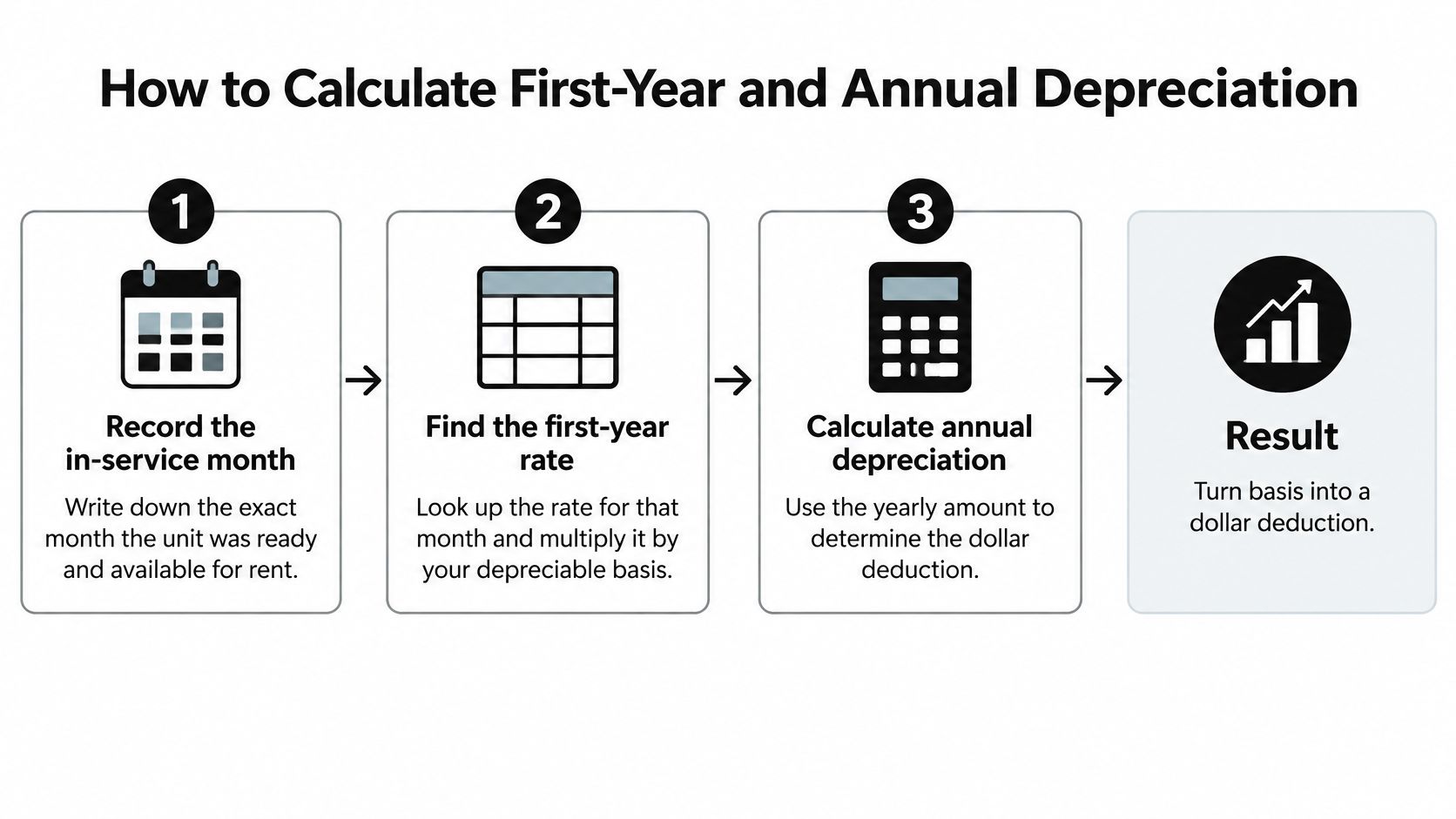
Here's a visual summary of the three moves before you run your own month.
Run the Calculation in Four Steps
- Record the exact month the unit was ready and available for rent.
- Look up the first-year rate for that month in the table below and multiply it by your building basis.
- For each full year after that, divide basis by 27.5. That gives you 3.636 percent a year.
- Carry the final year amount until the full basis is used up over the 27.5 year span.
The mid-month convention is why January and December produce wildly different first years. The rules treat property as placed in service in the middle of the month, no matter which day you listed it. A January placement gets most of a year. A December placement gets half a month.
First-Year Mid-Month Rates for Residential Rental Buildings
| Month placed in service | First-year rate | First-year deduction on $300,000 basis |
|---|---|---|
| January | 3.485% | $10,455 |
| February | 3.182% | $9,545 |
| March | 2.879% | $8,636 |
| April | 2.576% | $7,727 |
| May | 2.273% | $6,818 |
| June | 1.970% | $5,909 |
| July | 1.667% | $5,000 |
| August | 1.364% | $4,091 |
| September | 1.061% | $3,182 |
| October | 0.758% | $2,273 |
| November | 0.455% | $1,364 |
| December | 0.152% | $456 |
Use the $300,000 basis from the land split example. Ready in January, your first year deduction is $10,455. Ready in December, it's $456. Same house, same basis, a difference of nearly $10,000 created entirely by the month. From year two onward, both owners claim $300,000 ÷ 27.5 = $10,909 in each full year.
Quick check: If you placed the property in service after January, your first year deduction should be below the full year figure. If it isn't, you've probably taken a full 12 months.
That annual amount flows to Schedule E line 18, and Form 4562 may be needed for the first year or when you're making elections. Whether the resulting loss is fully usable this year is a separate question, so check the rules on the rental property depreciation income limit rather than assuming the deduction automatically offsets other income. Owners thinking ahead to an eventual sale can also compare tax-saving options for landlords while the schedule is still young.
One final sanity test. Add up every year, including the short first and final years. The total should equal your building basis, no more and no less. Store the exact in-service month in your records or software, because a generic 12 month first year will throw that total off from day one.
When Your Rental Was Once Your Home
Many small landlords don't buy a rental. They move out of a house and keep it. That route changes which value you depreciate, and it's where the purchase price on an old closing statement misleads people most.
Set up your documents before you touch the formula, as this desk layout suggests.
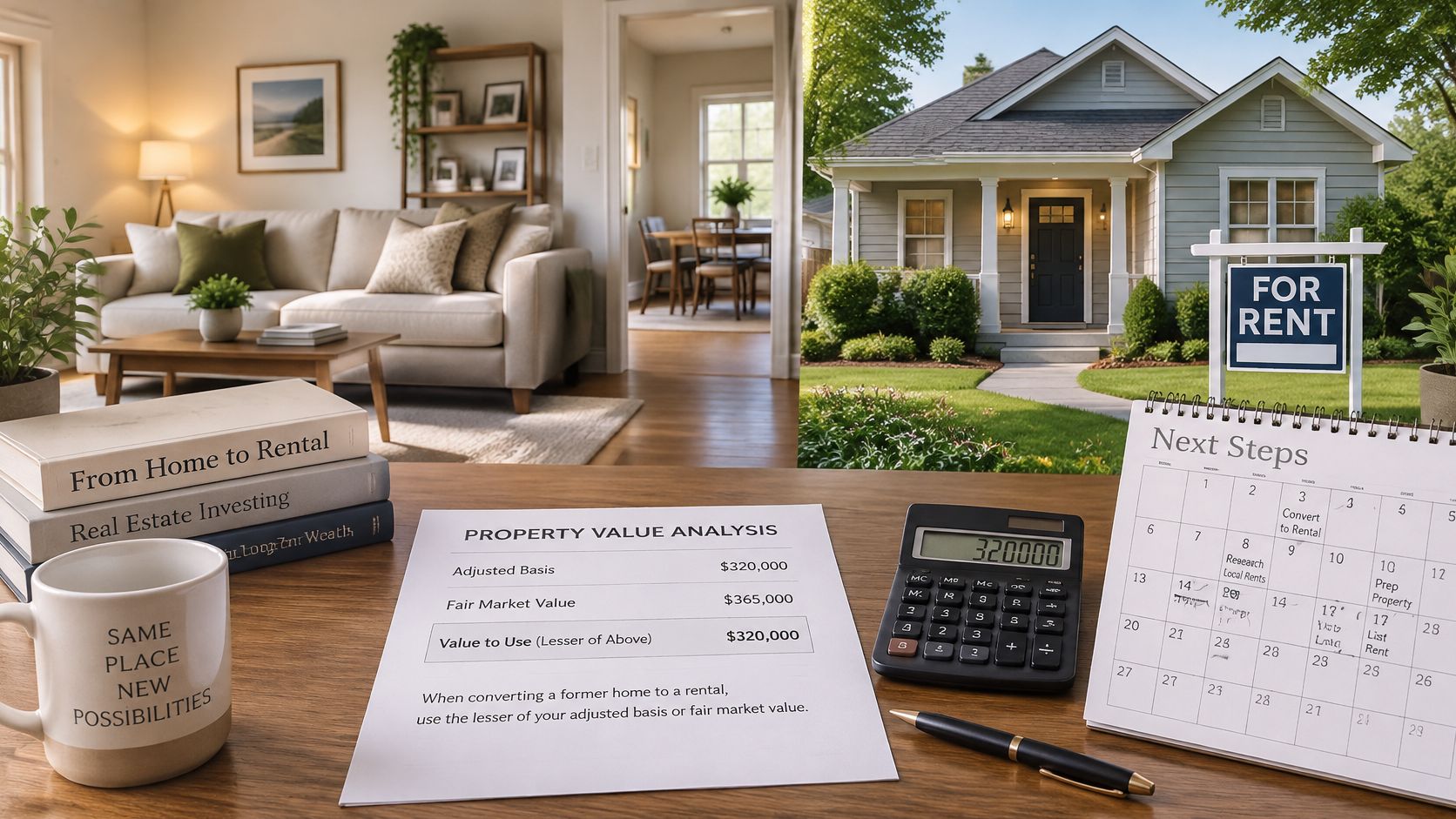
Say an owner bought a home for $310,000, lived there for several years, then moved for work and decided to rent it instead of selling. On the day it becomes a rental, the home is worth $340,000. The instinct is to depreciate $340,000 because that's today's value. That instinct is wrong.
IRS Publication 527 for residential rental property confirms that a home converted from personal use is depreciated as residential rental property over 27.5 years, but the basis is the lesser of adjusted basis or fair market value on the conversion date. Here adjusted basis is $310,000 and fair market value is $340,000, so $310,000 controls.
Apply the Land Split to the Controlling Value
Now separate land from that controlling figure. With a 25 percent land share, land takes $77,500 and the building basis is $232,500.
- Controlling value at conversion: $310,000
- Less land at 25 percent: $77,500
- Building basis: $232,500
- Full year depreciation: $232,500 ÷ 27.5 = roughly $8,455 a year
Notice what didn't happen. There's no depreciation for the years the owner lived there, because a personal home is never depreciated. Nothing carries over. The rental schedule starts fresh at conversion, using the lower value, after the land split.
If fair market value had fallen below adjusted basis, the lower fair market value would control instead. That's exactly why you need a dated appraisal from the conversion period, not a value you estimate years later when you sell.
This short video walks through the conversion scenario with the dates in view.
The placed in service date is the day the unit was ready and available for rent after the move, which sets the first year rate from the mid-month table. It isn't the original purchase date, and it isn't automatically the day the moving truck left if you still needed weeks of work before listing it.
Save four things in one folder for this property.
- Conversion appraisal: Proves fair market value on the relevant date
- Original closing statement: Supports adjusted basis
- Improvement invoices: Shows capital work that adjusted basis over time
- First listing record: Supports the date the property was available for rent
With those four items, another preparer could rebuild your number without asking you to remember a move from years ago.
Confirm Your Schedule and Set Up Records Now
A depreciation schedule stands or falls on three small facts. Confirm each one before you file, then stop second guessing the division.
- Building basis is split from land, using a ratio you can reproduce from a document.
- The in-service month is recorded, not just the year.
- Each component carries its own recovery period, with its own start date.
If any one of those is missing, fixing it now is cheaper than correcting several filed returns later.
A per property ledger is what keeps those three facts attached to the right unit year after year.
Weigh Bonus Depreciation Carefully
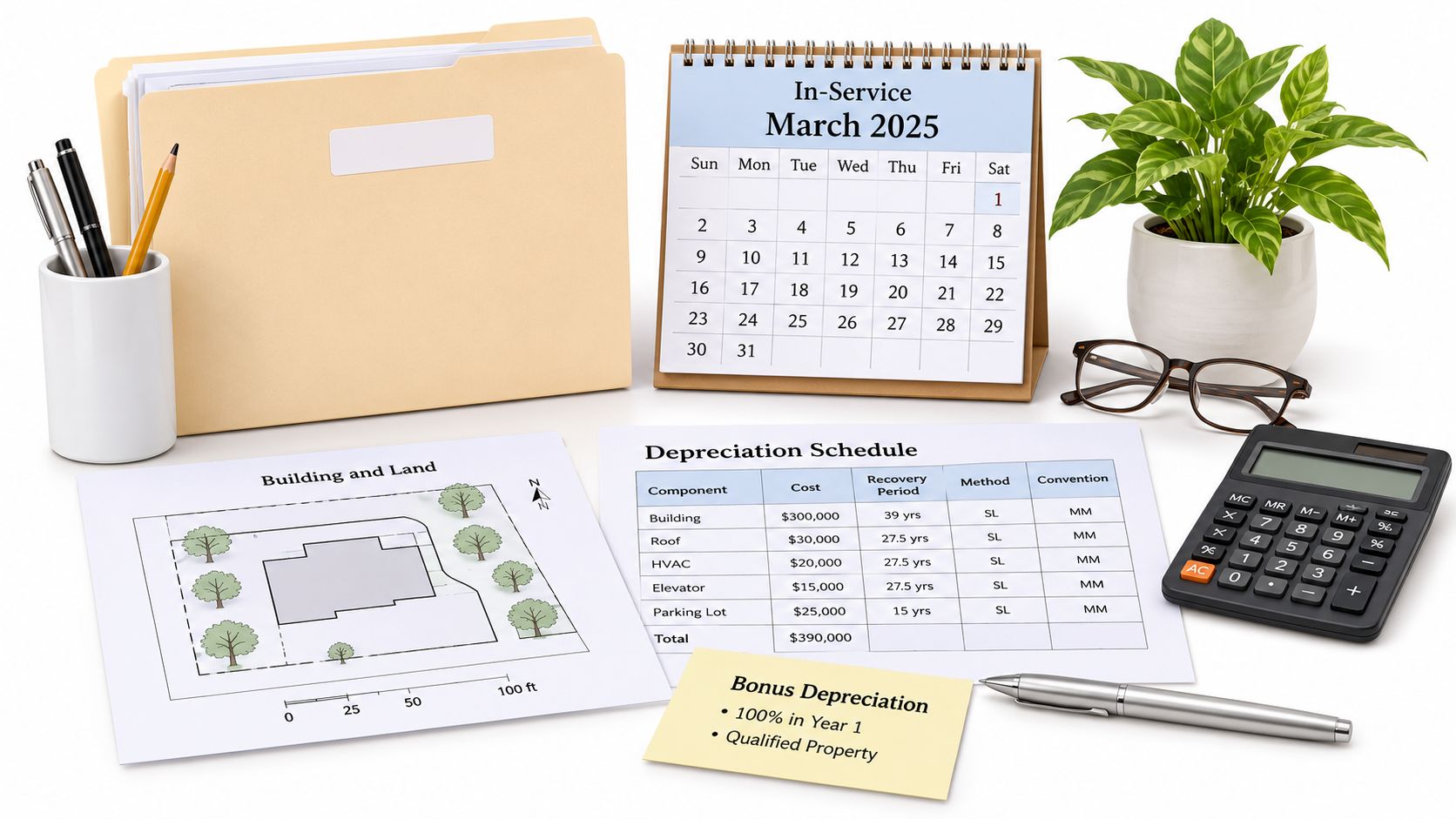
Faster isn't always better, and it never applies to the whole building. Bonus depreciation lets you deduct a larger share of a qualifying asset's cost in the year it goes into service, but the percentage and eligibility rules have shifted more than once in recent years, so confirm the current rules before you build a return around them. Qualifying assets are generally those with recovery periods of 20 years or less.
That means certain shorter life components may qualify. The 27.5 year building itself does not, and land is always excluded. Major replacements such as roofs, windows, and furnaces are capital improvements with their own placed in service dates, generally recovered over 27.5 years, so don't assume a renovation invoice qualifies just because it's large.
Faster deductions can improve near term cash flow. They can also complicate your records, interact with passive loss limitations, and raise the depreciation recapture you may owe when you sell. Categorize every invoice by asset, placed in service date, and recovery period before you decide, not after you've claimed it.
Keep One Ledger per Property
Set up one ledger per property that stores basis, in-service month, asset class, and disposal date, and do it before the next filing. In VerticalRent, income and expenses are tracked per property, every rent payment is automatically recorded as rental income in the Schedule E category with no manual entry, and the AI Expense Categorizer maps a receipt to an IRS Schedule E category, such as repairs, depreciation, or utilities, and logs it to the ledger. That structure makes it far easier to tie your depreciation line to the rest of your rental income on Schedule E without rebuilding the year from bank statements.
If the property was once your home, or any component is shared between rental and personal use, have a tax professional review the schedule before you file.
That one line test catches most situations where a clean formula hides a messy set of facts. Everything else, you can now calculate and defend yourself.
Set up your per property depreciation ledger in VerticalRent, where you can record purchase price, land allocation, and in-service date and keep income, expenses, and Schedule E categories organized property by property. Enter your building basis once, store the exact month your unit was ready for rent, and you'll have a schedule you can check against your return every year.
Put this into practice
VerticalRent tools related to this guide
Legal Disclaimer
VerticalRent and its authors are not attorneys, CPAs, or licensed legal or financial advisors, and nothing on this site constitutes legal, tax, or professional advice. The information in this article is provided for general educational purposes only. Landlord-tenant laws, eviction procedures, security deposit rules, and tax regulations vary significantly by state, county, and municipality — and change frequently. Nothing on this site creates an attorney-client relationship. Always consult a licensed attorney or qualified professional in your jurisdiction before taking any action based on information you read here.
Co-founded VerticalRent in 2011, growing it from nothing to 100k landlords and renters. Sold it in 2019, then re-acquired it in 2026 to make it better than ever.


