Rental Income Schedule E: How to Report It Line by Line
Rental Income Schedule E explained: which receipts count, deductible expenses, depreciation, loss limits and a filled sample section.


You've opened your rent ledger, gathered the invoices, and reached the number at the bottom: a loss. You're ready to enter it on your tax return, but you're not sure whether that number belongs on Schedule E or whether you can actually deduct it.
Those are different questions. Schedule E calculates a rental profit or loss. Other tax rules determine how much of a loss you can use. Getting both answers right starts with placing each receipt and expense in the correct category.
Where Each Rental Number Lands on Schedule E
Start with the property's records, not the deduction you hope to claim. Keep rent receipts together, separate expenses by category, and identify purchases that belong in the property's basis rather than among current expenses.
Schedule E, Part I generally applies when you rent residential real estate and provide basic services such as heat, light, and trash collection. Substantial services can point toward Schedule C instead, and not-for-profit rentals don't follow the normal Schedule E treatment, as explained in IRS Publication 527's rental reporting guidance.
Match the transaction to the category
Use this map to organize your ledger. An item belongs under the category that describes its purpose, not the payment method you used.
| Line | Category | What Goes There |
|---|---|---|
| 3 | Rents received | Monthly rent and other reportable rental payments |
| 4 | Royalties received | Royalty receipts, not ordinary apartment rent |
| 5 | Advertising | Rental listing fees and tenant-search advertisements |
| 6 | Auto and travel | Qualifying rental-management mileage or travel |
| 7 | Cleaning and maintenance | Turnover cleaning and routine upkeep |
| 8 | Commissions | Leasing-agent commissions |
| 9 | Insurance | Landlord insurance premiums |
| 10 | Legal and professional fees | Qualifying rental attorney and accounting fees |
| 11 | Management fees | Property-management charges |
| 12 | Mortgage interest paid to banks | Qualifying rental mortgage interest |
| 13 | Other interest | Other qualifying interest attributable to the rental |
| 14 | Repairs | Work that keeps the existing property functioning |
| 15 | Supplies | Supplies used for the rental |
| 16 | Taxes | Deductible property taxes attributable to the rental |
| 17 | Utilities | Rental utilities you pay |
| 18 | Depreciation | Annual cost recovery for depreciable rental property |
| 19 | Other | Itemized qualifying expenses without a more specific category |
| 20 | Total expenses | The combined expense categories |
| 21 | Rents minus expenses | The property's preliminary profit or loss before applicable limitations |
A listing invoice belongs under advertising even if you paid it from a personal account. A management charge belongs under management fees even if the manager withheld it from rent before sending you a payout.
Practical rule: Classify expenses by what you purchased, then reconcile how you paid for them.
Schedule E is a profit-and-loss reporting mechanism, not merely a place to enter deposits. Consistent categories let you trace a total back to individual transactions without rebuilding the year from bank statements.
Don't treat the preliminary loss as the final deduction flowing through your return. The limitation checks come later.
Which Receipts Count as Rental Income
For a cash-basis landlord, receiving rent works a little like receiving a parcel. You generally recognize it when it arrives, not when you open it or when the related lease month begins.
That distinction matters around year-end. Advance rent generally belongs in income when received, even when the tenant is paying for a later rental period.
Separate earned receipts from refundable money
Your receipt review should distinguish money you're entitled to keep from money you're holding for someone else.
- Regular and advance rent: Identify payments for occupancy, including payments received ahead of the rental period.
- Fees you keep: Review late charges, pet fees, and lease-termination payments for inclusion in rental income.
- Replacement income: Check whether an insurance payment replaces lost rent rather than reimbursing a different kind of loss.
- Refundable deposits: Keep these separate from rent while you remain obligated to return them.
A refundable security deposit isn't rental income merely because it appears in your bank account. If you return it, it never becomes rental income. If you retain an amount for unpaid rent or damage under the lease, record the retained amount in the appropriate year.
The paperwork matters as much as the bank entry. Keep the lease, deposit record, and any written explanation of deductions together so you can show why the money changed from refundable to retained.
Record reimbursements without hiding the expense
Suppose the utility account is in your name. You pay the provider, and the tenant reimburses you. Don't assume the reimbursement can disappear from the books because it offsets a bill.
Record the rental receipt and the corresponding qualifying utility expense separately. Otherwise, your deposits won't reconcile cleanly, and your utility records won't explain the full activity.
A bank deposit tells you that money arrived. The lease and supporting records tell you what that money was.
Before totaling rental income, label each receipt as rent, another retained payment, a reimbursement, or a refundable deposit. Then confirm the receipt date against the bank record. This small review prevents a deposit balance from becoming an inflated income total.
Sorting Expenses and Depreciation Between Now and Later
Ask this before categorizing a contractor's invoice: Did the work maintain the existing property, or did it improve the property? Paying for something this year doesn't necessarily mean you deduct its entire cost this year.
A repair generally addresses existing wear or damage. An improvement involves a betterment, restoration, or adaptation that must be capitalized. The scope of the project matters, so don't classify the work solely from a short invoice description.
Read the whole job before choosing the treatment
The following examples describe typical treatment. Work performed as part of a larger improvement project may need a different classification.
| Expense | Treatment | Why |
|---|---|---|
| Fix a leaking faucet | Repair, line 14 | Restores an existing fixture's function |
| Repaint units between tenants | Generally repair, line 14 | Routine upkeep when performed independently |
| Replace an entire roof | Improvement, depreciate | Replaces a major building component |
| Install a new HVAC system | Improvement, depreciate | Replaces a major system |
| Kitchen remodel with a new layout | Improvement, depreciate | Changes and improves the existing kitchen |
| Tenant advertising and listing fees | Current expense, line 5 | Cost of finding tenants |
| Legal fees to buy the property | Add to basis | Acquisition cost rather than ongoing rental operation |
Ask contractors to describe what they repaired or replaced. “Plumbing work” doesn't explain whether someone fixed a leak or replaced a substantial system.
Stewart Accounting Services offers a resource to help readers find eligible landlord expense deductions. It's a UK resource, so use it for expense-organizing context, not as authority for U.S. Schedule E treatment.
Understand the non-cash deduction
Under the general IRS framework, residential rental buildings placed in service after 1986 use straight-line depreciation over 27.5 years under the MACRS General Depreciation System; land isn't depreciable, according to the IRS rental-property depreciation guidance. That guidance's basic calculation means a $275,000 building basis produces approximately $10,000 of annual depreciation, before the applicable first-year timing adjustments.
Depreciation reduces reported rental income without requiring a current-year payment. That's why a property can have money left from operations but still report a tax loss.
Start by establishing the building basis separately from land. Preserve the purchase allocation and its supporting appraisal or assessment information rather than applying an unsupported split. Then maintain improvement costs as separate basis records instead of burying them among repair invoices.
Your rental property depreciation schedule should connect each depreciable asset to its basis, placed-in-service date, and prior depreciation. Keep those records through ownership and eventual disposition because today's classification affects later basis and depreciation-related tax calculations.
Why a Schedule E Loss May Not Fully Reduce Your Taxes
“Why does my Schedule E show a loss, but my return doesn't deduct the whole amount?” Usually, the missing step is a limitation calculation.
An accounting loss isn't automatically an allowable tax loss. The IRS Schedule E instructions explain that rental losses may first face the at-risk rules and then the passive-activity rules. Follow that order when checking your result, even though the visual below places the checks differently.
Use this graphic as a reminder of the issues to review, not as a substitute for the required calculation order.
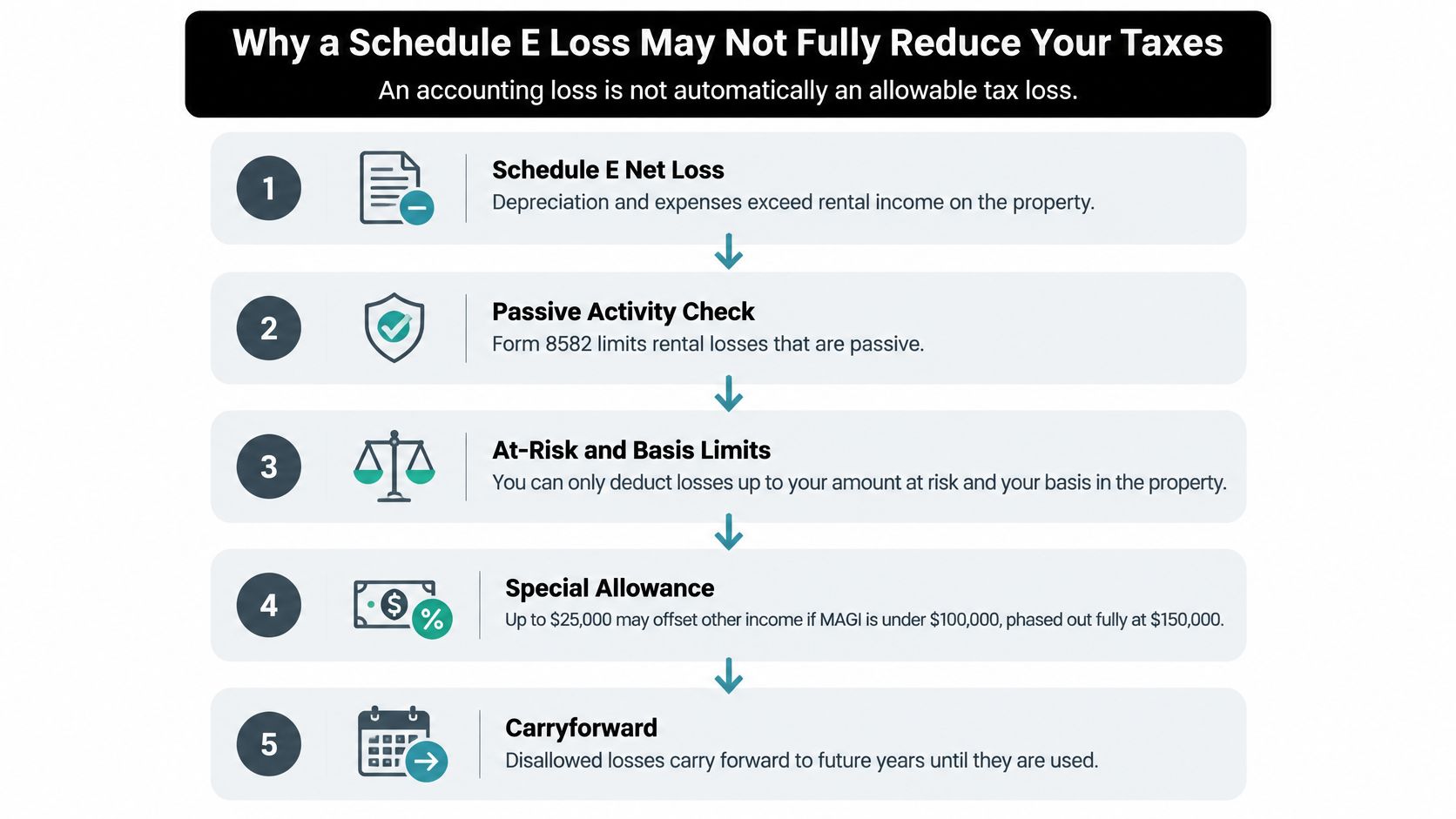
Check the amount at risk first
Your property's tax basis and your amount at risk are related but aren't interchangeable. Review invested funds, financing documents, and any personal guarantees to determine your actual economic exposure.
Don't assume the entire mortgage qualifies merely because the property secures it. Financing treatment requires checking the applicable rules and loan facts. Preserve the documents supporting your calculation, then apply the passive rules to the loss remaining after the at-risk limitation.
Apply the passive rules next
Rental activities are generally passive, even when the owner works on the property. Real-estate-professional status combined with material participation can change that treatment.
An actively participating owner may qualify for a special allowance of up to $25,000 against nonpassive income, reduced by 50% of modified adjusted gross income above $100,000, under IRS Publication 925's passive-loss rules. That publication also explains the separate, more restrictive treatment for married taxpayers filing separately.
A $30,000 rental loss, for example, isn't automatically deductible in full under those rules. The current benefit depends on participation, income, passive income, filing status, and the other applicable limitations.
- Calculate the allowed amount: Use Form 8582 when required rather than transferring the preliminary loss directly to the return.
- Track the remainder: Preserve suspended losses by activity and distinguish passive carryforwards from at-risk carryforwards.
- Review a sale carefully: A qualifying disposition can affect suspended losses, but selling property doesn't automatically resolve every limitation.
The Schedule E filing instructions explain the limitation sequence and circumstances in which qualifying rental losses may avoid Form 8582. Keep your basis records, ownership percentage, participation evidence, filing information, and carryforward schedules together.
For a closer explanation of how those records connect, use this guide to passive activity loss rules.
Splitting Costs When You Also Use the Property
Splitting mixed-use property expenses resembles dividing a shared grocery bill. You wouldn't divide everything evenly if someone bought food only for themselves. Rental expenses also need to follow who used the space and what the cost actually served.
Direct rental costs and shared property costs require different treatment. A booking charge tied to a rental stay isn't the same allocation problem as electricity used throughout a home.
Establish the use before allocating the cost
Begin by confirming the reporting category. Apply the basic-services distinction discussed earlier, and remember that renting personal property in a business points toward Schedule C rather than the residential real-estate treatment.
Next, maintain a calendar of fair-rental days, personal-use days, and genuine vacancy. Don't automatically label an unoccupied period as personal use. Keep availability records and listing evidence that explain what happened during the gap.
The IRS Schedule E form asks for fair-rental and personal-use days. Those entries need to agree with your calendar, not an estimate made while filing.
Match the allocation to the expense
| Cost | How to Split | Example |
|---|---|---|
| Mortgage interest and property taxes | Apply the appropriate rental-use allocation | Document the days or rented-space method used |
| Utilities | Use a supported allocation reflecting shared use | Connect the bill to the space and period served |
| Repairs only to the rented room | Assign the qualifying direct rental cost to that room | Repairing damage confined to the tenant's room |
| Shared structural repair, not a replacement | Allocate the qualifying rental share | Divide a shared repair using a documented use method |
| Depreciation on the building | Apply the rental share to depreciable building basis | Exclude the owner-occupied share |
| Booking platform fee on rental stays | Assign the qualifying fee to rental activity | Match the fee to the related booking |
A room rental may require both a space allocation and a time allocation. Dividing every expense by calendar days can misstate the rental share when the owner and tenant occupy different portions of the property.
Personal use can also trigger vacation-home limitations. Review those rules before assuming that an allocated expense can generate a deductible loss, and review any personal interest or tax treatment separately.
Before entering totals: Write down the allocation method, supporting day counts, space measurements where relevant, and the reason each direct cost belongs entirely to the rental.
Keep that schedule with the bills. It should let someone reproduce your rental share without relying on your memory.
A Filled Schedule E Example for One Rental
Consider a condo owner who has finished sorting the year's records. The tenant's payments appear in the rent ledger, the manager has supplied statements, and the owner has separated a repair invoice from a capital project.
The useful exercise isn't choosing sample amounts. It's learning where each supported amount goes and which documents prove it. The completed worksheet below shows the reporting path without supplying figures that should come from the owner's actual records.
Build the property column from documents
| Line | Item | Amount | Source Note |
|---|---|---|---|
| 3 | Rents received | Total reportable rental receipts | Rent ledger reconciled to bank deposits |
| 5 | Advertising | Total qualifying listing costs | Listing fees |
| 7 | Cleaning and maintenance | Total qualifying upkeep costs | Turnover cleaning invoices |
| 9 | Insurance | Rental share of qualifying premiums | Landlord policy premium |
| 14 | Repairs | Total qualifying repair costs | Faucet and lock replacement invoices, reviewed for scope |
| Other expense lines combined | Remaining expenses | Sum of separately classified expense categories | Ledger totals supported by the corresponding bills |
| 18 | Depreciation | Current allowable depreciation | Property and improvement depreciation schedules |
| 20 | Total expenses | Sum of reportable expense entries | Expense worksheet |
| 21 | Rents minus expenses | Rental receipts less total expenses | Preliminary property profit or loss |
The combined-expenses row is a worksheet shortcut, not permission to combine distinct categories on the filed form. The owner still enters management fees, mortgage interest, taxes, utilities, and other qualifying costs in their respective categories.
Likewise, the lender's interest statement supports the interest entry; it doesn't establish every deductible cost of owning the condo. The manager's payout statement also needs review because the net payment alone doesn't explain gross receipts and withheld charges.
Reconcile the result without confusing cash and tax
The owner should compare the tax result with a separate cash summary. Depreciation appears in the tax calculation without a current cash payment, while other cash movements may not be current deductions.
That comparison explains differences. It doesn't replace the tax calculation, and it shouldn't be described as spendable profit without reviewing the full cash records.
If the completed property column shows a loss, the owner then applies the limitation checks already discussed. A favorable income level alone doesn't establish deductibility; participation and the remaining conditions still matter.
The finished file should therefore contain both the property calculation and the allowable-loss calculation. Keeping those together prevents a preliminary negative number from being mistaken for an approved deduction.
Build Your Ledger Before Filing Season
Give each property its own supporting file and transaction trail. A useful ledger connects the payment, the reason for it, the property involved, and the reporting category.
- Dated receipts: Identify the property, payer, receipt date, and payment purpose.
- Repair documentation: Keep invoices detailed enough to distinguish upkeep from improvements.
- Basis evidence: Preserve closing documents, allocation support, and improvement records.
- Depreciation records: Maintain placed-in-service dates and depreciation schedules.
- Use records: Retain fair-rental, personal-use, vacancy, and relevant mileage logs.
- Loss schedules: Keep property-level participation information and suspended-loss balances.
Use this checklist to review the supporting records before you finalize the ledger.
Investigate differences rather than forcing a match
Start with platform and management statements. If a service withholds fees, reconcile the gross rental activity, the separately classified fee, and the net deposit. Entering only the payout can obscure both income and expenses.
Then compare the interest and tax categories with the lender statement and property tax bills. Investigate timing differences, allocation adjustments, and classification mistakes instead of changing a total merely to match another document.
Suspended losses need their own reconciliation. Confirm that the opening balance agrees with the prior return, that current adjustments are explained, and that each balance remains attached to the correct activity.
For a visual companion to your records review, use the following video.
Choose a workflow you can maintain
A spreadsheet, bookkeeping software, or a property-management ledger can support this process. What matters is whether you can trace every reported total back to its transactions and evidence.
An income and expense ledger should keep property-level activity separate and make category review straightforward. Exported tax reports still need your review for improvements, personal-use allocations, depreciation, and loss limitations.
Keep basis and depreciation documents available through disposition and the applicable record-retention period. Don't discard long-term property records just because you've finished the current return.
Before filing, reconcile bank activity to the ledger, the ledger to the expense categories, and the property result to the limitation worksheets. Correct unexplained differences before you approve the return.
VerticalRent offers online rent collection, a property-level income-and-expense ledger, and Schedule E reports for tax preparation. Visit VerticalRent to organize your rental transactions and prepare an export you can reconcile with your records before filing.
Put this into practice
VerticalRent tools related to this guide
Legal Disclaimer
VerticalRent and its authors are not attorneys, CPAs, or licensed legal or financial advisors, and nothing on this site constitutes legal, tax, or professional advice. The information in this article is provided for general educational purposes only. Landlord-tenant laws, eviction procedures, security deposit rules, and tax regulations vary significantly by state, county, and municipality — and change frequently. Nothing on this site creates an attorney-client relationship. Always consult a licensed attorney or qualified professional in your jurisdiction before taking any action based on information you read here.
Co-founded VerticalRent in 2011, growing it from nothing to 100k landlords and renters. Sold it in 2019, then re-acquired it in 2026 to make it better than ever.


