Rental Property Depreciation Income Limit: A Practical Guide
Understand rental property depreciation income limit rules, the $25,000 allowance, passive activity losses, and how to track deductions……


Up to $25,000 of rental loss from depreciation may offset nonpassive income if you actively participate, but the allowance phases out completely at $150,000 of modified adjusted gross income. For married taxpayers filing separately, the maximum allowance is $12,500 and the phaseout runs from $50,000 to $75,000 of modified adjusted gross income.
You buy a rental, collect rent, pay the mortgage, and discover that depreciation has turned an otherwise profitable property into a tax loss on paper. That sounds like a win until your income is too high to use the loss against wages or business income. The deduction hasn't necessarily disappeared, but it may be trapped until the tax rules allow it through.
That's the hidden complication behind the rental property depreciation income limit. Depreciation itself isn't limited by your income. The limitation applies to whether the rental loss created by depreciation can offset nonpassive income, such as wages or other business earnings. Treating the deduction as immediate cash savings without checking the passive activity rules is how landlords end up celebrating in April and investigating their tax return in October.
Why Rental Depreciation Feels Like a Tax Break Until It Is Not
A landlord collects rent, pays the mortgage and operating bills, and sees depreciation turn a profitable rental into a tax loss. No cash left the bank account for depreciation, so the owner expects the loss to reduce salary or business income automatically.
That expectation can fail after the return reaches the income limits. The rental still shows a loss, but some or all of it may be unavailable against nonpassive earnings for the current year. Depreciation did its job. The surprise is that passive loss rules control when the benefit can be used.

The deduction and the cash are different things
A rental can put cash in an owner's account while reporting a tax loss after operating expenses, interest, and depreciation. That accounting result is useful, but it is not spendable cash and it is not automatically an immediate reduction of wages or business income.
For example, a $12,000 depreciation deduction on a building with a $180,000 basis could leave a $4,000 paper loss after $8,000 of net operating income. That $4,000 still has to be tested against modified adjusted gross income and the applicable passive activity rules. The IRS rules for passive activity losses explain how those limits affect the current use of rental losses.
Practical rule: Never treat a depreciation loss as spendable tax savings until you know whether the loss is currently deductible.
Why the trap appears late
Owners often discover the problem after filing because property performance and tax treatment follow different tracks. Rent can rise, repairs can decline, or another income source can move modified adjusted gross income into the phaseout range. The property may perform exactly as expected while the owner's current deduction changes.
Recordkeeping is where many landlords create a second problem. Keep the depreciation schedule, operating statements, interest records, repair invoices, and prior-year suspended-loss figures together. A total rental loss is not enough to explain what created it or what happens next.
Before relying on the deduction, ask:
- What created the loss? Separate operating expenses, interest, and depreciation.
- What income would the loss offset? Passive and nonpassive income follow different rules.
- Can the loss be used this year? If not, record the suspended amount and the event that could release it.
Depreciation remains a valuable non-cash deduction, but it works as part of a multi-year tax plan. A spreadsheet showing a loss is not a promise that this year's tax bill will fall by the same amount.
How Rental Property Depreciation Works in Practice
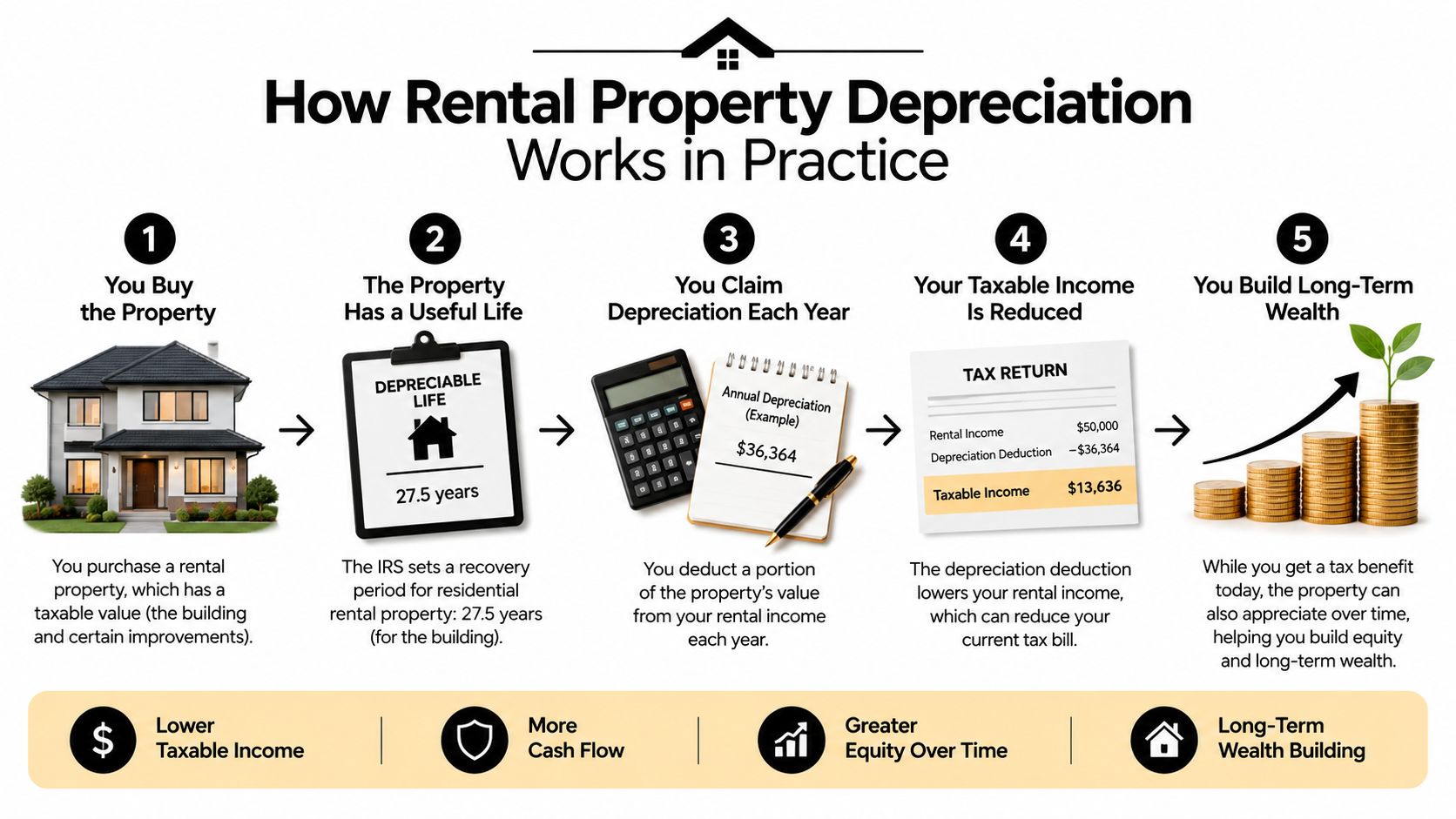
Depreciation is the tax system's way of spreading the cost of a qualifying rental building across its recovery period. For U.S. residential rental property, the IRS generally uses MACRS, the straight-line method, and a 27.5-year recovery period. The period begins when the property is placed in service for income production, so the deduction is spread across 330 months, rather than claimed all at once, as explained in IRS Publication 946.
That schedule applies to the depreciable building basis, not automatically to every dollar on the closing statement. The first job is separating the property into the parts that can and can't be depreciated.
Start with the right basis
The purchase price is not the same as the depreciable basis of the building. Land generally isn't depreciated, while the residential structure is. Improvements and certain separately identifiable assets may require their own treatment, so copying the settlement statement into a tax return is not a substitute for building a proper depreciation schedule.
Use this sequence:
- Identify the total acquisition cost. Preserve the closing statement, invoices, and other documents that establish what you paid.
- Separate land from the building. The land allocation reduces the amount assigned to the residential structure.
- Record the placed-in-service date. This is the point when the property is ready and available for income production, not just the date you first became interested in it.
- Track improvements separately. A roof replacement, appliance, or renovation shouldn't disappear into an unlabelled maintenance category.
- Reconcile the schedule annually. Compare the tax depreciation record with the property ledger and prior return.
The arithmetic can look deceptively simple. Dividing a building's depreciable basis by 27.5 produces a rough annual figure, but actual returns can reflect the applicable conventions and the date the property entered service. That's why a clean basis allocation matters more than a back-of-the-envelope estimate.
Here's a visual walkthrough of the process:
A short explanation can also help owners see how basis, timing, and taxable income connect:
For owners comparing documentation methods, this practical guide on how to claim with Everglow Prosperity provides another explanation of the building-versus-land distinction. The useful lesson is consistent: depreciation lowers the property's remaining tax basis over time, even though it doesn't reduce the owner's current bank balance.
Passive Activity Loss Rules and Why They Matter
The central mistake is calling the issue a depreciation cap. There isn't an income limit that stops the depreciation schedule itself. The question is whether the rental loss, after depreciation and other deductions, can offset income from outside the rental activity.
Rental real estate generally sits inside the passive activity system. Passive losses usually stay within the passive activity category unless an exception applies. An owner may have a genuine economic loss, a correctly calculated depreciation deduction, and still lack permission to use that loss against wages or other nonpassive earnings in the current year.
Active participation changes the outcome, but only within limits
Active participation provides a limited exception for eligible rental owners. It's a management standard, not a declaration that the entire rental business has become nonpassive. A landlord may participate in decisions about tenants, leases, repairs, or property management and still face the income-based ceiling on losses used against nonpassive income.
The IRS guidance for individual landlords in Publication 527 explains the important distinction: the limit applies to rental real estate loss, which may include a loss created or enlarged by depreciation. It doesn't turn depreciation into a separate deduction category with its own unrestricted access to wages.
The useful question isn't “How much depreciation did I claim?” It's “How much of my total rental loss can I use against this year's nonpassive income?”
That framing prevents two common errors. First, an owner may assume that a larger depreciation deduction always produces a larger current-year tax benefit. Second, an owner may see a rental loss on the tax return and assume it was fully applied against salary income when the passive loss limitation restricted the result.
What to check before filing
Review the property activity as a whole rather than looking only at the building schedule. The relevant calculation may include rental income, deductible operating costs, interest, and depreciation. Then check participation and modified adjusted gross income before deciding how much of the loss is currently usable.
A landlord who uses a property manager isn't automatically disqualified from active participation, but hands-off ownership requires careful review of the actual facts. Keep evidence of meaningful management decisions, not just a vague assertion that you own the property.
Landlords who want a deeper operational explanation can review passive activity loss rules. The practical takeaway remains straightforward: depreciation can create the loss, but passive activity rules decide where that loss can go.
The $25,000 Active Participation Allowance and Income Phaseout
A rental can show a deductible loss on paper while your salary still carries the household tax bill. The special allowance determines how much of that rental loss an actively participating taxpayer may apply against nonpassive income. It starts at $25,000, then falls by 50% of modified adjusted gross income above $100,000 and reaches zero at $150,000, as noted earlier.
For married individuals filing separately, the maximum is $12,500, with a phaseout range from $50,000 to $75,000 of modified adjusted gross income. These limits affect the current use of rental losses against nonpassive income. They do not shorten the property's depreciation schedule or change the amount recorded there.
Run the phaseout calculation carefully
Suppose a single landlord actively participates in a rental and has $120,000 of modified adjusted gross income. The excess over $100,000 is $20,000. Half is $10,000, reducing the potential allowance from $25,000 to $15,000.
At $135,000 of modified adjusted gross income, the excess is $35,000. Half is $17,500, leaving a potential allowance of $7,500. That second calculation is useful because it shows how quickly the benefit contracts before reaching $150,000, where no special allowance remains against nonpassive income.

| Modified adjusted gross income | Potential special allowance |
|---|---|
| At or below $100,000 for an eligible taxpayer | Up to $25,000 |
| At $135,000 | $7,500 after the phaseout calculation |
| At or above $150,000 | No special allowance against nonpassive income |
| Married filing separately | Maximum of $12,500, with a $50,000 to $75,000 phaseout range |
The calculation is only useful if the underlying records support active participation. A landlord may approve rental terms, review applicants, select contractors, or make other meaningful management decisions without personally replacing every water heater. A property manager also does not automatically settle the question. Keep emails, approvals, invoices, meeting notes, and other evidence showing what decisions you made and when.
Record the rental activity as a whole. Combine rental income with operating costs, interest, and depreciation before deciding whether there is a loss and how much may fit within the allowance. The allowance covers rental real estate loss, not investment interest, unrelated business income, or every expense connected with owning property.
A tax loss can be real, correctly calculated, and still unavailable against your salary this year.
Before buying a property for its projected tax benefit, compare its expected rental performance with the possible tax treatment. A discussion of net rental yield tax impact provides useful context, but your modified adjusted gross income, participation facts, and records determine the result.
Real Estate Professional Status versus Active Participation
Landlords often use “active,” “material,” and “professional” as if they describe the same level of involvement. They don't. Active participation can support the limited rental loss allowance, while real estate professional status is a separate route that may change how rental activities are classified when the applicable participation requirements are also met.
Most small landlords should begin with the modest question: do I qualify for the limited allowance? They shouldn't jump straight to claiming professional status because they answer tenant messages after work or coordinate repairs on weekends.
Two different decisions
Active participation is comparatively practical for an owner who makes meaningful management decisions but retains a job or another primary business. It can provide access to the special allowance, subject to the income phaseout. The rental remains subject to the broader passive activity framework.
Real estate professional status requires a substantially stronger factual record. The owner must satisfy the applicable real estate service and participation requirements, and the activities must be supported by credible records. Merely owning several rentals, spending money on contractors, or calling yourself a property manager doesn't establish the status.
| Question | Active participation | Real estate professional status |
|---|---|---|
| What does it address? | Limited access to rental loss deductions | Potential nonpassive treatment when all requirements are met |
| Who commonly considers it? | Working landlords and small owners | Owners whose working time is substantially tied to real property activities |
| What records matter? | Management decisions and ownership facts | Detailed time, activity, ownership, and participation records |
| What is the main risk? | Assuming the full allowance survives the income phaseout | Claiming a status that the facts and records don't support |
The trade-off is clear. Professional status may offer more flexibility for qualifying taxpayers, but it creates a heavier compliance burden and more room for challenge. A landlord who can't reconstruct the year's activities should be cautious about taking the position.
The comparison in real estate professional status and larger tax deductions is useful for separating the two concepts. Keep the decision grounded in actual work performed and contemporaneous records, not in the size of the depreciation deduction.
Suspended Losses and Depreciation Recapture Explained
A rental loss that can't be used currently isn't automatically worthless. The passive activity rules can defer the loss, which means the owner must track it rather than dropping it from the records. That's where many landlords fail. They preserve invoices for the property but lose the tax history that explains why an amount was not deductible in the original year.
Suspended losses may become useful when the taxpayer has passive income or when the rental activity is disposed of in a transaction that releases the applicable losses. The precise outcome depends on the activity, ownership structure, and form of disposition, so a spreadsheet labelled “old rental losses” is not enough.
The sale can change the timing
A landlord may spend years seeing a rental loss on paper while receiving no current-year deduction against wages. Later, the property is sold, and the tax return must account for both the accumulated passive losses and the property's adjusted basis. The losses and basis are connected to the property's tax history, not merely to the owner's memory of the original purchase.
That makes the rental property depreciation income limit a timing issue as much as a current deduction issue. A tax benefit postponed is different from a tax benefit lost, but the owner needs accurate records to prove which one applies.
Depreciation can create a later tax obligation
Depreciation also changes the property's adjusted basis. When the property is sold, previously claimed depreciation can contribute to a tax liability commonly described as depreciation recapture. The tax treatment at sale isn't just “sale price minus what I paid,” because prior depreciation affects the calculation.
Depreciation is a long-game deduction. It can reduce taxable income today while increasing the importance of basis records tomorrow.
This doesn't mean an owner should refuse depreciation. Failing to claim allowable depreciation generally doesn't erase the basis adjustment that tax rules require. It means the owner should model the whole holding period, preserve every depreciation schedule, and discuss a planned sale with a tax professional before signing documents.
How to Track Depreciation Correctly on Schedule E and Form 8582
Good tax results start with a boring file that survives scrutiny. For each property, keep the closing statement, land and building allocation, placed-in-service date, improvement invoices, depreciation schedules, prior returns, and records showing how passive losses were treated. If the property changes ownership or use, preserve the documents that explain the change.
Depreciation generally flows through the rental reporting process and contributes to the result reported on Schedule E. When passive activity limitations apply, Form 8582 helps determine how much loss is allowed and how much is suspended. The forms don't repair missing records, so the schedule should be built before filing rather than reconstructed years later.
A workable landlord checklist
- Create a property file: Store acquisition documents, allocation support, and the original basis calculation together.
- Mark the service date: Record when the property became available for income production.
- Separate land: Don't include land in the depreciable building basis.
- Label improvements: Track major work separately from ordinary repairs and recurring maintenance.
- Reconcile annually: Compare the depreciation schedule with the return and the property ledger.
- Track suspended losses: Carry forward the amounts and the activity they belong to.
- Document management: Keep decisions, approvals, vendor communications, and other evidence relevant to participation.
- Review before sale: Recalculate adjusted basis and identify potential depreciation-related tax consequences.
The Schedule E instructions can serve as a practical reference while you organize the reporting workflow. A rental accounting system can also keep income, expenses, maintenance, and property records in one ledger, but automation doesn't remove the need to verify land allocations, placed-in-service dates, and improvement classifications.
VerticalRent records rental income and expenses in a ledger and can produce IRS Schedule E reports, giving independent landlords a more consistent starting point for reviewing their tax information. Use the output as organized documentation for your tax professional, not as a substitute for tax advice.
If your depreciation loss is affecting this year's return, start by organizing the basis, building allocation, placed-in-service date, and suspended-loss history before you file. Visit VerticalRent to manage rental income and expenses in one ledger and keep the records behind your Schedule E reporting easier to review.
Put this into practice
VerticalRent tools related to this guide
Legal Disclaimer
VerticalRent and its authors are not attorneys, CPAs, or licensed legal or financial advisors, and nothing on this site constitutes legal, tax, or professional advice. The information in this article is provided for general educational purposes only. Landlord-tenant laws, eviction procedures, security deposit rules, and tax regulations vary significantly by state, county, and municipality — and change frequently. Nothing on this site creates an attorney-client relationship. Always consult a licensed attorney or qualified professional in your jurisdiction before taking any action based on information you read here.
Co-founded VerticalRent in 2011, growing it from nothing to 100k landlords and renters. Sold it in 2019, then re-acquired it in 2026 to make it better than ever.


