What Is a FCRA Background Check: The Landlord's Guide
Learn what is a fcra background check, how landlords use it for tenant screening, and your rights under the Fair Credit Reporting Act.


An FCRA background check is a regulated tenant screening report produced by a consumer reporting agency, covering credit history, criminal records, evictions, and rental history, used by landlords with permissible purpose and subject to strict disclosure and dispute rules. Most negative information generally has a seven-year reporting window, while bankruptcies can remain for 10 years.
You've reviewed five rental applications, and several candidates look financially stable on paper. Before choosing one, you want to verify rental history, public records, and other information without treating an online search as a complete answer or violating an applicant's rights.
That's where the Fair Credit Reporting Act comes in. The law became effective on April 25, 1971, and it established a framework for how consumer reports are collected, shared, reviewed, corrected, and used in decisions about housing, employment, credit, and insurance. Federal guidance on the Fair Credit Reporting Act explains that tenant screening services fall within this regulated system.
For a landlord, compliance isn't one form you sign before ordering a report. It's a connected process: establish a permissible purpose, certify the intended use to the screening company, review accurate and relevant information, provide the right notice after an unfavorable decision, and respond properly if the applicant disputes the result.
The Tenant Screening Scenario
A landlord has an applicant who meets the stated income and rental criteria, but the application doesn't answer every practical question. Has the applicant paid housing obligations consistently? Does a public record belong to this person? Is an eviction entry current, complete, and correctly matched?
An FCRA background check is a consumer report prepared by a consumer reporting agency for a housing decision. It may include credit-related information, payment patterns, public records, criminal records, eviction information, and rental history, depending on the provider and the lawful scope of the request. It is not just a criminal-record search copied from a public database.

The distinction matters because the FCRA regulates the entire decision workflow, not just the information that appears on the screen. A landlord must have a legally permitted reason to obtain the report, and the screening company must provide it only to someone with that valid purpose.
The landlord's compliance map
Think of the process in four stages:
- Screening setup: Explain the screening process and obtain the applicant's authorization through the provider's workflow.
- Permissible purpose: Confirm that the report is being requested to evaluate a rental application or lease renewal.
- Decision: Review the report carefully instead of treating every entry as automatically disqualifying.
- Post-decision response: If the report contributes to a denial or less favorable rental term, send the required adverse action notice and preserve a clear record.
Renters also face related decisions about protecting their belongings and personal liability. For broader move-in planning, Mai & Associates offers this resource on how much is renters insurance California, which can help applicants and landlords distinguish insurance questions from screening questions.
How FCRA Background Checks Work
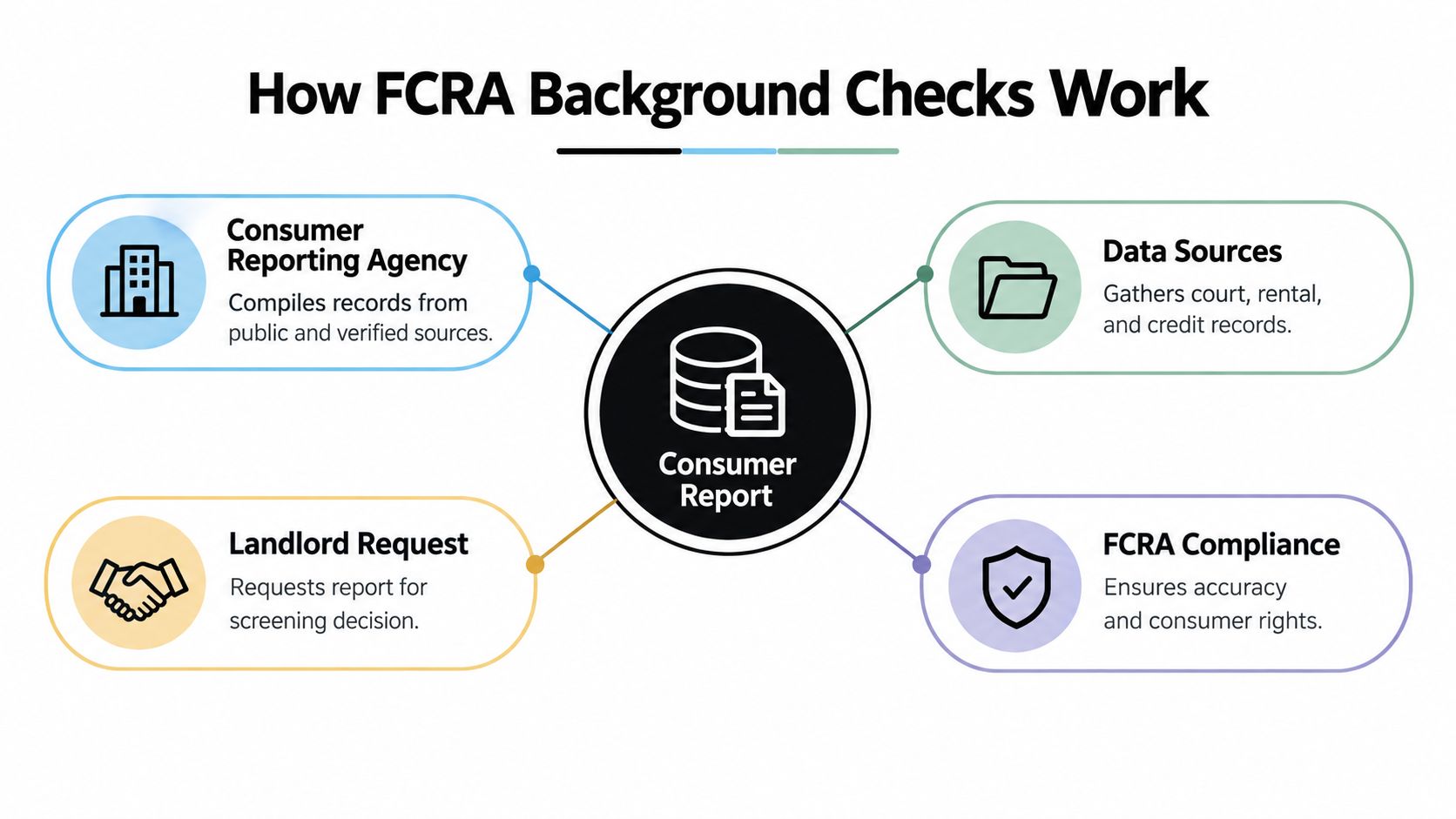
The central legal concept is the consumer report. A consumer reporting agency gathers information from sources such as credit reporting systems, court records, and rental-history databases, then organizes it for a permitted housing purpose. The landlord receives a report, but the agency remains responsible for taking reasonable steps to maintain accuracy.
A useful mental model is to separate the report into four connected layers:
- Identity and matching: Information used to connect records to the correct applicant.
- Financial information: Credit history and payment patterns, where the provider's lawful report includes them.
- Housing and public records: Rental history, evictions, arrests, judgments, and bankruptcies may appear depending on the source and reporting rules.
- Compliance controls: Permissible purpose, accuracy procedures, access rights, adverse action obligations, and dispute handling surround the data.
Freshness depends on the record type
Federal reporting rules don't treat every negative item identically. The Federal Trade Commission's FCRA summary states that many forms of negative information generally can't be reported after seven years, while bankruptcies can remain for 10 years. Criminal convictions don't have that same federal seven-year limit, although other applicable laws may impose additional restrictions.
That difference creates an important landlord obligation. An old civil record and a conviction aren't interchangeable, and an entry that appears in a report still needs to be matched to the correct person and understood in context. A stale or misidentified record can lead to a wrongful denial.
For a practical discussion of screening reports and how applicants may encounter problematic records, RentReboot's screening report guide provides additional context. Landlords should also make sure the applicant has authorized the screening before the report is ordered, using a dedicated process such as this tenant background check authorization form.
Permissible Purpose and Landlord Certification
A landlord can't request a consumer report merely because an applicant is curious, because a neighbor asks for information, or because the landlord wants to investigate someone without a real housing decision in view. The FCRA requires a permissible purpose, which means the request must fit a legally recognized use.
For tenant screening, that purpose commonly includes evaluating a person who has applied to rent a property or deciding whether to renew an existing lease. The landlord must certify to the reporting company that the report will be used only for that housing-related purpose. This certification gives the screening provider a documented reason to release sensitive consumer information.
Examples of proper purpose
Suppose Jordan submits an application for an available apartment. The landlord may request a report to evaluate Jordan's application, provided the screening workflow includes the required authorization and certification.
Now suppose Jordan already occupies the unit and the lease is approaching renewal. A report requested as part of a genuine lease-renewal decision may also fit the housing purpose. The landlord should document the property, applicant or resident, date, and reason for the request.
A prospective roommate presents a more nuanced situation. If the roommate will become an applicant, co-tenant, or responsible party under the lease, the landlord may have a housing-screening purpose. If the person is only visiting or informally sharing space without becoming part of the rental decision, the landlord shouldn't assume that a consumer report is permissible.
Practical rule: Before ordering a report, write down whose housing eligibility is being evaluated, for which property, and why the decision is being made.
The certification isn't a formality to click through without thought. It connects the landlord's request to the applicant's protected information and helps prevent reports from being used for unrelated investigations, personal curiosity, or informal tenant blacklists.
Adverse Action Notice Requirements
An adverse action occurs when a landlord takes an unfavorable step based partly or entirely on a tenant screening report. That can mean denying the application, increasing the rent or deposit, requiring a co-signer, or imposing another less favorable rental condition.
The FTC's landlord guidance requires the landlord to provide an adverse action notice in those circumstances. The duty applies even when the report is only one factor among several, not the sole reason for the decision.
Build the notice around the decision
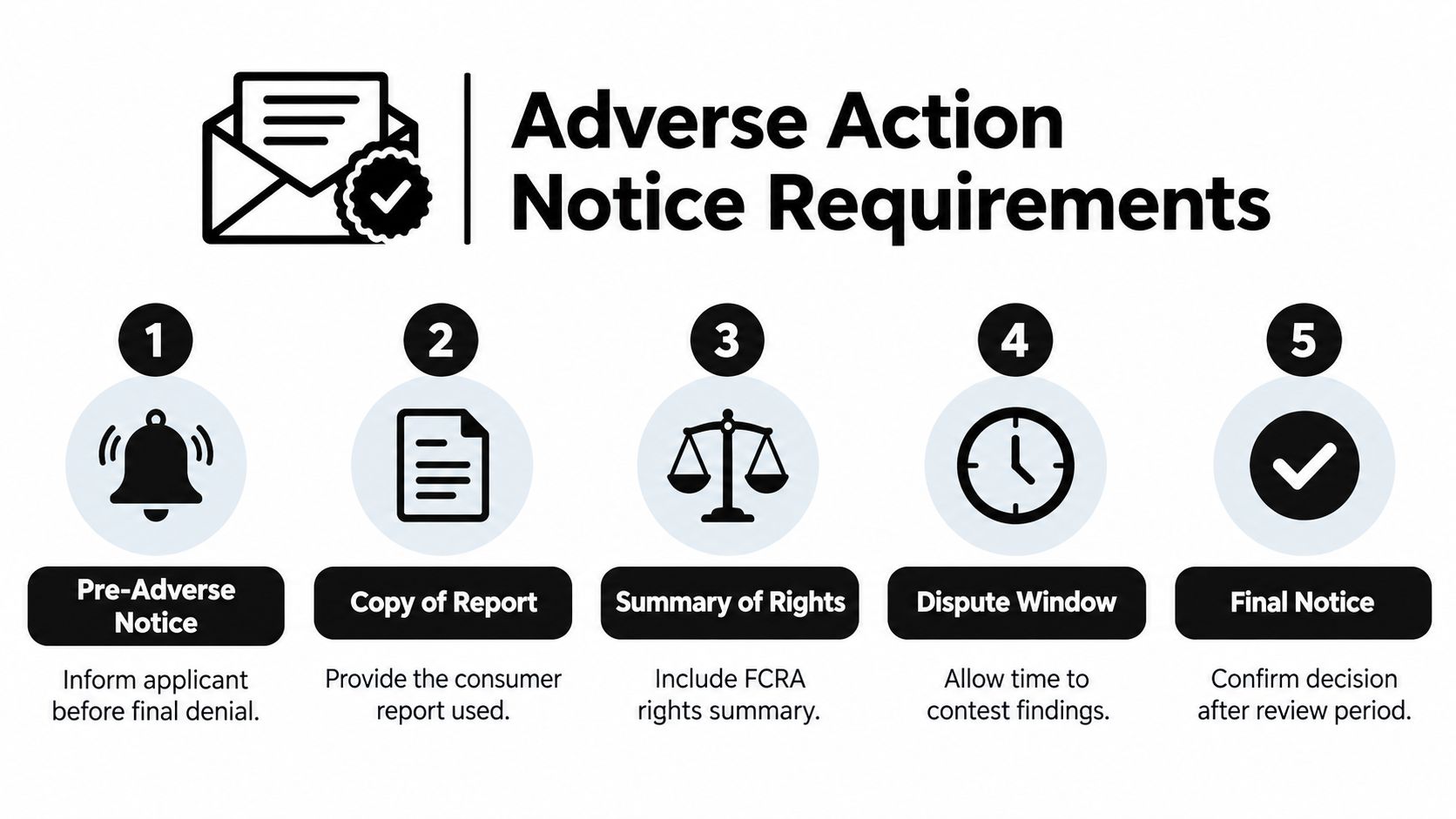
A clear workflow separates the initial concern from the final decision. Before finalizing an unfavorable outcome, give the applicant a meaningful opportunity to review the information and raise an error. If the landlord proceeds, the final notice should identify the screening company and explain the applicant's rights.
Use this checklist:
- Identify the reporting company: Give the company's name and contact information.
- Explain the decision connection: State that the rental decision was based partly or entirely on information in the consumer report.
- Explain the dispute right: Tell the applicant they can dispute inaccurate information with the reporting company.
- Explain the copy request: Tell the applicant they can request a free copy of the report within 60 days.
- Describe the unfavorable term: Say whether the application was denied, the deposit or rent was increased, a co-signer was required, or another specific condition was imposed.
Use concrete language
A vague message such as “Your application didn't meet our standards” leaves the renter unsure whether the decision involved the report. A clearer structure would say:
We're taking an unfavorable action on your rental application based partly on information in a tenant screening report provided by [company name and contact information]. The reporting company didn't make the rental decision. You have the right to dispute inaccurate or incomplete information with the reporting company and to request a free copy of the report within 60 days.
Landlords should keep the report reviewed, the decision rationale, the notice, and delivery details together. For a reusable document workflow, this adverse action letter resource can help organize the notice process.
Tenant Dispute Rights and Landlord Responsibilities
A tenant may receive an adverse action notice and spot the problem at once. The report might attach another person's eviction to the application, preserve an outdated negative item, or leave out facts that change a record's meaning. A dispute can therefore affect the decision after screening, not just the tenant's understanding of the report.
A mismatched record works like the wrong label on a file. The tenant should identify the disputed entry, request the report from the consumer reporting agency, and provide information that supports the correction. The agency generally must complete its investigation within 30 days and provide written results within five days after the investigation is completed, as described in Federal Deposit Insurance Corporation guidance on FCRA dispute procedures.
A dispute in practice
Suppose a landlord declines an applicant because a screening report lists an eviction judgment. The applicant obtains the report and finds that the judgment belongs to someone with a similar name who lived in another county. That detail changes the issue from a negative housing record to a possible identity match error.
The landlord should treat the complaint as part of the compliance workflow, rather than dismissing it as a delay tactic. Record when the notice and dispute were received, retain the report used in the decision, and ask the applicant for correction information. Where the process permits, pause final reliance on the disputed entry while the reporting company investigates. The agency then sends written results after completing its review.
If a corrected report no longer supports the original decision, the landlord should reassess the application using the same criteria applied to other applicants. The landlord does not conduct the reporting company's investigation, but remains responsible for handling the screening result carefully.
Keep a defensible record
A useful file should show:
- The report the landlord reviewed.
- The information that affected the decision.
- The date the adverse action notice was delivered.
- The entry or entries the tenant disputed.
- What the reporting company confirmed or corrected.
- Whether the landlord reconsidered the application.
The purpose is fair, traceable decision-making. A tenant's dispute should not trigger retaliation, and a final housing decision should rest on relevant information that was matched correctly and reviewed through a documented process.
Screening Workflow Comparison
Manual screening can look simple at first. A landlord searches court websites, asks an applicant to explain prior housing, checks a credit report through a separate service, and records the result in a spreadsheet. The difficulty appears when those separate tasks don't preserve authorization, permissible-purpose certification, notice delivery, or dispute history in one place.
A compliant platform workflow treats screening as a connected record. It can capture electronic consent, route the request for the stated housing purpose, assemble available report categories, and preserve the steps taken after the result arrives. Automation doesn't remove the landlord's responsibility to make a lawful decision, but it can reduce the chance that a required step disappears in email.
| Feature | DIY Manual Screening | Compliant Platform Screening |
|---|---|---|
| Applicant authorization | Landlord may use disconnected forms or miss authorization before ordering | Consent is captured within the screening workflow |
| Permissible purpose | Certification may be stored separately or overlooked | The request is tied to the housing-screening purpose |
| Report review | Multiple databases and documents require manual matching | Credit, criminal, eviction, and rental information can be presented in one workflow |
| Adverse action | Landlord must draft, send, and document notices independently | The platform can generate the required notice when the decision calls for it |
| Dispute handling | Applicant emails, corrections, and follow-up may be scattered | Dispute-related actions and screening records can remain in an audit trail |
| Local requirements | Landlord must research applicable state and county rules | A platform may provide state- and county-specific compliance controls |
A landlord comparing providers should ask whether the system records consent, supports adverse action notices, maintains an audit log, and explains how it handles disputes. VerticalRent offers FCRA-compliant tenant screening with credit, criminal, eviction, and rental history data, electronic consent, adverse action notices, and a screening audit record.
Compliance as a Continuous Workflow
A landlord screening an applicant for an available apartment may start with a report request, then discover that compliance continues after the report arrives. The process must connect authorization, permissible purpose, review, decision-making, notice, and dispute handling. Treating screening as a single database search can leave gaps where applicant rights apply.
A repeatable workflow looks like this:
- Define the housing decision: Identify the property, applicant or resident, and reason for screening, such as a new application or lease renewal.
- Obtain authorization: Get clear written or electronic permission before requesting the report. Keep the authorization with the applicant's file.
- Certify permissible purpose: Confirm to the reporting company that the report will support a rental application or lease-renewal decision.
- Review the information carefully: Check identity matches, record type, recency, and relevance. An item appearing in a report does not make it accurate or connected to the applicant.
- Document the decision: Record which information affected the outcome and apply the same rental criteria consistently across comparable applications.
- Send the required notice: If the report contributes to an unfavorable decision, identify the reporting company and explain the applicant's rights to dispute the information and request a copy of the report.
- Respond to disputes: Preserve the original decision record, track the investigation, and reconsider the application if corrected information changes the decision's basis.
This sequence explains why FCRA compliance is a lifecycle rather than a one-time check. The Fair and Accurate Credit Transactions Act of 2003 expanded accuracy protections, identity-theft safeguards, and consumer access to free annual reports. The broader FCRA framework also involves reporting agencies, landlords and employers that use reports, and data furnishers that help investigate disputed information.
Consistency protects both sides
A defensible landlord does not need to approve every applicant. The landlord needs stated criteria, legally obtained information, consistent application of those criteria, and a meaningful way for renters to challenge errors. A current, verified record should be assessed differently from a stale, incomplete, or mismatched entry.
Clear records also improve communication. Applicants can understand what happened, landlords can explain the decision without vague language, and both parties can identify the information considered. A compliance platform for agencies can help teams coordinate screening, records, and other regulated real estate workflows. Smaller landlords may use a focused screening system supported by a documented checklist.
Use this FCRA compliance checklist for landlords before the next application. Confirm that authorization, purpose certification, report review, adverse action notices, and dispute records connect to the same applicant and property file.
VerticalRent supports tenant screening with electronic FCRA consent, credit, criminal, eviction, and rental history information, along with adverse action notices and an audit record. VerticalRent also organizes screening with leases, rent collection, and everyday rental management.
Put this into practice
VerticalRent tools related to this guide
Legal Disclaimer
VerticalRent and its authors are not attorneys, CPAs, or licensed legal or financial advisors, and nothing on this site constitutes legal, tax, or professional advice. The information in this article is provided for general educational purposes only. Landlord-tenant laws, eviction procedures, security deposit rules, and tax regulations vary significantly by state, county, and municipality — and change frequently. Nothing on this site creates an attorney-client relationship. Always consult a licensed attorney or qualified professional in your jurisdiction before taking any action based on information you read here.
Co-founded VerticalRent in 2011, growing it from nothing to 100k landlords and renters. Sold it in 2019, then re-acquired it in 2026 to make it better than ever.


