How to Check My Tenant Screening Report and Fix Errors
Learn how to check my tenant screening report step by step, read credit, criminal, and eviction data, dispute errors under the FCRA, and protect……


You apply for a rental, wait for the landlord's answer, and get a short message saying the application was denied. No explanation. Then another landlord says the same thing. By the third rejection, you're wondering whether the problem is your income, your credit, or something buried in a background check you've never seen.
Sometimes the cause is an eviction filing that was dismissed, a criminal record belonging to someone with a similar name, or a duplicate court entry that makes one case look like several. Learning how to check your tenant screening report gives you a chance to see the underlying data, challenge mistakes, and approach your next application with evidence instead of guesswork.
Why You Should See Your Tenant Screening Report Before a Landlord Does
A landlord can reject your application because of a report you have never seen. By the time you learn that an eviction entry, criminal record, or rental-history detail influenced the decision, the application may already be closed. Reviewing the report first gives you time to identify errors, gather records, and decide how to respond.
A tenant-screening report is generally a consumer report under the Fair Credit Reporting Act. A reporting company assembles information that may affect a housing decision, such as credit history, criminal records, eviction information, and rental history. The landlord makes the final decision, but the screening company supplies the information used to assess you.
That distinction creates a serious risk. A report may include a court filing without making its outcome clear, repeat one case as separate entries, or attach an address or record to the wrong applicant. You should not have to defend an inaccurate report after a landlord has already accepted it as fact.
Practical rule: Never treat a database hit as proof that the underlying event happened to you or ended badly.
A federal review of tenant-screening complaints, covered in detail in the section on identity-matching errors, found that most complaints concerned inaccurate information. Treat that finding as a reason to inspect your report before an application becomes a housing decision.
What proactive checking changes
Review the report while you still have time to act. Compare its identifying details with your own records, check whether each negative entry includes a clear outcome, and note anything that is incomplete, duplicated, or unfamiliar. Do not rely on a score or summary. Read the underlying entries and record the reporting company's source information.
The review also helps you prepare a factual explanation when information is accurate but lacks context. A dismissed filing, resolved balance, or old rental dispute may require supporting documents so a landlord can understand what happened.
Finish with an organized file containing the report, source details, court or rental records, and every written correction request. Keep copies of delivery confirmations and responses. That file gives you evidence if a landlord takes adverse action, a reporting company rejects your dispute, or the same error appears again.
Requesting Your Report and Knowing Your FCRA Rights
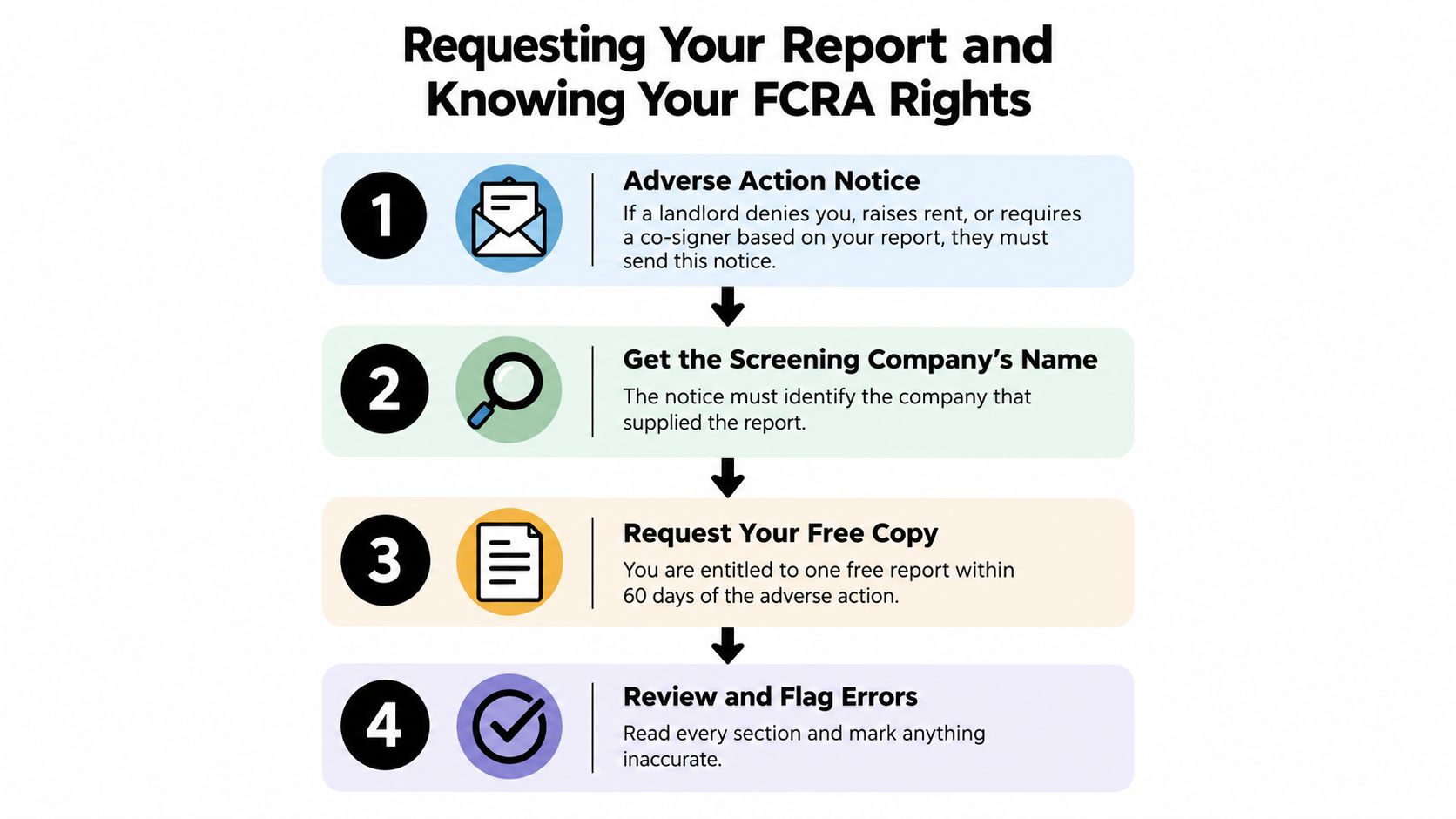
Start with the document that triggered the rental decision. If a landlord denies your application, raises your rent or deposit, requires a co-signer, or takes another unfavorable action partly because of a tenant-screening report, the landlord must provide an adverse-action notice identifying the reporting company. The notice should also explain that the reporting company didn't make the housing decision and describe your right to dispute incomplete or inaccurate information. The Federal Trade Commission's landlord guidance explains this obligation.
Follow the 60-day request window
Use this sequence:
- Ask for the adverse-action notice. If the landlord only sent a rejection message, request the formal notice in writing. Keep the message, application date, property address, and landlord's contact information.
- Identify the reporting company. The notice should name the company that supplied the consumer report. Contact that company directly, not just the landlord or a general credit-monitoring service.
- Request the complete report within 60 days. You can request a free copy from the reporting company when your request is made within 60 days of the adverse action. Ask for the complete file and source information, not merely a score or summary.
- Preserve the delivery trail. Save your request, identity-verification documents, confirmation number, email, letter, and the report you receive.
Don't settle for a score
A score can hide the reason for a decision. You need the names, dates of birth, addresses, case numbers, account details, reporting dates, and court outcomes that allow you to test whether each entry belongs to you and is legally described.
You can also look for a compliant consumer-reporting provider that allows you to review your own rental-screening information before applying. The report may not match the exact format a particular landlord uses, but it can expose identity or court-history problems early. For general background on what an FCRA background check is, use a source that distinguishes consumer-report access from a landlord's decision-making process.
Reading Each Part of Your Screening Report
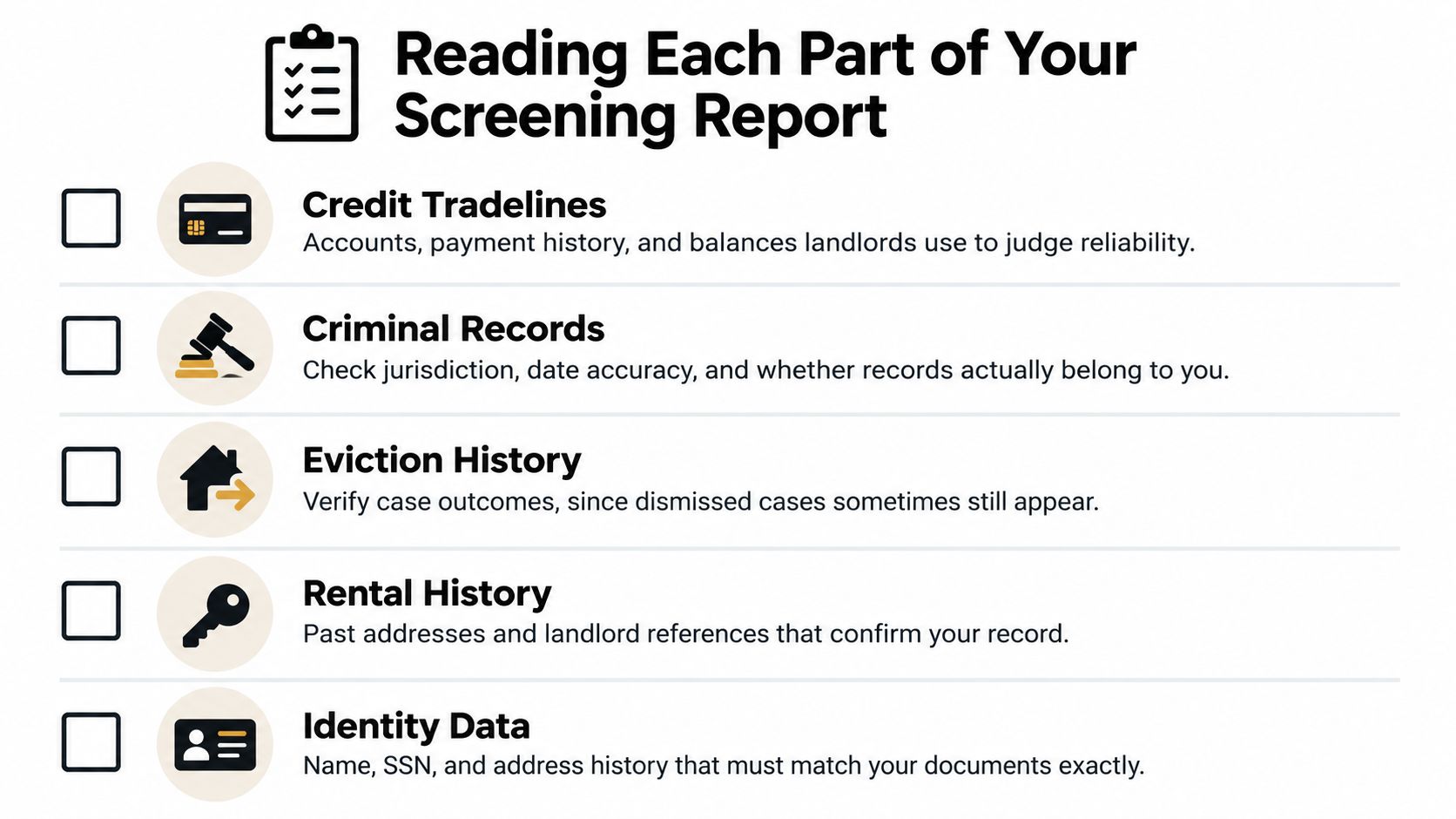
Read the report as a collection of separate evidence categories, not as one overall judgment. A tenant-screening file may combine credit, criminal, eviction, rental-history, and identity information. Each category needs a different comparison with your records.
Federal guidance emphasizes access to the underlying file and a meaningful dispute process, rather than only a score or summary, because screening databases may lack unique identifiers and risk assessments can depend heavily on whether a record belongs to the applicant. You can review practical information about how to read a credit report while working through the credit portion, but don't stop there.
Start with identity data
Check your full legal name, aliases, date of birth, current address, and prior addresses. Compare the information against your identification and personal records. An incorrect middle name or unfamiliar address doesn't automatically prove an error, but it deserves investigation before you accept any linked criminal or eviction entry.
Review credit tradelines
Look at each account, including open and closed tradelines, payment history, account status, balances, collections, and accounts you don't recognize. Confirm that a paid account isn't shown as unpaid and that a closed account isn't described as active. For a broader explanation of legal rights on credit checks, consult a consumer-focused resource, then use the actual report and account records as your evidence.
Separate filings from outcomes
An eviction section may show a case filing, a judgment, or both. Find the case number, filing date, court, parties, and final disposition. A dismissed filing isn't the same as an eviction judgment, and a record appearing in a report isn't proof that you were removed from a property or caused a monetary judgment.
Criminal records require the same discipline. Verify the jurisdiction, charge, case number, disposition, and reporting date. An arrest isn't a conviction, and a charge without a final outcome shouldn't be presented as one.
Check rental history and duplicates
Compare listed addresses with your leases, landlord contacts, and payment records. Look for one case repeated under different descriptions, because duplicate entries can make a single event appear more serious than it is.
Spotting Identity-Matching Errors in Criminal and Eviction Data
A tenant can lose an application because a screening database matched the wrong person to their name. Similar names, incomplete birth dates, and outdated addresses can attach someone else's criminal or eviction history to your file before anyone checks the court record. Treat identity matching as the highest-risk part of the report.
The GAO tenant-screening review recorded approximately 26,700 complaints submitted to the CFPB between January 2019 and September 2022, with about 17,200, roughly 64%, involving inaccurate information. Reported problems included wrong-person criminal records, sealed or expunged records, duplicate entries, missing dispositions, and eviction records that misstated the result.
If a landlord sends an adverse-action notice, use it immediately. Identify the screening company named in the notice and request your free report within the available 60-day window. That report gives you the version of the file that influenced the decision, not merely a generic copy.
Audit every field against the court record
Do not write “this isn't mine” and stop. Compare each disputed entry with the primary docket and check:
- Identity: Full name, aliases, date of birth, and prior addresses.
- Court details: State, county, court jurisdiction, case number, and parties.
- Event description: Charge, claim, filing date, and reporting date.
- Legal outcome: Dismissal, judgment, settlement, expungement, sealing, or another disposition.
- Duplicate status: Whether several lines describe the same case or filing.
A shared name does not prove that an entry belongs to you. A mismatch in date of birth, address history, parties, or jurisdiction is a concrete reason to investigate. An eviction filing shows that a case was brought. It does not by itself show that the landlord won. A criminal entry may describe an arrest or charge rather than a conviction.
| Error Pattern | What It Looks Like | Evidence to Attach |
|---|---|---|
| Wrong-person match | A criminal or eviction entry shares your name but not your identity details | Identification, date-of-birth proof, address history, and court records |
| Missing disposition | The report lists a filing or charge without showing how it ended | Court docket, dismissal order, judgment, or final disposition |
| Sealed or expunged record | The report includes information removed or restricted by a court | Sealing or expungement order and a current docket |
| Duplicate case | One matter appears under multiple case numbers, descriptions, or dates | Court docket showing the entries refer to the same matter |
| Mischaracterized eviction | A filing appears as a judgment, removal, or monetary award | Certified court disposition and payment records |
The most serious error is often inaccurate identity or case status, not the mere presence of a record. Correct those fields first. A wrong-person match or harsher-than-supported outcome can distort the entire application before a landlord reviews the facts.
Filing a Dispute and Tracking the 30-Day Investigation
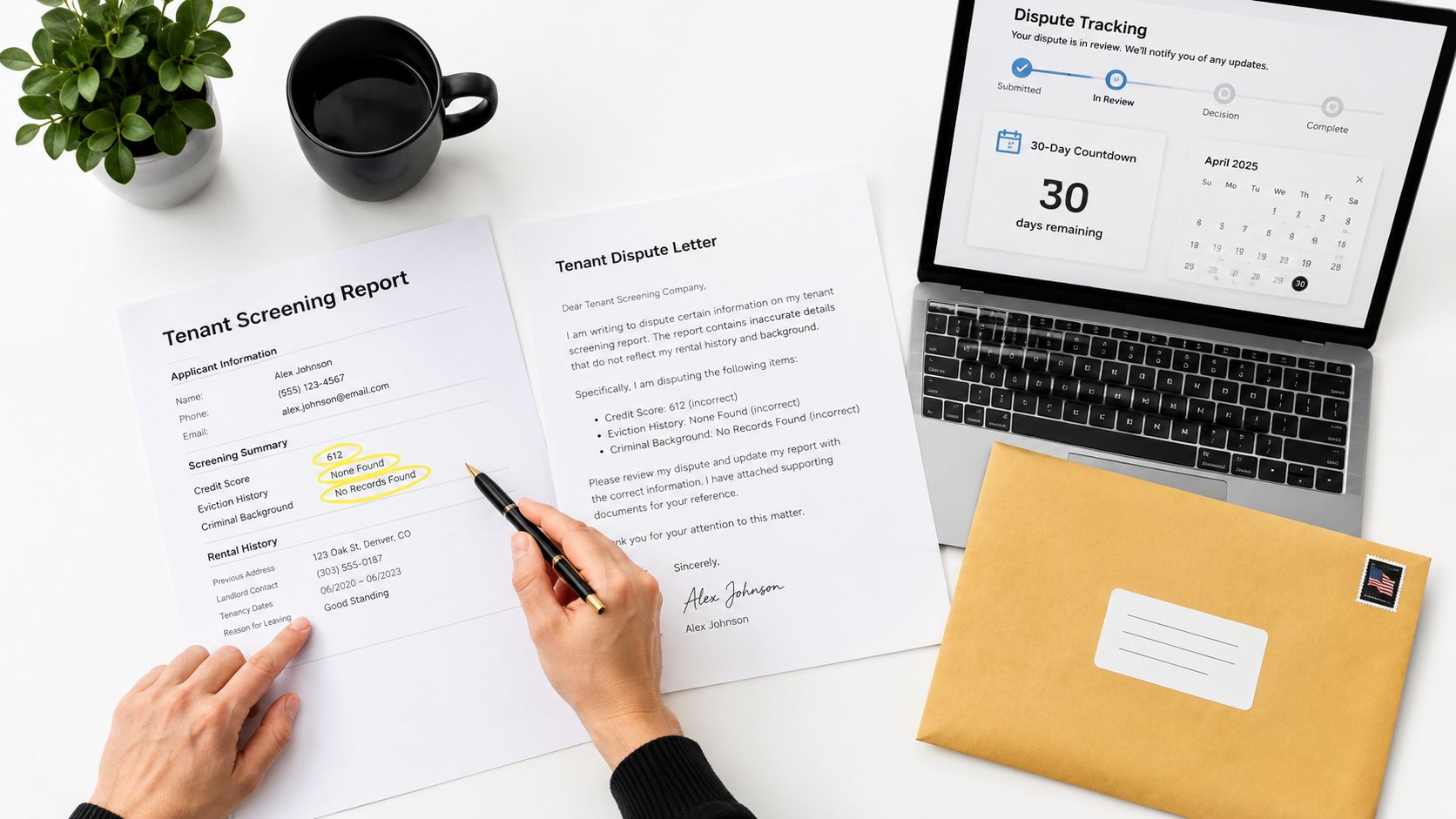
Send the dispute to the tenant-screening company that prepared the report. Identify each incorrect field separately, state exactly why it is inaccurate, and attach documents that let an investigator verify the correction without guessing.
Build an evidence-based dispute
Use a simple entry-by-entry format:
- Report entry: Identify the page, section, case number, account, or line.
- Specific error: State whether the entry belongs to another person, omits a dismissal, duplicates a case, or misstates an account status.
- Correct information: Explain what the court, creditor, or identity document shows.
- Supporting evidence: Attach the relevant disposition, dismissal order, expungement order, payment record, or identity document.
- Requested correction: Ask the company to delete, amend, or update the specific field and provide a revised report.
Adapt this language:
I dispute the eviction entry identified as [case number] on page [page]. The report describes the matter as [description], but the attached court disposition shows [accurate outcome]. Please investigate this specific entry, correct the report, and provide the revised file and investigation results.
A generic request to “remove all errors” is weak because it gives the company no clear audit trail. If you need help understanding the structure of a written challenge, this guide to understanding credit dispute forms offers useful context, although your tenant-screening dispute should address the exact rental-report fields at issue.
Track the investigation
Federal guidance states that screening companies must investigate a disputed error within 30 days, and the FTC's consumer guidance on tenant background checks explains that consumers don't need to pay a credit-repair company to initiate disputes.
Keep proof of submission, delivery confirmation, uploaded files, and every response. Separately tell the landlord that the report is disputed and provide a concise explanation if a housing decision is still pending.
If the company doesn't correct the entry, request reinvestigation and ask for the method and result of the investigation. Preserve the complete file for complaints to federal consumer-protection agencies or for legal review. Don't discard the first report after receiving a revised version, because the change itself may matter.
This short video provides another overview of the dispute process:
Where to Find State and County Records and What to Ask
The report is a secondary summary. The court docket is the primary source. If an entry concerns an eviction or criminal case, locate the relevant state or county court system and compare the report with the docket, case documents, and final disposition.
Search the official court website for the county and court named in the report. If the docket isn't available online, contact the clerk's office and ask how to obtain a case record or certified disposition. Request the document that resolves the question, such as a dismissal order, final judgment, expungement order, or payment record. Keep the case number and filing date in your notes so the screening company can trace the same matter.
Ask about reporting limits
Rules governing what may appear can vary by state and local law. Ask the court clerk, a consumer-protection office, or a qualified attorney what restrictions apply to sealed, expunged, dismissed, or older records. Don't assume that a record is reportable merely because you can find it in a database.
The complaint record reinforces why primary-source checking matters. Between January 2019 and September 2022, approximately 26,700 screening-related complaints were submitted to the CFPB, and about 17,200 concerned inaccurate information, including wrongly attributed and inaccurate arrest, criminal, or eviction records, as described in this Justice Department announcement about tenant-screening enforcement and complaints.
Use precise questions
Ask the landlord:
- Which company supplies your screening reports?
- Which categories do you review, and what criteria do you apply?
- If you take adverse action, will you provide the required notice and company details?
- Can I submit a court disposition or correction before you finalize the decision?
Ask the screening provider:
- What source supplied each disputed entry?
- Which identity fields were used to match the record?
- How do I submit a field-by-field dispute?
- When will you provide the investigation result and revised report?
A practical guide to checking for evictions can help you organize the court-record search, but your proof should come from the official docket or court documents whenever possible.
Landlords also benefit from directing applicants toward the report and dispute process. Clear source information reduces confusion, gives applicants a fair opportunity to correct mistakes, and creates a better record of how the housing decision was made.
Practical Tips for a Stronger Next Application
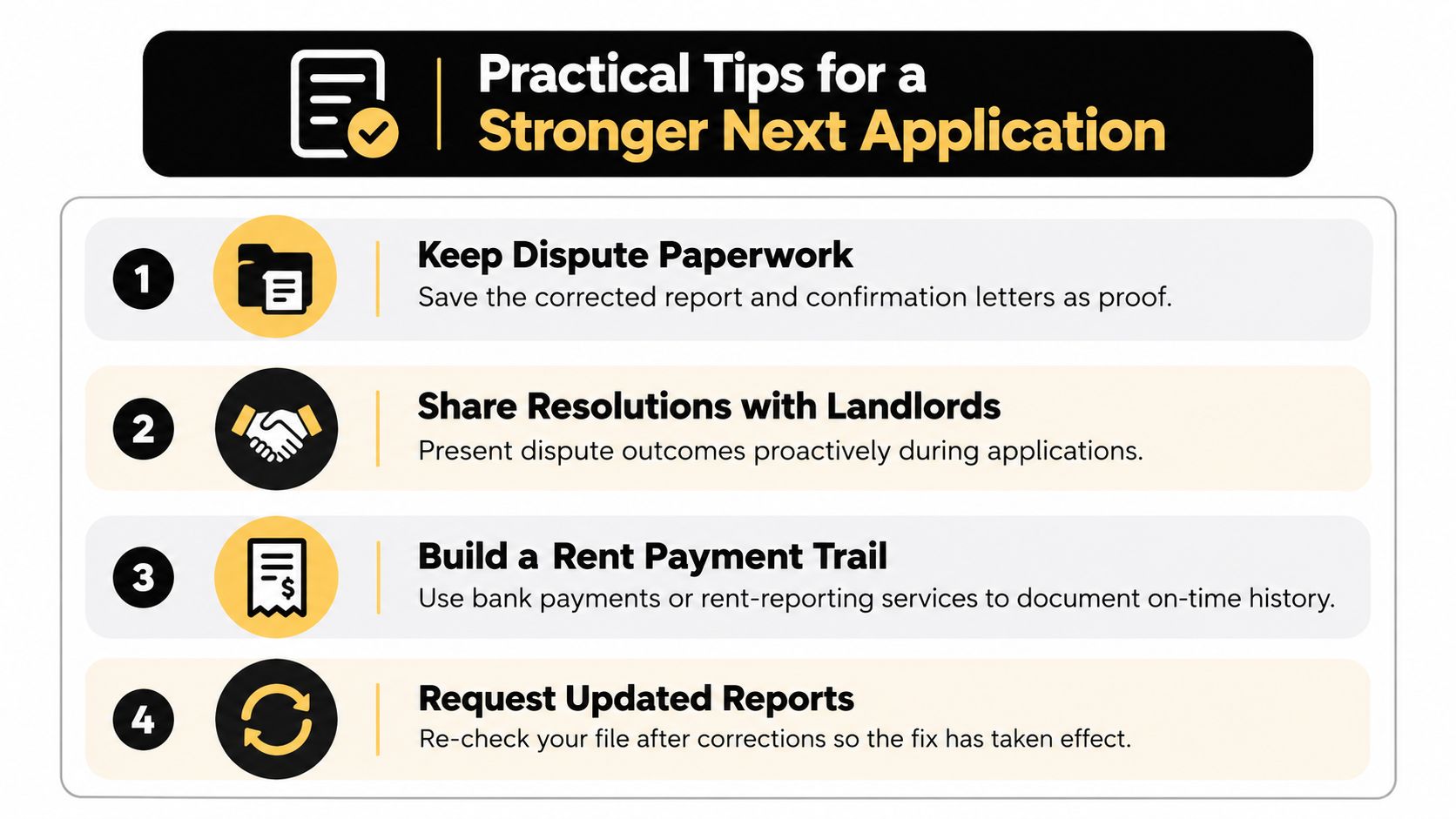
A corrected report is valuable only if you can prove that it was corrected. Save the original report, dispute letter, evidence, delivery confirmation, investigation response, and revised report in one folder. Name each file clearly so you can find the case number, date, and outcome during a fast-moving rental search.
If a negative entry is accurate, don't pretend it isn't there. Prepare a short explanation that states what happened, how the matter ended, and what has changed. Attach relevant payment records, a landlord reference, or the final court document when it supports your explanation. Honest context is more persuasive than hoping a landlord won't notice.
Keep an application file ready
Create a compact packet with:
- Corrected reports: Include the revised screening file and the company's response.
- Identity proof: Keep the documents that distinguish you from a person with a similar name.
- Rental evidence: Save leases, rent-payment records, move-out documentation, and landlord references.
- Explanation letter: Use a factual summary for any accurate negative history that needs context.
- Dispute timeline: Record the notice date, report request, dispute submission, response, and reinvestigation.
A consistent paper trail also helps landlords and property managers organize applicant records and boost real estate productivity without relying on scattered email attachments. If a landlord uses a rental platform, ask whether applicants can review or provide screening information through that platform, while remembering that the landlord may still order a separate report.
Use this final checklist
- Request the adverse-action notice.
- Identify the reporting company.
- Request the free report within 60 days, as described in the earlier FCRA guidance.
- Review identity, credit, criminal, eviction, and rental-history fields.
- Compare every questionable entry with primary documents.
- Dispute each error separately with supporting evidence.
- Track the 30-day investigation period.
- Save the revised report and all correspondence.
- Give future landlords concise context when accurate negative history remains.
Checking a tenant-screening report isn't asking for special treatment. It's using a consumer right to see the information that may influence your housing options, challenge inaccurate data, and present the facts clearly.
VerticalRent gives landlords and applicants a structured way to handle rental screening information, including credit, criminal, eviction, and rental-history reports, while keeping application records organized. Visit VerticalRent to review its rental-management and screening tools before your next application or leasing decision.
Put this into practice
VerticalRent tools related to this guide
Legal Disclaimer
VerticalRent and its authors are not attorneys, CPAs, or licensed legal or financial advisors, and nothing on this site constitutes legal, tax, or professional advice. The information in this article is provided for general educational purposes only. Landlord-tenant laws, eviction procedures, security deposit rules, and tax regulations vary significantly by state, county, and municipality — and change frequently. Nothing on this site creates an attorney-client relationship. Always consult a licensed attorney or qualified professional in your jurisdiction before taking any action based on information you read here.
Co-founded VerticalRent in 2011, growing it from nothing to 100k landlords and renters. Sold it in 2019, then re-acquired it in 2026 to make it better than ever.


