Tenant Background Check Without Social Security Number
Run a tenant background check without social security number using layered identity matching, ITINs, and FCRA-compliant workflows that protect every applicant……


An application arrives on a Tuesday night from a married couple. Both applicants have income, solid rental references, and a complete address history. The only problem is an empty Social Security number field. Your credit portal won't start, the eviction search produces almost nothing, and the paper documents on your desk don't line up neatly with the digital screening workflow.
That moment isn't a screening verdict. It's a workflow fork. A tenant background check without a Social Security number can still be careful and defensible, but you have to rebuild the identity-matching layer before relying on credit, eviction, or criminal data. The practical sequence is simple: resolve the applicant's identity first, then run each search with clear matching controls and treat missing data as missing data, not as a negative result.
When the SSN Box Stays Empty
A missing SSN creates a small cascade of failures. The credit vendor may reject the application, an eviction database may return a nearly blank profile, and a name search may produce several possible records without enough information to know which one belongs to the applicant. A landlord who treats those separate failures as one failed screening can reject a qualified renter or, worse, attach someone else's record to the application.
The first move is to stop asking, “Can I run the usual report?” Ask instead, “What identity information would let me match the right person across each source?” That change matters because credit, eviction, civil, and criminal systems don't necessarily share the same records or matching rules. An SSN often acts as a convenient connector, but it isn't the only way to establish identity.
HUD describes SSN use as part of a broader identity-validation process involving a person's name and date of birth. HUD also recognizes people who haven't been assigned an SSN, including certain noncitizens who don't claim eligible immigration status. That distinction supports a practical landlord rule: no SSN doesn't mean no identity, no income, or no rental history. See the SSN verification guidance for renters for additional context on why the number should be treated as one screening input rather than an automatic eligibility requirement.
Practical rule: Never convert a failed SSN-based lookup into an automatic denial. Convert it into a documented alternate path.
Start by separating the questions your screening process normally collapses into one report:
- Identity: Is the applicant the person named on the application?
- Income: Can the applicant's current resources be verified?
- Credit: Is there an accessible credit file, and what does it show?
- Rental history: Can prior housing performance be confirmed?
- Public records: Do court or criminal records match the applicant through more than a name?
Once those questions are separated, the empty SSN field becomes manageable. You aren't lowering the standard. You're replacing an unreliable shortcut with multiple checks that a reviewer can explain later.
What an SSN Actually Does in Screening
An SSN carries out several different functions inside a conventional screening stack. Treating it as one magical key makes it difficult to design a fair alternative. Treating it as a set of functions gives you a workable process.
First, it helps a consumer-reporting agency distinguish one person from another when names are similar. Second, it can connect information across systems that hold credit, eviction, civil, or criminal records. Third, it can help locate a file when an applicant has limited visible history. Finally, it gives a vendor a familiar identifier for documenting the permissible purpose and authorization behind a consumer report.
Those functions are separate. A passport or government-issued ID can support identity resolution. A documented date of birth and address history can help distinguish similar names. Direct employer and landlord verification can address income and rental performance when a credit file is thin or unavailable. None of these alternatives should be treated as a guaranteed substitute for an SSN, but they can fill specific gaps.
HUD's housing guidance is useful because it separates administrative identity verification from the broader question of housing eligibility. Public housing rules can require SSN documentation or a certification that a household member has no SSN, while also recognizing exceptions for people who aren't eligible for one. That program-specific treatment is why landlords shouldn't turn a public-program rule into a universal private-rental requirement. The HUD Public Housing Occupancy Guidebook also identifies alternative documents such as taxpayer-identification records, passports, government-issued licenses, and employment authorization cards in relevant screening contexts.
| SSN Function | What It Does | No-SSN Alternative |
|---|---|---|
| Person matching | Helps distinguish the applicant from people with similar names | Full legal name, date of birth, address history, and government-issued identification |
| Cross-system linking | Connects a person to records held by different screening sources | Use the same verified identity tuple for each search, then corroborate matches |
| File discovery | Helps locate a credit or consumer file | Submit permitted alternative identifiers where the provider accepts them, or document that no file was accessible |
| Screening documentation | Supports an authorized consumer-reporting workflow | Obtain written authorization, identify the sources used, and record the matching method |
An Individual Taxpayer Identification Number, or ITIN, can be a useful supporting identifier where applicable. It isn't proof of lawful presence, and it isn't automatically accepted by every screening provider. Use it for the function it can support, while keeping immigration status separate from legitimate rental qualification.
Building Identity Without a Social Security Number
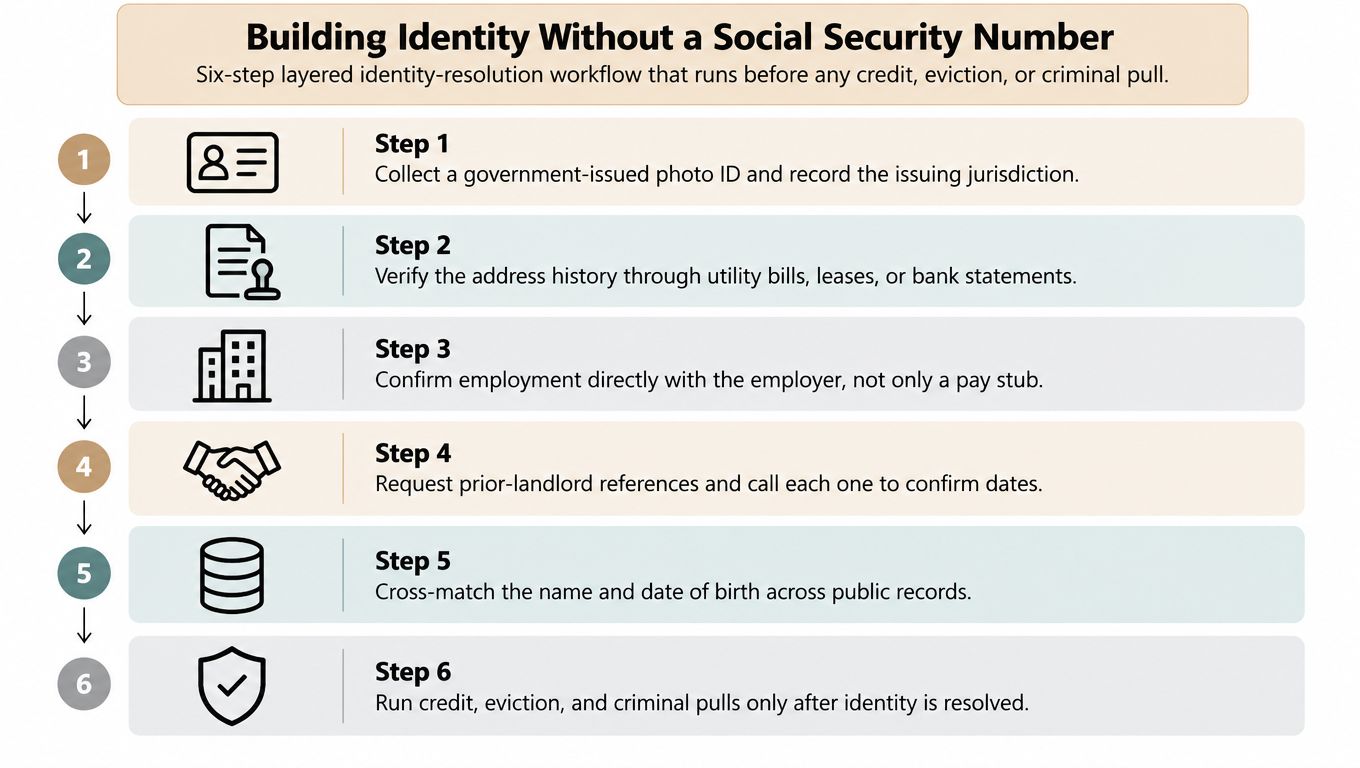
The identity workflow should happen before you pull records. If you search first and resolve later, you risk spending time interpreting records that may belong to someone else.
Start with a documented identity packet
Ask every applicant for the same core information, not just applicants who lack an SSN. Record the applicant's full legal name, any previously used names disclosed on the application, date of birth, current address, and prior addresses. Collect a government-issued photo ID where your policy and local law permit it, and record the issuing jurisdiction, document number, and expiration rather than relying on a visual glance at the document.
The address history becomes especially valuable when the SSN is unavailable. A name and date of birth may produce multiple candidates. A name, date of birth, current address, and prior address pattern gives each source more context for separating those candidates.
Resolve ambiguity before ordering reports
Use additional supporting records only when they serve a defined purpose. An ITIN document may support tax-identity information. A utility statement, lease, or bank statement may help corroborate a name and address. An employment authorization card, passport, driver's license, or other official record may support identity, but it shouldn't automatically expand your inquiry into immigration status.
Don't accept a single fuzzy match as proof. The CFPB states that name-only matching doesn't satisfy the FCRA's reasonable-procedure standard for maximum possible accuracy. Its tenant-screening review describes the need for additional identifiers such as address or date of birth. A defensible internal rule is to require agreement from at least two independent identifiers before associating a record, then send any ambiguous cluster to manual review.
Lock the result and preserve the reasoning
Once you've resolved the identity, save the matching decision with the application. Record which identifiers were supplied, which sources were searched, when the search occurred, and why a record was accepted, rejected, or left unverified. A landlord should be able to explain the decision without reconstructing it from old emails and downloaded files.
If an applicant submits sensitive documents through an email attachment, move the process into a controlled intake channel and limit access. Tools that support invisible fraud detection for browsers can be considered as part of a broader identity workflow, but no tool removes the need for consistent criteria and human review.
For bank records, use a purpose-limited request rather than asking for an entire financial history. The bank statement verification guidance can help frame what the document is meant to verify and what information doesn't belong in the file.
Running Credit, Eviction, and Criminal Searches
Once identity is resolved, run the searches separately. A single “background check” label can hide important differences in coverage, source quality, and matching accuracy.
For credit, submit the identifiers the provider permits, including the applicant's name, date of birth, current address, and prior addresses. If the result is a thin file or no hit, record that exact outcome. A no-hit result means the source couldn't match or return a file. It doesn't prove the applicant has no credit history, and it isn't a clean criminal or eviction history.
Eviction records require particular care. Search the relevant court sources using the applicant's verified identity and prior addresses. If a possible case appears, retrieve the underlying record and confirm the case number, jurisdiction, dates, disposition, and identifying information. Don't treat an initial filing as the final outcome. Reporting controls should also address duplicate entries, sealed matters, expunged matters, and records that lack a final disposition.
Criminal searches should be jurisdiction-specific and use more than a name. A common-name result without matching date of birth or address information should be classified as unverified. If the record could affect the decision, give the applicant a meaningful opportunity to dispute an identity error or provide relevant context before making an adverse decision.
| Search Type | Primary Identifiers Used | Minimum Tuple Without SSN | Common Pitfall |
|---|---|---|---|
| Credit | Name, date of birth, current and prior addresses | Name plus date of birth and corroborating address | Treating no file as negative credit |
| Eviction | Name, date of birth, address history, court jurisdiction | Name plus address and matching court details | Relying on an initial filing without disposition |
| Criminal | Name, date of birth, address, jurisdiction | Name plus date of birth and jurisdiction | Attaching a common-name record to the wrong person |
| Rental history | Prior address, landlord contact, occupancy dates | Address plus independently verified landlord contact | Calling a number supplied only by the applicant |
| Income | Employer, pay records, financial records | Applicant identity plus source confirmation | Treating an editable screenshot as final proof |
Rental references and income verification become more important when the credit file isn't available. Contact prior landlords using independently sourced contact information where possible, and ask consistent questions about occupancy dates, payment performance, notices, property condition, and whether the landlord would rent to the applicant again. Confirm employment directly when feasible, rather than relying only on a pay stub.
A no-SSN applicant may need additional lawful documentation or manual review. That isn't the same as requiring a higher standard from one national-origin group. Apply your written policy to any applicant with the same missing data, regardless of citizenship or background. If you want broader context on screening choices for applicants with unusual risk profiles, a high-risk tenant insurance guide can help separate insurance considerations from your tenant-selection criteria.
A thin file is a data condition. A verified negative record is a risk condition. Your policy should never confuse the two.
Staying FCRA-Compliant With Weaker Identifiers
Weaker identifiers don't weaken your obligations. If you obtain or use a consumer report for a housing decision, you still need a permissible purpose, appropriate authorization, and procedures designed to produce accurate matching. The applicant's missing SSN changes the mechanics of the search, not the reason you are allowed to conduct it.
Your consent language should describe the screening process accurately. Explain that the landlord may use alternative identifiers, that some sources may return no result, and that an ambiguous match may require manual review. Don't imply that a no-hit result proves a clean record. The consent should also identify the categories of reports you may obtain, such as credit, rental, eviction, or criminal information, where applicable.
The CFPB's tenant-screening materials emphasize that name-only matching is not enough for maximum possible accuracy. In practice, keep an identity-resolution worksheet that shows the identifiers used, the source searched, the result returned, and the reviewer who made the match decision. If multiple candidates appear, document why one was excluded or why the record remained unverified.
An adverse decision based in part on a consumer report requires an appropriate adverse-action process. Give the applicant a meaningful opportunity to identify inaccurate information, and identify the consumer-reporting agencies or vendors whose reports contributed to the decision. Keep the report, the decision rationale, and the notice together. The FCRA background check overview provides a useful starting point for reviewing the larger framework.
A practical notice should be specific rather than vague:
We considered information from the following consumer-reporting sources in making this decision: [agency or vendor names and contact information]. The decision was based on [written criterion]. You may dispute inaccurate or incomplete information directly with the reporting source and provide relevant information for our review.
Fair housing risk grows when a no-SSN policy produces a different outcome for applicants associated with a particular national origin. HUD's guidance on alternative documentation supports a consistent approach: verify identity and ability to pay through equivalent records, document why additional review was needed, and don't deny solely because the number is missing.
The Privacy Trade-Off Most Guides Miss
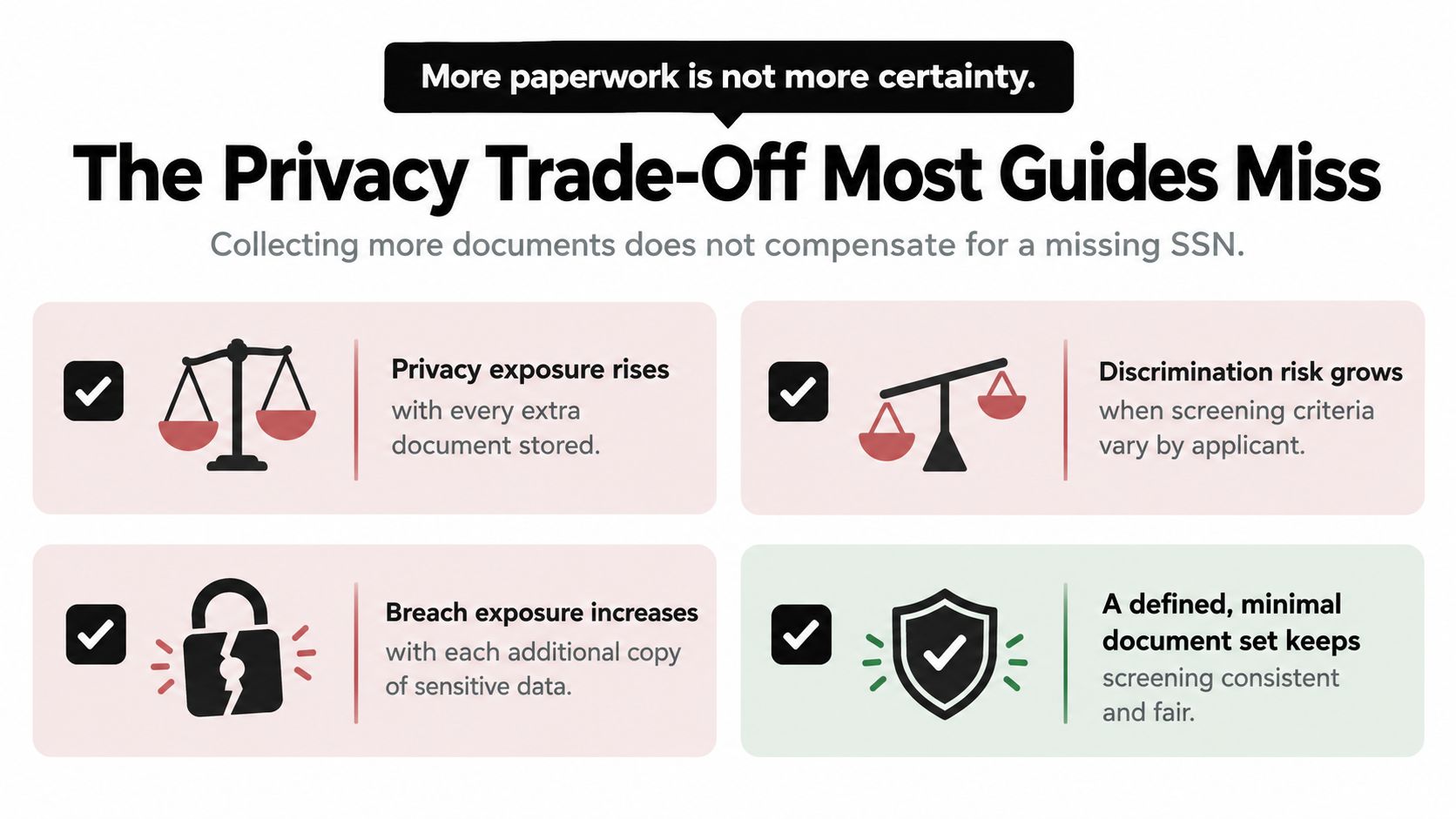
Collecting more documents can solve one matching problem while creating several privacy problems. A passport, ITIN record, bank statement, pay record, and employment document together reveal far more about an applicant than a landlord needs for every decision.
California tenant-rights guidance says identity or financial documents should be requested for specified purposes, such as verifying income or credit, complying with rental-assistance requirements, court orders, or subpoenas. That principle is useful even outside California. State the purpose of each request, collect only the fields needed for that purpose, and don't turn a screening file into a permanent archive of immigration or financial records.
Use a minimum-viable document protocol
For each document, write down four decisions before you request it:
- Purpose: What exact screening question does this document answer?
- Fields: Which name, date, address, or income details need review?
- Access: Which staff member or vendor can see the document?
- Disposal: When and how will the document be deleted or securely destroyed?
Don't ask for immigration papers to establish income if an employer confirmation or financial record answers the question. An ITIN is a tax identifier, not proof of lawful presence. Asking for immigration-related information without a legitimate screening purpose can increase discrimination risk and make applicants feel they must disclose more than other renters.
Secure storage matters too. Use one controlled intake location instead of scattered inboxes, personal devices, and downloaded desktop files. Restrict access, maintain an access record where available, and remove sensitive copies when the documented retention need ends. Small landlords don't need an elaborate security program to improve their process, but they do need to know what they hold, who can access it, and why.
Privacy principle: More paperwork is not more certainty. A smaller, purpose-built document set is easier to verify, protect, and explain.
A Written Policy and Audit Trail You Can Use Today
The strongest no-SSN process is the one you can apply on a busy leasing day without improvising. Put the alternative path in the same written screening policy as the standard path. State which identifiers you collect, the order in which you check them, how many identifiers must corroborate a record, and when a manual review is required.
Your policy should also say what you won't do. Don't use name-only matches. Don't treat a no-hit result as a clean history. Don't request immigration information unless it serves a documented and lawful purpose. Don't apply extra conditions only because an applicant lacks an SSN. If the same missing information appears in another applicant's file, use the same alternate procedure.
Record the decision while the facts are fresh
Keep an identity-resolution worksheet, signed authorization, reports obtained, source details, decision rationale, and any adverse-action correspondence. Summarize sensitive documents where a full copy isn't necessary, and use a secure retention and disposal process based on applicable law and your documented business need.
| Log Field | Example | Retention |
|---|---|---|
| Applicant identity | Full legal name and date of birth | Under your written application-record policy |
| Identifiers reviewed | ID type, issuing jurisdiction, address history | Only as long as needed to support the decision |
| Search timestamp | Date and time each source was queried | With the corresponding report record |
| Vendor or source | Consumer-reporting agency, court source, employer, or landlord | With the result and authorization |
| Match decision | Confirmed, unverified, or excluded, with reason | Through the applicable dispute and recordkeeping period |
| Decision rationale | Written criterion applied to verified facts | With the application and decision file |
| Notice record | Date and delivery method of any adverse-action notice | With the report and dispute packet |
A quarterly self-audit can be simple. Select completed files and ask whether authorization was obtained, the same identity rules were followed, every report source was recorded, unverified matches were kept out of the decision, and sensitive documents were handled according to policy. Review vendor contracts and security practices as part of that check, but don't treat a vendor certification as a substitute for your own access and retention controls.
For owners managing multiple properties, the screening workflow should sit beside the rest of the property operation. A platform that also handles application records, rent collection, leases, and maintenance can reduce the number of disconnected files, while a separate security solution may be relevant for multifamily gate access control. The important point is integration with your written process, not the number of features.
Use the following file checklist for every completed application:
- Signed screening authorization
- Identity-resolution worksheet
- Search results and source names
- Income and rental-history verification notes
- Decision rationale tied to written criteria
- Adverse-action packet, if applicable
- Applicant dispute correspondence
- Document-disposal record, where required
A missing SSN is manageable when your workflow can show how you established identity, what each search returned, and why the final decision followed the same standard used for comparable applicants.
If you manage a small rental portfolio, VerticalRent provides an application and screening workflow that can support documented identity, credit, criminal, eviction, and rental-history review, including a paper-application path where criminal and eviction checks use the applicant's name, date of birth, and signed authorization without requiring an SSN. Review your current process, write the no-SSN path into your policy, and use the platform to keep the application, screening records, and decision trail together.
Put this into practice
VerticalRent tools related to this guide
Legal Disclaimer
VerticalRent and its authors are not attorneys, CPAs, or licensed legal or financial advisors, and nothing on this site constitutes legal, tax, or professional advice. The information in this article is provided for general educational purposes only. Landlord-tenant laws, eviction procedures, security deposit rules, and tax regulations vary significantly by state, county, and municipality — and change frequently. Nothing on this site creates an attorney-client relationship. Always consult a licensed attorney or qualified professional in your jurisdiction before taking any action based on information you read here.
Co-founded VerticalRent in 2011, growing it from nothing to 100k landlords and renters. Sold it in 2019, then re-acquired it in 2026 to make it better than ever.


