Tenant Screening Tools: A Small Landlord Guide
Find tenant screening tools that save time and reduce risk. Compare top options designed for small landlords in 2026.


Credit, criminal, eviction, and rental history are the four report layers most landlords should require, and FCRA compliance applies the moment a vendor supplies a consumer report used to decide housing eligibility. For a small landlord, the right tenant screening tool is less about collecting every possible data point and more about creating a consistent intake, review, and documentation process.
You've probably felt the pressure already. A promising applicant wants the unit, another prospect is waiting, and you're tempted to accept a clean-looking application before the vacancy drags on. Then a skipped eviction search or a weak identity match turns into unpaid rent, damaged flooring, and a repair bill that makes the original screening fee look irrelevant.
I've learned to treat screening like a checklist, not a vibe. The tool should help you collect the same information from every applicant, inspect the underlying records, reduce application drop-off, and preserve a defensible decision file.
What Tenant Screening Tools Actually Do for a Small Landlord
A landlord with two units once skipped the eviction search because the applicant had decent income and a plausible rental reference. After the tenancy ended badly, the unit needed roughly $4,000 in rehabilitation, according to the landlord's own account. The expensive mistake wasn't a lack of advanced artificial intelligence. It was an incomplete workflow.
Tenant screening tools usually combine several tasks in one workspace:
- Application intake: The applicant submits personal, housing, income, and consent information through a digital form.
- Identity verification: The platform checks whether the applicant's identifying information is consistent enough to support a reliable report.
- Consumer reporting: The system can request credit, criminal, eviction, rental-history, and sometimes income information.
- Decision support: A vendor may calculate a risk score or recommendation from multiple records.
- Documentation: The landlord can retain the application, reports, decision rationale, and adverse-action records.
The four core report layers are credit, criminal background, eviction history, and rental history. Income and employment verification sit beside them because a landlord needs to compare the applicant's documented ability to pay with the rent obligation.
For an owner managing one to ten units, the priority is not an enterprise dashboard packed with controls you'll never use. You need a repeatable sequence that prevents skipped checks, keeps applicant treatment consistent, and makes it easy to explain a denial without relying on memory.
The three workflow problems worth solving
First, tenant screening tools reduce inconsistent intake. If one applicant sends a text with partial information while another completes a formal application, you're making decisions from different starting points.
Second, digital records replace scattered paper, email attachments, and screenshots. That matters when an applicant disputes a decision or you need to reconstruct what information influenced it.
Third, a good system creates an audit trail. The record should show consent, identity checks, reports reviewed, decision criteria, and any notice sent after a denial.
The market is mature. Tenant screening reports emerged in the 1970s, became a common part of landlord decision-making by the 1990s, and now commonly combine rental history, credit, criminal background, and civil records such as evictions or debt collection cases, as described in this legal aid review of tenant screening. The important question for a small landlord is no longer whether to screen. It's whether the process catches good applicants before they abandon it and protects you when the data is wrong.
The Five Data Layers Most Screening Reports Bundle
More data doesn't automatically produce a better decision. Each layer answers a different question, and each has a predictable blind spot.
Credit history can reveal payment patterns, open obligations, and account delinquencies. It may also contain rental-related debts or an eviction judgment when those records were reported, but it won't fully describe a cash-heavy applicant or someone with a thin file. Treat a limited credit file as a prompt for additional verification, not automatic proof of poor tenancy.
Criminal background data can identify convictions or pending matters where the vendor has lawful access to the relevant records. Coverage and reporting depth vary by jurisdiction, and sealed, expunged, or mismatched records can create serious accuracy problems. A record needs identity reconciliation and context before it becomes part of a housing decision.
Eviction history focuses on court filings, judgments, and related civil records. It can expose a risk that a credit report misses, but stale records, duplicate entries, sealed cases, and same-name matches can distort the result.
Rental history is where you learn whether the applicant paid on time, followed lease terms, caused damage, or left a balance. The weakness is practical: the former landlord may be unreachable, biased, or unable to verify the tenancy. A polished reference call isn't equivalent to an independent record.
Income and employment verification tests whether the applicant can meet the rent obligation. Pay stubs, tax documents, employer confirmation, payroll data, or bank-linked verification can provide useful evidence, but uploaded documents can be incomplete or manipulated. Verify the source and apply the same standard to every applicant.
| Report Layer | What It Reveals | Common Blind Spot |
|---|---|---|
| Credit | Payment behavior, debts, delinquencies, and reported rental obligations | Thin files, cash income, and unreported housing history |
| Criminal | Reportable convictions or pending matters within available jurisdictions | Coverage gaps, expunged records, and identity mismatches |
| Eviction | Court records and rental-related civil filings | Sealed, duplicate, stale, or incorrectly matched records |
| Rental history | Lease compliance, payment conduct, property care, and balances owed | Unreachable or unreliable references |
| Income and employment | Ability to support the rent from documented resources | Altered documents, incomplete records, and unstable income |
Before choosing a platform, compare its bundle against the practical guidance in this tenant screening report overview. Ask whether the vendor merely displays a score or gives you access to the source records behind it.
The CFPB describes tenant reports as consumer reports under the FCRA when landlords use them to determine housing eligibility. Reports may bundle credit, criminal, eviction, rental-history, and employment information, which means the vendor must use reasonable procedures to assure maximum possible accuracy, as explained in the CFPB bulletin on rental information. That should change how you compare products. A cheap bundle that hides its coverage gaps is not a bargain.
FCRA Compliance Without the Legal Headache
The Fair Credit Reporting Act becomes relevant as soon as a screening company supplies a consumer report that you use to evaluate a rental applicant. The vendor generally operates as a consumer reporting agency, while you act as the end user with a permissible purpose.
That doesn't mean a small landlord needs a legal department. It does mean you need a fixed process and must follow it every time.
Set up permission before pulling a report
Start with a clear, written application and obtain the applicant's authorization before ordering the report. The disclosure should explain that you'll obtain a consumer report for housing purposes. Keep that consent with the application record.
Don't bury the disclosure inside a lease or bury it among unrelated language. The applicant should be able to see what they're authorizing and why.
You'll also certify to the vendor that you have a permissible purpose and won't use the report for an unrelated purpose. The vendor may provide the required certification flow, but you remain responsible for using the information properly.
For a plain-language explanation of the framework, review this guide to FCRA compliance.
Handle a denial as a documented process
If information in the report contributes to a denial, a higher deposit, a co-signer requirement, or another unfavorable action, treat that as an adverse-action event. Your workflow should support a pre-adverse notice, a copy of the report, and a summary of the applicant's rights before the final decision is completed.
Give the applicant a meaningful opportunity to identify inaccurate information. If the applicant disputes a record, pause the decision long enough to review the dispute and the underlying data. A final notice should identify the reporting company, provide its contact details, and explain the basis used for the decision, including any score or score range that influenced it.
Practical rule: Never decline an applicant because a dashboard shows “high risk.” Open the source report, verify the identity, record the specific objective criteria, and then complete the notice workflow.
The CFPB has found that tenant-screening data can be ambiguous, outdated, or erroneous, and that proprietary risk scores can inherit those flaws, as documented in its consumer snapshot on tenant background checks. The safest habit is simple: preserve the report used, the decision rationale, and the notices sent.
AI Risk Scoring and What It Is Really Telling You
An AI risk score is a sorting device. It isn't a tenant, a lease, or a legal conclusion.
Many platforms compress several records into one label or number. That can help you prioritize which file to review first, but the composite may hide the factor that drove the result. A low score could reflect a thin credit file, a first-time renter, or a mistaken identity match. A high score can look reassuring while concealing an unresolved eviction record or inconsistent income evidence.
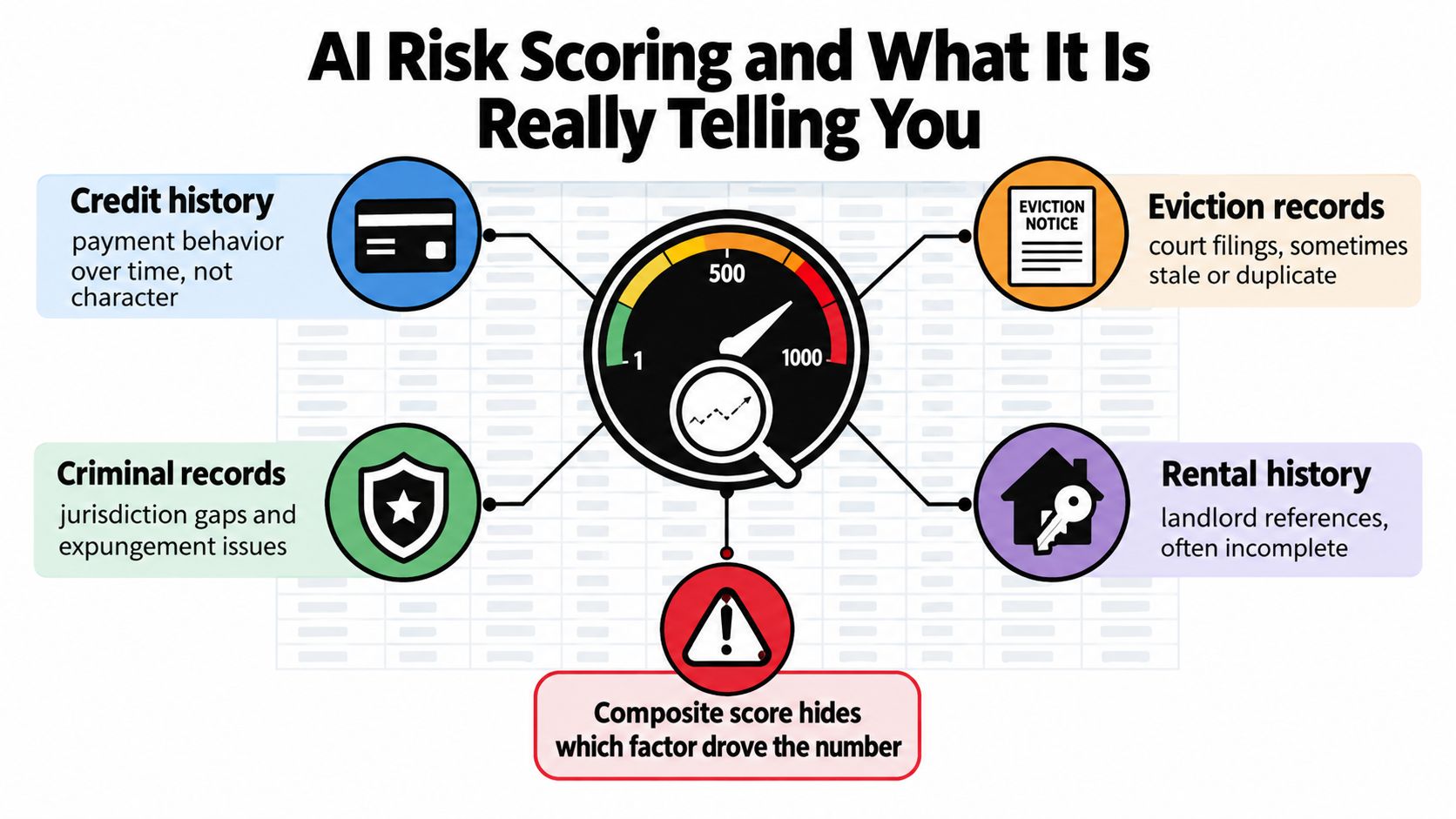
Use the score to triage, not decide
A responsible review moves from the summary to the evidence:
- Inspect the identity match. Confirm date of birth, address history, and other available identifiers. Name-only matching is not enough.
- Read the source records. Check the actual credit entries, eviction filings, and criminal records rather than accepting the label.
- Resolve contradictions. Ask for documentation when the application, report, and income evidence don't align.
- Record your reasoning. Note the objective criteria applied and whether you accepted or overrode the score.
You can watch a short overview of the process here:
The score is useful when it makes a repetitive process faster. It becomes dangerous when it replaces judgment. Fair-housing obligations and accuracy requirements still attach to the landlord's decision, not to the vendor's interface.
A score tells you where to look. It doesn't tell you what happened.
For a small portfolio, transparency matters more than novelty. Choose a vendor that shows the records supporting the output and lets you document why the final decision differed from the automated suggestion.
A Practical Screening Workflow Step by Step
A reliable workflow starts before the report runs. It begins with the listing, the application rules, and the way you communicate them.
Seven checkpoints for a small portfolio
1. Publish objective criteria. State the standards you'll apply, such as income documentation, rental history, credit review, and identity verification. Don't invent a new requirement for one applicant because their file feels unusual.
2. Use one application path. Send every adult applicant through the same digital form. Require written authorization for the consumer report before you order it.
3. Verify identity. Reconcile the applicant's name, date of birth, address history, and available Social Security number or ITIN information. A typed name paired with a date of birth isn't a sufficient identity strategy by itself.
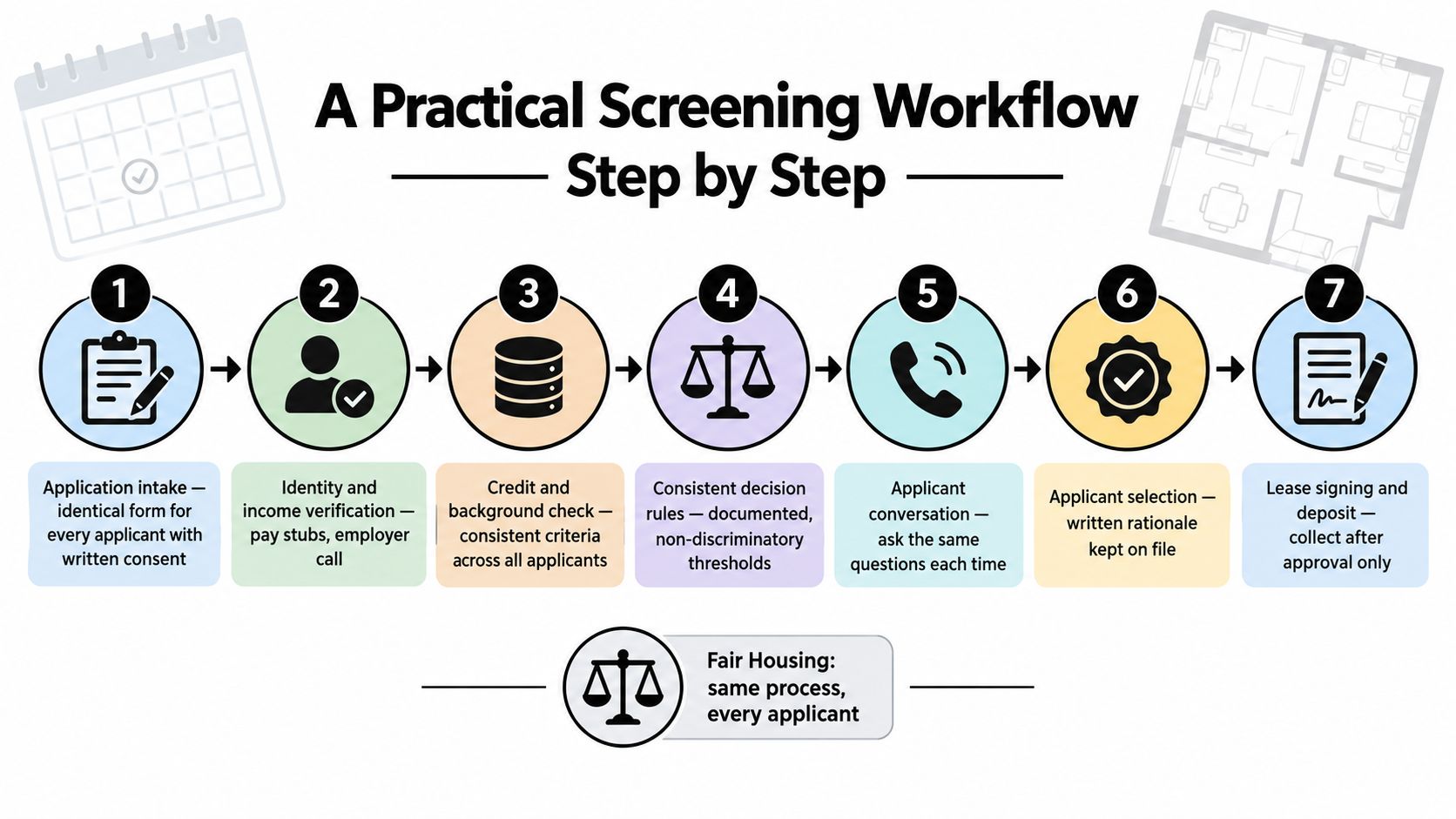
4. Pull the core reports in a fixed order. Request credit, criminal, eviction, and rental or address history through the screening provider. If the platform separates these checks, confirm that none was skipped.
5. Verify income and employment. Review the evidence against the stated income and employment details. Escalate inconsistencies instead of guessing.
6. Review the score beside the records. Use the automated risk flag for triage, then inspect the underlying data. Record the facts that supported approval, conditional approval, or denial.
7. Close the file correctly. If you deny or impose an unfavorable condition because of consumer-report information, trigger the appropriate adverse-action process. Collect a deposit only after approval and preserve the final decision record.
The friction points are predictable. Applicants abandon long forms, stop between consent and payment, submit incomplete documents, or fail identity verification. Your tool should show where the process stopped so you can distinguish a weak applicant from a broken intake experience.
Landlord checklist: Same form, same criteria, same report layers, same documentation, every time.
How to Compare Tenant Screening Tools Side by Side
Don't choose a platform because its dashboard looks modern. Run every candidate through the workflow you use on a Tuesday night when an applicant is waiting and you're fixing a leaking sink.
Score each vendor from one to five across the categories below, then give greater weight to report transparency and compliance automation than to decorative AI features.
| Criterion | What to Look For | Weight | Common Gaps |
|---|---|---|---|
| Features | Credit, criminal, eviction, rental history, income verification, identity checks, source-level reports | High | A bundled score with limited record detail |
| Compliance | Digital consent, permissible-purpose certification, adverse-action workflow, report retention controls | High | Templates without a guided process |
| Pricing | Per-applicant cost, subscription requirements, add-on charges, and who pays | Medium | Low entry price with essential checks behind extra fees |
| Integrations | Property-management sync, e-signature, rent collection, accounting, and listing connections | Medium | Repeated data entry between systems |
| Turnaround | Clear expectations for instant results, manual reviews, and local court coverage | Medium | “Instant” branding that excludes difficult records |
| Tenant experience | Mobile application, plain consent language, transparent payment flow, and progress visibility | High | Long forms that cause qualified applicants to quit |
Ask the vendor to demonstrate a complete denial, not just an approval. You want to see where consent is captured, how reports are displayed, how identity disputes are handled, and whether the system records the decision rationale.
Pricing deserves a hard look. Industry reporting cited in the CFPB market materials places common screening fees in the $25 to $55 per applicant range, but a lower fee can hide missing county coverage or separate charges for income verification, as discussed in the CFPB tenant background-checks market report. Compare the complete workflow cost, not the advertised entry price.
The same report notes that most residential landlords use tenant screening reports, while the provider market lacks a required federal registration system. That uncertainty makes vendor due diligence essential. Ask who supplies each report, how the vendor handles possible matches, and what happens when a local record needs manual confirmation.
Common Pitfalls and Best Practices Independent Landlords Miss
Small landlords usually get into trouble through shortcuts, not malicious intent. A shortcut becomes expensive when it changes the process for one applicant or leaves no record of what happened.
| Pitfall | Why It Hurts | Specific Fix |
|---|---|---|
| Treating an AI score as the verdict | The score can hide stale, ambiguous, or mismatched data | Review source reports and record the reason for the decision |
| Matching by name alone | Similar names can attach another person's record to the applicant | Reconcile date of birth, address, and other available identifiers |
| Skipping the adverse-action workflow | The applicant may not receive the required information or dispute opportunity | Use the vendor's documented notice process after a report-based denial |
| Asking personal or protected-class questions | The application conversation can create fair-housing exposure | Use scripted questions tied to objective rental criteria |
| Keeping reports indefinitely | Sensitive consumer data can remain exposed without a business need | Set a retention policy and securely delete records when appropriate |
Your application script should focus on rent-relevant facts. Ask about move-in timing, occupants, pets where lawful, income documentation, prior rental obligations, and authorization for screening. Don't ask about family status, disability, religion, national origin, or other protected characteristics.
The same rule applies to exceptions. If you accept a thin credit file because verified income and rental references satisfy your published criteria, write that down. If you require a co-signer because a documented standard wasn't met, apply that condition consistently.
A clean decision file should contain the application, consent, identity-verification result, reports reviewed, income evidence, decision rationale, and any notices. Keep access limited, use secure storage, and follow a defined deletion schedule rather than allowing old reports to accumulate in email.
How VerticalRent Fits Into a Modern Screening Workflow
VerticalRent can serve as one option for landlords who want screening inside a broader rental workflow. Its tenant-screening tools support credit, criminal, eviction, and rental-history reports, with applicant-paid or landlord-ordered screening paths, digital consent, and an AI Risk Score that combines those report categories into a single explanation.
The useful distinction is how the features fit together. Screening can feed into a decision record, lease generation can follow approval, and online rent collection can keep the post-lease payment workflow in the same system. That reduces rekeying, but it doesn't remove the landlord's obligation to inspect records and apply consistent criteria.
The platform's tenant screening workflow is most relevant when you want more than a standalone report. Look for source-level visibility behind the score, documentation for report-based decisions, and an applicant experience that works on a phone. Those details address the key failure points: incomplete intake, weak identity matching, and missing compliance records.
Use this action checklist before you approve anyone:
- Standardize criteria: Write the requirements before reviewing applicants.
- Verify identity: Don't rely on name-only matches.
- Review the records: Treat the score as a prompt, not a verdict.
- Document decisions: Keep the evidence and reasoning together.
- Close compliance steps: Complete adverse-action notices when required.
- Protect data: Limit access and delete records under a written policy.
The best tenant screening tools don't merely bundle more reports. They help you run the same process, catch friction before applicants disappear, and prove what you reviewed when a decision is questioned.
VerticalRent combines applicant intake, credit, criminal, eviction, and rental-history screening with AI-assisted risk summaries, lease creation, and online rent collection for independent landlords. If you want one workflow for the checks and records that matter, visit VerticalRent and evaluate it against your screening checklist.
Put this into practice
VerticalRent tools related to this guide
Legal Disclaimer
VerticalRent and its authors are not attorneys, CPAs, or licensed legal or financial advisors, and nothing on this site constitutes legal, tax, or professional advice. The information in this article is provided for general educational purposes only. Landlord-tenant laws, eviction procedures, security deposit rules, and tax regulations vary significantly by state, county, and municipality — and change frequently. Nothing on this site creates an attorney-client relationship. Always consult a licensed attorney or qualified professional in your jurisdiction before taking any action based on information you read here.
Co-founded VerticalRent in 2011, growing it from nothing to 100k landlords and renters. Sold it in 2019, then re-acquired it in 2026 to make it better than ever.


