Resident Score vs Credit Score: What Landlords Must Know
Resident Score vs Credit Score. Compare resident scores vs credit scores for tenant screening.


A ResidentScore can be more useful than a traditional credit score for rental risk, and TransUnion says it predicted evictions 15% better than traditional credit scores alone. TransUnion-branded materials and landlord guides also report that it identified 19% more skips than typical credit scoring.
You're reviewing an application from someone with a respectable credit score, but their former landlord describes repeated late rent and a lease that ended badly. Another applicant has a thin or damaged credit file, yet provides strong rental references and a consistent payment record. Which one presents the lower risk?
That's the practical problem behind resident score vs credit score. The two numbers may look similar, but they answer different questions. A credit score helps estimate how an applicant manages borrowing obligations. A ResidentScore is built for rental decisions and focuses more directly on risks such as late rent, skips, and eviction.
The mistake is treating either number as a complete verdict. A score should support a documented screening policy, not replace rental-history verification, income review, identity checks, and fair housing compliance. The framework below helps you decide when each score adds value, how to interpret conflicting signals, and where a seemingly objective cutoff can create legal trouble.
The Landlord's Screening Dilemma
The application looks strong at first. The prospective tenant has a credit score that meets your usual standard, steady employment, and enough documented income. Then you call the previous landlord and hear that rent was often late, communication broke down, and the tenant left before the lease ended.
The next application reverses the problem. The applicant has limited credit history and a weaker traditional credit profile, perhaps because they rarely use credit or are rebuilding after a difficult period. Their rental references, however, are positive, and the prior landlord confirms that rent was paid reliably.
Neither application can be judged responsibly by one number.
The score can answer the wrong question
A traditional credit score was created to evaluate borrowing behavior. That information still matters to a landlord because rent is one of several recurring obligations competing for an applicant's money. But a clean borrowing record doesn't prove that someone will communicate with a landlord, follow lease terms, or prioritize rent when other expenses arrive.
A rental-specific score approaches the decision from a different direction. ResidentScore is designed for rental decisions and uses rental-relevant data alongside credit-report information, with different weighting intended to estimate tenancy risk. That makes it especially relevant when the central concern is future rental income rather than loan repayment.
Practical rule: Treat the credit score as financial context and the resident score as rental-risk context. Neither one is a substitute for verified rental history.
Landlords often get into trouble by asking a score to do the work of a reference check. A low score may deserve an explanation, not an automatic rejection. A high score may deserve confirmation, not automatic approval. Medical collections, student debt, identity errors, a recent move, or a disputed landlord report can all create a mismatch between the number and the applicant's actual tenancy record.
A sound process starts with written criteria and consistent evidence collection. The complete landlord guide to tenant screening is useful for organizing those checks, but the decision still belongs to the landlord and must follow applicable law.
Understanding Resident Scores and Credit Scores
A traditional credit score estimates borrowing risk. It reflects patterns such as payment history, credit utilization, the length of a person's credit history, available credit, new inquiries, and other information in a credit report. Lenders use that profile to assess whether a borrower is likely to repay financial obligations.
A ResidentScore is a TransUnion tenant-screening score built specifically for rental decisions. It uses the same 350 to 850 scale as many traditional credit scores, but the scale doesn't mean the models are interchangeable. ResidentScore adds rental-relevant data and weighs factors differently to better estimate risks connected to tenancy.
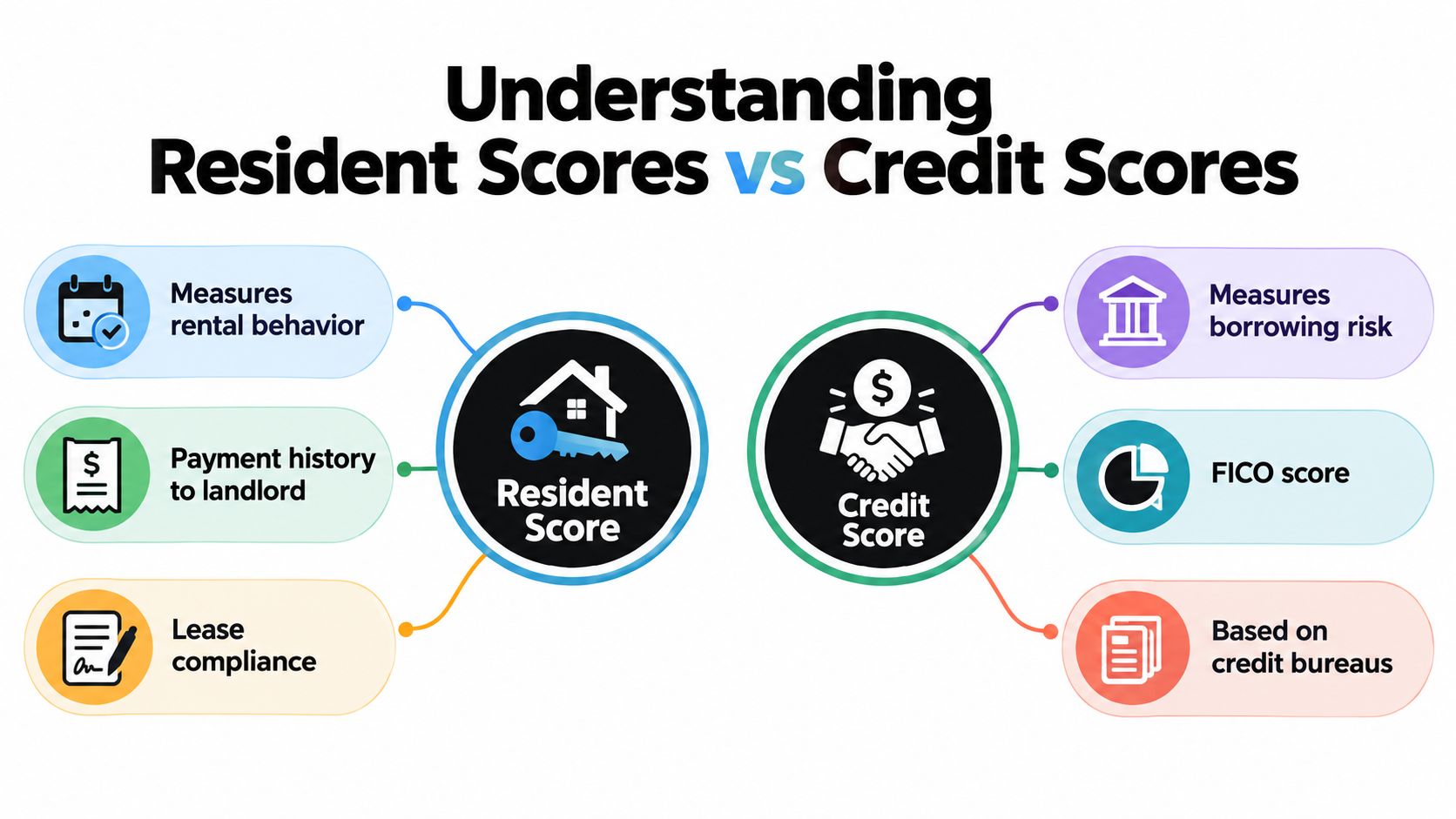
Two numbers, two risk questions
| Screening measure | Primary purpose | Useful landlord question | Main limitation |
|---|---|---|---|
| Traditional credit score | Estimate repayment behavior for borrowing | Does this applicant generally manage debt and credit obligations? | It wasn't designed specifically to predict tenancy outcomes |
| ResidentScore | Estimate rental-related risk | Does this applicant's profile suggest a higher or lower risk of rental-income problems? | It remains a model-based signal, not proof of future conduct |
| Rental references | Verify actual tenancy behavior | Did the applicant pay rent, follow the lease, and communicate responsibly? | References may be incomplete, biased, or difficult to verify |
| Income and employment evidence | Assess payment capacity | Can the applicant reasonably afford this rent under the property's criteria? | Capacity doesn't guarantee payment priority or lease compliance |
The distinction matters because landlords aren't evaluating only whether someone can repay debt. They're trying to forecast whether rent will arrive on time, whether the lease will be honored, and whether the tenancy will end without a skip or eviction. ResidentScore is positioned around those rental-specific outcomes.
Landlords who need a technical overview of common credit-file fields can use BatchData credit score attributes as a reference when reviewing the underlying information. That kind of detail helps explain why two scoring models can read the same credit history differently.
A credit score can be especially useful when an applicant has a substantial borrowing history, multiple active obligations, or notable payment problems. ResidentScore can add value when the landlord wants a signal designed around rental risk rather than a general lending decision. The practical comparison is not “which number is higher?” It's “which risk does this number help me evaluate?”
For a plain-language explanation of how credit history fits into an apartment application, see how credit scores affect renting an apartment. Use that context to avoid treating a familiar scale as a universal standard.
How Each Score Is Calculated
Traditional credit scores and ResidentScore may draw from overlapping credit-report information, but they don't apply the same logic. TransUnion's materials identify ResidentScore inputs such as payment history, utilization, history length, available credit, and inquiries. The model then weighs those signals for rental-risk prediction rather than applying a general borrowing-risk formula.
That difference explains why one applicant can appear stronger under a traditional credit model while receiving a less favorable rental-specific assessment. The applicant's underlying history hasn't changed. The question being predicted has changed.

Traditional credit scoring
A credit score generally places emphasis on whether someone has handled borrowed money responsibly. Payment problems, high utilization, a short history, limited available credit, and frequent inquiries can influence the result. Those factors tell a lender something meaningful about repayment behavior, but they don't directly confirm how the applicant handled a lease.
For example, an applicant may maintain credit cards carefully while struggling with rent because of inconsistent income timing. Another may have a damaged credit profile caused by a past financial event but pay rent first and communicate early when circumstances change. The score captures patterns, not the complete story.
Rental-focused scoring
ResidentScore uses a familiar 350 to 850 range, while its rental-specific design changes the interpretation of the inputs. TransUnion describes the score as intended to estimate risk to future rental income. Third-party landlord education sources similarly describe it as emphasizing rental behavior more than a standard credit score.
The predictive purpose is the important distinction. A credit score can help answer whether the applicant has historically repaid debts. ResidentScore is intended to help estimate outcomes such as eviction or skipping a lease. That makes it more directly relevant to a landlord's core exposure, but it doesn't make the model infallible.
A responsible screening file should preserve the report, the model name, the vendor's explanation of the score, and the specific criteria used at the time of the decision. Don't copy a threshold from another landlord's policy. Scores may use different models, and a number from one provider may not be comparable with a number from another.
Predictive Accuracy for Rental Outcomes
The strongest argument for ResidentScore is its stated rental-specific predictive performance. TransUnion's SmartMove landlord guidance says ResidentScore predicted evictions 15% better than traditional credit scores alone. TransUnion-branded screening materials and third-party landlord guides also report that it identified 19% more skips than typical credit scores. These figures support using a rental-focused model when the landlord's main concern is the loss of rent associated with a failed tenancy.
The figures don't mean that every applicant with a particular score will behave in a predictable way. They describe comparative model performance, not certainty about an individual. A landlord still needs to inspect the report, verify the applicant's identity, and check whether the records actually belong to that person.
What the numbers do and don't tell you
ResidentScore's advantage comes from matching the model to the decision. A lender cares about loan repayment. A landlord cares about rent payment, lease continuation, and the risk of a skip or eviction. When the outcome changes, a model designed for that outcome can add information that a general credit score misses.
Traditional credit scores remain useful because they provide broader financial context. An applicant may have a strong rental signal but significant unresolved obligations that affect available cash flow. Another applicant may have a weak credit profile but a credible explanation, stable income, and a documented history of reliable rent payments.
A predictive score improves a screening decision only when the landlord understands what it predicts.
Compliance comes before prediction
A lawful screening process requires more than a statistically useful model. Landlords must tell applicants what information they'll access, what criteria may result in denial, and how consumer-report rights apply when a screening report is used. The exact requirements depend on the jurisdiction, so a policy copied from another state can be unsafe.
The same principle applies to adverse action. If a landlord denies an application or approves it with conditions because of information in a consumer report, the landlord should follow the applicable notice requirements and explain the basis accurately. A score doesn't remove the need for documentation, accuracy reviews, or a consistent process.
Landlords evaluating automated tools should also distinguish risk scoring from decision automation. AI tenant screening scores can organize multiple records, but the landlord remains responsible for using lawful criteria and handling disputes appropriately.
Strengths and Limitations of Each Approach
ResidentScore is strongest when the landlord needs a rental-specific risk signal. Its purpose aligns more closely with the financial event a property owner fears, such as a tenant stopping payment and leaving an unpaid balance. That alignment can make the score more useful than a general credit score when the two signals disagree.
A traditional credit score is strongest as a broad view of financial behavior. It can reveal payment patterns, credit dependence, and unresolved obligations that may affect an applicant's ability to carry rent alongside other bills. It's familiar, widely used, and often easier for applicants to understand.
Neither model sees the entire tenancy.
Where ResidentScore can miss context
A rental-specific model may still struggle with applicants who have thin or unusual credit files. A person who has little borrowing history can be difficult to evaluate through any score, even if they have paid rent reliably for years. The model also can't replace a direct conversation about a prior tenancy, a verified ledger, or an explanation for a disputed record.
A landlord who relies on ResidentScore alone may reject a viable applicant without investigating the reason behind the result. That creates both a business blind spot and a fairness concern.
Where credit scoring can mislead
Traditional credit data may reflect obligations that don't map neatly to rental reliability. Medical debt, student loans, a past hardship, or an isolated reporting error can lower a credit profile without demonstrating that the applicant fails to pay rent. Conversely, strong credit management doesn't prove that the applicant has respected lease obligations.
The best decision depends on the property's actual exposure. Consider these situations:
- Strong credit, poor rental history: Give greater weight to verified rental conduct, investigate the discrepancy, and document the reason for the final decision.
- Weak credit, strong rental history: Review the cause, confirm current income and payment capacity, and avoid assuming that one difficult period predicts the next tenancy.
- Both signals are weak: Apply the written policy consistently, verify the reports, and assess whether local law permits any lawful conditional approval.
- Both signals are strong: Complete the remaining checks. A favorable score combination doesn't eliminate identity, income, reference, or fraud concerns.
The practical lesson is simple. Use each score for the question it was built to answer, then let verified evidence resolve the disagreement.
Using Both Scores in Tenant Screening Decisions
A dual-score process works best when it's consistent, explainable, and flexible enough to handle legitimate exceptions required by law. It doesn't mean averaging two numbers and allowing a spreadsheet to make the decision. It means assigning each signal a defined role before applications arrive.
Start with a written policy
Write down which reports you'll obtain, how you'll verify them, and what conditions may result in approval, denial, or further review. Include the model name and the score range used by your screening provider. Don't assume that every rental score uses the same scale as ResidentScore.
Set criteria around the property and applicant pool, but don't invent universal thresholds. The verified materials establish the ResidentScore range, not a single nationwide “passing” score. A cutoff suitable for one property may be inappropriate for another, and a rigid number can create fair housing problems when it ignores a legally required reasonable accommodation.
Use a review band rather than treating every result as automatic. A result near your policy boundary should trigger verification and documented judgment, not an improvised standard created for one applicant.
Give each signal a job
Use the traditional credit score to review broad payment behavior and existing obligations. Use ResidentScore to add rental-focused context. Then compare both against the records that describe actual tenancy behavior.
A practical file-review sequence looks like this:
- Confirm identity first. Make sure the report belongs to the applicant and that names, addresses, and identifying information are consistent.
- Review both model labels. Record whether the report shows a traditional credit score, ResidentScore, another rental score, or a composite product. Don't compare numbers until you know what each represents.
- Read the underlying report. Look for payment patterns, disputed accounts, inquiries, utilization, and other details that explain the score.
- Verify rental history. Contact prior landlords through independently obtained information where possible. Confirm dates, rent payment behavior, lease compliance, and the reason for move-out.
- Check affordability lawfully. Follow local rules for income sources, vouchers, subsidies, and acceptable documentation. A screening ratio that ignores protected income or applies an unlawful calculation can invalidate an otherwise careful process.
- Resolve conflicts consistently. If the credit score is favorable but rental history is poor, document why the rental evidence carries more weight for a rental decision. If the opposite occurs, document the explanation and the verification supporting approval.
Decision checkpoint: If you can't explain why the score supports your decision using the written criteria and verified records, pause before sending an approval or denial.
Keep the human review defensible
A low score isn't automatically evidence of bad character, and a high score isn't a promise of successful tenancy. Ask whether the result reflects a current risk, an old event, a reporting error, limited history, or a mismatch between the model and the applicant's circumstances.
Background reports also contain different categories of information, and applicants may need to understand what an employer or housing provider can see and challenge. The overview of what employers see on background checks offers useful general context, although landlords must follow the rules that apply specifically to tenant screening and consumer reports.
For small landlords who want one workflow rather than scattered reports, VerticalRent combines credit, criminal, eviction, and rental-history information into an AI Risk Score with plain-English explanations. It can be used as an organizing tool, but it doesn't change the landlord's responsibility to verify information, apply written criteria consistently, and provide required notices.
Before you finalize the policy, test it against difficult examples: good credit with poor references, limited credit with strong rental records, a disputed account, and an applicant using a lawful subsidy. If the rule produces an automatic result without a way to correct inaccurate data or consider a required accommodation, revise the process before the next application.
Visit VerticalRent to review a screening workflow that brings these records and explanations into one platform. Use it to compare signals in a single file, then keep your final decision grounded in verified rental history, documented criteria, and the law that governs your property.
Put this into practice
VerticalRent tools related to this guide
Legal Disclaimer
VerticalRent and its authors are not attorneys, CPAs, or licensed legal or financial advisors, and nothing on this site constitutes legal, tax, or professional advice. The information in this article is provided for general educational purposes only. Landlord-tenant laws, eviction procedures, security deposit rules, and tax regulations vary significantly by state, county, and municipality — and change frequently. Nothing on this site creates an attorney-client relationship. Always consult a licensed attorney or qualified professional in your jurisdiction before taking any action based on information you read here.
Co-founded VerticalRent in 2011, growing it from nothing to 100k landlords and renters. Sold it in 2019, then re-acquired it in 2026 to make it better than ever.


