Tenant Credit Score Minimum: What Landlords Really Use
Typical tenant credit score minimum ranges, what each band signals about rent risk, and legal alternatives to a strict cutoff for landlords.


There's no universal legal tenant credit score minimum in the United States; many landlords use around 600 as a screening anchor, not an official requirement. The mistake is treating that number as proof that an applicant will or won't pay rent.
A cutoff makes applications easier to sort. It doesn't tell you whether an overdue account belongs to the applicant, whether a collection has been paid, or whether the renter has consistently paid a previous landlord. A useful policy separates credit screening from the final leasing decision, with clear rules for what gets verified before anyone is declined.
Typical Credit Score Minimums Landlords Use
Many landlords anchor their minimum at 600, according to Hemlane's 2025 tenant-credit analysis. That's evidence of a screening habit, not evidence that everyone below the line presents unacceptable rental risk.
For a small property owner, the attraction is obvious. A number is quicker to compare than pay statements, account histories, and landlord references. But speed comes at a cost when a shortcut becomes the whole decision.
Treat score bands as review instructions
The following is an illustrative landlord policy, not a set of validated rental-risk categories or official FICO or VantageScore classifications. The numerical boundaries show how a landlord might organize review; the responses are not nationwide requirements.
| Score band | Typical landlord response | What the band usually signals |
|---|---|---|
| 740 and above | Pass the score check, then complete other verification | A stronger consumer-credit profile, not proof of rent performance |
| 670 to 739 | Approve on the credit component, subject to verified income | Generally stronger loan repayment history, potentially with little rental information |
| 620 to 669 | Review the underlying accounts and rental evidence | Credit weaknesses that need explanation rather than an automatic verdict |
| 580 to 619 | Consider conditional approval or decline after reviewing the cause | Possible delinquencies or debt pressure; inspect the actual report |
| Below 580 | Require substantive review before making a decision | Significant credit concerns may be present, but the score doesn't identify their cause |
| No score or thin file | Review rent history, verified income, and references | Limited reported credit use, not established failure to pay rent |
A score doesn't diagnose a file. Don't assume a particular band means recent delinquency, medical collections, or excessive card balances without opening the report.
The CFPB's tenant-background-check market report says most residential landlords use screening reports and cites industry estimates that only 1.7% to 2.3% of U.S. renters have rental-payment tradelines in their credit files. Your applicant's most relevant payment history may therefore be missing from the number you're evaluating.
Tell applicants what the number actually does
Publish whether your minimum triggers rejection, additional verification, or an opportunity to provide supporting records. Otherwise, applicants can't distinguish a firm requirement from an initial screening preference.
For an applicant-facing explanation of preparing for screening, Superior Credit Repair's apartment approval guide can be a useful companion to your written criteria. It shouldn't replace the property's own requirements.
Practical rule: Use a score band to decide what to verify next, not to substitute for verification.
Why a Score Misjudges Rent Risk and How to Decide
Using a credit score as a rent-payment forecast is like using a thermometer to measure blood pressure. The instrument may work for its intended purpose while answering the wrong question.
HUD's rental-screening guidance explains that credit scores were designed to estimate consumer-loan default risk, not rent-payment performance, and reports no known studies establishing that credit reports or scores accurately predict successful tenancy. That doesn't make credit information useless. It means you shouldn't claim a cutoff measures something it hasn't been shown to measure.
Keep those different obligations separate when reading an application.

Compare the cause, not just the score
Say applicants arrive with identical credit scores. One has an unresolved balance owed to a former landlord and can't explain gaps in the rent ledger. The other has paid medical collections, current verified earnings, and documented on-time rent payments.
A score-only policy treats them alike. A verification-first policy asks different questions because the underlying concerns differ.
The first file needs confirmation of the housing debt, its status, and the applicant's explanation. The second needs confirmation that the collection is accurately reported and that current housing payments are affordable. Neither inquiry requires guessing about character.
The problem isn't merely theoretical opacity. In a 2025 survey of attorneys, advocates, and counselors assisting renters, the National Consumer Law Center found that 84% reported observing private landlords use credit scores to deny applicants, while 46% said private landlords rarely or never reviewed the underlying screening-report information. Those are respondents' observations, not measured denial rates across all rental applications.
Reviewing the underlying file takes more time than accepting a recommendation. It also lets you distinguish an unresolved housing obligation from a paid account or an identity error.
Write approval, review, and decline outcomes
Approve should mean the applicant satisfies your published requirements after verification. A strong score alone shouldn't excuse missing identity, income, or rental documentation.
Review should mean a named person examines specified evidence before a stated internal deadline. Don't leave an applicant in an undefined pending status while you continue collecting applications.
Decline should identify the specific unmet criterion and supporting fact. A reason such as verified unresolved rental debt is more explainable than low screening recommendation, provided the underlying criterion and decision comply with applicable law.
Give the reviewer a short worksheet:
- Capacity: Identify verified income, the applicant's actual rent obligation, and material recurring debt payments.
- Rental performance: Examine the ledger, payment receipts, and independently verified landlord references.
- Account context: Record whether a negative item is recent, paid, disputed, housing-related, or incorrectly matched.
- Decision basis: State which written criterion was satisfied or unmet, and what evidence supports that conclusion.
Avoid collecting unnecessary medical details. The question is whether the account information is accurate and relevant to your written policy, not what treatment an applicant received.
Match the response to the actual problem
These are suggested review paths, not promises of approval.
| Applicant situation | What to verify | Likely outcome |
|---|---|---|
| No credit score or thin file | Income against the published affordability standard, landlord references, and rent ledger | Approve if the other criteria are satisfied; otherwise review |
| Discharged bankruptcy | Discharge documentation, subsequent income stability, and subsequent rent payments | Review current circumstances and documented compensating factors |
| Paid medical or student debt in collections | Account type, dates, housing connection, and proof of payment | Usually not a stand-alone decline under a rent-focused policy |
| Prior unpaid rent or eviction judgment | Correct identity, case outcome, outstanding balance, payment record, and references | Review or decline under a lawful written policy, not merely because a filing exists |
| Identity mismatch on the report | Matching identifiers, dispute documentation, and corrected report | Pause the affected decision while verifying the record |
| High debt load with strong rent history | Verified income, required debt payments, proposed rent burden, and authentic ledger | Approve or review based on current payment capacity |
Consider another hypothetical comparison: an applicant with stronger credit but substantial required debt payments and documented late rent versus an applicant with weaker credit and a clean rental ledger. The higher score doesn't erase the affordability question in the first file.
A clean ledger doesn't erase an affordability problem either. If the proposed rent is materially different from the applicant's previous obligation, assess the new payment rather than assuming past performance transfers unchanged.
Decide whether you need credit screening at all
HUD's guidance on screening rental applicants states that providers may omit credit checks when their policies are applied consistently and without discrimination. That option deserves consideration if your process mainly needs to establish identity, income, and prior rent performance.
The trade-off is losing visibility into obligations that could affect payment capacity. If you retain credit checks, define which information you use in practice rather than purchasing a report and defaulting to its recommendation.
A lower score should trigger a relevant question. The verified answer should determine the outcome.
How to Dispute a Bad Report Before Declining
A low score based on a mixed file is an unverified risk. Before applying your cutoff, give the applicant a defined opportunity to identify inaccurate entries and submit supporting records.
Keep the written sequence with the application so the reviewer and applicant work from the same process.
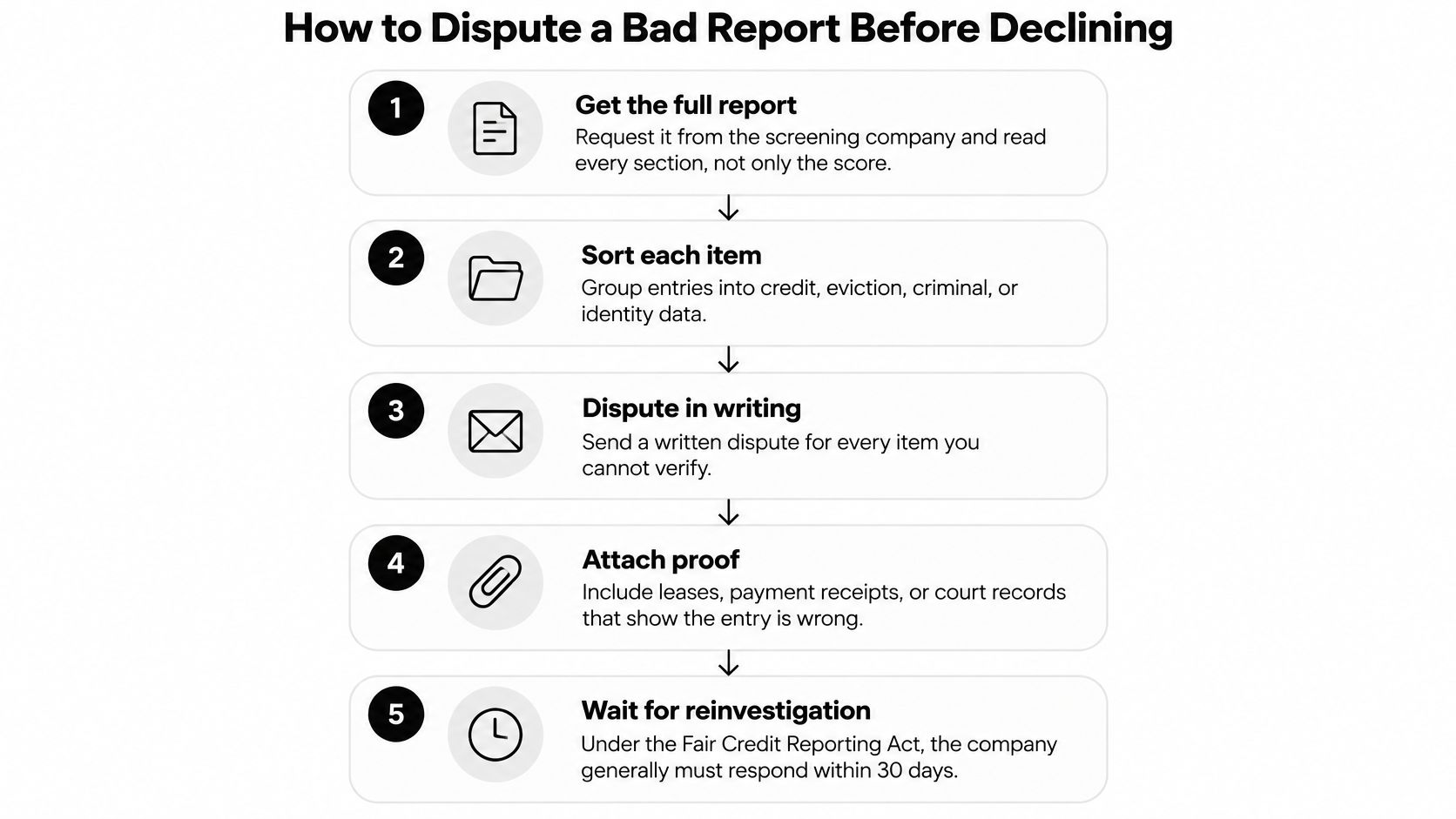
Follow a documented correction process
Request the complete report. Ask the screening company for every section, including the underlying credit, eviction, criminal, and identity records. These steps for checking a tenant screening report show applicants what to review before filing a dispute.
Identify the type of error. Separate credit accounts, eviction records, criminal records, and identity mismatches. A paid collection and a court record belonging to someone else require different corrections and supporting documents.
Dispute the exact entry in writing. Contact the screening company and the organization that furnished the information. Name the specific record, explain what is wrong, and request the appropriate correction.
Attach usable proof. Payment receipts, paid-in-full letters, dismissal orders, and lease documents can support the challenge. Keep copies of submissions and confirmations so the reviewer can trace what was disputed.
Request reconsideration under the published policy. Send the corrected report with a short cover letter identifying the changed information. Ask the landlord to evaluate the file under the same criteria applied to other applicants.
Confirm the application's status. Ask whether the decision will be held during verification and which documents are still needed. Filing a dispute does not reserve the unit or guarantee approval.
The CFPB's tenant-background-check guidance explains that matching records solely by name can produce inaccurate results and may not meet the FCRA's accuracy requirements. It also notes that hard credit inquiries requested during rental applications can lower an applicant's score, so applicants should ask which identifiers were matched and what type of inquiry an application will trigger.
Keep the landlord's hold explicit
Record the disputed item, the evidence received, the assigned reviewer, and the date the applicant should expect an update. State whether the unit will remain available while the screening company reviews the file.
Apply the hold consistently under your written policy. A temporary pause can create a fair window for verification, but it does not replace required notices or guarantee that the report will change.
For another walkthrough of the screening-report process, use the video alongside the written steps.
Alternatives to a Strict Score Cutoff
An alternative works only when it addresses the actual gap. A guarantor may provide another source of payment, but it won't correct a mismatched identity. An additional deposit won't make an unaffordable monthly obligation sustainable.
Choose the tool after identifying the concern, not before.
| Alternative | Best used when | Watch-out |
|---|---|---|
| Co-signer or guarantor | Income is sufficient but credit history is weak | Apply written guarantor standards and put the guarantee terms in writing |
| Larger security deposit | A permitted additional deposit addresses a specific financial concern | Check applicable deposit limits before requesting more |
| Prepaid rent | The applicant has documented reserves but weak credit | Verify whether advance rent is permitted and how it must be handled |
| Rent-to-income check | Current payment capacity is unclear | Verify earnings and apply the appropriate treatment to subsidies |
| Documented rent history from prior landlords | The credit file doesn't reflect housing payments | Authenticate records and check for gaps across the tenancy |
| Conditional approval with written terms | A defined, lawful condition can resolve an identified concern | Evaluate adverse-action obligations when a report contributes to worse terms |
Verify capacity rather than collecting impressive documents
Pay statements should support the income figure entered on the application. For variable or self-employment income, reconcile deposits with relevant tax or business records rather than treating every bank credit as earnings.
Gross income isn't spendable income. A rent-to-income calculation is an initial affordability check, not a complete budget review. Required debt payments and the reliability of the income still deserve attention.
Likewise, a bank balance may show reserves without establishing recurring income. Decide in advance how reserves will be evaluated so applicants receive the same treatment.
Authenticate rental evidence and guarantees
A ledger is useful when you can establish who issued it and what period it covers. Compare it with the lease and payment records, and independently confirm the reference's connection to the property rather than relying solely on a phone number supplied by the applicant.
A focused rental-history verification process helps distinguish usable evidence from a favorable but unsupported reference.
For a guarantor, verify identity, financial qualifications, and the signed obligation. Have the guarantee form reviewed for the jurisdiction and tenancy rather than assuming an informal promise is enforceable.
Choose the remedy that fits the gap: Better documentation can resolve uncertainty. Extra money shouldn't be the default answer to every weak credit file.
Write down which alternatives are available and when. Before offering additional deposits or advance rent, verify the applicable rules with a qualified local resource.
Fair Housing and State Rules That Limit Minimums
Adverse action includes more than rejection. When a consumer report contributes to a denial or materially worse terms, handle the required notice even if you describe the result as conditional approval.
The notice should identify the reporting company and explain the applicant's relevant report-access and dispute rights. Don't assume the screening provider sent it merely because its dashboard recorded your decision.
Separate the report from your decision
The reporting company supplies information; the landlord chooses the screening policy and makes the leasing decision. Your records should show what you relied on and who authorized the outcome.
Build a notice checkpoint into the workflow for declined applications and report-based conditions. A request for a guarantor or additional deposit needs attention, not just an outright rejection.
Use these operational checks:
- Notice delivery: Confirm the required information is included and preserve evidence of delivery.
- Decision ownership: Identify the person responsible for the leasing decision and applicant follow-up.
- Record accuracy: Confirm that the adverse item belongs to the applicant and reflects the relevant account or case outcome.
- Local review: Have jurisdiction-specific requirements checked before publishing the policy.
Consistency is necessary, but not sufficient
A neutral-looking cutoff can still have disproportionate effects on protected groups. Uniform application is important, but it doesn't by itself establish that every criterion is lawful or appropriately justified.
Evaluate why you need each screening factor and whether a less exclusionary method can address the same legitimate concern. A blanket refusal based on any negative credit item is harder to explain than a documented review of relevant, current obligations.
A practical fair housing tenant-screening checklist can help organize that review. Obtain local advice when your policy involves protected characteristics, disability-related accommodation requests, or source-of-income requirements.
Voucher applications also need a defined process. Check applicable source-of-income protections and affordability rules rather than improvising a separate standard when a subsidized applicant arrives.
Check the rules where the property sits
State and municipal requirements can affect credit checks, screening disclosures, application fees, deposits, and advance rent. Consult the state attorney general, local housing agency, or a qualified housing attorney rather than copying another landlord's form.
Before publishing a minimum, confirm:
- Permitted criteria: Can you use the proposed credit information for this property and program?
- Applicant protections: What disclosures, review opportunities, and accommodations apply?
- Financial conditions: Are the proposed deposit and prepaid-rent terms permitted?
- Application charges: Is the screening fee capped, restricted, or subject to specific handling requirements?
A lawful screening decision doesn't cure an unlawful application charge. Check the fee independently from the credit policy.
Write Your Minimum Policy Before the Next Application
Write the policy when no applicant is waiting for an answer. You'll make clearer decisions when you're not balancing a vacancy, an approaching move-in date, and a persuasive explanation.
The document doesn't need elaborate language. It needs instructions another reviewer could follow without asking what you meant.
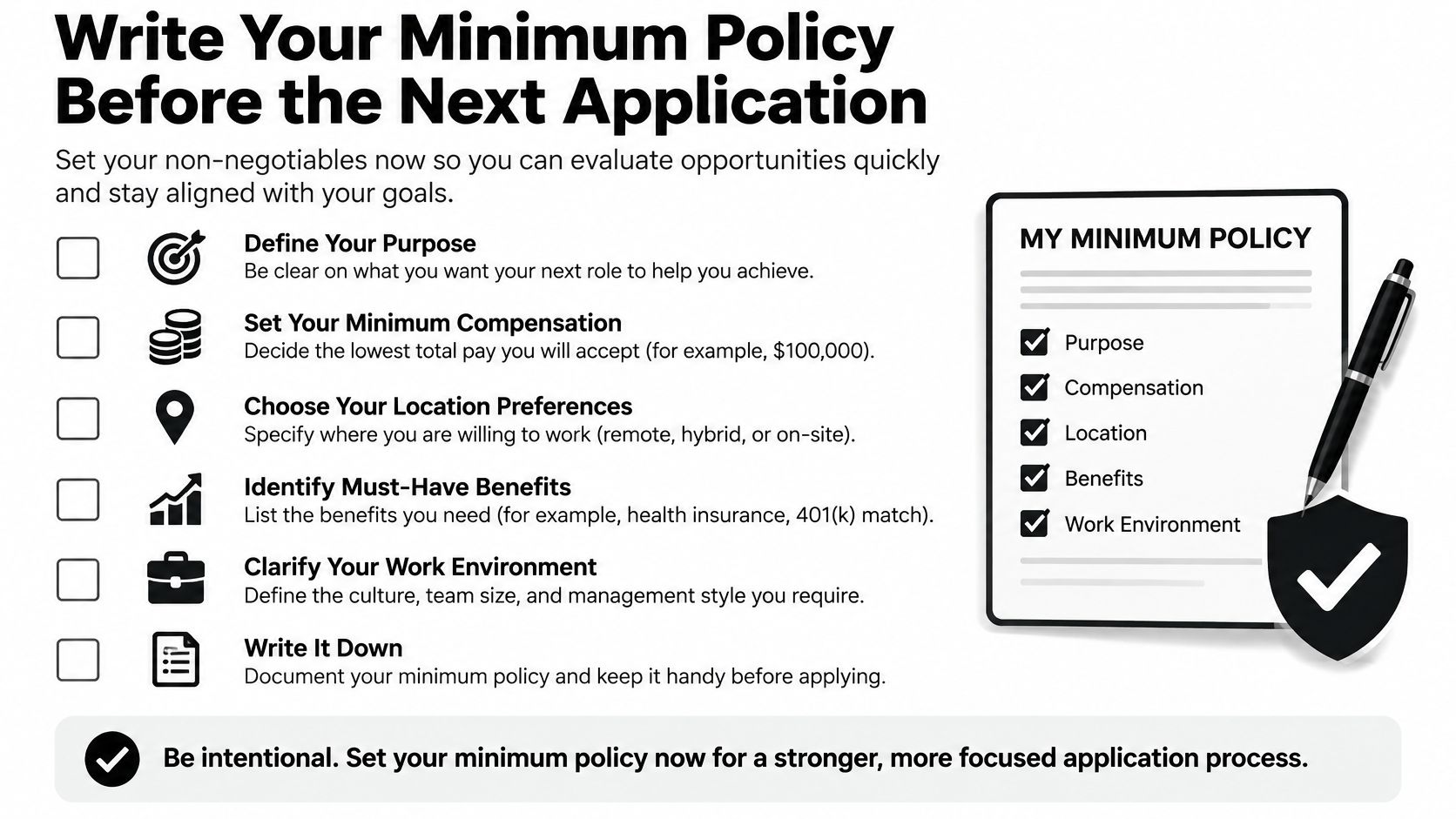
Build a usable decision checklist
- Define the score bands. State whether each band triggers ordinary processing, additional review, or a potential decline. Identify any verification required before the outcome becomes final.
- List the evidence. Specify acceptable income documentation, rental-payment records, references, and identity checks.
- Name compensating factors. Describe which verified strengths may address a weak credit file and which concerns require separate resolution.
- Assign borderline reviews. Name the decision-maker, establish an internal turnaround target, and explain how applicants receive updates.
- Preselect lawful alternatives. Document when a guarantor, additional deposit, or advance rent may be considered.
- Apply the policy uniformly. Account for applicable voucher rules and accommodation procedures rather than creating exceptions informally.
- Record the reason. Use a specific reason code and supporting note for each decline or conditional approval.
Use the checklist as a reminder to complete the policy before processing the next file.
Test the instructions against actual decisions
A useful reason code describes a verifiable issue, such as income documentation incomplete or unresolved housing balance confirmed. Avoid labels like bad applicant, which don't explain what criterion was unmet.
Keep a dated policy version with the file. If you change your standards, record when the revision takes effect instead of applying different expectations to applications already underway without notice.
Draft your tenant credit score minimum policy this week and test it against last year's applications. Compare the outcomes you reached with those the proposed policy would produce, then investigate where a cutoff would have excluded an otherwise qualified renter or overlooked a relevant payment concern.
VerticalRent brings credit, criminal, eviction, and rental history into one screening report so you can review the underlying information alongside your written criteria. Visit VerticalRent to organize your screening process around verification rather than a score alone.
Put this into practice
VerticalRent tools related to this guide
Legal Disclaimer
VerticalRent and its authors are not attorneys, CPAs, or licensed legal or financial advisors, and nothing on this site constitutes legal, tax, or professional advice. The information in this article is provided for general educational purposes only. Landlord-tenant laws, eviction procedures, security deposit rules, and tax regulations vary significantly by state, county, and municipality — and change frequently. Nothing on this site creates an attorney-client relationship. Always consult a licensed attorney or qualified professional in your jurisdiction before taking any action based on information you read here.
Co-founded VerticalRent in 2011, growing it from nothing to 100k landlords and renters. Sold it in 2019, then re-acquired it in 2026 to make it better than ever.


