Tenant Background Check California: Legal Rules and Steps
Tenant Background Check California: consent, FCRA notices, lawful criteria and compliant steps for landlords.


It's a Saturday morning, you have one vacancy in a fourplex, and three applications are sitting in your inbox. One report comes back with a flag near the bottom, and your instinct is to move to the next name and get the unit filled before Monday.
That instinct is where most small California landlords get into trouble. Not because they set out to discriminate, but because nobody told them that the order of their checks, the paperwork in the file, and the way they handled the screening fee decide whether a denial holds up six months later. A background report is a stack of claims about a person. What you do with those claims is the part the law regulates.
Why California Screening Rules Are Stricter Than You Think
An applicant with a strong income file and eight years at the same employer fills out your application. The report comes back and, halfway down, a line reads: arrest, twelve years ago, no disposition listed. You decline that afternoon and rent to the next person in line.
That single decision carries more legal risk than almost anything else in the rental process. California doesn't permit an adverse housing decision built on an arrest that never produced a conviction, and a report entry that shows an arrest with no outcome isn't evidence of anything you're allowed to weigh. The report told you something accurate and legally unusable at the same time.
Two layers of rules sit on top of that document. The federal Fair Credit Reporting Act governs how you obtain the report, what you must disclose before ordering it, and what you owe the applicant when its contents hurt them. California's rules go further and restrict which items may drive a housing decision at all, and they can be violated by a policy's effect rather than its intent.

Three mistakes cause most of the trouble in small portfolios:
- Treating the report as proof. Online court databases are not official records and go stale. A flag is a lead, not a finding.
- Blanket criminal-record exclusions. A flat "no felonies" policy is the fastest route to a fair-housing complaint, regardless of how carefully you apply it.
- No written criteria. If the standards lived in your head, you can't show you applied them the same way to everyone.
The rest of this guide follows the process in the order it has to happen: what you may check, the consent and criteria paperwork, the sequence of checks, how to weigh criminal and eviction records, fee handling, adverse action notices, and a file checklist. A screening process is lawful when every denial traces back to written criteria, applied the same way to every applicant.
What You Can and Cannot Check in California
One report can contain six or seven different categories of information, each with its own legal status. The table below sorts them before you open your next file.
| Check type | Allowed in California? | Key limit |
|---|---|---|
| Identity verification | Yes | Match name, date of birth and address; flag mismatches before relying on a record |
| Income and employment | Yes | Review after neutral criteria are met; apply the same income standard to every applicant |
| Credit history | Yes | Apply consistently; the applicant can dispute inaccurate items |
| Rental history and references | Yes | Verify with prior landlords; note periods with no verifiable address |
| Eviction records | Yes, with limits | Court-verified filings only; seven-year lookback applies in California |
| Criminal convictions | Yes, individualized | Must be directly related to tenancy obligations or safety; no blanket exclusions |
| Arrests without conviction | No | Cannot be grounds for an adverse housing decision |
| Sealed, dismissed or expunged records | No | Cannot be used in the decision |
| Juvenile-justice records | No | Cannot be used in the decision |
Sort the report before you weigh it
Identity, income and rental history are the low-drama categories, and that's exactly why they belong first in your workflow. They answer a neutral question: can this person cover the rent, and has this person paid rent before? Those standards should be numbers you wrote down before any application arrived, such as a rent-to-income ratio, applied to every file in the same order. Order matters here. A landlord who checks criminal history before income has already created a record that looks like pretext, even when the final decision was legitimate.
A rental history report earns its place in this first pass. It shows periods with no verifiable address and addresses that don't match what the applicant listed on their application, which are follow-up questions, not automatic denials. What it does not show matters just as much: no credit score, no eviction filings, no criminal records. Each of those is a separate search with its own consent and cost implications, so treat the rental history as a verification step, not a shortcut around the other checks.
Credit sits in the same low-drama group, with one caveat. Disputes happen, and a collections entry that turns out to belong to someone else is common enough that you should never deny on a single line item without reading the rest of the file. When you set your credit standard, resources covering how landlords screen tenant credit can help you think through score thresholds, provided you pick your number before you open anyone's report and apply it identically afterward.
The categories that need a second look
Eviction and criminal records are the two that generate denials and, therefore, complaints. California's test for criminal history is the one out-of-state landlords most often fail. Los Angeles County's tenant screening guidance states that housing providers generally may not discriminate based on criminal history unless the conviction directly relates to the applicant's ability to fulfill tenancy obligations.
Everything in the bottom three rows of the table is off limits, full stop. A report may still display a dismissed case or an old arrest, because the data vendor dumped a county index into your file. Your job is to filter, not to forward. If a prohibited item appears in your decision notes, a judge or investigator will reasonably assume it influenced the outcome, and "I didn't rely on it" is a weak defense when it's written in your own spreadsheet.
The one question to ask of every line: can I tie this specific, lawful piece of information to whether this applicant can pay rent and protect the property?
If the answer is no, the item doesn't belong in your reasoning, your notes, or your decision. That discipline keeps a tenant background check in California narrower than most landlords expect, and narrow is exactly what survives scrutiny.
Consent, Criteria and the Compliant Screening Sequence
An applicant clears income, the file looks clean, and the denial still fails because the report was ordered before consent was on file. California treats that sequence as part of the decision, not as office housekeeping. Four documents have to exist before you pull a report, not after someone asks why they were turned down.
The paperwork that has to exist first
Written authorization. When you run a report on an applicant, you must certify that you hold their written authorization. No signature on file, no order.
A disclosure that a consumer report may be obtained, stating what the report can include and that the applicant has rights under the Fair Credit Reporting Act, including the right to a copy and to dispute errors.
Your written screening criteria, attached to the application. The applicant should see the income standard, the credit standard, and the criminal-history approach before they submit or pay anything.
A retrievable timestamp. Electronic consent is fine when you can pull the record later. Before any eviction search begins, the applicant must provide written consent. VerticalRent collects that consent electronically with a timestamped record that drops into the landlord's compliance file, which is the version that still exists if a dispute arrives eight months later. An email that says "yes, go ahead" is a weak substitute. Use a proper tenant background check authorization form before the next applicant cycle.
The nine-step sequence
Run this identically for every applicant, in this order. Deviating is where liability starts.
- Publish dated, version-controlled criteria and attach them to the application. Note the version number and the date. Criteria change, and you need to know which version governed which file.
- Record the completion time. California processes applications in the order completed, so a timestamp is what proves who was first when two applicants both qualify.
- Collect written consent and save it, then order the report. Never order first and chase paperwork later.
- Verify identity by matching name, date of birth, and address history. Flag mismatches, name variations, and gaps before you read anything else.
- Assess neutral criteria first. Income, employment, and verified rental history. Score these before criminal or eviction data enters the conversation.
- Review criminal and eviction information only for applicants who pass step five, and only in the categories the law permits.
- Run an individualized analysis on any conviction, and give the applicant a real opportunity to submit mitigating information: rehabilitation evidence, the age at the time of the conduct, disability or domestic-violence context, and rental history since.
- Have a person review any proposed denial before it is issued. An automated score is an input, not a verdict.
- File everything together. Report, criteria version, consent, timestamps, and reasons in one folder per applicant.
The California Civil Rights Department guidance on criminal history screening lays out those mitigating factors. Read it before you write your criteria, not after a complaint arrives.
Assessing criminal history before income means the criminal record did the work. That is the pattern investigators look for.
Three slips account for most of the failures here: ordering the report before consent is on file, reviewing criminal history first because it is the most interesting part of the file, and accepting an automated pass or fail without checking the underlying record. Any one of them turns a defensible decision into an arbitrary one. I would rather delay a strong applicant one day than defend a denial whose consent, criteria version, and timestamps do not line up.
Criminal and Eviction Records You Can Use
These two record types drive most denials, so they deserve the most documentation. The standard isn't whether a record exists. It's whether you can explain, in writing, why this record affects this tenancy.

How to document a conviction
The California Civil Rights Department housing guidance frames the test clearly. A blanket policy excluding everyone with a criminal record is unlawful. If criminal history contributes to a denial, the decision must rely on a conviction that is "directly related" to the applicant's ability to meet tenancy obligations or to protect the health and safety of people or property. The state's rules also recognize that a policy can be unlawful because of its discriminatory effects even when nobody intended to discriminate, and those requirements became especially significant when the clarifying regulations took effect on January 1, 2020.
For each conviction, write a short note covering four things:
- Nature and seriousness of the offense, in plain words rather than a statute number.
- Relevance to paying rent or to protecting people and property. A decades-old shoplifting conviction has no bearing on either.
- Time elapsed since the conduct, not since the sentencing.
- Mitigating evidence the applicant supplied, including rehabilitation, references, and rental history since the conviction.
Sealed, dismissed, and expunged records never enter the analysis, and neither do juvenile-justice records.
Eviction filings need a second look
A filing is not an eviction. Cases get dismissed, settled, or resolved before judgment, and the outcome is what tells you whether the applicant cost a previous landlord money or had a dispute that ended without one. The seven-year lookback for eviction records applies in California, so anything older should be excluded from the decision rather than weighed lightly.
| Record type | Usable? | Rule and factors to document |
|---|---|---|
| Criminal conviction | Yes, individualized | Nature and seriousness, relevance to rent or safety, time elapsed, mitigating evidence |
| Eviction filing | Yes, court-verified only | Check the outcome (judgment, dismissal or settlement); exclude filings older than seven years |
| Arrest without conviction | No | Cannot support an adverse housing decision |
| Blanket criminal-record exclusion | No | Unlawful under California guidance |
Identity matching deserves its own paragraph, because it's the failure mode that produces the worst outcomes. Common names in dense counties generate false matches regularly, and the only defense is comparing date of birth and address history against the court record before you act. If the report gives you a name and a case number and nothing else, verify at the county before it touches your decision.
Here's how the time factor changes an analysis. Two applicants carry the same conviction for a theft offense. The first was released eight months ago and has no rental history since. The second was released eleven years ago, has rented for nine of those years, and has a landlord reference confirming on-time payments. The first raises a legitimate question about current risk. The second doesn't, and denying them on that record alone is the kind of decision a fair-housing investigator will pick apart.
Write one short note per record saying whether you used it and why. That note is the difference between a documented individualized assessment and a decision someone has to reverse-engineer from a score.
Application Fees and Reusable Reports
Fee compliance is where careful landlords still get it wrong, because the rules govern the process behind the charge, not just the number.
| Fee rule | What it requires | Landlord action |
|---|---|---|
| Maximum fee | $30 per applicant | Keep the fee at or below the cap |
| Basis of fee | Actual screening costs only | Tie the fee to real costs and permitted screening |
| Refund | Unused amount returned if no personal-reference check or credit report is done | Track each applicant's spending and refund the difference |
| No unit available | Fee cannot be collected when no unit will be available within a reasonable period | Confirm availability before collecting |
| Screening process | Required offer of a qualifying screening process when collecting the fee (since 2025) | Document the process offered |
| Reusable report accepted | No extra application-screening fee or access fee | Waive both charges for applicants who submit one |
The California Civil Code section governing application screening fees permits a screening fee only for actual screening-related costs, caps it at $30 per applicant, and requires unused amounts to be returned when the landlord doesn't perform a personal-reference check or obtain a consumer credit report. Recent state guidance adds that, since 2025, a landlord collecting the fee must offer a screening process meeting specified requirements, and can't collect at all when no unit will be available within a reasonable period.
That last point is the contrarian one worth internalizing: charging $20 instead of $30 doesn't make a process compliant. The fee still has to be tied to actual costs and to legally permitted screening activity. A landlord who takes $20 and runs nothing has a simpler problem than one who takes $30 without the qualifying process, but both owe money back.
When the fee has to come back
Refunds get lost when nobody tracks per-applicant spending. I would keep a simple log with three columns: amount collected, report ordered, and amount refunded with the date. If you skip the personal-reference calls and don't pull a consumer report, the unused balance goes back, and the log is your proof it did.
Reusable tenant-screening reports changed the arithmetic. The California Department of Real Estate resource guide confirms that landlords aren't required to accept a reusable report, but if you do accept one, you may not charge an additional application-screening fee or any fee to access it. The report must contain five core categories: the applicant's name, contact information, employment verification, last known address, and eviction history.
For applicants, that improves portability across a dozen applications. For landlords, it sets a useful benchmark for what a complete screening file contains, and it means your fee workflow needs a branch for applicants who arrive with a report in hand. A clear rundown of California rental application fee rules helps when you're setting the fee schedule for the year.
Adverse Action Notices and Disputes
Adverse action is where the common assumption breaks. Landlords tend to think a report settles the question. It doesn't. A joint comment from state attorneys general notes that online court databases are not official records and can contain errors or omissions requiring verification for accuracy, currency, and completeness, which is a polite way of saying the record in front of you may be wrong.
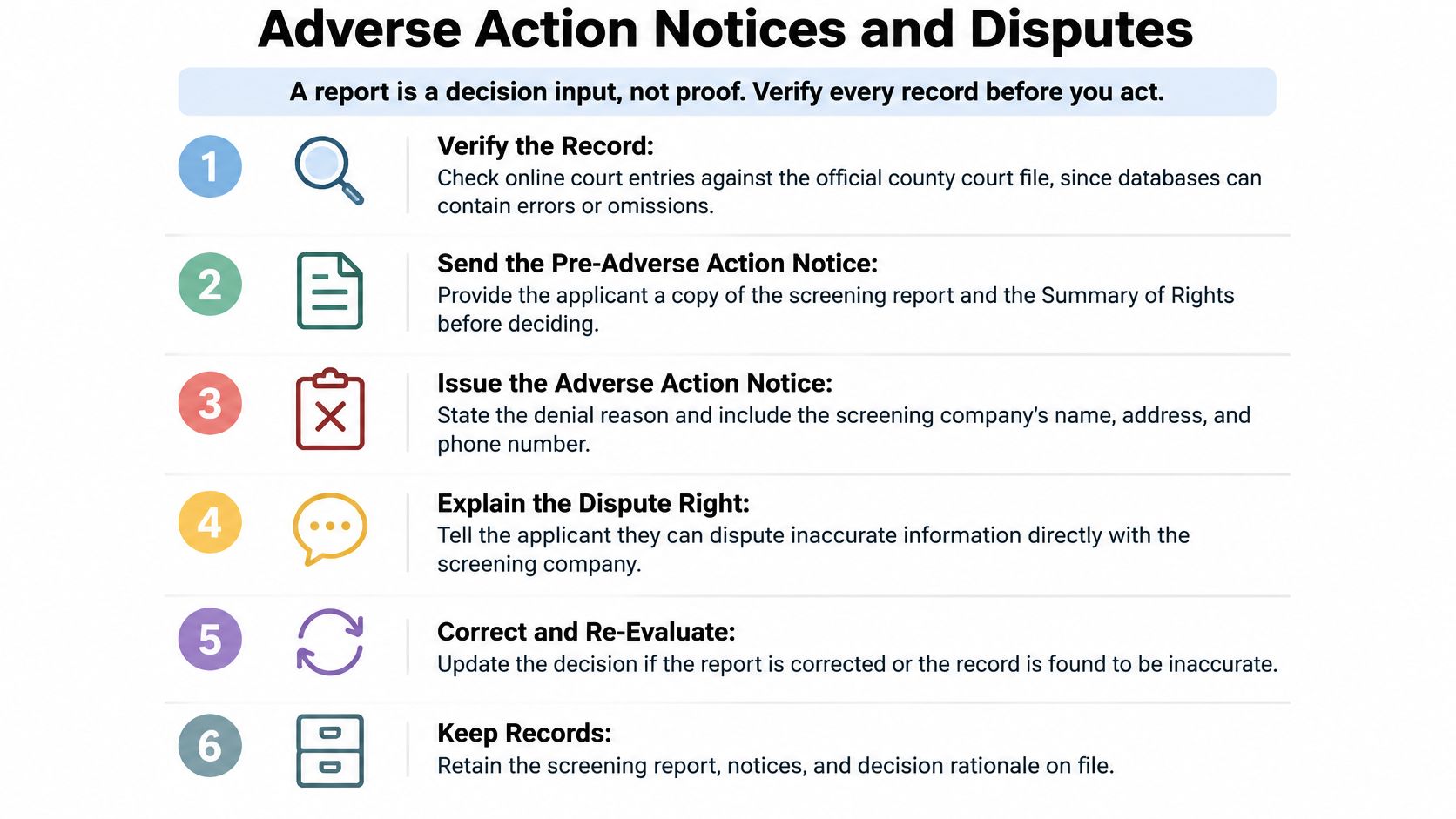
Under the Fair Credit Reporting Act as applied to tenant screening.pdf), when report information contributes to a denial or other adverse action, the applicant must receive notice. The FTC identifies two rights that notice has to convey: the right to receive the adverse-action notice itself and the right to dispute inaccurate information.
What the notice has to contain
- The material report information that drove the decision, identified specifically rather than described as "screening results."
- The consumer reporting agency's name, address, and phone number, so the applicant can request their free copy and dispute directly.
- The applicant's dispute rights, stated plainly. For eviction-based denials, the notice goes out before the denial takes effect, not alongside the rejection text.
VerticalRent generates the FCRA-required adverse action notice automatically when an application is denied based on eviction history, including the consumer reporting agency's contact information. That removes the formatting error risk, but the reasoning is still yours to review. On this topic, how to write an adverse action letter covers the wording that holds up.
Run disputes as a pause, not a fight
When an applicant disputes an item, stop the clock. Pull the county court record, confirm the case number, the parties, and the disposition, and compare date of birth and address history against your applicant. If the record belongs to someone else or the case was dismissed, correct the file, withdraw the item, and re-evaluate the application on the remaining information. Then log the outcome, the date, and who reviewed it.
A dispute isn't an argument to win. It's the cheapest error-correction mechanism you have, and using it protects you from the one failure that's hardest to defend: a false match that became an unreviewed denial.
Before you close the file, confirm it holds the report copy, the signed consent, the criteria version in force at application time, the completion timestamp, a copy of the notice sent, and the dispute log if there was one. That bundle is what you'd hand over if anyone ever asks why this applicant and not another.
Confirm Your Screening Workflow Before the Next Application
The rules only matter if your records prove you followed them, and the fastest way to find out is to test the workflow against files you already have. Pull your last three applications and read them cold.
Each file has to prove four things. The criteria version in force at application time is on file. Consent was recorded before the report was ordered. Every criminal or eviction item is tied to a permitted category and carries an individualized note. The fee matches actual costs and any required refund was tracked and dated.
Files that fail any of those checks need correcting before you issue another denial. That correction work is unglamorous and worth doing on a quiet weekend rather than in the middle of a vacancy.
Then take two actions this week.
Standardize the record. Put the consent, criteria, timestamp, report, and notice templates into your application package so every applicant generates the same file structure by default. The paperwork standards described earlier become a checklist you file against, not something you reconstruct when a question comes up.
Name one reviewer. Assign a single person, even if that person is you, to review every proposed denial before the notice goes out. The reviewer's job is narrow: confirm the record was verified, the category is permitted, and the note explains the connection to this tenancy.
This is general information, not legal advice, and local ordinances in some California cities add requirements on top of state law. If you're already in a disagreement with an applicant or a fair-housing organization, talk to a California attorney before you respond.
VerticalRent gives independent landlords the screening workflow this article describes: FCRA-compliant credit, criminal, eviction, and rental history reports with electronic consent captured and timestamped, plus automatic adverse action notices when a denial rests on eviction history. If you're tightening your process before the next vacancy, publish your criteria, run the checks in order, and let VerticalRent keep the file complete from application through decision.
Put this into practice
VerticalRent tools related to this guide
Legal Disclaimer
VerticalRent and its authors are not attorneys, CPAs, or licensed legal or financial advisors, and nothing on this site constitutes legal, tax, or professional advice. The information in this article is provided for general educational purposes only. Landlord-tenant laws, eviction procedures, security deposit rules, and tax regulations vary significantly by state, county, and municipality — and change frequently. Nothing on this site creates an attorney-client relationship. Always consult a licensed attorney or qualified professional in your jurisdiction before taking any action based on information you read here.
Co-founded VerticalRent in 2011, growing it from nothing to 100k landlords and renters. Sold it in 2019, then re-acquired it in 2026 to make it better than ever.


