Rental Application Approval Criteria: What Landlords Check
Learn the rental application approval criteria landlords use: income, credit, rental history, background checks and fair housing rules, with clear numbers.


Three rental applications land in your inbox on a Tuesday afternoon. One applicant has a high credit score but started a new freelance consulting business two months ago. The second has steady W-2 income at three times the rent, a lower credit score from an old medical bill, and four years of on-time rent receipts. The third uses a housing voucher and has spotless landlord references, yet your screening software flags them with a borderline score. Without written rental application approval criteria, you're stuck guessing, and guessing is where landlords lose money or trigger fair housing complaints.
The stakes for getting screening right keep climbing. In a 2024 survey published by the National Multifamily Housing Council, WPXI reported that 93.3% of owners, managers, and developers experienced rental-application fraud during the previous 12 months. Tightening your process makes sense, yet overly rigid cutoffs create a different trap. Most screening guides skip two practical realities: upfront cash at application and move-in often blocks qualified renters before monthly affordability ever does, and raw records require contextual review rather than automatic rejections. Holding every applicant to the exact same written thresholds, without letting an opaque score make the final call, protects both your cash flow and your legal standing.
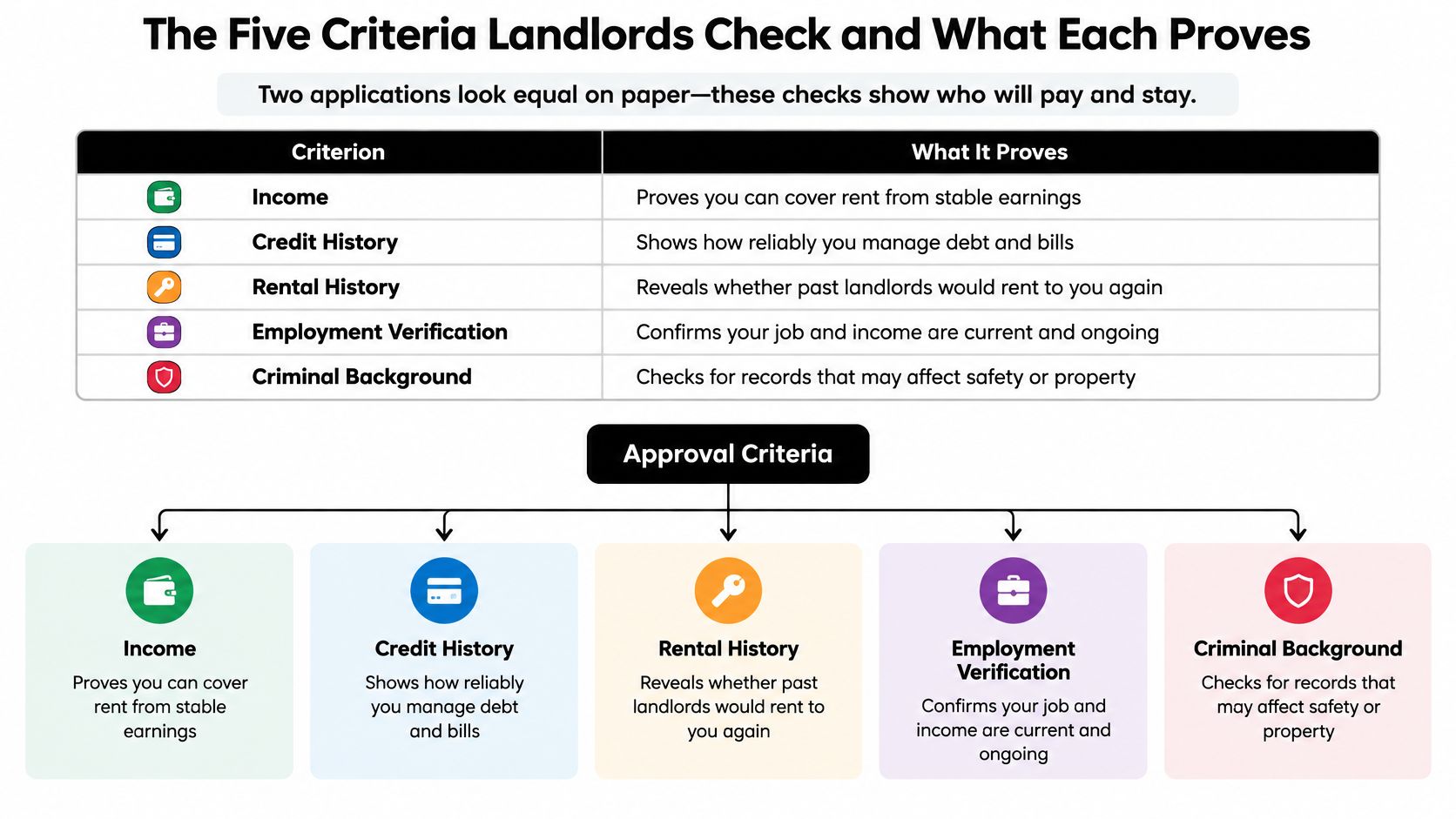
The Five Criteria Landlords Check and What Each Proves
Consider two applicants competing for the same two-bedroom apartment. Both submit clean forms, both show up on time for the tour, and both claim steady work. On paper, they look identical until structured verification separates who's likely to pay reliably and care for the unit from who's stretching their budget thin.
Before you review a single file, lay out the five core checks side by side so you know what each piece of evidence measures.
| Criterion | What It Shows | Common Benchmark | Usual Source |
|---|---|---|---|
| Income | Ability to pay rent | Gross monthly income of about 2.5x to 3x the rent | Pay stubs, tax returns, bank statements |
| Credit history | How debt obligations were handled | Score cutoff written into the policy | Consumer credit report, with applicant consent |
| Rental history | Past payment and lease behavior | Verified on-time rent and no unresolved judgments | Prior landlord verification or rental history report |
| Background and public records | Relevant conduct and safety risk | Relevant convictions inside a set look-back period | Criminal and eviction records, with written authorization |
| Landlord references | Conduct as a tenant | Consistent, reasoned ratings from prior landlords | Direct contact with former landlords |
Each check answers a narrow operational question. Income proves ongoing cash capacity, while credit history tracks how the applicant manages recurring debt obligations. Rental history focuses directly on housing payment behavior and lease compliance, background and public records screen for verified conduct that threatens resident safety or property, and landlord references reveal day-to-day tenancy habits that databases never capture.
The visual chart below maps how those five checks branch down from one consistent approval decision.
Defining Your Screening Variables Before Listing
Picking five categories isn't enough to make a policy defensible. According to the 2024 HUD FHEO screening guidance, a sound screening model evaluates applicants using prepublished, consistently applied criteria across at least four dimensions: ability to pay, credit obligations, rental history, and relevant public-record information.
What makes that policy hold up under scrutiny is locking down five technical controls before the vacancy opens:
- Look-back period: Set the exact time window you'll examine for late payments, eviction judgments, or relevant criminal convictions.
- Data source: Name which documents or consumer reporting agencies count as valid verification for each category.
- Decision threshold: State the numeric cutoff or factual standard required for standard approval.
- Exception process: Define in advance how borderline applicants can qualify through documented mitigating evidence or conditional terms.
- Documentation requirements: Specify what you'll save in the file, including input records, reviewer notes, and exception proof.
Write every threshold on a single page before you publish your next listing. If you can't measure two competing applicants against that exact sheet without improvising a new rule, your criteria aren't finished yet.
How Much Income Qualifies Using Rent Multiplier Math
Most independent landlords start with a simple benchmark: gross monthly income should equal 2.5 to 3 times the monthly rent. The math exists for a practical cash-flow reason. Once rent consumes much more than a third of pre-tax income, taxes, utilities, groceries, childcare, and car repairs squeeze what's left, and a single unexpected expense can trigger a missed rent check.
Here is how those two multipliers translate into required gross monthly earnings across four common rent levels.
| Monthly Rent | Income at 2.5x | Income at 3x |
|---|---|---|
| $1,000 | $2,500 | $3,000 |
| $1,500 | $3,750 | $4,500 |
| $2,000 | $5,000 | $6,000 |
| $2,500 | $6,250 | $7,500 |
If you're calibrating whether 2.5x or 3x fits your local market wages and utility structure, our guide to the income-to-rent ratio for rental screening breaks down the trade-offs in more detail.
Counting Nontraditional Income Co-Applicants and Vouchers
Writing "3x rent" on a listing isn't enough because real households don't all earn a single W-2 paycheck. Decide ahead of time which income streams count and how you'll verify each one. Standard acceptable sources include salaried wages via recent pay stubs, self-employment or gig earnings via tax returns and several months of bank statements, Social Security or disability benefits via award letters, and court-ordered alimony or child support if the applicant chooses to disclose it.
Three situations come up on almost every multi-bedroom listing, and your written sheet should answer all three clearly:
- Co-applicants and roommates: State one consistent rule for combining household earnings. Most landlords count the combined gross income of all adult leaseholders in full, provided every adult completes the full screening process and signs the lease jointly.
- Housing vouchers and subsidies: Count lawful source-of-income payments at their verified amount. In many jurisdictions, and as a smart standard everywhere, you subtract the voucher portion from the monthly rent first and apply your multiplier only to the tenant's out-of-pocket share. On a $2,000 unit where a voucher covers more than half the rent, a 2.5x standard applies only to the tenant's remaining portion rather than requiring the full $5,000 in gross monthly income.
- Borderline income with strong reserves: Rather than issuing an automatic denial when an applicant sits slightly below the multiplier, define a written conditional-approval path. A verified savings cushion, a qualified guarantor who meets a higher income multiple, or a larger security deposit (where local caps permit) lets you protect against default without turning away a reliable payer.
Why Upfront Liquidity Blocks Qualified Renters
Monthly rent math only tells half the affordability story. Upfront cash required just to apply and move in often determines who can compete for your unit. In the National Low Income Housing Coalition's 2025 National Renter Survey, nearly three-quarters of renters who moved in the prior year paid a median application fee of $75, and respondents pointed to an inability to afford security deposits, application fees, or move-in fees as a reason they couldn't move. Among renters in that same survey who were told why an application was denied, 70.6% cited credit score and 55.4% cited household income below the landlord's requirement.
Charging non-refundable screening fees to applicants who clearly don't meet your published multiplier burns trust and wastes your review time. Disclose your exact screening fee and minimum thresholds in writing before taking anyone's money, and consider offering structured deposit payment plans where lawful when a renter's ongoing monthly cash flow is solid. Whatever multiplier, income sources, and conditional paths you choose, apply the exact same formula to every applicant for that unit.
Reading Credit and Rental History Without Overreacting
A raw credit score tells you how someone managed auto loans and credit cards, not necessarily whether they prioritize paying their landlord on the first of the month. Treating a thin credit file like a defaulted credit file is one of the fastest ways to reject strong renters. Federal housing principles reinforce this distinction: HUD's public-housing screening guidance explains that a lack of credit history, unlike a poor credit history, isn't by itself sufficient justification for rejection. The same logic holds for rental history. A first-time renter or someone returning from living with family has missing rental history, not poor rental history, and shouldn't be turned away solely for a blank line.
Look at two applicants who both carry the same borderline credit score. Applicant A has twelve consecutive on-time rent payments confirmed by their current landlord, zero housing collections, and a score dragged down by a single high-utilization credit card during a family emergency. Applicant B holds that exact same score, but their ledger shows two late rent payments in the past twelve months and an unpaid balance owed to an electric utility. If you only stare at the three-digit score, those files look identical. When you examine housing-specific payment history, the risk gap is obvious.
Separating Real Risk Signals From Credit Noise
When you open a consumer credit report, scan past the headline number and sort what you find into three clear buckets:
- Housing and utility obligations: Unpaid balances owed to former landlords, housing collections, or active utility charge-offs directly predict tenancy risk and deserve the heaviest weight.
- Payment patterns over isolated slips: Count late payments over the past twelve months. One late payment during a documented job transition reads very differently than three late checks in six months.
- Medical collections and disputed accounts: Separate a single medical collection, a small disputed bill, or an older discharged obligation from open, recurring delinquencies.
Some otherwise dependable applicants are actively rebuilding rental history after debt discharge following a Chapter 7 filing, which wipes out competing unsecured debts and can free up monthly cash for rent. Checking current verifiable income and recent post-discharge payment habits gives you a far better read than an automatic ban.
Practical screening rule: Never treat "no score" as "bad credit." When an applicant has a thin file or a gap in traditional leases, ask for twelve months of bank statements showing recurring rent transfers, canceled rent receipts, utility payment histories, or a verifiable reference from a previous housing provider.
Write down in advance which credit and rental signals disqualify an applicant outright, which require a short written explanation, and which carry no weight on their own. Then save a two-sentence note in the file explaining how you weighed those exact signals for every approval or denial.
Background Checks, Criminal Records and Eviction Filings
Many small landlords still keep a blanket line in their listing that says "no criminal record, no evictions." That single sentence creates massive fair housing exposure and often produces flatly wrong screening decisions. On April 4, 2016, HUD issued formal Fair Housing Act guidance establishing that housing providers shouldn't use arrests or charges that didn't result in a conviction as automatic grounds for denial, because an arrest proves nothing about underlying conduct. The guidance warns that overly broad criminal, credit, and rental-history bans can unjustifiably exclude applicants based on race, color, or national origin, and recommends an individualized review weighing the type, nature, and severity of a conviction, how long ago it happened, and mitigating factors like age at the time, rehabilitation, and subsequent rental history.
Replacing a blanket ban with an evidence-based policy starts by verifying what each public record represents before assigning it any weight.
| Record Type | What to Verify | How to Weigh It |
|---|---|---|
| Eviction filing | Whether a judgment was entered or the case was dismissed | A filing alone is not a judgment; weigh recent judgments only |
| Criminal conviction | Offense type, date and identity match | Weigh relevant convictions inside the policy look-back period, reviewed individually |
| Arrest with no conviction | Whether a conviction followed | Not grounds for automatic denial |
| Unpaid collection or debt | Whether it was paid, settled or disputed | Paid or disputed items count less than open balances |
Setting Look-Back Periods and Individualized Review
A defensible criminal screening standard specifies exactly which offenses relate to resident safety or property protection and caps how far back you look. For instance, your written policy might evaluate relevant convictions occurring within three years from the application date, rather than reaching back a decade for a minor misdemeanor. Keep in mind that old or dismissed entries still linger in commercial databases even when the person qualifies to have them sealed; understanding who can clear a criminal record helps explain why older court entries sometimes appear on background reports before expungement paperwork finishes clearing every private vendor's feed.
Before you rely on any negative court or eviction hit, confirm the identity match thoroughly. Never attach a record to an applicant based on name alone. Cross-check full legal name, date of birth, middle initial, and prior address history so a common name doesn't saddle an innocent renter with someone else's docket.
Getting Proper Written Authorization First
Legal compliance starts before you click "run report." When a landlord runs a screening report on an applicant, the landlord must certify that they have the applicant's written authorization. Before any eviction search begins, the applicant must provide written consent, which VerticalRent collects electronically with a timestamped record for the landlord's compliance file. Keeping that signed authorization paired with the verified report protects you if a screening decision is ever questioned.
Keeping Criteria Fair Under Fair Housing Rules
Landlords often buy automated screening software assuming that a numerical score eliminates bias. Data-driven criteria aren't automatically fair. A U.S. Government Accountability Office report warns that tenant-screening algorithms can create disparate impacts when they rely on criminal or eviction records, because those databases reflect unequal exposure to the criminal-justice and housing-court systems. The GAO report also describes allegations that a screening algorithm assigned low scores to Black applicants using housing vouchers, even when guaranteed voucher income and strong tenancy history provided countervailing evidence. A 2025 Georgetown analysis similarly reports that automated screening can return inaccurate, outdated, or misleading information and may disproportionately affect Black and Latino renters.
The balance between consistent quantitative checks and fair housing obligations requires human oversight, not blind automation.

Building a Contextual Review Workflow
Outsourcing a decision to an AI-assisted scoring model doesn't remove your legal responsibilities under federal, state, or local fair housing regulations. If an opaque red-yellow-green recommendation rejects a qualified voucher holder or penalizes a dismissed court filing, you're still the housing provider on the hook.
To keep decisions both uniform and defensible, add a contextual review step whenever a report flags a borderline or negative record:
- Confirm record outcomes: Check whether an eviction docket ended in a judgment against the tenant or was dismissed, settled, or filed during a repair dispute.
- Verify debt status: Confirm whether a reported collection was subsequently paid, settled, or formally disputed before counting it against the applicant.
- Count lawful income identically: Apply the same calculation method to vouchers, benefits, and nontraditional pay across every applicant, without penalizing the source.
- Invite mitigating evidence: Give applicants a consistent, time-bounded window to submit rehabilitation records, proof of payment, or landlord explanations before finalizing a denial.
Good fair housing compliance isn't about lowering your standards. It's about proving your standards accurately measure tenancy risk and giving every applicant the same fair review.
Keeping an Audit Trail You Can Defend
Every screening decision should leave a clear paper trail. For each vacancy, save the published criteria sheet that was active when the listing went live, the verified input documents, the reviewer's brief rationale for approving or denying, and any mitigating evidence submitted during contextual review. Where legally permissible, review your approval and denial patterns periodically across properties to spot whether a seemingly neutral rule is screening out reliable renters for reasons unrelated to paying rent on time.
How to Handle a Denial Under FCRA Adverse-Action Rules
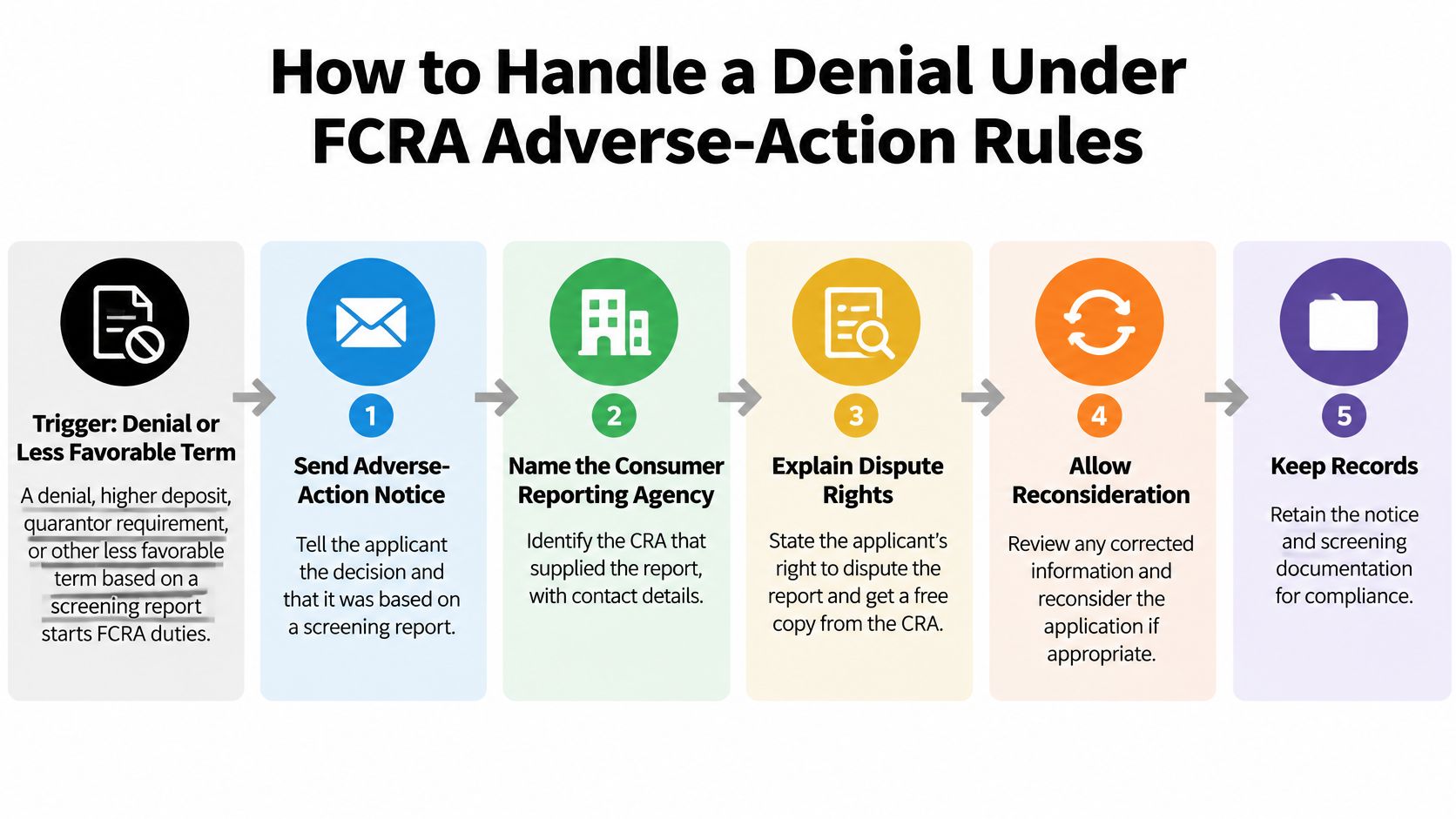
Turning down an applicant isn't the only decision that triggers federal reporting duties. Under the Fair Credit Reporting Act, a full denial, a higher security deposit, a guarantor requirement, or any other less favorable lease term based in whole or in part on a tenant-screening report starts adverse-action obligations. According to Consumer Financial Protection Bureau materials, an applicant generally has 60 days to obtain a free copy of their report from the screening company after an adverse action, and disputes over inaccurate items are typically investigated within 30 days.
The process chart below outlines the core compliance flow once a screening report leads to a denial or conditional approval.
Six Steps for a Compliant Adverse-Action Workflow
Relying on a bare pass-or-fail score breaks down the moment you have to explain a denial. Follow these six steps every time a screening report drives a negative or conditional outcome:
- Pinpoint the exact criterion. Identify the specific report attribute and written policy threshold that caused the decision, separating verified bureau or court records from applicant-supplied details. Writing a vague phrase like "failed screening" invites legal challenges and leaves the applicant unable to spot reporting errors.
- Double-check identity markers. Verify that the name, date of birth, and address history on the adverse record fully match your applicant before taking action. Screening vendors aren't permitted to match public records solely by name, and catching a mixed file early prevents wrongful denials.
- Offer pre-adverse-action review when appropriate. Where local law requires it or a negative record looks questionable, share the specific finding before finalizing rejection so the applicant can point out a dismissal, payment receipt, or identity mismatch.
- Pause long enough for notices and corrections. Hold off on closing the file immediately if the applicant flags a clear reporting error and opens a formal dispute with the reporting agency. Giving the statutory dispute window room to work avoids turning away a strong tenant over bad vendor data.
- Send a complete written adverse-action notice. Tell the applicant clearly that screening information influenced the decision, name the consumer reporting agency with its contact details, explain that the agency didn't make the rental decision, and state the applicant's right to dispute inaccuracies and request a free copy. If you need a breakdown of required wording, review our checklist for writing a compliant adverse-action letter.
- Log the final outcome. Keep a dated copy of the notice in your compliance file and record whether the decision changed after any dispute correction or mitigating documentation came in.
If you deny an application based on eviction history, VerticalRent generates the FCRA-required adverse action notice automatically, including the consumer reporting agency's contact information.
For a quick walkthrough of how these federal disclosure rules apply in day-to-day screening, watch the video below.
Confirm Your Approval Criteria Before the Next Application
Policies that live in your head fail the first time you get busy or face a tough choice between two applicants. Put your complete rental application approval criteria on one clean page before you list your next unit, covering every threshold, look-back window, data source, exception path, and required document.
A Sample One-Page Approval Criteria Sheet
Here is what a practical, balanced policy looks like once filled in for a typical independent rental:
- Income threshold: Verifiable gross monthly income of 3x monthly rent (with housing vouchers subtracted from rent first, applying the multiplier to the tenant's share), verified through two recent pay stubs, tax returns, or benefit award letters.
- Credit review: Open landlord or utility collections disqualify; bare scores below cutoff trigger contextual review of twelve-month rent payment history rather than automatic rejection.
- Rental history: Twelve months of verifiable on-time rent via prior landlord contact; applicants with no rental history qualify by supplying twelve months of bank statements, utility records, or an alternate housing reference.
- Criminal records: Individualized review of relevant convictions affecting safety or property within a three-year look-back period from the application date; arrests without conviction aren't considered.
- Eviction records: Verified eviction judgments within the look-back window only; dismissed filings or pending disputes aren't counted as disqualifiers.
- Conditional approval route: Applicants who fall slightly below the income or credit threshold can qualify with a guarantor meeting 4x monthly rent or an increased security deposit within state limits, documented in writing.
Three Habits to Lock In Consistency
Writing the sheet is half the job; running it cleanly across every vacancy is the other half. Put these three operational steps on your calendar:
- Assign one owner for adverse-action notices. Decide before listing who generates and sends every required notice so a denied or conditionally approved applicant never slips through without paperwork.
- Log the written criterion behind every denial. Record the exact policy line and supporting document in a simple spreadsheet or property management log for each rejected application.
- Audit your approval and denial rates quarterly. Review why applicants are getting turned down every three months to spot whether one cutoff is rejecting otherwise reliable renters or creating avoidable friction.
Modern screening tools can trim hours off this workflow without replacing your judgment. VerticalRent's AI Application Coach reviews a renter's application and gives tips to improve approval odds before submission. On the landlord side, automated landlord reference verification has prior landlords rate tenants across 6 categories with star ratings, in about 2 minutes, with no signup required.
A one-page criteria sheet only protects your rental business if every single applicant who tours the property meets the exact same version of it.
Ready to turn your written screening sheet into a fast, documented workflow? With VerticalRent, independent landlords can collect timestamped electronic screening consent, run FCRA-compliant credit, criminal, eviction, and rental history checks, and automate required adverse-action notices from one dashboard. Visit the platform before your next vacancy opens to screen every applicant consistently and lease with confidence.
Put this into practice
VerticalRent tools related to this guide
Legal Disclaimer
VerticalRent and its authors are not attorneys, CPAs, or licensed legal or financial advisors, and nothing on this site constitutes legal, tax, or professional advice. The information in this article is provided for general educational purposes only. Landlord-tenant laws, eviction procedures, security deposit rules, and tax regulations vary significantly by state, county, and municipality — and change frequently. Nothing on this site creates an attorney-client relationship. Always consult a licensed attorney or qualified professional in your jurisdiction before taking any action based on information you read here.
Co-founded VerticalRent in 2011, growing it from nothing to 100k landlords and renters. Sold it in 2019, then re-acquired it in 2026 to make it better than ever.


