Landlord Tenant Law Louisiana: Rules and Deadlines
Learn the essentials of landlord tenant law Louisiana: lease rules, deposit deadlines, repair duties, notice periods and the eviction process.


A tenant texts you on a Friday afternoon. The unit is empty, the keys are on the kitchen counter, and she wants to know when the deposit arrives. You remember the move-out roughly. You don't remember the exact date, you never photographed the hallway carpet, and the only repair invoice is a text from your handyman saying "fixed it."
That gap, small as it feels on Friday, is where Louisiana deposit and eviction disputes usually start. The dates and the documents decide the outcome, not the amount of rent owed. This walkthrough goes from the lease outward, names the deadlines Louisiana sets, and shows where a missing record costs more than the money in dispute.
Louisiana Landlord and Tenant Rules at a Glance
Start with the calendar, because Louisiana's rules are unusually date-driven. A deposit deadline that runs from the day possession ends, a notice period counted in business days, and a court process that can't begin until the notice has run its course all sit on the same timeline. Miss one date and the rest of the file stops mattering.
Here is the reference table. Every row is a rule you can put on a calendar today.
| Topic | Louisiana rule | Where it comes from |
|---|---|---|
| Security deposit return | Return the balance or account for it within one month after the lease ends | La. R.S. 9:3251 |
| Deposit demand penalty | Failure to remit within 30 days after a written demand is willful; exposure is the withheld amount plus the greater of $300 or twice that amount | La. R.S. 9:3251 |
| Itemized deductions | Any amount kept must be itemized with the reasons | La. R.S. 9:3251 |
| Notice to vacate | At least five days from delivery, generally five business days excluding weekends and holidays | La. C.C.P. art. 4701 |
| Waiver of notice | Permitted by a written lease provision; filing may begin right after the tenancy ends | La. C.C.P. art. 4701 |
| Eviction | Court filing, judgment and sheriff's possession order required | Louisiana eviction procedure |
| Self-help lockout | Not a lawful way to remove a tenant | Louisiana eviction procedure |
| Month-to-month termination | Either party may end the tenancy with written notice at least ten days before the end of the current rental month | La. C.C. art. 2728 |
Two features of this table deserve a slower read.
The first is how the penalty math works. Say a landlord keeps $800 of a deposit without an itemized statement and never responds to the tenant's written demand. The exposure is the $800 withheld plus the greater of $300 or twice that amount, which here means $1,600. Total: $2,400, over a deposit dispute that started with a missing document. The paper trail is worth more than the money it describes.
The second is how the rows connect. The notice to vacate runs in business days, so a notice delivered on a Thursday before a holiday weekend doesn't finish counting when a landlord expects it to. Filing before those five days run their course means starting over. And a month-to-month tenancy that isn't terminated ten days before the month's end rolls into another month.
Calendar each deadline on the day a tenancy starts, not the day it ends, because the deposit clock and the notice clock both start running at moments when you're busy. If a date in your lease can't be traced to the statute or to a written clause, confirm it before you act on it.
How a Louisiana Lease Works From Signing to Renewal
Think of the lease as a house's wiring diagram and the statutes as the electrical code. The diagram tells you where this particular house runs its lines. The code fills in everything the diagram leaves blank, and it wins when the two conflict. That's the practical shape of Louisiana landlord tenant law: a lease-driven system with a statutory backstop.
A fixed-term lease ends on a set date, and both sides know it from day one. A month-to-month tenancy has no end date at all. It continues until someone gives notice, which is why the notice clause deserves as much attention as the rent figure.
What to check before anyone signs
Written leases exist for one reason: proof. An oral agreement can be valid, but when a dispute arrives months later, the landlord who can produce a signed document with clear dates wins arguments the other landlord has to have from memory.
- Rent terms. Amount, due date, grace period, and how a late fee is calculated and added to the balance.
- Payment mechanics. Whether autopay is required or optional, and what happens when a payment method fails.
- Occupancy. Who may live in the unit, how long guests may stay, and what happens when an unauthorized occupant appears.
- House rules. Pets, smoking, parking, and quiet hours, written specifically enough to be enforceable.
- Deposit terms. The amount, what it may be applied to, and where the refund statement gets sent.
- Required disclosures. For older housing, the federal lead-based paint disclosure for homes built before 1978.
Renewal, holdover and the end of the term
When a tenant stays past the end date, you're in holdover territory, and the lease should say what happens next. Does it convert to month-to-month? Does it renew for another full term? What notice is required to prevent either? A lease that's silent here hands the decision to a judge.
Month-to-month tenancies continue until notice is given. State the notice period in the lease, and confirm it against current Louisiana statute before ending any month-to-month tenancy, because this guide doesn't set that period for you. Our lease agreement laws guide walks through the clauses that most often cause trouble.
At the signing meeting, confirm four things out loud: the term, the notice rules, the deposit terms, and that each party leaves with a signed copy. A lease nobody can find is barely better than a handshake.
Security Deposits and the One-Month Return Deadline
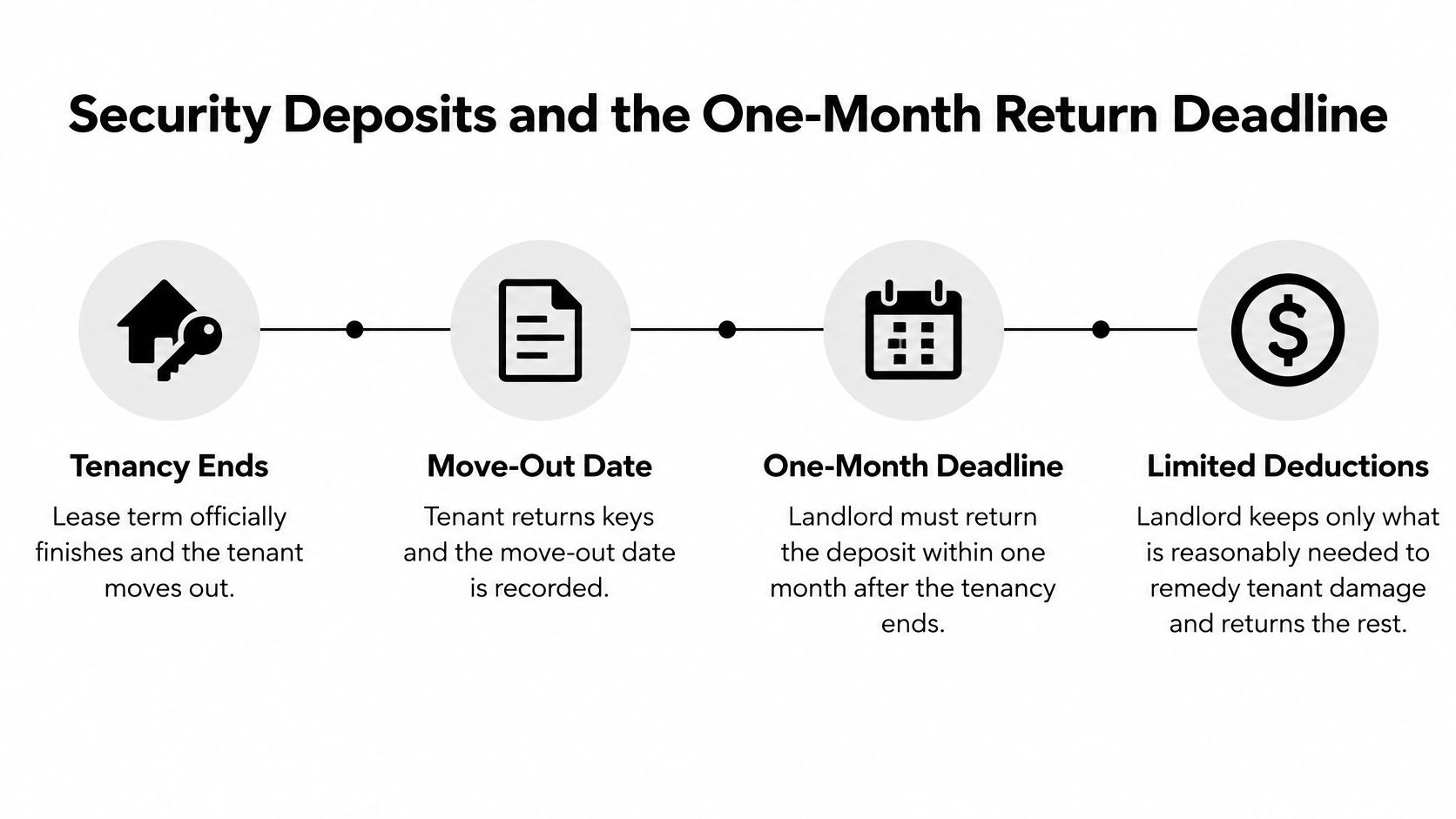
Louisiana's deposit rule lives in Louisiana Revised Statutes § 9:3251. Money a tenant pays as security for a written or oral residential lease must generally be returned within one month after the lease terminates. Keep any portion, and the statute requires an itemized statement explaining the deductions plus payment of the remaining balance inside that same one-month window.
Two details trip people up. First, the clock runs from when the tenancy ends and possession is returned, not from when you finish the final inspection or get the painting quote. Second, the statute carves out an exception when a tenant abandons the premises without the required notice or before the lease ends, but abandonment gets disputed, so document it as carefully as any other move-out.
What you may and may not deduct
You may keep what is reasonably necessary to remedy a tenant default or unreasonable wear to the premises. Everything else goes back.
| Charge | Deductible? | Proof to keep |
|---|---|---|
| Unpaid rent | Yes, when owed under the lease | Payment ledger and lease |
| Damage beyond ordinary wear | Yes, when tied to tenant default | Dated photos and repair invoice |
| Ordinary wear and tear | No | Move-in and move-out inspection notes |
| Cleaning needed after tenant default | Yes, only the amount needed to remedy the default | Cleaning receipt |
| Forwarding address | Not a deduction; it sets where the statement is sent | Written request and mailing record |
That last row matters more than it looks. The statute directs the itemized statement to the tenant's forwarding address, so a missing address is a documentation problem, not a reason to keep the money. Ask for it in writing at move-out and keep the record of how you sent the statement.
The five steps that keep you inside the deadline
- Start the clock at move-out. Write the date down the day keys come back, and count one month from there.
- Inspect and photograph with the tenant present if possible. A walkthrough both sides attend produces fewer arguments than a solo inspection.
- Build the itemized statement line by line. Every amount gets a reason and a document behind it.
- Send the balance and statement before the deadline. Not on the deadline day if you can avoid it.
- Keep the file. Ledger, invoices, photos, statement copy, and forwarding address, all in one place.
Here's a short walkthrough of the move-out and deposit side of the process.
Missing the deadline after a written demand changes the arithmetic entirely. Failure to remit within 30 days after the tenant's written demand constitutes willful noncompliance, and the exposure becomes the wrongfully retained amount plus the greater of $300 or twice that amount. A tenant who knows the statute can send a demand letter citing it, so keep proof of the demand and of your response.
How the Louisiana Eviction Process Works, Step by Step
Eviction in Louisiana runs on written notice and court paperwork, in that order. The controlling rule is Louisiana Code of Civil Procedure article 4701, which requires written notice to vacate giving the tenant at least five days from delivery before you seek possession through the courts.
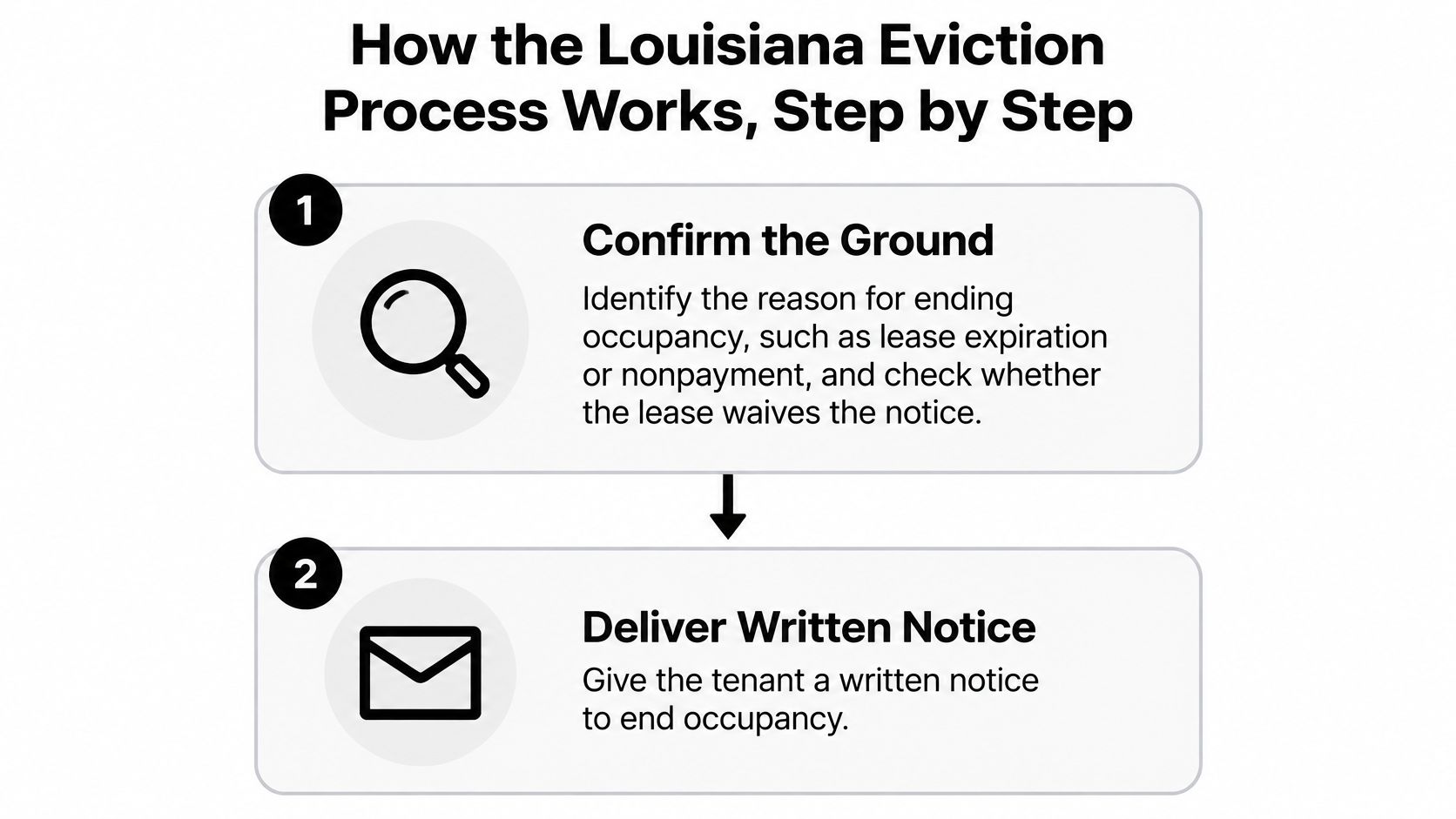
- Confirm the ground for ending occupancy. Lease expiration, nonpayment, or another termination. Then check the lease: article 4701 lets a tenant waive the notice in a written lease provision, and if that waiver is valid you may file as soon as the tenancy ends.
- Deliver the written notice to vacate. Five days from delivery, generally calculated as five business days excluding weekends and holidays. Keep proof of delivery, because the date of delivery is the date that matters.
- File the eviction suit if the tenant stays. The five-day notice is a milestone, not a court order. A tenant who remains still requires a filed action.
- Serve the petition and allow the response time the court sets. Bad service is one of the most common reasons a possession case stalls.
- Attend the hearing and obtain judgment. The tenant may raise defenses, including a repair-and-deduct claim, so bring the lease, the ledger, the notice, and proof of how it was delivered.
- Request a writ of possession. The sheriff carries out the order. Court timing and local steps vary by parish, so confirm the mechanics with the clerk or your attorney before filing.
Self-help removal, whether that's changing the locks, cutting utilities, or setting belongings on the curb, isn't a shortcut through this process. It's a separate liability. If you want to see how the notice and filing dates stack up in your parish, our eviction timeline calculator maps the sequence.
Repairs, Withholding and Tenant Protections
The most expensive misunderstanding in Louisiana rental housing is the belief that a serious repair problem automatically lets a tenant stop paying. It doesn't. Withholding rent isn't protected merely because a condition is bad, and a tenant who stops paying without the right paper trail can still face a nonpayment eviction.
What makes this complicated is that a repair-and-deduct claim can function as an affirmative defense to a nonpayment eviction when the landlord blocked the tenant from exercising the repair remedy. The Loyola University New Orleans housing law manual lays out the shape of that remedy: the tenant makes a written demand, the landlord fails to make necessary repairs within a reasonable time, and the tenant then has repairs done and seeks reimbursement or applies the cost to rent, limited to what was necessary and reasonably priced.
Landlords remain responsible for necessary repairs except those attributable to the tenant. Read that sentence twice before you treat a maintenance ticket as an operational chore.

The evidence chain that separates a lawful deduction from nonpayment
When a tenant deducts a repair cost from rent, the file either supports it or it doesn't. Six items decide which:
- The dated written demand. Not a phone call. A message or letter with a date, describing the problem and asking for the repair.
- The date the landlord was notified. This starts the "reasonable time" analysis, so it's the most important date in the file.
- Photos of the condition. Dated, and taken before any repair work begins.
- Contractor invoices. The actual cost, itemized, from a real vendor.
- Emergency facts. Whether the problem required immediate action or could wait for a scheduled repair.
- A rent calculation. What was owed, what was deducted, and what remained.
If you're the landlord in that scenario, the same six items are your defense. A maintenance log that shows the request, your response, the vendor dispatch, and the completion date answers the claim before it reaches a courtroom.
Practical rule: a timestamped record of the repair request and your response is worth more in a possession hearing than a verbal explanation of how busy the plumber was.
Where faster action creates bigger exposure
Speed isn't automatically the safer strategy. A landlord who ignores a documented repair demand can strengthen the tenant's defense and invite a separate damages claim on top of the rent dispute. Four protections limit what you can do after a complaint lands:
- No lockouts, no utility shutoffs, no removed belongings. These aren't lawful substitutes for court process, and each one converts a rent dispute into a wrongful eviction claim.
- The habitability duty. The unit must stay fit for its intended use. A documented complaint raises your exposure, and a pattern of complaints raises it further.
- Retaliation risk. A rushed notice that lands days after a repair complaint looks like retaliation, even when your ground for termination is legitimate and unrelated.
- Fair housing rules. Screening criteria and treatment of tenants must be applied consistently across units. Different treatment of similar applicants is the thread that unravels a defense.
The lease gives you a key. The law only opens the door the court approves.
Our guide to habitability standards covers what "fit for use" means in practice and how to document a repair response.
Check Your Compliance Before the Next Notice
Run this checklist before you send any notice, return any deposit, or file any eviction. It takes twenty minutes and it prevents the kind of error that costs more than the rent at stake.
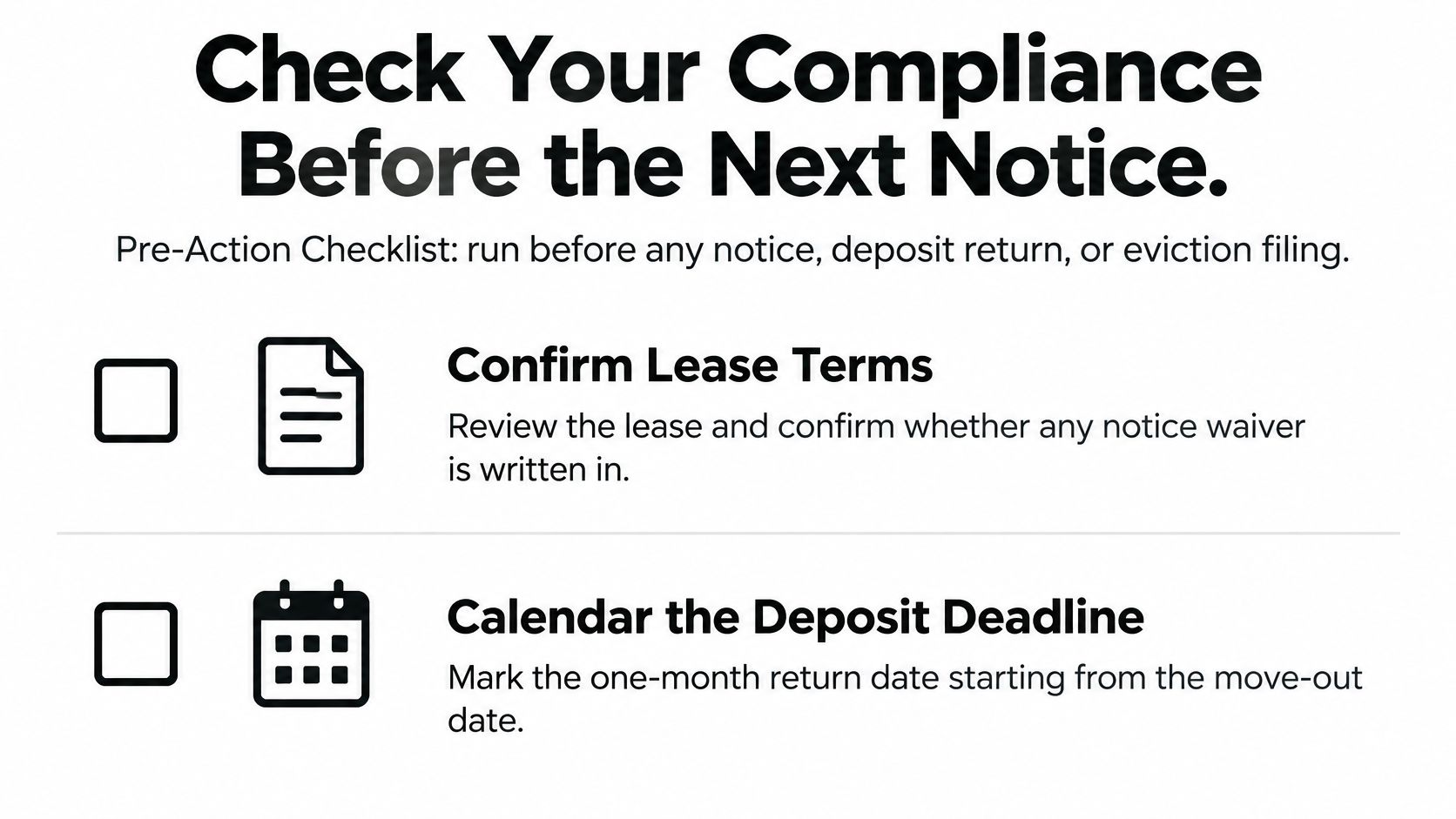
- Confirm the lease terms, including whether a notice waiver is written in.
- Calendar the deposit deadline from the day possession ends.
- Assemble dated inspection photos, invoices, and the itemized statement in one file.
- Pull every written repair demand and the response you gave it.
- Recount the five-day notice in business days, excluding weekends and holidays, and confirm you can prove delivery.
- Verify the local court steps for your parish before filing.
Then ask three questions before you act. Is there a documented ground? Is the notice period met? And would this action look any different if the tenant had never complained?
If the third answer is uncomfortable, slow down. A file that survives scrutiny is built from documents, not from being right about the facts. Everything above is general information, and a Louisiana attorney should review any dispute involving eviction, habitability, or a damages claim.
The decision worth making now is a setup decision. Build the lease, deposit, and notice calendar before the next tenancy begins, so the deadlines are already on the page when the Friday text arrives. Our leases are lawyer-reviewed state by state, and landlords can start with a free workspace for one door, no credit card required, set up in two minutes.
The fix for the Friday-afternoon text isn't a better memory. It's a system that already knows the move-out date, the one-month deposit deadline, and the notice count before the dispute starts. VerticalRent generates state-specific leases, tracks deposits and notices alongside your rent ledger, and keeps maintenance requests timestamped in one place, so the record exists when you need it. Start free with one door and see how much of this calendar runs itself.
Put this into practice
VerticalRent tools related to this guide
Legal Disclaimer
VerticalRent and its authors are not attorneys, CPAs, or licensed legal or financial advisors, and nothing on this site constitutes legal, tax, or professional advice. The information in this article is provided for general educational purposes only. Landlord-tenant laws, eviction procedures, security deposit rules, and tax regulations vary significantly by state, county, and municipality — and change frequently. Nothing on this site creates an attorney-client relationship. Always consult a licensed attorney or qualified professional in your jurisdiction before taking any action based on information you read here.
Co-founded VerticalRent in 2011, growing it from nothing to 100k landlords and renters. Sold it in 2019, then re-acquired it in 2026 to make it better than ever.


