Tenant Background Check Authorization Form Guide
Master the tenant background check authorization form with FCRA rules, required fields, state variations, and digital workflow tips for independent landlords.


You've found a promising applicant, and the screening portal is ready to run the report. Then you notice the rental application only contains a vague checkbox, or the applicant's signature appears on a page packed with unrelated lease language. At that point, the question isn't whether the applicant seems trustworthy. It's whether your process clearly proves that you had permission to obtain and use a consumer report.
A tenant background check authorization form is the control point that connects an applicant's written consent to the rest of the screening workflow. A well-designed form supports the initial application, digital recordkeeping, later re-screening, and any adverse action that follows. A poorly designed form can leave gaps even when the landlord acted in good faith.
The Role of the Authorization Form in Tenant Screening
A landlord receives an application from two adults who want to rent a duplex. The application identifies both people, lists their addresses, and includes a sentence saying the landlord may “verify information.” The landlord assumes that sentence covers credit and criminal screening, submits the application, and receives a report.
That assumption is the problem. A general verification clause may not give the applicant a clear, standalone disclosure that a consumer report will be obtained for housing purposes. It may also fail to show which individual authorized the report, what the applicant signed, or whether the landlord preserved the executed document.
The authorization form turns an informal request into a documented process. It should show that the applicant knew a consumer report could be obtained for tenancy purposes and gave written permission before the report was ordered. The form commonly supports screening for credit history, criminal history, eviction history, and other consumer data, but the report still has to be obtained and used within the applicable legal framework.
Why a buried checkbox creates avoidable risk
A checkbox hidden among application questions may be easy to complete, but convenience doesn't automatically make the disclosure effective. The FTC's landlord guidance recommends a clear, conspicuous, standalone disclosure rather than language buried in a broader application.
That distinction matters during a dispute. A landlord may remember that the applicant agreed to screening, but a reviewer will look for the actual record. The strongest file contains the disclosure, the applicant's identifying information, the signature or electronic consent, the date, and evidence that the applicant received a copy.
Practical rule: Treat the signed form as the permission record, not as a box to tick before the “real” application begins.
The form also establishes discipline for everyone involved. Each adult being screened should authorize screening individually. If one roommate signs and another does not, the landlord shouldn't treat the first signature as permission to screen the entire household. This keeps the file aligned with the person whose consumer report is being accessed.
The form is also a data record
Digital screening creates another responsibility. Landlords must be able to retrieve the executed authorization alongside the report, application, communications, and decision record. Guidance on storing applicant data in 2026 is useful for thinking through retention, access, and document organization before an application pipeline becomes difficult to audit.
The form therefore does more than authorize a single search. It anchors a defensible workflow. If the landlord later reviews the applicant's file, receives a dispute, or needs to explain a decision, the authorization shows where the screening process began and what the applicant agreed to at that stage.
FCRA Compliance and Permissible Purpose Requirements
The Fair Credit Reporting Act, commonly called the FCRA, regulates how consumer reports are obtained and used. The law was enacted in 1970, creating the modern federal framework for access to consumer-report information, including information used in tenant screening. A landlord doesn't gain a lawful basis merely because a person submitted a rental application.
The report must be requested for a legally recognized permissible purpose. Housing screening is a permissible purpose when the landlord is evaluating an applicant for tenancy, but the landlord still needs a process that documents the applicant's written permission and limits use of the report to that housing decision.
Why the form matters so much
The Consumer Financial Protection Bureau's tenant background check market report states that no federal law requires tenant screening companies to be licensed or registered as consumer reporting companies. That fragmented market structure makes the landlord's documentation especially important.
The authorization form often functions as the practical compliance gate between the landlord and the screening file. It helps establish that the landlord wasn't accessing consumer data out of curiosity, for an unrelated purpose, or without the applicant's knowledge. It also gives the screening provider a record supporting the request.
A compliant process should answer these questions before the report is ordered:
- Who authorized the report? Match the form to the individual applicant.
- What was disclosed? State that a consumer report may be obtained for tenancy purposes.
- When was permission given? Preserve the date and time where the system records them.
- How was consent captured? Keep the signature or electronic consent event.
- Where is the record stored? Make the form retrievable with the application file.
Landlords who want a plain-language explanation of the broader framework can review this overview of what FCRA compliance involves. The key operational point is simple: authorization is necessary, but it isn't the entire FCRA workflow.
Permissible purpose doesn't end after the search
A landlord should use the report only for the housing purpose described in the process. Sharing raw screening information casually with unrelated people, using it for a different business purpose, or allowing unrestricted access creates unnecessary exposure.
The authorization also doesn't excuse inaccurate or incomplete screening. The landlord remains responsible for following the applicable adverse action process if report information influences a denial, conditional approval, or another negative rental decision. The form creates the starting record, while the later decision requires its own documentation and notices.
Required Fields and Standalone Disclosure Language
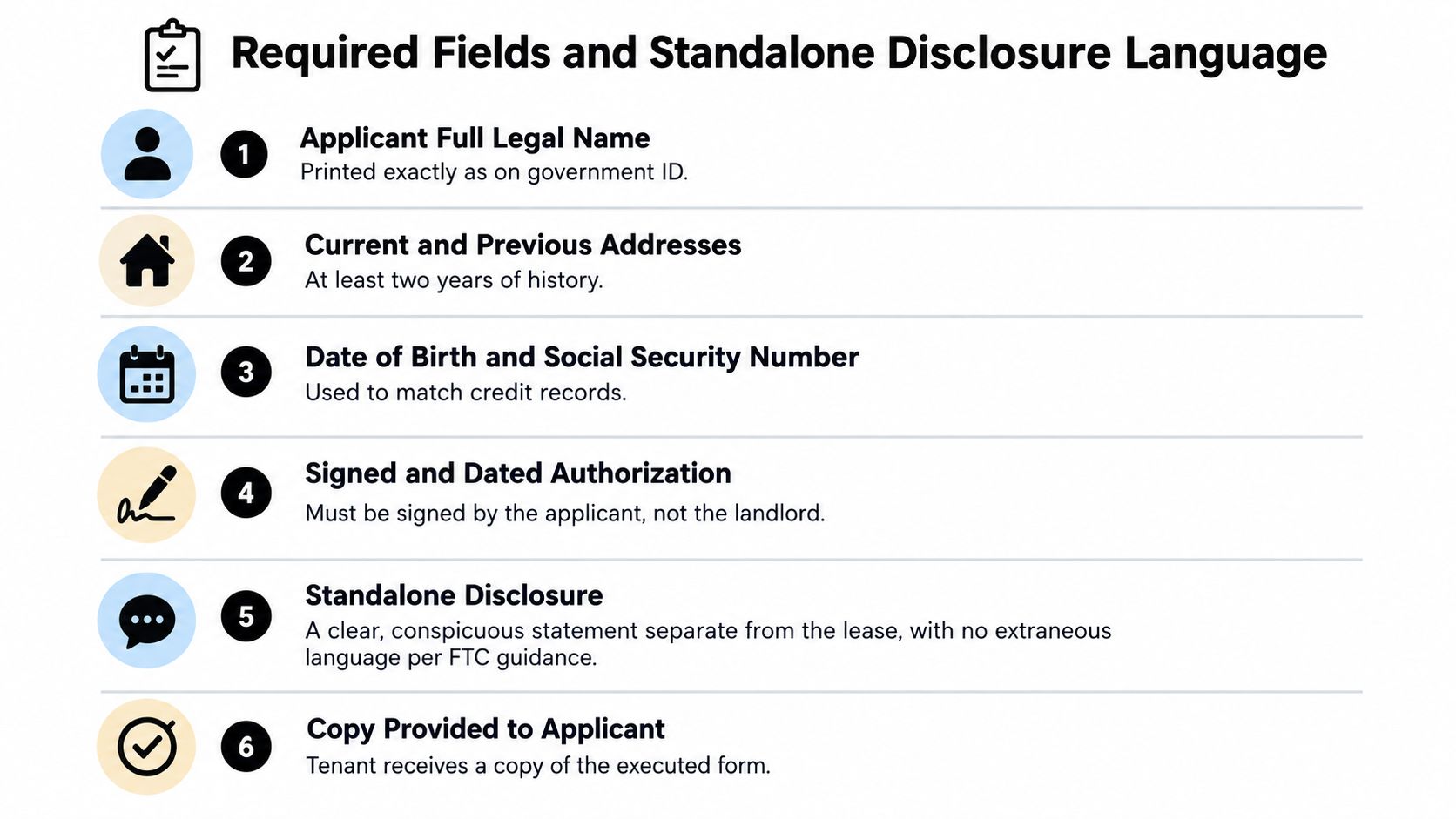
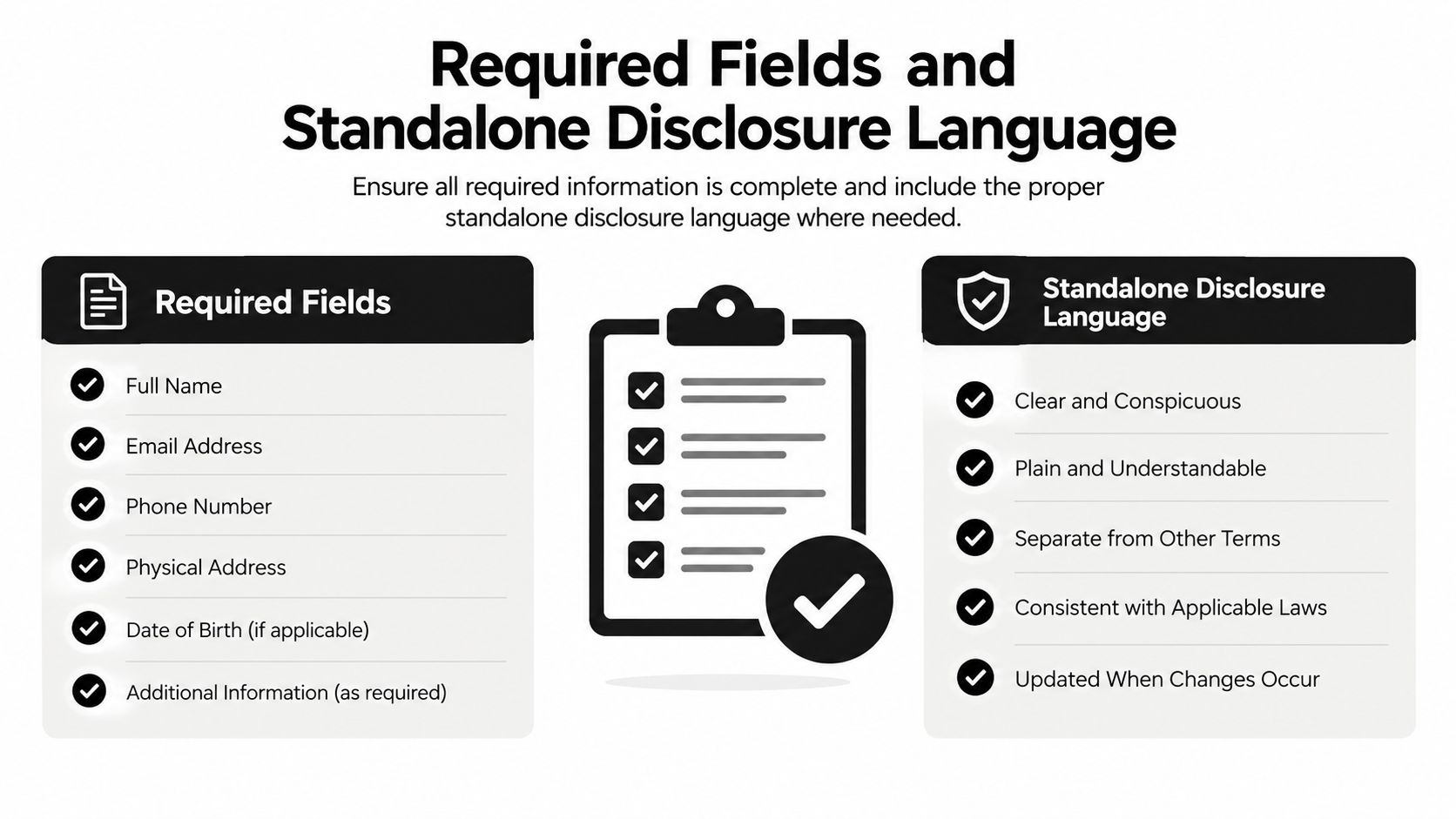
A good form is short enough to read and complete without confusion. It doesn't need dense legal language to sound serious. It needs a clear disclosure, accurate applicant details, an authorization statement, and a reliable record of execution.
The FTC's guidance for landlords using consumer reports supports a standalone disclosure that tells the applicant a consumer report may be obtained for tenancy purposes. The disclosure should be conspicuous and separate from the rest of the rental application.
Build the form field by field
Start with the applicant's full legal name, written consistently with the identity information used by the screening provider. Include contact details and the information needed to distinguish the applicant from someone with a similar name.
Then add the landlord or property manager's identity and contact information. The applicant should know who is requesting the report and how to contact that party about the screening process.
The disclosure itself can use plain wording such as:
I understand that a consumer report may be obtained for tenancy purposes. I authorize the landlord or property manager to obtain and use the report to evaluate my rental application.
Treat that as a drafting model, not a substitute for counsel's review. The form should identify the types of reports the workflow may request, such as credit, criminal, eviction, or other consumer information, without burying the core disclosure in unrelated provisions.
Make execution unambiguous
The applicant's signature, date, and method of signing should be clear. For electronic forms, preserve the completed document and the associated consent record rather than storing only a database flag that says “accepted.”
Include an acknowledgment that the applicant received, or was given access to, the applicable FCRA summary of rights. Provide the applicant with a copy of the executed authorization. A copy reduces later uncertainty about what the person saw and accepted.
Keep the authorization separate from the lease and avoid combining it with broad clauses about rent, maintenance, waivers, or unrelated data use. A practical rental application form guide can help distinguish the general application from the specific screening authorization.
Avoid unnecessary collection
Collect only the identity and contact information the screening workflow needs. More fields create more opportunities for mismatches and increase the amount of sensitive information the landlord must protect.
Before publishing a form, check it on a phone. The disclosure should be visible without forcing the applicant to scroll through unrelated text, and the signature step should make it obvious that the applicant is authorizing a consumer report rather than merely submitting an application.
Navigating State-Specific Variations and Local Laws
Federal requirements are the floor, not a universal form that works unchanged in every location. State and local rules may regulate criminal-history questions, application procedures, disclosures, screening fees, fair chance housing, and the timing of inquiries. A national template can therefore be technically complete under the FCRA and still be unsuitable for a particular property.
California is a familiar example because landlords may need to consider state consumer-reporting rules alongside the federal framework, including the California Investigative Consumer Reporting Agencies Act. New York landlords may also face state and local housing requirements that affect how screening information is requested and used. Local “Ban the Box” or fair chance housing rules can restrict when a landlord asks about criminal history or how the landlord evaluates it.
The authorization form should reflect the property's location and the actual workflow. Don't add a nationwide paragraph that claims to solve every local requirement. Instead, identify the jurisdiction, review the current rule, and have a qualified housing attorney adapt the form where necessary. For a property in Hawaii, for example, a local resource such as a Kona landlord tenant attorney may be more useful than a generic national template.
Federal and local requirements side by side
| Requirement Category | Federal Baseline (FCRA) | Common State or Local Additions |
|---|---|---|
| Consent | Written authorization before obtaining a consumer report | Extra wording, notices, or prescribed timing |
| Disclosure | Clear, conspicuous, standalone disclosure | State-specific disclosure language |
| Criminal history | Use consumer-report information for a permissible housing purpose | Restrictions on when criminal-history questions may be asked and how records are considered |
| Screening fees | Follow applicable federal and contractual requirements | Fee limits, itemization, refund rules, or local procedures |
| Decision criteria | Use reports for tenancy purposes and follow adverse action duties | Fair housing safeguards, individualized review, or local restrictions |
| Recordkeeping | Preserve evidence of authorization and the screening decision | Additional retention, privacy, or access requirements |
Adapt the workflow, not just the wording
A local rule may require a change to the form, but it may also require a change to when the form appears. If criminal-history questions must wait until a later stage, the digital application should not request them at the beginning. If a local law requires a particular notice before a fee is charged, the payment step must match that sequence.
Review the form whenever the property changes jurisdiction, the screening vendor changes, or the application flow is redesigned. A static PDF can conceal a process change, while an online workflow can continue presenting outdated language to every new applicant.
Integrating the Form into Online Screening Workflows
Paper forms are easy to understand because the signature, date, and document sit together. Online workflows are faster, but they can separate the applicant's click, the disclosure text, the identity record, and the final report unless the system is configured carefully.
Start by making the authorization a required stage before screening begins. The applicant should see the standalone disclosure, review the relevant rights information, provide consent, and receive a completed copy. The platform should prevent the report request from moving forward when consent is missing.
Configure the digital sequence
A practical sequence looks like this:
- Create the applicant record: Use an individual profile for each adult applicant, including co-applicants.
- Display the disclosure: Present the consumer-report notice separately from general application terms.
- Capture consent: Record the applicant's electronic signature or equivalent affirmative consent.
- Generate the screening request: Send the report request only after the consent event is complete.
- Store the audit trail: Retain the executed form, timestamp, consent method, delivery record, and report connection.
Electronic signatures can support a modern process when the system preserves evidence of the transaction and allows the applicant to access the electronic record. Your vendor should explain how it handles consent, document delivery, record integrity, and later retrieval under applicable electronic-signature requirements.
Preserve the evidence, not just the outcome
A screening dashboard that displays “approved” isn't enough for a strong file. Store the version of the disclosure shown to the applicant, the signed document, the applicant's identifying details, and the event history associated with the consent.
The same logic applies outside housing. Workflows such as nonprofit volunteer screening also demonstrate why consent, identity, and audit records should remain connected rather than scattered across email and spreadsheets.
For landlords comparing digital application tools, review how online rental applications handle required fields, individual applicants, signed disclosures, copies, and exportable records. A mobile-friendly screen is useful, but the compliance value comes from preventing skipped steps and preserving proof.
Handling Ongoing Consent and Re-Screening During Tenancy
Many authorization forms are written as if screening happens once, immediately before a lease is signed. Property managers know that isn't always the operational reality. A landlord may want to re-screen during renewal, investigate a newly added occupant, or use a lease-based monitoring arrangement.
The difficult question is whether the original signature covers that later report. A clause saying that authorization “remains on file” may express the landlord's intent, but it doesn't automatically answer whether the applicant received a sufficiently clear disclosure for a later screening event, whether the lease permits the practice, or whether state law imposes additional requirements.
Draft for the actual tenancy workflow
If repeated screening is part of the rental relationship, address it directly. The form and lease should identify the circumstances in which a later report may be requested, the housing purpose for the request, and the types of information involved. Avoid language that gives the landlord unlimited permission to obtain any report for any reason.
A carefully drafted provision might explain that the applicant authorizes later consumer reports for specified tenancy-related purposes, subject to applicable law and required notices. That wording still needs legal review because an ongoing authorization isn't a universal substitute for fresh consent.
Consent should match the event. A signature collected for an initial application is strongest when the later use was clearly disclosed, reasonably connected to tenancy, and permitted by law.
Decide when to obtain fresh consent
A fresh signature is the safer choice when the original form didn't mention re-screening, the purpose has changed, the screening provider or data categories have materially changed, or local law requires renewed authorization. Obtain new consent for a new adult occupant rather than relying on another tenant's signature.
For a renewal, give the tenant a clear notice of the intended screening and preserve the renewed authorization with the new request. If the lease contains an ongoing-consent clause, keep the original form, the lease, the notice, and the later report connected in the file.
Don't let automation make the legal decision. A property management system can trigger a task, but a landlord should confirm that the authorization supports the planned report before allowing the request to proceed.
Connecting Authorization to the Adverse Action Process
The authorization form is the first link in a longer chain. A landlord may obtain a report lawfully and still mishandle the rental decision afterward. If report information contributes to a denial, a conditional approval, or another unfavorable change in the terms offered, the landlord must follow the applicable adverse action requirements.
The FTC's landlord guidance requires the notice to identify the consumer reporting agency, explain that the agency didn't make the decision, and tell the applicant about the right to dispute inaccurate information and request a free copy of the report within 60 days. Those details belong in the decision workflow, not in a vague rejection email.
Capture the agency details early
The authorization file should connect to the screening request and the agency that supplied the report. This makes it easier to prepare an accurate notice if the applicant is declined or approved only with different terms.
A defensible file should show:
- The report used: Identify the report or screening transaction that influenced the decision.
- The decision reason: Tie the outcome to written screening criteria, not an informal impression.
- The agency identity: Use the correct consumer reporting agency name and contact details.
- The applicant notice: Preserve the adverse action notice and delivery record.
- The dispute path: Explain the applicant's rights as required by the applicable rules.
Don't treat conditional approval as automatically neutral. A higher deposit, guarantor requirement, or other less favorable rental term may be an adverse action when it results from report information. The landlord should evaluate the decision under the same documented criteria used for outright denials.
Keep decision-making separate from data accuracy
The screening company supplies information. It doesn't make the landlord's rental decision. That distinction must appear in the notice and should also be reflected in the landlord's internal notes.
If an applicant disputes an item, pause the process where appropriate and follow the required procedures. A signed authorization proves permission to obtain the report. It doesn't prove that every item in the report is accurate, complete, or correctly matched to the applicant.
Quick Reference Checklist for Form Drafting and Review
Before sending an applicant into screening, open the form as if you were the person signing it. The document should make the purpose obvious, identify the parties, and leave no uncertainty about what consent means.
Confirm the document itself
- Standalone format: Keep the disclosure separate from the general rental application and lease.
- Plain statement: Say clearly that a consumer report may be obtained for tenancy purposes.
- Applicant identity: Use the applicant's full legal name and the identifying information needed by the screening workflow.
- Requester identity: Name the landlord, property manager, or authorized housing provider.
- Report categories: Describe the consumer information the process may request.
- Signature record: Capture the applicant's signature or electronic consent and the date.
- Rights information: Provide or acknowledge the applicable FCRA summary of rights.
- Applicant copy: Deliver a copy of the completed authorization.
Test the workflow around it
A strong form can still fail if the software lets the landlord order a report before consent is complete. Test the application with a missing signature, an incomplete profile, and multiple adult applicants. The system should keep each person's authorization tied to that person's report.
Review access permissions too. A landlord should know who can view raw reports, who can see decision summaries, and where executed forms are stored. Restricting access reduces accidental disclosure and makes the file easier to manage.
Watch for common drafting failures
The most frequent mistakes are predictable:
- Combining documents: A disclosure hidden inside a long application or lease.
- Using broad wording: Permission to “verify information” without identifying consumer reports or tenancy purposes.
- Signing for someone else: A landlord or staff member completing the applicant's authorization.
- Missing the copy: No reliable proof that the applicant received the executed form.
- Ignoring local rules: A national template used without jurisdiction-specific review.
- Skipping later-use analysis: A one-time form treated as unlimited permission for future screening.
Update the form when the process changes, not only when a dispute occurs.
Frequently Asked Questions About Tenant Authorization Forms
How long can negative information appear on a tenant screening report?
The FTC explains that tenant background check companies generally can't report negative information older than seven years under the FCRA. The seven-year limit affects what may appear in many screenings, but it doesn't mean the authorization form permits every item that a vendor might locate. The landlord should still use a reputable consumer reporting company and evaluate the report under applicable federal, state, local, and fair housing requirements.
Can a landlord charge an application fee before the form is signed?
The authorization form and an application fee serve different functions. A landlord may be allowed to charge a fee under local law before receiving the signed form, but the landlord shouldn't order a consumer report until the required disclosure and authorization are complete. Check local rules governing fee amounts, disclosures, handling, and refunds before setting the workflow.
How long must physical or digital authorization forms be retained?
The federal materials cited here establish the importance of retaining proof of authorization, but they don't provide one universal retention period for every landlord and jurisdiction. Keep the executed form, delivery record, screening transaction, decision notes, and notices together for a period selected with legal and insurance guidance. Digital records should remain readable, retrievable, access-controlled, and connected to the correct applicant.
What happens if an applicant refuses to sign?
You can't obtain the consumer report without the required authorization. Apply the same written screening policy consistently, explain that the screening step is part of the application requirements, and document the applicant's refusal. Don't search the applicant through another route or ask a roommate's consent to cover the person who declined.
Does a digital signature count?
Electronic consent can support an online workflow when the process captures the applicant's affirmative action, preserves the signed record, provides access to the document, and maintains an audit trail. Ask the platform how it records the consent event and produces a copy. A checkbox with no preserved disclosure or transaction history is weaker than a complete electronic authorization record.
For independent landlords, the practical standard is straightforward. The form should be clear before the report is ordered, individual for each screened adult, connected to the applicant file, and usable when a later decision requires an adverse action notice. Review the form with counsel for the jurisdictions where you operate, especially if your workflow includes re-screening during tenancy.
VerticalRent provides online rental applications with electronic FCRA consent captured before screening, alongside tenant screening and related rental management workflows. Visit VerticalRent to review how its application process can help keep authorization records connected to your screening file.
Put this into practice
VerticalRent tools related to this guide
Legal Disclaimer
VerticalRent and its authors are not attorneys, CPAs, or licensed legal or financial advisors, and nothing on this site constitutes legal, tax, or professional advice. The information in this article is provided for general educational purposes only. Landlord-tenant laws, eviction procedures, security deposit rules, and tax regulations vary significantly by state, county, and municipality — and change frequently. Nothing on this site creates an attorney-client relationship. Always consult a licensed attorney or qualified professional in your jurisdiction before taking any action based on information you read here.
Co-founded VerticalRent in 2011, growing it from nothing to 100k landlords and renters. Sold it in 2019, then re-acquired it in 2026 to make it better than ever.


