12 Month Leases Explained for Renters and Landlords
12 month leases explained: standard terms, renewal and termination rules, benefits and drawbacks, and how renters and landlords should decide in 2026.


A one-year term is the market standard for fixed-term residential leases in the U.S., which is exactly why so many renters and small landlords sign one without pricing it. That is a mistake. Twelve months is a trade, stability on one side and flexibility on the other, and the exchange rate is written into the clauses.
A 12 month lease works like a price lock welded to a mobility restriction, both signed on the same page. Renters get a fixed monthly number and a fixed move-out date. Landlords get a predictable vacancy cycle and a rent figure they can't raise mid-term. Both sides pay for those guarantees somewhere, usually in flexibility: the renter pays when life forces an early exit, and the landlord pays when the market rises and the rent stays frozen.
Before you sign or renew, work through four questions in order. Which clauses decide what the year costs you? When does the renewal clock start, typically 90 days before expiration, and how much notice does each side owe? What are the legitimate ways out of a year you can't finish? And how does a 12-month term price out against six-month, month-to-month, and break-clause alternatives? Rules vary by state and city throughout, so treat every figure here as a benchmark to check against your local law, not a replacement for it.
What a 12 Month Lease Commits You To
A 12 month lease is a fixed-term residential agreement that runs exactly one year, with a named start date and a named end date. It isn't the same as a month-to-month tenancy, which renews automatically in 30-day cycles until one side gives notice.
That format dominates the U.S. market. In the Bureau of Labor Statistics CPI Housing Survey, 59.6% of leases lasted exactly 12 months, against 31.8% month-to-month and 8.6% at other lengths. Zillow's 2024 Consumer Housing Trends Report puts the renter-side figure at 64% of fixed-term renters saying they signed a 12-month lease. Tenure explains the gap: among households in their unit less than a year, 91.9% held 12-month leases, while past five years the split is nearly even at 49.7% fixed-term and 50.3% month-to-month.
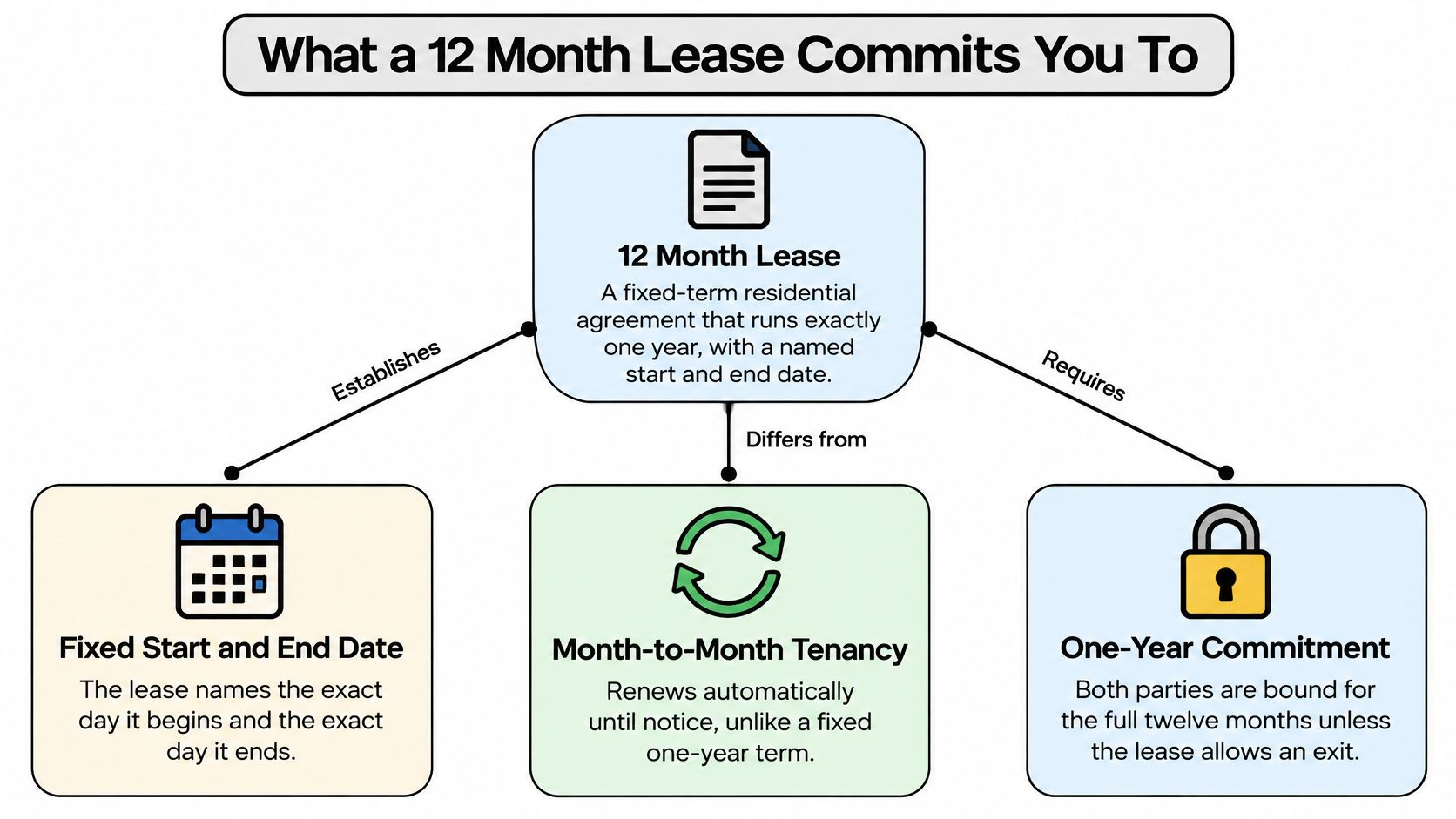
Think of the document as a one-year price lock with an exit door cut to a specific keyhole. The lock is the rent figure, frozen for twelve months. The keyhole is the early termination clause, and its shape is set by state law, not by the landlord's mood.
The Anatomy of the Document
Nine parts do the work: term and dates, rent and due date, grace period and late fee, security deposit and return conditions, utilities, maintenance duties, occupancy and guest rules, pet addendum, and the renewal or notice window. A tenth, the early termination or sublet clause, decides what leaving costs. Each is a sentence or two, each can be negotiated before signature, and almost none can be renegotiated afterward.
The one-year term is customary, not statutory. A lease binds because both parties signed a written document that includes the disclosures your state requires, typically lead-based paint for pre-1978 buildings, a security deposit receipt or account notice where required, and any local rent-regulation statement. Where a clause contradicts state law, the statute wins and the clause is void.
Check your local law: a deposit cap, a notice period or a rent-increase limit that applies in one city may not apply in the county next door. Confirm the rule where the property sits before you sign or send an offer.
The Lease Clauses That Decide the Outcome
Most lease disputes come from three lines that renters skim on signing day and landlords forget by month eight. The table below is a benchmark, not a legal standard. Compare your own contract against it and flag every gap.
| Clause | Typical value or range | What to verify |
|---|---|---|
| Term and dates | Exactly 12 months with a named start and end date | Both dates match your plan, and whether the term converts to periodic if nobody renews |
| Rent and due date | Fixed monthly amount, due on the 1st | Amount, payment method, and any online payment fee |
| Grace period and late fee | 3 to 5 day grace period; late fee often 5% of rent or a flat charge | Whether the fee accrues daily and whether your state caps it |
| Security deposit | Often one to two months' rent, capped by state law | The state return deadline, the itemized deduction rule, and whether a receipt or separate account is required |
| Early termination | Often one to two months' rent, or rent until the unit is re-let | Whether a buyout is allowed and how much notice it requires |
| Sublet and guests | Written landlord approval for sublets; guest stays often capped at 7 to 14 consecutive days | Whether the clause is enforceable in your state and how approval is requested in writing |
| Maintenance | Landlord handles structure and major systems; tenant handles minor upkeep | Who pays for repairs, how requests are filed, and whether pest control sits with the owner |
| Renewal notice | 30 to 60 days before expiration | The exact date you must give notice to renew or leave |
| Rent increase notice | 30 to 90 days depending on jurisdiction | The legal maximum increase if the unit is rent-regulated |
Where Disputes Start
The deposit. Many states cap deposits at one or two months' rent and set a return deadline after move-out, often 14 to 30 days, with an itemized statement of deductions. Check the cap, the deadline, and whether your state requires the money held separately or acknowledged with a receipt.
The early termination clause. A buyout of one to two months' rent is common, but so is language that holds you responsible for rent until the unit is re-let. Those are very different numbers in a slow market.
The renewal window. A 30 to 60 day notice requirement means the decision deadline arrives while you're still deciding. Put the date in your calendar the week you sign, not the week it matters.
Maintenance language splits structure and systems from minor upkeep, and that split is where responsibility shifts. A clause making the tenant responsible for pest control can conflict with local habitability rules, so look at how far a city pushes the duty back onto the owner, as in these Miami rental pest compliance rules.
Before signing, confirm every number against the table, write down the notice dates, and keep a signed copy plus dated photos of the unit's condition. If you're drafting rather than reading, start from a lease agreement template and edit the clauses that vary by state instead of the boilerplate.
Benefits and Drawbacks on Both Sides
One term, two audiences, opposite calculations. Read the same twelve months from each side of the contract.
| Perspective | Benefits | Drawbacks |
|---|---|---|
| Renter | Rent locked for 12 months; a move date you can plan around; a stronger application in competitive buildings | Reduced mobility for a new job, relocation or school move; an early termination fee of one to two months' rent; less leverage at renewal |
| Landlord | Predictable income; fewer turnover turns; one re-pricing decision per year | Below-market rent locked in if the market rises; mid-term eviction complexity; a narrower applicant pool when renters prefer flexibility |
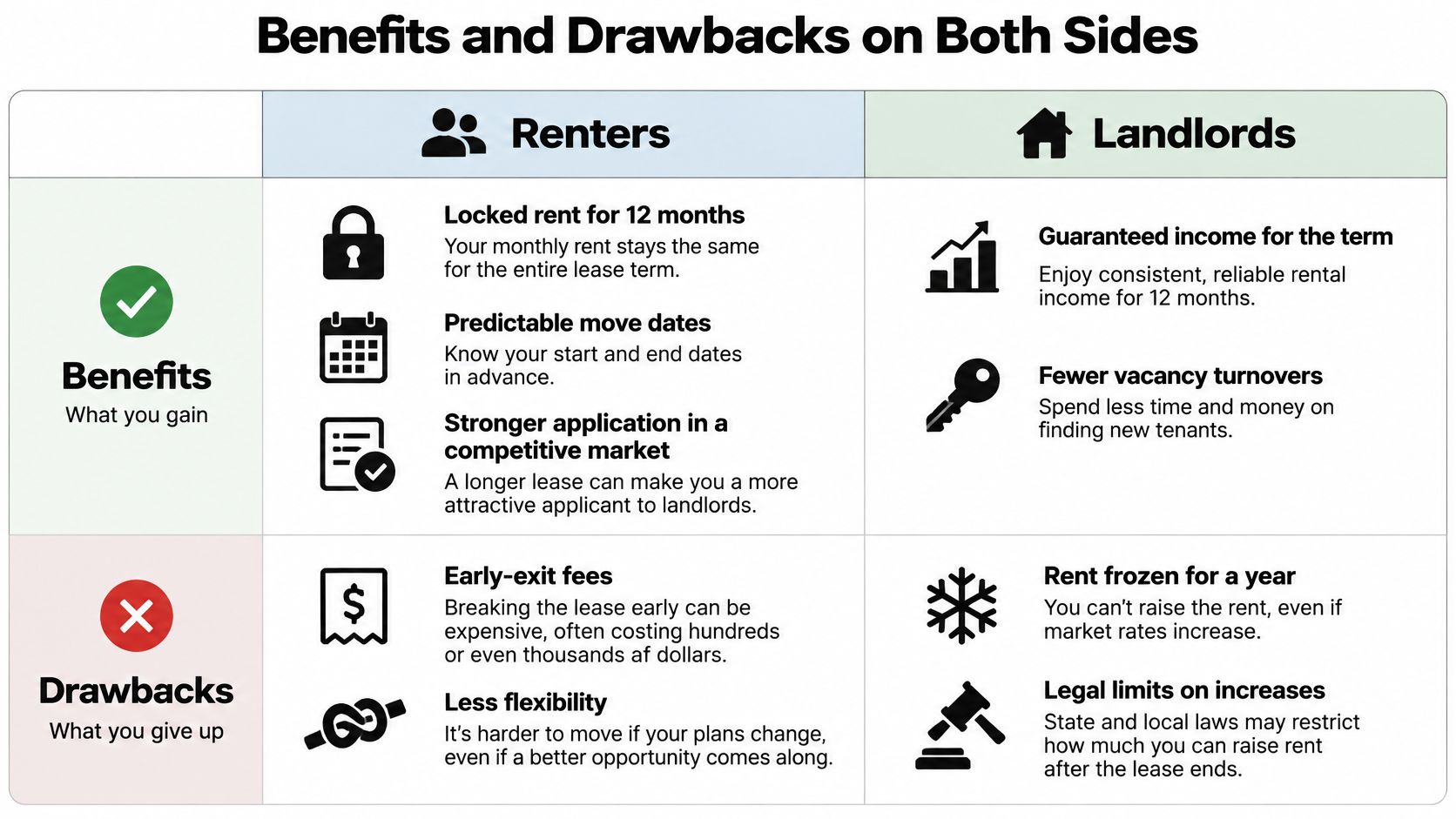
For a renter, the year buys certainty. The rent can't move, the move-out date can be planned around a job or a school year, and the application reads stronger in a competitive building. The cost appears only if plans change. It shows up in the exit fee and in the reduced bargaining power at renewal, because the landlord knows moving is expensive for you.
For a landlord, the year turns a stream of unknown months into a single decision. Income is predictable, turnover work drops to once a year at most, and there is one re-pricing decision instead of several. The cost appears when the market moves up and the rent doesn't, or when the tenant screened in March becomes a mid-term problem in September. Evicting mid-term is harder than declining to renew, because the lease you drafted to protect income now protects the tenancy too.
The trade-off is really a pricing question on both sides. A rigid term narrows the applicant pool whenever renters are weighing job moves, relocations or school schedules, and a thin pool means longer vacancies. Every week a unit sits empty costs roughly a quarter of a month's rent, which can erase the premium a landlord hoped to protect by locking the term. Flexibility and turnover pull in opposite directions: shorter terms widen the pool but multiply the turns, while longer terms shrink the pool but protect the income. Neither side wins by default. Both win by pricing the term correctly.
For renters: a 12 month lease is only a bargain if the monthly rent is lower than the shorter alternative, because you're selling a year of mobility to get it.
Renewal Rent Increases and Notice Timelines
The last 90 days of a lease decide more of the year's income than the first 300. Sequence them and the renewal is a price: this tenant's rent against the vacant days you would spend finding the next one. Skip the sequence and the term ends by accident.
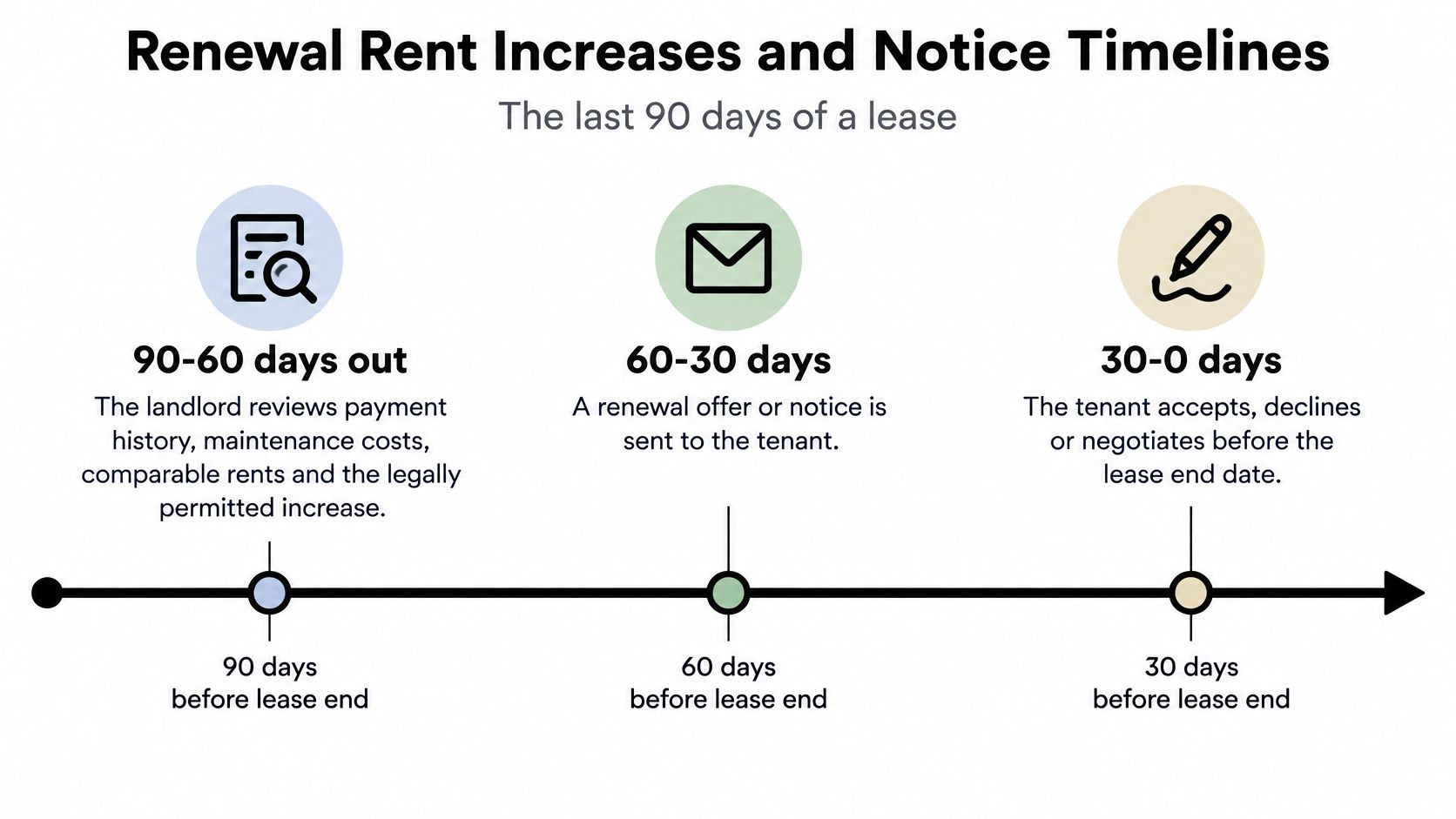
The notice window closes before the end date, not on it. A renewal works like a round-trip ticket change. Miss the cutoff and the seat you wanted is gone. You are then negotiating with a tenant who already knows you needed an answer last month.
The 90 Day Renewal Clock
- 90 to 60 days out: review payment history, maintenance costs, comparable rents and the legally permitted increase.
- 60 to 30 days: send the renewal offer or the nonrenewal notice inside the jurisdiction's notice window.
- 30 to 0 days: the tenant accepts, declines or negotiates before the end date.
Check your local law for how long that notice must be, and for the form it must take. The clock above is a working order.
Legal Caps and Sensible Numbers Are Different Things
New York City's rent-stabilized renewals for leases beginning between October 1, 2025 and September 30, 2026 were capped at 3% for one-year renewals and 4.5% for two-year renewals, according to NYC311. A legal maximum is a ceiling. The offer should still be the number that beats an empty unit.
Average rent increases were 12.2% for new tenants versus 3.5% for existing tenants whose leases had been renewed within the prior six months, per the BLS housing lease data. Replacing a tenant is a re-pricing event with vacancy and make-ready costs attached. A smaller renewal can win once those empty days are in the math.
Pricing rule: price the renewal against vacancy days and make-ready cost, not against market rent alone.
Run the renewal as a written record you can defend later: original rent, proposed rent, effective date and the notice sent, filed together. Our guide to renewing a lease walks through the offer letter itself.
Moving Out Early Without Breaking the Lease
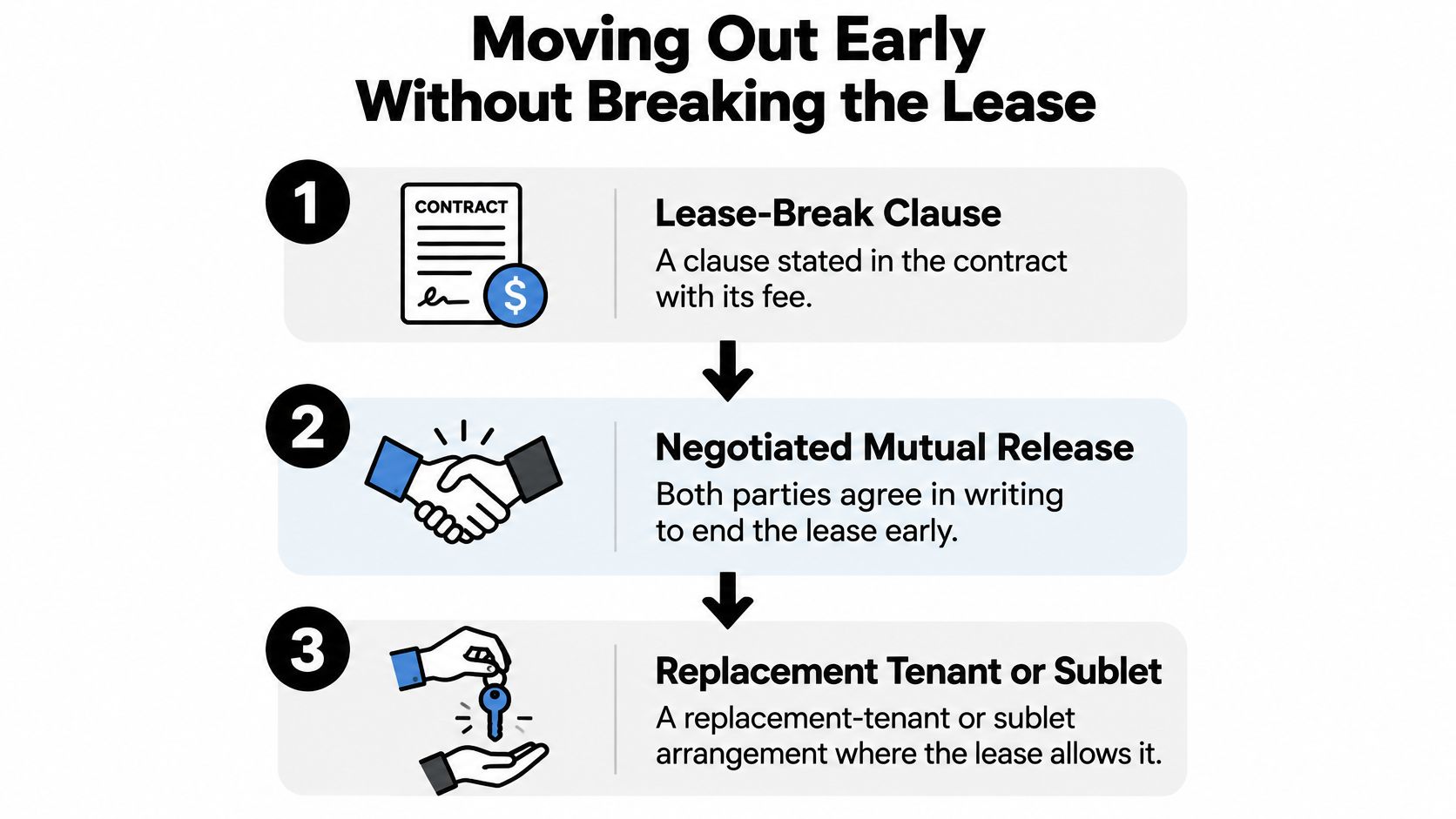
Exits exist, and they cost different amounts. Work down this list from cheapest to most damaging.
- Lease-break clause. The contract states the fee and the notice required. Pay it and leave cleanly.
- Negotiated mutual release. Both sides agree in writing to end the term early, often because the landlord already has a replacement applicant.
- Replacement tenant or sublet. Where the lease allows it, you supply a qualified applicant and cover the gap until they move in.
- Protected exits. Military and domestic-violence statutes exist in many states and usually require written documentation.
- Plain breach. The deposit is forfeited, rent continues until the unit is re-let, and the balance can reach collections.
For a renter, the sequence matters as much as the option. Read the early termination and sublet clauses first, put your reason in writing, request a mutual release or an approved replacement, get the agreement signed before the truck arrives, and photograph the unit at a joint inspection. A documented Top Cleaners on tenancy deposit cleaning is cheap insurance against a deduction you'd otherwise argue about for weeks.
For a landlord, many jurisdictions impose a duty to mitigate, which means re-advertising promptly and keeping a record of every showing and inquiry. A court is unlikely to award rent for months the unit sat empty while you waited for a better offer.
Expiration isn't termination. In New South Wales, a fixed-term agreement that ends without a new agreement continues as a periodic tenancy rather than stopping, per the NSW residential tenancy guidance. A missed date leaves you with an occupied unit on rolling terms. If you're weighing whether to end the term, what happens when you break a lease covers the consequences in order.
Choosing Between 12 Month Leases and Shorter Terms
Lease length is a pricing decision with a mobility term attached. Put the common structures side by side and the trade-offs stop being abstract.
| Lease length | Rent stability | Tenant mobility | Landlord turnover cost | Best fit |
|---|---|---|---|---|
| 12 months | Fixed for a full year | Low; early exit usually costs one to two months' rent | Low; one renewal decision per year | Stable tenants and landlords who value predictable income |
| 6 months | Fixed for half a year | Medium; two moves possible per year | Medium; two re-lets per year | Tenants on short assignments, or landlords testing a market |
| Month-to-month | Re-priced with required notice | High | High; continuous vacancy risk | Established tenants past the first year, and transient renters |
| 12 months with break clause | Fixed unless the clause is triggered | Medium; exit fee or notice applies | Medium; predictable but not locked | Renters unsure about relocating, and landlords who want occupancy |
Match the Term to the Next Twelve Months
Stable tenant, staying two years or more: sign 12 months and get the renewal terms in writing at the same time.
Relocating within the year: six months, or a 12-month term with a break clause, even at a higher monthly rate. The premium is the price of the option.
Landlord in a soft market: a longer term with a modest concession usually beats a high rent that leaves the unit empty through a slow season.
Landlord in a tight market: don't lock a below-market rent for a full year without a planned step-up written into the renewal.
The one-year term is a benchmark rather than a universal rule. OECD housing-regulation data lists 12 months as the typical minimum duration in Switzerland and the typical duration in the United States, while England commonly uses six-month terms, Sweden generally relies on open-ended contracts, and Spain permits freely agreed durations with statutory tenant extension rights for the first five years, or seven when the landlord is a legal entity.
The same one-year line appears in tax treatment, where the one-year rule for capital gains separates short-term from long-term treatment on a property you hold and rent.
Your Next Step Before You Sign or Renew
Two short checklists, one for each side of the table.
Renters. Confirm the end date and the notice window in writing. Benchmark the deposit against your state's cap. Ask directly whether an early-exit or break clause exists and what it costs. Keep a timestamped copy of everything you sign, including the condition photos.
Landlords. Put the renewal date on the calendar 90 days ahead. Calculate the permitted increase before you mention a number to the tenant. File the original rent, the new rent and the notice record together, because a renewal dispute is won or lost on documentation.
We set the due date, grace period, late fee amount and autopay rules on each lease individually rather than globally, and our lease language is lawyer-reviewed state by state, so the same clause reads correctly in two neighboring states with different rules.
Choose the term that maximizes risk-adjusted annual income for this property and this tenant segment, not the term that happens to be most common.
VerticalRent builds state- and county-specific leases in under 30 seconds with its AI Lease Generator, part of the Platinum plan, and keeps the grace period, late fee and renewal dates attached to each one so the 90-day clock isn't something you have to remember. Rent collection, a Schedule E ledger and FCRA-compliant screening run from the same workspace, which means the lease you signed and the money you collect stay in one record. Start a free workspace for your first door at VerticalRent and write the lease around the term you chose.
Put this into practice
VerticalRent tools related to this guide
Legal Disclaimer
VerticalRent and its authors are not attorneys, CPAs, or licensed legal or financial advisors, and nothing on this site constitutes legal, tax, or professional advice. The information in this article is provided for general educational purposes only. Landlord-tenant laws, eviction procedures, security deposit rules, and tax regulations vary significantly by state, county, and municipality — and change frequently. Nothing on this site creates an attorney-client relationship. Always consult a licensed attorney or qualified professional in your jurisdiction before taking any action based on information you read here.
Co-founded VerticalRent in 2011, growing it from nothing to 100k landlords and renters. Sold it in 2019, then re-acquired it in 2026 to make it better than ever.


