Rental Application Bank Statement: What Landlords Review
Learn why landlords request a rental application bank statement, what they review, and how to protect your privacy or offer alternatives.


You opened the listing, filled in the application, and then hit a line that asks for a rental application bank statement. Maybe you're the renter staring at a PDF full of grocery runs and a medical copay. Maybe you're the landlord who just got that PDF and isn't sure whether a healthy ending balance means the rent will clear. Both of you are looking at the same pages for different reasons, and the confusion usually starts in the same place: a statement shows money moving, not a promise that it will keep moving.
A clean request is narrower than expected. The landlord needs enough to see that claimed pay lands in an account the applicant controls. The applicant needs a way to show that without handing over a full spending diary. The rest of this walk-through is the practical middle: what gets checked, how deposits become a number you can defend, what to black out, and what to send when pay isn't the same every month.
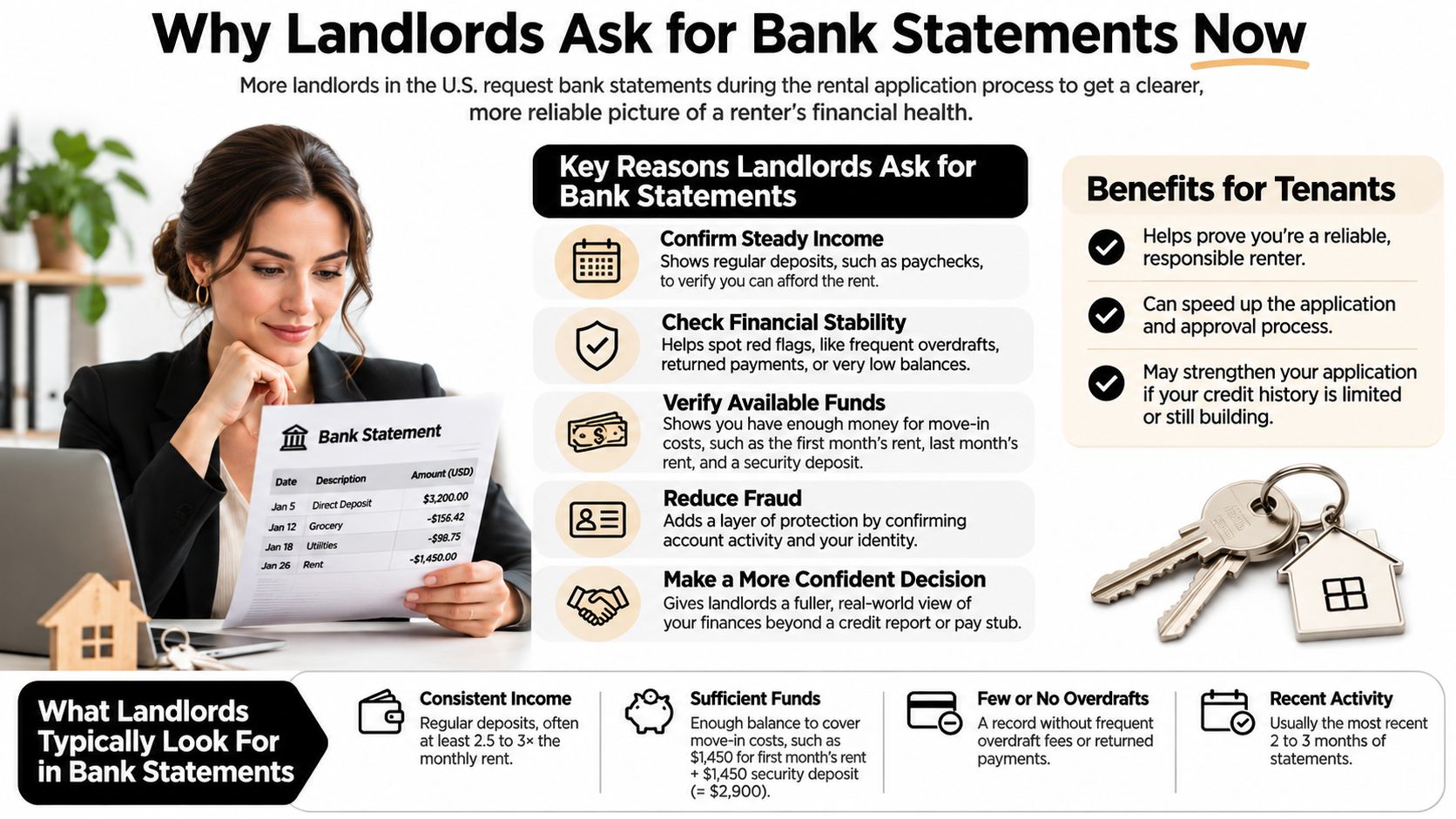
Why Landlords Ask for Bank Statements Now
Income is the easiest line on an application to invent. A job title and a salary figure take one sentence. A credit file and a criminal record are harder to rewrite because someone else holds the record. That's why a bank statement has moved from a backup document to a standard ask.
In a 2026 survey of 1,400 landlords and property managers across 14 major U.S. metropolitan areas, 67% had encountered a rental application with fabricated or falsified information within the previous five years. Nearly one-third estimated that as many as 25% of the applications they reviewed in the preceding year included some falsified information.
Where the worry actually sits
The same survey ranked the documents people worry about most. Fake or altered pay stubs and bank statements were the leading fraud concern for 37% of respondents. Concealed criminal or eviction histories came next at 24%. Fake identities sat at 19%. Landlords aren't mainly afraid of a mystery name. They're afraid the paycheck on the form never hit an account.
Screening habits show the gap those statements are asked to fill. 73% reported running criminal-background checks, 65% used dedicated identity-verification services, and 64% pulled credit reports. Only slightly more than half said they verified income directly. A credit report tells you how someone has handled borrowed money. It doesn't show this month's deposit from an employer. A statement is the piece that tries to show cash arriving.
Practical rule: Treat the survey as a read on U.S. housing providers, not on applicants worldwide and not as proof that a given file is fake.
That limit matters if you're the person uploading pages. A request for statements is a market habit among landlords, not a finding about you. It also isn't the whole screen. Someone who asks for a statement will often ask for a second source, such as a pay stub or an employer confirmation, because a PDF alone is easy to edit and a balance alone can be borrowed for a week. Your job is to make the deposits match the income you wrote down. Their job is to check that match without treating every odd transaction as a lie.
What Landlords Check on Your Statements
A landlord opens a statement and sees a balance that could cover rent. The deposits look promising, too. But a balance is only a snapshot, like a photograph of one moment: it does not show whether the money came from regular income, a transfer, or a one-time payment. A useful review checks whether the pages fit together and support what the applicant reported.
HUD's verification materials favor third-party verification over self-certification and describe an applicant-authorized bank link as one way to confirm salary. A PDF can still help, but the reviewer must compare its details with the rest of the application. For renters, that means sharing enough to make the income trail clear without exposing unrelated account activity.
The seven checks
| Check | What a Clean Statement Shows | Red Flag to Expect |
|---|---|---|
| Account holder name | Matches the applicant's ID and application | Name differs or the account belongs to a third party |
| Statement period | Consecutive months, with all pages included | Missing months or cropped pages |
| Balance arithmetic | Opening balance plus credits minus debits equals closing balance | Totals do not reconcile from one month to the next |
| Recurring deposits | Payroll-like deposits that fit the stated pay frequency and amount | Irregular timing or amounts that differ from the stated income |
| Deposit descriptors | Employer name or payroll processor on income deposits | Cash, peer-to-peer payments, or unexplained transfers presented as salary |
| Overdrafts and returned payments | Few or none | Frequent overdraft fees or returned rent payments |
| Formatting and metadata | Consistent layout and fonts from the bank | Mismatched fonts, altered text, or signs of an edited PDF |
Name first. If the statement is for a parent, partner, or business account, the deposits do not establish the applicant's income on their own. The applicant can explain the relationship and provide supporting documentation. A shared account may be legitimate, but the reviewer needs to understand who owns the funds and whether they are available for rent.
Check the calendar next. Complete, consecutive statements give a clearer picture than selected pages or a highlight of the best two weeks. Missing pages can conceal transactions that change how a deposit should be read. For a renter, submitting the full relevant statement period helps prevent an ordinary gap from looking like selective disclosure.
Follow the arithmetic. The opening balance, credits, debits, and closing balance should reconcile. The following month should open with the prior month's closing balance. A mismatch warrants a closer look, but it is a reason to confirm the record, not proof by itself that someone edited it.
Look for a repeatable pay pattern. Biweekly pay should appear at roughly that interval, in amounts close to the net pay shown on the stub. One large deposit labeled “payroll” does not establish the same pattern. Compare the descriptor, timing, and amount with the income information in the application.
Read the descriptors in context. “ADP,” an employer's name, or a payroll processor can help identify wages. “Cash App,” “Venmo,” or a counter deposit needs more explanation before it can be treated as salary. Overdraft fees and returned payments do not automatically disqualify an applicant, though repeated entries may prompt a fair question about whether rent payments will clear.
What a mismatch should trigger
When the applicant agrees, a read-only connection to the bank or payroll provider can verify information at its source. If the review relies on uploaded files, compare the account name, statement period, balances, transaction order, and deposit descriptions across the pages. Ask only for clarification that resolves a specific discrepancy.
A mismatch can have an ordinary explanation: the wrong month may have been downloaded, a couple may share an account, or a payroll descriptor may differ from the employer's public name. Ask for the original statement from the bank's portal or another independent check before drawing a conclusion. The goal is to establish what the record shows, not to treat every unfamiliar entry as evidence of a problem.
If screening information contributes to a denial, a higher deposit, a co-signer requirement, or another adverse condition, tell the applicant and name the consumer-reporting company used. That notice helps the applicant learn whom to contact about the file. Keep the pages used for the decision, limit access to them, and follow a clear retention and deletion schedule. For applicants, a focused submission with complete relevant pages and clear income evidence is more useful than sending unrelated account details.
How Landlords Turn Deposits Into Verified Income
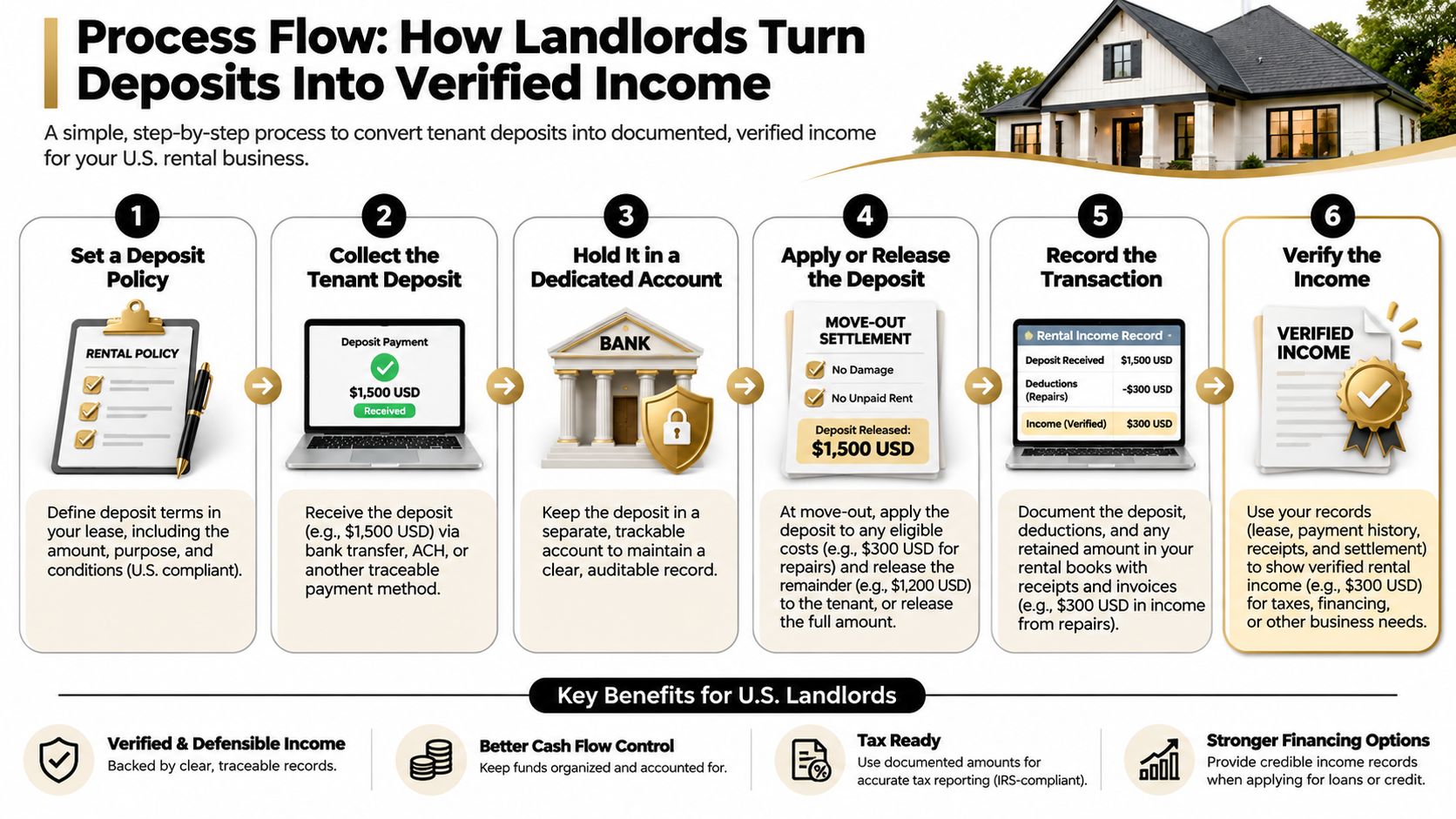
Suppose an applicant lists monthly income that is higher than the recurring deposits on their statements. The useful figure is verified recurring monthly income, the amount supported by deposits that appear regularly and can be tied to a source. A large balance or one unusually high deposit does not establish that income will continue.
HUD income-verification guidance recommends reviewing two months of bank statements or bank-card activity, matching pay-stub income to identifiable deposits, and considering other recurring deposits. Use the records to calculate a figure you can explain. Landlords may compare it with an income requirement based on rent, so applicants and landlords can review how the 3x rent rule works before interpreting the total.
Seven moves from pages to a number
- Gather two months of records that align with the pay stubs in the application. Bank-card activity can help when a formal statement is unavailable, provided the deposits are identifiable.
- Record each credit's date, amount, source description, and whether it recurs. Use the same method for every applicant.
- Separate payroll-like deposits from transfers, refunds, cash, one-time credits, and peer-to-peer payments. A Cash App, Zelle, Venmo, or PayPal deposit needs an explanation before it can be counted as income.
- Compare recurring deposits with the pay frequency and amount reported on the application. Weekly, biweekly, and monthly pay follow different schedules, so do not treat them as interchangeable.
- Use the median monthly amount for deposits from the same source rather than choosing the highest month. A bonus, tax refund, or family loan can raise one month's total without showing income that repeats.
- Ask for a brief written explanation of deposits you cannot identify. An unexplained deposit may have an ordinary reason, but it is not verified income until its source is clear.
- Compare the resulting figure with the stated income requirement and document why the application meets it or falls short. A short, consistent note is more useful later than relying on memory.
A gap that looks small until you annualize it
An applicant lists $4,000 a month. In each of two months, the statement shows two paychecks of $1,900, making recurring deposits $3,800 monthly. The unexplained $200 could reflect rounding, a pretax benefit, or pay deposited into another account. It could also affect whether the applicant meets the landlord's requirement.
The median helps prevent a one-time transfer from distorting the calculation. If one month also includes a $2,000 transfer from the applicant's own savings, counting the highest month could make the income look like $5,800. The median of the payroll-like deposits remains $3,800. Ask for a pay stub showing gross and net pay, or a note explaining that part of the pay goes to another account. Then assess the explanation rather than assuming the application figure is correct.
A statement documents cash flow during the period shown. It does not establish that a job will continue or that rent was paid on time in the past. Consider it alongside authorized employment checks and a rental-history check. A temporary high balance or borrowed funds can make an account look stronger for a moment without showing income the applicant can count on each month.
How Much Statement to Share and What to Redact
A statement can confirm income without exposing every purchase. A request for three to six months of complete statements may reveal account numbers, Social Security numbers, medical payments, charitable gifts, and ordinary spending. Those details go beyond an income check. Guidance aimed at renters discusses redaction, but renters still need a clear standard for what to leave visible.
For a basic income review, share the applicant's name, the statement period, the recurring income deposits, and the ending balance. Redact the account number and transactions unrelated to income. If a landlord requests more, ask how the additional information relates to the income test.
A redaction checklist you can finish in one sitting
- Mask the account number, leaving only the last four digits visible if needed to distinguish the account.
- Remove any Social Security number or tax identifier. These are examples of identifying personally identifiable information, and they are not needed to confirm that payroll arrived.
- Black out transactions that are not income, such as medical charges, donations, and personal purchases.
- Cover other household members' names on joint activity that is not part of the income claim.
- Keep the bank name, statement dates, income deposits, and balances readable.
- Check that the visible figures still add up. If a redaction hides a total needed to reconcile the month, the landlord may ask for a different version.
Use the bank's PDF tools or a proper redaction feature. A comment box or highlight may be removable, while a properly flattened redaction conceals the underlying text.
Same request, same clock, for every file
Landlords should use the same document list for applicants and set out how long they will keep the pages and when they will delete them. A consistent process helps both sides understand what is being requested and why. Requesting only the banking information needed for the income test keeps unrelated household details out of the review.
A refusal to provide a fully unredacted download does not, by itself, show that income is being hidden. Applicants can explain that they have kept the income deposits and balances visible while covering unrelated purchases. Landlords can then assess the information that bears on the stated test, rather than treating private spending as part of the application.
State the document request and its purpose in the listing or application instructions. A narrow, clearly explained request gives renters a practical way to provide evidence without handing over a full record of their personal spending.
Alternatives When Income Is Irregular
A PDF review punishes people whose pay is real and uneven. Gig workers, freelancers, tipped staff, seasonal employees, someone newly self-employed, and people paid by a benefit often won't show the same deposit on the same day. Rejecting the file because the amounts aren't identical confuses a formatting habit with an ability-to-pay problem.
Authenticity is a separate question from affordability. In the 2026 Checkr look at rental fraud, 55% of the 1,400 landlords and property managers surveyed had discovered or suspected that the occupant was not the person who was approved. A genuine statement in the wrong name, or a real deposit pattern attached to a swapped identity, fails a different test than a thin month. Answer both before you approve: is this document about this person, and does the recurring amount cover the rent under a rule you use for everyone.

Which document closes which gap
| Document | Best For | Main Limit |
|---|---|---|
| Recent pay stubs | Salaried or hourly workers with steady pay | Easy to edit, so the employer may need to confirm |
| Employer verification letter | Confirming job start date and pay rate | The letter only helps if the employer responds |
| Tax returns or 1099 forms | Self-employed, freelance and gig workers | Show annual income, not the current month |
| Direct payroll or bank connection | Verified deposits with applicant consent | Needs authorization and proves income, not future rent capacity |
| Benefit award letter | Fixed benefits such as Social Security or disability | Shows the amount but not work history |
Stubs are fast for a W-2 job and weak alone, because a template can mimic one. A letter on letterhead helps when the job is new and stubs don't exist yet, but only if you reach the employer at a number you looked up yourself. Tax returns and 1099s are the right lead document for self-employment. They lag. Someone who had a strong year and a quiet spring can look richer on last year's return than this month's deposits show. Self-employed applicants often meet the same documentation problem on a mortgage file, and a home loan guide for business owners walks through how lenders read those returns when monthly pay isn't steady. The rental version is shorter, but the idea matches: pair the annual picture with recent deposits.
A permissioned payroll or bank connection cuts the forgery problem because there is no PDF to edit. It still doesn't prove the applicant will pay rent next year. A benefit award letter is strong for a fixed amount and says nothing about a job. If you need a simple map of which packet fits which earner, start from how to provide proof of income and then add the statement only for the deposits that letter or return can't show.
How to read an uneven month without inventing income
Don't automatically count cash deposits, transfers between the applicant's own accounts, tax refunds, gifts, or one-time bonuses as recurring income. Average the source-consistent months conservatively, or use the median, and ignore the spike. Offer a path instead of a flat no: a larger deposit, a co-signer, or one extra month of statements with a short note on the non-payroll lines. Direct data lowers the chance you're reading a forgery. A human still has to decide whether the pattern can carry the rent, and that decision should look the same for the next applicant with the same kind of pay.
Confirm Your Document Set Before You Apply
Before sending anything, match each document to the income you reported. Share only what supports that income, and avoid adding pages that make the relevant deposits harder to identify.
Salaried applicants can usually provide a recent pay stub and statements showing the corresponding income deposits. Redact unrelated purchases and sensitive details, while leaving the account holder's name, bank name, and income lines readable. Self-employed, gig, or otherwise irregular earners can use tax returns or other documents that support the income pattern, then add a short note identifying deposits that may not be obvious. A larger packet is not automatically a clearer one.
Ask the landlord for the written document policy before exporting files, and confirm that the same requirements apply to every applicant. For statements, leave only the last four account digits visible, cover tax identifiers and unrelated household names, and keep the information needed to match deposits to your application. This minimum-data approach protects privacy without making the income evidence difficult to assess.
Three checks, then one send
- Confirm that the account holder's name matches the application, including any middle initial.
- Check one statement period: the opening balance, credits, and debits should reconcile with the closing balance.
- Match recurring deposits to the employer or income source and the pay frequency you listed.
Keep a copy of the exact files and any note you sent. If a deposit descriptor does not clearly identify the source, explain it briefly rather than leaving the landlord to guess.
Bank statements show cash flow, while rental history reports help confirm addresses. With an applicant's consent, a landlord can use a rental history report to verify where the applicant has lived. Landlords running a report must certify that they have the applicant's written authorization. Renters can also run a free rental history report on themselves. It can clarify address history, but it does not replace income documents.
Clear filenames, complete pages, and the right document for each income source help prevent follow-up requests. For more on avoiding common packet pitfalls, keep the files organized and avoid mixing documents from different periods. The application should also describe income consistently with the records you attach. This guide to how to fill out a rental application can help you check those entries before submitting.
VerticalRent helps independent landlords run tenant screening with written authorization, generate leases, collect rent online, and track maintenance in one place. Visit VerticalRent to learn about its rental management tools.
Put this into practice
VerticalRent tools related to this guide
Legal Disclaimer
VerticalRent and its authors are not attorneys, CPAs, or licensed legal or financial advisors, and nothing on this site constitutes legal, tax, or professional advice. The information in this article is provided for general educational purposes only. Landlord-tenant laws, eviction procedures, security deposit rules, and tax regulations vary significantly by state, county, and municipality — and change frequently. Nothing on this site creates an attorney-client relationship. Always consult a licensed attorney or qualified professional in your jurisdiction before taking any action based on information you read here.
Co-founded VerticalRent in 2011, growing it from nothing to 100k landlords and renters. Sold it in 2019, then re-acquired it in 2026 to make it better than ever.


