Landlord Tenant Laws in California: Rules for 2026
Landlord Tenant Laws in California explained: rent caps, the one-month deposit limit, repairs, notices and eviction steps, updated for 2026.


Nearly 17 million Californians, representing 44% of the state's residents, lived in rented homes, according to the California Attorney General's 2024 tenant-rights announcement. That's close to half a state living under rules that don't come from a single statute book. They come from the Civil Code, from city rent boards, from county ordinances, and from appellate decisions that reinterpret all of it.
This guide builds landlord tenant laws in California in order, the way an owner meets them. First, the numbers you need before you sign a lease or serve a notice. Then how the layers stack. Then leases, rent increases, deposits, repairs, and eviction. Every threshold here is worth re-checking against your own city's rule, because a lease or rent increase that's lawful in one California city may be restricted in the next one over.
California Rent, Deposit and Notice Limits at a Glance
A tenant who has lived in a covered unit for a year faces a different set of deadlines than a new tenant in an exempt building. The table below gives the starting numbers. Your address, building age, and ownership type decide which rows stay on the list.
| Rule | Limit or deadline | Who it applies to |
|---|---|---|
| Rent increase cap | Lower of 5% plus regional CPI or 10% in any 12 months | Covered units under AB 1482 |
| Rent increase notice | 30 days for 10% or less; 90 days above 10% | Most residential tenancies |
| Security deposit maximum | One month's rent, furnished or unfurnished | Most tenancies from July 1, 2024 |
| Small-owner deposit exception | Up to two months' rent | Owners of no more than 2 properties with 4 units in total |
| Deposit return deadline | 21 days after move-out, with itemized statement | All residential tenancies |
| Just-cause protection | Required after 12 months in the unit | AB 1482 covered units |
| Nonpayment pay-or-quit notice | 3 days, excluding weekends and court holidays | Before an unlawful detainer filing |
The rent cap is a calculation, not a fixed percentage. Under the Tenant Protection Act, AB 1482, the ceiling for a covered unit is the lower of 5% plus the regional Consumer Price Index change or 10% total over a 12-month period, as the California Department of Real Estate landlord-tenant guide sets out. Notice scales with the size of the increase. A rent increase of 10% or less requires 30 days' notice and a larger increase requires 90 days' notice, a timing rule that same guide summarizes for residential tenancies.
Deposits changed in 2024. Since July 1, 2024, the standard maximum dropped from two months' rent for unfurnished units and three months' for furnished units to one month's rent for both. A narrow exception survives for small landlords who own no more than two rental dwellings containing no more than four total units, who may still collect up to two months' rent. Whatever you collect, the balance plus an itemized statement of deductions is due within 21 days of move-out. Miss that deadline and you lose your ability to pursue any dispute about cleaning, damage, or unpaid rent.
Just cause works on a clock. After a tenant has lived in a covered unit for 12 months, a landlord generally cannot terminate the tenancy without a legally recognized just cause, subject to exemptions and required notices. State rules and city rules overlap here. A unit exempt from the state just-cause row may still face local just-cause limits, and a unit covered by both must satisfy both.
Nonpayment follows court days, not calendar days. The 3-day pay-or-quit notice excludes weekends and court holidays. That detail matters. A notice served on a Thursday before a holiday weekend expires later than a straight three calendar days would suggest, and filing an unlawful detainer before the period runs can invalidate the case.
Before you use any number in that table: confirm the unit is covered, confirm the city allows the increase, and confirm the notice date. A correct percentage served at the wrong time is still an unlawful demand.
Buildings with a certificate of occupancy issued within the last 15 years sit outside the rent cap and just-cause rows, and so do certain single-family homes owned by individuals rather than corporations or investment trusts. Mark which rows apply to your property in the margin before you calculate an increase, collect a deposit, or serve a notice.
How State, City and Court Rules Stack Up
Think about a building code. The state sets a minimum wall thickness, a city can require more insulation than the state does, and an inspector or a judge decides what the rule means for the wall you built. Rental law stacks the same way.
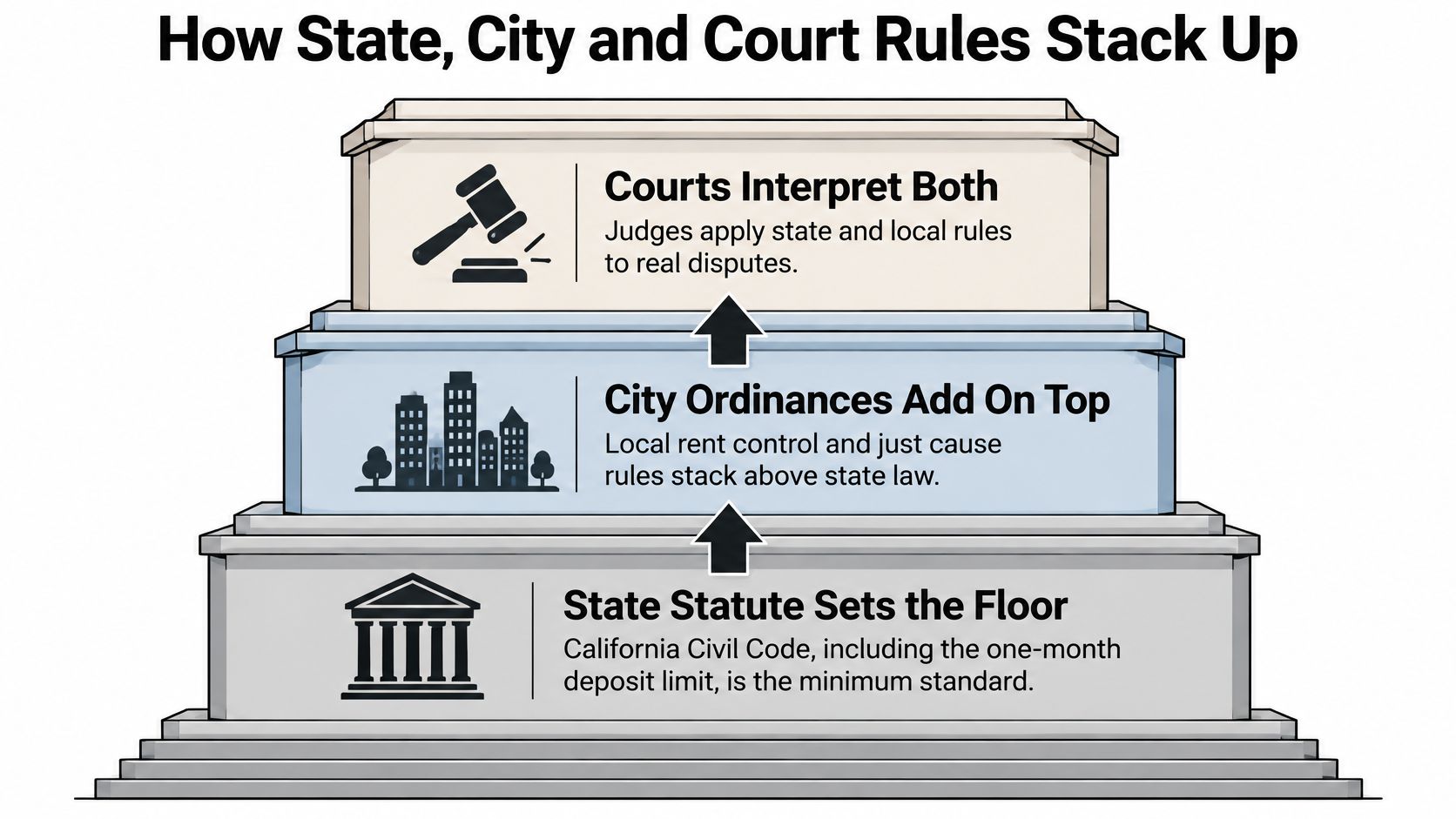
That structure has deep roots. California enacted a security-deposit statute in 1971, placing it among the earliest states to regulate how much landlords could collect, and by the late 1980s 14 cities, including Los Angeles, San Francisco, San Jose, and Oakland, had some form of rent control, as this Cornell Law School review of California rent regulation recounts. Courts required those limits to still allow a landlord a fair rate of return, and the Costa-Hawkins Rental Housing Act later limited how far local rent control reaches, generally preserving market-rate pricing for newly constructed units and after certain vacancies.
Four questions decide which layer governs your unit:
- Where is the property? City boundaries decide whether a rent board exists at all.
- When was it built? Construction date decides whether a unit falls outside the state cap.
- What type of tenancy is it? A single-family home owned by an individual is treated differently from a corporate-owned apartment.
- Does a local rent board apply? If it does, its formula and paperwork requirements sit on top of the state rules.
Answer those before you rely on any statewide percentage. Owners who skip straight to the cap arithmetic usually end up recalculating under a city ordinance a week later. For a second, plain-language pass over the same statutes, Edinhart Realty's California rental law guide is a useful companion to read alongside the code text.
California Lease Requirements and Protected Terms
Every California lease needs the same skeleton, whatever the city. Name the parties, the unit address, the rent amount and due date, the start date, the length of the tenancy, and the deposit amount, which can't exceed the limit that applies to your property. Leave any of those out and you're arguing about intent later instead of pointing at a document.
Fixed-term and month-to-month are different animals. A fixed-term lease commits both sides to a date, while a month-to-month tenancy continues until one side gives the notice the statute requires. Which one you're using changes the notice period for ending the tenancy, so state it in the first page, not in a schedule at the back.
What a lease cannot do
A lease is a contract built on statute, not a substitute for it. Clauses that waive the right to a habitable unit, waive the repair remedy, or shorten the notice a tenant is entitled to are unenforceable, and they read as bad faith to a judge who later sees the file. A single overreaching clause can taint an otherwise clean agreement.
Disclosures that belong in the signing packet
Federal lead-based paint disclosure and the EPA pamphlet apply to most homes built before 1978. California adds its own stack: the sex-offender registry notice, a smoking policy, shared-utility allocation, and, for many properties, bedbug and mold information. Your city may add another page. Build one packet per property and reuse it.
Four checks before you send the lease
- Rent clause. Make sure the increase language doesn't promise or imply more than the state cap allows for a covered unit, and that it names the correct notice period.
- Deposit clause. Match the legal maximum and spell out the return timeline and the itemized statement.
- Appliance clause. Reflect the stove and refrigerator duty that applies to leases entered into, amended, or extended from January 1, 2026 onward.
- Notice clause. State the address where notices go and the method of service you'll use.
Our California lease agreement form guide walks through the fields in order, and every lease we generate carries lawyer-reviewed language, state by state, with county-level clauses added automatically.
Rent Increase Limits and How to Calculate Them
For a covered unit, rent setting is arithmetic with a legal answer. The California Attorney General's rent cap page describes the maximum as the lesser of 5% plus the applicable cost-of-living percentage or 10% total in any rolling 12-month period. The cost-of-living piece depends on geography: California guidance points to Bureau of Labor Statistics CPI data for major metropolitan areas and California Department of Industrial Relations CPI data for other counties.
How the cap moves with inflation
| Regional CPI change | Formula (5% plus CPI) | Maximum allowed increase |
|---|---|---|
| 0% | 5% | 5% |
| 1% | 6% | 6% |
| 3% | 8% | 8% |
| 5% | 10% | 10% |
| 7% | 12% | 10% ceiling applies |
The pre-notice checklist
- Confirm coverage. Identify each exemption that could apply, or confirm none does.
- Set the baseline. Write down the current rent and the date of the last increase.
- Pick the right index. Use the series for the county or metro area where the property sits.
- Calculate both limits. Compute 5% plus CPI and the flat 10%, then take the lower figure.
- Save your work. Keep the source data, the date you pulled it, and the calculation.
Skip step two and you'll measure the 12-month window from the wrong month, which makes an otherwise lawful increase unlawful. Skip step five and you can't prove the number when a tenant challenges it.
A worked example
Take $2,000 in monthly rent. A 6% increase adds $120 a month, bringing the new rent to $2,120. At the 10% ceiling, the same unit adds $200 a month, for $2,200. On a $2,000 base, a single percentage point is worth $20 a month, or $240 a year, which is why owners push toward the ceiling and why cities watch that line closely.
The statewide result isn't the final word. Local ordinances can set a lower limit, and they have to be checked separately before you serve anything. Run both numbers through a rent increase calculator to see the monthly and annual difference, then compare the result against your city's rule.
Security Deposits From Collection to Return
A deposit is not operating revenue. Under Civil Code §1950.5, most residential landlords may collect no more than one month's rent, furnished or unfurnished, and a narrow exception lets an individual landlord, or an LLC whose members are all individuals, owning no more than two rental properties comprising no more than four units, collect up to two months' rent in addition to the first month, as the text of AB 12 on the Legislature's site sets out.
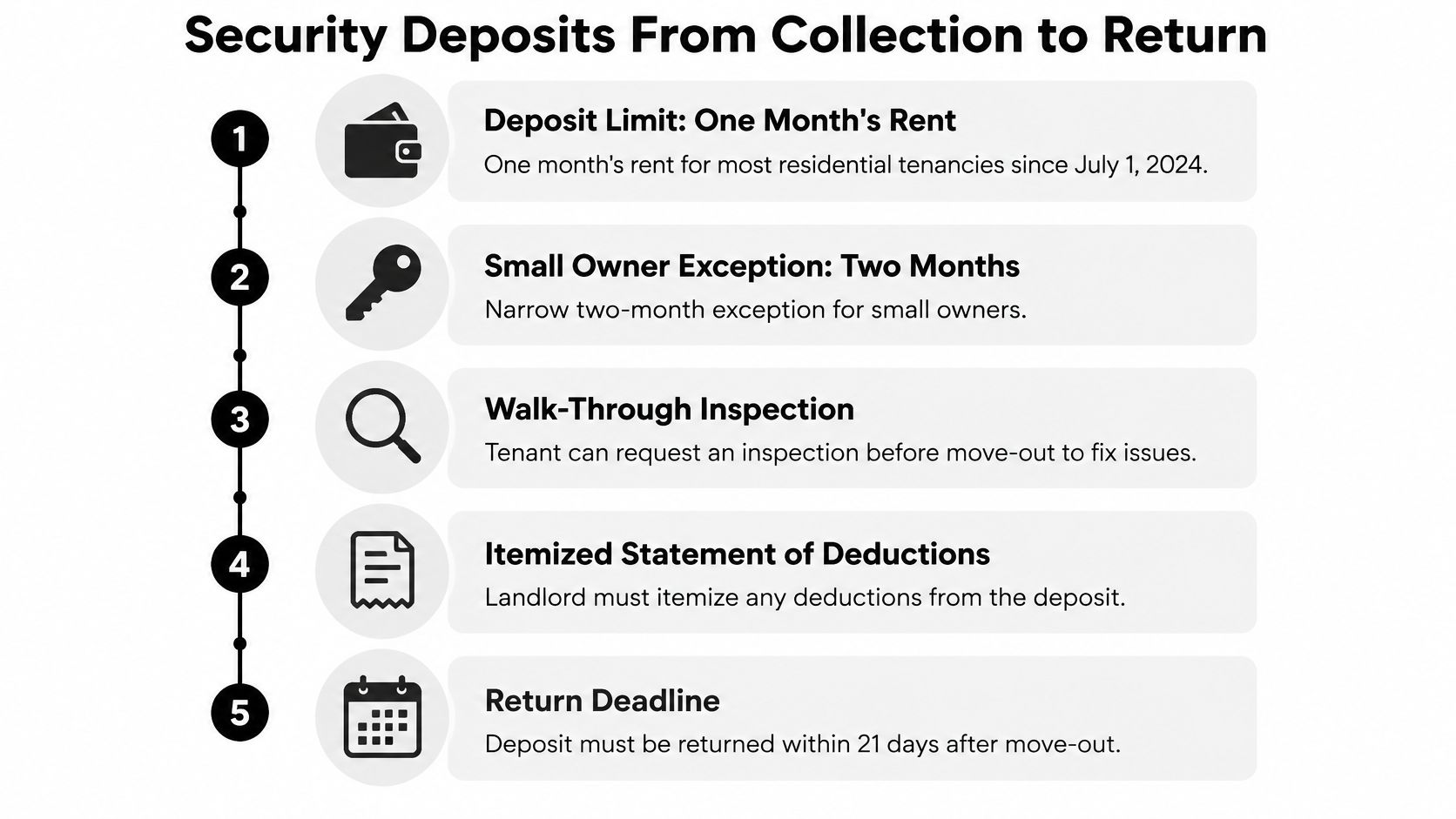
Hold the money separately from rent in your ledger, because permissible deductions are limited to unpaid rent, repairing tenant-caused damage beyond ordinary wear and tear, cleaning needed to restore the move-in level, and repairing or replacing landlord property authorized by the lease. Treat a deposit as ordinary income and you've lost the thread before the first dispute.
The photograph requirement most summaries leave out
Starting April 1, 2025, landlords generally must photograph the unit after possession is returned but before repair or cleaning, then again after the chargeable work is done. For tenancies beginning on or after July 1, 2025, move-in photographs are required too, as the San Francisco guidance on the security-deposit photo rules explains. Those photographs must be provided with the itemized accounting, and the accounting itself generally still goes by first-class mail unless the tenant agrees in writing to another method.
The point isn't the camera. It's a defensible before-and-after record tied to a specific deduction, taken before the repair erases the evidence. A polished invoice can't substitute for the required factual record, and bad-faith noncompliance can cost a landlord the right to deduct anything at all.
If a video walkthrough helps you picture the sequence, this one covers the same ground:
Separating wear from damage
Scuffed paint after five years is wear. A fist-sized hole in the drywall is damage. A dated move-in photo settles the argument faster than either description, so shoot wide frames of each room plus close-ups of anything already flawed when the tenant moves in. Then keep every invoice and receipt that supports a line on the statement, and trigger the 21-day clock the day you get possession back. A security deposit return calculator helps you check the math before the statement goes out.
Habitability, Repairs and Appliance Duties
A rental works like a car you lend to someone every day. It must start, stop, and keep the driver safe in rain and heat, not just look clean in the driveway. California applies the same test to housing through the implied warranty of habitability. Weather protection, plumbing with hot and cold water, heating, electrical systems, sanitation, and structural safety must all function. When one fails, the unit is defective and the landlord owes a repair.
State law sets the floor. City inspection programs and court orders add layers on top. A stove or refrigerator that stops working is a good example of that overlap. State habitability rules already require a livable kitchen, and newer appliance duties make the repair or replacement duty explicit for cooking and cold storage. Most summaries of rent caps skip this part completely, yet a broken appliance can create a compliance file as fast as a rent dispute. For the rent side of that overlap, the California Attorney General's updated resources on statewide and local rent rules helps explain why a statewide limit rarely answers the question alone.
Local formulas move often. An owner who pays for a new refrigerator and then raises rent to recover the cost may find the city allows less than the state figure for that notice date. Check the city cap that applies on the date of the notice before you assume the statewide number controls.
Notice starts the repair clock. The tenant should give written notice that names the specific defect, and the landlord should respond in writing and complete the repair within a reasonable time. Some tenants may arrange a repair themselves or withhold rent if the landlord does not act, but those self help steps carry strict procedural limits and real litigation risk.
Take a refrigerator that stops cooling on a Friday night. The tenant sends a written report with the date, the address, and the symptom. You log the report the same night. You send a technician on Monday and keep the work order with the file.
Keep one file per unit. Record the date reported, the exact problem, the written notice, your response, and the completed repair. That record shows when you learned of the problem and what you did next, which matters far more than an invoice alone when habitability is questioned.
How an Eviction Moves From Notice to Judgment and When to Get Legal Help
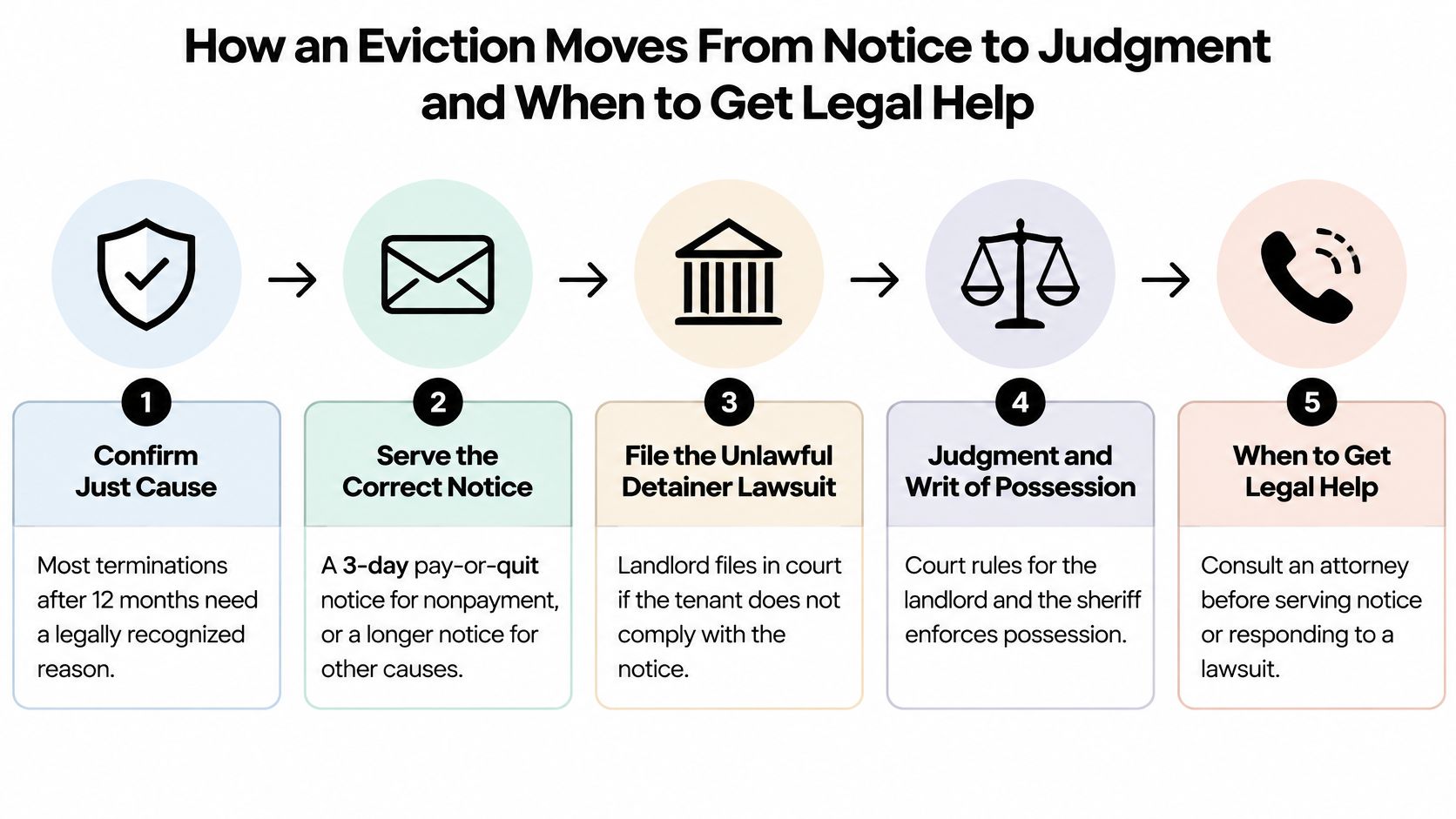
A California eviction fails when one procedural gate is missed. The tenant remains, the filing fee is lost, and the notice sequence restarts from zero.
- Confirm just cause. If the unit is covered and the tenant has occupied for 12 months, the termination needs a legally recognized reason, stated in writing.
- Serve the correct notice. Nonpayment uses a 3-day pay-or-quit, counted in court days. Other terminations use a 30-day or 60-day notice, depending on length of tenancy and the reason, with cause and any cure period spelled out.
- File the unlawful detainer complaint in superior court if the deadline passes with no payment and no move out.
- Serve the summons and complaint. The tenant receives a short response window, also counted in court days.
- Move to hearing or trial if the tenant files an answer.
- Obtain judgment by proving both the facts and the procedure.
- Request a writ of possession. Only the sheriff or marshal performs the lockout.
Court-day counting creates frequent errors. Weekends and court holidays do not count toward a 3-day notice or the time to answer, so calendar math produces a short notice that a judge will reject.
Self-help is off limits. Changing locks, placing belongings on the curb, or shutting off utilities to force a tenant out is illegal in California. It gives the tenant a damages claim that can exceed the unpaid rent.
Get counsel involved before service, not after the answer arrives. That timing matters for just cause analysis, for a rent increase near the state or local cap, and for conflicts where city rules add relocation, filing, or notice duties beyond state law. Your city rent board or housing office can confirm which ordinance covers the address. Organized records shorten that review, and many landlords use virtual legal assistants to assemble the notice trail, photographs, ledgers, and correspondence before sending the file to counsel.
Audit one active lease this week against the rent cap, deposit workflow, and appliance duty. Date the audit and store it in the property file, so the next review starts from evidence rather than memory.
VerticalRent builds the paperwork side of this for small portfolios: leases with lawyer-reviewed language, state by state, and county-level clauses added automatically, so the rent, deposit, and notice terms match the rules in the city where your property sits. Screening, online rent collection, and the income and expense ledger sit in the same workspace, which makes the compliance trail easier to produce when a tenant asks. Start a free workspace for one door, no credit card required, and see how the California terms generate at VerticalRent.
Put this into practice
VerticalRent tools related to this guide
Legal Disclaimer
VerticalRent and its authors are not attorneys, CPAs, or licensed legal or financial advisors, and nothing on this site constitutes legal, tax, or professional advice. The information in this article is provided for general educational purposes only. Landlord-tenant laws, eviction procedures, security deposit rules, and tax regulations vary significantly by state, county, and municipality — and change frequently. Nothing on this site creates an attorney-client relationship. Always consult a licensed attorney or qualified professional in your jurisdiction before taking any action based on information you read here.
Co-founded VerticalRent in 2011, growing it from nothing to 100k landlords and renters. Sold it in 2019, then re-acquired it in 2026 to make it better than ever.


