Tenant Screening Report on Myself: How to Get and Fix It
Learn how to get your tenant screening report on myself, check it for errors, and dispute mistakes before landlords see them.

You've found an apartment that fits your budget, submitted the application, and started thinking about moving. Then the landlord asks for a larger deposit or turns you down, and you haven't seen the report behind that decision. If you're searching for “tenant screening report on myself,” the useful next step isn't just checking whether you pass. It's checking whether the file accurately shows who you are and how each recorded case ended.
Why Check Your Own Report Before You Apply
Say a landlord tells you an eviction appeared in your background check. You remember a dispute with a former landlord, but the court dismissed it. Without seeing the report, you can't tell whether the screening company recorded the dismissal, confused you with another renter, or listed the same case twice.
Screening is routine: the Consumer Financial Protection Bureau's tenant-screening snapshot cites National Consumer Law Center research indicating that approximately 90% of landlords run background checks on prospective tenants. Checking your file is preparation for a common application step, not an admission that something is wrong.
An adverse-action notice is your starting point when a report influences a negative decision. Ask for it rather than accepting a vague explanation about your background.
Practical rule: Don't dispute a label such as eviction until you've identified the case, the reported outcome, and the company that supplied it.

Keep your application audit separate from move-day spending. If your wider plans include a London move, you can compare fixed-price London removal quotes through Best London Removals Ltd while you confirm your housing arrangements. That's a separate logistical task, not a substitute for checking a U.S. screening file.
Before another application, aim to have the report, supporting documents, and a clear list of disputed items. A correction request is much easier to explain when you can identify the exact field that's wrong.
How to Request Your Free Report Step by Step
Start with the company that supplied the landlord's report, not a random background-search website. Buying an unrelated search won't necessarily reveal the information that influenced your application.
Locate the right file
Find the screening company. Look at your adverse-action notice and application paperwork. According to the Federal Trade Commission's tenant-background-check guidance, a landlord taking adverse action based on a report must identify the reporting agency by name, address, and telephone number, and you can request a free copy within 60 days. If you haven't applied yet, ask the prospective landlord which screening company they use.
Gather your identifying information before opening the request form. Have your full legal name, former or maiden names, date of birth, current address, and previous addresses ready. Provide your Social Security number only through the company's verified, secure identity-verification process, not an unsolicited email or text message.
Choose the tenant-file request. On the company's official website, look for consumer disclosures, file requests, tenant screening, or rental history. Don't accidentally purchase an employment background check or a people-search subscription. If the request offers several report types, confirm which one corresponds to the housing decision.
Preserve what you receive
Record the request date and confirmation. Save the submission receipt, reference number, and any message explaining how the company will deliver your file. If the company needs additional identity documents, keep its request with your response so you can explain any delay.
Download the complete report, including explanatory pages. Save a PDF and dated screenshots if the report appears in an online portal. A screenshot of the decision alone isn't enough, because you need the underlying names, accounts, and case entries.
Check identity before interpreting results. Read your name, birth details, aliases, and addresses first. If those fields don't match, flag them before assuming that an unfamiliar eviction or account belongs to you. Don't dismiss an address discrepancy merely because the rest of the report looks familiar.
Our guide to getting a free rental history report can help you distinguish an address-history check from a broader screening file. That distinction matters when you're deciding whether you've obtained the information the landlord reviewed.
Keep everything in a private folder named for the screening company. Use clear filenames such as “original report,” “request confirmation,” and “supporting court documents,” rather than overwriting earlier copies.
What Your Report Shows and What It Leaves Out
A tenant screening report may combine identity information, credit accounts, court records, and rental information. Don't assume that every report contains every category, or that an empty section means a nationwide search found nothing.
Read the scope and section labels before interpreting the results. An address trace, for example, answers a different question from an eviction search.

What each part of a tenant report can show and what to verify
| Report section | What it can show | What to verify |
|---|---|---|
| Identity and aliases | Names, maiden names, and name variations associated with your identifying information | Unfamiliar names and incorrect birth details |
| Address history | Addresses linked to your file, including possible gaps | Addresses you never lived at and periods without a verifiable address |
| Eviction records | Filings, judgments, payments, and case outcomes | Dismissed, sealed, or paid cases incorrectly shown as open |
| Criminal records | Arrests and convictions from court sources | Missing outcomes, incorrect identity matches, and expunged records |
| Rental history | Prior tenancies, landlord information, and rental-payment information when included | Tenancies or landlords you don't recognize |
| Credit data | Credit accounts and payment history, when included | Accounts belonging to someone with a similar name |
Read the scope before drawing conclusions
Our free rental history and SSN trace report shows addresses associated with your SSN, generally going back 7–10 years, along with associated name variations. It doesn't include eviction filings, criminal history, or a bureau credit score. It also isn't identity verification, which is a separate service.
For criminal-record terminology, the guide to what a criminal background check shows provides useful context. Keep the distinction between a charge and a final outcome in mind when reading any court entry.
Compare the report against documents, not memory alone. A lease can establish where you lived; a court disposition can establish how a case ended; a payment receipt can support a balance correction. An unfamiliar property-owner name may require clarification rather than deletion, especially if you dealt with a management company instead of the owner.
How Long Old Records Stay Visible
Record age and record outcome are separate checks. An entry may be recent enough to report but still be inaccurate because it omits a dismissal or payment. An accurate description can also raise a reporting-limit question.
The Consumer Financial Protection Bureau's rental-background-check guidance explains that arrest records, civil suits, and civil judgments are generally reportable for seven years or the applicable statute-of-limitations period, whichever is longer, while criminal convictions may be reported indefinitely under federal law.
How long common adverse records can be reported
| Record type | Typical reporting limit | Check first |
|---|---|---|
| Arrest records | Generally seven years or the applicable statute-of-limitations period, whichever is longer | Whether the report supplies the outcome |
| Civil suits | Generally seven years or the applicable statute-of-limitations period, whichever is longer | Favorable resolutions and reporting dates |
| Civil judgments | Generally seven years or the applicable statute-of-limitations period, whichever is longer | Whether payment or satisfaction is recorded |
| Criminal convictions | Indefinitely under federal law | State sealing or expungement status |
| Eviction filings | Check applicable civil-record limits and state restrictions | Dismissed, sealed, or settled cases described as judgments |
Don't assume an eviction filing has no federal reporting restriction because the report calls it an eviction rather than a civil case. Ask a legal-aid office about the applicable record category and local rules when the classification is unclear.
Check what actually happened
The housing applicant-screening guidance hosted by the National Consumer Law Center cites a study of 3.6 million eviction records finding that 22% contained ambiguous information or incorrectly represented a tenant's eviction history. A filing alone doesn't establish that a tenant lost or was removed.
For each case, verify:
- Identity: Name, property address, and docket number.
- Timeline: Filing date and final disposition.
- Money: Judgment amount, payment, and satisfaction.
- Restrictions: Sealing, expungement, and any limits on reporting.
A paid judgment isn't automatically an erased judgment. Likewise, criminal-record sealing is jurisdiction-specific; the Law Office of Bryan Fagan guide offers context for readers exploring that process in Texas, not a nationwide eligibility rule.
The explanation of whether evictions show up on credit reports helps separate credit reporting from court-record screening. Your central question remains: Does this entry accurately describe the event and its resolution?
Errors That Cost Renters Applications
Prioritize an error by what it could cause a landlord to conclude. Someone else's eviction or an incorrectly open housing judgment deserves attention before a harmless spelling variation that doesn't affect identity matching.
The U.S. Government Accountability Office reported approximately 26,700 screening-related complaints submitted to the CFPB from January 2019 through September 2022, including about 17,200 involving inaccurate information. Those complaints included another person's information, outdated entries, and inaccurate arrest, criminal, or eviction records.
Pair each problem with usable proof
Common report errors, the proof to send and where to send it
| Error type | Evidence to send | Where to send it |
|---|---|---|
| Another person's information | ID copies and a signed explanation identifying the mismatched fields | Screening company and any identifiable court-data provider |
| Duplicate eviction case | Court docket showing the entries concern the same case | Screening company |
| Dismissed or sealed case still listed inaccurately | Dismissal or sealing order | Screening company; court if its underlying entry needs correction |
| Address you never lived at | Lease, utility bill, or ID supporting your actual address | Screening company |
| Outdated record past the permitted reporting period | Court or arrest documents establishing dates | Screening company |
| Missing address history | Lease, rent receipts, or landlord letter | Screening company |
Correct the underlying claim, not just the wording. If a dismissed case appears as an outstanding judgment, identify the incorrect disposition and balance. Merely saying that the entry looks unfair doesn't tell the investigator which fields need attention.
An arrest without a conviction also needs careful handling. Establish the actual outcome and whether reporting is permitted, rather than assuming every arrest entry must disappear. For a duplicate, compare docket numbers and parties so you don't mistake separate procedural entries for separate cases.
This video offers additional background while you organize your review.
Send proof that answers the disputed question. A rent receipt can establish payment, but it doesn't establish that a court dismissed a case.
Application preparation matters too. Homes By Carmen tenant screening advice can help you organize the broader application process, while your dispute packet addresses the specific inaccurate record.
Preserve a dated original alongside your evidence. If the same incorrect case appears at different screening companies, note each company separately so you can track which file has changed.
How to File a Dispute and Track the Deadlines
A useful dispute gives the investigator a clear comparison: what the report says, what the supporting document establishes, and what needs correcting. You don't need legalistic language, but you do need identifiable records.
Send a field-specific dispute
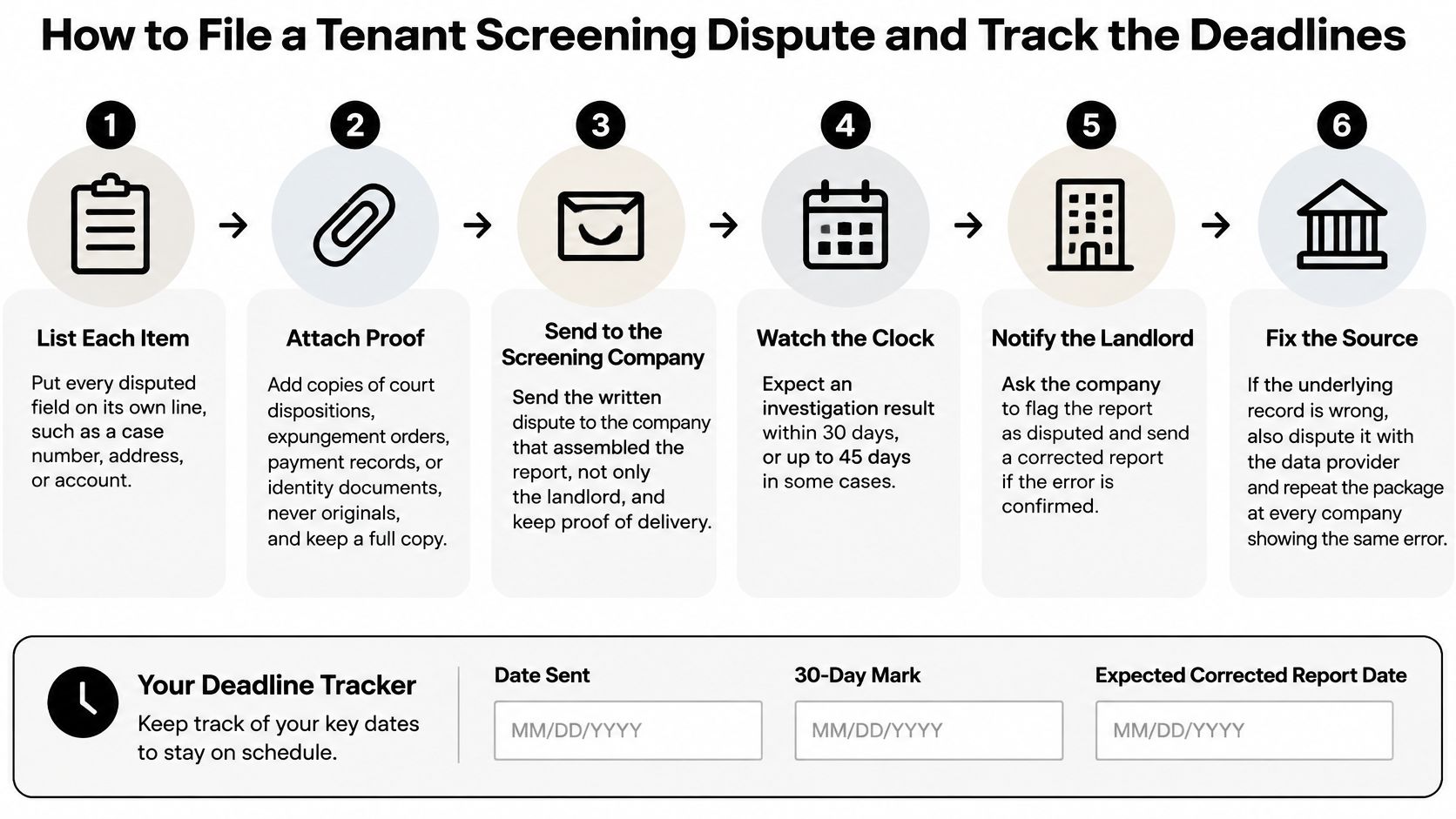
List each disputed item separately. Identify the report reference, page, case number, account, or address. State whether the problem is identity, duplication, disposition, balance, or reporting age.
Attach copies of the relevant documents, never originals. Label each attachment so the investigator can connect it to the disputed entry. Keep a complete copy of the submission, including any text entered into an online form.
Send it to the screening company. Follow the company's dispute instructions and retain delivery confirmation or the portal receipt. Telling only the landlord doesn't put the dispute before the company that assembled the file.
Track the investigation. The formal process generally calls for an investigation within 30 days, with up to 45 days in some cases. Record when the company received your dispute and retain any explanation of an extended timeline.
Notify the landlord directly. Explain that you've disputed a specific entry and provide the submission confirmation if useful. Ask the screening company to identify the disputed information and send a corrected report if it confirms an error.
Correct the source when necessary. If the court's entry or another provider's information is itself wrong, contact that source too. A change in a screening file doesn't automatically rewrite the underlying record.
Use a simple tracker to keep these actions connected.
Make the requested correction explicit
A concise dispute might say:
Requested correction: The report lists this case as open with an unpaid balance. The attached court disposition shows dismissal. Please reinvestigate the disposition and balance fields and provide an updated report.
Don't promise the landlord that the company will delete an accurate record or finish before an application decision. Ask whether the landlord will consider your supporting documents or hold the application while the company investigates.
Your tracker should contain the date sent, date received, investigation checkpoint, and expected corrected-report delivery date. If the company gives you a delivery date, record it separately from the investigation deadline. Follow up using the original reference number rather than opening an unexplained new complaint.
Confirm the Corrected Report Reaches Your Landlord
An investigation result isn't the same as a verified correction. Open the updated file and compare the disputed fields with your supporting documents, especially the case number, disposition, balance, and identity information.
Save the new PDF beside the original rather than replacing it. That comparison lets you show exactly what changed and identify any field the company overlooked.

Close the communication loop
- Confirm receipt: Ask the landlord whether they received the corrected report and which version they reviewed.
- Request delivery: Ask the screening company to send the correction to recipients of the inaccurate report, including the landlord handling your application.
- Identify unfinished work: If a field remains wrong, send a focused follow-up with the original delivery date, reference number, and supporting document.
Keep your message to the landlord brief:
The screening company corrected the disposition for the case identified in the attached updated report. Please confirm receipt and review my application using the corrected information.
Share sensitive documents through a secure channel, and don't send unrelated identity material just to explain a corrected court entry. Schedule your next self-check before submitting another application, leaving room to request documents rather than relying on a last-minute explanation.
This week, finish the comparison and take the outstanding action: submit the remaining dispute or forward the corrected file to the landlord considering your application.
VerticalRent offers renters a free rental history and SSN trace report to help check associated names and addresses before applying. Visit VerticalRent to review that part of your file, then use the audit steps above to investigate anything that doesn't match your records.
Put this into practice
VerticalRent tools related to this guide
Legal Disclaimer
VerticalRent and its authors are not attorneys, CPAs, or licensed legal or financial advisors, and nothing on this site constitutes legal, tax, or professional advice. The information in this article is provided for general educational purposes only. Landlord-tenant laws, eviction procedures, security deposit rules, and tax regulations vary significantly by state, county, and municipality — and change frequently. Nothing on this site creates an attorney-client relationship. Always consult a licensed attorney or qualified professional in your jurisdiction before taking any action based on information you read here.
Co-founded VerticalRent in 2011, growing it from nothing to 100k landlords and renters. Sold it in 2019, then re-acquired it in 2026 to make it better than ever.


