Online Maintenance Request System: A Guide for Landlords
Simplify property upkeep with an online maintenance request system. Track repairs, manage tenant requests, and stay organized.


At 11 PM, the phone lights up with a tenant saying the water heater is leaking and the floor is already wet. You're trying to finish dinner, answer one work email, and decide whether this is a bucket-and-towels problem or a call-the-plumber-now problem. If the only record is a voicemail, the next morning usually starts with scribbled notes, a vendor who never got the message, and a tenant who feels like nobody's taking it seriously.
That same mess is why many small landlords move from scattered messages to an online maintenance request system. The point isn't to add software for its own sake, it's to turn a stressful repair into a traceable case with a start, a middle, and a finish. When the request is structured from the beginning, the landlord doesn't have to rebuild the story later from memory.
The Midnight Leak That Changed How a Landlord Works
A voicemail is easy to miss and even easier to misread. Was the leak active, or just a drip? Was the tenant asking for advice, or warning that the ceiling was about to fail? Without a record, the landlord ends up acting like a detective instead of a property operator.
A good emergency repair path starts with a clear source of truth. If a pipe burst or active leak is suspected, tenants need a fast way to report it, and landlords need a way to document what happened from the first call onward. A practical emergency reference like AMPM Restoration emergency response can help landlords understand the urgency of water damage, but the bigger lesson is operational, not technical. The repair only gets easier when the report is captured in a consistent system.
What usually happens without a system
The first 48 hours often turn into a chain of small failures. The landlord leaves a voicemail for the plumber, forgets to follow up after lunch, and later learns the vendor never received the address. The tenant sends another message, now irritated, because the same problem keeps being retold instead of resolved.
That's why structured maintenance handling matters even for owners with one to ten units. The workflow doesn't just help on busy days, it protects the ordinary days too, when a leaky faucet, a broken appliance, or an HVAC issue might otherwise disappear into text threads and sticky notes. An actual request system gives the landlord one place to see the report, assign it, and prove what happened next.
A repair that isn't documented tends to become two problems, the physical issue and the argument about whether it was handled.
When that midnight leak is entered into a system, the rest of the story changes. The tenant gets a ticket, the landlord gets a timestamp, and the vendor gets a clear job instead of a vague memory. That's the difference between chasing a crisis and running a repeatable process.
What an Online Maintenance Request System Actually Does
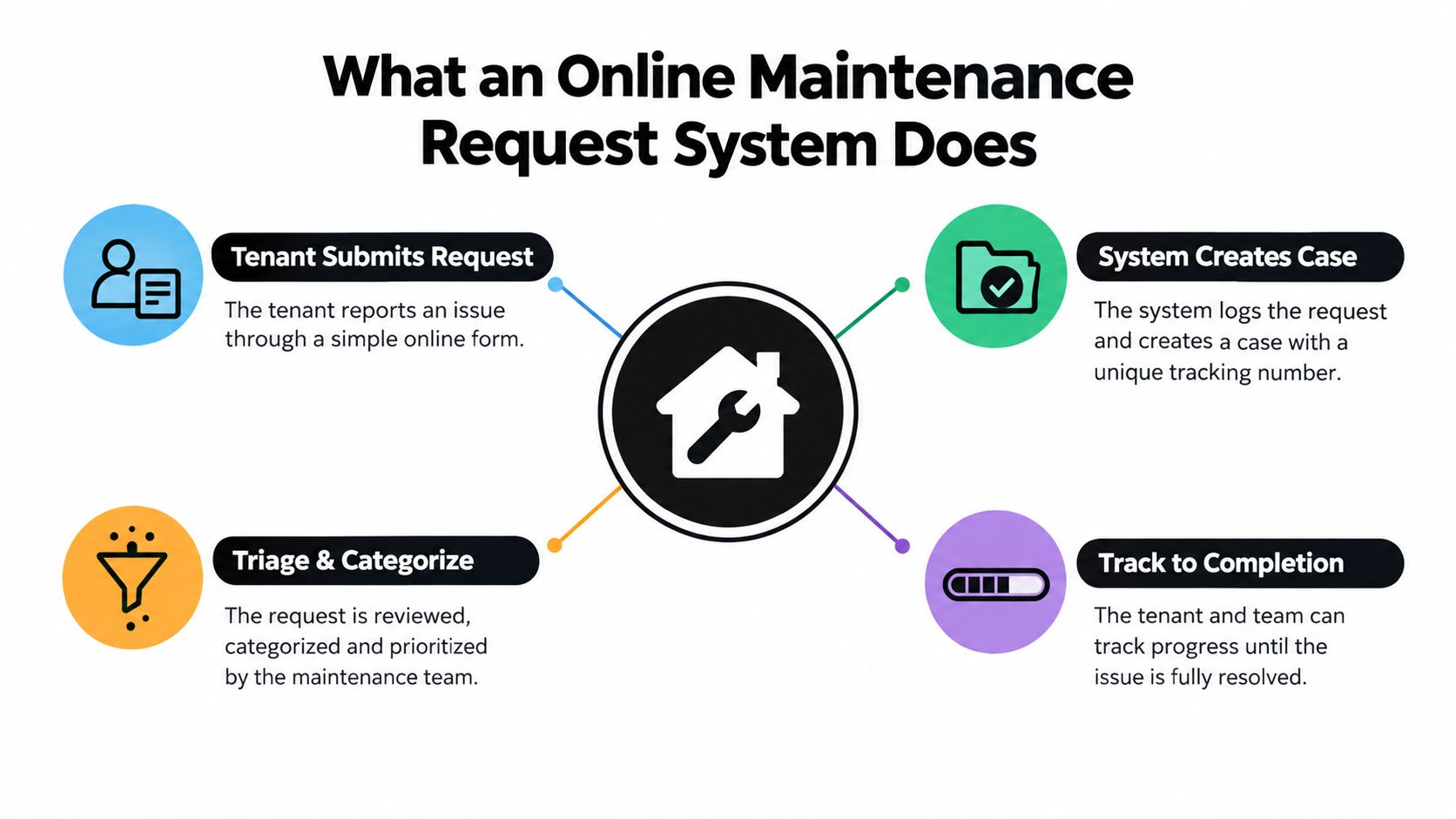
An online maintenance request system turns a tenant repair report into a documented case. The request can be submitted, categorized, assigned, tracked, and closed with proof. A medical chart or an order status page is a useful comparison, because the value is not the message box, it is the record that stays with the work.
The four moving parts that matter
The first part is tenant submission, where the renter describes the issue and sends it in. The second is AI-assisted triage, which reads the message and helps sort the issue by category and urgency. The third is vendor dispatch, where the request is matched to the right trade and sent with the right details. The fourth is tracking, which keeps everyone aware of the case until it is finished.
That structure matters because maintenance work is repetitive in specific ways. Hemlane's analysis of rental maintenance requests by category shows that plumbing, heating and HVAC, appliance repair, and electrical problems account for most of the work orders in its dataset. A real system helps landlords handle the same kinds of issues the same way every time, instead of rebuilding the process for each request.
Practical rule: if a request cannot be searched, assigned, and closed in one place, it is not a system yet, it is only a message collection tool.
A shared inbox or text thread can receive information, but it usually cannot manage ownership, deadlines, status changes, or closure proof well. A true system sits underneath the conversation and keeps the case file intact. That is why the best maintenance tools act more like a record of action than a chat app.
How Tenants Submit a Maintenance Request
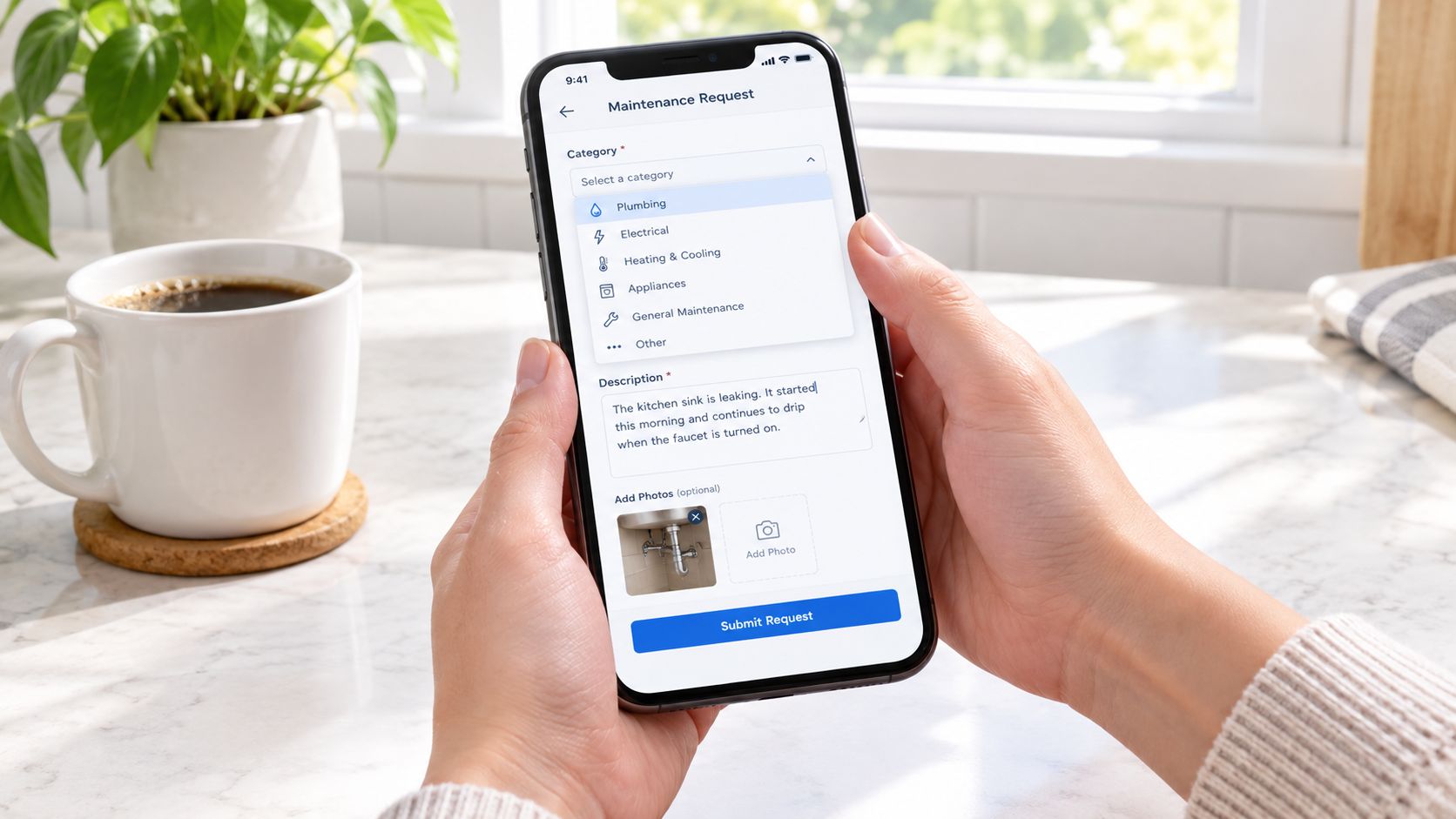
A tenant shouldn't have to write a perfect essay to report a broken sink. They should see a simple form with the right fields, because the landlord's job is to capture the facts that will matter later. A strong intake form usually asks for the category, a description in the tenant's own words, a photo or video, an urgency flag, permission to enter, and a preferred contact window.
Why each field earns its place
The category helps the system sort the issue quickly. A photo helps the landlord and vendor tell the difference between a cosmetic annoyance and a problem that could worsen if ignored. The urgency field keeps the tenant from having to guess how the landlord will interpret the message, while permission-to-enter and contact timing reduce back-and-forth when a vendor is ready to visit.
Old habits hide too much information. A voicemail can miss the unit number, a group text can bury the actual request, and a vague email can leave the vendor guessing. A structured form captures the same details every time, which means the landlord can route the issue without playing phone tag.
A renter should also get an immediate confirmation after submission. That confirmation should include a ticket number, an expected response window, and a way to add updates if the situation changes. If the leak gets worse at 2 AM, the tenant shouldn't have to start over from scratch.
After a request is submitted, the case should already feel different from a loose message. It should have a place in the system, a visible status, and a clear next step. That's what reduces anxiety for the tenant and eliminates guesswork for the landlord.
How AI Triage Decides What Happens Next
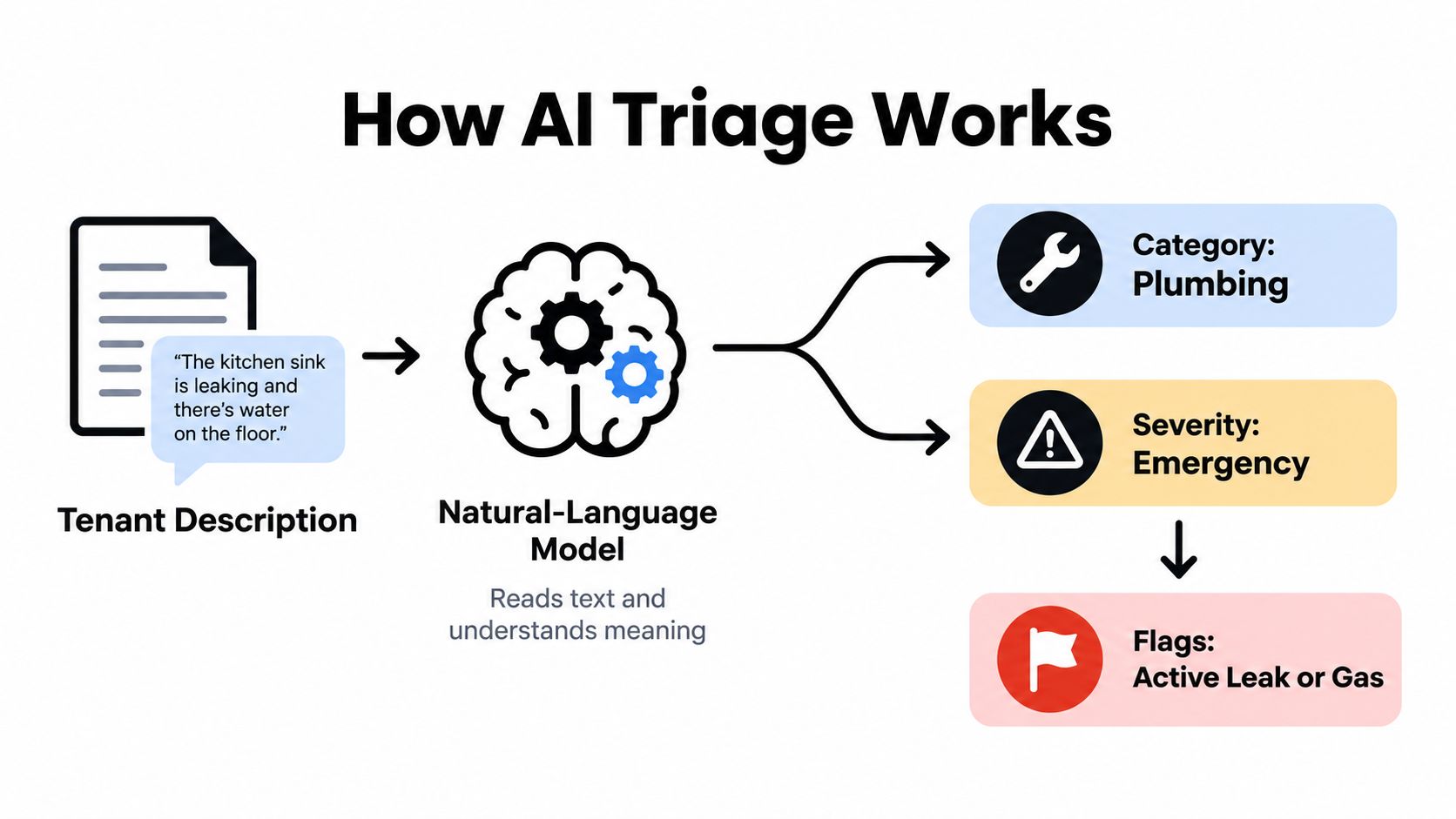
AI triage works best as a sorting clerk, not a final authority. It reads the tenant's description, identifies likely categories, and flags severity based on the language it sees. A message like “water heater leaking onto floor, towels down” should surface very differently from “dishwasher making noise,” because the first one may involve an active water problem.
Where AI helps and where it must stop
The value of AI is speed and consistency. It can map hundreds of similar requests into a controlled set of categories so the landlord isn't manually interpreting every message by hand. That matches the logic in the NIST incident-response guidance, where response time depends on incident type, severity, service-level expectations, and workload, because not every incident deserves the same handling path NIST SP 800-61r3.
But AI should not make the final safety call on its own. A landlord still needs human review for emergencies, habitability issues, and anything that could involve code or safety risk. The system can suggest that a report looks urgent, but the person on duty has to decide whether it needs immediate escalation.
For that reason, the best setups keep the original tenant text visible alongside the AI category. That way, the landlord can see both the machine's interpretation and the renter's actual words. It's a simple safeguard that helps prevent a bad classification from becoming a bad response.
Important distinction: AI can speed up routing, but it shouldn't be the thing that decides whether a leak, loss of heat, or gas concern is treated as safe to wait.
The internal logic behind this should be transparent enough that a landlord can explain it later. If a request is marked emergency, there should be a reason attached to that label. If a human overrides the suggestion, that override should also be logged, because accountability starts with traceability.
For a deeper look at that workflow, the AI maintenance triage guide shows how landlords can reduce on-call chaos without handing safety judgment over to software.
Vendor Dispatch and the Path to a Completed Repair
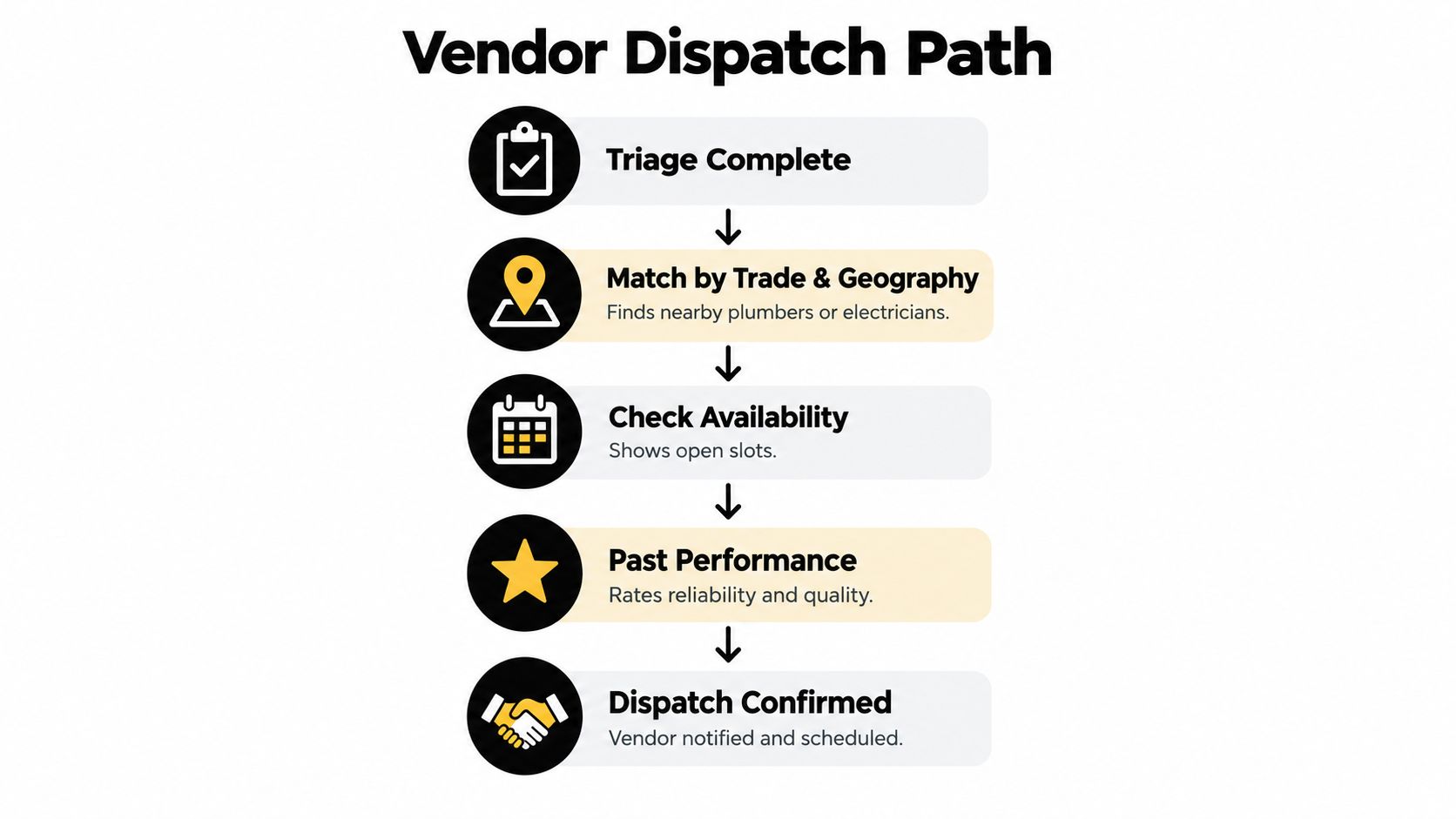
Once triage is done, the request has to move from a record into action. That means matching the issue to the right trade, checking availability, and sending a job brief that includes the tenant's description, any photos, access instructions, and the preferred contact method. A vendor who gets that package doesn't have to waste time guessing what's wrong.
Dispatch is the start of the repair record
Good dispatch isn't just “we told someone about it.” It's a documented handoff that shows who owns the job and when. The status should move through clear stages, such as assigned, scheduled, on-site, awaiting parts, completed, and tenant-confirmed, so the landlord can see where the case stands at a glance.
The proof matters as much as the fix. Before-and-after photos, invoices, closure notes, and tenant confirmation create a file that can be used later if the issue reappears or a dispute comes up. If the repair was more involved than expected, those records also help show why the job took the time it did.
A practical vendor workflow also needs a reliable roster. If a landlord needs to book a local plumber, a professional scheduling page like book North Metro Atlanta plumbers shows the kind of direct dispatch experience a modern workflow should support. The process should feel this clear inside the maintenance system, even when the trade is different.
The underlying data layer matters too. A structured record makes it easier to see recurring problems by asset, unit, or vendor, instead of treating every breakdown as a surprise. For a broader operational view, the vendor management platform guide is useful for thinking about how assignments, communication, and follow-up fit together.
When the repair is complete, the case should end with evidence, not optimism. A landlord shouldn't have to wonder whether the issue was handled correctly, because the system should already show what was done and when it was verified.
Why Small Landlords See the Biggest Payoff
For a small landlord, the value shows up quickly. As noted earlier, Hemlane's dataset found 3.3 requests per rental unit in 2024, up from 2.93 in 2020. Even a four-unit property can generate more than a dozen repair events in a year, and each one can turn into an after-hours interruption if the workflow depends on texts, calls, and memory.
That is why the payoff appears in day-to-day operations, not only in emergencies. A landlord spends less time searching old messages, vendors receive clearer information, and the repair file is easier to use later for disputes, tax questions, or recurring maintenance planning. A cleaner workflow also lowers the odds that the same issue gets reported twice because the first attempt never closed properly.
What to measure after the first ninety days
Track median acknowledgement time, not just whether someone eventually replied. Track repair duration, because a few long cases can hide inside an average. Watch the reopen rate, since repeat failures show whether the fix held. Add cost per incident so you can compare recurring issues instead of relying on memory.
A phased rollout usually works better than trying to automate everything on day one. Start with the categories that come up most often, especially plumbing and HVAC, then expand once the workflow is stable. That keeps the learning curve manageable while still reducing the biggest sources of stress.
The goal is not to make every repair feel automated. The goal is to make every repair feel accounted for.
Small landlords benefit when the process is simple enough to use on a busy night and structured enough to explain later. That combination turns a maintenance system from a convenience into a real operating habit.
Closing the Loop on Accountability and Fair Access
A portal alone doesn't solve maintenance, because acknowledgment isn't the same as resolution. The system has to timestamp every major status change, attach closure photos or invoices when they're appropriate, and let the tenant confirm the outcome or reopen the ticket if the repair didn't hold. That's how a landlord proves the request moved all the way through the workflow, not just into an inbox.
The historical HUD review found that 88% of rental owners and managers handled maintenance immediately and practiced preventive maintenance, while only 4% generally postponed routine work and addressed major problems as quickly as possible HUD review of rental-housing owners and managers. That kind of prompt handling is still the standard renters expect, but the modern version needs better documentation and better access. A strong system doesn't just record urgency, it records the trail from report to repair.
Fair intake matters as much as fast intake
Digital-first workflows can leave people behind if they depend on one channel. Renters with limited English proficiency, disabilities, low digital literacy, or unreliable internet still need a way to report problems that lands in the same ticket history. Phone, SMS, email, image uploads, translated submissions, and human fallback shouldn't create separate side processes.
That's why the workflow has to preserve one complete case file, even when the entry point varies. If a tenant calls instead of using the portal, the request still belongs in the same system. If someone sends a photo by text, that photo should attach to the same case the landlord reviews later.
For a practical reminder of what a real record looks like, the maintenance request log guide is a useful companion. The key idea is simple, if the landlord can't show what happened, when it happened, and how it was closed, the system isn't fully doing its job.
An accountable maintenance workflow gives every tenant a real path to report issues and gives the landlord a defensible record of what happened next. That's the standard worth building toward.
How to Choose the Right System for Your Portfolio
Start with the questions that affect daily use, not the ones that sound impressive in a demo. A small landlord should look at pricing, tenant intake depth, AI triage override options, vendor dispatch tools, closure evidence, accessibility, multilingual support, data export, accounting integration, and mobile usability for both tenants and vendors. If the system misses one of your priorities, it is probably the wrong fit, no matter how polished the dashboard looks.
A simple scoring method works well. Pick two or three must-haves, such as closure photos, phone fallback, or tenant status updates, and reject any system that can't support them cleanly. Then compare the remaining options on ease of use, recordkeeping, and how well they support the way you already work.
A practical comparison table
| Criterion | Why it matters | What to ask the vendor |
|---|---|---|
| Intake form depth | Better intake means fewer follow-up calls | Can tenants submit photos, urgency, access notes, and preferred contact times? |
| AI triage controls | Automation should help, not guess blindly | Can you override categories and review the original tenant message? |
| Vendor dispatch | A request has to become a job, not just a notification | Does the system match by trade, location, and availability? |
| Closure evidence | You need proof that the repair was finished | Can you store photos, invoices, notes, and tenant confirmation? |
| Accessibility | Some renters can't use one channel reliably | Does it support phone, SMS, translated, and mobile-friendly submissions? |
| Data ownership | You may need records later for disputes or reporting | Can you export the full ticket history and attachments? |
| Mobile experience | Tenants and vendors won't use clunky tools | Does the portal work well on a phone for both sides? |
If you want a real-world example of how a portfolio-facing platform packages these pieces, 1st Choice Home Repairs portfolio is a useful example of how service presentation can support dispatch-oriented workflows.
After you choose a system, don't try to launch every feature at once. Spend the first thirty days on one intake path, one priority framework, and one closure routine. If that works, expand into more categories and vendor rules after the process is stable.
If you're ready to replace scattered calls, texts, and voicemails with one clear maintenance workflow, VerticalRent gives independent landlords a practical way to collect requests, triage them, and track repair outcomes in one place. Use it to build a cleaner record, reduce confusion, and handle every maintenance case like the documented job it really is.
Put this into practice
VerticalRent tools related to this guide
Legal Disclaimer
VerticalRent and its authors are not attorneys, CPAs, or licensed legal or financial advisors, and nothing on this site constitutes legal, tax, or professional advice. The information in this article is provided for general educational purposes only. Landlord-tenant laws, eviction procedures, security deposit rules, and tax regulations vary significantly by state, county, and municipality — and change frequently. Nothing on this site creates an attorney-client relationship. Always consult a licensed attorney or qualified professional in your jurisdiction before taking any action based on information you read here.
Co-founded VerticalRent in 2011, growing it from nothing to 100k landlords and renters. Sold it in 2019, then re-acquired it in 2026 to make it better than ever.


