Maintenance Request Log: A Landlord's Step-by-Step System
Build a maintenance request log that protects your property, ensures habitability compliance, and cuts repair time by 30%. Practical guide with templates.


A dataset of more than 193,000 rental requests found a 13.1-day median resolution time, while coordinated repairs reached 10.1 days, roughly 31% faster than self-managed repairs. A well-structured maintenance request log makes that coordination possible by giving every request an owner, deadline, status, and proof of resolution.
The difference shows up when a tenant reports a heating failure on a Friday evening and expects a clear answer. Without a reliable record, the request may live in a text thread, a voicemail, and a contractor's inbox. Weeks later, you're trying to reconstruct what happened from memory while the tenant is asking why nobody acted.
I've seen landlords treat maintenance documentation as an administrative chore until a dispute, insurance claim, or expensive repeat repair exposes the gaps. The practical solution isn't a more elaborate spreadsheet for its own sake. It's a maintenance request log that functions as an operating system, from intake through verification and escalation.
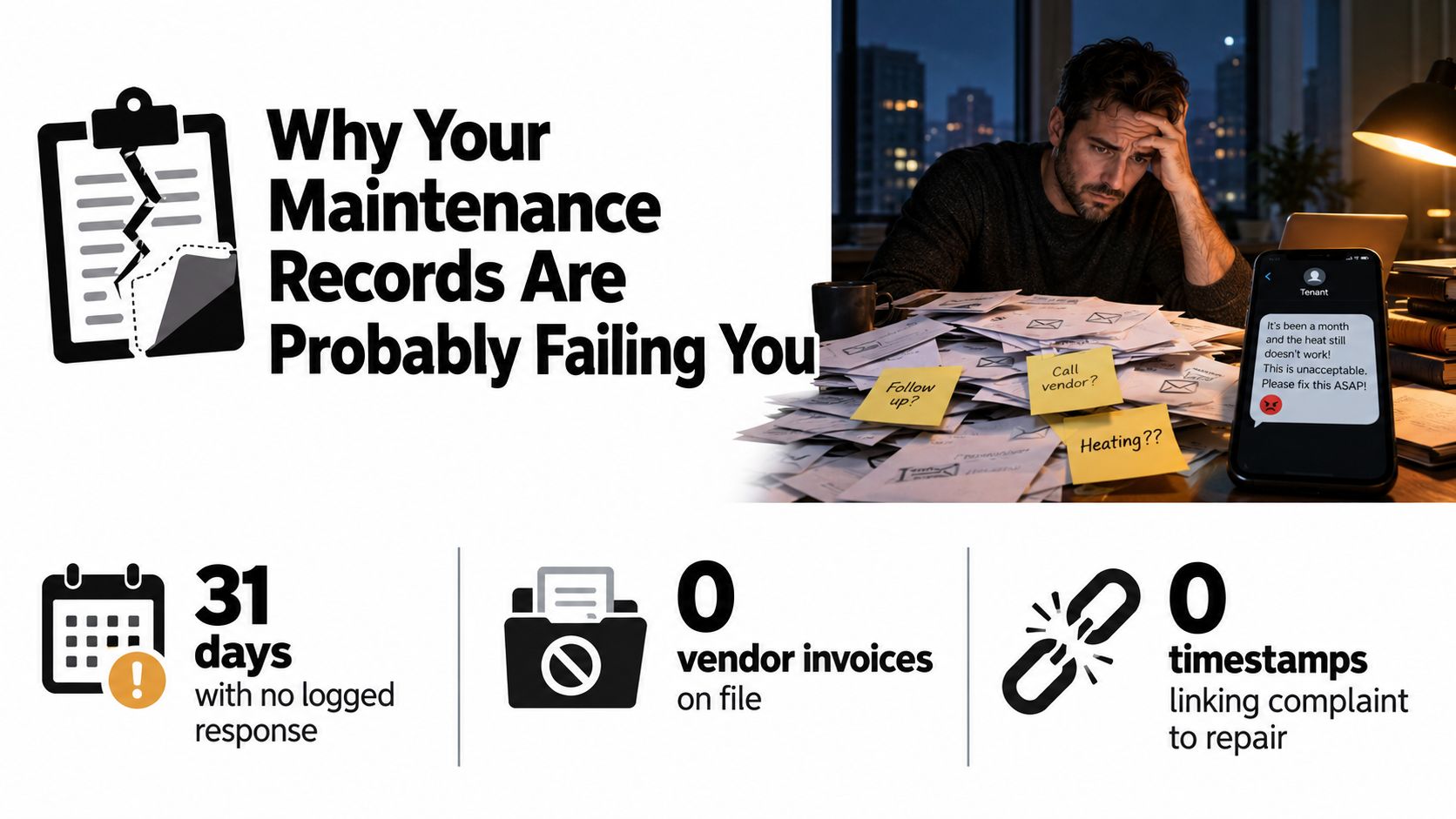
Why Your Maintenance Records Are Probably Failing You
Friday night, a tenant reports no heat. By Monday, you have a text from the tenant, a missed call from the HVAC company, a note in a spreadsheet that says “heater,” and no clean record of who acknowledged the issue, when it was triaged, or why service was still out. That is how landlords end up losing arguments they might have won.
Bad maintenance records rarely fail because nothing was written down. They fail because the record stops at the complaint and never becomes an operating tool. If your log cannot show notice time, urgency level, response target, assigned vendor, delay reason, follow-up, and confirmed restoration of service, it cannot support service standards or escalation.
The questions that matter are practical:
- When did the tenant notify you?
- How was the issue classified?
- When was it acknowledged?
- Who owned the next action?
- What blocked progress?
- When was service restored?
- Did the same issue return?
The cost of incomplete records
Maintenance is not bookkeeping clutter. It is a major operating cost that needs the same control as rent collection or turnovers. One rental-property maintenance cost analysis estimated that the median property spent approximately $1,600 per unit on maintenance and repairs in 2023, while the highest-spending 10% spent at least $7,500 per unit. The same analysis estimated maintenance at roughly 42% of rental-property operating costs, with single-family rentals costing about twice as much per unit to maintain as large apartment properties.
On a small portfolio, one poorly documented repair can do more than raise costs. It can hide the reason costs rose. If you do not track category, property, vendor, repeat visits, and time to resolution in a consistent way, you cannot tell whether you had a one-time failure, a contractor problem, or an asset that should have been replaced earlier.
That is where paper files, scattered texts, and “I'll remember it” systems break down. They store fragments, not timelines. They also make it hard to spot repeat failures, missed response targets, and repairs that should have escalated sooner, which is a recurring problem in this explanation of why paper maintenance tracking systems fail.
A useful log does more than preserve history. It lets you measure whether your process is working. If emergency calls sit unacknowledged, if standard jobs keep missing their target dates, or if the same vendor needs multiple visits to close basic work, the log should expose that early.
Documentation protects more than the budget
Landlords usually focus on records after a dispute starts. That is late. Good documentation protects you while the work is still active, because it creates a dated chain of notice, triage, action, delay, and resolution.
Residential rental obligations still turn on basic questions. Was the issue serious. Did you respond in a reasonable time. Did you communicate clearly. Did you authorize the work. Did the repair restore service. A thin record makes each answer harder to prove.
Practical recordkeeping guidance says to capture the request itself, the reporting date and time, the reporting channel, the tenant's description, severity, response, vendor details, inspection findings, authorization, completion date, and total cost, with routine maintenance records often kept for roughly three to seven years and longer retention for disputes, claims, major systems, and capital work (landlord maintenance documentation guidance).
My rule is simple. If a request could turn into a complaint, insurance issue, tax question, or repeat repair, document it so another person could audit the entire timeline without asking you what happened.
That standard changes how you log work. The record stops being a passive file and starts functioning as a service ledger, with response expectations, escalation triggers, and enough closure detail to judge first-time resolution instead of just marking “completed.”
Building a Complete Work-Order Lifecycle Record
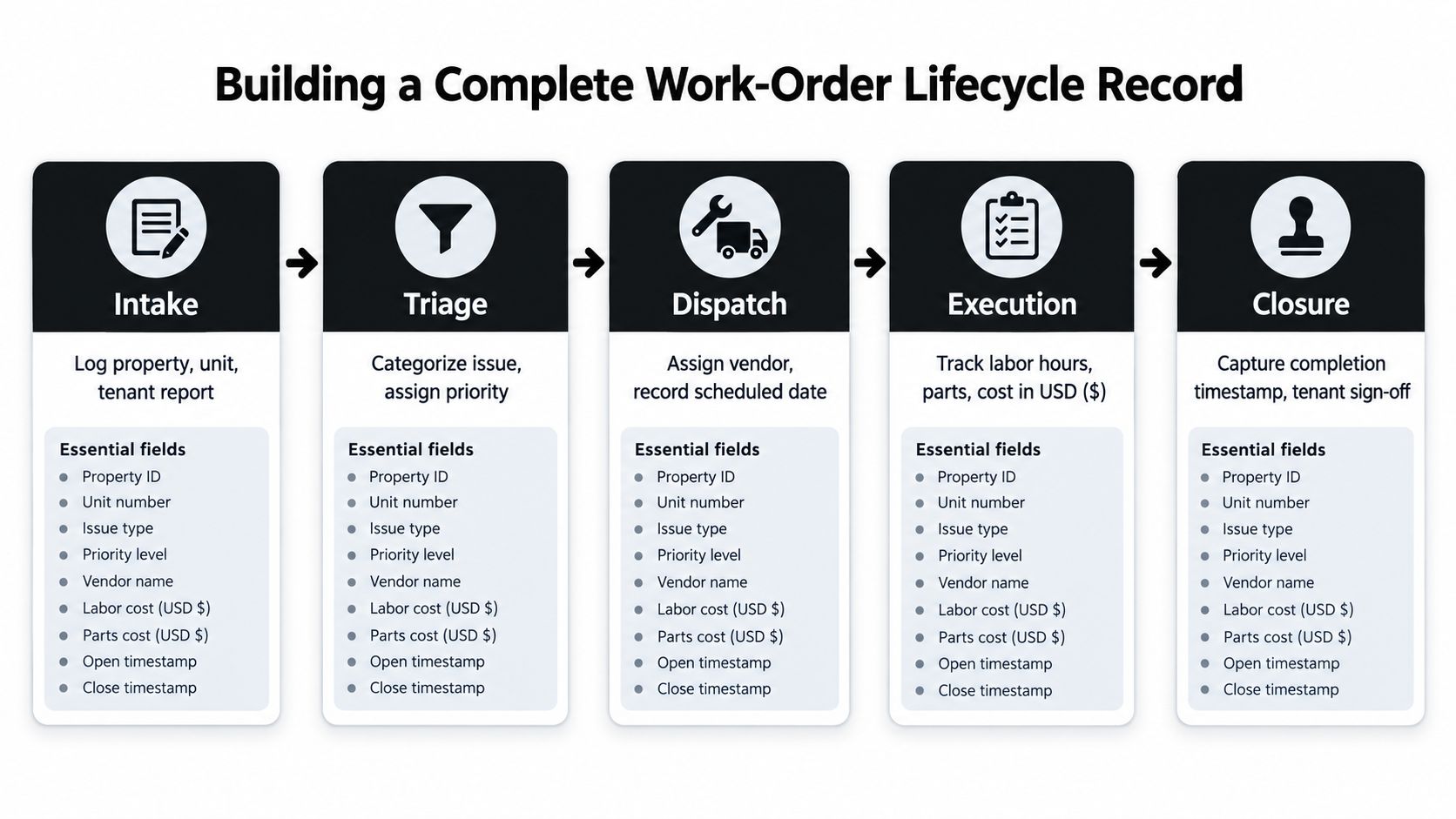
A good maintenance request log carries the job from the first tenant message to verified resolution. If it stops at “reported” or “completed,” it fails right where disputes, repeat calls, and missed handoffs usually start. The record should track five stages, intake, triage, dispatch, execution, and closure.
Start with a complete intake
The first entry has to be specific enough for someone else to act on it without chasing basic facts. Capture the property, unit, tenant, reporting channel, exact timestamp, issue category, symptoms, photos, access permission, and the tenant's preferred contact details. “Plumbing issue” creates delay. “Water is pooling under the kitchen sink when the faucet runs” gives triage something usable.
This is also where the log starts working as an operational tool instead of a storage folder. Record the tenant's stated urgency, then add your own classification after review. If you separate reported urgency from actual urgency, you can track whether the job met the expected response window and whether the original triage call was sound.
Use fields that line up with the stage where the information is captured:
| Lifecycle point | Fields to capture |
|---|---|
| Intake | Property, unit, tenant, channel, submitted timestamp, description, category, photos, access |
| Triage | Severity, habitability risk, triage decision, acknowledgement timestamp, next update |
| Dispatch | Vendor, authorization limit, scope, appointment window, assigned timestamp |
| Execution | Arrival, diagnosis, parts, labor, communications, photos, completion timestamp |
| Closure | Follow-up inspection, tenant confirmation, final cost, closure reason, reopen status |
That structure extends the core record set described earlier into a full lifecycle. It also reduces duplicate entry, because each field belongs to a defined step instead of getting copied across emails, texts, and invoices.
Preserve responsibility at every handoff
A timestamp alone is weak. You need the name or role attached to it.
Record who acknowledged the request, who classified severity, who approved spending, who assigned the vendor, and who signed off on completion. That is how you find bottlenecks. It is also how you enforce escalation. If a request sits in triage too long, or a vendor has not accepted the job by the target time, the log should show exactly where it stalled and who owns the next move.
Authorization limits belong in the same record. If a contractor can proceed up to a set amount, log the limit and any exception approval. Keep estimates, invoices, photos, inspection notes, and tenant or vendor messages attached to the work order itself. Once those records get split across inboxes and folders, nobody has the full history, and first-time resolution becomes hard to judge.
The workflow varies by trade, but the mechanics are similar. This overview of a work order system for cleaning businesses is a useful reference for how service teams handle assignment, status changes, and completion records.
Close only after service is restored
“Complete” from the vendor is a status update, not proof the problem is solved. Log what was done, what parts and labor were used, when the work finished, and whether follow-up was recommended. Then confirm with the tenant, or record the contact attempt and why confirmation was not obtained.
Some jobs deserve an extra check. Leaks, heating faults, electrical work, security issues, and intermittent problems can appear fixed for a day and fail again. A closed request without confirmation should be marked as an exception, not treated the same as a verified repair. That distinction matters if you want the log to measure first-time resolution instead of just closure speed.
If you are comparing software setups, review a maintenance work order system with the same standard in mind. The useful feature is not the screen design. It is the ability to hold one auditable timeline with SLA tracking, escalation points, and closure evidence in a single record.
Coordinated Versus Self-Managed Repair Outcomes
A blended maintenance benchmark can hide the problem. Rekey and lock work closes in 7.9 days, while appliance repair takes 15.8 days. If your log treats both as the same kind of job, you will know the average age of open requests, but not where your process is breaking.
| Repair approach or category | Median resolution or closure time |
|---|---|
| Coordinated repairs | 10.1 days |
| Self-managed repairs | 14.7 days |
| Rekey and lock work | 7.9 days |
| Appliance repair | 15.8 days |
| Overall dataset median | 13.1 days |
| Overall dataset average | 50.2 days |
That category spread is why coordination has to be judged as an operating method, not just a faster inbox. In the comparison above, coordinated repairs reached a 10.1-day median resolution time versus 14.7 days for self-managed repairs (rental maintenance request outcomes). The practical takeaway is straightforward. Someone has to own intake, urgency, assignment, access, updates, and proof of restoration, or the request drifts between people until the tenant chases it again.
I have seen self-managed jobs fail in ordinary, predictable ways. A contractor gets a text but does not confirm. The tenant is available only on certain days. Approval sits in a message thread. Then the landlord believes the issue is in motion because somebody said they would “take a look.” None of that is coordination. It is hopeful forwarding.
Coordinated handling cuts those dead spots because each step has an owner and a timestamp. You can see whether the request was acknowledged, whether the vendor accepted it, whether access was arranged, whether the appointment happened, and whether the tenant confirmed service was restored. That matters if you want the log to measure first-time resolution instead of simple closure.
The same dataset's 50.2-day average versus 13.1-day median shows why averages need caution. A smaller group of stalled, disputed, or unusually complex jobs can pull the average far above what a typical request looks like.
A median shows the typical request. The outliers show where the process failed.
Use both numbers, then inspect the exceptions one by one. Check for missed access, vendor no-shows, parts delays, unclear approvals, repeat visits, and jobs marked complete before the tenant confirmed the result. The same habit applies outside repairs. If you are weighing outsourced versus do-it-yourself work, this Top Cleaners cleaning comparison is a good reminder to compare like with like and set the decision criteria before the work starts.
The Service-Level and Escalation Framework Most Landlords Skip
A ticket marked “closed” may still represent a failed repair. The tenant may still be without heat, the leak may have returned, or the vendor may have completed work without explaining what happened.
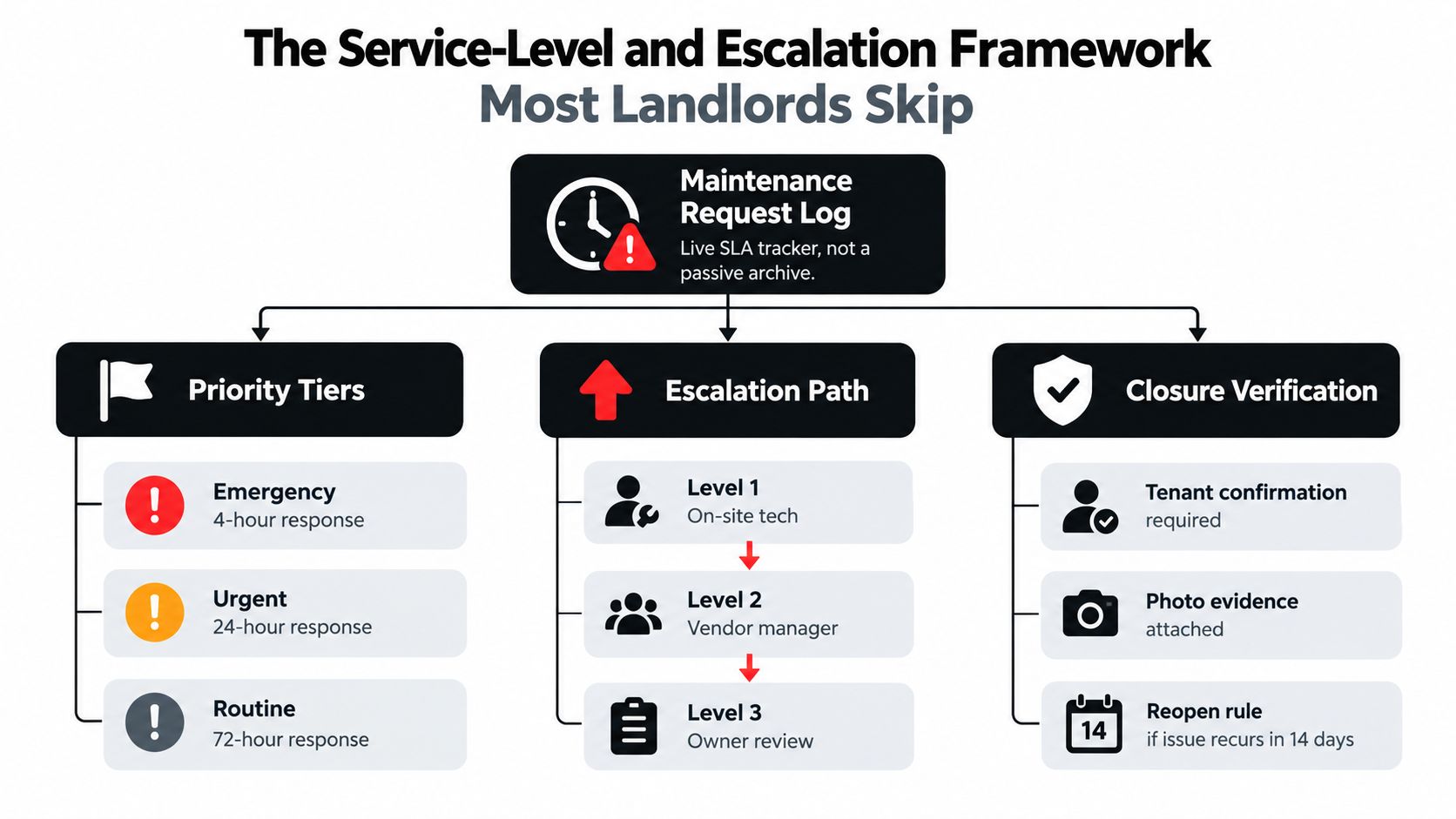
A service-level framework gives the log a live job beyond historical recordkeeping. It tells you how quickly to respond, when to escalate, what update to send, and what evidence is required before closure.
Classify urgency before assigning work
Use categories that a small landlord can apply consistently:
- Emergency: Gas concerns, electrical hazards, flooding, serious security failures, or extreme-temperature conditions that threaten safety or habitability. Escalate immediately through the applicable emergency procedure.
- Urgent: A significant failure affecting livability but not presenting an immediate severe hazard. Assign a clear owner, record the promised next update, and monitor the request until the vendor accepts it.
- Routine: Minor defects, cosmetic work, and non-critical repairs. Place them in the normal queue, but don't let “routine” mean “untracked.”
- Recurring: A repeat request or an asset with repeated failures. Link it to earlier work and require owner review, even if the current symptom appears minor.
The response target must follow local law, the lease, and your emergency policy. Don't copy a generic national deadline into your log. Instead, record the applicable target, the clock-start timestamp, and the reason for any missed target.
England's 2024/25 Tenant Satisfaction Measures illustrate why escalation deserves its own field. Landlords completed 79% of 11 million non-emergency responsive repairs within target timescales, compared with 91% of emergency repairs, and the same dataset recorded more than 290,000 stage-one complaints (England Tenant Satisfaction Measures).
Track the signals that precede a complaint
A useful dashboard for a one-to-ten-unit landlord doesn't need dozens of metrics. It needs measures that reveal a request becoming unsafe, expensive, or adversarial:
| Metric | What it reveals |
|---|---|
| First-response SLA compliance | Whether tenants receive acknowledgement on time |
| Time to dispatch | Whether triage turns into action |
| Time to first visit | Whether the vendor actually engages |
| Time to resolution | Total elapsed service time |
| Reopen rate | Whether the repair was durable |
| Vendor no-show rate | Whether assignments are reliable |
| Cost per completed request | Spending by category and property |
| First-time resolution | Whether one visit solved the reported issue |
Track the promised next update, not just the final completion date. If a part is unavailable, tell the tenant when the next update will arrive and record that communication. If access is delayed, log the attempted appointment and the tenant's response rather than leaving the request looking abandoned.
For pest, wildlife, or recurring infestation issues, a specialist such as Vanish Pest Control Inc. may become part of the vendor network. The log should still capture the same facts, including the reported symptoms, treatment scope, follow-up requirement, and confirmation that the condition was addressed.
Escalate with a visible path
Create escalation levels that match the people available to you:
- Level one, on-site technician: Diagnose and complete work within the authorized scope.
- Level two, vendor manager: Intervene when the technician misses an appointment, lacks parts, or can't resolve the issue.
- Level three, owner review: Approve additional spending, replace the vendor, or authorize a capital decision.
Closure should require tenant confirmation when practical, completion evidence, and a reopen rule for recurrence. The exact recurrence window should fit your policy and local requirements, but it must be explicit. A request that returns should link to the original record instead of appearing as an unrelated new job.
This distinction between a service request and a more serious incident is also clarified in guidance on service requests versus incidents. Your log should preserve that distinction because an ordinary repair and a safety event may require different communication, documentation, and escalation.
Your Monthly Maintenance Review Routine
A maintenance request log only earns its place when you review it often enough to change decisions. For a small portfolio, a monthly review can be short and disciplined if every request already has structured fields.
Start by checking intake quality. Every request should include a category, urgency, symptoms, access permission, and photos when they're useful. If tenants keep submitting vague descriptions, change the intake form or provide examples. Don't expect a better downstream process to compensate for poor information at the start.
Next, inspect the open queue by urgency and elapsed time. Confirm that each emergency has an active response, each urgent request has a named owner and next update, and each routine request has an expected path to completion. Any request beyond its applicable target needs a reason code, not a silent status change.
Review the vendor and completion data
For each completed request, check whether the record includes arrival evidence, diagnosis, parts, labor, invoice, completion proof, and tenant confirmation. A vendor's status update can be enough for a simple job, but recurring leaks, heating failures, electrical work, and security repairs deserve stronger verification.
Then review these measures:
- SLA compliance rate: How often did acknowledgement and response meet the applicable target?
- First-time resolution rate: How often did the initial repair solve the reported problem?
- Reopened requests: Which jobs returned within your defined review window?
- Vendor no-show rate: Which contractors create avoidable scheduling failures?
- Cost per completed request: Which categories, units, or vendors consume the most money?
- Requests per unit per year: Which properties generate unusually frequent work?
- Recurring asset failures: Which appliance, system, or building component needs preventive action?
The reopened-request measure deserves special attention. Rapid closure without durable repair creates attractive completion statistics while tenants continue reporting the same problem. Link the reopened job to the original request and record whether the cause was diagnosis, workmanship, parts, access, or a new failure.
Turn patterns into decisions
Segment results by category, vendor, property age, and geography where those fields apply. Don't compare appliance repairs with lock work, or emergency failures with routine defects. Don't penalize a vendor for a delay caused by unavailable tenant access, but do record the access issue so the timeline remains fair and complete.
The monthly review should produce actions, not just a report. Replace a consistently unreliable vendor, stock a commonly needed part, schedule an inspection for a recurring asset, revise the tenant intake questions, or move an expense from routine repair planning into capital-improvement review where appropriate.
For landlords managing one to ten units, this routine creates a practical feedback loop. The request comes in, the landlord triages it, the vendor performs the work, the tenant confirms restoration, and the monthly review changes the next decision.
VerticalRent lets tenants submit maintenance requests with descriptions and photos while landlords track assignments, status updates, vendor work, communications, and completion in a centralized history. Visit VerticalRent to evaluate whether its maintenance workflow fits your portfolio and replace scattered messages with a documented process.
Put this into practice
VerticalRent tools related to this guide
Legal Disclaimer
VerticalRent and its authors are not attorneys, CPAs, or licensed legal or financial advisors, and nothing on this site constitutes legal, tax, or professional advice. The information in this article is provided for general educational purposes only. Landlord-tenant laws, eviction procedures, security deposit rules, and tax regulations vary significantly by state, county, and municipality — and change frequently. Nothing on this site creates an attorney-client relationship. Always consult a licensed attorney or qualified professional in your jurisdiction before taking any action based on information you read here.
Co-founded VerticalRent in 2011, growing it from nothing to 100k landlords and renters. Sold it in 2019, then re-acquired it in 2026 to make it better than ever.


