How Do Apartments Verify Income: A Landlord's Complete Guide
How Do Apartments Verify Income. Learn how apartments verify income with this step-by-step guide for landlords.


You've got a stack of applications on your desk, and at first glance one of them looks easy. The credit is clean, the references sound polished, and the applicant says the income is more than enough. Then you start checking the numbers, and the story gets less tidy, because the central question isn't what they wrote on the form, it's whether that income is stable, documented, and likely to keep showing up.
How Income Verification Protects Your Rental Business
A strong application can still fail the reconciliation step. I have seen applicants present a salary that clears the rent threshold on paper, while the pay stub is stale, the bank deposits are irregular, or the paperwork does not match the story. Apartments verify income to sort a hopeful claim from evidence you can defend.
Landlords report using income checks and employment checks as standard screening steps, which is why applicants should expect a file review that compares sources instead of accepting one document at face value survey result. If you skip that review, you are not only betting on one month's rent. You are accepting avoidable lease risk.
For independent landlords, the process has to stay consistent and defensible. A repeatable workflow also makes it easier to compare applicants who earn through wages, benefits, commission, or contract work. VerticalRent's tenant screening guide is a practical starting point for building that kind of process, and Cyndra's real estate AI agents can help portfolio owners model how verification outcomes affect occupancy and default risk.
Practical rule: treat income verification like a reconciliation exercise, not a document collection exercise.
The key question is whether the income is authentic, recurring, and sufficient to cover the rent without strain. That means checking for consistency across pay stubs, deposits, employer contacts, and any other source that can confirm the same pattern. It also means being careful with non-traditional earners, because irregular income can still be dependable if the records line up. This approach protects the rental business, and it also keeps honest renters from being judged on a single thin document.
Standard Income Documentation and the Evidence Hierarchy
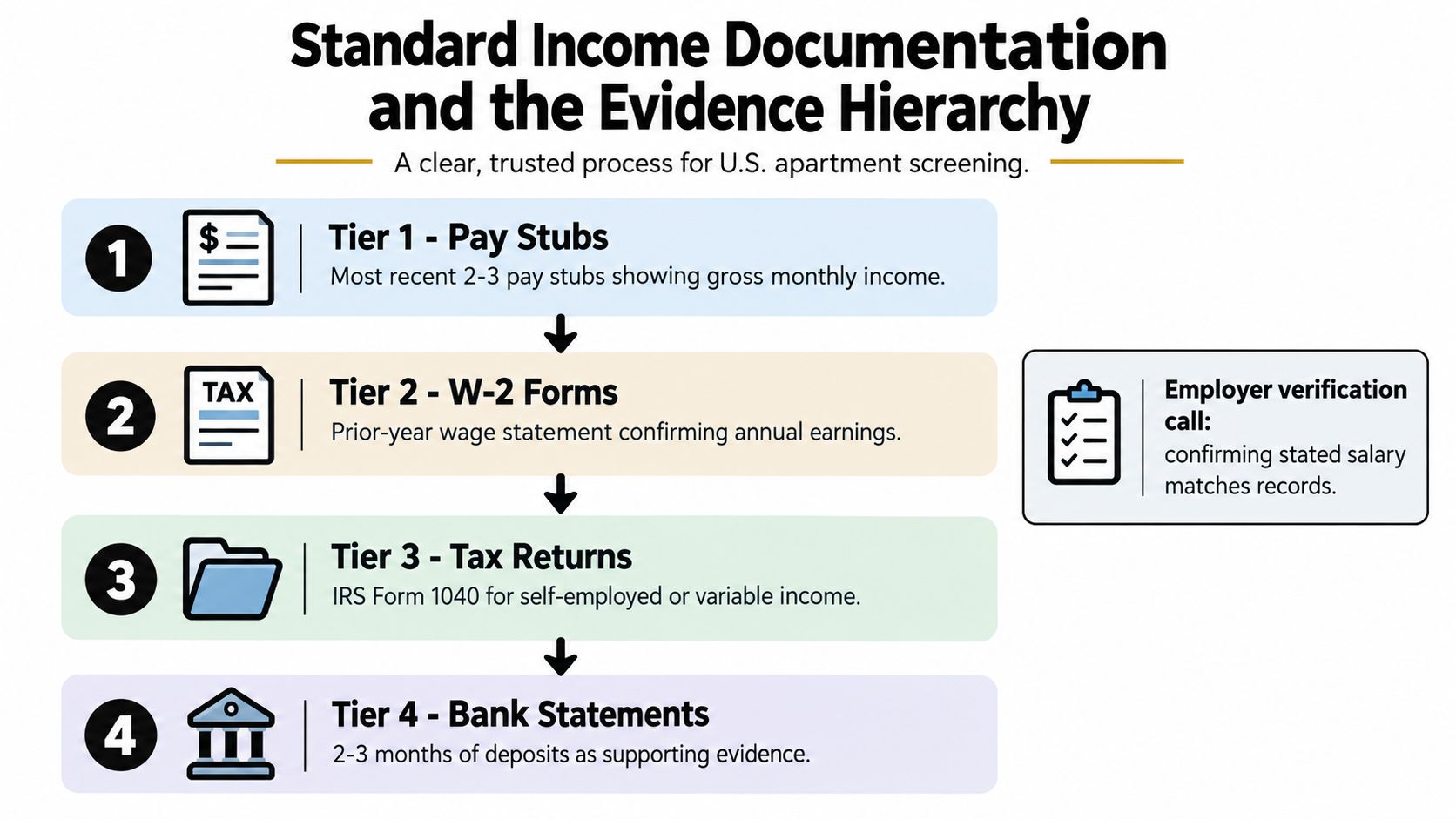
A rental file gets stronger when the proof lines up from the source outward. That is the answer to how do apartments verify income, because a clean file is not just a stack of papers, it is a reconciliation of claims against records, deposits, and third-party confirmation.
The strongest tier is automated or direct third-party verification, because the information comes from the employer, benefits source, or verification provider instead of the applicant. The next tier is written employer or benefits-source confirmation, which still gives you a record outside the tenant's own file. If those options are not available, move to oral confirmation with a call log, and only then rely on applicant-provided documents or self-certification when nothing better exists.
Fannie Mae's employment-income standards call for income used in qualification to be verified through the borrower, employer, or a third-party employment-verification provider, and its documentation standards point to recent pay stubs, W-2s, tax returns, and other records that support the claim Fannie Mae standards. That is mortgage guidance, not apartment law, but the principle carries over: one statement is weak, several matching records are stronger.
Before you set a threshold, review how the 3x rent rule and its alternatives frame qualifying income. A practical file usually includes recent pay stubs, W-2 forms, IRS Forms 1099, tax returns, bank statements, and evidence of recurring payments where relevant. The point is to match the evidence to the income type. A W-2 employee and a freelancer do not prove income the same way, and forcing both into one template creates bad calls.
Useful standard: if you cannot verify the claim from the source, document why, then move one step down the evidence ladder.
Recordkeeping is where many landlords slip. HUD guidance expects owners to document why they relied on a weaker method and to keep the verifier's name, position, and contact details in the file HUD guidance. That turns the file into an auditable record, not just a folder of uploads.
Calculating Qualifying Income from Pay Stubs and Statements
A single paycheck rarely tells the full story. I have seen applications fail because someone treated one gross pay figure as a stable monthly income, even though the applicant had variable hours, changing overtime, or a recent payroll shift.
HUD's handbook says to use at least two current, consecutive pay stubs when determining annual income, then annualize current earnings projected over the next 12 months HUD handbook. For apartments, that means the key question is not what showed up on one stub, but whether the pattern supports the rent for the next year.
Normalize the payment schedule
Weekly, biweekly, semimonthly, and monthly pay all need the same annual basis. If you skip that step, income gets overstated or understated without anyone noticing. Gross pay is the better screening number here, since deductions vary too much to compare cleanly across applicants.
Variable compensation needs its own treatment. Overtime, commissions, bonuses, and tips should be averaged from reliable history, not assumed at peak levels. A recent job change deserves extra scrutiny too, because start date, expected hours, and termination risk can matter as much as the headline salary.
Use the documents to reconcile the claim
A file is only as good as its internal consistency. The pay stub, employer contact, and bank deposit pattern should line up. When they do not, I want the mismatch explained before approval, not after move-in.
The checks that usually surface trouble are simple:
- Date recency: stale documents can hide a job change or leave status.
- Year-to-date earnings: if the YTD figure does not fit the monthly claim, stop and verify.
- Deposit logic: actual deposits should broadly match the stated pay pattern.
- Source authentication: screenshots without origin are weak support, not proof.
If the numbers do not reconcile, do not smooth over the gap. Resolve it or treat the file as incomplete.
A clean file also needs to stand up later if the applicant questions the decision. That means keeping the verification trail clear, including who reviewed the documents and what evidence supported the final income number.
Verifying Income for Self-Employed and Gig Workers
Traditional pay stubs work only when payroll exists. Freelancers, contractors, creators, and delivery workers often have none of that, which means the screening question changes. You're not asking for a standard employment record, you're trying to establish recurring income from irregular sources.
HUD guidance recognizes internet-based business income and recommends reviewing current evidence such as bank statements or platform records showing gross deposits to establish continuity HUD internet-based income guidance. That matters because platform deposits can look healthier than the income really is before expenses and taxes. A single strong month doesn't prove stability.
Compare the common document types
| Income Type | Required Documentation |
|---|---|
| W-2 employment | Recent pay stubs, W-2, employer verification |
| Self-employment | Tax returns, profit-and-loss statement, bank deposits |
| Gig or platform work | Platform statements, bank deposits, tax returns |
| Commission-based work | Pay stubs, commission statements, historical averages |
| Other recurring support | Benefit letters, award notices, third-party confirmation |
For self-employed applicants, tax returns and 1099s usually matter more than one month of deposits. Profit-and-loss statements help only when they're current and credible, because they show activity instead of just past history. Bank statements help you see continuity, but they can also include transfers, reimbursements, and non-income deposits, so they need context.
A fair policy distinguishes gross receipts from net income. Gross deposits may look large, but business expenses, taxes, and uneven seasonality can reduce the amount that supports rent. That's why a landlord should average evidence over a defined period rather than cherry-pick the best month.
For applicants with irregular earnings, bank statement verification guidance can help you think through what the deposits prove and what they don't. The main mistake is treating every deposit as usable income. The better approach is to ask whether the cash flow is recurring and whether it can reasonably continue.
Good question to ask: does this file show a business that produces repeatable cash flow, or just a temporary spike?
The same standard should apply to everyone, even when the document set changes. If one applicant proves income with payroll and another with platform records, the decision still has to rest on continuity, credibility, and the ability to support rent without guesswork.
Detecting Fraud and Automating the Verification Workflow
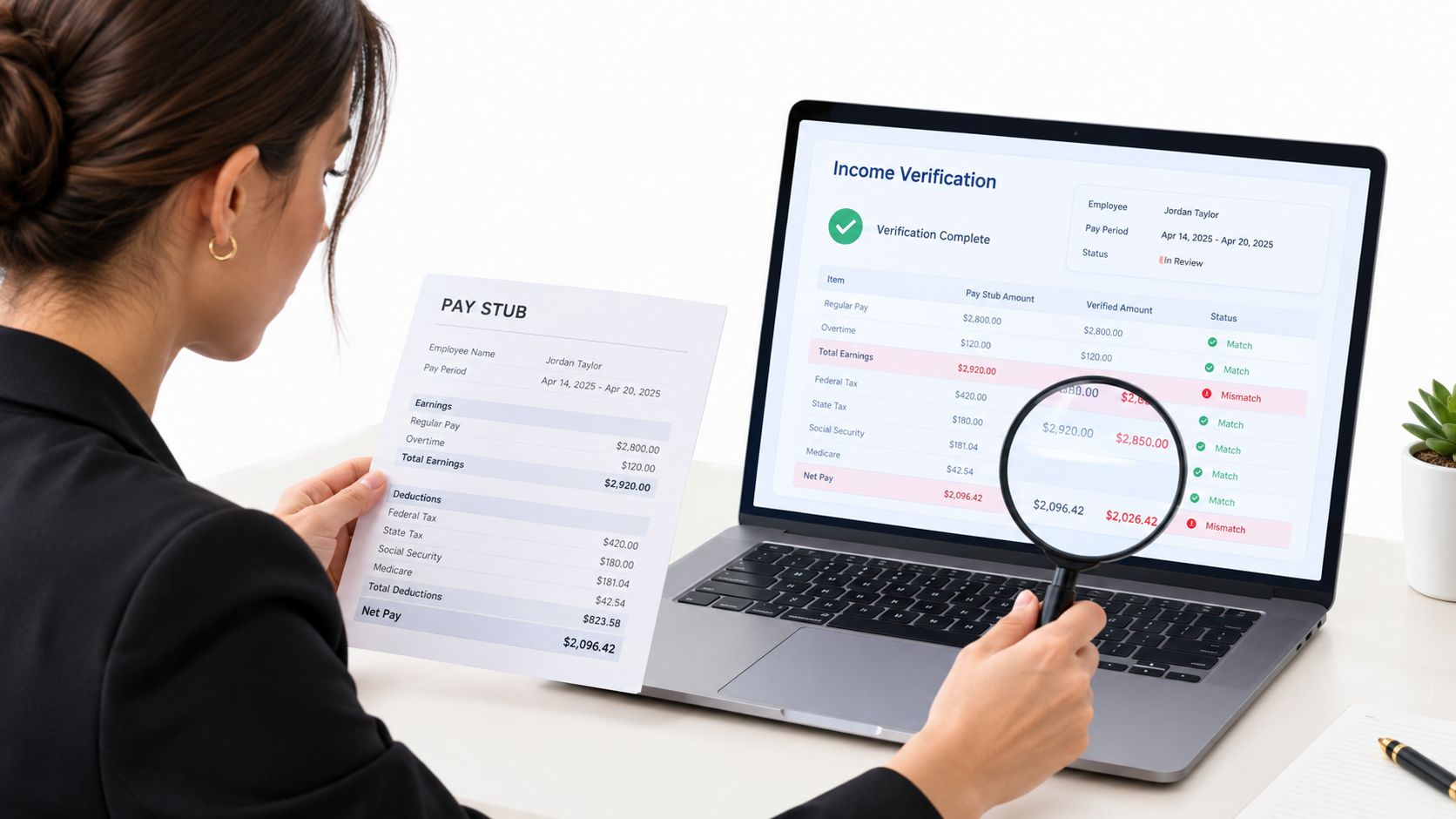
Fake or manipulated income files usually break in the reconciliation step. The fonts may shift, the math may not add up, dates may be out of sequence, or the deposits may not match what the employer says. I trust the comparison more than the paper itself, because bad documents often look fine until you line them up against the source.
Start with the numbers on the document itself. If a pay stub shows year-to-date earnings, divide that figure by the weeks or pay periods shown on the file and compare it with the stated gross pay per period. A material mismatch is a flag. The same check applies to bank deposits, because regular payroll should follow the stated schedule, while deposits from transfers, reimbursements, or mixed sources need explanation before they count as income.
A file should also answer a few plain checks.
- Does the stated salary match the pay stub?
- Do the deposits line up with the pay cycle?
- Is employment independently confirmed?
- If something changed, is there written support for the change?
A mismatch does not automatically mean fraud. A raise, unpaid leave, commission timing, a payroll-provider change, or a non-income deposit can all create an apparent inconsistency. The difference is whether the applicant can reconcile it. Ask for clarification, record the discrepancy, and give the applicant a chance to fix a clerical issue or explain a payroll transition. That keeps the process fair and reduces the chance of rejecting a solid applicant for the wrong reason.
Where automation helps
Automated screening tools cut down the time spent matching documents by hand, especially when several income sources are in play. They help flag inconsistencies, organize source documents, and preserve the audit trail you need if a decision is challenged later. VerticalRent is one option in this space, with Plaid income-verification reports that let landlords review digital income data alongside the rest of the application.
The risk side is real. NLIHC data shows that millions of renter households in the United States face high housing-cost burdens, so rent affordability is already tight for a large share of the market. In that setting, income verification does two jobs at once. It screens for affordability and it exposes fraud. If you verify too loosely, you take on more default risk. If you verify too aggressively or inconsistently, you create unfair barriers and lose qualified applicants.
Keep the workflow lean, not intrusive
Collect enough to establish ability to pay, then stop. More documents do not always produce better decisions, especially when extra requests dig into unrelated personal financial details. A tight process, current documents, source confirmation, and a clear appeal path usually does more good than a stack of PDFs with no reconciliation behind them.
Put this into practice
VerticalRent tools related to this guide
Legal Disclaimer
VerticalRent and its authors are not attorneys, CPAs, or licensed legal or financial advisors, and nothing on this site constitutes legal, tax, or professional advice. The information in this article is provided for general educational purposes only. Landlord-tenant laws, eviction procedures, security deposit rules, and tax regulations vary significantly by state, county, and municipality — and change frequently. Nothing on this site creates an attorney-client relationship. Always consult a licensed attorney or qualified professional in your jurisdiction before taking any action based on information you read here.
Co-founded VerticalRent in 2011, growing it from nothing to 100k landlords and renters. Sold it in 2019, then re-acquired it in 2026 to make it better than ever.


