ACH Rent Payments for Independent Landlords
Master ACH rent payments to automate collection, reduce fees, and avoid late disputes. Learn setup, settlement timing, and risk management for small portfolios.


The first day of the month used to mean checking the mailbox, watching the bank account, and sending reminders to tenants who hadn't paid yet. A check could be delayed, misplaced, or deposited without a clear connection to the right lease. A payment sent through a peer-to-peer app might arrive quickly but still leave you matching names, units, and months by hand.
ACH rent payments replace that recurring uncertainty with a defined electronic workflow. The tenant authorizes a bank-to-bank transfer, the payment processor submits it through the ACH Network, and your ledger records each stage until funds settle or the transaction returns. The change isn't just “collect rent online.” It's a shift from chasing individual payments to managing a process with known dates, visible statuses, and documented exceptions.
The End of the First-of-the-Month Check Chase
Manual rent collection creates work long after the tenant has supposedly paid. You may need to confirm whether a check was mailed, determine whether a cash payment was received, or search a bank statement for an unfamiliar transfer. When a late fee is disputed, the problem often isn't the fee itself. It's the absence of a clean record showing when the tenant authorized payment, when you submitted it, and when money became available.
I've found that the most expensive part of paper checks isn't the deposit. It's the uncertainty around the deposit. A check sitting in the mail isn't the same as rent received, and a tenant saying “I sent it” doesn't tell you whether the payment belongs in the ledger as pending, collected, or overdue.
Practical rule: Treat every payment method as a workflow with evidence, not as a promise that money is on its way.
ACH gives independent landlords a more consistent foundation. A tenant can authorize a recurring debit from a checking or savings account, or initiate a one-time bank transfer through a payment portal. The processor handles the electronic submission, while the landlord's system connects the transaction to the property, unit, tenant, and rent charge.
That structure matters even with a small portfolio. An owner managing a few homes still needs to know which rent has been authorized, which payment has settled, and which debit has failed. A digital record also makes tenant communication less awkward because you can refer to a specific payment status instead of relying on memory or a screenshot.
For landlords comparing collection options, this guide to free online rent payment for landlords provides useful context on moving away from checks and cash. The operational objective is straightforward: make the normal payment path automatic, then reserve personal attention for exceptions.
ACH doesn't eliminate late payments, returned debits, or disputes. It does make those events easier to identify and handle. That distinction is important. Automation works when it replaces repetitive administration, not when it hides the point at which a payment can still fail.
Understanding the ACH Network and Scale
ACH, or Automated Clearing House, is the electronic bank-to-bank payment network used for recurring transfers across the United States. For rent collection, the practical difference from a card payment is that the transaction moves through a bank-account network rather than a card authorization and interchange process.
The network is best understood as organized payment plumbing. A landlord or payment processor originates an entry, financial institutions exchange and process the entry, and settlement occurs according to banking-day schedules. The process is highly structured, but it isn't an instant movement of cash just because a tenant clicked a button.
Why the rail matters for rent
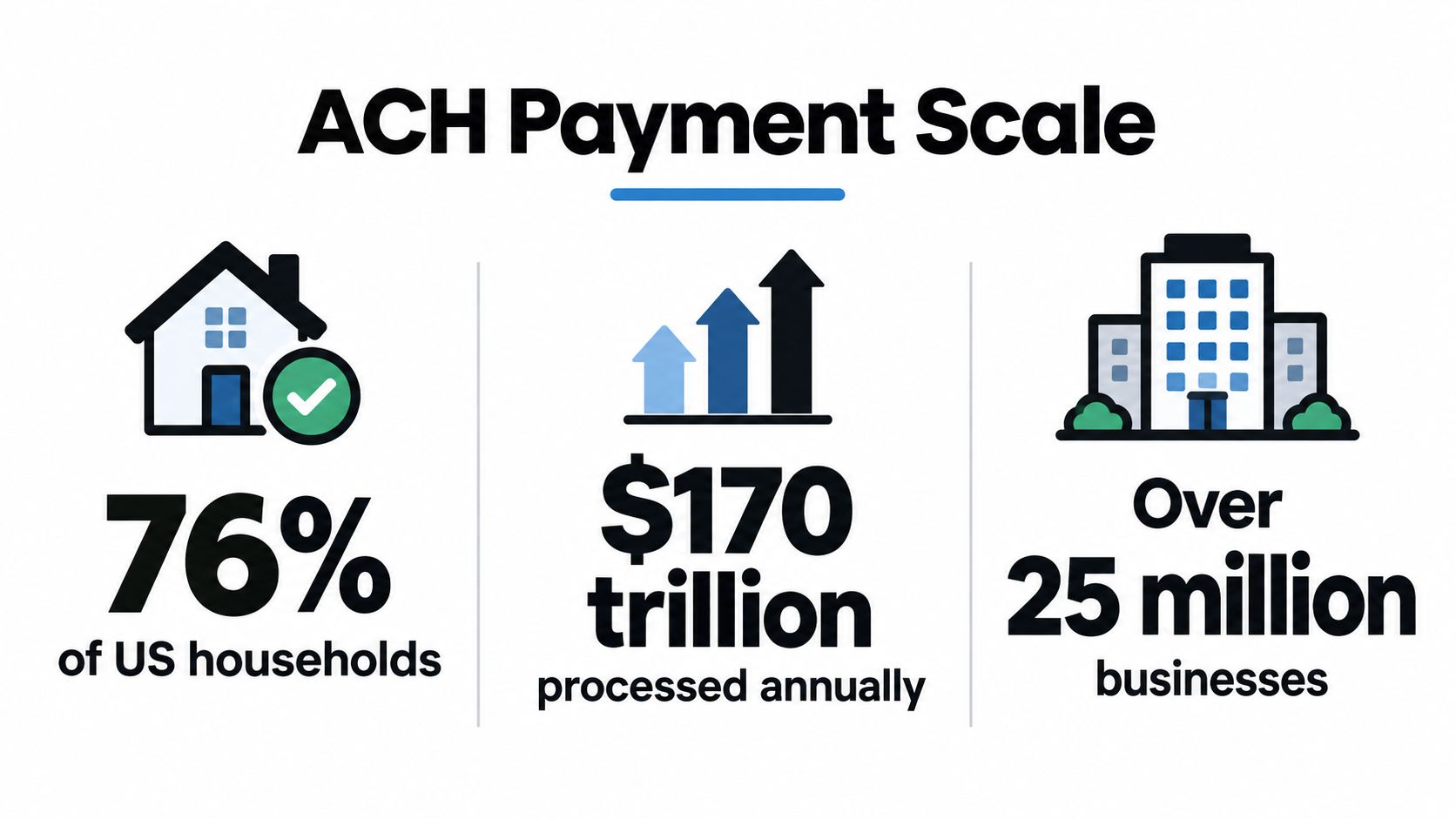
The ACH Network isn't a niche payment experiment. The Federal Reserve reported that ACH transfers totaled $104.06 trillion in value during calendar year 2024 and represented 74% of the value of all U.S. noncash payments. The same study recorded 236.6 billion total noncash payments across the U.S. economy, placing rent collection inside an established national payment infrastructure. Federal Reserve payment-system data describes the entire U.S. payment ecosystem, not residential rent specifically, but its scale explains why bank transfers are a practical foundation for recurring obligations.
Nacha reported 33.6 billion ACH payments worth $86.2 trillion in 2024, with ACH volume rising 6.7% from the prior year and value rising 7.6%. Business-to-business ACH payments reached 7.3 billion transactions, while Same Day ACH exceeded 1.2 billion payments worth $3.2 trillion. These figures cover every major ACH use case, not only rent, but they show a payment rail with broad commercial adoption and growing support for faster processing. Nacha's 2024 ACH Network infographic provides the network-level detail.
What scale does and doesn't guarantee
Large infrastructure supports reliability and bank-account reach. It doesn't guarantee that a particular tenant's account has enough funds, that account details are accurate, or that a submitted debit won't be returned. Landlords still need authorization records, clear status labels, and reconciliation rules.
ACH also changes the cost conversation. Bank transfers generally avoid the interchange structure associated with many card transactions, but processors may apply their own fees or service terms. The right comparison includes the cost of processing, tenant access, return handling, and the time required to maintain accurate books.
For practical setup considerations, this ACH payment setup guide is a useful companion to the infrastructure overview. The key takeaway is simple: ACH gives you a mature rail, but your operating procedures determine whether that rail produces clean rent records.
Evaluating the Trade-offs for Landlords and Tenants
ACH is attractive because it removes several recurring tasks. A landlord can schedule a debit, send reminders, associate the payment with a lease, and reconcile deposits without opening envelopes or interpreting free-form payment notes. Tenants can avoid writing checks and may avoid the percentage-based fees that often accompany card payments.
The trade-off is control over cash timing. A tenant with a fixed salary may find recurring autopay convenient. A tenant whose income changes from month to month may see the same debit as an overdraft risk. Entrata's 2025 resident survey found that 13% of renters who did not use autopay were uncomfortable with it because their income fluctuated month to month, while 52% preferred to pay manually to avoid overdraft risks. The Entrata 2025 Resident Report supports a policy built around choice rather than pressure.
Compare the payment rails
| Feature | ACH Bank Transfer | Credit/Debit Card |
|---|---|---|
| Funding source | Tenant's bank account | Card account |
| Recurring use | Well suited to scheduled bank debits | Convenient, but subject to card limits and provider rules |
| Fee structure | Often based on a flat processing fee or included service terms | May include percentage-based processing costs |
| Tenant concern | Debit timing can conflict with irregular income | Fees, card limits, and reliance on available credit |
| Landlord workflow | Strong potential for recurring authorization and ledger matching | Fast authorization experience, with separate funding and dispute considerations |
| Best policy | Offer autopay and scheduled one-time payment options | Disclose all convenience fees before payment |
A tenant shouldn't have to choose between an inflexible autopay mandate and a confusing manual alternative. Offer recurring ACH for people who want set-and-forget payments, scheduled one-time ACH for people who know their pay dates, and a clear manual option where your lease and local rules permit it.
Align convenience with tenant reality
Let tenants see the draft date, amount, and cancellation process before they authorize a recurring debit. Explain whether partial payments are allowed, how returned-payment fees are handled, and what happens if a tenant changes bank accounts. These details prevent the common dispute in which a renter believed they had stopped autopay while the landlord believed authorization remained active.
For a more detailed side-by-side discussion, this comparison of ACH versus credit card payments can help frame the decision. ACH works best when both parties understand that low friction for the landlord must not become unpredictable timing for the tenant.
Setting Up Authorization and Secure Onboarding
A landlord can't treat a bank account number as a casual payment detail. ACH collection requires explicit authorization, and the authorization record must match the transaction you submit. The safest onboarding process makes the amount, frequency, timing, and cancellation method visible before the tenant consents.
Capture permission before collecting
Use a payment portal or processor that records the tenant's authorization electronically. The authorization should identify the account holder, the account being used, the payment purpose, and whether the instruction covers a one-time payment or recurring debits. Keep the confirmation and any related communications with the lease records.
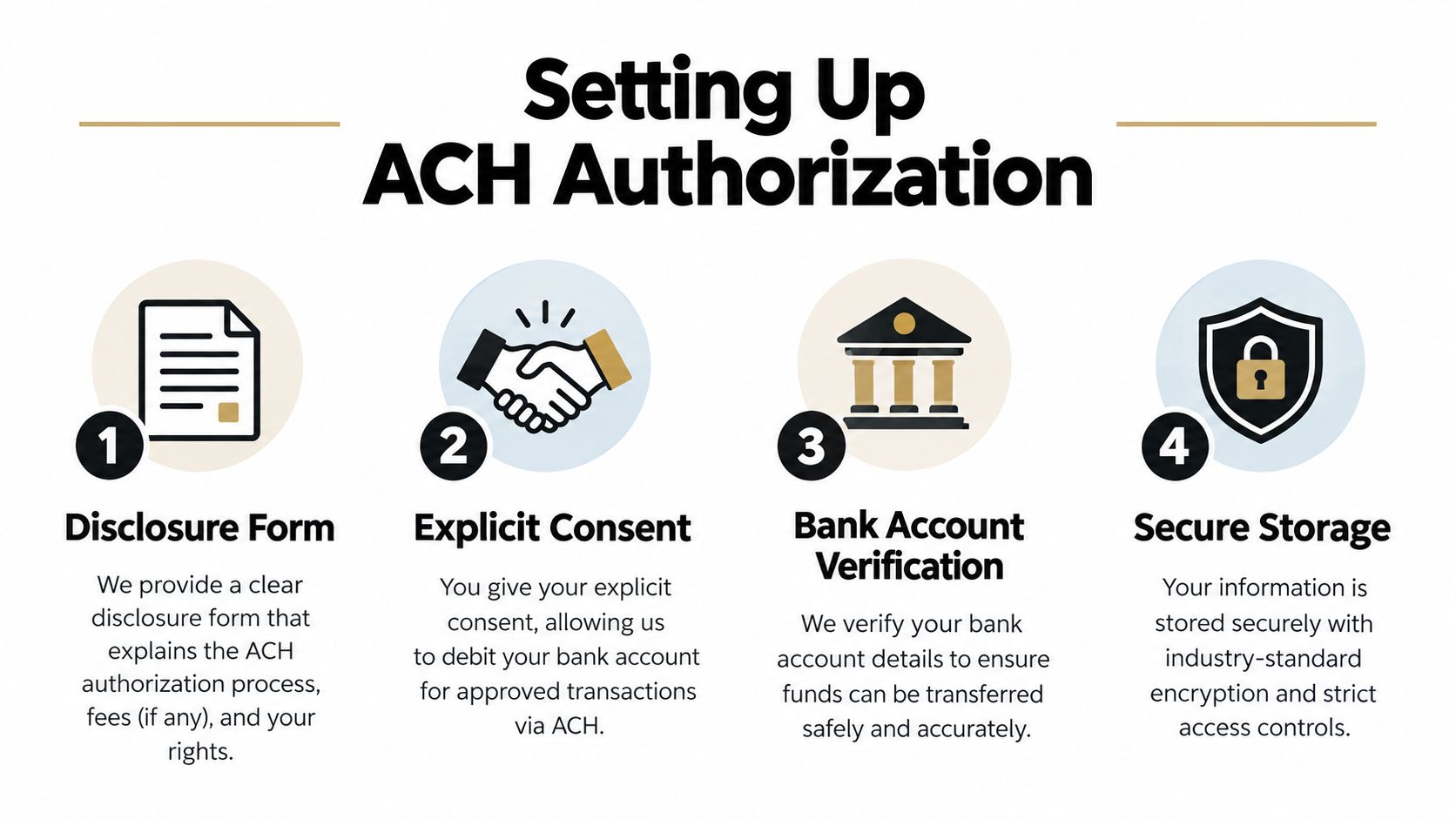
A practical onboarding sequence looks like this:
- Explain the debit. Show the tenant the rent amount, anticipated draft date, recurrence, and any applicable fee before they enter bank details.
- Capture explicit consent. Require a clear digital authorization rather than relying on a general lease clause or an email saying “please take rent.”
- Verify the account. Use the processor's supported verification method and give the tenant a way to correct an account or routing detail before submission.
- Confirm the record. Send a receipt that identifies the authorization and tells the tenant how to update or stop recurring payments.
- Protect the data. Use a gateway that tokenizes sensitive bank information, so the landlord doesn't need to keep raw account numbers in a spreadsheet.
Keep landlords out of the data path
Independent landlords often create avoidable exposure by copying routing and account numbers into email, notes, or an unprotected workbook. A dedicated payment processor should control access, encrypt information, and return a token or masked identifier for routine administration. The landlord needs to know which authorized account is attached to the lease, not retain a second private database of banking credentials.
Authorization also needs an operational owner. Decide who can change a draft date, who can cancel a recurring debit, and how staff document a tenant's request. If a renter updates bank information, preserve the old authorization history and record when the new account became active.
Don't promise a tenant that an authorization guarantees immediate collection. It grants permission to initiate the payment. The transaction still passes through processing, settlement, and return stages, which must be visible in the ledger.
Navigating Settlement Timing and Banking Days
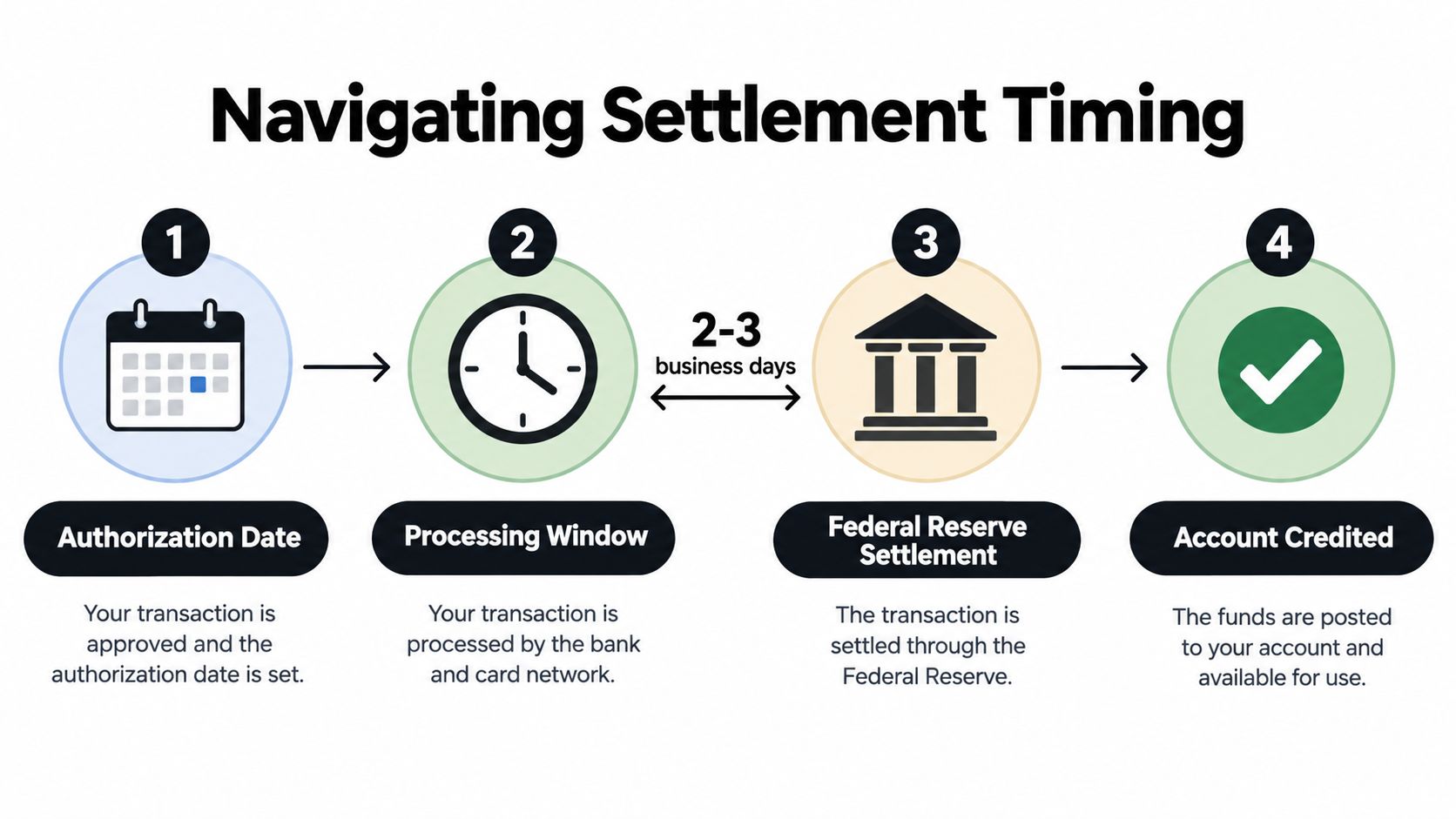
The payment date shown on a tenant's screen and the date funds become available aren't always the same. ACH settlement follows banking days, not a simple calendar clock. A standard ACH payment settles on the following banking day, while an eligible Same Day ACH entry can be processed and settled within the same banking day. Settlement doesn't occur on weekends or federal holidays. The Federal Reserve's FedACH processing schedule explains the processing windows and limits.
That distinction creates many late-fee disputes. A tenant may authorize a debit on a Friday, see “processing” in the portal, and assume the rent was paid on the due date. A landlord may see the same status and apply a late fee because funds haven't reached the operating account. Neither conclusion is safe without a policy that defines the relevant date.
Separate the dates in your ledger
Your system should distinguish at least these events:
- Authorization date: The tenant approved the payment.
- Submission date: The processor sent the entry into the ACH workflow.
- Effective entry date: The date assigned for processing.
- Settlement date: The date the financial institutions settle the entry.
- Funds-availability date: The date the landlord can use the deposited funds under the processor and bank terms.
Use the lease and applicable state law to define when rent is considered timely. Don't let an interface timestamp decide whether a late fee is owed. Automated reminders should go out early enough for tenants to review balances and correct problems before the debit is submitted.
Late-fee safeguard: A pending ACH status should trigger monitoring, not an automatic penalty.
Same Day ACH can help when a tenant pays close to a due date or when a landlord needs funds to move faster than standard batch timing. It still depends on the participating financial institutions, submission windows, and eligibility rules. Same Day ACH generally excludes international ACH transactions and individual entries above $1 million, with the current ceiling for eligible domestic transactions set at $1 million. The limit is unlikely to affect ordinary residential rent, but it illustrates why “same day” isn't a universal promise.
This timeline visual reinforces the difference between permission, processing, settlement, and account credit:
Configure reminders and grace-period logic around the actual lease language. If a due date falls near a weekend or federal holiday, tell tenants when the debit will be submitted and how you'll treat a timely authorization that settles later because of the banking calendar.
Managing Returned Payments and Ledger Reconciliation
An ACH debit that has been submitted isn't necessarily collected rent. A transaction can show as processing and later return because the account lacks funds, the account information is invalid, the account has closed, or the authorization is no longer valid. The landlord's ledger must preserve that distinction instead of posting every initiated debit as final income.
Nacha's guidance supports modeling payment status as a state machine: authorized, originated, accepted, settled, returned, or reversed. Nacha's ACH payments fact sheet explains why network activity must be tracked beyond the initial submission. A receipt should represent the status that occurred, not the status everyone hoped would occur.
Use a controlled return procedure
When a payment returns, follow a written sequence:
- Freeze final receipt treatment. Change the ledger from pending to returned or reversed, depending on the processor's notice.
- Preserve the evidence. Store the transaction identifier, amount, authorization record, timestamps, and return code.
- Notify the tenant promptly. State that the debit was returned, identify the amount still due, and provide the available payment options.
- Review the cause. An insufficient-funds return may call for a different conversation from an invalid-account return or a revoked authorization.
- Apply fees carefully. Charge a returned-payment fee only when the lease and applicable state law permit it, and disclose the amount before collection.
- Document the resolution. Record whether the tenant paid manually, corrected bank details, entered an arrangement, or remained delinquent.
Reconcile settlement before disbursement
Bank reconciliation should compare the processor's settlement report, the operating account, and the property ledger. A batch deposit may contain payments for multiple units, so the ledger needs transaction-level references that let you trace each amount back to a tenant and lease.
Don't disburse owner funds solely because a payment appears in a portal as initiated. A returned debit can create a shortfall after the landlord has already transferred money to an owner or paid a vendor. The safer rule is to base final income treatment and downstream disbursement on settled funds, subject to your processor's risk terms and accounting policy.
A tenant-facing status should also be precise. “Payment initiated” tells the renter that the request entered the workflow. “Funds settled” tells both sides that the payment reached the settlement stage. Those labels prevent duplicate payments, premature late fees, and avoidable arguments about whether rent was received.
Best Practices for Automated Rent Collection
A dependable ACH workflow combines tenant choice, accurate dates, secure authorization, and disciplined reconciliation. Start with reminders before the draft date, not after a payment fails. Give renters enough notice to check their balance, update an account, or choose a one-time payment when recurring autopay doesn't fit their income cycle.
Set the portal to show the amount, draft date, and payment status clearly. The tenant shouldn't need to email you to discover whether a payment is authorized, pending, settled, or returned. Clear status labels reduce support work and make disputes easier to resolve.
Connect settled transactions to the income and expense ledger. The system should match payments to the correct unit and rent charge, preserve the transaction reference, and leave a visible trail for month-end reconciliation and tax reporting. Review exception queues regularly rather than treating automation as a reason to stop reviewing bank activity.
For broader operating guidance, landlords can browse property management best practices alongside their payment procedures. The useful principle is consistent across a small portfolio: automate routine collection, but design explicit human review for returned payments, disputed dates, changed bank accounts, and unusual balances.
VerticalRent offers online rent collection through ACH or card, recurring payments, automated reminders and late-fee workflows, and an income and expense ledger that records transactions for reporting. Visit VerticalRent to evaluate whether its rent-collection workflow fits the way you manage your properties.
Put this into practice
VerticalRent tools related to this guide
Legal Disclaimer
VerticalRent and its authors are not attorneys, CPAs, or licensed legal or financial advisors, and nothing on this site constitutes legal, tax, or professional advice. The information in this article is provided for general educational purposes only. Landlord-tenant laws, eviction procedures, security deposit rules, and tax regulations vary significantly by state, county, and municipality — and change frequently. Nothing on this site creates an attorney-client relationship. Always consult a licensed attorney or qualified professional in your jurisdiction before taking any action based on information you read here.
Co-founded VerticalRent in 2011, growing it from nothing to 100k landlords and renters. Sold it in 2019, then re-acquired it in 2026 to make it better than ever.


