Do Evictions Show Up on Credit Reports? Where They Appear
Do evictions show up on credit reports? Usually not on the big three bureaus, but tenant screening reports can list filings for seven years.


Evictions usually don't appear as a standard tradeline on the three major credit reports, but eviction court records can appear on tenant-screening reports for up to seven years from the filing date.
That makes the popular advice to check your credit report incomplete. You could find no rental-related problems on your credit file while a landlord sees a court case in a separate screening report, including a case that never resulted in your removal.
The useful question isn't just whether an eviction affects your credit. It's which record exists, where it appears, and whether it accurately describes what happened.
Where Evictions Appear on Credit Files and Screening Reports
An eviction filing or possession judgment generally isn't a standard credit account on Equifax, Experian or TransUnion reports. It therefore doesn't automatically lower a FICO or VantageScore. A related debt, however, can create a separate credit problem.
Where each eviction-related record appears
| Record type | Credit report | Tenant screening report | Public court record |
|---|---|---|---|
| Eviction filing, no judgment yet | No standard tradeline | Usually listed when available | Yes, unless access is restricted |
| Judgment for possession | No standard tradeline | Usually listed when available | Yes, unless access is restricted |
| Dismissed or settled case | No standard tradeline | May be listed with its disposition | Yes, unless sealed or otherwise restricted |
| Unpaid rent sent to collections | Yes, if reported as a collection account | May be listed | Not usually, unless a lawsuit was filed |
| Sealed or expunged case | No eviction tradeline | Should be excluded | Not publicly accessible |
| Informal move-out, no court case | No eviction tradeline | No court-based eviction entry | No eviction case |
The table separates the eviction record itself from other information about the tenancy. A move-out without a lawsuit doesn't create a court filing, but it also doesn't prevent an unpaid balance or rental-payment history from being reported through another channel.
A credit account isn't a housing-court case
Think of a credit file as a record of credit obligations and repayment. A court-based eviction search is closer to a review of a court docket. The landlord may receive both kinds of information during screening, but they answer different questions.
A credit report might identify a collection agency, an account balance and a payment status. An eviction report might identify a court, a filing date, the parties and a case outcome. The collection account concerns money owed; the court case concerns a legal proceeding.
As Experian explains in its guidance on unpaid rent, unpaid rent or fees sent to collections can appear on credit reports and hurt credit scores. Repair charges, legal fees and other rental balances may also become credit-reportable collection accounts when placed with or sold to a collector.
Say a renter leaves after a possession case, and the landlord sends an unpaid balance to collections. A prospective landlord could encounter the court proceeding in an eviction search and the debt in a credit report. Those aren't duplicate descriptions of the same thing, and resolving one doesn't establish the status of the other.
Practical rule: Read the court record for the case outcome and the credit account for the debt status. Don't use either as a substitute for the other.
Who assembles the screening file
Specialty consumer reporting agencies compile tenant-screening reports. Their reports can combine court information with other rental-related information, rather than reproduce a bureau credit file.
That distinction matters when interpreting a screening package. A heading labeled rental history doesn't necessarily mean the package includes an eviction search, and a credit score doesn't tell you whether someone has a housing-court record. Check the actual report components instead of relying on the package name.
If you're reviewing credit information, our guide to how to read a credit report can help you distinguish account details from other entries. For a rental decision, though, the practical takeaway is broader: renters should inspect the relevant files separately, and landlords shouldn't treat clean credit as proof of a court-record-free rental history.
How Long an Eviction Stays Visible
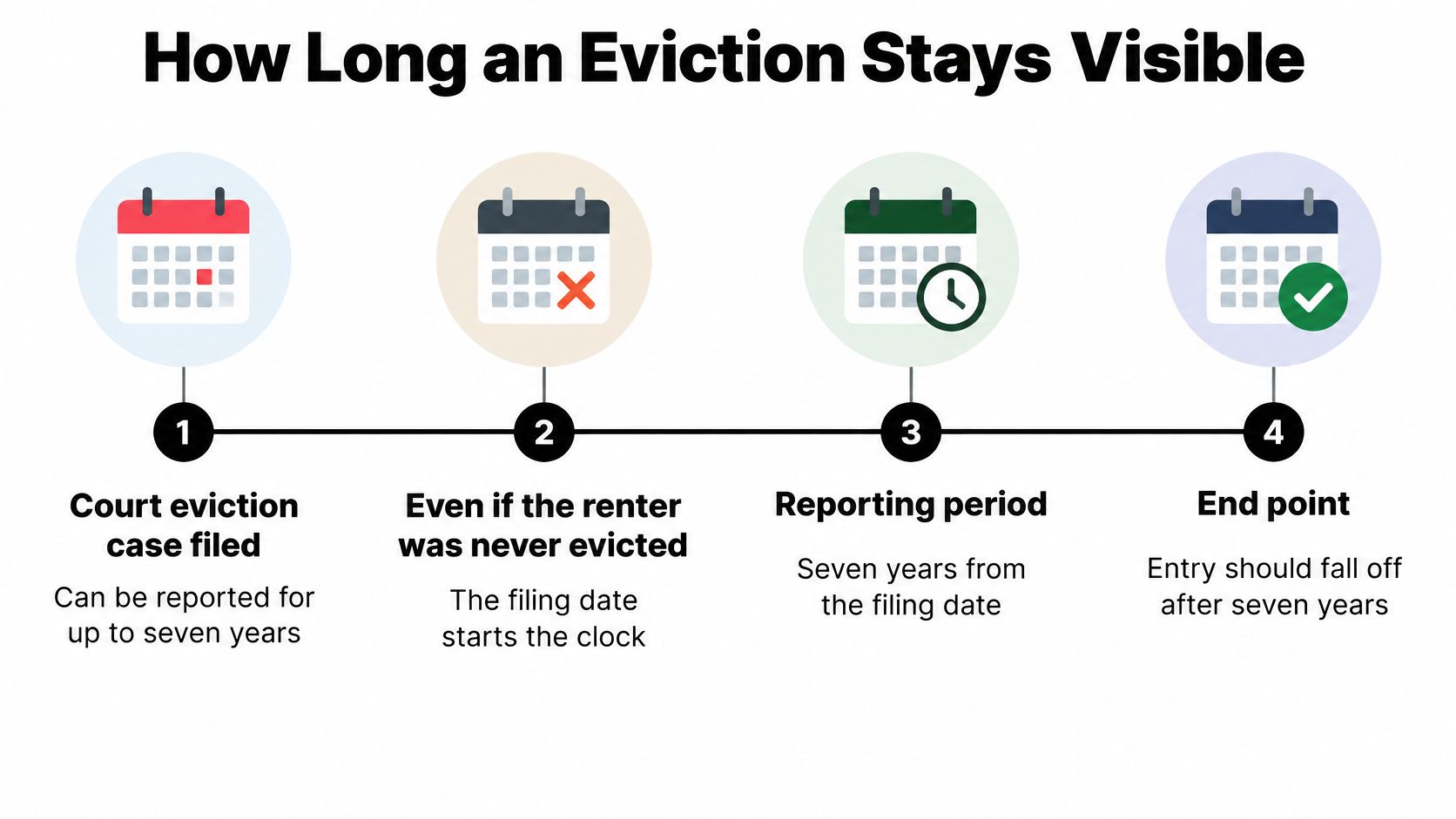
An eviction court case can remain reportable even when the renter was never ultimately evicted. The Federal Trade Commission's tenant-background-check guidance explains that eviction cases may be reported for up to seven years from the filing date, while sealed or expunged cases shouldn't appear.
The important date is when the landlord filed the case, not when the renter moved out or when the court later entered a judgment. A report that prominently displays a later update date can be confusing, so compare the entry with the original court filing.
The timeline below illustrates the filing-based reporting period.
Separate records have separate clocks
A rent-related collection account uses the original delinquency date, rather than the eviction filing date, to determine its reporting period. Don't assume the court entry and the collection account will disappear together just because they arose from the same tenancy.
How long each record type can be reported
| Record | Clock starts | Typical maximum | Exception |
|---|---|---|---|
| Eviction court case | Filing date | Federal reporting window described above | Some states impose shorter limits; sealed records excluded |
| Collection account from unpaid rent | Original delinquency date | Applicable credit-reporting limit for the delinquency | An inaccurate original delinquency date should be disputed |
| Sealed or expunged case | Not applicable | Shouldn't be reported | Court order removes or restricts the case |
These are reporting boundaries, not promises that every screening company will display every eligible record until the last possible day. Availability, state restrictions and court orders can change what may appear. A public court docket also isn't the same thing as a consumer report, so don't assume a reporting cutoff automatically erases the underlying court file.
A recent status update doesn't turn an old filing into a newly filed case.
Check the date against the document
For a hypothetical filing in March of a given year, calculate the applicable reporting endpoint from that filing month, not from a later settlement or move-out. Then check whether a shorter state limit or an exclusion applies before deciding the entry is eligible.
Keep a copy of the filing document and any final order together. Those documents let you challenge a wrong date or outdated status with something more useful than a recollection of when you left the property.
What a Filing, Judgment or Dismissal Really Means
A filing is an allegation brought to court, not proof that a renter was removed. It shows that the landlord started a legal proceeding. Without the case outcome, a landlord can't reliably tell whether the claim succeeded, ended by agreement or was dismissed.
The federal guidance on screening applicants for rental housing warns that court-based screening can include eviction records regardless of disposition and that old, incomplete or irrelevant information may create unjustified discriminatory effects. It recommends using information relevant to tenancy obligations and allowing applicants to correct records.
How each case outcome should read
| Case outcome | What it means | How a fair screen should show it |
|---|---|---|
| Filing only, no judgment | Landlord asked the court for possession; no decision is shown | Identified as a filing, with pending or unknown status |
| Dismissed | Case ended without a possession ruling for the landlord in that case | Clearly marked dismissed, not as a completed eviction |
| Settled or paid | Parties agreed to terms or payment resolved an issue | Available settlement or resolution information included |
| Judgment for tenant | Court ruled against the landlord's claim | Tenant-favorable outcome clearly shown |
| Judgment for landlord | Court ruled for possession | Judgment date and any money amount actually awarded shown separately |
| Sealed or expunged | Court removed or restricted the record | Excluded from the screening report |
The final row isn't a stronger negative signal. It's an exclusion. Nor should the other outcomes be treated as a simple risk ranking without reading the actual order.
A possession judgment isn't proof of every claimed debt
A landlord might seek possession and money in the same proceeding, but the resulting order determines what the court awarded. A report shouldn't turn the amount the landlord requested into an amount the judge ordered the tenant to pay.
Similarly, a judgment for possession doesn't, by itself, establish that an officer physically removed the renter. Use the language the record supports rather than substituting a broader conclusion.
Say a landlord files over unpaid rent, the parties reach an agreement and the court dismisses the case. An entry showing only an eviction filing omits the fact most useful to understanding the proceeding: how it ended.
Fair screening requires context
Before relying on an entry, a landlord should ask:
- Identity: Does this case belong to the applicant?
- Outcome: Does the report include the latest available disposition?
- Relevance: What does the established outcome show about tenancy obligations?
- Current evidence: What do recent rent records and references add?
A filing alone doesn't prove an actual eviction or establish that an applicant can't pay future rent. A defensible review considers the court's decision, the age of the event and current rental-payment evidence instead of allowing a broad eviction label to decide the application.
How to Check for an Eviction on Your File
Start with the report a landlord used, not just a score-monitoring dashboard. The Consumer Financial Protection Bureau's consumer reporting company directory identifies specialty reporting companies and explains that tenant-screening information can include eviction records, rent-payment history, credit history and past-due rent sent to collections.
The CFPB also notes that most screening companies don't hold information on someone unless that person applies for housing or authorizes a report. You may therefore need to identify the specific company involved rather than expect a universal rental file.
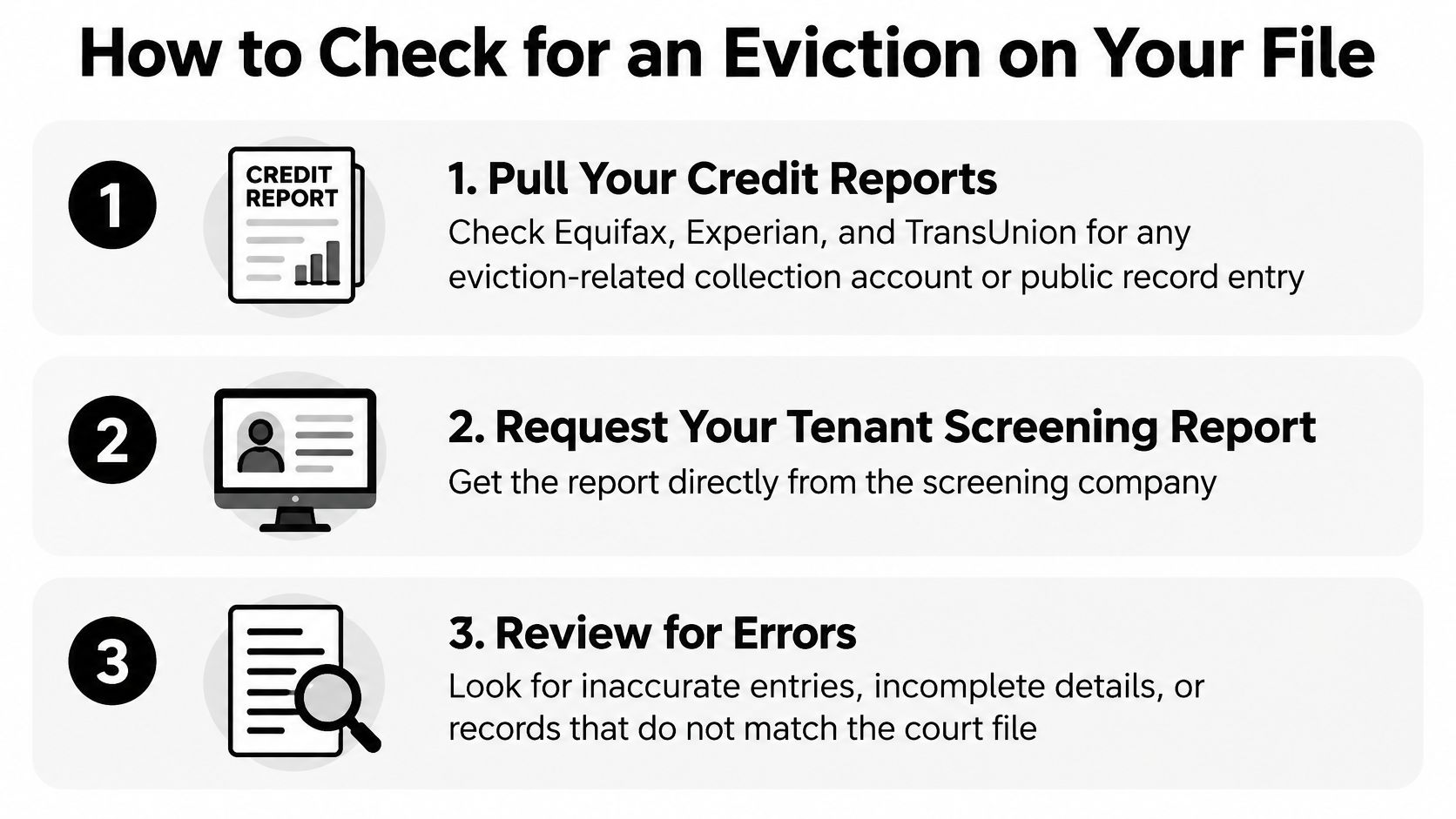
Use this checklist to organize the review.
Review the documents in a workable order
- Pull your credit reports from Equifax, Experian and TransUnion, looking for rental-related collections or unexpected entries rather than assuming an eviction will appear as an account.
- Request the tenant-screening report from the agency involved in your application so you're reviewing the same information the landlord received.
- Read each court entry for case type, filing date, court, county, state and disposition because a case number alone doesn't explain the outcome.
- Verify the identity match using available names, addresses and identifying details so another person's proceeding isn't attributed to you.
- Flag incomplete or excluded records when an entry implies a completed eviction without supporting outcome information or includes a case covered by a sealing or expungement order.
- Dispute errors in writing with the reporting agency, attaching the relevant court documents and keeping a complete copy of what you send.
- Read any adverse-action notice to identify the reporting company when a landlord rejects your application or imposes different terms based on a consumer report.
For a more detailed document checklist, use our guide to how to check for evictions.
Make the dispute specific
A useful dispute identifies the exact entry, states what's wrong, and names the correction requested. For example, explain that the report omits a dismissal and attach the dismissal order, rather than just saying the eviction is unfair.
Include the case number so the agency can match your documents to the disputed entry. If the problem concerns identity, explain which address or identifying detail doesn't belong to you without sending unnecessary sensitive information.
Keep a dispute folder: Save the report, court documents, written dispute and responses together so you can show exactly what needs correcting.
A landlord reviewing a disputed entry should distinguish an unsupported explanation from documentary evidence. A court order showing the final outcome is directly relevant to whether the screening entry accurately describes the case.
State Limits, Sealed Cases and Informal Move-Outs
The standard reporting window doesn't answer every question about whether a record can be used. State restrictions, court orders and the absence of a lawsuit can each change the analysis.
Start with the law governing the record and the rental decision. A record's technical availability doesn't establish that a landlord may lawfully rely on it, and a federal reporting maximum isn't permission to disregard a shorter state limit.
Restricted records need a different response
A sealed or expunged case shouldn't be treated as an ordinary reportable filing. If you have a court order restricting the record, obtain a complete copy showing the court, case number and terms of the order.
Don't assume that paying a balance, signing a settlement or receiving a dismissal automatically means a case was sealed. Those are different events. The wording of the court's order matters.
For our screening process, we follow state sealing laws and exclude sealed records. Cases expunged by court order don't appear in eviction reports.
When reviewing a potentially restricted entry, focus on:
- The order itself: Confirm which case the court restricted and what the order says.
- The reported entry: Match the case number and court rather than relying only on similar names.
- The applicable law: Check local requirements before using the information in a rental decision.
Leaving without a lawsuit creates no eviction case
Say a renter falls behind, reaches a move-out agreement and returns the keys before the landlord files in court. There's no eviction court record to retrieve from that event.
That doesn't mean the tenancy ended without problems. A landlord may still have unpaid rent records, payment history or a reference describing the move-out. A screening report may contain payment-related information even when the eviction portion has no matching case.
For landlords, the distinction prevents false reassurance. No eviction record means no reportable matching court case was found, not that every previous tenancy went well. Evaluate references and payment records on their own terms.
For renters, it prevents the opposite mistake: calling every difficult departure an eviction. Describe what happened accurately and keep any written agreement documenting the return of possession or resolution of the balance.
State-specific questions deserve state-specific answers. Check local law or obtain housing-law advice before deciding that a case must be disclosed, may be reported or can lawfully support a denial.
Decide What to Do When an Eviction Appears
An eviction-related entry should trigger a document review, not an automatic conclusion. The appropriate response depends on whether you're trying to correct your file or decide a rental application.
Reviewing the actual documents is more useful than debating a screening label.

If you're the renter
Confirm that the entry belongs to you and compare its disposition with the court documents. Dispute inaccurate reporting, but explain accurate information that needs context. A correctly reported filing doesn't become inaccurate merely because you weren't removed; an entry falsely describing that filing as a completed eviction presents a different problem.
Keep debt questions separate from record-correction questions. If bankruptcy is part of your situation, Morgan & Morgan on bankruptcy and eviction, from Morgan & Morgan Attorneys at Law P.C., provides context for Georgia-related questions. Don't assume that addressing a debt automatically removes the underlying court history.
Use our guide to how to check your tenant-screening report to organize the information you need before contacting the reporting agency.
If you're the landlord
Write a screening standard that distinguishes pending filings, dismissals, settlements and judgments, then apply it consistently. Consider the established outcome alongside current payment evidence rather than treating every match as equivalent.
When eviction history supports a denial, send the required adverse-action notice before denying tenancy, including the consumer reporting agency's name and contact information. A report-based requirement for a higher deposit, higher rent or a co-signer also calls for adverse-action handling, and applicants should have a meaningful opportunity to correct inaccurate information.
For another way to review the topic, the following video offers additional context.
Take one concrete step today: pull the report you're relying on and verify the disposition against the court record before you act. That check helps renters challenge the right problem and helps landlords avoid making a decision on an incomplete account.
VerticalRent offers a nationwide eviction-history search that separates court filings, judgments and dismissals from rental-history information. Visit VerticalRent to review the screening options and build a rental review around case dates and outcomes, not an eviction label alone.
Put this into practice
VerticalRent tools related to this guide
Legal Disclaimer
VerticalRent and its authors are not attorneys, CPAs, or licensed legal or financial advisors, and nothing on this site constitutes legal, tax, or professional advice. The information in this article is provided for general educational purposes only. Landlord-tenant laws, eviction procedures, security deposit rules, and tax regulations vary significantly by state, county, and municipality — and change frequently. Nothing on this site creates an attorney-client relationship. Always consult a licensed attorney or qualified professional in your jurisdiction before taking any action based on information you read here.
Co-founded VerticalRent in 2011, growing it from nothing to 100k landlords and renters. Sold it in 2019, then re-acquired it in 2026 to make it better than ever.


