Does FCRA Apply to Criminal Background Checks for Rentals
Does FCRA apply to criminal background checks for tenant screening? See when a report counts, the 7-year rule, and adverse action steps.


Yes, the FCRA applies when a consumer reporting agency prepares a criminal background report and a landlord uses it to evaluate a rental applicant or make the rental offer less favorable. A personal courthouse lookup without a consumer report is a different case.
But if a screening report is FCRA compliant, does that mean you can legally reject the applicant?
That's the gap landlords need to understand. The rules governing a report aren't the same as the rules governing a housing decision. A vendor can supply reportable criminal information without establishing that the information belongs to your applicant, remains legally usable, or justifies denying that particular tenancy.
For independent landlords, the safest workflow separates those questions rather than letting a screening score answer all of them.
Does FCRA Apply to Criminal Background Checks
Yes, when the criminal check is a consumer report obtained for a rental decision. The Fair Credit Reporting Act isn't limited to credit scores or unpaid bills. Criminal-history information supplied by a consumer reporting agency falls within its consumer-reporting framework.
The practical distinction is how you obtained the information and what you do with it. Public availability doesn't remove FCRA obligations when a screening company collects the information and delivers it as a tenant-screening report.
When the FCRA covers a criminal check
| Situation | FCRA applies | Duty that matters |
|---|---|---|
| Nationwide criminal report ordered to evaluate a rental applicant | Yes | Permissible purpose, certification to the agency, and reporting accuracy |
| Criminal data bundled with credit or eviction history | Yes | Treat the tenant-screening file as a consumer report |
| Sex-offender registry result delivered inside a vendor report | Yes | Treat it as report data, not as a personal public-record lookup |
| Landlord personally reads a court docket and gets no compiled report | Generally no consumer-report duties | Fair-housing and other restrictions can still apply |
| Applicant mentions a conviction in conversation and no report is pulled | No report duties triggered by that disclosure alone | Apply lawful written criteria rather than inventing a consumer-report notice requirement |
| Report causes a higher deposit or stricter terms but not a denial | Yes | Adverse action includes a less favorable offer |
A landlord shouldn't assume that approving an application avoids the notice issue. An approval on worse terms can still be an unfavorable decision influenced by a consumer report.
Accuracy means more than finding a matching name
The January 23, 2024 Federal Register advisory on background screening explains that reasonable accuracy procedures must prevent reporting expunged, sealed, or legally restricted records, include available disposition information, and prevent duplicate reporting of the same event.
Those requirements change how a useful report should look. An arrest entry shouldn't appear without an available court outcome that explains what happened afterward. Separate database entries shouldn't make the same underlying event appear to be multiple incidents.
Practical rule: A professionally formatted report is still information to evaluate, not permission to skip review.
The screening agency has accuracy obligations, but the landlord still chooses whether and how to rely on the report. If an entry appears incomplete, duplicated, or inconsistent with the application, resolve the discrepancy rather than letting the formatting make it look settled.
Federal compliance is also a baseline, not the entire legal standard. State and local privacy, fair-housing, and fair-chance restrictions can require a narrower screening process.
When a Criminal Record Becomes a Consumer Report
A courthouse file is a public record kept by a court. When a tenant-screening company gathers criminal history and supplies it for a housing decision, the resulting product is a consumer report.
Say an applicant applies for your vacant duplex. You order a screening package, and the provider returns criminal, rental, and eviction information. You haven't received a collection of unrelated public documents. You've obtained information assembled to help evaluate that applicant.
The FTC's guidance for landlords using consumer reports identifies tenant background checks containing criminal, credit, rental, and eviction histories as consumer reports and explains the landlord's permissible-purpose and certification duties.
The court file and the screening file serve different purposes
The court maintains a record of its proceedings. The screening company selects, matches, and presents information for someone else's decision. That additional work creates opportunities for both useful context and serious mistakes.
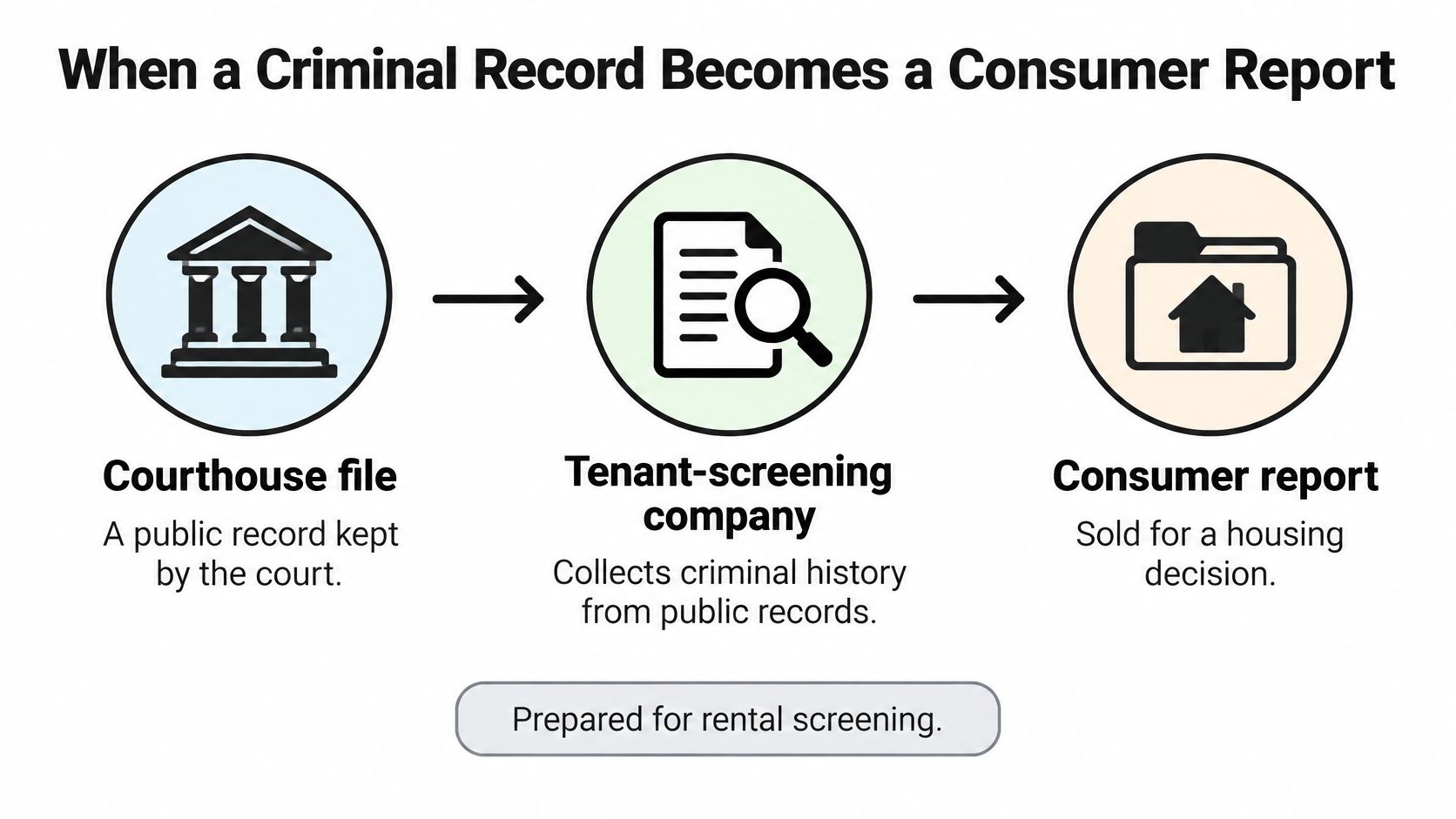
The parties have distinct responsibilities:
- The consumer reporting agency must use reasonable procedures to assure maximum possible accuracy. VerticalRent is a consumer reporting agency regulated under the FCRA.
- The landlord must have a permissible rental purpose, certify the intended use to the agency, and control who can access the report.
That certification isn't a promise to ignore every conviction. It also isn't permission to forward the report to a friend, maintenance contractor, or neighboring tenant who wants to know more about the applicant.
Verify the person and the current record status
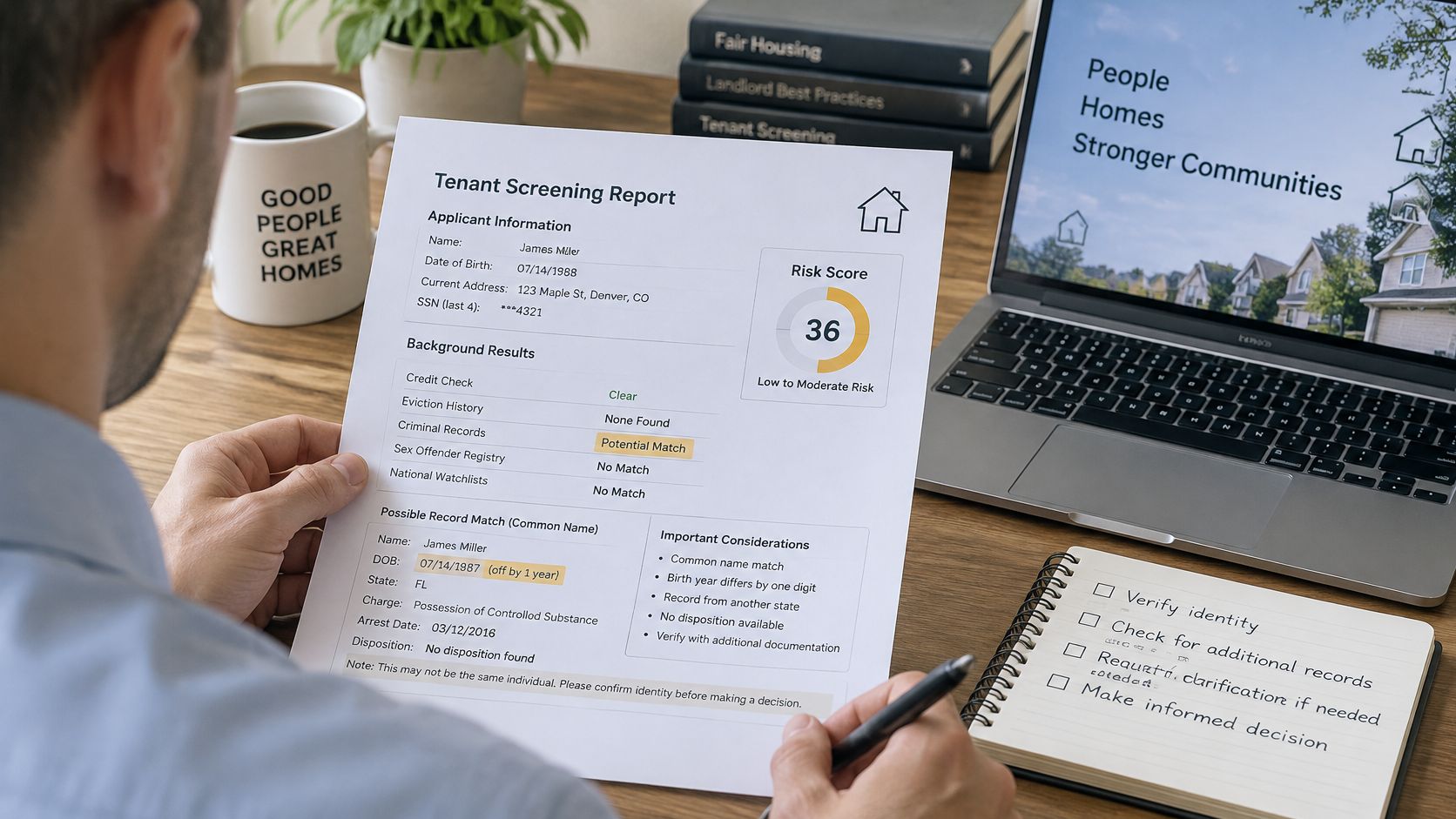
Suppose the report lists a case under the applicant's name, but the birth information doesn't match. A shared name doesn't resolve the discrepancy. Compare the identifiers available through the authorized screening process and ask the agency to review the match.
Record status needs separate attention. For a Connecticut-specific explanation of why a case's legal status matters, The Law Offices of Attorney Angel Lugo offers a resource on understanding expungement in Connecticut. Use jurisdiction-specific resources to understand terminology, not to substitute for verification of the applicant's actual record.
A vendor risk score can summarize a file, but it can't establish identity or supply a missing court outcome. The agency owns its accuracy procedures; the landlord owns the report's purpose, access, and use in the housing decision.
Arrests Convictions and the Seven Year Limit
An arrest and a conviction don't follow the same federal reporting clock. Treating every criminal-history entry as a conviction creates avoidable errors before you even evaluate the applicant.
Under 15 U.S.C. § 1681c, arrest records, civil suits, and civil judgments generally face a seven-year reporting limit, or a longer applicable statute of limitations, while criminal convictions have no general federal expiration. That distinction concerns what can appear in a report, not what automatically justifies a rental denial.
Read the record type before its age
Federal reporting limits by record type
| Record type | Federal FCRA time limit | Measured from | Mistake to avoid |
|---|---|---|---|
| Criminal conviction | No general federal expiration | Conviction is outside the obsolete-information ban described above | Assuming every state permits the same lookback |
| Arrest that did not result in conviction | General arrest limit described above | Date of entry of the arrest record | Presenting it as a conviction |
| Arrest that later resulted in a conviction | Arrest retains its reporting limit; conviction is treated separately | Arrest date for the arrest item | Merging both into an undated criminal hit |
| Civil suit or civil judgment | General civil-record limit described above | Date of entry | Treating a civil matter as a criminal conviction |
| Charge or case with no disposition | Available disposition information should be included; that requirement isn't itself a reporting clock | Filing status and applicable reporting rule | Calling an unresolved charge a completed conviction |
| Sealed, expunged, or duplicate record | Legally restricted records should be excluded; duplicate events should be prevented | Legal restriction or single underlying event | Counting the same case repeatedly |
The arrest associated with a conviction doesn't become indefinitely reportable merely because the conviction has no general federal expiration. They remain different record items with different treatment.
The outcome changes the meaning
A charge records an accusation. A dismissal records a different outcome from a conviction. When a screening report leaves out an available disposition, a landlord can mistake the beginning of a case for its conclusion.
Brian Hansford Law's explanation of dismissed charges on background checks provides additional context for distinguishing an arrest entry from the case's eventual result. For screening purposes, ask for the disposition rather than inferring it from an offense label.
Don't create your own conviction category called criminal history and place everything inside it. Identify whether the entry describes an arrest, pending charge, dismissal, or conviction before applying any rental criterion.
State restrictions may be tighter than the federal conviction rule. A nationwide search doesn't create nationwide permission to use every result. The applicable state requirements still govern the reporting and consideration of the information.
Landlord Duties from Consent to Adverse Action
A workable screening process should tell you what to do before ordering a report, while reviewing it, and when communicating the result. It shouldn't depend on whether you remember a compliance step after an applicant challenges the decision.
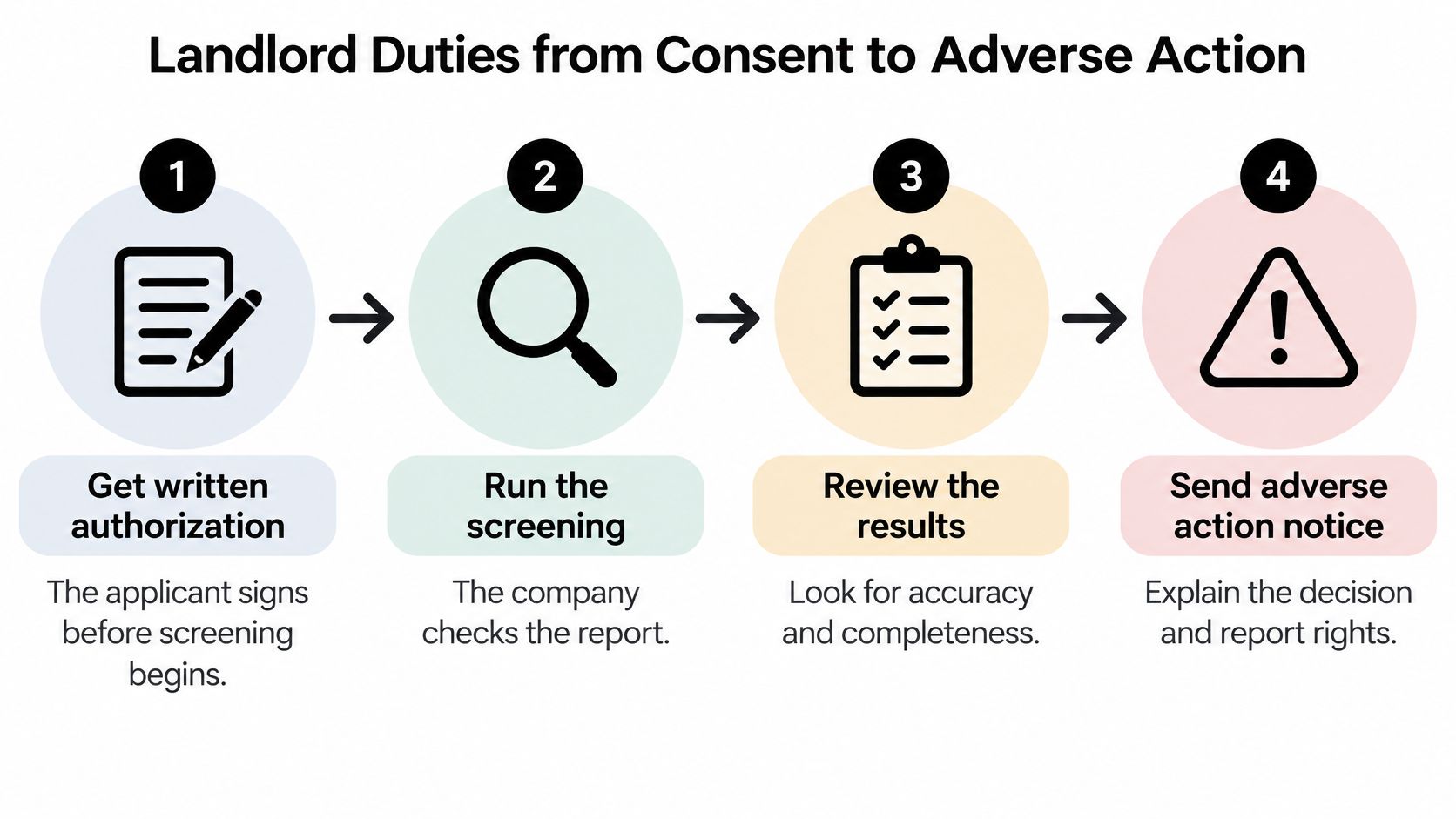
Use this sequence as an operating checklist, with local requirements reviewed before you begin.
Follow a documented screening sequence
Obtain authorization before ordering. Get the applicant's written authorization and document the rental purpose. At VerticalRent, landlords must certify that they have the applicant's written authorization. Use a separate, clearly identified screening disclosure as a sound documentation practice, while confirming which disclosure requirements your jurisdiction and screening arrangement impose.
Limit the search and access. Order information relevant to your lawful rental criteria. Keep the resulting report available only to people who need it for the application decision, rather than attaching it to broadly shared emails.
Read the underlying entries. Review identity information, offense type, dates, and disposition before relying on a summary or score. Flag contradictions for review instead of choosing whichever version looks more concerning.
Apply the written criteria consistently. Separate arrest-only entries from convictions and document which permitted criterion matters. A short explanation tied to a verified entry is more useful than a note saying the applicant failed screening.
Send the required adverse-action notice. If report information contributes to a denial, conditional approval, higher deposit, or other less favorable offer, provide the notice. Mixed reasons don't erase that obligation: a report can influence the decision even when income or another factor also matters.
Explain report rights without outsourcing the decision
The adverse-action notice must identify the consumer reporting agency and explain the applicant's rights to obtain and dispute the report. Include the agency's contact information and make clear that the agency supplied information rather than made your rental decision.
Don't automatically import an employment-style preliminary-notice procedure into housing screening. Check applicable housing rules for additional timing or review requirements. For our eviction-history workflow, landlords must send the adverse-action notice before denying tenancy based on that history.
Documentation check: Keep the authorization, report, criterion applied, and notice together in a restricted application file.
The FCRA compliance checklist for landlords can help turn these actions into a repeatable administrative routine. For applicants or landlords working through Texas-specific concerns, the Law Office of Bryan Fagan PLLC provides Bryan Fagan's guide to housing denials.
A properly sent notice doesn't validate an unlawful criterion. It documents the consumer-report consequence and gives the applicant a route to question the information.
How a Similar Name Hit Should Change the Decision
Say an applicant has a common surname. The screening report shows an out-of-state arrest, no disposition, and birth information that conflicts with the application. The score flags risk.
That combination calls for a review hold, not an immediate rejection. You have an unresolved match and an incomplete case history, not a verified reason to deny housing.
Preserve the issue and allow a meaningful response
Save the underlying report and write down the exact disputed entry. Tell the applicant what needs clarification without asserting that the case belongs to them. Direct the matching and record-status questions to the reporting agency.
According to the FTC's explanation of tenant background-check rights, an applicant receiving an adverse-action notice has 60 days to request a free copy of the report from the reporting company and may dispute inaccurate criminal, eviction, or lawsuit information. That request window isn't an automatic requirement to hold a vacant unit for the entire period.
Where practicable, allow time for clarification before deciding. Be explicit about the review status and next communication rather than promising an indefinite delay. Our disputes are investigated under the FCRA, and reports can be corrected when appropriate.
The applicant can use this guide to checking a tenant-screening report to understand what information to examine.
The corrected facts determine the next step
The scenario can end differently depending on what verification establishes:
- The arrest belongs to someone else. Remove the mismatched item from your decision. Don't preserve its effect by continuing to rely on the original risk score.
- A verified conviction remains. Evaluate it under lawful written criteria and applicable housing restrictions. If those permit an unfavorable decision and the report influences it, provide the required notice.
- The outcome remains unclear. Seek the disposition rather than turning uncertainty into a conviction. Document what remains unresolved and whether further review is practicable.
A database hit is a reason to ask a precise question, not a substitute for the answer.
The escalation path is straightforward: match identity, obtain the disposition, pursue correction or wait where practicable, then decide and provide notice.
Fair Chance Housing Rules Beyond the FCRA
FCRA compliance isn't a green light to deny housing. It addresses consumer reporting and associated duties, while fair-housing principles and state or local fair-chance rules can independently restrict the decision.
The FTC's credit-reporting guidance explains the consumer-reporting framework and dispute protections. That framework doesn't establish that every conviction must be ignored or that every conviction justifies rejection.
FCRA versus rules that limit the housing decision
| Question | FCRA | Fair-housing principles | Local fair-chance or ban-the-box rules |
|---|---|---|---|
| Does it regulate the screening report? | Yes, for covered reports supplied for housing purposes | Focus on discriminatory housing decisions and policies | May regulate when and how history is requested or used |
| Do convictions expire? | No general federal expiration for conviction reporting | Time and relevance can affect whether a policy is defensible | May limit lookback periods or eligible offense types |
| Is a blanket ban on any record safe? | Report accuracy and notice duties don't approve the policy | Blanket and automated exclusions create substantial risk | May restrict or prohibit broad exclusions |
| What must the applicant receive? | Required adverse-action information when report use triggers it | Consistent, documented decision-making is safer than unexplained scoring | May require an opportunity to explain or correct information |
A correct notice can accompany a flawed policy
Suppose a landlord automatically rejects every applicant with any arrest, then sends a complete adverse-action notice. The landlord has addressed the communication requirement but may still have an indefensible exclusion policy.
Another landlord never orders reports and tells everyone with a felony not to apply. Avoiding the consumer-report chain doesn't eliminate fair-housing concerns.
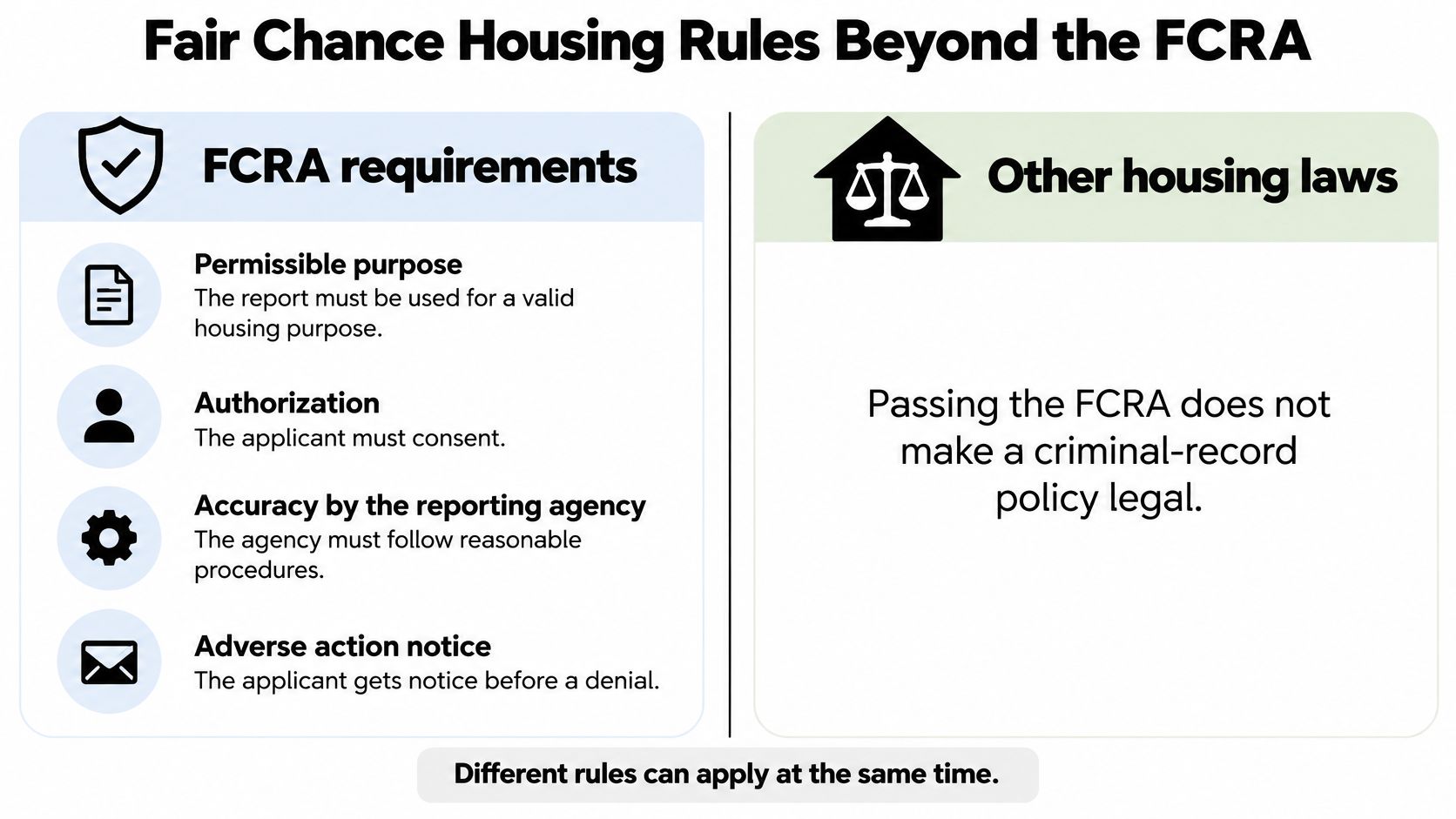
A more defensible approach uses individualized, written criteria that consider the offense, elapsed time, and relevance to the tenancy, subject to applicable restrictions. Consistency matters, but consistently applying an unlawful rule doesn't make it lawful.
Check the property's city and state requirements before using criminal information. The guide to fair-chance housing laws and screening policies can help identify the policy questions to resolve.
Run the Next Screening with a Written Decision Rule
Before accepting the next application, write a concise decision rule. Specify which verified convictions may affect approval, how recency matters where legally permitted, and what relevance the offense must have to the tenancy.
Include an explicit review hold for a mismatched record or missing disposition. State that arrest-only information won't be treated as a conviction. Have the rule checked against the property's state and local requirements before staff or software starts applying it.
Put the rule beside the report
Keep a short decision worksheet with fields for:
- Authorization and purpose. Record that permission was obtained and the report was ordered for the application.
- Verified information. Identify the matching record and its disposition.
- Decision basis. Name the lawful criterion applied, including any required individualized review.
- Applicant communication. Record the notice sent and any correction raised.
We offer a nationwide, FCRA-compliant criminal background check, distinct from a rental-history check. Reports arrive within minutes, and built-in adverse-action notices include AI drafting when a landlord denies an applicant after screening.
Fast delivery should shorten the administrative work, not the accuracy review. You still certify the permissible purpose, apply the written rule, check local law, and ensure that the required notice reaches the applicant.
Adopt the rule before the next screening begins. Then follow the same order for each application: authorization, report, match, decision, and notice. That gives you a process you can explain without pretending a score made the choice.
VerticalRent offers FCRA-compliant nationwide criminal screening and built-in adverse-action notices to support a documented rental decision. Visit VerticalRent to set up your next screening, then pair the report with your written criteria and local housing requirements.
Put this into practice
VerticalRent tools related to this guide
Legal Disclaimer
VerticalRent and its authors are not attorneys, CPAs, or licensed legal or financial advisors, and nothing on this site constitutes legal, tax, or professional advice. The information in this article is provided for general educational purposes only. Landlord-tenant laws, eviction procedures, security deposit rules, and tax regulations vary significantly by state, county, and municipality — and change frequently. Nothing on this site creates an attorney-client relationship. Always consult a licensed attorney or qualified professional in your jurisdiction before taking any action based on information you read here.
Co-founded VerticalRent in 2011, growing it from nothing to 100k landlords and renters. Sold it in 2019, then re-acquired it in 2026 to make it better than ever.


