How to Check for Evictions Without Missing Records
Learn how to check for evictions the right way — from court records to screening reports, FCRA rules, and what to do when results are unclear.


A rental application lands in your inbox, the applicant's income appears adequate, and the first screening report comes back with no eviction record. It's tempting to approve the application and move on. That decision can become expensive if the applicant previously lived in another county, the court's records aren't included in the screening database, or the report lists a filing without explaining how the case ended.
Learning how to check for evictions means understanding both the search process and the limits of the information you find. The dependable approach uses two passes: a broad screening search followed by direct court verification in the jurisdictions that matter. You need a method for handling a “no result” response and a way to interpret hits without treating every filing as proof that a tenant was removed.
Why Eviction Checks Matter Before You Approve a Tenant
A clean screening report can create false confidence. In my own checks, a nationwide search has sometimes returned nothing while the applicant's former county portal showed a landlord-tenant case under an earlier address and a slightly different legal name. The gap did not necessarily mean the screening company made a mistake. The relevant court data was not included in that search.
That is why I use a two-pass process. First, run a broad screening search to identify possible cases and jurisdictions. Second, verify the relevant names, addresses, and case outcomes through the appropriate court source. This approach also gives you a clear response when no result appears: confirm the applicant's prior counties, check name variations, and determine whether the source covers the period and court involved before treating “no record found” as meaningful.
An eviction check helps assess documented disputes involving unpaid rent or lease enforcement, but it does not turn every filing into proof of removal. A case may have been dismissed, paid, settled, sealed, or resolved without the tenant losing possession. Read the disposition and judgment details before drawing a conclusion.
Independent landlords need a repeatable process, not disconnected lookup tricks. A complete tenant screening guide can help organize eviction checks with income, identity, rental history, and credit review. Eviction records still require separate attention because they are tied to court venues rather than one universal file.
The cost of a rushed lookup
Eviction records generally are not held in one national database. The Eviction Lab explains that the U.S. government does not collect eviction data nationally, and many state governments do not either. County court systems therefore become the practical starting point, while aggregated repositories may help identify additional leads.
A missed filing can distort a decision in either direction. You could approve an applicant without seeing relevant history, or reject someone because an ambiguous entry appears to show an eviction when the case was dismissed. A second pass helps separate those situations.
Practical rule: Treat a screening report as an efficient lead generator, not the final authority on what happened in court.
What a defensible check gives you
A careful process produces more than a yes-or-no answer:
- Jurisdictional coverage: You can record which counties and states were searched.
- Case detail: You can review filing dates, case types, judgments, dismissals, and possession orders when available.
- A documented rationale: You can apply the same criteria to comparable applicants.
- A fair review opportunity: You can let the applicant respond to an inaccurate or incomplete record.
Landlords operating in different legal settings may also benefit from region-specific guidance, such as these tenant screening tips for NSW landlords. Screening practices and privacy expectations vary by location. The practical lesson is consistent: a quick database result is a lead, not a complete housing history.
Where Eviction Records Actually Live and Why Results Vary
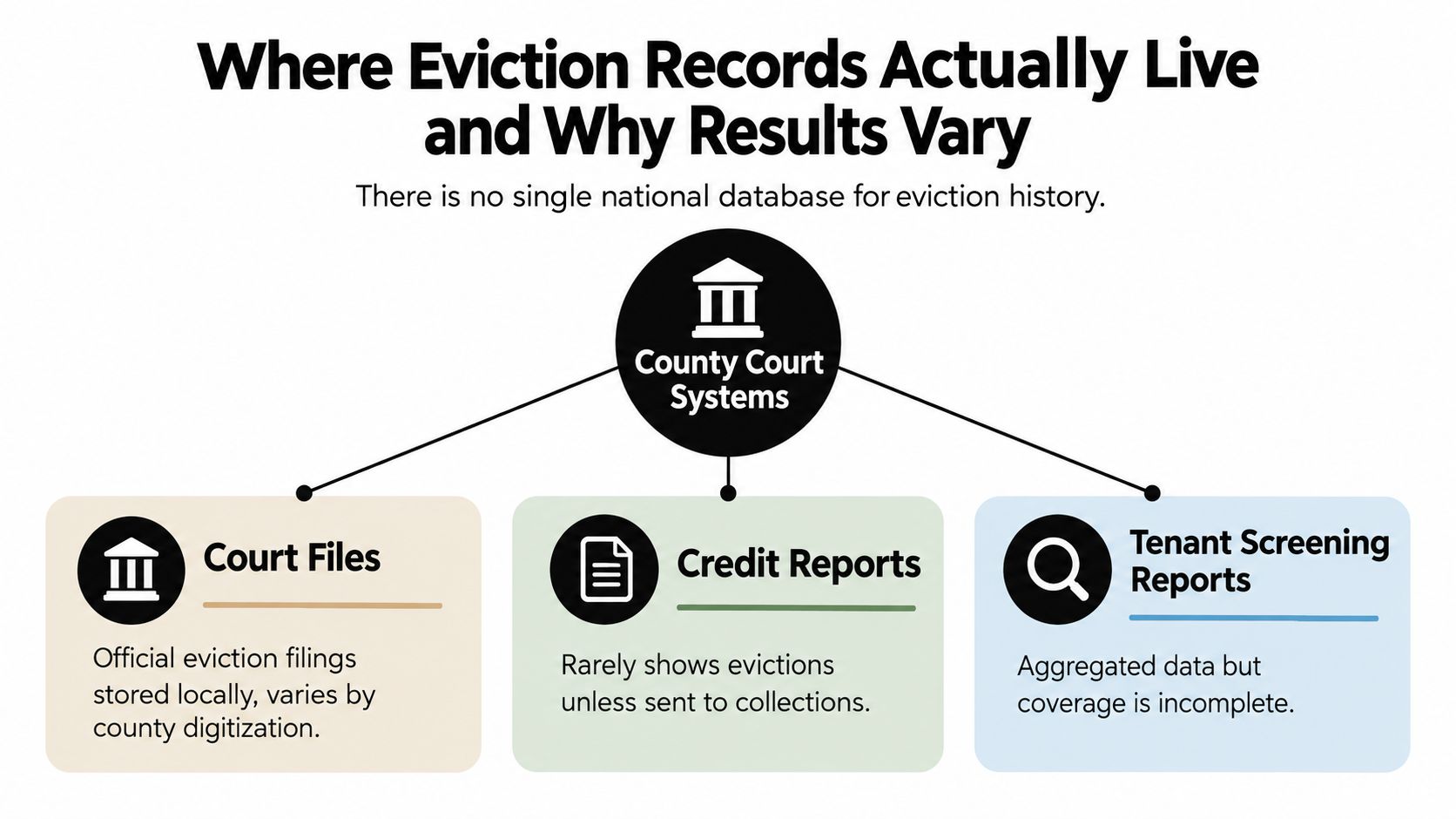
An applicant may have a clean screening report and still have a relevant court case in another county. Eviction history is primarily a court-record problem, not a credit-report problem. The landlord files where the rental property is located, and that court keeps the docket, filings, judgments, and related orders. Some courts offer searchable portals. Others provide only limited entries, require an account, or keep older files in formats that require help from the clerk.
Three record layers
Court files are the controlling record of what was filed and how the case ended. Depending on the court, they may show the parties' names, filing date, case type, disposition, judgment status, payment or settlement entries, and writs of possession.
Tenant screening reports combine court data so landlords can search more quickly. They provide useful breadth when an applicant has lived in several places, but results depend on the provider's source coverage, update schedule, matching rules, and access to local records. A name match can also be incomplete or misleading when legal names, spellings, or identifying details differ.
Credit reports generally do not provide a complete eviction history. Unpaid rent or collections may affect someone's finances, while the civil court case itself may not appear as a clear eviction entry.
Large data projects show why broad searches can help without replacing local verification. The Legal Services Corporation's Civil Court Data Initiative aggregates eviction filing data from many jurisdictions, while other repositories combine records from courts and purchased datasets. Coverage at that scale still does not mean every local docket is current, complete, or equally detailed.
Why geography changes the answer
Search the property's former counties, not only the applicant's current address. A person who moved across county lines may have a case in each jurisdiction, and the correct venue is tied to the rental property involved.
Records also age unevenly. One court may display recent electronic entries but lack older documents. Another may show a case number without the disposition. That is why a no-result screen is not proof that no case exists, and an ambiguous hit needs the docket, not a guess.
Start with the signed application, prior addresses, former legal names, alternate spellings, and other identifying information the screening service is permitted to use. If a record remains difficult to locate or identity details conflict across jurisdictions, specialist services such as tracing agents London demonstrate the value of careful address and identity research. Use screening databases for coverage, then check the relevant court record before treating a result as decision-ready.
How to Check for Evictions With a Reliable Two Pass Workflow
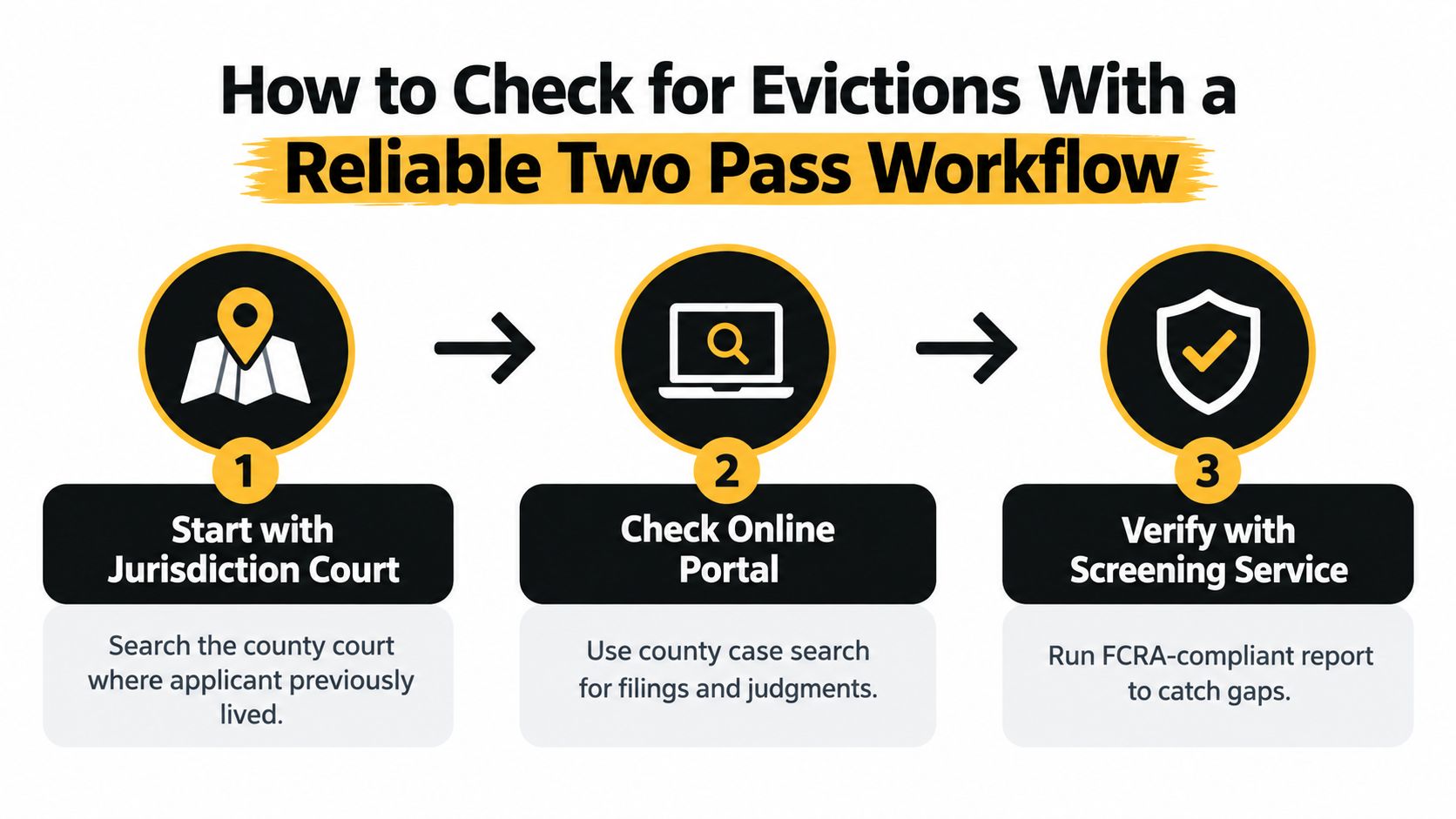
The most reliable workflow combines breadth first with depth second. A national screening search helps identify possible cases across jurisdictions. Direct court research then confirms whether those cases exist, what happened, and whether the record supports a housing-related concern.
Pass one starts with broad coverage
Begin with a consumer-reporting screening service that searches civil court records across the applicant's reported jurisdictions. Use the application to build the search profile, not just the current address. Capture every recent state and county of residence, former legal names, alternate spellings, and identifying information the service is permitted to use for accurate matching.
The CFPB identifies about 3.6 million eviction records created each year in the U.S. in its tenant background-check market report. That volume explains why a screening provider needs wide geographic coverage and regular data updates, but it doesn't make an aggregated result self-authenticating. A report can identify a possible case. The court docket determines what that case means.
Search results should be treated as leads:
- Record found: Save the case number, court, parties, filing date, case type, and reported outcome.
- Partial match: Don't assume the record belongs to the applicant. Compare full legal name, prior address, date information, and other permitted identifiers.
- No record found: Continue to the second pass. Absence in one database isn't proof that no case exists.
For broader operational guidance, these tips for tenant background checks can help you coordinate screening documents and applicant information before you make a decision.
Pass two verifies the actual court record
Start with the court that has jurisdiction over the property address connected to any possible case. Search its online portal using the applicant's exact legal name and the relevant landlord-tenant case categories, such as eviction, unlawful detainer, possession, or failure-to-pay-rent proceedings. Court labels vary, so search the categories the local portal uses rather than relying on one universal phrase.
Then repeat the search for each recent county or state where the applicant lived. A prior address list is essential because the court venue follows the rental property. Searching only the applicant's current address is one of the easiest ways to produce an incomplete result.
If the portal is unavailable or appears incomplete, contact the clerk's office. Ask whether the court maintains older paper dockets, whether landlord-tenant cases are searchable under a different case type, and how to request the docket or disposition. Don't ask the clerk to interpret the applicant's character. Ask for procedural information and the public record available under the court's rules.
Match names carefully
Exact-name searching reduces false negatives, but exact matching alone isn't enough. Check reasonable variations supplied by the application, including former surnames, middle-name differences, initials, common misspellings, and formatting differences. Keep a written record of which variations you searched and which jurisdictions returned results.
A sound file should contain:
- The signed application and address history.
- The screening report and search date.
- Screenshots, docket copies, or clerk responses where available.
- Notes explaining how you matched or rejected a possible record.
- The final decision and the stated screening criteria applied.
That workflow takes longer than typing one name into one database. It works better because it separates discovery from verification and gives you a defensible explanation for the decision.
How to Read Eviction Results Without Misjudging Applicants
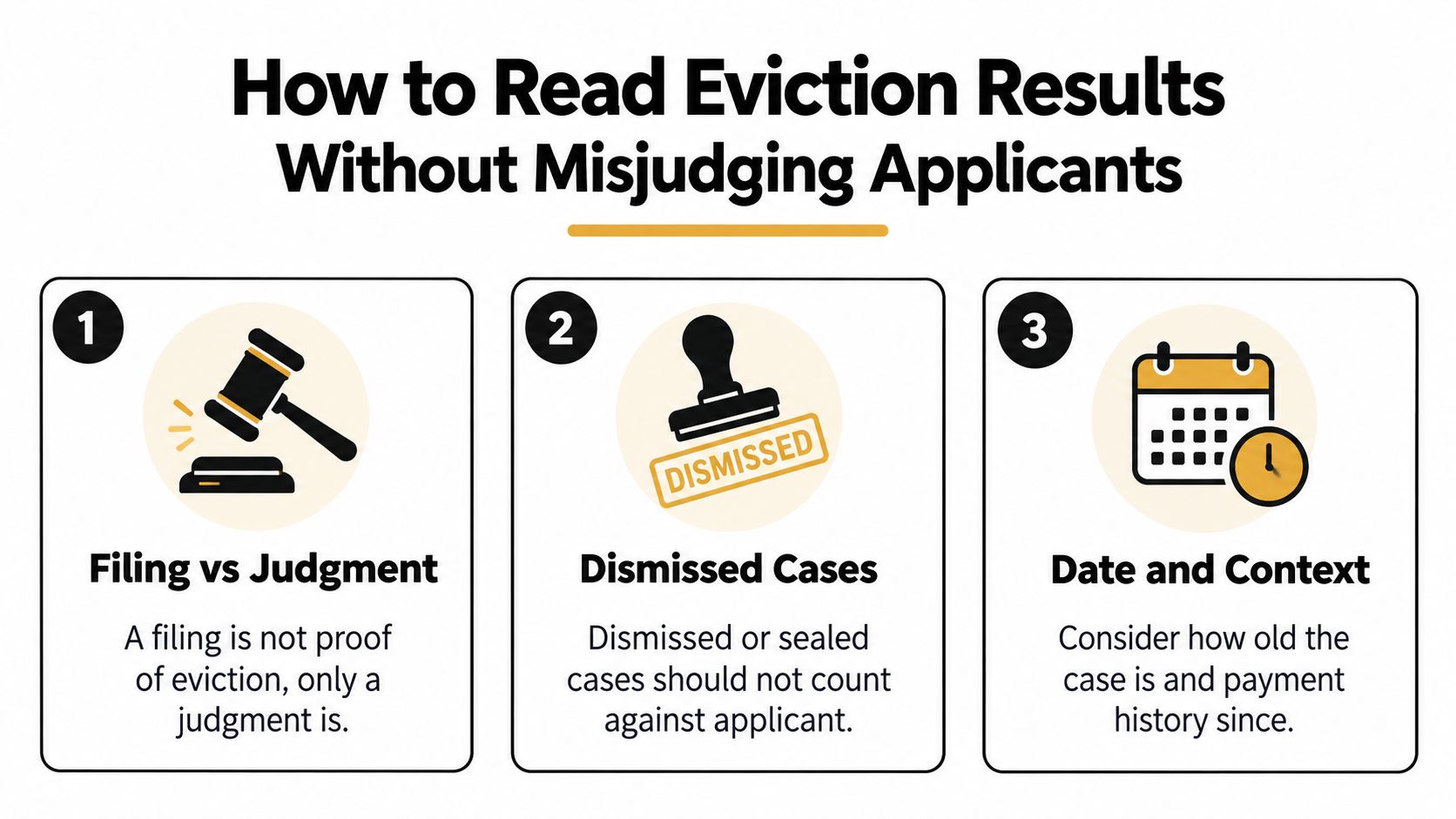
An eviction hit is not a conclusion. It's an invitation to inspect the court record.
A filing means someone started a court proceeding. It doesn't by itself prove that the tenant lost, moved out through a court order, or owed the amount alleged. A judgment is a later procedural outcome, but you still need to determine whether it was entered for possession, money, or another remedy. A writ of possession or comparable order may show that the court authorized enforcement, but the docket may not establish whether an officer completed a removal.
Read the disposition, not just the label
Look for the case's final status and the documents supporting it. Important distinctions include:
- Dismissed: The court ended the case without the requested outcome, although the reason may require further review.
- Settled or satisfied: The parties may have reached an agreement, paid a balance, or arranged a move-out.
- Judgment for possession: The landlord obtained a court order relating to possession, subject to the specific record.
- Money judgment: The record may concern unpaid rent or costs without establishing that a physical eviction occurred.
- Pending: The case may still be active, so the current docket matters more than an old summary.
Sealed or expunged records create another complication. A public portal may omit them, while an older screening entry may still require correction through the provider. Don't treat a mismatch as proof of dishonesty until you know which record is current and legally reportable.
Age and context change the decision
Tenant screening datasets can retain eviction histories for years. One large study cited in the supplied guidance found average retention of around 2.4 to 2.5 years for individuals with eviction histories, as discussed by Hemlane's landlord guidance on eviction checks. That figure isn't a universal rule for every provider or jurisdiction, but it demonstrates why a database entry may outlast the practical relevance of the underlying event.
Federal tenant-screening rules commonly treat eviction-related records as reportable for seven years, while public court systems may make records available for longer under local rules. The safest approach is to verify the date, disposition, and accuracy before applying your written criteria.
The NCLC has highlighted the risk of ambiguous or misleading eviction records, and its discussion cites an estimate that about 22% of eviction court records may be ambiguous or misleading. Review how to read an eviction history report like a pro before treating a hit as disqualifying.
The question isn't simply “Was there an eviction record?” It's “What did the court decide, when did it happen, and what does the complete record actually prove?”
Staying Compliant When You Check Eviction History
A careful search can still create legal exposure if the process is informal or inconsistent. When you obtain a tenant background report from a consumer reporting agency, the Fair Credit Reporting Act shapes what you must do before ordering it, while reviewing it, and after relying on it.
Obtain the applicant's written permission through a clear disclosure. The authorization should stand apart from unrelated application language where required, and your process should identify the company providing the report. Don't order a consumer report first and ask for consent later.

Use consistent criteria
Write your screening policy before reviewing the applicant's result. Define how you'll handle a recent judgment, a dismissed filing, a pending case, an identity mismatch, and an incomplete docket. Apply the same standards to similarly situated applicants, subject to applicable federal, state, and local housing rules.
Consistency protects applicants from arbitrary decisions and protects you from explaining different treatment later. It also keeps you from changing the standard because one result feels unusually persuasive or concerning.
Follow the adverse-action process
If information in a consumer report contributes to a denial, a higher deposit where permitted, a guarantor requirement, or another adverse housing decision, provide the required adverse-action notice. The notice generally identifies the consumer reporting agency, provides its contact information, explains that the agency didn't make the decision, and informs the applicant of rights to dispute the report and obtain a copy.
Before taking final adverse action, use a pre-adverse process where applicable. Give the applicant the report or required information, the applicable rights notice, and a reasonable opportunity to identify inaccurate or incomplete information. Then review any response before finalizing the decision.
The FCRA compliance guide is useful for organizing these obligations, but it isn't a substitute for legal advice about your jurisdiction. Keep the application, authorization, report, notices, correspondence, court documents, and decision notes according to a consistent retention policy.
Avoid informal workarounds. Social media searches, personal references, and casual conversations with former landlords don't replace a compliant consumer-report process, and they can introduce inconsistent or protected-class information into the decision. Use authorized records, documented criteria, and a review path the applicant can understand.
Making a Confident Decision After Your Eviction Check
A good eviction check ends with a documented decision, not an automatic rejection. Sort the application into one of three practical categories: clean and sufficiently covered, unclear or incomplete, or verified adverse history.
For a clean result, confirm that the search included every jurisdiction disclosed by the applicant and that the provider's coverage is suitable for the locations involved. Record the search date and the basis for concluding that no relevant record was found.
For an unclear result, pause the decision and use a short verification checklist:
- Names: Search former legal names, initials, middle-name variations, and reasonable spelling differences.
- Places: Recheck every prior county and state connected to the rental history.
- Court access: Ask the clerk whether older dockets are paper-based, archived, or indexed under another case type.
- Record status: Determine whether a case was dismissed, sealed, expunged, satisfied, pending, or incorrectly matched.
- Applicant explanation: Request documents or a written explanation when the record remains incomplete.
- Rental performance: Review verifiable payment and landlord references under the same policy used for other applicants.
For verified adverse history, compare the outcome with your prewritten criteria. Consider the case's age, disposition, amount and type of judgment where legally relevant, later rental performance, and whether the applicant had a meaningful chance to dispute an inaccurate report. Don't let a database label make the decision for you.
VerticalRent offers screening that includes nationwide eviction-history searches across civil courts, along with credit, criminal, and rental-history information, AI risk scoring, plain-English summaries, and record-keeping tools. It can be used as one part of a documented workflow, while direct court verification remains important whenever a result is incomplete or consequential.
The practical standard is simple: search broadly, verify locally, interpret the outcome, and document the reason for your decision. That process is faster to repeat and easier to defend than relying on a single “no record found” screen.
Use VerticalRent to run FCRA-compliant tenant screening with nationwide eviction-history data, clear summaries, and organized records for each application. Start your next check with the two-pass process, then use the platform to keep the report, review, and decision in one place.
Put this into practice
VerticalRent tools related to this guide
Legal Disclaimer
VerticalRent and its authors are not attorneys, CPAs, or licensed legal or financial advisors, and nothing on this site constitutes legal, tax, or professional advice. The information in this article is provided for general educational purposes only. Landlord-tenant laws, eviction procedures, security deposit rules, and tax regulations vary significantly by state, county, and municipality — and change frequently. Nothing on this site creates an attorney-client relationship. Always consult a licensed attorney or qualified professional in your jurisdiction before taking any action based on information you read here.
Co-founded VerticalRent in 2011, growing it from nothing to 100k landlords and renters. Sold it in 2019, then re-acquired it in 2026 to make it better than ever.


