Lease Agreement vs Rental Agreement: How to Choose
Lease agreement vs rental agreement comes down to term and notice, not the title. Compare 12-month leases with month-to-month rules and pick the right form.

A lease agreement vs rental agreement usually describe the same rental bargain, but a lease is typically a fixed term, commonly 12 months, while a rental agreement is typically month-to-month and ends on the notice your jurisdiction requires. That distinction, not the title printed at the top, controls your cash flow, your next rent change, and how quickly you can regain possession.
If you manage one to ten units, you're really choosing between predictability and flexibility. A fixed term locks in occupancy and rent for months you can plan around, but it also locks you in. A periodic agreement lets you respond to market rents, a sale, or a change in plans, but every month becomes a possible move-out, notice deadline, and vacancy. The right answer depends on the property, the tenant's likely stay, local vacancy, and the rules where the unit sits. I would start with what the written terms do, then decide which trade-off you can afford.
What Separates a Lease from a Rental Agreement
The title on the first page isn't the law. Both forms do the same basic job: they give a tenant permission to occupy a dwelling in exchange for rent. What separates them is duration and termination, and that's where your attention belongs when you weigh a lease agreement vs rental agreement for a real property.
A fixed-term lease sets a start date and an end date, commonly 12 months. Until that date arrives, the rent and core conditions generally stay as agreed, unless the document contains an early termination clause or the law gives a party a right to end it sooner. A periodic rental agreement, most often month-to-month, has no final expiration date. It renews for successive rental periods until someone gives the written notice state or local law requires.
Notice periods for ending a month-to-month tenancy are set by statute, not by the form. Many states require written notice of around 30 days from either party, though some set shorter or longer windows, and a few cities layer their own rules on top. That legal floor is the practical point. You're not buying a label. You're choosing whether the tenancy ends on a fixed date or keeps rolling until notice stops it, and the notice requirement decides how fast "rolling" can stop.
The comparison that matters
| Feature | Fixed-term lease | Month-to-month rental agreement |
|---|---|---|
| Typical duration | Commonly 12 months; also 6, 13, or 24 | One rental period, usually a month, renewing automatically |
| Rent during the term | Generally fixed until the end date if the tenant complies | Changeable after the notice the jurisdiction requires |
| How it ends | Expires on the stated date; early exit needs a clause or legal ground | Ends after proper written notice, often around 30 days depending on the state |
| Renewal | New fixed term, or conversion to month-to-month if the form says so | Renews each period until notice |
| Landlord flexibility | Low until expiration | Higher, but local just-cause and rent rules can limit it |
| Income predictability | High | Lower, because vacancy and rent resets arrive sooner |
| Best fit | Stable occupant and predictable cash flow | Short stays, uncertain plans, or volatile market rents |
Read the table as an operating comparison, not a vocabulary lesson. The fixed term gives you steadier income and fewer turnovers, but it can't fix a rent price you set too low in month one. The periodic term gives you a faster path to a rent change or possession, and it charges you for that speed in recurring notice deadlines and the chance of a move-out landing in your slowest leasing month.
Why the document title does not control
Terminology alone won't decide a dispute. The written terms, the jurisdiction governing the property, and how the parties conduct the tenancy determine the rights. A document called a rental agreement that names a firm end date behaves like a fixed-term lease. A document called a lease with no end date and a monthly renewal clause behaves like a periodic tenancy. Courts and housing authorities read what the fields say.
Read the fields, not the cover. If the form doesn't say when it starts, when it ends or how it renews, what notice is required, and what happens on an early move-out, the title won't save it.
Any written form you use should name, at minimum, the rent amount, the commencement date, the expiration or renewal mechanics, the notice requirement, and the consequence of leaving before the term ends. Those five items do more work than every boilerplate paragraph that follows them.
How Often Landlords Use Each Term Length
The 12-month term is the largest single category, while periodic arrangements account for a substantial share of the market. The U.S. Census Bureau lease-term data shows 59.6% of reported leases lasted 12 months and 31.8% were month-to-month; the same figures supply the additional duration, tenure, and state splits below. For a landlord, that mix means planning for two operating patterns: a defined expiration that concentrates repricing and renewal decisions, and a rolling agreement that moves those decisions into recurring notice periods.
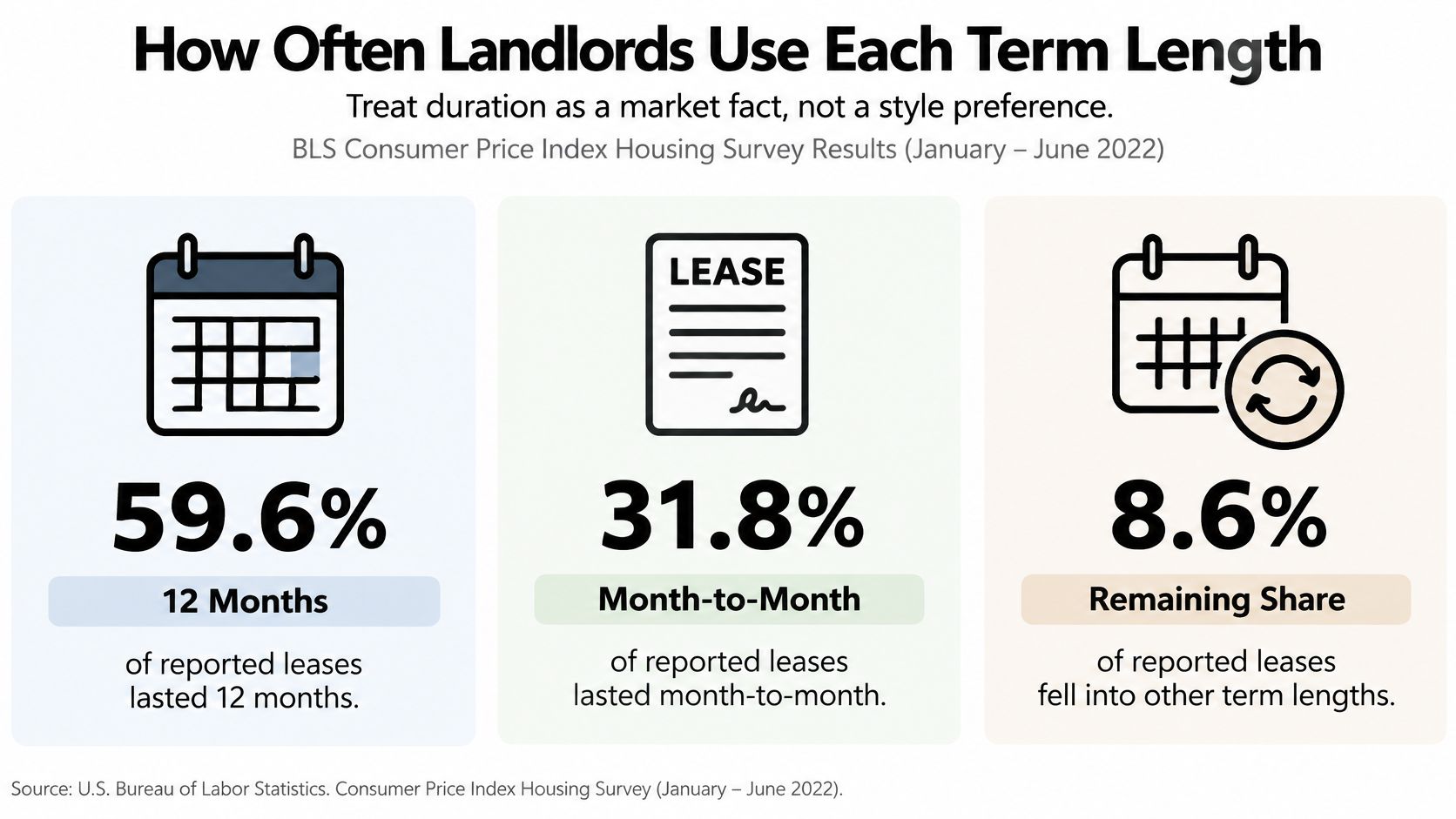
| Group | 12-month lease | Month-to-month | Other terms or note |
|---|---|---|---|
| All reported leases, Jan to Jun 2022 | 59.6% | 31.8% | 8.6% other durations |
| Share within the other-duration group | Not applicable | Not applicable | 29.9% were 24 months; 14.8% were 13 months; 12.4% were six months |
| Occupied the unit under 1 year | 91.9% | 8.1% | Fixed-year terms dominate early occupancy |
| Occupied the unit 5 years or more | 49.7% | 50.3% | Long tenure is nearly an even split |
| California | Not listed | 62.7% | Highest month-to-month share among states with 100+ responses |
| District of Columbia | Not listed | 58.4% | Second-highest month-to-month share |
| Arkansas | Not listed | 57.1% | Third-highest month-to-month share |
What tenure does to the mix
A fixed year dominates at move-in. That gives rent collection, turnover budgeting, and the first repricing decision a defined planning period before either side has to make another commitment.
Long tenure changes the exposure. Once a household has remained in place for several years, fixed and periodic terms appear in nearly equal shares. A rolling agreement often means the original term expired and the relationship continued without a new end date, or that both sides stopped needing one.
That arrangement does not automatically make the income unstable. A long-tenure tenant can produce fewer turns and steadier collections than a new occupant, even without annual paperwork. The practical exposure is the warning you receive before the tenancy ends: the applicable notice period, the season in which the unit could become vacant, and whether reserves cover a slow re-rental.
What your state does to the mix
State patterns show that month-to-month can be a standard housing arrangement rather than a fallback after a lease expires. In markets where periodic terms make up the majority, applicants, owners, courts, and local rules are accustomed to that structure. Renewal timing and termination expectations can differ sharply from markets where a fresh annual signature is customary.
If you buy a property with existing tenants, review the current agreements and the local rules governing notice, nonrenewal, and rent changes before trying to standardize everyone on a fixed term. Tenant expectations matter too. A market accustomed to rolling terms may respond differently to a mandatory annual commitment than a market where every new tenancy starts with one.
Use the figures as a negotiating baseline. A fixed first year matches the dominant move-in pattern, periodic terms operate at a large enough scale to be considered normal, and tenure or geography can change which structure is customary. The useful choice is the amount of cash-flow predictability you need and the amount of flexibility local vacancy patterns and notice rules give you.
Choosing Between a Fixed Term and Month-to-Month
Start with what you need the tenancy to do, then test each term against five numbers you can estimate on paper. You don't need software for this, you need honest inputs from your own ledger and your local notice rules. Los Angeles County's consumer guidance on rental agreements and leases states the underlying trade-off plainly, during the specified lease period the rent and lease terms are fixed, and if the tenant complies the landlord generally cannot raise rent or require move-out before expiration. A month-to-month tenancy, by contrast, is indefinite and ends through the advance notice the law requires.
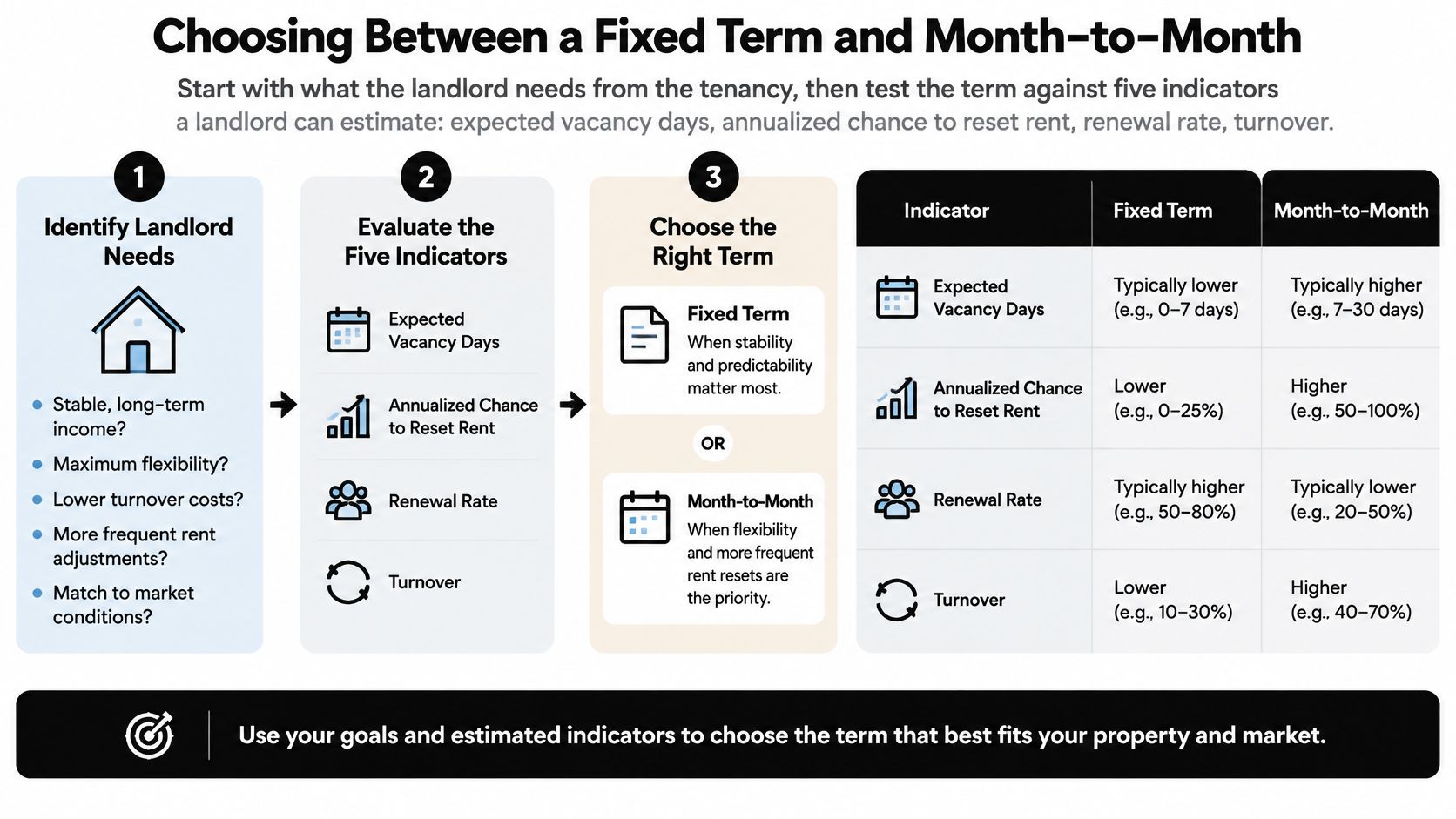
Five indicators worth estimating
- Expected vacancy days: How long this unit realistically sits empty between tenants in this season, not your best turn ever.
- Annualized chance to reset rent: How often each structure lets you lawfully reprice, and whether market rent is moving enough for that to matter.
- Renewal rate: The share of your good tenants who stay when a term ends, which tells you whether a long term is protecting you or just postponing a decision.
- Turnover cost per move-out: Cleaning, paint, minor repairs, advertising, screening time, and any leasing help you pay for, totaled per turn.
- Notice to possession time: The days from giving proper notice to lawfully getting the keys back, including local notice periods and court time if the tenant doesn't leave.
Run those five for both structures and the choice usually stops being abstract. If your turnover cost is high and your vacancy days stretch in winter, a fixed term that pushes the next turn into spring can beat a slightly higher monthly rent on a rolling term. If market rents are climbing fast and your turns are cheap and quick, the monthly reset has real value. For a closer look at how the fixed option is structured, our guide to the fixed-term lease agreement walks through the mechanics.
The tenant's side of the calendar matters too. A fixed term binds your tenant to rent through the end date, which is protection for you and a commitment they're weighing before they sign at all. On a month-to-month, the tenant owes the notice your state requires before leaving, so the discipline runs in both directions and you should track both deadlines.
The short video below walks through the same decision in plain language, and it's worth watching before you settle on a term for a new listing.
Four scenarios, four verdicts
A new occupant in a normal market. Choose the fixed year. New tenancies are where your screening is least proven and your turn costs are already spent, so a quick second vacancy hurts most here. The market default supports you, a 12-month offer is what most applicants expect, and you can revisit flexibility at renewal once you know the tenant.
A long-tenure household paying on time. Either form can work, so choose based on the relationship, not habit. Deloitte's outlook on shifting rental models reports that renewals represented about 57% of leasing activity and some large operators recorded turnover as low as 7.9% in early 2025, which points to retention mattering more than the nominal contract type. If a proven tenant prefers the rolling term and your rent is at market, keeping them is worth more than forcing a signature. If you need the certainty for a refinance or a planned sale, say so and offer the fixed term early.
A soft market with rising vacancy. When units around you sit longer and landlords start offering concessions, rigid terms get expensive. Insisting on a full year from a tenant who'd sign for six months or month-to-month can leave the unit empty while you wait for a perfect applicant. I'd take the shorter or periodic term, price it fairly, and use the occupied months to ride out the soft patch. Income at a flexible term beats vacancy at an ideal one.
A regulated unit. Your menu is whatever the ordinance allows, so work inside it. Regulated programs commonly define the renewal lengths you may offer, often a choice between set terms such as one or two years, and they control how and when you present those options. When the law sets the renewal structure, your job shifts from picking a term length to delivering the allowed choices correctly and on time.
Retention by a good tenant in the wrong contract form beats a vacancy created by insisting on the right one.
The decision line is simple once the scenarios are clear. Choose a fixed term when turnover cost and cash-flow certainty dominate. Choose month-to-month when pricing, sale, or possession flexibility dominates. Choose the ordinance's renewal length when the unit is regulated, and don't pretend you have options the law has already removed.
State and Local Rules That Override the Form
A national blank form fails the first time it meets a local rule. Notice periods and termination grounds are set at the state level, and in many places city rules sit on top of them, so the identical month-to-month sentence produces different calendars in different zip codes. The choice between a fixed term and a periodic tenancy is really a choice between predictability and flexibility, and local rules decide how much of each you get.
The pattern looks like this. Written notice before the termination date is the common baseline for ending a month-to-month tenancy, and many states set that window at about a month. Some states, California among them, lengthen the landlord's required notice once a tenant has occupied the unit beyond a set threshold. Rely on a form that hard-codes the shorter window and you will serve defective notice on the long-term tenants you most need to handle carefully. Our overview of lease agreement laws covers how these layers fit together.
Expiration is not the same as possession
A fixed term that reaches its end date does not hand you back an empty unit. If the tenant stays with your consent and no new term is signed, the tenancy commonly continues as month-to-month at the existing rent until someone gives proper notice.
Treating the printed end date as a guaranteed move-out date is how landlords end up stuck with a holdover they accidentally consented to by cashing the next month's rent without a plan.
Local overlays cut across both forms. A just-cause eviction ordinance can mean a periodic agreement gives you no automatic right to non-renew, because ending the tenancy still requires a listed reason. Rent stabilization can mean a lease expiration gives you no right to reset rent to market. The cities where periodic tenancies are most common tend to be the cities where these overlays are strictest, which is why a county-level clause outperforms a longer national template.
Three checks before anyone signs
- Minimum written notice: What is the shortest lawful notice to end a month-to-month tenancy here, and does it grow with the tenant's length of occupancy?
- Cause requirements: Does the city limit eviction or non-renewal to specific listed causes, and does your situation fit one of them?
- Rent increase rules: Is there a cap on increases, and does a rent change carry its own notice period separate from termination notice?
Build the notice and rent-change fields in your agreement from the property's state and county rules, not from the last form you used in another market. Then read the holdover sentence out loud before signing. If you cannot say exactly what happens the day after the term ends, the form is not finished.
Clauses and Sample Language Worth Writing Down
Store the tenancy structure in explicit fields, not in the document title. California's Department of Real Estate guide for consumers notes that the terms lease and rental agreement are often used interchangeably, while distinguishing fixed-term tenancies with a defined duration such as six or 12 months from periodic tenancies that renew for successive periods until legally terminated with proper notice. It also identifies rent amount, payment timing, tenancy length, and security deposit as core agreement terms. Treat those four as validation checkpoints before anything goes out for electronic signature.
For a small portfolio, your template should hold these fields where you can see and check them: start date, end date, renewal behavior, notice period, rent-change rules, and early-termination provisions. A fixed term improves revenue and occupancy predictability but limits your ability to change rent or end the tenancy without a contractual or statutory basis. A month-to-month gives pricing and possession flexibility but creates recurring notice and compliance events. The fields are how you manage either one.
Sample lines to localize
The sentences below are patterns, not universal legal text. Fill every bracket from your state and local rules before use.
- Fixed term: "This lease begins on [date] and ends on [date]. Rent of $[amount] is due on day [X] of each month."
- Periodic term: "This agreement continues month to month until either party gives written notice of at least [local minimum] days, effective at the end of a rental period."
- Early exit: "If the tenant vacates before the end date, the tenant remains responsible for rent through the term unless a buyout of $[amount] is paid and accepted in writing," adjusted to what your state allows, including any duty you have to re-rent the unit.
- Holdover: "If the tenant remains after the end date with the landlord's consent and no new term is signed, the tenancy continues month to month at the same rent until notice."
Money mechanics belong in the same pass. On each lease, the landlord sets the due date, grace period, late fee amount, and autopay rules, with late fees added to the amount due. Write those numbers into the document itself rather than a side agreement, because the signed lease is what you'll point to when a payment is late.
The six-item pre-sign review
Before you send any agreement for signature, check it against the structure you chose:
- Parties and address: Every adult occupant named, full property address with unit number.
- Rent and due date: Amount, due day, grace period, and late fee all stated.
- Deposit: Amount collected and consistent with your state's limit and handling rules.
- Term or renewal: A firm end date for a fixed term, or an explicit monthly renewal for a periodic term.
- Notice: The exact written notice each side owes, matched to the local minimum.
- Early-move consequence: What the tenant owes if they leave before the end date, and how a buyout works if you offer one.
Localize every bracket. A sample sentence with the wrong notice period is worse than no sentence, because it looks finished.
If any of the six items is missing or contradicts the term you intended, fix it before signing, not after the first dispute. Notice periods and termination grounds vary by jurisdiction, so generate these fields from the property's rules rather than copying a generic national form.
Generate the Agreement That Matches the Property
Write down your decision first, in one line: a 12-month fixed term, a shorter fixed term, or month-to-month, plus whether a local renewal rule applies to this unit. That single sentence is the instruction everything else follows. If you can't write it yet, go back to your five indicators, because a generator can't make the decision for you.
Then produce the document from the property's state and county instead of editing a generic national form and hoping the defaults are close enough. Our AI Lease Generator is part of Platinum and creates a state-specific lease in under 30 seconds, with lease language that's lawyer-reviewed, state by state. Generated leases include county-level clauses automatically, which is where notice, deposit, and local-rule drift usually creep in. You can see how it works in our walkthrough of the lease agreement generator.
The generator handles the wording, you still own the decision. If you're comparing drafting tools more broadly, AI contract drafting software from LegesGPT is a useful reference for how automated drafting handles clauses outside the landlord context. For a residential tenancy, though, the state and county fit is what decides whether your notice clause survives contact with a real dispute.
Before signing, run the finished document against the six-item review: parties and address, rent and due date, deposit, term or renewal, notice, and the early-move consequence. For a month-to-month agreement, confirm the notice sentence matches the state minimum and any longer notice owed to a long-term occupant. For a fixed term, confirm the holdover sentence so expiration doesn't turn into an unmanaged periodic tenancy you never chose.
Sign only when every field matches the one-line decision you wrote at the start. That's the whole discipline behind a Lease Agreement vs Rental Agreement choice that holds up: pick the term on purpose, generate the form for the place the property sits, and verify the money and notice fields before anyone's signature makes it real.
Decide your term length on purpose, then generate the matching document in seconds with state-specific, lawyer-reviewed language and county-level clauses built in. Pair it with online rent collection, tenant screening, and maintenance tracking in one place built for independent landlords. Get started today at VerticalRent and put your next tenancy on the right agreement from day one.
Put this into practice
VerticalRent tools related to this guide
Legal Disclaimer
VerticalRent and its authors are not attorneys, CPAs, or licensed legal or financial advisors, and nothing on this site constitutes legal, tax, or professional advice. The information in this article is provided for general educational purposes only. Landlord-tenant laws, eviction procedures, security deposit rules, and tax regulations vary significantly by state, county, and municipality — and change frequently. Nothing on this site creates an attorney-client relationship. Always consult a licensed attorney or qualified professional in your jurisdiction before taking any action based on information you read here.
Co-founded VerticalRent in 2011, growing it from nothing to 100k landlords and renters. Sold it in 2019, then re-acquired it in 2026 to make it better than ever.


