What Is Roommate Matching and How Does AI Pair Renters
What is roommate matching? Learn how AI compatibility scores work, the benefits for renters and landlords, and the privacy limits to know.


Roommate matching is the process of pairing people who want to share a home by comparing lifestyle and practical preferences and recommending the most compatible candidates instead of random assignment. You're looking at a move-in date, a spare room, and a group chat that went quiet, and you still don't know who you'll share a kitchen with.
Say you're a student who doesn't know anyone in the new city, or a landlord with a two-bedroom that needs two names on the paperwork. Random placement can work. It can also put a night-shift worker and a 6 a.m. riser on opposite sides of one thin wall. A score on a screen is a claim about habits, not proof that those habits are real.
What Roommate Matching Means in Practice
A student moving into a dorm may be asked about sleep, noise, or smoking before seeing possible roommates. That information helps a housing service compare people's stated preferences rather than assign them without considering how they live. Roommate matching is the process of recommending potential housemates by comparing lifestyle and practical preferences. Inside Higher Ed describes matching as helping people identify compatible individuals to share a home, apartment, or dorm room.
The comparison works like a seating chart. A host with only a guest list can seat people randomly; a host who knows their preferences can make a more considered arrangement. For housing, answers about sleep schedules, cleanliness, smoking, study or work habits, social preferences, and budget help shape recommendations.
A matching system generally brings together three things:
- A profile describing the renter's day-to-day habits, based on their own answers.
- A preference set listing the kind of housemate they want, from deal-breakers to softer wishes.
- A ranked recommendation list ordering candidates by how closely their profile and preferences align.
Online services made it possible for students to review profiles and contact potential roommates before moving in. One early service, RoommateClick, was later marketed to colleges. The approach gave students a way to express preferences before housing decisions were made, although matching did not always lead to a mutually chosen roommate. Some students still accepted assignments based on basic criteria such as gender and smoking status.
The important distinction is between a match and proof. A high ranking means the answers appear to line up; it cannot show that someone's habits are accurately reported or predict how they will act at home. Renters can use recommendations to decide whom to contact, while landlords and housing providers can use profiles to organize options. The score alone does not verify identity, sign a lease, or decide who is approved.
The same idea applies in campus housing, private rentals, and shared homes. People working away from home may also compare shared living options for remote workers. In each setting, matching helps find and rank candidates, while the people involved still need to make the housing decision.
Four Ways Roommates Get Paired
| Method | How pairing happens | Who makes the final choice | Main weakness |
|---|---|---|---|
| Administrative assignment | An institution or landlord places people using basic, practical details | Institution or landlord | Differences in habits may surface after move-in |
| Rule-based filtering | An applicant narrows the pool with fixed filters | Applicant, within the filters | Filters can exclude suitable matches |
| Questionnaire scoring | Lifestyle answers produce a ranked compatibility score | Applicant reviews the ranked list | The score depends on honest self-reports |
| Hybrid self-selection | A score suggests candidates, then both parties communicate | Both parties accept or decline | Communicating takes time before move-in |
Administrative assignment puts the decision in an institution's or landlord's hands. Placements may use practical details such as budget, city, or move-in month, but the applicant has little say in who is paired with them. Differences around dishes, guests, or sleep habits may become clear only after the boxes are unpacked.
Rule-based filtering gives applicants fixed switches to narrow the pool. Budget, city, and move-in month can reduce a long list quickly. The trade-off is that a filter may remove someone who could have been a good housemate for reasons the filter does not measure.
Questionnaire scoring compares stated lifestyle answers, turns them into a compatibility percentage, and ranks candidates. The applicant still decides whom to contact. A high score is a claim based on what people report about themselves, not proof of how they will behave at home.
Hybrid self-selection combines a ranked suggestion with a chance for both people to decide. They can message, ask about the details that matter to them, and accept or walk away. This gives renters more control than an assignment alone, though the score still cannot confirm whether answers match real habits.
Campus housing has moved toward giving applicants tools to browse and contact potential roommates before move-in. In 2025, StarRez reported that 54% of institutions let first-year students self-select roommates, while nearly 80% let returning residents choose. Off campus, some renters find housemates without using a questionnaire. In 2023, 65% of respondents to Flatmates' National Share Accommodation Survey said they found their new housemate through Flatmates.com.au. Renters starting from scratch can use this guide to finding roommates in a new city to plan their search. More choice lets people assess a potential match themselves, rather than relying on an algorithm alone.
How an AI Compatibility Score Is Built
A compatibility score is a weighted comparison of two questionnaires. It isn't a personality test, and it isn't a background check. The sequence below is what a careful renter should expect, and where each step usually goes soft.
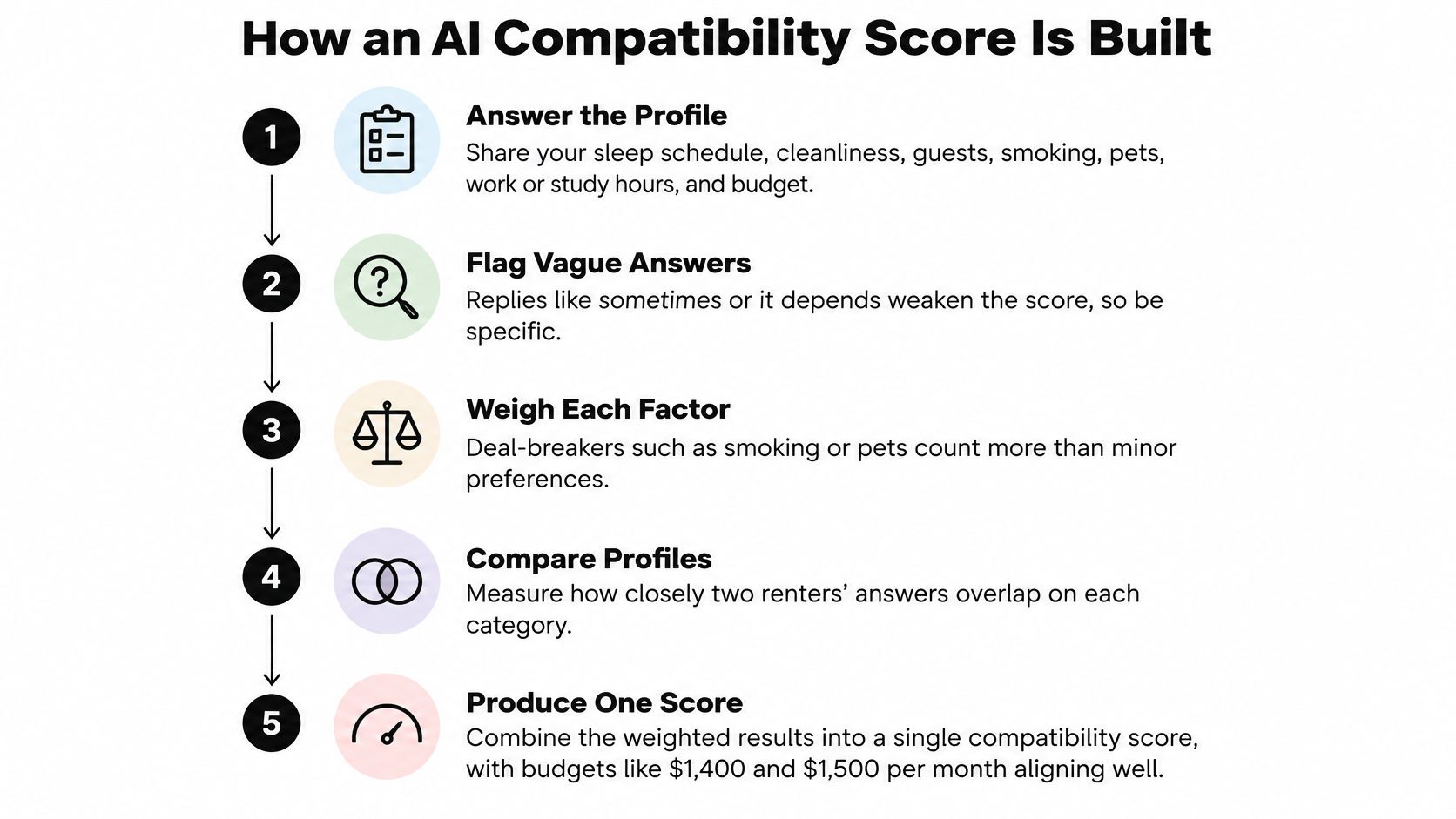
- Answer the profile in specifics. You record sleep schedule, cleanliness, guests, smoking, pets, work or study hours, and budget. "Flexible" and "it depends" look agreeable, and they give the comparison almost nothing to measure. A night owl who writes "sometimes early" will look compatible with an early riser until the first week of alarms.
- Put every answer on one scale. The system converts replies into shared categories so two profiles can be compared item by item. If one person picks "very clean" and another writes a paragraph, the software has to map both onto the same ladder. Sloppy mapping is why two similar people can score far apart.
- Weight the questions. Deal-breakers such as smoking, pets, or a hard need for quiet hours count more than soft preferences such as music taste. A platform that weights every question equally will rank a smoker and a non-smoker as a near match if they agree on playlists. Ask which items are weighted as hard conflicts.
- Compare the pair question by question. For each item, the system records agreement or conflict. Overlap on budget and clash on guests are separate facts, not one blended vibe. This is the step renters never see, so a 92% can hide one fight you would never accept.
- Turn weighted agreement into a percentage. Agreements add points, conflicts subtract them, and weights decide how much each item moves the number. Change one deal-breaker answer and the percentage can jump or collapse. Treat the figure as a sort order, not a promise.
- Show a ranked list with practical filters. You usually narrow by budget, location, and move-in date after the lifestyle score is built. Filters sit on top of the score. They don't rewrite it. A top-ranked person three months off your date is not a usable match.
- Start with a mutual message, not a signature. A request or chat turns the score into a lead. Nobody has agreed to live together, and nobody has been approved. Skipping the conversation because the number looks high is the most common slip.
What the AI layer actually changes
Some platforms later adjust those weights using which pairs still report a good fit after move-in. Many don't. If a vendor won't say whether weights are fixed or learned, assume they're fixed. Either way, the score ranks candidates. It doesn't predict how someone behaves once rent is due, and editing your profile can change every percentage attached to your name.
Benefits for Renters and Landlords
Shared housing is the market this tool sits in. A 2025 analysis of American Community Survey data from Eye On Housing reported a record-high 6.8 million U.S. households sharing with unrelated housemates, roommates, or boarders in 2023. People ages 25 to 34 represented nearly 1.6 million of those households, about 23%, and adults aged 55 and older accounted for 30%. Matching isn't only a campus product.
| Party | Benefit | Trade-off to watch |
|---|---|---|
| Renter | Finds routine-compatible housemates before signing | Scores reflect stated answers, not proven behavior |
| Renter | Lower risk of an early move-out caused by a clash | A written house-rules agreement is still needed |
| Renter | Access to a wider pool than an existing friend group | Strangers need identity and reference checks |
| Landlord | Fewer roommate disputes after move-in | Matching does not replace tenant screening |
| Landlord | Faster leasing for shared or multi-occupancy units | Each occupant still needs a lease-compliant process |
| Landlord | Clearer shared-lease expectations from the start | Matching criteria must avoid protected characteristics |
The table's gains are real, and so are the gaps it can't close. A renter can meet someone whose stated bedtime matches theirs and still discover, two weeks in, that "quiet" meant something else. Landlords can fill a unit faster when two applicants already want to live together, and they still have to screen each person under the same lawful process they would use for any applicant.
People relocating for a short contract often need a housemate and a furnished room at the same time. A temporary housing guide for relocating professionals is a useful companion when the stay itself is temporary and the match has to work for months, not years. In that window, privacy, guests, and who pays which bill matter more than whether two people share a school.
Compatibility Factors Worth Measuring
A useful factor has to pass three tests. You can observe it in daily life, it ties to a real household fight, and it describes behavior rather than identity. If a question fails those tests, it doesn't belong in a score.
| Factor | What it predicts | Example conflict | Safe to ask |
|---|---|---|---|
| Sleep schedule | Noise and light conflicts | Night-shift worker and early riser | Yes, as a routine question |
| Cleanliness standard | Friction over shared spaces | Dishes and bathroom cleaning frequency | Yes |
| Guests | Privacy and overnight stays | Weekend visitors who stay several nights | Yes, as frequency and notice |
| Smoking and vaping | Air quality and lease violations | Indoor smoking in a no-smoking lease | Yes |
| Pets | Allergy and lease conflicts | Pet not allowed or allergy in shared space | Yes, check the landlord rules first |
| Budget and payment method | Late payment and utility disputes | Uneven rent split or late utility bills | Yes, as a range and payment method |
| Social preference | Time spent together at home | Roommate who expects daily shared meals | Yes |
| Protected characteristics | None | Not a legitimate compatibility factor | No, never filter on them |
Sleep schedule and cleanliness are the rows people expect. Guests surprise them. Two people can both call themselves "social" and still clash if one means a friend over on Saturdays and the other means a partner staying four nights a week. Ask for frequency and notice, not a personality label.
Smoking, vaping, and pets look like lifestyle taste, and they're often lease terms. A match that ignores a no-smoking clause or a no-pet building just creates a violation with a high percentage attached. Budget should be a range and a payment method, not a demand for bank balances or a credit story.
Social preference is the row renters under-ask. In 2024, 64.1% of 1,016 roommate-quiz respondents in an ApartmentAdvisor survey said they wanted a roommate they could socialize with at home several times per week. Someone who wants a quiet house and someone who wants weekday dinners are not a small mismatch.
Before you rank anyone, split your list into deal-breakers and preferences. Deal-breakers are household rules you will not bend on. Preferences are nice to have. The last row of the table is a hard stop, not a preference you can soften.
Privacy, Fair Housing and Score Limits
A high match can still be an unsafe home. A 2025 study of LGBTIQ+ people in shared housing, covered by Phys.org, found that 52% had experienced discrimination in their living situation, including 23.8% who said discrimination came directly from roommates. Some respondents reportedly chose rough sleeping rather than remain in discriminatory housing. A questionnaire that reveals or filters identity can push people into that harm.

Legitimate questions stay on behavior you can live with day to day: noise, guests, smoking, pets, schedules, cleanliness, privacy, and how you'll communicate when something breaks. Questions that sort people by religion, politics, sexual orientation, disability, or other protected characteristics don't measure compatibility. They measure exclusion.
Safeguards a platform actually needs
- Hide sensitive data so identity details never sit on a public profile by default.
- Let each user control what other renters can see, field by field.
- Offer reporting, blocking, and escalation when a message turns harassing.
- Send disputes to a person, not only to an automated queue.
- Run a clear accommodation path when a disability-related need comes up.
For landlords, the line is just as plain. Matching can introduce two people who want the same unit. It isn't a substitute for lawful tenant screening, and it can't be used to drop applicants because of religion, sexual orientation, disability, or family status. Independent owners who need the legal boundaries in one place should read what the Fair Housing Act requires of independent landlords. If a question wouldn't be fair in a housing interview, it doesn't belong on a matching form.
How VerticalRent Implements Roommate Matching
VerticalRent is an AI-native rental management platform for independent landlords. It has operated since 2011 and serves all 50 states. Its renter tools include roommate matching, which lets a renter create a profile, look for potential housemates, and shortlist people to contact. A match score is best read as a claim based on the information people provide, not proof that two people will live well together.

Landlord screening serves a separate purpose. VerticalRent offers FCRA-compliant reports covering credit, criminal, eviction, and rental history, along with AI risk scoring and plain-English summaries to help landlords assess applicants. That information concerns tenancy risk, not whether two renters' habits will suit each other.
Two jobs, two decisions
Matching can help renters identify people to contact. Screening is a separate step in a landlord's decision about an applicant. A good conversation cannot replace screening, and a screening report cannot show whether housemates will agree about daily routines. A ranking only helps sort potential candidates. Read profiles and talk with the people behind them before treating any match as a plan.
Verify a Match Before You Commit
Treat a match score as a starting point for conversation, not a promise that living together will work. A matching FAQ warns that a score is not a guarantee and recommends messaging, video calls, references, and in-person meetings. Temple University's roommate guide notes that match percentages depend on applicants answering profile questions accurately. A lower score may still lead to a good household when people communicate and agree on boundaries. A high score can be misleading if answers are incomplete, polished to appear ideal, or flatly inaccurate.
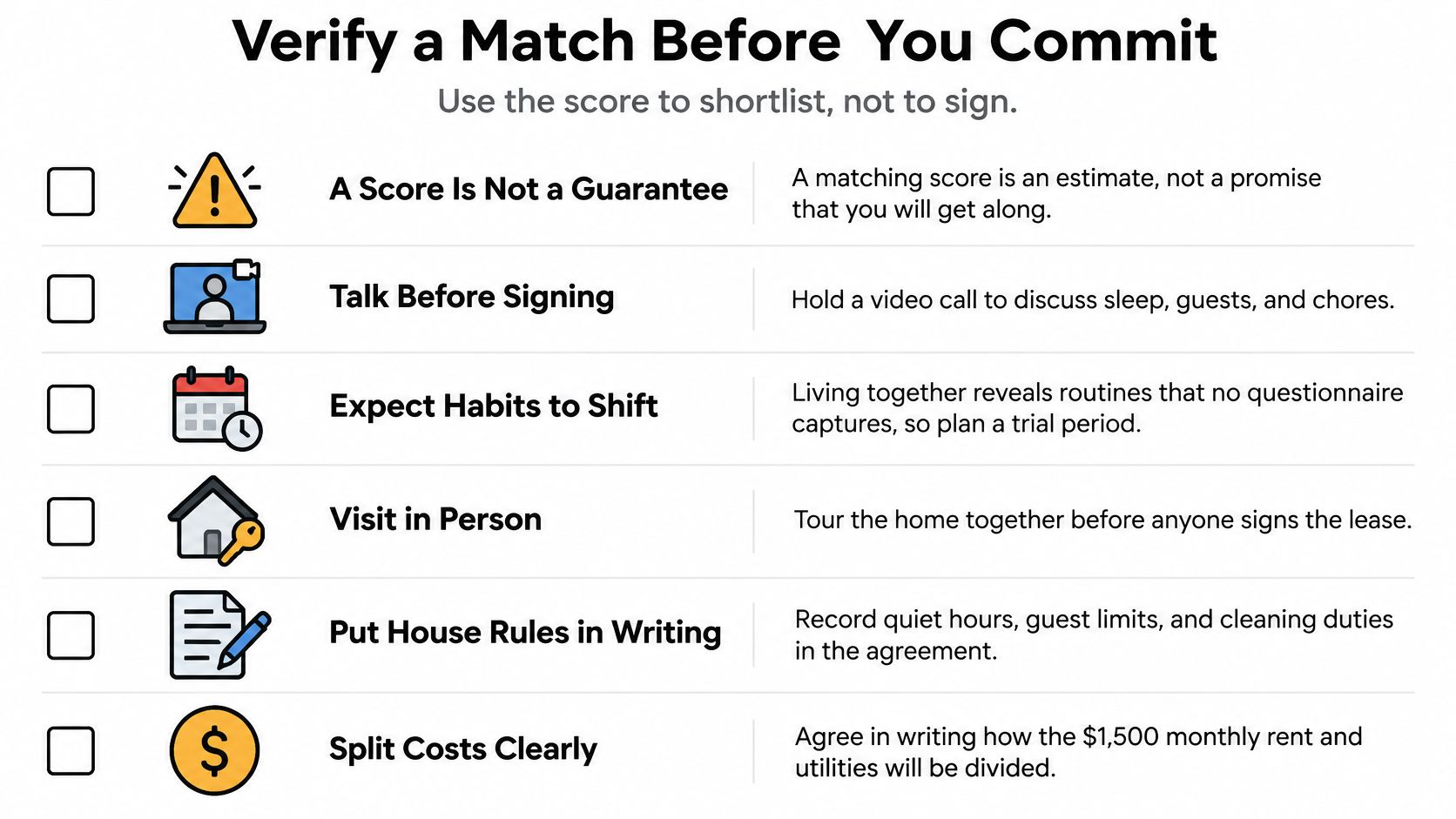
- Confirm identity with a government ID and a live video call, so you know who is behind the profile.
- Ask for a previous landlord reference. If you're applying, review a rental history report rather than relying only on a stranger's summary. This roommate rental application guide walks through steps for a joint household.
- Agree on money before committing to a unit: rent split, utilities, deposit, and what happens if someone pays late.
- Write the house rules, including quiet hours, guest limits, a cleaning rota, and notice before overnight visitors.
- Name the conflict path. Decide how to raise problems and who makes the final call when you disagree.
- Meet in person before anyone signs.
Move forward when the checks are complete and the written agreement feels fair. If an answer remains vague, keep looking.
VerticalRent offers renters roommate matching, guided applications, and free rental history reports. Independent landlords use a separate workflow for screening, leases, and rent collection. If you're ready to find possible housemates or fill a shared unit without treating a percentage as approval, start at VerticalRent. Create a renter profile or open a landlord account, and keep matching separate from screening.
Put this into practice
VerticalRent tools related to this guide
Legal Disclaimer
VerticalRent and its authors are not attorneys, CPAs, or licensed legal or financial advisors, and nothing on this site constitutes legal, tax, or professional advice. The information in this article is provided for general educational purposes only. Landlord-tenant laws, eviction procedures, security deposit rules, and tax regulations vary significantly by state, county, and municipality — and change frequently. Nothing on this site creates an attorney-client relationship. Always consult a licensed attorney or qualified professional in your jurisdiction before taking any action based on information you read here.
Co-founded VerticalRent in 2011, growing it from nothing to 100k landlords and renters. Sold it in 2019, then re-acquired it in 2026 to make it better than ever.


