Rental Application Fee: The Landlord's Legal Guide
Master rental application fees with this guide. Learn state laws, caps, refund rules, and how to collect compliant fees using VerticalRent.


The average rental application fee is roughly $50, but the legal limit varies entirely by state, with caps as low as $20 in New York or zero in Vermont. A landlord can therefore charge a fee that looks ordinary in one market and unlawful in another.
You've probably seen the problem firsthand. An applicant tours the property, says they want it, and then stops responding when the application asks for payment. Meanwhile, the unit remains vacant, another prospect may be waiting, and a disagreement over a screening charge creates more friction than the fee is worth.
That friction doesn't mean you should eliminate the rental application fee. It means you need to understand what the fee covers, how local law treats it, and what happens if the screening never takes place. The most expensive mistake isn't always charging too much. Sometimes it's collecting a fee without the records, disclosures, refund process, or location-specific rules needed to defend it.
The Real Cost of a Stalled Lease
A prospective tenant applies on a Monday morning. You send the screening authorization, the applicant reaches the payment screen, and they object to the charge. They ask whether the fee is refundable, whether every adult must pay, and whether the amount is legal. You answer from memory, the applicant delays, and by the time the questions are resolved, they may have moved on to another property.
For an independent landlord, that delay has a direct operating cost. A vacant unit produces no rent, while advertising, maintenance, utilities, insurance, and financing obligations continue. The vacancy cost calculator can help put that exposure into a clearer financial frame before you decide whether a particular screening process is saving money or creating avoidable delay.

Why the charge can help
A rental application fee can discourage casual inquiries and focus your time on applicants prepared to authorize screening. It doesn't prove that an applicant is financially stronger, more reliable, or more likely to sign. It creates a defined step in the process and helps reimburse the screening work you perform.
The fee has become a familiar part of the U.S. rental search. A 2024 Zillow survey found that 79% of recent renters reported paying an application fee, with a typical fee of $50. The same Zillow source reported a $50 median application fee, while CFPB market research found that fees typically ranged from $40 to $59.76 and that 68% of renters reported paying them. Those figures explain why applicants may expect a charge, but they don't establish what you're allowed to collect in your jurisdiction.
Practical rule: Treat the fee as cost recovery for a documented screening process, not as a revenue source attached to every inquiry.
Where landlords lose control
The fee becomes risky when the property manager collects it before confirming that the unit is available, charges different applicants different amounts, or keeps the money after deciding not to run the reports. A landlord can also create confusion by describing the charge as an “application fee” while using part of it for unrelated administrative work that local law doesn't permit.
Keep the workflow simple:
- Advertise the amount early: Show the fee and any other application-related charges before the applicant invests time in the process.
- Explain the purpose: Identify the reports or screening steps the charge is intended to cover.
- Apply one policy: Use the same fee rules for similarly situated applicants, and document any lawful waiver policy.
- Stop when the unit is gone: Don't continue accepting screening payments after another applicant has been approved or the property is no longer available.
- Preserve the record: Keep the authorization, receipt, report order, decision date, and refund calculation together.
Your accounting process matters too. A practical Florida real estate accounting guide can help landlords think through transaction records, categorization, and documentation, although fee compliance still depends on the law governing the property.
Understanding What the Fee Actually Covers
A rental application fee is often described as an administrative charge, but that description can be too vague. In practice, the amount is usually connected to a consumer reporting workflow that may include credit, criminal, eviction, and rental-history checks. The broader the screening package, the more important it becomes to explain exactly what the applicant is paying for and to retain evidence that those services were ordered.
The CFPB tenant background-check snapshot estimated the average fee at $40 to $59, and reported that 9% of applicants paid more than $100. The same source describes screening as more than a simple credit pull. Landlords may be paying for a bundled process involving credit information, criminal records, eviction records, and rental history.
The components behind the charge
A credit report can help you assess payment history and current obligations. An eviction search may identify prior filings or judgments, but the result still requires careful interpretation because a filing isn't automatically proof of wrongdoing or a valid reason for denial. Criminal-history searches are also subject to jurisdictional limits and fair housing considerations, so you shouldn't treat a database result as a complete or self-executing decision.
Rental-history verification can involve contacting prior housing providers, reviewing the applicant's rental record, and checking whether the information is consistent. Some workflows also include income verification, identity checks, or reference requests. Those additions may increase the provider's cost, but they don't automatically justify any amount you choose to charge.
A useful internal cost record should identify:
- Report charges: What the screening provider charged for each report.
- Completed steps: Which reports were ordered and delivered.
- Applicant allocation: Which applicant paid and which reports relate to that payment.
- Unused balance: Any amount collected but not spent on permitted screening activity.
- Delivery evidence: When the report or required receipt was provided.
That last category is easy to overlook. If a state requires an itemized receipt or a refund of unused funds, the landlord needs more than a bank transaction. The file should show how the amount was calculated.
Why a flat markup creates trouble
A flat charge is operationally convenient, but it can look like an arbitrary markup where the law permits only actual screening costs. It also becomes difficult to defend when one applicant's report is completed and another's fails because of missing information, a provider error, or the property being rented to someone else.
Landlords should also distinguish screening from unrelated labor. Time spent answering messages or reviewing an application may be part of ordinary leasing overhead, but a local statute may not allow you to fold that time into a screening fee. Before setting the price, read the applicable statute and the screening provider's invoice structure. The application fee explanation can provide useful operational context, but it doesn't replace a property-specific legal review.
Navigating State and Local Regulations
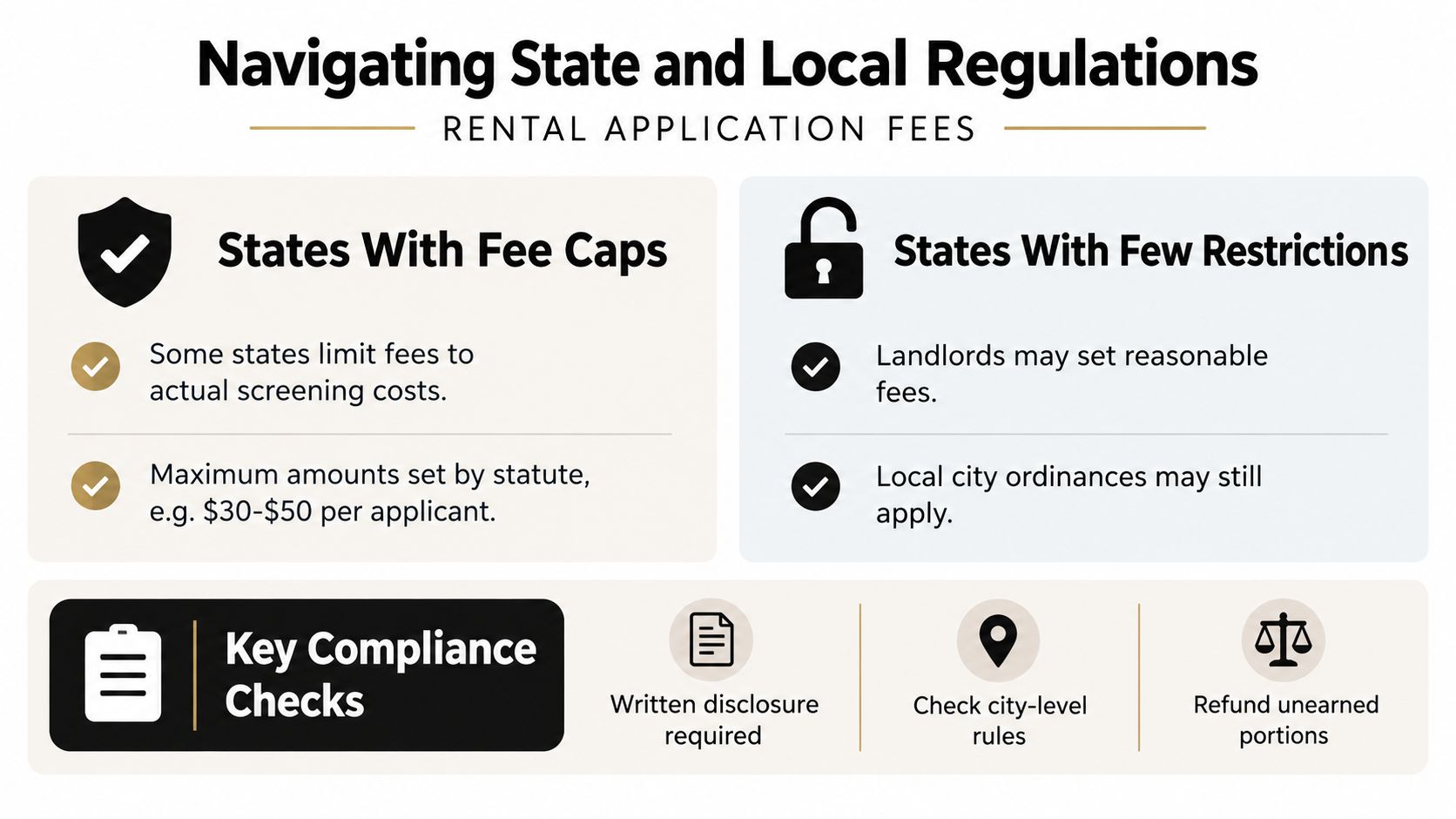
The dangerous assumption is that a rental application fee is governed by a national standard. It isn't. State statutes, city ordinances, screening rules, disclosure requirements, and refund provisions can all affect the amount you collect and what you must do with it afterward.
The regulatory direction is also clear. NPR's reporting on state rental application fee laws describes Vermont's total ban, New York's $20 cap adopted in 2019, and the growth of reusable or portable screening rules. California adopted a law in 2023 allowing applicants to use trusted third-party screening, while Maryland and Washington later required broader reusable screening components. These developments reduce the safety of a one-policy-for-every-property approach.
Start with the property's exact location
Before accepting money, identify the state, county, city, and property type governing the transaction. Don't rely on the address of your management office. A city ordinance can impose a different requirement from the state rule, and special rules may apply to subsidized housing, small landlords, or properties covered by local tenant protections.
A compliance check should answer these questions:
- Is an application fee allowed at all? Vermont banned rental application fees, and other jurisdictions may distinguish between a prohibited application charge and a permitted fee for an actual screening report.
- Is there a maximum amount? New York's cap is $20, while Washington, D.C. set a maximum rental housing application fee of $54 for calendar year 2026. The D.C. amount illustrates why a local cap may require an annual review.
- Must the fee match actual cost? Some jurisdictions allow only direct screening costs or require the landlord to return the unused portion.
- Can the applicant provide a reusable report? Portable screening rules can mean you shouldn't charge for a new report when the applicant supplies a qualifying recent report.
- What must the applicant receive? The answer may include a written disclosure, receipt, report copy, or refund explanation.
Examples that change the workflow
California is a high-control example. Under California Civil Code section 1950.6, the fee is limited to the landlord's actual out-of-pocket screening cost and cannot exceed $30 per applicant. If a personal reference check or consumer credit report isn't completed, the unused portion must be returned. Berkeley adds operational requirements, including an itemized receipt and delivery of a credit report within 7 days.
New Jersey offers a different warning. Its 2026 guidance sets a $50 cap and allows penalties of up to $1,000 per violation, according to the New Jersey housing-provider guidance. Seattle's 2025 rules tie screening or application fees to $50 plus CPI and require advertisements and forms to disclose all fees. These rules make stale templates and manually entered amounts particularly dangerous.
Compliance advice: Maintain a fee matrix by property location, update it when a statute or ordinance changes, and require a human review before changing the amount shown in an advertisement.
Don't stop at the cap. A lawful amount can still create liability if your disclosure is incomplete, your screening provider wasn't used, or your refund process is missing.
Building a Legal Fee Strategy
The safest fee strategy starts with the screening process, not with a round number that feels normal in the market. List the reports you order, identify the direct cost of each, and then compare that total with the state and local limits. Where the law permits a reasonable fee, staying close to documented screening costs makes the charge easier to explain and less likely to look punitive.
California demonstrates why this discipline matters. Its $30 maximum and actual-cost rule mean that a landlord needs a process for recording the amount spent on each applicant. If a report isn't completed, the landlord must be able to identify the unused portion and return it. That's a process-control issue, not merely a lease-drafting issue.
Build the policy around predictable decisions
Write the policy before advertising the vacancy. It should state the amount, the intended screening services, who pays, whether a reusable report is accepted, and what happens if screening cannot be completed. Avoid promising that the fee is “always nonrefundable.” That phrase may conflict with a local rule requiring a full or partial refund.
A workable policy can use a decision tree:
- Screening completed: Retain only the amount the applicable law allows for the completed process.
- Screening partly completed: Separate completed costs from unused amounts and return any portion required by law.
- Screening not started: Follow the local rule for a fee collected before the report was ordered.
- Applicant provides an accepted report: Don't charge for duplicative screening where portable-report rules prohibit it.
- Property is leased first: Stop the workflow and apply the jurisdiction's refund requirement.
Refund exposure is becoming a more important part of fee planning. Realtor.com's discussion of rental application fee reforms identifies Michigan's 2025 bill, which would require refunds within 60 days after denial, and Montana's 2025 law requiring refunds for unsuccessful applicants. The obligations differ by jurisdiction, so don't use these examples as a nationwide rule. Use them as a reason to check whether your own state has moved beyond the simple question of whether charging is legal.
Keep fairness separate from convenience
Charge applicants consistently under the same written criteria. A landlord who waives the fee for one favored applicant but not another may create a fair housing problem, even if the dollar amount is modest. If you offer a waiver, define the qualifying circumstances and apply them uniformly.
The fee should support a consistent screening standard, not replace one. A lower charge doesn't make a weak process safer, and a higher charge doesn't produce a better tenant. Good screening depends on lawful criteria, accurate records, and the ability to explain what happened to every dollar.
The Difference Between Processing and Deposits
An application fee and a security deposit serve different purposes. The fee relates to the work performed before approval, while the deposit secures obligations that arise after a lease begins, such as unpaid rent or damage beyond ordinary wear. Combining them on one form or receipt makes it harder for the applicant to understand the transaction and harder for you to prove that you handled each amount correctly.
Consider two payments made on the same day. An applicant pays a screening charge so you can obtain authorized reports. An approved applicant later pays a deposit under the lease. The first payment belongs to the application workflow. The second is connected to the tenancy and should be governed by the deposit rules applicable to the property.
Compare the purpose, timing, and treatment
| Payment | Main purpose | When it is collected | Typical legal question |
|---|---|---|---|
| Application fee | Pays for permitted screening activity | Before approval | Was the charge allowed, disclosed, and tied to actual work? |
| Security deposit | Protects against lease-related obligations | At or before lease signing | Was it held, applied, and returned under deposit law? |
Calling a deposit a “nonrefundable application fee” won't change its legal character. If the money is held to cover future damage or unpaid rent, a court or regulator may treat it as a deposit regardless of the label. Conversely, calling a screening payment a deposit can mislead the applicant about when and why it will be returned.
Use separate records
Issue separate receipts. Use separate ledger categories. Put the screening authorization and fee disclosure with the application file, then place the deposit terms, move-in condition documentation, and deposit accounting with the executed lease file.
Tell applicants what happens in plain language:
- Before screening: The payment authorizes a defined screening process.
- After an incomplete screening: Any required refund is calculated from the work performed and the local rule.
- After approval: The deposit is collected under the lease and applicable deposit law.
- After move-out: The deposit is handled through the statutory inspection, deduction, and return process.
Applicants often need guidance on the second payment more than the first. A practical resource on full deposit return tips can help explain the condition and documentation issues that commonly affect deposit disputes, although it isn't a substitute for the deposit statute governing your property.
Keep the application fee, deposit, and rent in separate accounting categories. Clear records prevent ordinary leasing payments from becoming one ambiguous balance.
Automating Compliant Fee Collection
Manual collection creates predictable failure points. A landlord enters the wrong amount for a city with a local cap, forgets which applicant paid, accepts an application after the unit is rented, or keeps the full payment when only part of the screening was completed. Automation can reduce those errors, but only when the underlying fee rules are configured correctly.
Configure the workflow before publishing
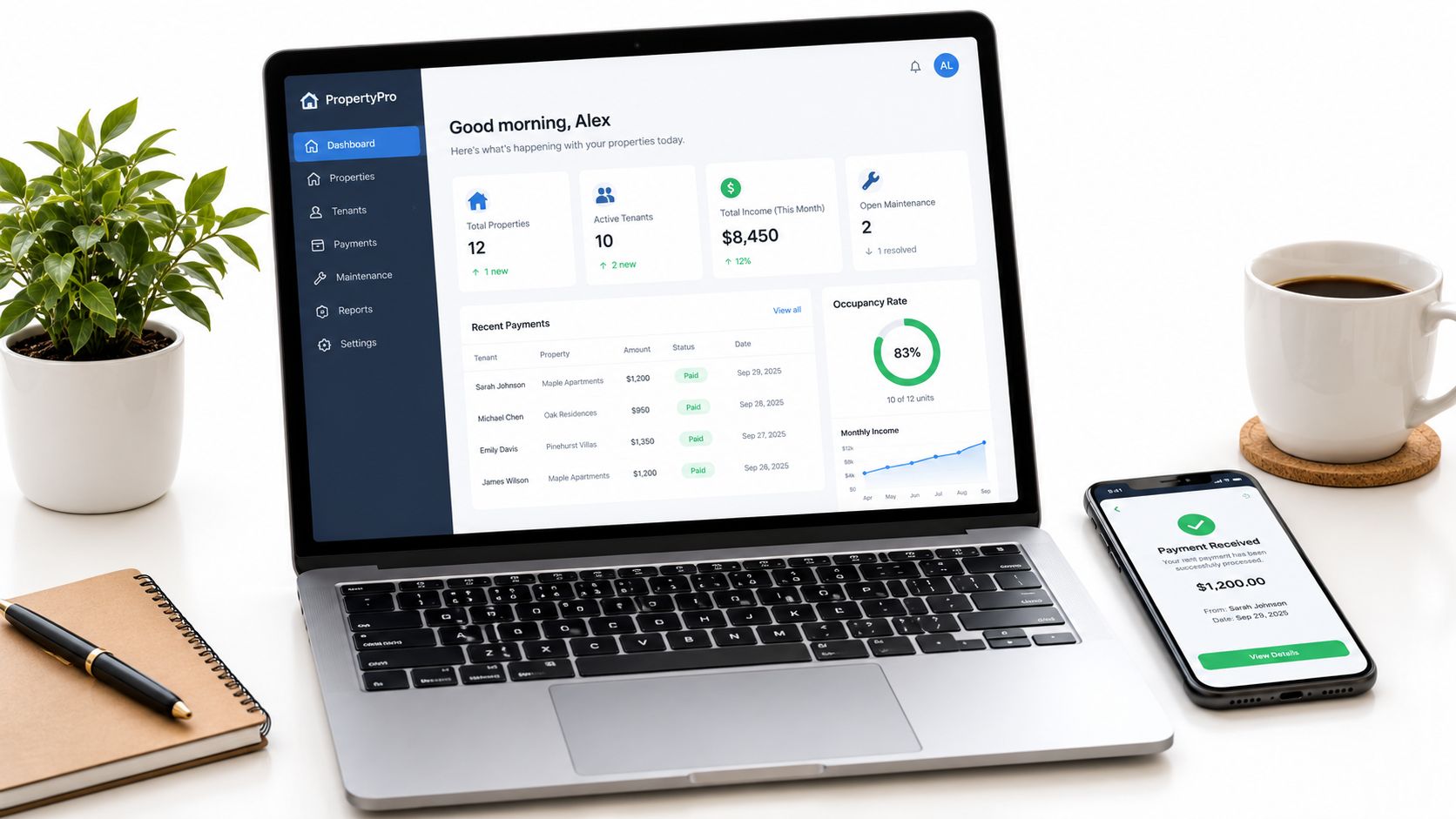
Start by assigning the correct property location and entering the permitted fee for that jurisdiction. Then connect the fee to the application rather than to a general payment request. The applicant should see the amount, purpose, and relevant refund terms before authorization.
VerticalRent is one option for this workflow. Its online application process supports applicant-paid screening, calculates application fees for compliance purposes, and uses Stripe to split the payment between the platform and landlord. That can reduce manual reconciliation, but you still need to verify the configured amount against current state and local law.
Use a short implementation checklist:
- Confirm the rule: Verify the applicable state and municipal requirements before activating collection.
- Define the screening package: Identify the reports the fee covers and the conditions that trigger a refund.
- Test the applicant view: Submit a test application and confirm that the displayed fee and disclosure are accurate.
- Reconcile each payment: Match the transaction to the applicant, property, reports ordered, and any refund.
- Review changes: Recheck caps and disclosure requirements when local rules change.
Technology won't decide whether a criminal-history procedure is lawful, whether a reusable report qualifies, or whether an applicant was treated consistently. It can, however, preserve the payment trail and make it harder to skip a required step. For landlords who want to move the process online, online rental applications can help frame the operational requirements before choosing a workflow.
The following video provides additional product context for organizing rental management tasks:
Use the system as a control layer, not as legal advice. Review the fee matrix, disclosure language, refund rules, and screening sequence yourself or with qualified counsel. That combination gives you a defensible process without forcing every applicant and payment into the same national template.
If you want to reduce manual errors, VerticalRent lets you configure online applications, collect compliant screening fees, and route payments through Stripe with transaction records for your property files. Visit VerticalRent to review the application and rental-management workflow for your portfolio.
Put this into practice
VerticalRent tools related to this guide
Legal Disclaimer
VerticalRent and its authors are not attorneys, CPAs, or licensed legal or financial advisors, and nothing on this site constitutes legal, tax, or professional advice. The information in this article is provided for general educational purposes only. Landlord-tenant laws, eviction procedures, security deposit rules, and tax regulations vary significantly by state, county, and municipality — and change frequently. Nothing on this site creates an attorney-client relationship. Always consult a licensed attorney or qualified professional in your jurisdiction before taking any action based on information you read here.
Co-founded VerticalRent in 2011, growing it from nothing to 100k landlords and renters. Sold it in 2019, then re-acquired it in 2026 to make it better than ever.


